The Concrete Boundary: How One Hardworking Veteran Reclaimed His Land From a Rogue HOA Enforcer
CHAPTER 1: THE CEDAR BOUNDARY
The sound of gravel crunching beneath heavy tires yanked me from the quiet morning, jolting me out of my routine.
My black coffee sloshed over the rim of my ceramic mug as I turned just in time to watch Karen’s bright red ATV slam flat into the six-by-six cedar post I had sunk into the dirt three days ago.
The machine’s plastic front bumper crumpled with a dry, hollow crack.
Karen went airborne over the handlebars, tumbling over the top beam and landing flat on her back in a thick cloud of red dust.
Her sun visor skittered across the gravel toward my boots, her smartphone went flying into the tall grass, and her tiny dog began barking hysterically from the overturned vehicle.
“You tried to kill me!” she shrieked, flailing her arms like a upturned beetle while coughing through the dust. “You put a wall in the middle of the road!”
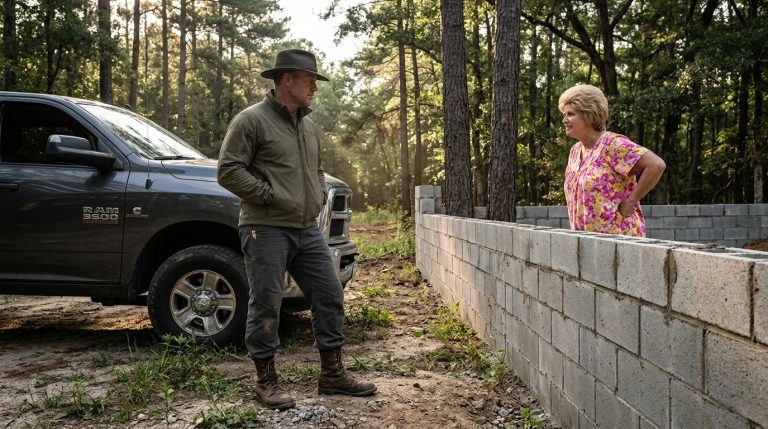
I took a slow, measured sip of my lukewarm coffee and leaned against the porch railing.
With my free hand, I pointed down at the freshly painted aluminum sign fastened right at eye level on the center beam.
“Private property,” I said, my voice steady and flat. “No access.”
“You can’t do this!” She pushed herself up onto her elbows, dirt clinging to her visor-less hair and her high-heeled gardening clogs completely covered in mud. “This is a public access route! Everyone uses this path!”
“It’s not a route, Karen,” I replied, tracing the worn edge of the brass folding rule tucked into my front pocket. “It’s six hundred feet of deeded dirt behind my barn.”
This wasn’t an honest mistake.
For six straight months, ever since I closed on the property, she had treated this trail as her personal drag strip, firing up her engine at dawn and tearing up my backyard without asking a single soul for permission.
When I tried talking to her nicely four months ago, she just waved like we were in a parade and kept the throttle pinned.
When I posted standard cardstock signs on the trees, she claimed the wind blew them down.
When I screwed high-visibility reflectors into the boundary trunks, she sent me a handwritten note calling them a neighborhood eyesore and threatening to report my property to the Homeowners Association.
That was the day I discovered Karen had appointed herself the neighborhood’s unofficial “Enforcement Officer,” wearing a homemade laminated badge and handing out absurd fines for mailboxes being an inch too low or lawnmowers parked beside a shed.
“You’ll be hearing from my lawyer!” she screamed, limping toward my porch step and slamming her mud-caked clog against the wood. “This is a death trap! You built a illegal barrier on HOA land!”
“The trail is mine,” I said, not shifting an inch. “And you’re currently trespassing.”
She yanked her phone from the grass, her face turning as red as her ruined vehicle. “I’m calling the police right now! You’re going to jail for this!”
“Go ahead,” I said, pointing up toward the eaves of the barn where two high-definition game cameras sat silently recording every word. “Tell them to check the video feed while they’re here.”
She froze, her thumb hovering over the screen as her mouth snapped shut into a thin, tight line.
Without another word, she grabbed her barking dog by its collar, hoisted the machine back onto three wheels, and dragged the broken frame down the trail, her heels digging deep ruts into the dirt all the way back to her driveway.
CHAPTER 2: THE ILLEGITIMATE SUMMONS
The morning sun hit the cedar wall, throwing sharp shadows across the property line where Karen’s ATV had taken its flying lesson.
I set the coffee mug down on the railing and pulled the brass folding rule from my pocket, snapping it open to check the concrete anchor on the lead post.
Four inches of solid steel held the footings flush to the bed of limestone.
It hadn’t budged an eighth of an inch when her front bumper hit it, though a smear of bright red plastic remained embedded in the rough cedar grain.
A white envelope slid under my front door early the next morning before the dew had even burned off the grass.
I picked it up on my way out to the barn.
The paper was cheap, but the letterhead was printed in bold, dark ink: HOA Board of Directors — Notice of Unlawful Obstruction & Safety Hazard.
Below it, a signature line read: Karen, Enforcement Liaison.
No last name, no official seal, just an arbitrary line demanding twelve thousand dollars in accumulated fines for “creating a public hazard” and “unauthorized visual obstruction.”
I didn’t lose my temper.
Instead, I took the envelope, walked inside, and grabbed my truck keys from the peg by the door.
Twenty minutes later, I was standing at the counter of the county recorder’s office, the smell of old paper and industrial floor wax filling the room.
A clerk with round spectacles and a navy cardigan took my parcel number, her fingers clicking rhythmically across her keyboard.
“Here it is,” she said, pulling a heavy manila folder from the sliding filing system behind her. “Tract 402, former Miller agricultural lot.”
She laid out the yellowed deed from 1982 onto the counter.
Attached to the corner by a single, severely rusted staple was a official county waiver, stamped in faded blue ink: Exempt from Municipal and Residential Association Covenants.
“It was carved out when the residential developer bought up the surrounding pasture,” she explained, running a manicured finger over the wax seal. “Your land was never annexed into the neighborhood HOA. They have zero legal jurisdiction over your parcel.”
I looked down at the blue stamp, the faint, faded lettering barely legible against the age-darkened paper, but clear enough to hold up in any courtroom in the state.
“Can I get a certified copy of this?” I asked.
“Two dollars,” she said, pulling a fresh page from the copier and affixing a crisp, silver state seal to the bottom right corner.
I paid her, folded the document neatly into my jacket pocket, and walked back out into the bright sunlight.
Karen had built an entire kingdom out of threat letters and fake authority, but she had built it on borrowed dirt.
When I pulled back into my driveway that evening, a silver sedan was parked near the tree line.
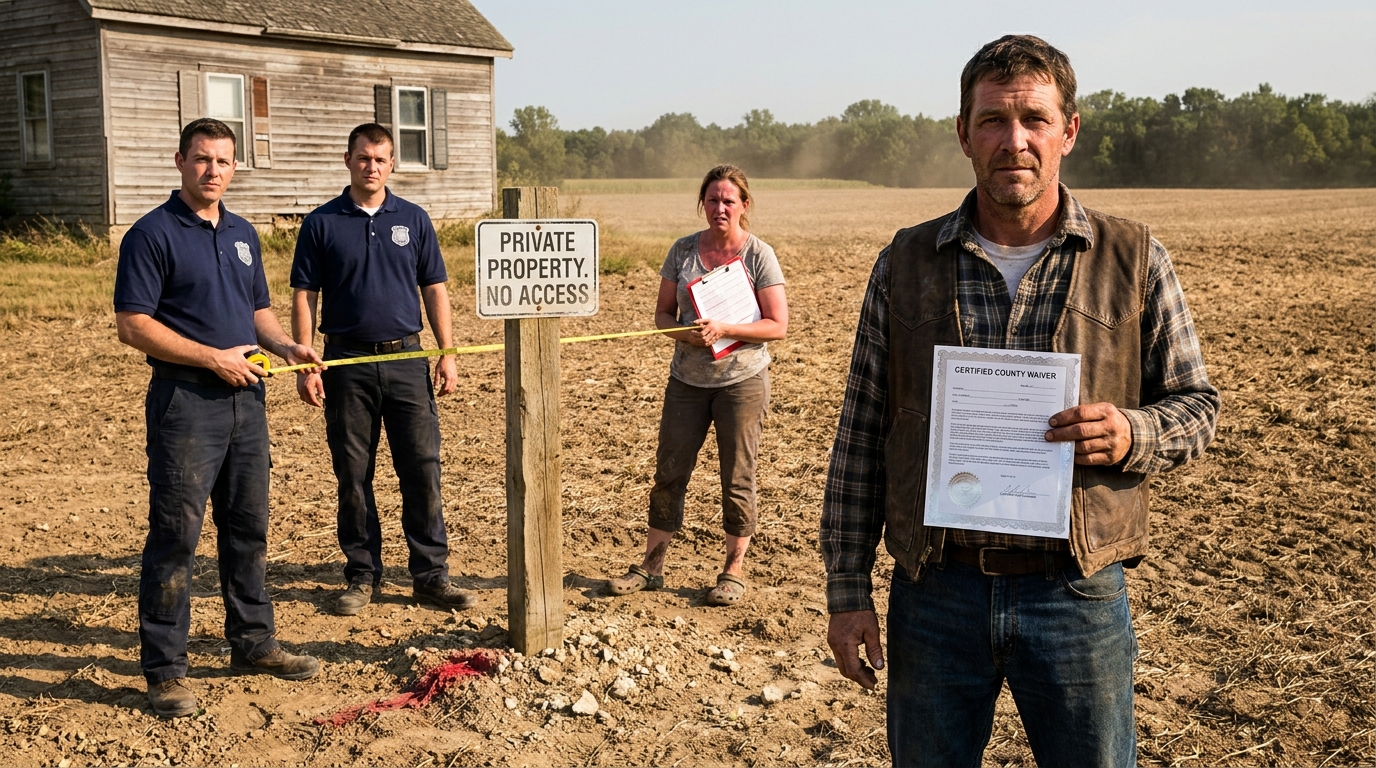
Karen stood near my cedar wall, accompanied by two men in identical polo shirts carrying clipboards and a long fiberglass measuring tape.
They were stretching the tape across my land like they were laying out a highway.
I slammed the truck door shut, the sound echoing across the open field as I walked toward the property line with my hands resting casually in my pockets.
CHAPTER 3: THE CLUBHOUSE SHOWDOWN
Karen held a clip-board against her hip, taking notes with a bright red pen while the two men tugged at the yellow tape.
“We need the exact distance from the tree line to the center post,” she barked, tapping her foot on the packed gravel. “It’s clearly an illegal encroachment on the community right-of-way.”
I reached into my inner jacket pocket, feeling the crisp, heavy stock of the certified county waiver against my fingers.
I pulled it out and held the page loosely between two fingers.
“You’re wasting your time, Karen,” I said, my voice dropping into that low, even register that usually makes loud people suddenly quiet. “And you’re standing sixty feet deep on my private parcel without permission.”
One of the men—a neighbor from two streets over whose lawn was always manicured to the millimeter—stopped stretching the tape and looked over at me.
“We have a mandate to survey community hazards,” he began, trying to sound authoritative. “The board received multiple safety complaints.”
“You don’t have a mandate,” I said, walking up to him and handing him the certified copy with the silver county seal reflecting in the late afternoon sun. “Read the bottom line.”
He blinked, unfolding the paper and scanning down the page until his thumb hit the blue stamped seal.
His face shifted, the artificial sternness evaporating as he read the 1982 exemption clause out loud.
“Tract 402… exempt from residential covenants and association oversight.” He looked up at Karen, his jaw slackening slightly. “Karen… this land isn’t in the neighborhood.”
Karen snapped her clipboard shut with a sharp crack that sounded like a gunshot in the quiet afternoon.
“That’s a technicality!” she snapped, her knuckles turning white as she gripped the plastic board. “It’s an abandoned tractor path! The entire neighborhood relies on it for recreation!”
“It’s private dirt,” I replied, taking the paper back from the board member and folding it carefully along its original crease. “And every foot of it is off-limits to you and your clipboards.”
“We’ll see about that at the emergency meeting tomorrow night!” she hissed, snatching the fiberglass tape from the man’s hand and marching back toward her sedan. “We are voting on an immediate safety removal order!”
I didn’t argue. I didn’t raise my voice.
I just turned around, walked back to my porch, and tapped the hidden GoPro in my front pocket to make sure the audio had recorded clearly.
The neighborhood clubhouse was packed the following evening.
Row after row of metal folding chairs were filled with residents sipping boxed lemonade, whispering among themselves while Karen stood up front in front of a giant projector screen.
She had printed out a five-foot poster board of her wrecked ATV lying beside my wall, framing it right under a header that read: UNLAWFUL COMMUNITY HAZARD.
“This dangerous structure was erected without board approval,” she announced into the microphone, her voice echoing off the hardwood floor. “It poses an existential threat to our community safety!”
The room went dead quiet as she pointed her laser pointer directly at the image of my wall.
I waited until she paused to sip her water, then I stood up slowly from the back row, my heavy work boots thudding against the floorboards as I walked down the center aisle.
CHAPTER 4: THE SECURITY LENS
Karen gripped the edges of the wooden lectern, her knuckles turning white under the bright overhead fluorescent lights.
“You don’t have the floor!” she snapped into the microphone, the speakers wailing with a sharp burst of feedback that made the front row flinch.
I didn’t pause. I reached the front table, set the certified county waiver flat on the wooden surface right in front of the board president, and tapped the silver county seal with my index finger.
“Tract 402 was carved out under a county agricultural exemption in 1982,” I said, my voice carrying clearly through the room without needing a microphone. “It is legally exempt from all residential covenants, bylaws, and association fines.”
The board president picked up the document, adjusting his reading glasses as he scanned down to the blue stamped seal at the bottom.
“This is signed by the county registrar,” he muttered, turning the page over to inspect the wax impression. He looked up at Karen. “Karen, why weren’t we informed this property was outside our boundaries?”
“It doesn’t matter!” Karen yelled, her voice straining through the speaker system. “He built a dangerous hazard! He owes twelve thousand dollars in non-compliance penalties!”
“I owe you nothing,” I said, pulling my phone from my pocket and tapping the screen. “And if another fraudulent notice drops on my porch, my attorney will file harassment charges against every member of this board individually.”
Silence fell over the room like a dropped iron curtain.
Two board members sitting beside the president leaned back in their chairs, exchange glances, and slowly pulled their pen caps back onto their pens.
“Meeting adjourned,” the president said quietly, sliding my document back across the table with a nod of cold acknowledgment.
I walked out of the clubhouse while Karen was still shrieking at the empty folding chairs, her voice echoing off the back wall as neighbors quietly filed out toward the parking lot.
The next morning, I walked out to my property line with a steaming cup of coffee in hand, stepping up to the cedar wall to inspect the timber.
Fresh, violent streaks of bright pink spray paint dripped down the rough cedar grain.
In jagged, lopsided handwriting, the words LAND THIEF were sprawled across the center beams, the fumes still hanging thick in the humid morning air.
I didn’t get angry. I took a slow sip of coffee, walked around to the hidden game camera mounted eight feet up in the white oak, and popped the SD card from the side slot.
Back inside the kitchen, I slotted the card into my laptop and pulled up the midnight footage.
The infrared sensor had triggered at 1:14 AM.
Clear as daylight on the high-definition lens, Karen’s teenage daughter stood in front of the wall, shaking a can of pink paint while her friend held a flashlight, both of them laughing as they painted the wood.
I paused the video right on her face, pulled out my phone, and dialed my cousin Allen—a senior civil litigator who had been handling land disputes for twenty-five years.
“Allen,” I said, leaning back in my chair as the screen glowed in the quiet room. “I’ve got property damage on camera, a paper trail of extortion, and an HOA officer who thinks she’s above state law.”
On the other end of the line, Allen let out a low, dry chuckle. “Send me the video file. I’m filling out the court filings right now.”
CHAPTER 5: THE LEGAL RETRIBUTION
Allen walked into the HOA clubhouse forty-eight hours later, carrying a thick leather briefcase under one arm and a stack of manila folders under the other.
Karen was mid-rant at the podium, waving her hands around as she tried to convince the remaining board members to authorize a private towing contractor to pull down my wall.
“And under subsection four,” she shrieked, slamming her hand onto the microphone stand, “we have the absolute right to remove any nuisance that threatens community access!”
Allen didn’t pause.
He walked straight up the center aisle, his expensive leather oxfords clicking loudly on the hardwood floor, and set a legal summons directly on top of her notes.
“Karen,” Allen said, his voice smooth, calm, and carrying to every corner of the silent room. “I’m Allen Vance, legal counsel for Tract 402. You have just been served.”
Karen stared at the white envelope like it was a coiled rattlesnake. “You can’t serve me! This is an official HOA proceeding!”
“This is a formal cease-and-desist,” Allen replied, stepping back and unbuttoning his suit jacket. “Along with an active filing for civil harassment, intentional property damage, and malicious extortion under state statute.”
The board president immediately stood up, his face turning pale. “Now hold on, counselor. The board hasn’t authorized any legal action—”
“The board is named individually in the suit,” Allen interrupted, turning to face the three men at the front table. “Because you allowed an unlicensed liaison to issue thousands of dollars in illegal fines against a non-HOA parcel.”
He pulled a tablet from his briefcase, tapped the glass screen, and held it up for the entire room to see.
High-definition night-vision video played in crisp, sharp detail—Karen’s daughter shaking the can of pink spray paint, laughing as she ruined the cedar wood, while Karen watched from thirty feet away near the tree line holding a flashlight.
“That’s criminal vandalism,” Allen said, his voice cold and precise. “And because it was executed to enforce an illegal HOA notice, it constitutes conspiracy to commit property damage.”
Two board members stood up so fast their folding chairs clattered backward onto the floor.
“I resign,” one of them blurted out, grabbing his pen and notebook off the table. “I never approved those notices. Karen issued those on her own!”
“Me too,” the second board member muttered, already hurrying toward the side exit without looking back.
Karen grabbed the microphone, her hand shaking so violently the stand rattled against the table. “This is my neighborhood! You can’t do this to me! I run this community!”
“Not anymore, Karen,” Allen said, shutting his briefcase with two sharp, metallic snaps. “The county commissioner’s office has already opened an investigation into your illegal assessment records. Have a good evening.”
She stood alone at the front of the room, her mouth opening and closing without making a sound, while the remaining neighbors quietly gathered their coats and walked out in total silence.
When I stepped out onto my front porch the next morning, the red ATV was gone from her driveway, replaced by a yellow police impound sticker on her front gate.
CHAPTER 6: THE QUIET BOUNDARY
The quiet that settled over the property was thick, absolute, and long overdue.
Across the dirt path, a yellow-and-black FOR SALE sign stood jammed into the edge of Karen’s front lawn, its corner swaying slightly in the early autumn breeze.
A large commercial moving truck was backed up to her front porch, two men in canvas overalls loading up the last of her wicker patio chairs and heavy storage bins.
Karen stood near the open tailgate, wearing a faded windbreaker, her clipboard nowhere in sight.
When she saw me standing near my cedar post, she didn’t shriek, yell about lawyers, or pull out her phone.
She just turned her back, climbed into the passenger seat of the rental cab, and pulled the door shut with a dull, heavy thud.
The diesel engine roared to life, kicking up a small cloud of gravel as the truck pulled down the driveway and turned onto the main road, heading out of the subdivision for good.
Nobody waved. Nobody stood at the end of their driveway to watch her go.
An hour later, the board president walked down the edge of my property line, stopping a respectful three feet short of my cedar wall.
He held a thin manila envelope in his hand.
“Morning,” he said, nodding toward the wall. “Looks good sanded down.”
“It’s sturdy,” I replied, taking a slow sip from my mug.
He held out the envelope. “Official notice from the board. We’ve updated the community parcel map to reflect the 1982 county exemption. Your lot is permanently logged as private agricultural land. No association claims, no access disputes.”
I took the envelope, glanced at the signed letter inside, and nodded once. “Appreciate it.”
“We’re auditing the last three years of assessment records,” he added, looking down at his boots for a second before meeting my eyes. “Turns out Karen wasn’t just making up fines for your parcel. She was pocketing late fees from six other neighbors too.”
“Figure that’s between her and the county prosecutor now,” I said.
He offered a brief, weary smile, turned around, and walked back up the road toward his own house.
I pulled the brass folding rule from my pocket, stepped over to the center cedar post, and unfolded the ruler across the top beam.
Six hundred feet of clean timber stretched straight from the edge of my barn to the thick oak tree line, sitting square and flush on my own dirt.
I snapped the brass rule shut, tucked it back into my front pocket, and took one last drink of hot coffee while the quiet morning settled over the land.