When Her Entitled Children Tried to Steal Her Home, This 68-Year-Old Matriarch Taught Them a Lesson They Will Never Forget
CHAPTER 1: THE COLD CORNER
The folding chair sat directly behind the caterer’s silver warming trays, wedged between the kitchen door frame and a stack of extra wine cases.
I smoothed the heavy silk of my burnt-orange wrap dress, adjusted the gold clip-on earrings David bought me for our twentieth anniversary, and kept my spine straight against the cold aluminum.
Near the marble bar cart, my son-in-law Malik let out a booming laugh, his gold chain catching the light of the Christmas tree as he pushed my glass dish of sweet potato squares three inches to the left—making room for a platter of ice-chilled oysters. The pyrex scraped against the granite with a sharp screech, stopping just short of the drop.
Nobody looked over.
Keesha swept past in her six-inch heels, her silk blouse smelling of expensive perfume and downtown boardroom meetings, her eyes scanning the room without once dropping down to my corner.
“Mama, make sure you don’t leave your cardigan on the sofa,” she said, her voice dropping like an order as she adjusted a floral centerpiece. “Dominique is coming by at eight, and we need the entry clean.”
I didn’t answer. I reached into my pocket, my fingers wrapping around David’s small recipe card—the index paper worn soft at the margins, his blue ink smudged right where his thumb had pressed into the corner thirty years ago.
Ten minutes later, I walked down the carpeted hallway toward the back bathroom, stepping quietly past the cracked door of Keesha’s home office.
The desk light was on.
Spread out right beside the laptop sat a stiff manila folder stamped in dark ink: Fayetteville Road Property Transfer – Draft Filing. Right underneath it lay a printed petition for cognitive evaluation, my full legal name typed across the top line in sharp black letters.
I didn’t scream. I didn’t cry.
I stood in the dim light of that hallway, my thumb pressing flat against the smudged blue ink of David’s card inside my pocket, feeling the cold air from the air vent blow across my ankles.
I turned around, walked down the corridor, put on my wool coat, and walked out into the cold Atlanta rain without saying goodbye to a single person.
CHAPTER 2: PAPER TRAILS IN DECATUR
The rain didn’t stop as I turned off Peachtree and cut south toward Commerce Drive. It hit the windshield in heavy, deliberate sheets, blurring the yellow streetlights into long gold smears on the asphalt.
I pulled into the gravel lot behind the old dry cleaner’s building at 7:52 PM. The single light above Robert Whitfield’s side door was burning bright, casting a dim white rectangle across the wet bricks.
I didn’t pause on the stairs. My knees ached from the damp cold, a dull, familiar thrum, but I kept my weight forward until I reached the second-floor door.
The brass knob turned before I could knock. Robert stood in the doorway, his wire-rimmed glasses resting low on his nose, holding a warm mug of black coffee out toward me without a word.
“You’re fast, Gloria,” he said, stepping back into the office. The room smelled of old paper, radiator steam, and cheap floor wax. “Hang that coat on the radiator. Let it dry out.”
I draped the wool over the iron fins, watching a soft wispy ghost of steam rise instantly from the hem. I didn’t sit right away. I stood over his desk, where two thick brown manila folders sat side by side on the green blotter paper.
“Show me,” I said.
Robert didn’t offer soft words. He knew better after nineteen years of handling David’s small-business filings and our family’s property titles. He pulled the top folder open and slid a single white page across the wood.
“This came through the county clerk’s digital queue yesterday morning,” Robert said, pointing a thin, ink-stained finger at the bottom of the page. “A quickclaim deed filing for the Fayetteville Road property. It lists you as the grantor, surrendering all title rights to a designated family trust entity.”
I leaned over the desk, my palm pressing against the edge of the dark oak.
Across the bottom line sat a signature in dark blue ballpoint ink. Gloria Hayes.
I stared at it. The loops were smooth, almost fluid, but my eyes locked onto the very first letter.
“Look at the G,” I whispered. My voice sounded flat in the quiet office. “I don’t leave my G open at the top. I haven’t left a letter open since third grade.”
“I know,” Robert said softly. “David used to joke about your closed loops looking like padlock shackles.”
“Malik,” I said. It wasn’t a question. “He took the tax assessment papers from my kitchen counter three weeks ago when he came over to ‘fix’ the refrigerator door.”
“He signed as the managing agent for the receiving entity,” Robert confirmed, turning the page to show the notarized signature block on page two. “And he didn’t stop at the land.”
He pulled the second folder forward and flipped it open. Inside lay a copy of a petition for emergency guardianship, filed with the DeKalb County Probate Court.
“They’re alleging cognitive decline,” Robert said, his tone turning crisp, professional, completely devoid of pity. “They claim you’ve been misplacing legal papers, missing property tax deadlines, and displaying confusion regarding family finances.”
I reached into my dress pocket and pulled out David’s smudged recipe card. The cardstock was stiff, worn, but dry. I laid it on the desk right next to the forged deed.
“David came to see you before he died,” I said, my thumb tracing the smudged blue ink on the recipe card. “Three weeks before the ambulance took him.”
Robert looked at me over the rims of his glasses. He slowly opened a locked lower drawer of his desk and pulled out a faded black leather notebook.
“November 14th,” Robert read quietly. “David sat in that exact chair you’re standing near. He told me, ‘Robert, my kids are going to get hungry. They’re going to look at that house in Decatur and that insurance payout, and they’re going to mistake Gloria’s quietness for weakness.'”
Robert closed the notebook with a soft thud.
“David didn’t leave you unprotected, Gloria. Five years ago, we transferred the Fayetteville Road title, the liquid estate accounts, and the entire five-hundred-thousand-dollar policy payout directly into an irrevocable family trust.”
He slid a thick, bound document with a red wax seal toward me.
“You are the sole surviving trustee. You have exclusive, unchallengeable authority over every asset. They can file a thousand fraudulent petitions; none of them touch the trust without your explicit, written consent.”
I looked down at the red seal. My chest didn’t heave. My hands didn’t shake. The cold fury that had been settling in my stomach since I left Buckhead locked into place like a steel bolt sliding home.
“They’re coming to the house tomorrow morning,” I said, looking Robert dead in the eye. “Malik said nine o’clock. He thinks he’s bringing a state-appointed evaluator to serve papers on a confused widow.”
Robert reached for his pen, a tight, thin smile touching the corner of his mouth.
“Then I suggest we give them a proper welcome.”
CHAPTER 3: THE DINING ROOM TRAP
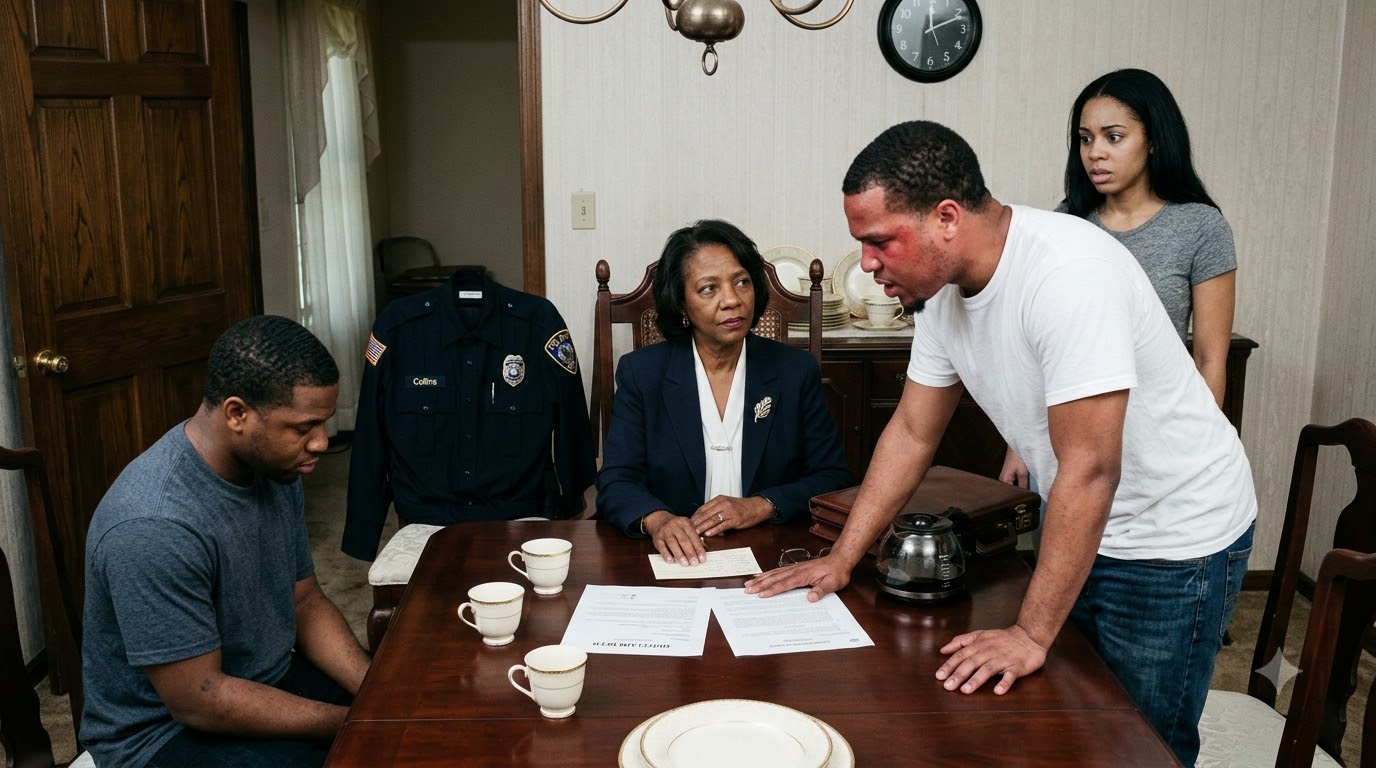
The pot of dark roast coffee steamed silently near the center of the table, flanked by four porcelain cups from my good ivory set—the ones with the delicate gold rim David bought for our first hosted Thanksgiving.
To my right, Robert Whitfield sat unhurried, his leather briefcase sitting flat on the floor beside his chair. Next to him, Officer Collins leaned back against the sideboard, her arms crossed loosely over her navy jacket, her eyes tracking the quiet ticking of the black wall clock above the refrigerator.
The front door lock clicked.
Keesha didn’t knock. She still had her spare key, pushing the heavy oak door open with the sharp confidence of someone who owned the air in the room. Malik walked in right behind her, his camel-hair coat unbuttoned, carrying a slim leather folder under his elbow.
Behind them came Jamal, his eyes fixed firmly on his expensive leather shoes, and a stranger in a gray tailored suit holding a notepad.
“Mama, we need to talk about some administrative details before the court offices close for the holiday weekend,” Keesha began, her heels clicking briskly against the hallway hardwood. She rounded the corner into the dining room—and stopped dead in her tracks.
Malik almost ran into her back, his hand coming up to catch the doorframe. His eyes darted from Robert’s calm face to Officer Collins’ badge resting on her belt, then down to the blue porcelain cups set neatly at every seat.
“What is this?” Malik asked, his voice dropping an octave as his jaw tightened. He adjusted the cuff of his shirt, a sudden nervous twitch pulling at his left eyebrow. “Gloria, who are these people?”
“Sit down, Malik,” I said. I didn’t raise my voice. I didn’t reach for my coffee. I stayed planted in David’s high-backed chair at the head of the table. “All of you. Sit down.”
Jamal took two steps back toward the entryway. “Mama, I told them we shouldn’t come over here like this—”
“I said sit down, Jamal,” I repeated, looking directly at my son until he pulled out a chair and sank into it without another word.
Keesha remained standing, her hand gripping the top of the nearest chair until her knuckles turned pale. “If this is about the party on Wednesday, Mama, you’re being utterly dramatic. You walked out without telling anyone, and now you’re bringing police into my family’s business?”
Robert reached down, lifted a thick paper envelope from his briefcase, and laid it flat in the middle of the table.
“This isn’t about a Christmas party, Mrs. Brooks,” Robert said, his voice level and razor-sharp. “This is regarding a fraudulent quickclaim deed filed with DeKalb County, along with a forged signature on a petition for cognitive guardianship.”
The stranger in the gray suit glanced at the legal seal on Robert’s documents, then down at Officer Collins’ silent, steady gaze. Without saying a single word, he tucked his notepad under his arm, turned on his heel, and walked straight out the front door. The heavy oak door clicked shut behind him.
Malik’s face flushed a dark, mottled gray. He stepped up to the table and slammed his palm against the mahogany.
“This is ridiculous! I am her legal power of attorney representative under the family asset management act! She’s sixty-eight years old, she’s losing her memory, and we are protecting this estate from being squandered!”
“You didn’t sign her name very well, Mr. Brooks,” Officer Collins said smoothly, shifting her weight as she pulled a certified forensic analysis sheet from her inner pocket. “The handwriting examiner noted four distinct hesitation marks on the grantor line. And Mrs. Hayes closes her capital letter G. Yours was wide open.”
Keesha turned her head sharply toward her husband, her eyes widening as the color drained from her lips. “Malik… what is she talking about?”
“She’s lying!” Malik barked, his voice straining as he pointed a finger directly at me. “She doesn’t even know what year it is! Ask her! Ask her who handles her property taxes!”
I reached into my dress pocket, pulled out the smudged recipe card, and set it gently beside the legal papers.
“I know what year it is, Malik,” I said, looking him straight in the eyes. “And I know exactly what my husband put in place before you ever thought about touching this house.”
CHAPTER 4: THE UNRAVELING
The dark red wax seal caught the morning light coming through the dining room window.
Keesha stared down at the thick stack of parchment, her breath catching sharply in her throat as she stepped closer to the table, her fingernails digging into the back of the dining chair.
“This is five years old,” Keesha whispered, her voice cracking as she read the top line of the cover sheet. “Dad signed this three weeks before he died?”
“Your father knew how money changes people when grief settles in,” Robert said smoothly, opening his leather briefcase again. He pulled out two crisp, blue-backed legal forms. “And he made sure that every asset—the house, the bank accounts, and the insurance policy—was placed firmly out of reach.”
Malik took a violent step toward the table, grabbing the forged quickclaim deed copy from under Officer Collins’ arm. “This doesn’t change anything! We’re her immediate family! She’s incompetent, and a piece of paper signed five years ago doesn’t prove—”
“Mr. Brooks,” Officer Collins interrupted, her voice dropping into an icy, authoritative calm as she stepped directly between Malik and the table. “You are currently standing in a private residence after being instructed to sit down. If you raise your voice or take another step toward Mrs. Hayes, I will place you under arrest for criminal trespass and attempted obstruction right now.”
Malik froze, his face turning an angry, blotchy red, his chest heaving under his unbuttoned coat.
“Furthermore,” Robert continued, tapping his pen against the blue-backed forms, “as of eight o’clock yesterday afternoon, a formal complaint was drafted for submission to the Georgia State Bar’s Ethics Review Board regarding the unauthorized use of identifying personal information in a legal filing. That complaint names your real estate firm’s corporate address, Malik.”
Malik’s hand dropped away from the paper. The color drained completely from his lips, leaving his mouth slightly open as he stared at Robert in dead silence.
Keesha sank slowly into the chair across from me, her posture collapsing as she buried her face in her hands. A single, quiet sob shook her shoulders.
“Dad always chose you first,” she choked out through her fingers, her voice barely audible over the hum of the refrigerator. “Every single time. Always you. Never us.”
I reached into my dress pocket and pulled out David’s smudged recipe card one last time, holding it firmly between my fingers.
“Your father didn’t choose me over you, Keesha,” I said, keeping my voice level, steady, and clear across the table. “He protected me so I wouldn’t have to sit in a folding chair in my own home while people I raised traded away my life behind my back.”
Jamal stood up from his chair, his head bowed low, refusing to meet anyone’s eyes. He didn’t say a word as he turned around and walked out down the hallway, the screen door clicking softly shut behind him.
Malik backed away toward the front door, his teeth clenched, his eyes darting frantically between Officer Collins and Robert’s paperwork. “You haven’t won anything, Gloria. We’ll fight the trust in probate court. You can’t keep us out!”
“The trust documents are unchallengeable, Mr. Brooks,” Robert replied without looking up from his briefcase. “And if you step foot on this property again, Mrs. Hayes has authorized a permanent restraining order.”
Malik turned on his heel and rushed out the door, leaving it standing wide open to the damp Atlanta air.
Keesha stood up slowly, her cheeks streaked with mascara, looking at me across the mahogany table as if seeing me for the first time in ten years. She opened her mouth to speak, but no words came out. She turned and followed her husband out into the gray morning.
I sat alone at the head of the table, listening to the two car doors slam outside in the driveway, followed by the quiet, steady thrum of rain hitting the roof.
CHAPTER 5: PACKING THE MEMORIES
The cardboard box on the coffee table was half full.
I picked up the three small potted succulents from the kitchen windowsill—the ones leaning slightly toward the sunlight, their leaf tips carrying a dull brush of brown—and set them side by side on top of a folded bath towel inside the box.
The doorbell rang once. Soft, cautious.
I walked to the entry and pulled the heavy oak door open. A middle-aged woman in a neat dark suit holding a blue leather clipboard stood on the porch, her sedan parked right behind my driveway.
“Mrs. Hayes?” she asked, checking her notes. “I’m Sarah Mitchell from Oakridge Property Management. Robert Whitfield sent over the residential lease management agreement for the Fayetteville Road house.”
“Come in, Sarah,” I said, stepping aside.
She walked into the foyer, her heels tapping against the hardwood. She looked around at the clean walls, the high ceilings, and the quiet sunlight streaming into the dining room.
“It’s a beautiful home,” Sarah said, handing me the pen from her clipboard. “The young family we screened yesterday is ready to sign a two-year lease starting February first. They have two small children. They promised to take good care of the rose bushes out front.”
I took the pen and signed my name on the trustee line at the bottom of the management contract. Gloria Hayes. The capital G closed tight and small, exactly where it belonged.
“Thank you, Sarah,” I said, handing the clipboard back. “Make sure they know about the back porch board. It creaks when you step on the left edge. Don’t let them try to fix it.”
She smiled, nodding as she tucked the papers into her bag. “I’ll make sure it’s written directly into the addendum.”
After Sarah left, I walked up the stairs to the master bedroom.
On the nightstand sat David’s reading glasses, folded neatly beside his old leather-bound dictionary. I picked them up, feeling the cool weight of the silver wire frames against my palm, and slipped them into the front pocket of my coat alongside his recipe card.
I wasn’t selling the house. I wasn’t letting Malik or Keesha turn thirty-seven years of hard work into quick cash for real estate deals or executive hair appointments.
The trust would collect the rent, maintain the property, and hold the land intact until someone in this family grew enough sense to understand what a home actually meant.
I taped the last cardboard box shut, grabbed my coat, and picked up the small box with the three houseplants resting on the bottom.
I turned off the kitchen light, pulled the heavy oak door closed behind me, and turned the key in the lock from the outside.
CHAPTER 6: THE SENECA SWING
The chain creaked with a slow, rhythmic groove against the porch beam above my head.
Down the block, a screen door slapped shut, followed by the faint, low hum of a neighbor’s lawnmower cutting through the humid summer air.
Aliyah came out through the front door, carrying a small cardboard box filled with index cards. She sat down beside me on the swing, her feet tucked under her yellow hoodie, and pulled out a fresh white card.
“Grandma,” she said, tapping her pen against the paper. “Tell me the sweet potato square recipe again. From the beginning. And don’t leave out the brown sugar part like Mama does.”
I reached into my sweater pocket, pulled out David’s original card, and laid it across her knee.
“Read his handwriting first, baby,” I said softly, guiding her thumb to the smudged blue ink in the corner. “That’s where the whole thing starts.”
Aliyah traced the block letters with her finger, her eyes quiet as she began copying the lines onto her own card.
The screen on my phone lit up on the porch table beside my mug. A text message from Keesha, sent twenty minutes ago, sat on the glass screen: Mama, the therapy sessions are helping me understand why I let Malik handle everything. I know I lost your trust, but I’m trying. I love you.
I looked at the message, then set the phone face down without typing a reply.
Forgiveness was one thing. Returning to a table where I had to sit in a folding chair was another.
“Are we still going to the fellowship hall at Calvary tomorrow morning?” Aliyah asked, looking up as she finished her card. “Sister Dorothy said eighteen women signed up for the Thursday cooking group this week.”
“We’re going,” I said, taking a slow sip of my warm tea. “We have twenty pounds of sweet potatoes sitting on the kitchen counter, and Hattie promised she wouldn’t burn the biscuits this time.”
Aliyah laughed, leaning her shoulder against mine as the porch swing rocked back and forth in the fading twilight.
The house behind us was quiet, filled with the clean smell of lemon oil, fresh paint, and warm tea. The three succulents sat thriving on the kitchen window sill, leaning straight toward the evening light.
I leaned my head back against the porch railing, closed my eyes, and listened to the steady, unhurried ticking of David’s wall clock through the open window.