The House on Cascade Road: A Woman’s Calculated Vindication Against Entitlement and Betrayal
CHAPTER 1: THE COLD LOCKOUT
The air off Cascade Road carried the sharp scent of turning leaves and wood smoke, but inside the foyer, the house smelled like fresh wax and polished brass. My hand rested on the solid walnut table in the entryway—the one I had spent four days sanding back down to the bare grain.
Darius didn’t even stand up from the linen sofa I’d bought with my own SCAD portfolio earnings. He sat back, one polished shoe crossed over his knee, his charcoal dress shirt crisp under the low light. Tiana sat beside him, running her manicured fingers along the armrest like she was test-driving a floor model.
“Go ahead and take your personal belongings, Ammani,” Darius said. His voice had that smooth, practical tone he used when closing a bad subcontractor account. “Whatever is yours personally. The rest stays here for us.”
Tiana didn’t hide her smile. She leaned back, resting her head against the caramel fabric, her eyes tracing the ceiling moldings I’d drawn by hand three summers ago. “He told me everything, honey,” she said softly, adjusting the collar of a silk blouse I’d bought Darius for Christmas two years back. “You’re getting older now. Time to step aside and let someone else take care of the place.”
I didn’t answer. I reached down, my fingers sliding along the heavy brass drafting ruler tucked into the side pocket of my leather tote. I didn’t pull it out. I just turned the cold, flat metal in my palm, feeling the etched increments bite into my thumb.
Darius stood up then, walked to the front door panel, and tapped the digital pad. The electronic chime sounded twice—the sharp, high sequence that confirmed a master code reset.
“Fingerprints are cleared,” he said, turning back with his hands in his pockets. He picked up a worn leather suitcase—my old weekend bag—and set it out on the porch floorboards. The thud against the wood was flat and heavy. “No need to make this difficult for the kids.”
“The kids are at my mother’s,” I said. My voice didn’t shake. I kept my breath low and slow, feeling the cold weight of the brass ruler against my skin. “They’re eating gumbo.”
I reached into my tote, bypassed the ruler, and pulled out the crisp manila folder I’d been carrying since Tuesday. I set it on the walnut table. The white edges of the court-stamped filings stuck out just enough to catch the chandelier’s light.
“You’re right,” I said quietly, looking Darius straight in the eye while Tiana tilted her head to inspect the crystal drops above her head. “I’m going to take exactly what’s mine.”
Darius gave a short, dismissive nod, already turning his back to offer Tiana a fresh drink. Neither of them touched the folder. Neither of them asked to see the receipts.
CHAPTER 2: THE SIXTYMINUTE STRIPPING
The clock on my dashboard read 5:58 AM when the two fifty-three-foot box trucks backed into the cul-de-sac.
Gerald jumped down from the lead cab before the air brakes even stopped hissing. He was a compact man with graying hair, a high-visibility vest pulled tight over a faded canvas jacket, and a metal clipboard clamped under his arm. He didn’t ask for explanations. He didn’t care about the quiet luxury of Cascade Road or the neat brick facades lit by early morning streetlamps.
“Mrs. Washington?” Gerald asked, his voice low, crisp, and completely devoid of drama.
“I’m Ammani,” I said, stepping off the bottom porch step. I pulled my thumb back from the sharp edge of the brass ruler and pointed toward the front door. “We have fifty-eight minutes before the first wave of guests shows up for a party that isn’t happening. Itemized list is attached to the Fulton County order.”
“Eight men,” Gerald said, signaling the crew jumping out of the second rig with folded moving blankets over their shoulders. “We work from the front entrance back. If it’s on the docket, it goes on the floor floorboards or the strap.”
Gerald didn’t waste a second. He walked straight up the brick steps, set his boot against the door frame, and pressed the heavy brass knocker.
Darius opened the door three seconds later, clutching a silk bathrobe around his waist. His hair was slept-on flat on one side, his face slack with the deep, slow confusion of a man who believed the world operated entirely on his schedule.
“What the hell is this?” Darius barked, stepping onto the threshold. “Ammani, what are you doing?”
Gerald didn’t flinch, didn’t shift his stance, and didn’t raise his voice. He slid the top white sheet off his clipboard and held it three inches from Darius’s chest.
“Court-filed property itemization, sir,” Gerald said flatly. “We’re on a timed order for Mrs. Ammani Washington. Step to the side, please. We’re starting with the living room.”
“Are you insane?” Darius snapped, his voice cracking into a high, thin register. He reached out to snatch the paper, but Gerald simply pulled the clipboard back half an inch, completely unbothered. “This is my house! You can’t just—”
“The land is deeded to my grandmother’s estate, Darius,” I said, staying at the bottom of the porch steps, my arms folded across my gray coat. “The house sits on my lot. And everything inside it was paid for from my client ledger. Read page three.”
From deep inside the foyer, heels clicked sharp against the hardwood. Tiana appeared in the hallway, wearing a wine-red silk cocktail dress, her hair done in loose, sweeping waves, a crystal glass half-filled with mimosa in her hand.
“Darius, baby, what’s all this noise?” Tiana called out, her voice dropping as her eyes landed on the eight men in work boots crowding the porch. Her gaze flicked to the idling diesel trucks, then to me. “What is she doing back here? The catering team is supposed to be here at six-thirty.”
“There is no catering team coming, Tiana,” I said.
Gerald’s crew moved past Darius like water around a stone. Two men wrapped thick quilted blankets around the caramel linen sofa—the one Darius had sat on twelve hours ago while telling me to step aside. They lifted it effortlessly, the frame clearing the front double doors with two inches to spare.
“Hey! Stop!” Tiana screamed, her polished composure shattering in a single second. She ran forward, her heels skidding slightly on the polished floor. “That sofa matches the rug! I invited twenty people from the country club! Put that back!”
“Item twenty-two,” Gerald read aloud, his thumb tracing a line down the paper. “Custom linen sofa. SCAD design invoice number four-eight-two. Paid in full by Ammani Washington. Load it.”
By 6:30, the living room was a void. The farmhouse dining table I had hauled back from East Point came apart in four clean sections, its heavy legs unbolted and carried down the steps. The custom velvet drapes came down with a soft zip of metal rings sliding off brass rods.
Tiana stood in the middle of the dining room, her mimosa long forgotten on an exposed radiator, her hands clutches in her hair. “Darius! Do something! Call the police! Tell them she’s robbing us!”
Darius pulled his phone from his bathrobe pocket, his thumb flying across the glass. “I’m calling my lawyer,” he muttered, his jaw working violently, a thick vein bulging along his temple. “I’m calling the sheriff. This is illegal.”
“Call him,” I said quietly, watching two movers unscrew the custom kitchen pendant lights. “Ask him about the Fulton County probate record filed three days ago. Ask him if a secondary construction loan gives you ownership of a permanent fixture paid for on a sole proprietor account.”
Darius stopped typing. His thumb hovered over the screen. He knew. He knew every line item because he had watched me write every single check while he was out building his image.
“Item seventy-four,” Gerald called out from the center of the living room, setting up a ten-foot aluminum ladder directly beneath the center ceiling junction. “Living room chandelier. Reclaimed glass and iron fixture. Inman Park antique record attached.”
Tiana let out a jagged, breathless shriek. She ran to the foot of the ladder, looking up at the heavy iron arms that had been the centerpiece of every party invitation she’d mailed out that week.
“No!” she yelled, her voice echoing off the bare plaster walls. “You promised me those lights! You told everyone at the brunch that the chandelier stayed with the house! You told me she gave up everything!”
She turned on Darius, her face twisted, her sweet, practiced smile completely gone. She slammed her hand against his chest. “You lied to me! You told me she was broke and desperate! You told me this was all yours!”
“Shut up, Tiana!” Darius hissed, trying to grab her wrist while stepping backward toward the hallway. “Lower your voice! The neighbors—”
“I won’t lower my voice!” she screamed. “My friends are going to be here in thirty minutes! What am I supposed to show them? An empty barn?”
Gerald’s man reached the top of the ladder, his wire cutters glinting under the exposed bulbs. With two clean, sharp clicks of steel on copper, the junction went dark. The heavy iron frame swung free, caught instantly by two men waiting below with a padded crate.
I stood in the doorway, watching the dust settle in the empty space where my home used to be. My hand reached into my tote, my fingers wrapping firmly around the brass ruler.
Down the dark hallway, half-hidden behind the frame of the home office door, a small piece of paper caught the grey morning light—a yellow default notice from a commercial lender I’d never seen before, stuck into the frame of an old ledger.
Darius hadn’t just tried to replace me. He was drowning.
CHAPTER 3: THE EMPTY SHELL
The guest stepped out of the car holding a gift bag wrapped in gold foil and tissue paper. She took three steps up the paved walkway, her heels clicking against the concrete, before her eyes drifted toward the two massive freight trucks idling at the curb.
She slowed down. Her gaze moved past Gerald’s men strapping down the ramp and shifted straight through the wide-open double doors of the house on Cascade Road.
Inside, there was nothing.
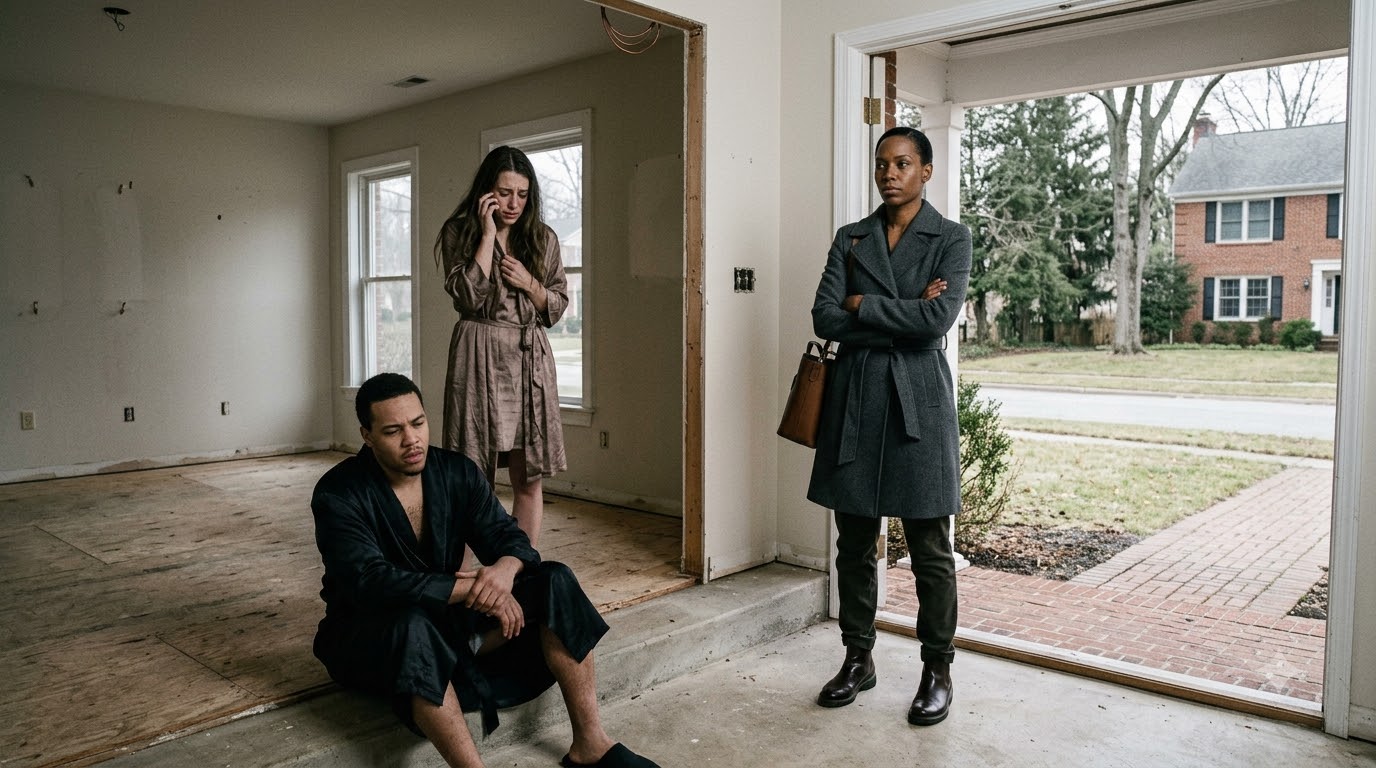
No linen sofa. No farmhouse dining table. No drapery covering the tall front windows. Just raw wall anchors, bare grey subfloor where the custom hardwood had been pulled up, and copper wire hanging down like frayed thread from the empty patch on the ceiling where the chandelier used to sit.
“Tiana?” the woman called out, holding the gold gift bag awkwardly against her waist. “Is… is the party inside?”
Tiana stood in the middle of the bare entryway. Her hair was falling loose around her neck, her silk cocktail dress wrinkled at the waist, her bare toes curled onto the dusty underlayment where four thousand dollars of Decatur timber had rested three hours ago. She tried to lift her chin, her voice rising into an anxious, brittle squeak.
“Evelyn! Hi!” Tiana took two steps forward, but her heel caught on an exposed carpet tack. She stumbled, grabbing the unpainted doorframe to steady herself. “We’re… we had a slight structural issue with the design team! Darius is handling it!”
Darius didn’t move. He sat three steps down on the front porch, his silk bathrobe pulled tight across his chest, staring blankly at the oil stain left on the driveway by Gerald’s lead truck. His shoulders were slouched forward, all the crisp authority of his charcoal dress shirts gone.
A second car pulled into the cul-de-sac—a dark blue coupe. Two men in sport coats got out, carrying a wooden crate of wine. They stopped right beside Evelyn, looking at the exposed drywall and the dust swirling through the vacant living room.
“Darius?” one of the men asked, squinting through the doorway. “Did you guys get hit by a storm? Where’s the furniture?”
Darius didn’t answer. His hands stayed clamped in the pockets of his bathrobe. His jaw worked silently, his face pale under the grey morning light.
“He promised me!” Tiana shrieked, turning on Darius, her voice echoing off the gutted walls for every guest on the sidewalk to hear. “He told me this was his house! He told me he owned everything inside it! He made me print two hundred invitations!”
Evelyn took one slow step backward down the brick path. She looked at Tiana, then at Darius sitting on the porch steps in his sleepwear, and finally at me as I adjusted the leather strap of my tote bag. She didn’t say another word. She turned around, got back into her sedan, and pulled out of the cul-de-sac.
The two men with the wine crate looked at each other. The taller one set the crate down on the edge of the lawn, turned without speaking, and walked back to his coupe.
“Darius, say something!” Tiana screamed, her hands shaking as she pulled at his bathrobe sleeve. “Tell them it’s a mistake! Tell them you’re buying new things!”
Darius jerked his arm away, his voice flat and broken. “Shut up, Tiana. Just shut up.”
I stepped around them, my boots making a quiet, steady sound on the concrete steps. I stopped four feet from where Darius sat. I didn’t raise my voice. I didn’t smile.
“I left the divorce papers on the kitchen counter,” I said, pointing back toward the bare, empty room. “The legal description of the land is attached. You have thirty days to respond to Fulton County.”
Darius looked up at me, his eyes rimmed with red, his chest heaving under the silk robe. “You destroyed everything, Ammani. You stripped the whole place.”
“I took what I paid for, Darius,” I said, reaching into my bag one last time to touch the smooth brass ruler before zipping it shut. “You just forgot who built the floor you were standing on.”
Tiana didn’t even look at him as I walked toward my car. She was already on her phone, her voice frantic, calling a rideshare while stepping over the bare subfloor toward the driveway, leaving Darius alone on the cold front steps.
I opened my driver’s side door, set my tote on the passenger seat, and looked back at the house on Cascade Road one last time. It was just a shell now—hollow walls and dangling wires.
I turned the key, shifted into drive, and pulled away toward Kirkwood, where my children were waiting.
CHAPTER 4: THE FINAL SETTLEMENT
The attorney was young, his grey suit slightly too stiff around the shoulders, his leather briefcase sitting flat between us. Darius sat beside him, his collar unbuttoned, dark circles under his eyes, and a small smudge on his watch glass that he kept rubbing with his thumb.
“Mrs. Washington,” the lawyer began, pulling out three stapled pages. “We’re filing for an injunction regarding the willful removal of marital property. You took fixtures, structural elements, and shared assets without judicial oversight. We intend to pursue full restitution for property damage—”
“Stop right there,” I said, sliding the top document from my folder straight across the glass table.
The paper hit the attorney’s thumb. He glanced down.
“Grandmother’s deed,” I said softly, my voice staying flat, grounded, and clear. “Recorded Fulton County, 1978. Probated solely in my name in 2019. Darius’s name is listed only as a co-signer on a secondary loan that was fully satisfied through my personal design LLC last quarter. Receipt number four.”
The lawyer adjusted his glasses. He looked at Darius. Darius didn’t look back; his eyes were fixed on his watch face, his thumb still making small, futile circles on the glass.
“Second document,” I continued, sliding the next thick packet across. “Itemized property list filed seventy-two hours prior to removal. Every fixture, every light, every board—bought, invoiced, and paid for from my personal SCAD design accounts. Nothing was taken that wasn’t legally mine.”
The attorney leaned forward, scanning the clerk’s raised seal on the corner of the filing. He cleared his throat, his mouth opening to construct a counter-argument, but I didn’t give him the room.
“And third,” I said, laying down the yellow slip I’d pulled from the home office frame two weeks ago, right beside a certified bank notice. “Your client attempted to pledge my ancestral lot as secondary collateral for a commercial line of credit to purchase a luxury vehicle registered in Midtown. The lender issued a notice of default three days before I moved.”
The conference room went entirely still. The morning light coming through the window caught the dust motes floating above the table.
The junior attorney looked at the default notice, then turned his head slowly to stare at Darius.
“Darius,” the lawyer whispered, his voice losing every drop of its professional confidence. “Is this authentic?”
Darius’s shoulders caved inward. The fight, the entitlement, the posturing—all of it collapsed right there in the quiet space of my office. He didn’t yell. He didn’t make a scene. He just gave one small, helpless shake of his head.
The attorney closed his thin file, slid his pen back into his breast pocket, and stood up. “Excuse me for a moment,” he muttered, picking up his briefcase and stepping out into the hallway, leaving the door slightly ajar.
It was just the two of us.
Darius sat with his hands resting palm-up on the polished wood. “You built all of it,” he whispered, his voice rough and dry. “The house… the life… everything. I thought I was holding the frame, Ammani. But you built the foundation.”
“I did,” I said. “And now I’m building a new one.”
“What about the kids?” he asked, his eyes suddenly wet, his voice cracking on the word.
“They’re going to have a quiet home where they feel safe,” I said. “Their father is still their father. You can see them whenever you’re ready to be present for them. That’s between you and them. It has nothing to do with me anymore.”
He nodded slowly, accepting the immovable boundary I had set between us. He didn’t ask for forgiveness. He knew there were no speeches left to make.
An hour later, after the paperwork was signed and the office was quiet again, I drove back to our townhouse in Kirkwood.
Ila was standing in the middle of the front room, her small hands raised toward the ceiling where Terrence had just finished mounting the reclaimed iron chandelier. When she flipped the wall switch, the crystal drops caught the low winter light, scattering small, bright stars across the freshly painted walls.
“Mama,” Ila whispered, her eyes wide as she looked up. “It looks like magic.”
“No, baby,” I said, putting my hand on her shoulder and feeling the steady, warm peace of our new home. “It’s just our light.”