The Legacy on the Shore: How a Weary Daughter Reclaimed Her Father’s Land
CHAPTER 1: THE COLD WELCOME
The damp Carolina gravel crunched under my tires as I rounded the final bend near the Morsville marina. I turned my 2012 Subaru onto the access road, the familiar smell of wet pine and turned earth filling the cabin through the cracked driver’s window. I shifted my right hand on the steering wheel, my thumb tracing the chipped rim of the white porcelain coffee mug sitting in the cup holder. I’d carried that same mug from my kitchen in Charlotte, three hours round-trip, just to spend a quiet Saturday checking the gutters before the autumn leaves settled.
The iron gate stood wide open.
My father built that double-leaf gate after Hurricane Hugo tore through the cove back in ’89. He set those posts four feet deep into red clay. It stayed locked. Always.
I pulled up behind Calvin’s rusted F-150, my boots hitting the wet driveway before the engine even sputtered out. Andre’s black Range Rover sat crooked near the boathouse, parked at a lazy angle over my mother’s hydrangeas. Beside it sat a cherry-red convertible with dealer tags.
Up on the teak dock—the one my father laid board by board the summer before his heart gave out—Andre stood with his hands on his hips. He wore pressed linen, his sunglasses hooked into his collar, surveying the water like a man inspecting an asset he’d already liquidated. Next to him stood Kendra Miles. She was thirty-four, tall, and wearing my dead mother’s straw sun hat—the one with the faint water stain on the brim from a thunderstorm twenty years ago.
Over on the porch, sitting in my grandmother’s oak rocker with a glass of sweet tea, was my mother-in-law, Monique. She didn’t look up when my car door slammed. She just took a slow sip from the cursive-etched glass my mother used for Sunday dinners.
“You’re nothing to me now, Joselyn,” Andre said.
He didn’t yell. He didn’t have to. The autumn air carried his voice straight across the quiet water of the cove, crisp enough for the neighbor working on his outboard engine two hundred yards away to freeze, tool in hand. Calvin stood fifty feet back near the tool shed, his weathered hands clamped over the wooden handle of an antique rake, his eyes fixed on the gravel between his boots.
“The divorce is practically done anyway,” Andre added, taking two measured steps down the dock toward me. He reached for his pocket, his voice dropping into that smooth, reasonable tone he used on bank loan officers. “Don’t make a scene in front of people, Joselyn. Kendra’s helping me organize the transition.”
Kendra tilted her head, the brim of my mother’s hat shading her face, a small, practiced smile settling on her lips.
I didn’t scream. I didn’t ask about the hat or the red car or the eighteen years of my life I’d spent managing his schedule while he built his firm. My fingers tightened around the cool porcelain handle of my mug, feeling the sharp little chip near the rim where my son Cory had knocked it against the sink in middle school.
I walked right past Andre. I didn’t look at Kendra. I didn’t look at Monique. I reached into my coat pocket, pulled out the brass key my father had stamped with his own steel dies back in 1988, and stepped up to the heavy front door.
“Joselyn, stop being dramatic,” Andre called out, his leather shoes clicking sharply on the porch steps behind me. “We’re discussing the appraisal today. The locks are being changed on Monday anyway.”
I turned the brass key in the deadbolt, stepped inside, and pulled the solid oak door shut until the iron latch bit deep into the frame.
CHAPTER 2: DEADBOLT LOGIC
The solid oak door absorbed the first blow from Andre’s fist. The wood didn’t shudder—my father had hung it in a reinforced steel frame back in ’88—but the noise echoed through the open living room like a gunshot.
“Joselyn!” His voice came through the heavy timber, muffled but sharp with disbelief. “Open this door right now. Stop acting like a child in front of my family.”
I didn’t answer. I stood in the foyer, my back to the door, feeling the vibration of his second knock travel straight down my spine. My thumb pressed hard against the chip on my porcelain mug, the cool glazed clay keeping my hands from shaking.
Through the glass sliding panel overlooking the porch, I saw Monique drop her teacup into its saucer with a sharp clatter. She pulled her phone from her purse, her fingers flying across the screen while her face twisted into a mask of righteous outrage. Beside her, Kendra stood frozen, holding my mother’s straw hat by the brim, looking around the property as if waiting for someone to come script her next move.
I walked past the turned-down photograph of my parents on the entryway table. I didn’t flip it back over. Not yet. Touch it now, and it would look like grief; right now, I needed every drop of cold, practical anger I had.
I reached the kitchen counter, picked up the landline handset, and dialed the number I’d known since I was twelve years old.
“Calvin,” I said the second the line picked up.
“I’m at the bottom of the porch steps, Miss Joselyn,” he replied, his voice low, steady, and entirely unbothered by the shouting outside. “He’s fixing to kick at the frame.”
“Change the gate code right now,” I told him. “Set it to my father’s old shop number. Then call the Iredell County Sheriff’s Office. Tell them we have a civil trespass on trust property. No drama, just give them the parcel number.”
“Already changing the gate box,” Calvin said smoothly. “Deputy’s usually patrolling Highway 21 around this time anyway. He’ll be here in ten.”
The glass door rattled as Andre moved from the front entry to the back deck, hammering his palm against the double-pane glass. “Joselyn, I have a signed agreement for an appraisal team coming on Monday! You can’t just lock people out of a marital asset!”
I walked over to the glass, stopping three inches from the pane. Up close, I could see the sweat glistening on his forehead, ruining the crisp, pristine image he’d spent the morning cultivating. The white linen shirt didn’t look quite so regal with his face pressed against the glass.
“This isn’t a marital asset, Andre,” I said, my voice barely carrying through the glass, but the words were clear enough from the movement of my lips. “It never was.”
“I paid for the dock repairs three years ago!” he snapped, pointing a finger at the floor. “I’ve covered the property taxes out of our joint account for five years!”
“With the money from my mother’s life insurance payout that you promised to return to the trust,” I said quietly.
His face flushed red. He opened his mouth to fire back, but the gravel drive behind him crunched under heavy tires. A white-and-blue cruiser from the Iredell County Sheriff’s Department pulled up behind his Range Rover, its roof lights casting a quiet, rhythmic blue strobe across the pine trees.
Andre froze. He turned slowly, his hands dropping to his sides as Deputy Vance stepped out of the vehicle, folder already resting against his hip.
“Mr. Powell?” the deputy called out, adjusting his belt as he walked up the path. “Got a call about a dispute over the gate access.”
“Deputy, thank God,” Andre said, instantly shifting into his polished, public-facing cadence as he stepped off the deck. “My wife is having an emotional breakdown inside. She’s locked me and my family out of our summer home.”
I unlocked the deadbolt, pulled the oak door open just wide enough to stand in the threshold, and crossed my arms.
“Deputy Vance,” I said, keeping my tone level. “The deed for Parcel 402 is held entirely by the Banks Family Land Trust. I am the sole surviving trustee. Mr. Powell has no signatory authority on this property.”
Deputy Vance looked from me to the folder in his hand, then at the moving van parked near the boathouse where two hired workers were currently holding a velvet sofa, completely unsure of what to do next.
“Sir,” Deputy Vance said, turning his full attention to Andre. “I have the land trust registration on file right here provided by Ms. Lawson’s office. According to county records, your name isn’t on this title.”
“We are in the middle of divorce proceedings!” Andre insisted, stepping closer to the officer. “This is a temporary arrangement while the property is evaluated for development—”
“If you don’t have a court order granting you access today, sir,” Deputy Vance interrupted, his voice dropping into that flat, unyielding law-enforcement tone, “you’re trespassing. You need to pack up these vehicles and clear the gate.”
Behind Andre, Kendra’s face went pale. She dropped my mother’s straw hat onto the wooden railing like it had suddenly caught fire.
CHAPTER 3: THE BOUNDARY LINE
The quiet that settled over the cove didn’t feel like peace. It felt like the heavy, pressurized stillness before a summer squall.
Calvin walked up the gravel path, his old work boots kicking aside a loose pinecone. He stopped at the edge of the porch, looking at me where I sat on the top step, my hands wrapped tightly around the cold porcelain handle of my mug.
“They’re out,” Calvin said, wiping a spot of grease from his thumb with a blue shop rag. “Gate’s re-coded. Deputy Vance said he’d keep a cruiser near the highway turnoff until sunset.”
“Thank you, Calvin,” I said, setting the mug down on the wooden riser beside my boot. “He won’t stop at a deputy.”
“No,” Calvin agreed, his jaw shifting as he looked out toward the tree line separating our parcel from the vacant lot to the north. “A man who brings a moving van on a Saturday morning didn’t start thinking about this yesterday.”
I stood up, the damp air biting through my sweater. “Show me where they were walking earlier. Before I got here.”
Calvin didn’t answer with words. He turned and headed down the slope toward the property boundary, his gait slow and methodical. I followed three paces behind, the wet leaves crunching under our soles.
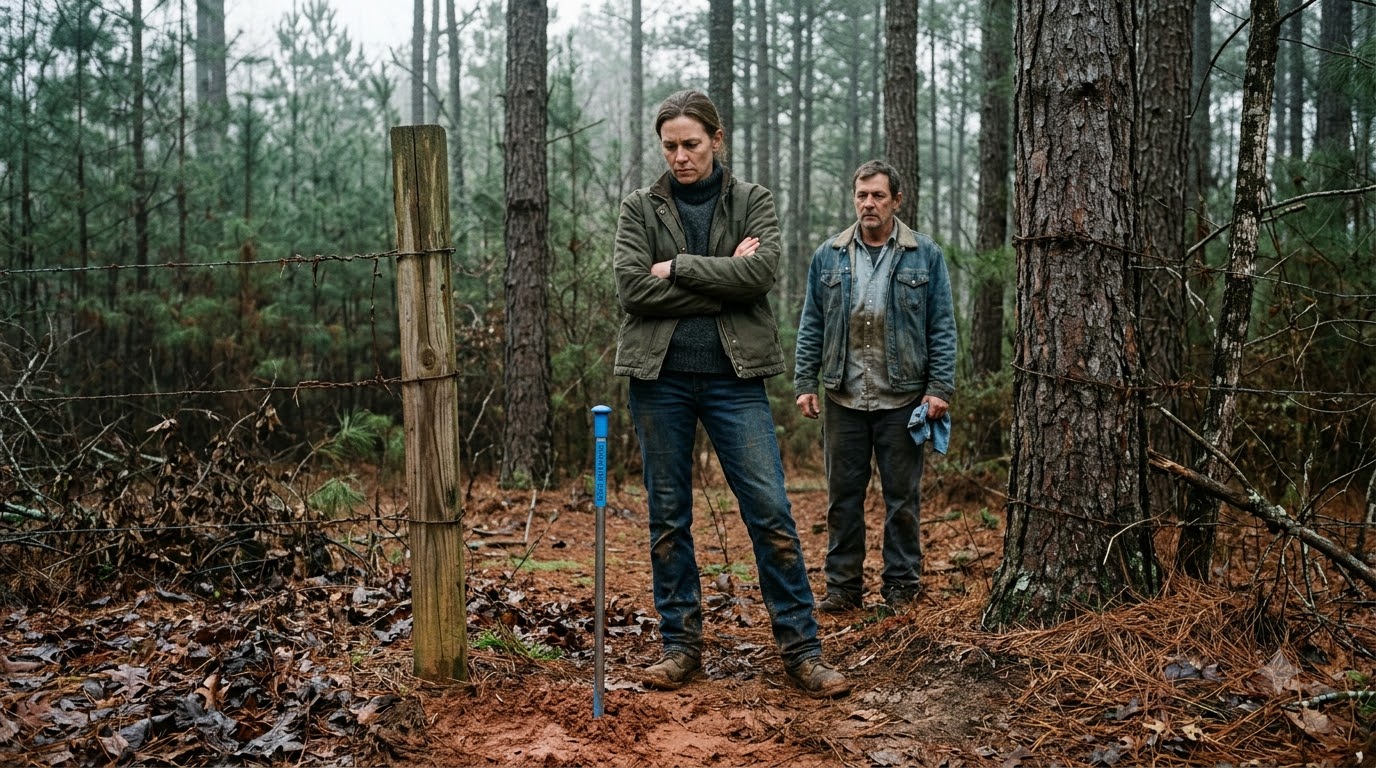
We reached the dense thicket of loblolly pines where my father had strung three strands of barbed wire back in ’88 to keep the neighbor’s cattle off his fresh grass. The wire was long gone, rusted away into the bark, but the corner cedar post still stood solid.
Calvin stopped two feet short of the post and pointed down with the toe of his boot.
Freshly churned red mud stood out against the dark decay of winter leaves. Driven flush into the soil, right beside a freshly cleared patch of brush, sat an iron surveyor’s pin capped with bright blue plastic.
I bent down, brushing away the pine needles. The blue cap was stamped with a fresh county registration number.
It was driven three feet inside my father’s original fence line.
“That wasn’t there in August when I bush-hogged the line,” Calvin said quietly. “And it ain’t a county boundary mark. That’s a private survey stake.”
My fingers touched the cold iron pin. Layer 1 was breaking wide open. Andre hadn’t just brought furniture up here for a weekend flex with his mistress. He was laying physical groundwork.
“He’s trying to shave the acreage,” I said, rising back up, my knees cracking in the chill. “The trust requires a minimum three-acre continuous waterfront parcel to maintain its non-commercial zoning exemption.”
“If they slice three feet along this whole four-hundred-foot line,” Calvin observed, “the parcel drops to two point nine eight acres.”
“And the zoning exemption collapses automatically,” I finished, the realization settling like lead in my stomach. “The land reverts to standard commercial shoreland.”
He didn’t need a court order to take the house today. He was trying to invalidate the trust from the dirt up, opening the entire cove to whatever developer was backing his play.
“Miss Joselyn,” Calvin said, his voice dropping an octave as he looked back toward the quiet house. “Your daddy didn’t leave a paper trail for this. He trusted the dirt to hold.”
“Then the dirt will hold,” I said, setting my jaw. “Call Gabrielle. Tell her we need a emergency injunction on parcel 402, and tell her to pull every commercial development filing submitted in Morsville over the last fourteen months.”
CHAPTER 4: THE PUBLIC HEARING
The Morsville Community Center smelled like stale urn coffee and floor wax. Four rows back, sitting beside a corporate land attorney in a charcoal suit, Andre leaned forward, his elbows resting on his knees, a confident smirk touching the corner of his mouth.
On the easel beside him stood three glossy foam boards showing turquoise infinity pools overlaid right where my mother used to keep her peach orchard.
“The petitioner argues that Parcel 402 has fallen out of active family trust compliance due to a boundary adjustment,” the board chairman droned, clicking his pen against his pad. “As such, the requested commercial variance for the Lake Norman Shoreline Resort would move forward subject to standard zoning approval.”
Andre’s attorney stood up, smoothing his tie. “Mr. Chairman, the private survey logged three weeks ago confirms the parcel falls under the three-acre non-commercial threshold. Mrs. Banks’ objection is purely emotional, driven by pending marital dissolution.”
A light murmur rippled through the audience. Kendra sat in the front row, holding a leather binder, nodding with a polished, sympathetic expression meant for the local reporters in the corner.
I didn’t reach into my bag for a heartwarming letter. I didn’t pull out old family photos. I reached for the thick manila folder Gabrielle had prepared, filled with tax receipts and certified county deeds.
“My name is Joselyn Banks,” I said, my voice echoing through the small room. “I am the sole trustee of the Banks Family Land Trust.”
Andre shifted, his smirk faltering as my voice cut clear through the microphone feedback.
“The private survey logged on October twelfth was driven three feet onto my property without authorization,” I continued, sliding a high-resolution aerial photograph across the clerk’s desk. “And the blue pin set by your developer’s surveyor rests directly over a certified 1988 iron pipe driven by Micah Banks and registered with Iredell County.”
The chairman paused, his pen stopping mid-click. He looked over his reading glasses at the photograph, then at Andre’s attorney.
“Furthermore,” I added, turning my eyes directly onto Andre, “under North Carolina General Statute 47-27, an unapproved boundary alteration conducted to circumvent environmental trust protections invalidates the petition on face. Without our recorded three-acre shoreline easement, this board lacks the legal authority to grant a variance.”
Andre’s attorney spun toward him, whispering harshly under his breath while flipping through his own binder. Andre’s face turned from pale white to a dark, mottled red.
“Mom,” a voice called out from the back row.
Cory stood up from the folding chairs near the exit. He wore his work jacket, his boots still dusty from his job site, his jaw set tight as he walked down the center aisle.
“Cory, sit down,” Andre snapped, rising half an inch from his chair before catching himself under the fluorescent lights.
Cory ignored him completely. He stopped right beside my podium, looking the board chairman square in the eye.
“My father told me this project was already approved and that my mother was just holding out for money,” Cory said, his voice raw but steady. “I came here today because I wanted to see the truth. The truth is he tried to erase my grandfather’s work behind our backs.”
A heavy, absolute silence fell over the room. The major investor sitting in the front row—a man in a navy blazer who had been taking notes all morning—quietly closed his leather portfolio, stood up without a word, and walked straight out the double doors.
Kendra’s hand went still on her binder. The chairman looked down at the documents, then tapped his gavel once against the wooden block.
“Application for variance on Parcel 402 is denied without prejudice,” the chairman announced flatly. “Clear the floor for the next item.”
CHAPTER 5: THE GATE STAND
He didn’t drive through. The keypad glowed red where Calvin had re-programmed the access box four hours earlier.
The driver’s door of the Range Rover opened with a heavy thud. Andre stepped into the driveway alone—no Kendra, no Monique, no legal team. He wore a dark jacket over a rumpled shirt, his hair damp from the misty drizzle settling over the cove.
Fifty feet back, near the shadow of the tool shed, Calvin’s silhouette remained still, his hand resting on the heavy wooden handle of his spade.
Andre walked up to the iron bars, gripping them with both hands. His knuckles were raw, his fingers white against the black metal.
“The board threw out the application, Joselyn,” he said, his voice raspy, stripped of its usual smooth cadence. “The development group canceled my consulting retainer before I even reached my car. I’m facing a full audit at the firm.”
I didn’t step closer. I stood six feet back on my side of the iron, my hands pulled deep into my coat pockets, my thumb resting against the chipped white mug I’d brought back down from the porch.
“You brought a surveyor onto this land without my knowledge, Andre,” I said plainly. “You knew what you were doing.”
“I was trying to build something that mattered!” he shouted, his voice cracking as he rattled the iron gate. The metal hinges groaned, but the deadbolt Calvin installed held fast. “Eighteen years I spent trying to scale that firm, and you wanted to stay buried in this rotting wooden box!”
“My father built this box with his hands,” I said. “And you tried to steal it to cover your firm’s bad investments.”
“It’s a piece of dirt!” he spat, leaning his forehead against the cold iron bar, his breath misting in the night air. “I gave you eighteen years, Joselyn! I gave you a home in Charlotte, a life, a reputation—”
“—You gave me a life where I had to ask permission to keep my own name,” I interrupted, my voice dropping into a quiet, unyielding register. “You used my mother’s insurance money to buy into your partnership and never mentioned it again. You brought another woman up here to wear her hat.”
He let go of the bars, taking a stumbling step back into the gravel. His eyes darted toward the tool shed, catching Calvin’s unmoving shape in the dark, then flicked back to me.
“My mother said you’d hold onto this out of spite,” he muttered, his jaw tight as he reached into his jacket pocket, pulling out a folded piece of paper. “I can file a lis pendens by Monday morning. I can tie this trust up in civil court for three years. You’ll spend every dime you have on legal fees just to keep the grass mowed.”
He was a cornered rat, reaching for the last dirty lever he could find. He expected me to flinch at the threat of court costs, to offer a quiet settlement or negotiate terms just to avoid the mess.
I took one slow step forward, stopping two inches from the gate.
“File it,” I said, looking him straight in the eye. “My attorney is already waiting at the clerk’s office with the fraud report on your private survey. If you file a false cloud on this title, Gabrielle will have a lien on your firm’s shares by noon.”
Andre stared at me through the bars. The paper trembled slightly in his grip before his hand dropped back to his side. The audacity had finally run out of room to maneuver.
CHAPTER 6: THE QUIET SHORE
The water lapped softly against the teak pilings, a steady, rhythmic splash that sounded like the shoreline breathing.
A heavy footstep sounded behind me on the wooden planks. Cory walked out carrying two metal folding chairs, setting them down three feet from the water’s edge. He sat down in one, crossing his ankles and resting his elbows on his knees, staring out at the calm gray expanse.
“Calvin finished mounting the stewardship sign by the driveway,” Cory said, his voice quiet in the crisp morning air. “The county recorded the conservation easement ten minutes ago. It’s locked in, Mom.”
“No variances,” I said. “No commercial leases.”
“No commercial leases,” Cory repeated. He reached down, picking up a tiny pebble from the dock board, tossing it gently into the water. “Dad’s firm finalized his severance yesterday. He’s moving to Atlanta to work for a regional brokerage.”
I didn’t answer. I lifted my mug, taking a slow sip of black coffee, feeling the warm steam rise against my face.
The legal battles were fully closed. Layer 1’s corporate lease scheme was dismantled when the planning board rejected the variance, and Layer 2’s fraudulent boundary line had been formally wiped from county records by Gabrielle’s filings. Andre had no leverage left, no claim to make, and no audience left to performance-act for.
Calvin walked out onto the dock, carrying a hand tool box. He stopped beside Cory, looking down at a loose brass cleat near the end of the pier.
“Need a quarter-turn on this bolt,” Calvin remarked, pulling a socket wrench from his pocket. He knelt down, applying pressure to the steel fastener until the iron bit flush against the teak.
“How’s the fence line look?” I asked him.
“Solid,” Calvin said, wiping his hands on his canvas trousers. “Re-hung the wire along the original ’88 survey pipe. Nobody’s moving that boundary again.”
I set my chipped mug down on the dock board beside my boot. The blue-capped pin Andre’s surveyor had driven into our dirt was gone, replaced by the permanent stone monument my father had set nearly forty years ago.
Cory leaned back in his chair, looking up at the house. The front oak door stood unlocked, swinging slightly in the morning breeze, showing the entryway table where my parents’ wedding photograph sat upright in the morning light.
“You going back to Charlotte tonight?” Cory asked.
“No,” I said, leaning back against the dock railing and wrapping my coat a little tighter around my shoulders. “I think I’ll stay right here.”