The Husband Who Returned From The Grave Found A Woman Who Stopped Mourning Nine Years Ago
CHAPTER 1: THE COLD PASSENGER
The air inside Delta Flight 1408 smelled of stale coffee and wet wool.
I kept my left thumb pressed firmly against the edge of my armrest, counting the steady rhythm of the cabin air recurrants to keep my pulse below eighty. Beside me, Elijah’s knuckles were white where he gripped his boarding pass. His twelve-year-old frame was rigid, his shoulders pinned hard against the cheap blue vinyl.
“Mom,” he whispered again. His voice didn’t shake; it had the flat, hollow tone of a child trying to report a nightmare while still awake. “That’s dad.”
I didn’t turn around right away. Nine years of ER night shifts teach you that panic is an expensive luxury. When a trauma patient hits the bay bleeding out, you don’t scream; you check the airway. You measure the room.
“Baby,” I said, keeping my eyes fixed on the seatback pocket in front of us. “You’re tired. O’Hare was a mess.”
“Two rows back,” he insisted. His breath hitched slightly against my shoulder. “Seat 19C. He has the mark on his eyebrow.”
I turned my head slow. Not fast enough to draw attention, just a quiet, casual shift of a mother adjusting her coat.
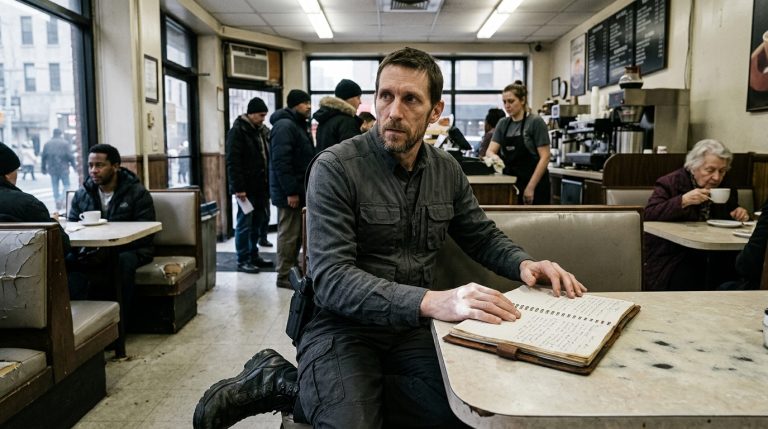
Through the narrow gap between the seats, a man was settling into the aisle row. Hair closely cropped, salt-and-pepper at the temples in the exact curve I had shaved every Sunday morning for fifteen years. He reached up to adjust the air vent, and his right hand dropped back to his knee. His thumb immediately began turning his wedding ring in a slow, continuous circle.
Click. Roll. Click.
It was the same unconscious tick Malik Washington used whenever a bank notice came in the mail or a contractor demanded cash upfront. Then he leaned toward the window, and the cabin lights hit his left temple. A thin, pale scar sliced straight through his outer eyebrow—the jagged souvenir from a rusted roof gutter in Englewood back in 2014. I had scrubbed the grit out of that cut myself at our kitchen sink while he complained about the smell of hydrogen peroxide.
My lungs emptied. For two full seconds, the roar of the jet engines simply vanished from my ears, replaced by a high, cold ringing.
He was sitting two rows away. He was breathing air.
I turned back to the front, my hands flat on my lap. I didn’t scream. I didn’t unbuckle my belt or cause a scene in the middle of a taxiing 737. If you let terror pick the ground, you lose before the fight even starts.
“Elijah,” I said, my voice flatter and colder than I had ever heard it sound. “Look at me.”
He turned his eyes toward mine, huge and dark.
“Don’t look back there again,” I said, smoothing a lock of his hair with a hand that I forced to stay perfectly still. “We’re going to land. We’re going to get our bags. And Mama is going to handle it.”
“Is he coming to the hotel?” Elijah whispered.
“I don’t know,” I said. “But he isn’t getting near you.”
The wheels hit the Virginia Beach tarmac with a heavy, rubbery thud that rattled the plastic overhead bins. Passengers around us began clicking their buckles undone, gathering coats, reaching for duffel bags. I stayed in my seat, holding Elijah’s shoulder, watching the aisle through the crack of the headrests.
Malik stood up. He swung a canvas bag over his shoulder, entirely unaware that the boy whose funeral flag sat in my bedroom drawer was sitting six feet in front of him.
He didn’t look back. He just stepped into the slow-moving line of strangers, heading for the jet bridge.
CHAPTER 2: TRACKING SHADOW
Elijah didn’t pull away, but his wrist was trembling under my fingers like a trapped bird.
We dragged our bags through the concourse while the rest of Delta 1408 scattered toward taxi stands and rental counters. I kept twenty paces of distance between us and the black canvas bag slung over Malik’s right shoulder. Every three steps, I brought my wrist up, checking the reflection in my watch glass to keep him framed behind us without turning my head.
He wasn’t running. He was walking with the casual, unhurried gait of a man on vacation, his left arm brushing against the box-braided hair of the young woman beside him.
She laughed at something he said—a high, easy sound that cut right through the terminal chime. She looped her arm through his elbow, leaning her head against his shoulder for a fraction of a second. I knew that tilt of his head. He was leaning down to whisper something meant only for her, the exact way he used to tell me he’d handle the snow on the driveway before I left for my morning ED rotation.
My stomach didn’t churn; it went dry, like bone meal.
At the baggage claim carousel, I pulled Elijah behind a concrete pillar near the rental desks. The air smelled of burnt jet fuel, ozone, and wet asphalt from the storm outside.
“Stay right here, baby,” I said, crouching so my eyes were level with his. I pulled a twenty-dollar bill from my coat pocket and pressed it into his palm, folding his fingers over it one by one. “Keep your eyes on the screen right there. If I’m not back before that bell rings three times, you don’t move. You understand me?”
“Mom,” he whispered, his eyes darting toward the crowd. “He saw us. In line. He looked at your name on the paper.”
“He saw what he wanted to see,” I said, setting my jaw. “Now stay put.”
I turned and walked straight toward the exit glass, using a family of six with four rolling suitcases as a dynamic shield. Outside, the rain was coming down in long, grey needles, bouncing off the yellow cabs idling at the curb.
Malik and the woman were already at the curb. A silver shuttle van pulled up, the side door sliding open with a heavy metallic clatter. Bold blue letters were painted along the driver’s door: Hilton Oceanfront Resort & Spa.
I memorized the license plate—Virginia tags, trailing sixes at the end—before the van pulled into the flow of airport traffic.
My fingers were stiff when I pulled my phone out. I bypassed my contacts, dialing Terrence Marshall’s private office line directly from memory. He answered on the second ring, his background quiet except for the distinct, heavy ticking of the grandfather clock in his Bronzeville office.
“Immani?”
“I’m looking at him, Terrence,” I said. My voice came out flat, stripped of everything except raw data. “He’s in Virginia Beach. He just boarded a hotel shuttle.”
Silence stretched over the line for four long seconds. I could hear the faint scratch of his fountain pen coming to an abrupt halt against paper.
“If he’s alive, Immani,” Terrence said, his voice dropping into that measured, tactical register he used when my co-sign on Malik’s business loans went sideways nine years ago, “the three-hundred-and-fifty-thousand-dollar payout from Prudential was collected on a fraudulent death certificate. If you touch this wrong, they’ll look at you first. Who co-signed the original claims?”
“Darius,” I said instantly. “Darius brought the notarized affidavit from the lake search to the kitchen table.”
“Don’t call him,” Terrence warned. “Don’t text him. If Malik is alive, Darius is either the blindest brother on earth or he built the wall himself. Do you have a room booked?”
“The Hilton,” I said, staring at the empty space where the shuttle had been idling. “I booked it three months ago for Elijah’s graduation trip.”
“He didn’t pick that hotel by accident,” Terrence said. “Get your boy. Check in. Call me the second you have a room number.”
I hung up, walked back to the concrete pillar, and took Elijah’s cold hand. We took a private cab. Neither of us spoke during the twenty-minute drive down Virginia Beach Boulevard. The wipers dragged across the glass with a rhythm like a dull pulse—scrape, thud, scrape, thud.
The Hilton lobby was all chrome, glass, and expensive white lily arrangements designed to make people forget their bank accounts.
I left Elijah on a velvet couch near the entrance, within clear sight of the security desk, and approached the marble counter. A young girl with a gold name tag that read Brianna was typing smoothly, her polished fingernails clicking like plastic dice against the mechanical keyboard.
“Welcome to the Hilton,” she said, offering a practiced, professional smile. “Checking in?”
“Immani Freeman,” I said, sliding my driver’s license across the cold marble. “And I think there might be a billing confusion with my party. My husband—Jamal Coleman—was supposed to link his card to the reservation.”
Brianna didn’t hesitate. She dragged my ID toward her scanner and began tapping keys. I leaned my elbow lightly on the edge of the desk, positioning myself just far enough over the lip to catch the glass screen’s reflection in the shiny black finish of the desk lamp beside her.
“Let’s see…” she murmured, her eyes scanning the lines. “Freeman… yes, room 514. But I don’t see a Jamal Coleman attached to 514.”
“Check the master block,” I said, keeping my voice gentle, exasperated, like a tired wife dealing with a clumsy husband. “He said he handled it two months ago.”
“Oh, here it is!” Brianna tapped a key, turning the screen slightly as she reached for a fresh keycard sleeve. “Mr. Jamal Coleman. He’s in room 512. Reservation was created sixty-two days ago. Specific request for a adjoining balcony connection.”
My blood turned to slush in my veins.
Sixty-two days ago. Two full months before Elijah mentioned wanting to see the ocean.
“Is there a problem, Mrs. Freeman?” Brianna asked, holding two magnetic plastic cards between her thumb and forefinger.
“No,” I said, taking the keycards. My hand didn’t shake. “No problem at all. Which floor did you say?”
“Fifth floor,” she smiled. “Elevators are right behind the palm trees.”
I walked back to Elijah, my heels making zero sound on the thick plush carpet. He looked up at me, his eyes wide, holding his knees tightly against his chest.
“We have room 514,” I said low, bending down to grab our luggage handles.
“Mom,” he whispered, staring toward the glass doors leading out to the resort pool. “Is he upstairs?”
“He’s in 512,” I said. “And he’s been waiting for us for two months.”
CHAPTER 3: THE OTHER LIFE
Elijah went inside without a word, slipping his sneakers off by the door and sitting straight on the edge of the unmade mattress. He didn’t turn on the television. He just sat there, staring at his palms.
I pressed the heavy door shut until the latch clicked, then pulled a heavy stainless steel pen from my purse. I rolled the cold metal casing between my index finger and thumb—tap, spin, tap—focusing on the sharp weight of the steel to lock my mind into place.
“Stay inside,” I told Elijah, setting my keycard on the nightstand beside his phone. “Keep the chain latched. I’m going down to the deck.”
“Mom,” he said, his voice barely a rasp. “Don’t talk to him.”
“I’m not going to talk to him,” I said.
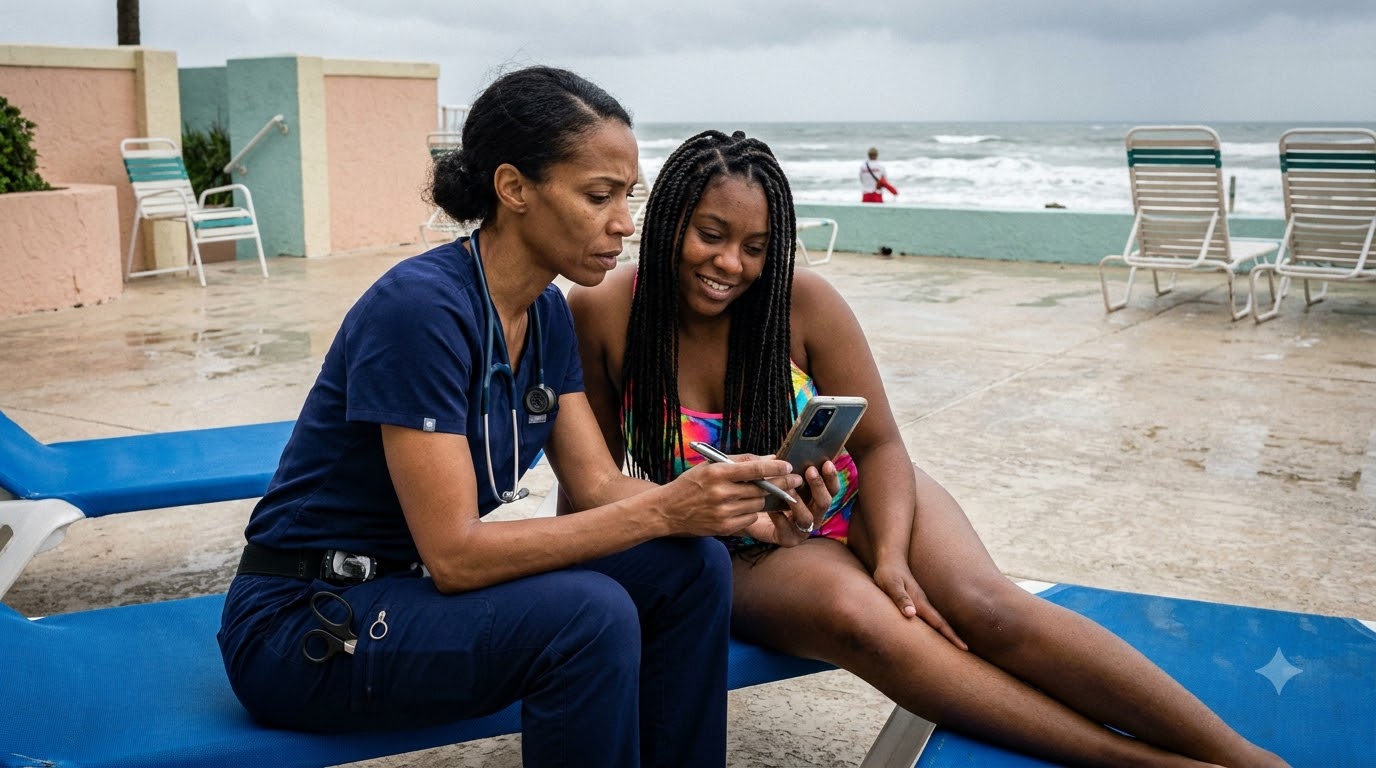
The resort pool smelled of chlorine, toasted coconut, and humid ocean rain. Heavy steel-drum music echoed off the stucco walls, designed to keep tourists lulled into an easy, brainless rhythm. I walked along the edge of the concrete deck, my eyes sweeping past rows of striped lounge chairs until I found the long box braids I had seen at the airport.
She was stretched out under a blue umbrella, her phone held high in her right hand as she swiped through photos.
I didn’t rush. I pulled a blue plastic lounge chair two feet away from hers, allowing the metal edge of my bag to lightly nudge the corner of her ice cooler.
“Oh, excuse me,” I said, setting my purse on the towel rack.
She pulled her sunglasses down to the tip of her nose, offering a quick, warm smile that showed off two deep dimples. “You’re fine, honey! There’s barely any room out here today anyway.”
“Tell me about it,” I said, unscrewing the cap of my steel pen and clicking it shut with a deliberate, audible snap. “Flight in from Chicago was a nightmare.”
“Chicago?” Her eyes flickered—just a half-second twitch toward the left—before her expression smoothed out completely. “Small world. My fiance’s family has roots up around there. I’m Kesha.”
“Immani,” I said.
She sat up, setting her iced drink in the cup holder. “You here with family?”
“Just my son,” I said, keeping my gaze locked on her face. “Celebrating a big milestone. His father isn’t in the picture anymore.”
“I hear that,” Kesha sighed, pulling her phone closer to her chest before relaxing her shoulders. “It’s tough raising boys alone. My Jamal came into my life four years ago, and thank God for him. He’s taking care of my Theo like his own blood.”
My thumb pressed so hard against the clip of my pen that the metal dug into the meat of my palm.
“Jamal?” I repeated softly.
“Jamal Coleman,” she said proudly, turning her phone screen toward me. “Look at him right here. We’ve got a little place out in Nevada now.”
The screen showed a dark-haired boy in a bright yellow shirt, sitting on a patio table. But my eyes didn’t stay on the child. They moved straight past him to the wall in the background of the living room photo.
Mounted in a cheap, dollar-store plastic frame, hung right at eye level, was a faded piece of construction paper.
At the bottom of the page, written in green crayon with the ‘E’ drawn backwards—the exact way a five-year-old child draws it when he’s still learning his letters—were four words: To daddy love, Elijah.
My throat closed so fast I couldn’t swallow.
I knew that drawing. I had sat at our kitchen table in Englewood seven years ago, watching my son press his tongue between his teeth as he pressed that green crayon into the paper. Malik had taken it to his office at the logistics company the next day, swearing he was going to pin it over his desk.
He hadn’t pinned it over a desk in Chicago. He had framed it and hung it on a wall in Nevada, presenting my living, breathing son as a tragic ghost to a woman who had no idea she was living inside a dead man’s stolen life.
“He’s real quiet about his past,” Kesha continued, her voice drifting over the steel-drum music like noise through a wall. “Lost his first boy years ago. Breaks his heart to talk about it. He keeps that drawing on the wall everywhere we move just to remember him.”
I looked Kesha dead in the eye. She was smiling, totally unguarded, completely convinced she was sharing a sweet story with a sympathetic stranger by a hotel pool.
“He tells you his first son died?” I asked, my voice flat as a iron board.
Kesha’s smile faltered slightly. The dimples disappeared. “Yeah. On a lake up North. Why?”
I stood up, sliding my steel pen into my pocket.
“It was very nice meeting you, Kesha,” I said. “Enjoy your vacation.”
I turned and walked away before my face could give out. I didn’t take the elevator. I took the concrete stairs three at a time, my lungs burning, my hands slick with cold sweat as I reached the fifth-floor corridor.
As I turned the corner toward Room 514, a figure stepped out from the recess near the vending machines.
A tall man in a dark cotton jacket was standing perfectly still against the wall. No phone in his hand. No hotel key. Just a pair of dark, sharp eyes tracking my movement down the hallway, shifting his weight from one foot to the other in a quiet, practiced stance that belonged to someone who spent his life waiting on orders.
He wasn’t looking at me like a tourist. He was looking at Door 512.
CHAPTER 4: THE HOTEL DOORWAY
I didn’t enter Room 514 right away. I stood in the narrow entry nook, my thumb hooked over the safety chain, listening through the deadened silence of the hotel corridor.
At 1:12 AM, three low taps hit the exterior wood of my door.
I didn’t call out. I slid the brass chain into the track, turned the heavy thumb-latch, and pulled the door open two inches.
Malik stood under the yellow hallway sconce. Up close, without the aisle space of an airplane separating us, the nine years showed in the deep, grey pockets under his eyes and the hollows of his cheeks. He carried a battered black canvas bag over his right shoulder, holding it by the strap like a man expecting someone to snatch it.
“Immani,” he rasped. His hands were raw around the knuckles, his fingernails bitten down to the quick. “Let me in. Please.”
“Elijah is sleeping,” I said, my voice dropping into an icy register. “Give me one reason why I shouldn’t scream for hotel security right now.”
“Because you know what happens if the desk gets involved,” he said, taking a half-step forward until his chest almost met the door frame. “You collected three hundred and fifty thousand dollars from Prudential nine years ago, Immani. You signed the final affidavit. They won’t look at my signature first. They’ll look at yours.”
The audacity of it hit my chest like a physical blow—the classic, shameless deflection of a man who breaks the house and then blames you for sweeping up the glass.
I unhooked the chain, stepped back, and let him inside.
He didn’t look toward the bedroom where Elijah lay. He walked straight to the small laminate desk near the balcony window, unzipped the canvas bag with three frantic, jerky pulls, and tipped its contents onto the glass table.
A battered steel box hit the surface with a loud, metallic clatter—the exact lockbox with the dented corner that had vanished from our Englewood closet two weeks before his “drowning” on Lake Michigan. Beside it fell a thin brass key, a drive wrapped in black electrical tape, and a Nevada state driver’s license bearing his face above the name Jamal Coleman.
“Start talking,” I said, crossing my arms and standing firmly between him and the hallway door. “And don’t leave out a single name.”
Malik dragged a palm across his forehead, leaving a streak of sweat against his temple. “Andre Jefferson ran the logistics firm, Immani. You remember Andre. He was washing cash through the freight routes out of Gary. I didn’t know until the second year, when the tax audits hit.”
“You signed the books, Malik,” I said bluntly. “You co-signed every load.”
“I tried to step out!” His voice cracked, rising an octave before he caught himself and glanced nervously toward the sleeping area. “Andre told me what it would cost to walk away clean. He gave me your shift schedule at Northwestern. He told me what time Elijah got off the bus at St. Sabina. Turn by turn, Immani. He described your drive home in the dark.”
“So you drowned,” I said. My tone was entirely stripped of pity. “You left a thirty-four-year-old nurse to raise your son alone on double shifts while you built a new kitchen in Nevada.”
“I was protecting you!” he snapped, his jaw tightening into that arrogant, desperate set I remembered from every argument about our savings account. “If I stayed dead, the debt died with me! Andre stopped looking at Englewood the day the Coast Guard pulled my vest out of the water!”
“And Kesha?” I asked, pointing a single finger toward the Nevada driver’s license on the desk. “And the four-year-old boy? Was that protection too?”
Malik’s eyes shifted toward the balcony window, his chest heaving as he swallowed hard. “It got complicated. Year two was fear. By year five… the danger was gone, Immani. But how do you walk back into a room and tell a woman you let her bury an empty box for five years for nothing? How do you explain that?”
“You don’t,” I said, stepping toward the desk and picking up the Nevada license. “You just let her keep paying off your eighteen-thousand-dollar business loan while you frame your son’s crayon drawing on a stranger’s wall.”
He reached for the license, but I shoved his hand back with the edge of my forearm.
“Who set up the Nevada paperwork, Malik?” I asked, leaning in until he had to look straight into my eyes. “A dead man can’t open a bank account or buy a house in Las Vegas without a verified living co-signer. Who signed the secondary identity verification?”
Malik’s mouth opened, but no sound came out. His left eyelid twitched—a hard, involuntary spasm. He looked down at the dented steel box, refusing to meet my gaze.
“Tell me,” I demanded.
“Darius,” he whispered.
CHAPTER 5: THE BROTHERS SHADOW
I pulled my phone from my coat pocket and tapped Terrence’s contact, keeping the speaker off as I pressed the receiver to my ear.
“I have the Nevada document,” I said, my voice dead and steady. “Darius’s signature is on the secondary identity affidavit. He signed it four months after the funeral.”
Terrence took a slow, heavy breath. “That gives him direct civil liability for the Prudential payout, Immani. If he co-signed the identity papers while filing the death claim in Illinois, he didn’t just help a brother hide—he structured the fraud.”
Malik stood up from the desk chair, his hands twitching at his sides. “Immani, don’t do this to Darius. He did it to keep the family intact—”
“Shut up, Malik,” I said without looking at him.
I walked out to the balcony, sliding the glass door shut behind me to block out Malik’s voice. The ocean air was cold and salt-heavy, spraying tiny droplets of mist against my cheeks. Below, the dark surf rolled against the shore with a dull, hollow roar.
I pulled up Darius’s number and hit dial.
He answered on the second ring, his tone booming, easy, and dripping with that familiar, protective warmth he’d used for nine long years. “Hey, sis! Y’all enjoying the beach? Elijah get his feet wet yet?”
I rested my elbow against the damp balcony railing, holding the stainless steel pen tightly in my free hand.
“Darius,” I said softly. “Did Malik ever tell you what brand of cedar soap he uses?”
The line went dead silent. The easy background hum of his living room television seemed to cut off instantly. Three seconds passed—long enough for the ocean breeze to whip a strand of hair across my face.
“What kind of question is that, Immani?” he asked, laughing too fast, a half-step too high. “The man’s been dead nine years. You having a rough night?”
“I’m looking at his Nevada license right now, Darius,” I said, my voice cutting through his laughter like a scalpel. “I’m looking at your signature on the notary line from Carson City.”
Silence hit the line again, heavier this time. No laughter. No quick deflections. Just the sound of his ragged breath catching against the phone receiver.
“Immani,” he said, his voice dropping the warm uncle facade entirely, replacing it with a flat, defensive hardness. “You don’t know what kind of mess he was in with Andre. I protected you. I made sure that three hundred and fifty thousand dollars went to Elijah’s school fund instead of Andre’s collectors.”
“You took a fee,” I said, catching the subtle shift in his tone. “You didn’t just sign paper out of brotherly love. How much of the Prudential check went back into your account?”
“You would have lost the Englewood house!” he barked, his audacity flaring up through the speaker. “You think you raised that boy alone? Who showed up every Thanksgiving? Who helped you hang the lights? I kept that secret so you wouldn’t end up in a courtroom!”
“You kept it so you wouldn’t end up in a cell,” I said. “And every time you sat at my kitchen table eating my food, you knew he was alive.”
“You can’t prove a dime went to me,” Darius sneered, his posture hardening into pure, unyielding defiance. “It’s your name on the insurance payout, Immani. You take this to court, you drag yourself down right beside us. You think a judge is gonna care about your little nurse’s uniform when three hundred grand is missing?”
“I don’t need a judge to figure out who you are, Darius,” I said, staring out at the black ocean line. “I just needed to hear you say it.”
I tapped the screen with my thumb, ending the call, and immediately saved the three-minute audio recording to Terrence’s secure legal server.
Behind me, the glass door slid open. Malik stepped out onto the balcony, his eyes wide with frantic, cornered panic as he saw the phone in my hand.
“What did you just do?” he demanded, stepping closer, his hands shaking violently. “Immani, what did you just do?”
CHAPTER 6: THE FINAL ACCOUNT
Late afternoon sun cut through the window blinds, striping the hardwood floor in quiet bands of gold. Outside, a neighborhood kid’s basketball hit the pavement in a steady, unhurried rhythm—the same sound that used to ring down our block nine years ago.
Malik stayed down on the rug at eye level, his hands resting flat against his knees. The arrogance that had carried him onto Delta Flight 1408 had completely evaporated, leaving only the hollowed-out frame of a man who had finally run out of exits.
“Elijah,” Malik said, his voice barely audible over the low hum of the refrigerator. “I’m sorry. I thought…”
Elijah didn’t step back, but his jaw set hard, taking on the same unyielding shape I saw in my own mirror every morning before a double shift. He reached into his pocket and pulled out a small, metallic memory card, holding it between his thumb and index finger.
“I found this last year in a box of your old tools in storage,” Elijah said, his voice flat and perfectly steady. “You recorded it five years ago. You said you could come home, but you stayed away because you had another family out West and didn’t want to break either one.”
Malik’s face broke—not with tears, but with the sudden, silent collapse of a man realizing his son had already judged him long before he stepped onto a plane.
“I already learned how to live without you,” Elijah said simply.
He didn’t yell. He didn’t slam a door. He just turned, walked down the narrow hallway to his bedroom, and pulled the door closed until the latch caught with a soft, clean click.
Malik remained on the floor, staring at the empty hallway.
“Darius called me an hour ago,” Malik rasped, his eyes fixed on the wood grain between his sneakers. “He’s hiring a civil defense attorney. He said you ruined us, Immani.”
“Darius ruined himself the day he took a cut of a dead man’s insurance payout,” I said, stepping forward until I stood over him. “And you ruined yourself the day you decided your comfort was worth nine years of my life.”
“What do you want me to do?” he asked, looking up with a pathetic, desperate flare of entitlement. “You want me to go to jail? You want me to give back every cent of the Nevada property? You’ll destroy Kesha and Theo too!”
“I don’t care about your property, Malik,” I said, opening the wooden box in my hands. Inside rested the small safe deposit key he had left in Virginia Beach, alongside the heavy gold wedding ring I had worn until my knuckles calloused over. “Terrence has already filed the formal civil declaration with Prudential. The fraud stays on you and Darius. My name is clean, my house is clean, and Elijah’s trust is untouchable.”
I picked up the safe deposit key and dropped it onto the floor between his knees. It hit the wood with a sharp, final clink.
“Take your key,” I said. “Take your second name. And get out of my home.”
Malik looked at the key, then up at my face. He searched for a crack, a sliver of hesitation, or the familiar leniency he had relied on for fifteen years of marriage. He found nothing except the cold, quiet composure of a woman who had stopped carrying his weight nine years ago.
He picked up the key, stood up slowly, and walked out the front door without saying another word. The brass latch clicked shut behind him, sealing the corridor in absolute silence.
I didn’t cry. I walked into the kitchen, picked up a fresh dish towel from the counter, and began drying the two glasses sitting in the rack by the sink.
Through the window, the late summer sun dipped low behind the Bronzeville rooftops, casting long, peaceful shadows across the alleyway. The basketball outside kept bouncing—steady, continuous, and unbothered.
I set the glasses in the cabinet, closed the door, and walked down the hall to check on my son.