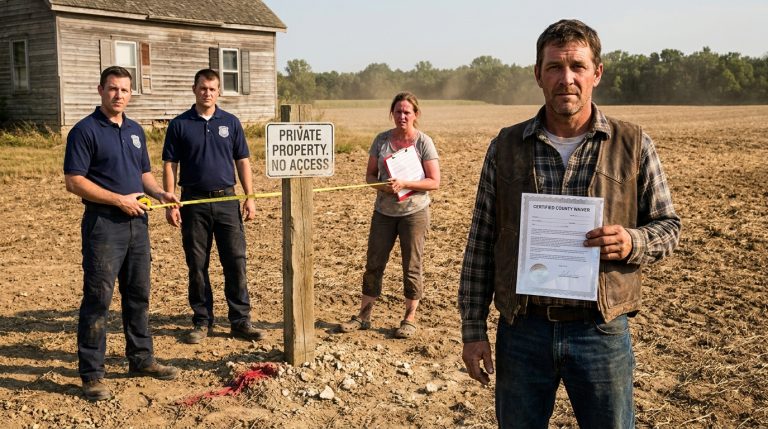
The Concrete Wall That Cut Off My Land Was Illegal, But Finding Out It Ran Straight Through Her Living Room Was Pure Justice
CHAPTER 1: THE BRICK WALL
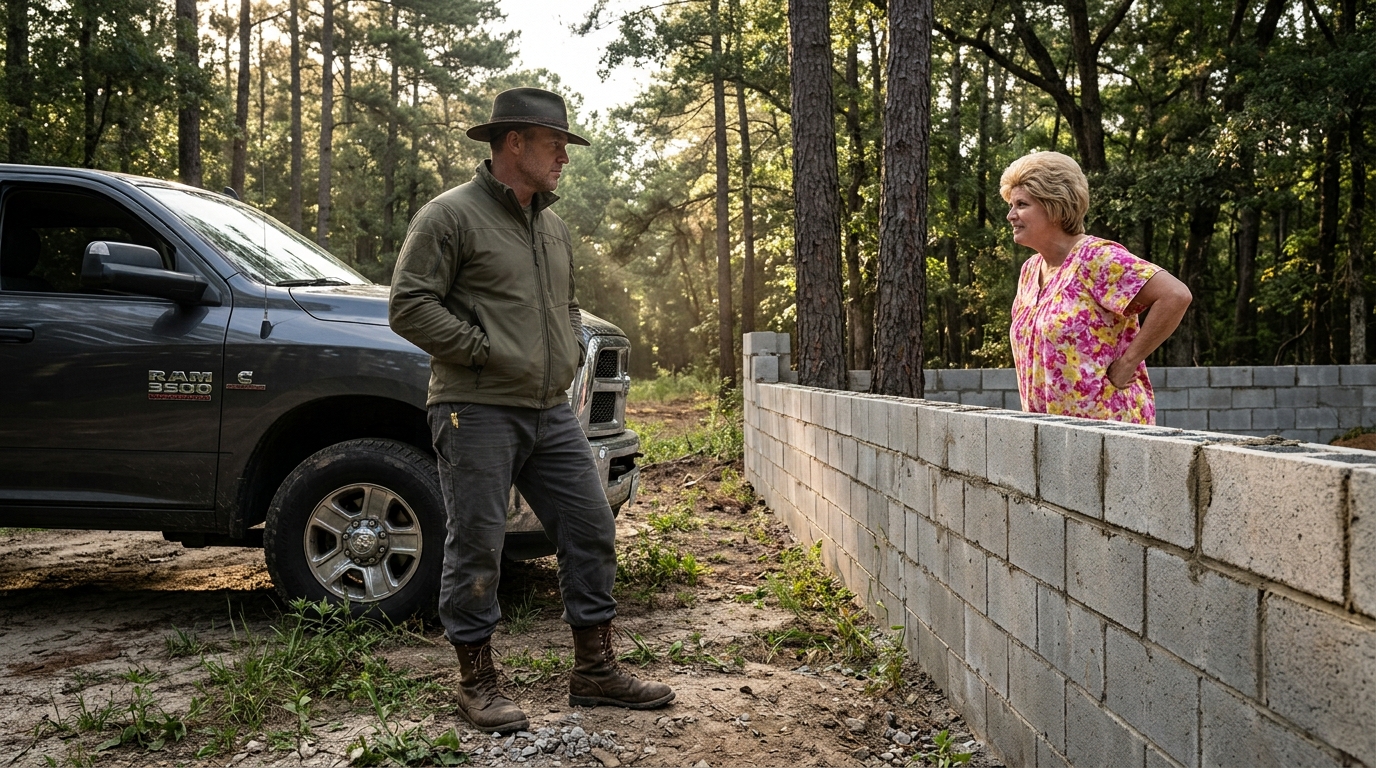
That road is HOA property now, Mr. Davidson.
Your back 40 is officially landlocked, and you should have thought of that before you parked your unsightly truck in your own driveway.
Karen Miller stood with her hands planted firmly on her floral print mumu, a helmet of hairspray-hardened blonde hair framing her triumphant smirk.
Behind her shimmered the freshly laid mortar of a six-foot cinder block wall, completely severing the dirt access road I had used for twenty years to manage my timber acreage.
I looked from the pale gray blocks to my Ram 3500, parked neatly on the concrete pad I had poured with my own hands after twenty-four years in the Marine Corps.
The sheer absurdity of it sat heavy in my chest, but anger is just a fire—discipline is the forge that shapes it.
I kept my voice low, steady, and entirely devoid of panic.
That is a county-recorded easement, Karen, and you cannot simply wall off a legal right-of-way because you want a butterfly garden.
She let out a short, barking laugh that echoed against the concrete barrier.
Always thinking the rules don’t apply to you military types, Mr. Davidson, but the developer’s new plat supersedes your dusty old papers.
The fine for that commercial truck is three hundred dollars, and it’ll be in the mail shortly.
Welcome to the neighborhood.
She turned on her heel, completely convinced her beige-painted tyranny was absolute.
She had no idea what kind of machinery she had just set into motion.
CHAPTER 2: THE BOARDROOM TRAP
The room smelled of off-white paint and cheap carpet adhesive.
Thirty neighbors sat huddled on metal folding chairs, their shoulders hunched like draft horses waiting for a whip to crack.
At the front of the room, perched behind a plastic folding table on a raised dais, sat Karen Miller flanked by her treasurer, Bob, and a pale secretary who looked one stern word away from tears.
Karen brought down a wooden gavel with the heavy, unearned authority of a magistrate sentencing a horse thief.
—Basketball hoops must be stowed out of sight by six in the evening, she announced, her eyes sweeping the front row.
—And the architectural review committee will issue an immediate three-hundred-dollar fine for any plastic lawn ornaments, particularly flamingos.
A young mother near the aisle raised a tentative hand, her voice barely carrying past the third row.
—What about my daughter’s swing set?
Karen didn’t even look up from her clipboard.
—The committee will issue a formal ruling next month; until then, unapproved structures remain non-compliant.
I let the brass Zippo snap shut in my pocket with a dry, metallic clack that cut clean through her voice.
I stood up from the back row, my leather folder tucked firmly under my arm.
—I’m Marcus Davidson, and I’m here to address the wall blocking my recorded easement.
Karen’s lip curled into a thin, triumphant line as she tapped a key on a laptop, projecting a slick blue-and-green map onto the wall behind her.
—Ah, the easement issue.
—As you can see from the county-approved final plat for Whispering Pines, Mr. Davidson, no such easement exists on HOA common area.
—The developer filed this plat, the county signed off on it, and your dusty old papers are legally irrelevant.
A collective shift went through the room, neighbors staring resolutely at their shoes to avoid her line of sight.
I stepped into the center aisle, holding out my folder.
—A newly drawn subdivision map doesn’t extinguish a hundred-year-old recorded deed, Karen.
She leaned back, resting her manicured hands on the table.
—Our legal counsel assures us our position is unassailable.
—Furthermore, Exhibit A.
The projector clicked, displaying a high-resolution photo of my Ram 3500 parked on my concrete pad.
—Bylaw 7.4 prohibits commercial vehicles exceeding one ton; that’s an initial three-hundred-dollar fine.
Another click showed my son Mark turning a tractor in our north timber patch.
—And Exhibit B, running an unapproved commercial forestry enterprise from a residential perimeter lot—five hundred dollars and a cease-and-desist order delivered tomorrow.
The absurdity of her unearned confidence hung in the quiet room like smoke.
I didn’t raise my voice or slam my fist on the table.
I simply tucked my folder back under my arm, met her smug gaze, and let the silence stretch until she shifted uncomfortably in her chair.
—This isn’t over, I said quietly.
I turned and walked out the heavy glass doors into the humid night air, my thumb already finding the cool brass edge of my Zippo.
CHAPTER 3: THE DUSTY ARCHIVES THE RED LINE
The leatherbound book hit the wooden counter with a heavy, thudding cloud of dust that settled on my knuckles.
Agnes, the county clerk whose tired eyes held the quiet sharp edge of someone who had seen fifty years of land disputes, leaned across the counter.
—Finding gold, or starting a war?
—A little of both, I said, flipping open the yellowed parchment of Deed Book 12.
My fingers traced the faded black cursive from April 17th, 1923, where Jedidiah Miller had carved my fifty acres out of the original three-hundred-acre ranch.
There it was, embedded in the legal text like an unexploded shell: reserving for the grantee, his heirs, and assigns a perpetual and non-exclusive easement 30 feet in width for ingress, egress, and all manner of conveyance.
Then came the precise surveyor’s language—meets and bounds, angles and chains, starting at an immutable iron pin on the northern perimeter.
I took high-resolution photos of every page with my phone, my thumb pressing against the scarred casing of my brass Zippo to steady my grip.
—If you need someone who can read those old numbers without flinching, Agnes murmured, sliding a slip of paper across the counter, call George Peterson; he hates bad surveys almost as much as he hates HOAs.
An hour later, I sat across from George in a greasy-spoon booth, three generations of deeds laid out over a sticky Formex tabletop.
George adjusted his reading glasses, his wild mane of white hair catching the harsh overhead fluorescent lighting as his gnarled finger tracked the 1923 description against a modern satellite printout.
—Well, I’ll be, George breathed, letting out a low, dry whistle.
—This thing is tighter than a drum; it runs with the land, son, no matter what glossy maps those developer suits filed last year.
He leaned in closer, tapping his magnifying glass against a bright red line he had just drafted across the aerial map.
—Here’s your anomaly, Marcus—the dirt track you’ve been driving for twenty years isn’t the legal easement.
—The dirt path drifted forty feet south back in the seventies around a wash out, but the 1923 legal corridor runs dead straight.
I leaned over the table, following the bright red band as it cut clean across Lot One of Whispering Pines Estates.
The red corridor didn’t just border the lot—it sliced straight through the front walkway, bisected the foyer, tore through the kitchen, and exited the back glass patio doors.
—Whose house is that? I asked, though the cold realization was already settling into my jaw.
George let out a rasping cackle, taking a slow sip of black coffee.
—That’s Lot One, son—the showcase home belonging to your HOA president, Ms. Karen Miller.
—Her whole house is sitting right in the middle of your legal highway.
CHAPTER 4: THE LEGAL COUNTERSTRIKE
Ben Carter leaned back in his leather executive chair, a quiet, dangerous smile fixing onto his face as he tapped the 1923 deed against the mahogany grain.
—Marcus, this isn’t just a property dispute anymore; this is absolute legal suicide for her.
—We send the cease-and-desist first, state our rights without giving away the precise line, and force her onto the record under oath.
Ten days later, Karen’s high-priced downtown attorney sent back a thirty-page refusal, doubling down and threatening a countersuit for harassment and six-figure legal fees.
I sat silently in the cold, glass-walled deposition room as Karen Miller strutted in wearing a sharp navy power suit, her lawyer, Preston Vance IV, hovering behind her like an expensive shadow.
Karen adjusted her gold watch, offering me a look of pure, unadulterated contempt before smoothing her skirt.
Ben clicked his pen once, his voice entirely conversational as the court reporter’s machine hummed in the corner.
—Ms. Miller, as HOA president, you authorized the construction of the cinder block wall blocking Mr. Davidson’s dirt access road, correct?
—We authorized a community beautification structure on HOA common land, she replied, tilting her chin up.
—There is no legal access to block; his claims are completely antiquated and superseded by the developer’s county-approved plat.
Ben slid a certified copy of the 1923 deed across the polished table.
—So it is your sworn testimony today that the new plat is the sole governing document regarding all boundaries and encumbrances within Whispering Pines?
—Absolutely, Karen snapped, barely glancing at the yellowed page.
—That plat is the law of this neighborhood, and Mr. Davidson’s dusty papers mean nothing.
Ben leaned forward slightly, resting his hands flat on the conference table.
—And to be crystal clear for the court, Ms. Miller—is it your sworn testimony under penalty of perjury that your own property, Lot One, carries no prior recorded easements or encumbrances whatsoever?
Preston Vance shifted in his seat, a subtle twitch hitting his jawline, but Karen didn’t hesitate for a single second.
—My lot is free and clear, she declared, staring Ben right in the eyes with unshakable arrogance.
—There are no easements on my land, and this whole lawsuit is a delusion.
Ben made a neat, deliberate checkmark on his legal pad, slowly capping his pen.
—Thank you, Ms. Miller; I have no further questions.
Karen smirked across the table at me, entirely convinced she had just crushed my spirit under the weight of her authority.
The moment the door clicked shut behind her, Ben turned to me, his eyes gleaming with cold satisfaction as he gathered his files.
—She just walked headfirst into a federal perjury trap.
—Now we call the surveyors and paint the truth right across her front porch.
CHAPTER 5: STAKING THE TRUTH
The morning sun reflected off the polished hood of the deputy’s patrol car as Frank, the lead surveyor, unbolted a heavy yellow tripod from the back of his utility van.
At 9:01 AM, Karen’s front door flew open and she charged down her stone walkway in black yoga pants and a bright pink sweatshirt, flanked by Bob and her hired security guard.
—What is the meaning of this? she shrieked, positioning herself directly between Frank and his equipment.
—You are trespassing on private HOA property, and I order you off this lot immediately!
Frank didn’t even raise his voice; he simply held a laminated piece of paper in front of her face.
—Ma’am, we are here under the authority of a court order signed yesterday afternoon by Superior Court Judge Miller to survey a recorded county right-of-way.
—If you obstruct our work, the deputy standing right behind me will take immediate action.
The deputy leaned casually against the fender of his cruiser, arms crossed over his chest, offering Karen a slow, firm nod that drained the color right out of her face.
She turned on me, her fingers shaking as she pointed across the grass.
—You, Davidson! You will be paying for every single blade of turf these people crush!
I stood in silent attention in my service alphas, letting the quiet weight of the court order do every ounce of the talking for me.
Frank set his transit over an iron pin at the curb, leveled his sight, and swung his arm toward the immaculate lawn.
His assistant walked forward ten paces and drove a thick wooden stake directly through Karen’s prize-winning rose bed, topping it with a bright, fluttering pink ribbon.
A collective gasp went up from the thirty neighbors gathered along the sidewalk, Dave and Mrs. Gable standing right at the front.
Hammer blow after hammer blow echoed down the quiet street as the line of pink ribbons marched in a mathematically perfect straight line toward Karen’s front porch.
It crossed her flagstone walkway, sliced past her potted ferns, and dead-ended right against her heavy oak front door.
Frank walked up the steps, consulted his handheld digital reader, and turned back toward the deputy.
—Officer, the court-ordered survey corridor continues directly through the primary residential structure.
The deputy walked up the steps, his voice perfectly even.
—Ma’am, you can unlock your door and allow access, or you can take a ride to county lockup for contempt of court—it’s entirely your choice.
Karen’s hands trembled so violently her keys clinked loudly against the brass door handle before she unlocked the latch and threw the door open.
Through the large front picture window, the entire neighborhood watched in stunned silence as Frank marched his muddy boots across her pristine white foyer tiles.
He set his laser target beside a faux-marble fireplace in the living room, stepped through the kitchen, and hammered two temporary stakes directly into her hardwood floor.
My thirty-foot legal highway didn’t just touch her property; it ran straight through her living room, and the whole street had seen the pink ribbons prove it.
CHAPTER 6: THE FINAL SETTLEMENT
My son Mark held the controls, his eyes fixed on the line of pink ribbon stakes marching down the center of the asphalt street toward Lot One.
Local news vans were parked along the curb, cameras rolling, while half the neighborhood stood gathered on Dave’s front lawn.
Karen Miller stood on her front grass in a brilliant white dress, her hands clenched into white-knuckled fists as she planted herself directly in the center of the pink survey line.
—You can’t do this! she screamed over the low thrum of the engine as I stepped down from the cab and walked toward her.
—This is my house! This is my home!
I stopped three feet away, my hands resting calmly at my sides, my voice low and completely devoid of malice.
—You should have thought of that before you built it in the middle of my road, Karen.
—The court order gives me the absolute right to maintain and clear my legal access way.
The deputy stepped up beside us, taking out a folded white court document and holding it out toward her.
—Ma’am, the judge’s order is absolute—you must clear the right-of-way immediately, or step aside so the owner can exercise his legal access.
Karen looked from the deputy to the steel blade of the idling bulldozer, then to the silent crowd of her neighbors watching her from across the street.
Her shoulders slumped, her chin dropped, and the arrogant mask she had worn for a year completely shattered in the morning sun.
She let out a dry, gasping sob, turned on her heel, and stumbled back up her steps, slamming her front door behind her.
I raised a single hand, and Mark cut the bulldozer’s engine, plunging the entire street into a sudden, deep silence.
Three days later, the HOA’s insurance carrier dropped them completely, citing gross negligence, leaving Karen and the board personally liable for hundreds of thousands in damages and court costs.
To satisfy the massive judgment and class-action lawsuit filed by our homeowners committee, Karen was forced to put Lot One on the market, the deed forever burdened by a thirty-foot legal access corridor running through her living room.
A demolition crew brought down the ugly cinder block wall by Friday afternoon, grinding the pale mortar into fine dust and reopening my original access track.
Now, I sit on my tailgate in the cool shade of the back forty timber, resting a mug of hot coffee on my knee as Mark greases the timber trailer fittings.
The quiet hum of the forest fills the afternoon air, uninterrupted by petty rules, illegal walls, or unearned authority.
I reach into my pocket, thumbing the smooth, cool brass casing of my old Zippo, completely at peace on my own land.