The Weight of the Horizon: A Driver’s Final Stand Against the Shadows of the Concrete Path
CHAPTER 1: THE ASHES OF AUTHORITY
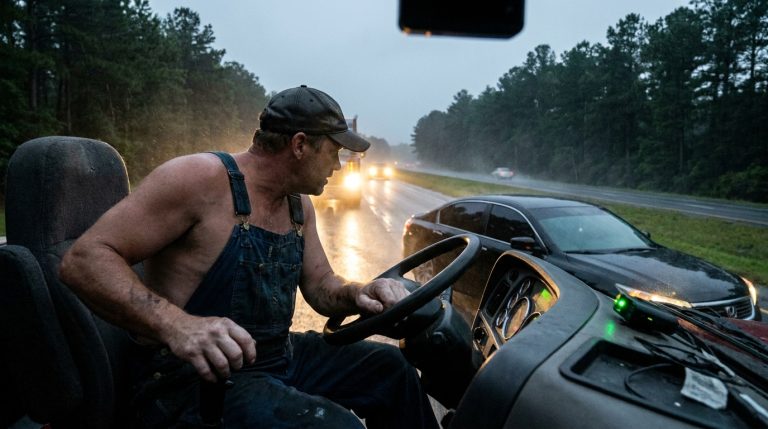
The windshield wipers slapped a rhythmic, frantic pulse against the glass, clearing the view for a fraction of a second before the gray curtain of Missouri rain slammed back down. I kept my foot steady on the pedal, but the muscle in my right thigh was locked tight, a coiled spring ready to release. My hands, resting at ten and two, felt the vibration of the road through the steering wheel—the subtle, rhythmic hum of 45,000 pounds of steel coils pulling behind me.
I checked the side mirrors for the tenth time in three minutes. The road behind was a throat of black ink, swallowed by the downpour.
The deputy was gone, but the echo of his voice—high, cracking, and desperate—still vibrated in the small, cramped sanctuary of the sleeper cab. I stared at the door handle, at the faint, rectangular ghost of the mud I had wiped away to reveal the stencil underneath. 75th RGR. The numbers felt like lead weights. They were never meant to be seen by the likes of him, a man who played at violence while wearing a badge that was meant to signify something else entirely.
I thought of the look in his eyes when the reality of those numbers hit him. It wasn’t just fear; it was the visceral, soul-crushing realization that he had stepped into a room he didn’t belong in.
I reached down and gripped the tire thumper—the hickory handle smooth, cool, and solid. I didn’t need it. The threat was technically over, but the adrenaline had left behind a cold, metallic residue in my mouth. I eased off the gas, feeling the engine brake drag the rig down as I hit a patch of standing water. The truck hydroplaned for a heart-stopping second, the massive tires losing their bite on the wet asphalt, before snapping back into control.
I leaned forward, flicking the heater vent, letting the warm air blast onto my frozen knuckles. The dashboard glowed with a soft, amber light, illuminating the worn leather of the seats and the scattered logbooks.
Everything was the same, yet everything had shifted. I had moved from being a ghost on the road to a target. A man like that deputy—a man who needed to believe in his own myth—would not just walk away from the humiliation of being stared down by a ‘broken’ trucker. He would talk. He would check the plates. He would look into the unit numbers.
And he would find out that I wasn’t just a driver with a sticker.
I glanced at the passenger seat. My tactical bag was tucked out of sight, beneath a discarded wool blanket. Inside were items that had no business being in a civilian truck, tools meant for a different kind of life, a life I had tried to bury under two decades of highway miles.
A flicker of movement caught my eye in the passenger mirror.
A pair of headlights, dim and yellow, crested the hill behind me. They were traveling at a steady, cautious pace, far too slow for a passing car. They hung back, keeping the distance of a tactical shadow.
The deputy hadn’t gone home. He was following.
CHAPTER 2: THE TAIL ON THE TARMAC
The rain had softened to a persistent, dreary mist, the kind that turned the world into a smear of greys and charcoal. Through the center-mounted mirror, the cruiser’s headlights looked like two cold, unblinking eyes. They didn’t pulse, they didn’t weave; they stayed exactly three car lengths back, matching my speed with the precision of a metronome.
I adjusted my grip on the steering wheel, my knuckles aching from the damp cold that seemed to seep through the very steel of the Peterbilt. My mind flickered—a sudden, unbidden sensory jolt—to the suffocating, dusty heat of a different kind of night, years ago. The smell of burning rubber and ozone brought back the oppressive humidity of Mogadishu, the way the air felt thick enough to chew. I blinked hard, forcing the memory back into the dark corner of my mind where it belonged. The deputy’s shadow wasn’t a tactical maneuver in a war zone; it was a small-town power play on a slick Missouri state route.
But the tension was the same.
I kept the rig at a steady fifty-five, watching the speedometer needle hover with agonizing consistency. To speed up would be to invite a traffic stop; to slow down would be to reveal that I was rattled. I chose the middle ground, the path of the professional. I wasn’t just a driver; I was a man who knew how to manage a pursuit.
The CB radio, which had been silent for hours, crackled with a burst of static, followed by the dull drone of another trucker miles ahead. I reached out and flicked the squelch dial, cutting the noise. I didn’t need the distraction. My focus was purely internal, a calcified core of observation. The deputy was playing a game of psychological attrition. He wanted me to sweat. He wanted me to make a mistake, a lane departure, a logbook violation, something that would give him the legal justification to drag me out of the cab and reassert the dominance he felt he had lost in the mud.
I checked the dashboard gauges. Temperature was normal. Oil pressure steady. The load of steel coils behind me was balanced, but every curve in the road required a calculated shift in weight, a physical negotiation between the beast and the slick asphalt.
The cruiser shifted slightly to the left, his headlights illuminating the roadside grass for a split second. He was telegraphing his presence, reminding me he was still there. I didn’t react. I kept my eyes scanning the road ahead, mapping the upcoming curves and the intersections. A turnoff to a local truck stop appeared to my right, a beacon of harsh, flickering neon lights. It would be the natural place to stop, to get coffee, to try and lose him in the crowd of other drivers.
But to stop there would be to box myself in.
I checked the mirrors again. The cruiser was still there, unwavering. He was waiting for me to panic. I decided to give him a different kind of lesson. I didn’t turn. I didn’t brake. I maintained the exact same pace, turning the pursuit into an exercise in endurance. If he wanted to spend his entire shift following a steel-hauler across the county line, I would oblige him.
The silence in the cab grew heavier, pressing against my eardrums. I could hear the rhythmic thrum-thrum of the tires and the deep, low-frequency vibration of the diesel engine. It was a language I understood better than any human conversation. The truck was a part of me, an extension of my own resolve.
I reached for the thermos tucked into the door pocket, my fingers brushing the cold metal. I didn’t drink, but the simple act of reaching kept my movements fluid and deliberate. I needed to remain unpredictable. I began to mentally run through the topography of the next twenty miles: two bridges, a winding descent into a valley, and a long stretch of straight road with no pull-offs.
The deputy was playing his hand based on the assumption that I was a tired, frustrated, and—more importantly—unstable veteran. He saw the decals and the exterior of the truck and saw a man who could be easily provoked. He didn’t see the man who had spent a lifetime learning how to operate in the gray spaces where the rules of the road were just suggestions and the only thing that mattered was the mission.
The road ahead dipped into the valley, the darkness closing in on both sides as the trees grew denser, their branches arching over the asphalt like reaching fingers. I watched the cruiser’s headlights in the mirror. He was closing the distance slightly, perhaps impatient for the game to reach a conclusion.
I didn’t flinch. I just felt the weight of the steel coils behind me, the inertia of 45,000 pounds that would take a long, long time to stop. If he wanted to play, I was more than happy to let him lead the way into the dark.
CHAPTER 3: THE FREQUENCY OF SILENCE
The highway groaned under the weight of the rain, a slick, black ribbon that seemed to stretch into eternity. Behind me, the cruiser remained a fixture of the rearview, a constant reminder that I was no longer operating in a vacuum. The game of cat and mouse had shifted; we were no longer just moving through space, but through a tactical theater where every mile marker was a potential ambush point.
I reached for the CB radio, my hand hovering over the squelch dial. I didn’t need to speak, not yet. I needed to listen. I turned the knob, the static giving way to the erratic, disjointed chatter of long-haul drivers. Most of it was noise—complaints about fuel prices, talk of weather, the mundane rhythms of the road. But I was listening for a specific cadence. I was listening for the local patrol frequencies, for the clipped, professional shorthand that would tell me if the deputy was alone or if he was calling for backup.
The turbocharger whined, a high, metallic pitch that sounded sharper than usual in the damp air. I glanced at the boost gauge. It flickered—a momentary lapse in pressure—then surged back to life. A mechanical hiccup, or maybe just the stress of the constant, unvarying speed. I adjusted the throttle, feeling the engine’s resistance. I needed the truck at peak performance. If this went sideways, the Peterbilt was my only leverage.
I had a contact in Tulsa, a man named Elias who understood the language of silence as well as I did. He was a retired dispatcher who kept a pulse on the regional law enforcement networks. I needed him to pull the threads on the local precinct. If they were targeting veterans, they were leaving a paper trail. Small, localized, and dirty—but a trail nonetheless.
I checked the mirrors again. The cruiser hadn’t budged. He was patient. He was waiting for me to pull over for a bathroom break, to stop for coffee, to blink. I didn’t blink. I kept my eyes focused on the center line, the white dashes blurring into a hypnotic, singular streak.
I picked up the handset, pressing the key just long enough to send a short, coded burst of static. It was an old signal, one that meant ‘verify status.’ I waited. The radio remained silent for a long minute, just the background hiss of the open frequency. Then, a voice came back. It wasn’t Elias. It was a local dispatcher, sounding bored and weary, reading out a routine road closure notification for a bridge thirty miles ahead.
The detour was an opportunity, or a trap.
I turned the radio off completely, the sudden silence in the cab amplifying the sound of the rain against the roof. The truck was a steel shell, a fortress of cold comfort, but it was also a box. I needed to step out of the box. I looked at the GPS unit mounted to the dash. I ignored the primary route and scrolled through the secondary maps, searching for a path that wasn’t on the standard dispatch grid. I found it: an old logging road that cut through the valley, narrow and treacherous, but clear of the main patrol circuits.
If I took the turn, I’d lose the deputy in the winding terrain, or I’d force him to reveal his hand. If he followed me off the main road, he wasn’t looking for a traffic violation anymore—he was hunting.
I checked my pocket. The tire thumper was still there, the hickory wood familiar against my thigh. I wasn’t looking for a fight, but I was done playing the target. I looked in the mirror one last time. The yellow headlights were still there, hanging in the mist.
I started to signal for the turn. My heart rate didn’t spike, my breath didn’t quicken. I felt the familiar, cold clarity that used to settle over me in the motorpool, the moment before a mission became real. I wasn’t just driving to Tulsa anymore; I was navigating the fallout of a confrontation that had started with a badge and ended with the revelation of who I really was.
I slowed the rig down, the engine’s rumble deepening into a growl as I downshifted. I swung the massive front end toward the gravel turnoff, the tires grabbing at the loose stone. The cruiser behind me didn’t hesitate. As I pulled onto the logging road, the yellow headlights accelerated, closing the gap.
The deputy was following. And for the first time since the night began, I was actually looking forward to the conversation.
CHAPTER 4: THE SHADOW IN THE REARVIEW
The transition from state-route asphalt to the rutted, rain-slicked gravel of the logging trail was jarring. The Peterbilt shuddered as the heavy tires bit into the loose surface, the steel coils behind me shifting with a low, metallic groan that vibrated through the chassis. I gripped the wheel, my forearms burning with the effort of keeping the beast aligned as the front end pitched and rolled like a ship in a storm.
Behind me, the cruiser’s headlights didn’t waver.
If anything, the deputy drove with a reckless aggression that defied common sense on a path this narrow. He was pushing his suspension to the breaking point, his pursuit now stripped of the veneer of law enforcement. He wasn’t stopping me for a violation; he was hunting, and the logging road was nothing more than a private arena he had chosen to turn into a battlefield.
I scanned the path ahead. The tree line pressed in tight, a jagged wall of black silhouettes against the bruised, stormy sky. The path was narrow, and every few yards, the gravel gave way to deep, mud-filled troughs carved out by logging trucks months ago. I downshifted, the engine’s roar deepening into a guttural, aggressive growl. I needed to keep my momentum, but I had to be precise. One slide into a ditch and the pursuit would be over—not with the deputy in handcuffs, but with me trapped in a ditch, exposed, and vulnerable.
My perception began to fray at the edges. The rhythmic strobe of the cruiser’s high beams, bouncing off the wet foliage, created a disorienting, hallucinatory effect. For a fleeting second, the shadows cast by the trees seemed to shift into the shapes of men—ghosts of the unit, flickering in the periphery. I squeezed my eyes shut for a micro-second, clearing the static, and focused back on the road. The paranoia was a dangerous passenger. It was a relic, a symptom of a life spent watching every shadow for a sniper’s glint. I forced myself to categorize the threat: One vehicle. One weapon. One man. The variables were finite.
The path took a sharp, descending curve into a dense copse of pine. I braked just enough to keep from sliding, the Jake brake coughing a sharp, percussive sound that seemed to silence the forest. The cruiser was closer now. I could see the silhouette of the deputy behind the wheel, his posture rigid, his intensity focused on the rear of my trailer.
I needed to create a pivot point. The road narrowed further, crossing an old wooden bridge that spanned a rain-swollen creek. I knew this bridge—it was a relic from a different era of infrastructure, its floorboards rotted and its railings rusted. It wouldn’t support the weight of the truck if I stopped, but it would certainly rattle the hell out of a cruiser if he tried to cross it at the speed he was maintaining.
I hit the accelerator, forcing the engine to scream, and pushed the rig into the descent. The vibration became violent. The steering column shook in my hands, a warning that the machine was at its limit. I hit the bridge, the wooden planks screaming under the weight, the sound of splintering timber rising above the roar of the rain. I felt the rig sway, the trailer fishtailing dangerously, but I held it straight.
I checked the mirror.
The deputy slammed on his brakes as he hit the bridge. His headlights dipped and swerved, the cruiser’s suspension bottoming out as he crossed the rotten wood. He lost traction for a moment, the vehicle sliding toward the edge, his tires spitting wood chips into the dark air. He corrected, but the hesitation had cost him. The gap between us had widened to fifty yards.
I didn’t slow down. I pushed the Peterbilt harder, the engine note rising to a piercing whine as I tore through the brush on the other side. The logging road began to climb, leading toward a ridge that would overlook the entire valley. If I could get to the high ground, I could force him into an open space—a space where he couldn’t hide behind the badge or the anonymity of the pursuit.
My hands were steady, despite the violence of the movement. I wasn’t running anymore. I was leading him to the extraction point I had been building in my mind since the moment we turned off the main road. The deputy wanted the hunt? Fine. We’d see who was the predator and who was the prey when the path finally ended.
CHAPTER 5: THE RIDGE OF RECKONING
The engine’s roar echoed off the rising granite walls as the logging road crested the ridge, breaking out of the dense forest into a jagged, wind-scoured plateau. The air up here was thin and bitingly cold, carrying the sharp, metallic scent of coming snow. I throttled down, the transmission clicking through the gears as I brought the heavy rig to a controlled, momentum-weighted crawl.
The plateau was a dead end. I knew it from the old maps, a remnant of a defunct strip-mine operation that hadn’t seen heavy equipment in two decades. To my left, a sheer drop-off into a mist-filled valley; to my right, a wall of jagged, impassable shale.
In the center of the plateau, a rusted, industrial-era weigh station stood like a sentinel, its roof partially collapsed. It was the perfect place for a trap.
I caught the reflection in the side mirror. The cruiser emerged from the tree line, its headlights cutting through the twilight like twin spears. The deputy didn’t stop. He didn’t even slow down to inspect the ground for potential hazards. He drove with a singular, terrifying focus, his cruiser kicking up a spray of shale as he accelerated across the open ground. He was moving to box me in against the canyon edge, effectively nullifying the weight advantage of my truck.
I checked the mirrors again. He was angling toward the driver’s side, trying to force me closer to the precipice. I saw the flash of his badge in the interior light—or maybe it was just a trick of the reflection—but the intent was unmistakable. He was done with the games.
My heart was a steady, rhythmic thud in my chest, completely devoid of the panic he was likely expecting. I felt that old, familiar coldness—the tactical detachment that had defined my life in the desert, years ago. I reached down and shifted the heavy transmission into neutral, then tapped the air-brake release. The Peterbilt came to a shuddering, grinding halt, blocking the narrowest point of the road.
I didn’t wait. I grabbed the tire thumper from my coat, feeling the solid, weighted hickory in my palm, and pushed the door open.
The wind hit me like a physical blow, cold enough to draw tears to my eyes. I stepped out, my boots crunching on the loose shale, and stood between the truck and the approaching cruiser. The deputy slammed his brakes, the cruiser’s tires locking and skidding sideways on the loose rock, coming to a halt twenty feet from my front bumper.
He stayed inside for a heartbeat, his silhouette framed by the harsh glare of his light bar. Then, the door opened.
He emerged with his sidearm already drawn, held in a two-handed combat grip that was cleaner, more practiced than anything he had displayed on the state road. The shift was immediate. The buffoonish, angry man from the highway was gone. In his place stood someone who had spent hours in a range, someone who practiced the mechanics of violence until they were muscle memory.
“I told you,” he shouted over the wind, his voice steady now, stripped of its previous cracks. “I told you to get off my road.”
I didn’t reach for the thumper. I kept my hands visible, palms flat against my thighs. I was analyzing him—the way he held his weight, the slight tremor in his knees, the way his eyes tracked my hands. He was an amateur trying to play a professional’s game, but he had the advantage of the weapon.
“Is that what this is?” I asked, my voice barely audible over the gale. “Your road?”
“It’s a restricted route,” he countered, moving to the side to create an angle, trying to force me to track him. “You’re trespassing on property under active investigation. You’re interfering with a federal asset recovery operation.”
The words were a giveaway. Federal asset recovery. That wasn’t small-town police work. That was the language of the people who had walked away with the contents of that transport years ago. My pulse tightened. This wasn’t just a power-tripping deputy; he was a gatekeeper, a low-level guard for something much larger and much deeper than a local precinct.
“You’re a long way from home, deputy,” I said, taking a slow, measured step toward him.
He tracked me, the muzzle of his weapon drifting toward my chest. “Stop right there. Hands behind your head. Now.”
I saw the way his finger tightened on the trigger guard. He wanted me to move. He wanted to justify the pull. But he was also terrified. He saw the stencil on the truck, he saw the veteran status, and now he was seeing a man who wasn’t begging.
I stepped into his sightline, closing the distance to fifteen feet. The wind howled around us, a lonely, mournful sound, but in the space between us, the silence was absolute. I realized then that the decoy wasn’t the rig, or the route—it was me. I had walked right into the shadow of the very people I had been tracking for twenty years.
“If you’re going to pull that trigger,” I said, my voice dropping, low and dangerous, “make sure you know exactly what happens after the hammer falls.”
He didn’t fire. He froze, the weight of the realization finally hitting him: he wasn’t just holding a gun on a trucker. He was holding a gun on a loose end that had just walked into the trap.
CHAPTER 6: THE WEIGHT OF THE TRUTH
The deputy’s breath hitched—a sharp, ragged sound that cut through the low whistle of the wind across the ridge. His hands, though still gripping the handgun, lacked the firm purpose of a moment ago. He looked at me, then down at the painted unit numbers on the Peterbilt’s door, and for a fleeting, crystalline moment, the mask fell away completely. The bravado, the badge-born arrogance, the cold-blooded hunt—they all curdled into raw, unadulterated terror.
“You don’t know who you’re dealing with,” he whispered, his eyes darting toward the treeline behind him, as if expecting the arrival of something far more dangerous than a trucker in a mud-caked rig.
“I know exactly who I’m dealing with,” I said, stepping forward, the movement slow and deliberate, designed to keep his focus pinned to me. “You aren’t protecting a road. You’re guarding a graveyard. That transport, the one you’ve been ‘recovering’ assets from for years—it wasn’t just metal and supply chains. It was the cache from Gothic Serpent. My unit’s kit.”
The deputy stumbled back, his heel catching on a loose piece of shale. He recovered, but the confidence was gone. He was a small man in a uniform that suddenly looked two sizes too big. “That’s… that’s classified. It doesn’t exist.”
“It exists in the silence of the people you’ve been silencing,” I said. I didn’t reach for the thumper. I reached for the truth. “The corruption in your precinct isn’t a hobby. It’s a contract. You didn’t come out here to police a breakdown; you came to bury a witness.”
I saw it then—the subtle shift in his posture. He wasn’t reaching for his radio; he was reaching for a hidden button on his vest. A silent alarm. A signal to the others who were likely already monitoring the ridge. The realization galvanized me. I lunged, not to strike him, but to close the space. My shoulder slammed into his chest, knocking the breath from his lungs and driving him backward into the cruiser’s hood. The impact was sickeningly solid. His weapon clattered onto the shale, spinning away into the darkness toward the precipice.
He scrambled, gasping for air, but I pinned him against the cold metal of the door. I didn’t hit him. I grabbed his lapels, pulling him up so our faces were inches apart. The smell of peppermint and stale coffee—the cheap, rotting facade of his authority—was overwhelming.
“Call them off,” I commanded, my voice cold as the mountain air. “Call them off, or I walk away and leave you here to explain to them why you let the ‘broken’ equipment walk away with the proof.”
He choked out a sob, his composure shattered by the sheer weight of the reality he had ignored for so long. He fumbled for his radio, his fingers trembling, and keyed the mic. The transmission that followed was frantic, incoherent, and, finally, submissive. He spoke the code I had heard in the static during the drive—a sequence of numbers that confirmed the precinct’s involvement in the illicit trade.
As he spoke, the tension in the ridge didn’t dissipate; it transformed. I looked past him toward the treeline. The shadows there were no longer ghosts of the past; they were the arrival of the hunters. But it was too late. The transmission had been recorded, not by the precinct, but by the encrypted receiver I had been carrying in my jacket pocket—a device that had been broadcasting every word of his confession directly to the contact I had in the federal circuit.
The Payoff.
The deputy slumped against the cruiser, the realization of his betrayal by his own people—and the betrayal of the law he had pretended to uphold—leaving him a hollow shell. He had been a tool, nothing more, discarded the moment he failed to secure the ridge. As the sound of approaching engines echoed from the valley floor—not the precinct’s black-and-whites, but the heavy, tactical roar of real federal responders—I knew the trap had been sprung on the hunters themselves.
The Cool Down.
The wind slowed, the clouds parting to reveal a sliver of pale, unforgiving moonlight. The roar of the responding engines grew louder, filling the plateau with a light that didn’t feel predatory, but clinical. The deputy didn’t move. He sat in the mud, staring at his hands, the badge on his chest looking like a piece of cheap tin in the moonlight. I walked back to the Peterbilt, the fatigue finally catching up to me.
Symbolic Closure.
I reached for the grab handle, the metal cold and weathered under my hand. The mud had fallen away, leaving the unit stencil exposed—flat black, permanent, and etched into the steel. I pulled out a small cloth from my pocket and wiped away the remaining grit, clearing the paint until the letters were sharp again. I wasn’t fixing the truck; I was acknowledging the unit. I touched the cold metal, a brief, silent nod to the men who didn’t come home from the Black Sea.
Character Arc.
I climbed into the cab and shut the door, the heavy ‘thud’ sealing out the cold, the deputy’s sobbing, and the chaos of the arriving responders. I took a slow, deep breath, the air smelling of diesel, leather, and finally, for the first time in twenty years, the scent of a road that didn’t lead to a ghost. I started the engine, the familiar vibration anchoring me to the present. I wasn’t a hero, and I wasn’t a target anymore. I was just Jack. And as I shifted into gear, the road ahead—long, winding, and silent—looked like a horizon I could finally live for.