The Echo of a Quiet Promise: Healing the Fractures of Memory and Shared Humanity in Denver
CHAPTER 1: THE WEIGHT OF STILLNESS
The silence was the first thing to settle. It was a physical presence, a thick, pressurized stillness that had replaced the rhythmic hum of the oxygen pump. Martha stood in the center of the living room, her fingers tracing the empty space on the side table where the monitor had stood for three years. The air here usually carried the sterile, sharp scent of medicine, but today it only smelled of dust, old paper, and the cold, lingering winter that pressed against the windowpanes.
She was not grieving in the way she had expected. She was simply observing the room, seeing it without the constant, frantic backdrop of Andrew’s survival. Her coat, still hanging on the hook by the door, felt heavier than it had a week ago. Her hands, which had spent years folding blankets and adjusting tubes, now felt aimless, hovering in the cold light that filtered through the curtains.
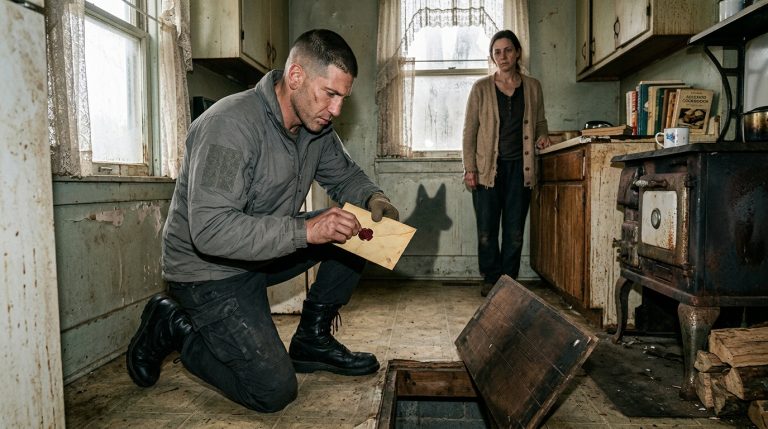
She moved toward the bedroom, her footsteps soft on the creaking floorboards. The bed was stripped, the mattress bare. As she reached down to gather the discarded linens, her toe caught on a slight protrusion near the baseboard. She knelt, her joints stiff, and noticed the wood grain was slightly askew. It was a small discrepancy, an architectural tremor in a house she had thought she knew perfectly.
Martha pried the board loose. Beneath it, protected by a scrap of oil-stained canvas, lay a small, leather-bound notebook. Her heartbeat quickened, a rapid thrum against her ribs. She didn’t recognize the notebook, but when she opened it, the handwriting—sharp, slanted, and deliberate—was unmistakably Andrew’s.
She turned the pages. These weren’t the mechanical logs he had kept for the shop. They were drawings. Sketches of landscapes she didn’t recognize—open fields, soaring mountains, and a small, A-framed cabin near a river. On the final page, tucked into the binding, was an envelope. It was yellowed at the edges, the seal brittle, addressed to her but never stamped.
Her fingers trembled as she pulled the letter out. The paper felt like a second skin, fragile and holding a temperature of its own. As she began to read, the house seemed to shift. The walls didn’t look like they were enclosing her anymore; they looked like they were hiding something.
A heavy knock echoed through the front door, rattling the glass. Martha jumped, the letter slipping from her hand. It was too early for Caleb, but the rhythm of the knock was unmistakable—steady, rhythmic, and intentional. She stood, clutching the notebook against her chest, and walked back into the living room, her mind racing with the realization that the man she had been leaning on for comfort might have been looking for exactly what she was now hiding.
CHAPTER 2: THE ANATOMY OF A HIDDEN TRUTH
Martha gripped the notebook, her knuckles white against the dark leather. The knock at the door came again—sharper, more insistent—but she didn’t move. She stared at the letter, her eyes tracing the hurried strokes of ink. Dear Mother, it began, though the rest of the line was obscured by a dark smudge. She felt a phantom vibration beneath her feet, a rhythmic, deep-seated thrumming that brought her back to the garage, to the heavy, oil-scented air and the way Andrew used to press his palm against a faulty engine block to “feel the sickness” before he even picked up a wrench.
The memory was sudden, invasive, and sharp—a psychological phantom that tasted like ozone and exhaust. It wasn’t just a memory of the shop; it was the sensation of the shop’s internal pulse, the rhythm Andrew had tried to decipher for years.
“Martha?” Caleb’s voice was muffled by the thick wood of the door, but it carried the same steady resonance that had anchored her during the darkest days of the funeral.
She stood, tucking the notebook and letter into the deep, hidden pocket of her apron. She couldn’t let him see this. Not yet. She walked to the door, each step requiring a conscious effort to steady the tremor in her legs. When she opened the door, the cold air rushed in, swirling around her ankles, bringing with it the smell of wet pavement and the impending winter dusk.
Caleb stood on the porch, his silhouette framed by the gray, dimming sky. Rex sat at his heel, his amber eyes tracking Martha with an intensity that made her feel, for a fleeting moment, like he could see through the fabric of her apron to the paper hidden inside.
“I thought I heard something,” Caleb said, his gaze dipping briefly to her face, then flickering toward the room behind her. “You’re trembling.”
“It’s the cold,” Martha replied, her voice thinner than she wanted. She stepped back, allowing him to enter. She didn’t offer a chair. She couldn’t bear the thought of sitting when every nerve in her body was screaming for movement.
Caleb stepped inside, his boots heavy on the floorboards. He looked around the room, noting the empty space where the medical bed had been. He didn’t ask about it. He knew the weight of that absence. “I brought some things,” he said, gesturing to the heavy canvas bag slung over his shoulder. “Fixed a few more things on the exterior—the gutter was pulling away from the eaves.”
Martha watched him. He was trying to normalize the space, to make it habitable again, but he was doing it with a methodical precision that felt like a surgical operation. He moved with a practiced grace that suggested he was looking for something, or perhaps just looking to keep his hands busy.
“Caleb,” she started, the notebook feeling like a burning coal in her pocket. “Why did you keep coming? Even after… even after everything was finished?”
Caleb paused, his hand resting on the back of the worn couch. He looked at her, his expression unreadable, the small scar beneath his eye catching the low, fading light. “Because I don’t leave things halfway, Martha. And because you were the only one who didn’t look at me like I was a broken machine when I came home.”
He moved toward the kitchen, but he stopped when he reached the middle of the room. He turned, his gaze drifting to the floor, to the spot where the floorboard was slightly askew. He had noticed.
Martha’s heart hammered a frantic rhythm against her ribs. She had to shift his focus. She had to be the one to drive the conversation, to control the pace.
“There was something,” she said, her voice gaining a fragile, hard edge. “In the garage. Andrew always talked about the shop’s rhythm. He said it didn’t match the work logs. He said someone was forcing the machines to run faster than they were rated for.”
Caleb’s posture changed instantly—the transition from helpful visitor to tactical analyst was seamless. He didn’t ask for details; he leaned in, his focus sharpening. “Did he say who?”
“He said they were ‘cleaning the books with oil,'” Martha whispered. She hadn’t realized she remembered that phrase until it was out.
Caleb’s eyes darkened. The air in the room seemed to drop another few degrees. He walked to the window, looking out toward the street, his silhouette a solid, immovable barrier.
“If he said that, he wasn’t just talking about maintenance,” Caleb said, his voice dropping to a gravelly, dangerous register. “He was talking about fraud. And if he was looking at the books, he was a liability.”
Martha felt the world tilt. She reached for the table to steady herself, her hand brushing the surface where the cake had sat. The truth was beginning to bleed through the floorboards of her memory. She hadn’t just lost a son to an accident; she had lost him to a machine that had been designed to break him.
“I found something,” she said, her voice barely audible. She pulled the notebook from her apron. She didn’t give it to him. She just held it, the weight of the leather dragging her hand downward. “And I think you need to tell me what you’ve been hiding since the day you showed up at that bakery.”
CHAPTER 3: THE SHADOW OF THE WRENCH
Caleb didn’t flinch. The shift in his expression was not one of guilt, but of a man who had been expecting a landslide and was merely assessing the debris. He moved away from the window, his boots making a dull, rhythmic sound on the hardwood that felt entirely too loud in the confined space of the room. He didn’t come closer; he maintained a distance that was both respectful and tactical, his eyes fixed not on Martha’s face, but on the notebook in her hand.
“You knew,” Martha said. Her voice wasn’t an accusation; it was a realization, sharp and cold. “You didn’t just come here to fix a hinge. You were looking for that.”
Caleb took a slow breath, his shoulders dropping just a fraction. “I was looking for proof, Martha. Not against you. Against the shop.”
He moved to the small kitchen table, pulled out a chair, and gestured for her to sit. It was a command disguised as an invitation, and Martha, feeling the sudden, dizzying drain of adrenaline, sank into the opposite seat. Rex moved from the doorway to the space between them, his presence a living, breathing anchor in the small room.
“Andrew didn’t die because of a mechanical failure,” Caleb said, his voice low, steady, and devoid of the comfort he had offered in the bakery. “And he didn’t die because of a simple accident. I spent the last three years digging into the ownership history of that garage. It was a shell company, Martha. It was designed to move money—illicit, untraceable money—under the guise of labor costs and equipment maintenance.”
Martha stared at him, the notebook still held tight in her lap. The faded textures of the room—the peeling wallpaper, the worn cushions of the chairs—seemed to sharpen, becoming vivid and harsh. “He was a mechanic, Caleb. He just wanted to fix things.”
“And that was his mistake,” Caleb replied, his tone hardening. “He was too good at it. He noticed the discrepancies in the logs—the parts that were ‘replaced’ but never actually installed, the labor hours that didn’t match the work being performed. He started keeping a ledger. A real one. Not the one the owners kept.”
Martha’s mind drifted to the notebook. She flipped it open to a middle page, her fingers trembling slightly. It wasn’t just drawings of landscapes; there were numbers, dates, and names of suppliers she had never heard of. She had spent three years grieving a tragic accident, a freak occurrence of gravity and steel. Now, the past felt like a construct, a lie built to keep her quiet.
“Why didn’t you tell me?” she asked, the words feeling like shards of glass in her throat.
“Because I didn’t have enough,” Caleb admitted, his gaze finally locking onto hers. It was an honest, grueling look. “I had suspicions, I had data, but I didn’t have the missing piece. I needed to know if Andrew left anything behind—anything that linked the sabotage to the specific people running the operation. If I had come to you earlier, if I had raised your hopes and then failed, I would have destroyed the only thing you had left: your peace.”
Martha looked at the notebook, then at Caleb. She felt a surge of indignation—the betrayal of his silence—clashing with the profound weight of his protection. He had carried this burden, just as she had carried the grief, each of them guarding a different piece of the same shattered truth.
“The letter,” Martha said, pulling the envelope from the notebook’s binding. She pushed it across the table. “He wrote this to me. He never sent it.”
Caleb took the letter, his movements slow, deliberate. He read it in silence, his face a study in restrained fury. When he finally looked up, the lines around his eyes were deeper, the scar beneath his left eye pulsing with a faint, rhythmic tension.
“He knew,” Caleb said softly. “He knew he was in danger. He was trying to tell you how to get out, how to distance yourself from the house and the shop before they realized he’d reached out to someone in the district attorney’s office.”
Martha felt a cold shiver trace the line of her spine. “He didn’t want to leave me. He wanted to protect me.”
“He did,” Caleb said. He stood up, his movements fluid and efficient, the posture of a man readying for a task that had been looming for years. “But he failed. They caught him. And they made it look like the machine took him.”
Caleb walked to the front door, his hand lingering on the brass handle. He didn’t look back. “I’m going to the site tomorrow, Martha. Not the house. The garage. The new owners—they haven’t cleaned out the sub-basement. If there’s anything left, if there’s a record of the sabotage in the main unit’s control console, that’s where it’ll be.”
Martha stood, her legs stronger now, fueled by a new, cold clarity. She looked at the notebook, the drawings of the cabin, and the maps of a life Andrew had only ever lived in his mind.
“I’m going with you,” she said.
Caleb turned, his eyes searching hers for doubt. He found none. He nodded once, a sharp, silent acknowledgement of a partnership born in the shadow of a grave. “Be ready by dawn,” he said. “It’s going to be cold.”
As the door closed behind him, Martha stood in the middle of the room, the scent of oil and damp concrete clinging to the air like a lingering ghost. She wasn’t afraid. For the first time in three years, the silence didn’t feel heavy; it felt like a countdown.
CHAPTER 4: THE IRON VEIL
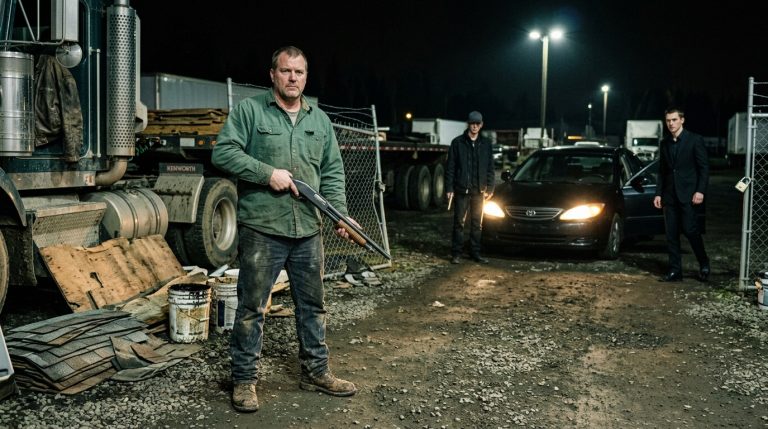
The walk to the garage had been a study in shared, grinding determination. The city of Denver was a monochromatic blur of slate-gray sky and bruised-white snow, the streetlights flickering with a sickly, dying yellow light that offered no warmth. Martha walked with a pace she hadn’t maintained in years, her boots crunching through the crusted snow, her hands thrust deep into her pockets. Beside her, Caleb was a dark, solid presence, his breath pluming in the air in short, rhythmic bursts.
When they arrived, the garage stood as a monument to rot. The paint had long since surrendered to the elements, peeling away in ragged strips to reveal the skeletal wood beneath. The main bay door was a expanse of corrugated steel, pitted with deep, orange-black rust that seemed to bleed into the surrounding drifts of snow.
Caleb stepped forward first, his gloved hand reaching for the latch. He paused, his head tilting—a subtle shift in his posture that told Martha he was listening for more than just the wind. He gripped the handle and pulled.
Nothing. The metal didn’t groan; it held firm, seized by the relentless intrusion of ice and rust.
“The mechanisms,” Caleb muttered, his voice barely rising above the whistle of the wind. “They didn’t just lock it. They froze it.”
He didn’t resort to brute force. Instead, he reached into his tool belt and pulled out a canister of de-icer and a slender, multi-purpose tool. He worked with the patience of a man who had spent his life dismantling threats. Martha watched him, her eyes tracing the way his knuckles tightened under the pressure of the tool. She was the lookout, her gaze sweeping the empty, desolate street, but her mind was fixed on the interior—on the sub-basement where the control console waited.
A sudden, sharp metallic crack echoed through the alley, like a gunshot. Martha flinched, but Caleb didn’t stop. With a final, controlled heave, he shifted his weight, and the massive door shrieked—a long, agonizing sound of iron grinding against iron—before inching upward.
The interior was a cavern of cold. The air inside smelled of stale transmission fluid, dust, and the sharp, metallic tang of an environment that had been abandoned by everyone except the shadows. Caleb clicked on a heavy-duty tactical flashlight, and the beam cut a harsh, white corridor through the gloom.
They moved inside. Every step on the concrete floor felt like a violation of a tomb. The heavy equipment, once the heartbeat of Andrew’s life, stood draped in grime-covered tarps, looking like gargoyles frozen in mid-motion.
“The sub-basement access is behind the main bay,” Caleb whispered, his flashlight dancing over the cluttered workstations.
Martha followed, her feet tracing the path Andrew must have walked a thousand times. She reached out and touched the edge of a workbench, her fingers coming away smudged with fine, dark grit. It was here that he had stood, day after day, trying to fix the world while the world was quietly orchestrating his end.
“Wait,” Martha said, stopping near the edge of the service pit.
Caleb halted, his beam fixed on the floor. “What is it?”
“The floor,” she said, pointing to the concrete near the pit’s edge. “It’s scarred. Scratched.”
Caleb brought his light down. The concrete was deeply gouged, as if something heavy—far heavier than a tool chest—had been dragged repeatedly across the surface. It wasn’t just a workspace; it was a site of struggle.
“He wasn’t just working here, Caleb,” Martha whispered, her heart hammering against her ribs like a trapped bird. “He was fighting. He was trying to move these machines to get to the console, wasn’t he?”
Caleb looked up, and for the first time, she saw a flicker of doubt in his eyes—not about the mission, but about the sheer, predatory scale of what they were facing. “They didn’t just sabotage him, Martha. They kept him contained. They were watching him, even when he was alone.”
A sudden sound—not the wind, but a rhythmic, metallic tink-tink—echoed from the back of the bay.
Caleb’s stance changed in an instant. He killed the light, plunging them into a suffocating, absolute darkness. He moved to Martha’s side, his hand gripping her shoulder with a pressure that was both warning and comfort.
“Someone is here,” he breathed into her ear, his voice barely a vibration.
Martha held her breath, the cold of the garage seeping into her skin. The tink-tink sounded again, closer this time, accompanied by the faint, distinctive click of a padlock being turned. They weren’t alone, and the truth they were hunting had decided to come looking for them first.
CHAPTER 5: THE WEIGHT OF EVIDENCE
The tink-tink continued, an erratic, uneven rhythm that seemed to mock the stillness of the garage. It was the sound of a key, or perhaps a metal pick, testing the tumbler of a long-neglected cabinet. Caleb’s hand tightened on Martha’s shoulder, a silent directive to remain motionless. In the absolute dark, his presence was a wall of heat and hard muscle. Rex, usually a shadow at their heels, had gone unnaturally still, his breathing shallow and soundless.
Martha felt a prickle of sweat despite the biting cold. The shadows in the corners of the garage seemed to stretch and shift, dancing with the flickering, unsteady perception of her own adrenaline. She saw movement—or thought she did—in the gaps between the tarp-covered machinery. For a heartbeat, the darkness seemed to breathe.
Caleb leaned down, his lips brushing the shell of her ear. “The sub-basement access,” he breathed, a ghost of a sound. “Go. Quietly. I’ll draw them away.”
“No,” Martha whispered back, firm despite the terror clawing at her throat. “We don’t leave each other.”
Caleb didn’t argue. He knew that tone—the stubborn, weathered iron of a woman who had spent three years staring at the face of loss without blinking. He adjusted his grip, his hand moving to the small, sturdy flashlight at his belt. He didn’t turn it on. Instead, he reached into his bag and withdrew a small, handheld thermal imager—a tool he had brought for contingencies she hadn’t wanted to think about.
He held it up, the screen casting a faint, ghostly blue light across his face. Martha peered at it. There were two heat signatures: one near the back cabinet, and a larger one, nearly motionless, standing directly behind the heavy partition wall that separated the main bay from the office.
They were being watched. And the observer was waiting for them to make the first move.
Martha’s eyes darted to the workbench. She saw a heavy iron pipe, a length of steel left behind from some long-forgotten repair. She reached out, her fingers finding the cold, rusted surface of the metal. It was heavy, a blunt, honest weight. She took it, the iron biting into her palm, the texture familiar and grounding.
Caleb noticed her movement. He nodded once, a sharp, affirmative gesture. They moved together, a single unit of purpose, ghosting through the aisle of machinery. Every creak of the floorboards was a gamble, every shift in the air a potential trigger.
They reached the edge of the office partition. Caleb signaled, counting down with his fingers. Three. Two. One.
They pivoted around the corner, Caleb’s light snapping on to flood the room with a blinding, white glare.
The room was empty.
But the back window was open, the glass shattered outward, and the cold winter air was whipping a pile of papers into a frantic, chaotic dance across the floor. On the desk, illuminated by Caleb’s steady beam, lay a single, open folder—a ledger, exactly like the one Andrew had described.
“They knew we were coming,” Caleb said, his voice stripped of all emotion, his eyes scanning the room.
Martha stepped forward, her gaze landing on the desk. The folder wasn’t just a record of fraud; it was a map. Names, dates, and account numbers were highlighted in vibrant, aggressive ink. Among them, one name stood out, circled in heavy red: Hayes, C.
Her heart skipped. She looked at Caleb, whose face had gone pale, his eyes fixed on his own name in the ledger.
“They were tracking you, too,” Martha breathed.
Caleb didn’t answer. He picked up the ledger, his fingers trembling—not with fear, but with a sudden, violent realization. “This isn’t just about the garage,” he said, his voice dropping into a low, jagged rasp. “It’s about what I found in the service, before I came back here. They didn’t just sabotage Andrew to protect their books. They used him to get to me.”
The realization hit Martha like a physical blow. The mystery wasn’t just a local crime; it was an echo of a much larger, darker machine—one that had reached into her home, taken her son, and left her with a life built on debris.
Outside, the distant, steady rumble of a heavy engine ignited. It was slow, deliberate—a vehicle pulling into the alleyway.
“They aren’t running,” Caleb said, looking at the door, his posture shifting into the stance of a man who had finally found the enemy he had been hunting for years. “They’re coming back to finish it.”
Martha tightened her grip on the iron pipe. The fear was gone, replaced by a cold, sharp clarity. The “accident” hadn’t just taken her son; it had started a war. And they were standing at the center of the battlefield.
CHAPTER 6: THE SILENCE OF THE GEARS
The spotlight hit the corrugated steel with a harsh, blinding glare, vibrating the metal until it hummed. Martha didn’t cower. She stood behind the heavy industrial lathe, the iron pipe steady in her hands, her breath slowing into the rhythm of someone who had already lost everything and had nothing left to fear. Beside her, Caleb moved with the economical, lethal grace of a predator who had finally cornered his prey.
“Stay behind the partition,” Caleb commanded, his voice a low, steady anchor. He didn’t wait for her acknowledgment. He moved toward the office, not to hide, but to leverage the geography of the room.
The bay door groaned as the engine outside revved—a deep, predatory growl. Two figures emerged from the glare, silhouettes rendered featureless by the backlighting. They moved with the overconfident stride of men who believed they were walking into an empty tomb.
“Clear it,” one of them rasped. The voice was thin, clinical—the sound of a man who traded in logistics, not violence.
Caleb moved. He didn’t use a weapon. He used the environment. As the first man crossed the threshold, Caleb triggered the overhead chain-hoist, sending a rusted, heavy engine block swinging on its tether. It slammed into the man’s chest with the force of a wrecking ball, the impact dull and sickening. He dropped like a sack of stone.
The second man panicked, his hand darting to his belt, but Martha didn’t hesitate. She stepped from behind the lathe, her movement silent, and struck the iron pipe against the control console’s main power lever. It was a precise, practiced swing. The massive main bay door slammed downward, powered by the hydraulic weight of the system’s override, catching the second man mid-stride and pinning him firmly against the concrete floor.
He didn’t die, but he was trapped, his leg crushed beneath the steel edge of the door, his screams muffled by the weight of his own hubris.
Caleb was on him in an instant, disarming him and securing his hands with zip ties that looked like industrial wire. He didn’t look at the man; he looked at the ledger he had dropped.
“The fraud,” Caleb said, his voice cold, looking at the groaning man. “The sabotage of the garage. The hit on Andrew. Was it all just to keep the money moving?”
The man, his face a mask of agony, wheezed, “You don’t understand… you’re just a ghost in their system.”
“Then I’m a ghost that’s going to haunt every ledger you’ve ever touched,” Caleb replied.
Martha walked over to the console. She didn’t look at the prisoner. She looked at the flashing red light on the dashboard—the emergency override Andrew had tried to trigger three years ago. She reached out and pressed the sequence he had noted in his sketches. The console beeped, and a hidden compartment beneath the desk slid open. Inside was a flash drive—the final piece, the digital trail of every dollar siphoned from the shop.
The aftermath was a blur of blue lights and sirens. Caleb called in the local authorities—not the ones he’d suspected of being on the take, but federal agents he had been quietly feeding information to for months. As the men were loaded into transport vehicles, the garage—once a site of cold, rusted trauma—began to feel like a space reclaiming its own history.
Caleb stood by the bay door, watching the last of the police cars pull away. He looked exhausted, the lines in his face deeper, but his eyes were clear. He walked over to Martha.
“You did it,” he said.
Martha looked at the iron pipe in her hand, then dropped it into a bin of scrap metal. She felt a profound, heavy quiet settling over her. She reached into her pocket and pulled out the leather-bound notebook. “He wasn’t a victim,” she said, her voice steady. “He was a witness. He knew who they were, and he died trying to bring them down.”
“He succeeded,” Caleb said, placing a hand on her shoulder. “It just took three years for the truth to catch up.”
They walked out of the garage together, the sun beginning to crest over the Denver skyline. The snow was beginning to melt in the early morning light, revealing the dark, damp earth beneath. It wasn’t a clean victory—it couldn’t be—but it was an end.
Later that afternoon, Martha returned to the living room. She sat in the quiet, the sunlight hitting the space where the bed had been. She picked up a small brass figurine of a car Andrew had fashioned for her when he was ten. It was tarnished, the surface marred by years of neglect. She took a cloth and some polish and began to rub, the metal gradually revealing its golden sheen.
She wasn’t mourning the past anymore. She was cleaning the tools she had to build a future. Rex lay by her feet, his head resting on her shoe, his breathing deep and rhythmic. Caleb sat on the porch, watching the street, his vigil finally over. Martha felt the weight of the house lift, not because the grief had vanished, but because it was finally, truly, anchored in the truth. The silence of the room was no longer the silence of a loss, but the silence of peace.