A Ghost Found in the Light: The Ripple Effect of One Man’s Quiet, Enduring Sacrifice
CHAPTER 1: THE WINDOW AT PORTSMOUTH
The air in the long-term care wing of the Naval Medical Center felt heavy, saturated with the scent of sterile lemon and the slow, rhythmic ticking of a clock that seemed to mark only the passage of forgotten time. Vice Admiral James Reeves moved down the corridor with the practiced gait of a man accustomed to command, his dress blues a sharp contrast against the muted, pale-yellow walls.
This was the routine—the optics of care, the necessary ritual of shaking hands with the architects of the past. He stopped at the window where a man sat, bathed in the soft, dusty light of a Tuesday morning. The old man was gaunt, his gray hair cropped with a precision that mocked his years, and a simple blue cardigan hung loosely over his frame. His left arm ended just below the elbow, the sleeve neatly pinned—a fabric fold that seemed to hold the weight of a thousand secrets.
Reeves cleared his throat, the sound small in the vast, quiet room. “Excuse me, sir. I’m Admiral Reeves. Just wanted to thank you for your service.”
The old man turned his head. His eyes were not the clouded, milky windows Reeves had grown accustomed to in this ward. They were a striking, piercing pale green, alert and hungry, as if they had spent forty years scanning a jungle canopy for movement.
“Appreciate that, Admiral,” the man replied. His voice was raspy, like dry leaves skittering over pavement.
Reeves extended a hand. He felt the firm, surprising strength of the veteran’s grip, a tension that suggested this man had never truly let go of a weapon. “You served in Vietnam?”
“Yes, sir.”
“Branch?”
“Navy. Special warfare.”
Reeves paused. A fellow frogman. He pulled up a plastic chair, the legs scraping harshly against the linoleum. “Hell of a time to be over there. You have a call sign?”
The old man went still. He looked out the window at the distant trees, his expression unreadable. When he finally spoke, the name didn’t sound like a title; it sounded like a ghost exhaling in a tomb.
“Ghost Walker.”
Behind Reeves, the air seemed to vanish. Command Master Chief Dale Thornton, who had been standing at ease, suddenly straightened, his skin losing all color. The younger SEAL, Valdez, shifted his weight, his confusion momentarily eclipsed by the heavy, sudden pressure in the room. Reeves felt a familiar, icy dread settle into his marrow. He had spent twenty-six years in the teams, and he knew the myth. Everyone knew the myth. But myths were meant to stay behind the glass of training slides and locker room stories.
“I’m sorry, sir,” Reeves whispered, leaning in. “What did you say?”
The old man turned back, his green eyes boring into the Admiral. “Ghost Walker.”
“Sir, that’s not possible,” Reeves countered, his voice steady despite the hammer of his heart. “Ghost Walker is a story. Motivation for the recruits. A phantom that doesn’t exist.”
“I know what they tell you,” the old man said, his gaze drifting back to the window, watching a shadow pass over the grass outside. “I know they tell you I’m a story. But what if the story is the only thing that kept the truth from swallowing you whole?”
Reeves froze. He realized then that the old man wasn’t looking at the trees. He was looking at something, or someone, lurking just behind the Admiral’s shoulder—a figure that had been waiting half a century to be seen.
CHAPTER 2: THE ANATOMY OF A SECRET
The silence in the room was not empty. It was pressurized, thick with the smell of floor wax and the metallic tang of fear. Vice Admiral Reeves felt the sudden, irrational urge to check the door, to ensure no one else was listening to a man whose very name was supposed to be a metaphor. He looked at Richard Cole—at the pinned sleeve, the pale green eyes, and the way the man’s frame seemed to occupy more space than his physical form allowed.
“Sir,” Reeves started, his voice hitting the sterile walls with an awkward resonance, “if you’re telling me that Ghost Walker isn’t just lore… then the entire history of the training curriculum at Little Creek is built on a foundation I don’t understand.”
Cole didn’t move. He continued to watch the window, his gaze fixed on a distant, invisible horizon. For a moment, Reeves felt a jolt of vertigo—a V-2 flash—as if the sunlight outside the Naval Medical Center had suddenly shifted to the humid, suffocating emerald gloom of a Vietnam jungle. He imagined the feeling of damp earth beneath his boots, the oppressive weight of a pack, and the constant, gnawing sensation of being watched by something that wasn’t human. He shook it off, grounding himself in the cool, smooth texture of his command chair.
“The history isn’t wrong, Admiral,” Cole said, his voice quiet. “It’s just… sanitized.”
Commander Master Chief Thornton shifted, his boots grating against the floor. “Sanitized, sir? We have records for everything. Every operation, every expenditure, every soul we put in the field. If you were running solo SCOPS, there would be a paper trail. The logistics alone—supplies, exfil, intel—it’s impossible to hide that for forty years.”
Cole looked at the Master Chief. His expression wasn’t one of anger, but of a weary, distant pity. “You’re talking about logistics. I’m talking about the void. When you go into the deep dark, you don’t use the supply chain. You don’t use radio bursts. You don’t use the system, because the system is exactly what the enemy is waiting to intercept. You become an anomaly.”
Reeves stood up, feeling the need to move. He paced the small room, his hand tracing the edge of the conference table. The wood felt cold and solid, a stark contrast to the ethereal nature of the man he was questioning. He knew he should end this. He should report this to his superiors, flag the discrepancy, and let the command staff handle the fallout. But there was a truth here, a resonance in Cole’s eyes that defied the orderly, bureaucratic structure Reeves had served for three decades.
“I have access to the archives at Little Creek,” Reeves said, stopping his pacing to face the older man. “There are records of Operation Black Veil. They’re restricted, sealed in deep storage. I thought they were just early psychological warfare failures. If you were the operator, the records should be there. Why aren’t they?”
“Because they were erased,” Cole replied, his tone as flat as a desert floor. “In 1975, when they pulled me out, they didn’t just retire me. They scrubbed the slate. My name, my service record, the successes, the failures—it was all moved to a different file, a different reality. You won’t find Richard Cole in the annals of the UDT. You’ll find a ghost.”
Valdez, the younger SEAL, leaned against the wall, his brow furrowed. “But why, sir? If the mission was successful—if it terrorized the enemy—why bury it? That’s an asset. That’s a legacy.”
Cole’s hand—his right hand—clenched into a fist, the knuckles white against his weathered skin. “Because a ghost doesn’t have a conscience, Valdez. At least, that’s what they thought. They realized that if the world saw what it took to win that kind of war, they wouldn’t applaud. They would recoil. They needed the myth to be clean. They needed the ghost to be a hero, not a man who had to leave pieces of his soul in the dirt just to keep from being found.”
Reeves stared at the man. He saw the faded texture of the blue cardigan, the way the fabric was beginning to fray at the cuffs, and he understood. The erasure wasn’t a punishment for the failure of the mission. It was a shroud. A protective barrier designed to shield the Navy from the ugly, human truth of what had been demanded of them. And in doing so, they had trapped the man in a lifetime of silence, a prison made of good intentions and polished, empty history.
Reeves drew a breath, the air in the room feeling thinner, clearer. “I’m going to find the files, Chief. Not the sanitised versions. The originals. I’m going to see what they hid.”
Cole’s eyes remained on the window, but a subtle shift occurred in his posture—a slight softening of the shoulders. “You won’t find them in the main database, Admiral. You’ll have to look for the things they forgot they locked away.”
CHAPTER 3: THE FIRST ECHO
Reeves didn’t leave the medical center immediately. He spent the better part of an hour coordinating the logistics of Cole’s security, not because he feared an outside threat, but because he feared the Navy’s own internal inertia. He left Thornton and Valdez at the door—a silent, immovable perimeter—and stepped into the hallway to make the necessary calls. Every word felt heavy, like shifting wet sand. He authorized a high-priority, low-profile digital audit of the Little Creek archives, specifically targeting the “Black Veil” designation.
The transition from the sterile, quiet wing of the hospital to the dimly lit office he occupied at Little Creek felt like stepping from a dream into a cold, abrasive reality. His office was a testament to order: crisp lines, perfectly aligned folders, and the rhythmic, hum of cooling fans. Yet, as he sat at his desk, the silence felt invasive. He pulled up the secure terminal, his fingers hovering over the keys.
Black Veil.
The search returned nothing. A null result. It was as if the program had never existed, as if the forest of the 1969 operational theater had never been touched by anything more than conventional reconnaissance. Reeves leaned back, his eyes tracing the grain of the desk. He felt the phantom pressure of the challenge coin that Cole had described, a physical representation of an invisible legacy.
He didn’t stop at the digital interface. He knew the protocol for “Ghost” projects—the ones that lived in the physical files of the legacy archives, deep beneath the active servers. He stood, grabbed his coat, and walked the long, subterranean corridors toward the bunker-like storage where the “Deep Archive” resided.
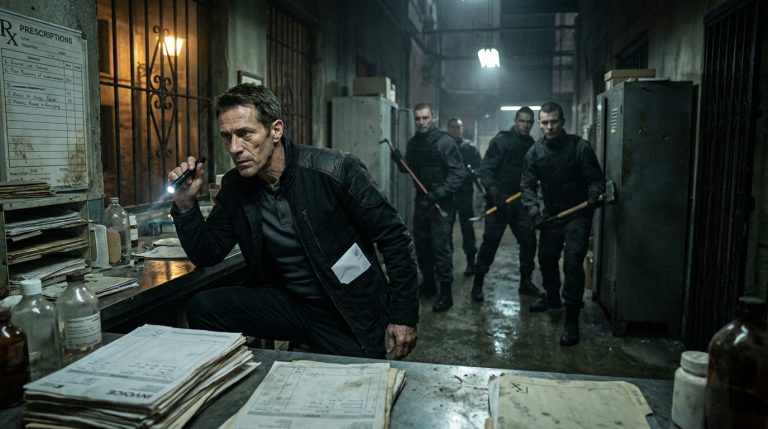
The air grew colder as he descended. The smell shifted from the sharp scent of office filtration to the dusty, metallic aroma of neglected paper and stagnant air. This was the graveyard of the Navy’s ghosts. He swiped his clearance card, the door clicking open with a sound like a dry bone snapping. Inside, rows of metal cabinets stretched into the darkness, their paint chipped and rusted at the edges.
He moved to the section labeled 1965-1975: Special Operations. His flashlight cut a sharp, white path through the dust motes dancing in the stagnant air. He began the hunt. He pulled drawer after drawer, scanning labels that belonged to a world of typewriters and carbon paper. Then, he saw it: a box marked Unallocated / Excess Assets. It wasn’t cataloged. It was tossed in the corner, forgotten, almost as if it had been placed there by someone who wanted to ensure it remained undisturbed, rather than destroyed.
He pried the lid open. Inside sat a heavy, leather-bound ledger. It was stained with something dark—a substance that might have been humidity or something more visceral. He opened it, his pulse thumping in his throat.
The pages were filled with names, dates, and locations. Phantom. Whisper. Shade. Each entry was meticulous, dated, and signed off with an authorization code that shouldn’t have existed. He reached the end of the Shade files and flipped to the next section.
Ghost Walker.
He stopped. The page was blank. No, not blank—the ink had been professionally, surgically removed. He pulled a magnifying glass from his kit, squinting at the paper under the sharp LED of his light. There, beneath the bleached surface, was the ghost of handwriting. A V-1 discrepancy: the dates didn’t align. The operational logs for the surrounding units reported a complete absence of activity for the entire sector, yet the ledger showed a series of “Black Veil” signatures that required massive supply chain logistics that were nowhere to be found.
He traced the signatures. They were authorized by a Vice Admiral whose name had been redacted with such heavy, frantic ink that the paper had torn. It wasn’t a disagreement over protocols. It was a cover-up of an entire ecosystem of shadow-operations. The reality hit him with the force of a physical blow: the Navy hadn’t just erased Cole to bury his failures. They had erased him because he was the only one who could testify to an order that had come from the very top, an order that had demanded the impossible—and gotten it.
Reeves closed the ledger, his hands trembling. He hadn’t just found a legend; he had found a crime. And as he stood in the freezing, dark archive, he realized that the “safety” of the sanitize operation was a lie. The Navy hadn’t been protecting Cole from the world; they had been protecting the world from the truth of what they were willing to build, and what they were willing to destroy.
He turned to leave, but his foot struck a metal container tucked behind the ledger stack. He paused, shining his light into the dark recess. There, gathering dust, were four small, tactical navigation kits—the kind issued to operators before they disappeared into the green. One was missing the insignia. One was burned. And one, sitting right in front of him, had the call sign Ghost Walker etched into the aluminum with a knife.
He picked it up. It was heavy, cold, and felt like it carried the weight of fifty years of silence. He wasn’t just investigating a patient anymore; he was holding the evidence of a war that had never been allowed to end.
CHAPTER 4: THE DAUGHTERS BURDEN
The fluorescent light overhead flickered once, twice, and then died, plunging the deep archive into a suffocating, heavy gloom. The sudden absence of artificial illumination forced Reeves to hold his breath. He clutched the aluminum kit to his chest, his eyes adjusting to the thin, blue glow of his tactical light. In the silence that followed, he heard it: the slow, measured shuffle of footsteps somewhere further down the aisle of rusted cabinets.
He wasn’t alone.
His mind immediately categorized the threat. If this was a security sweep, the personnel would have announced themselves. If it was maintenance, they would have a radio or a flashlight far brighter than the dim, intermittent beam he saw dancing on the opposite wall. This was quiet. This was purposeful.
Reeves moved with the fluid, calculated grace of a man who had trained for this exact scenario, though never in the belly of his own command. He set the aluminum kit down on a stack of ledgers and drew his service pistol—not out of panic, but out of absolute, cold necessity. He moved into the shadow of the shelving units, the metal groaning under the shift of his weight.
“Who’s there?” his voice came out flat, authoritative, stripping away the rank to leave only the operator.
The footsteps stopped. A beat of absolute silence followed, so dense it felt like physical pressure. Then, a voice emerged from the dark—softer than he expected, laced with a tremor of guarded exhaustion.
“Admiral Reeves. You’re looking for a ghost. You won’t find him in the files. You’ll only find the wreckage.”
A woman stepped into the periphery of his light. She looked to be in her fifties, wearing a simple, dark trench coat that seemed out of place in the sterile, high-security facility. Her hair was pulled back, her eyes sharp, intelligent, and currently fixed on the object Reeves had left on the ledger stack. She didn’t look like a threat; she looked like a woman who had been carrying a burden for four decades and had finally reached the point where the weight was going to break her spine.
“Who are you?” Reeves asked, not lowering his weapon, but stepping out of the shadows.
“I’m the reason the file was torn,” she said, nodding toward the ledger he had just abandoned. She walked forward, not with fear, but with a weary familiarity. “My name is Sarah Hayes. Lieutenant Marcus Hayes was my uncle. And the man you’re talking to in the hospital? He didn’t just save my uncle. He saved the only person in my family who knew what the ‘Black Veil’ actually was.”
Reeves felt the shift in the narrative. The decoy secret—the idea of a tactical disagreement—suddenly looked like a child’s toy compared to the reality of what stood before him. Sarah Hayes wasn’t a civilian. Her posture, the way she positioned herself to optimize her escape route and field of vision, screamed of a childhood spent around operators.
“You’ve been tracking this,” Reeves stated, finally lowering his sidearm, though keeping his hand close to the grip.
“I’ve been guarding it,” she corrected. “When my uncle came home, he didn’t talk about the war. He talked about the ‘Veil.’ He talked about how the Navy didn’t just end a program; they systematically dismantled the lives of everyone involved. My father—his brother—was the one who helped the Navy clean the records. He thought he was saving them from a court-martial. He thought he was saving them from the truth of what they had done. He spent his life drowning in the shame of it.”
She gestured to the surrounding cabinets. “You think you’re uncovering a crime, Admiral. You’re uncovering a grave. Every name in that ledger, every redacted code—it wasn’t a tactical success. It was a harvest. They used men like Richard Cole because they were isolated. They stripped them of their humanity, and when they didn’t break, they stripped them of their names.”
Reeves stepped closer, the weight of the aluminum kit in his mind pressing down on him. “Why come forward now? Why risk the breach?”
“Because he’s dying,” she whispered. Her voice broke, the first crack in her armor. “Richard Cole doesn’t have time for your investigation, and the Navy doesn’t have the stomach to face what they’ve done before he’s gone. My uncle spent forty-seven years looking for him, and I’ve spent the last ten trying to make sure that when he was found, the truth didn’t just vanish with him.”
She reached into her coat and pulled out a small, worn photograph. She held it out. It was a picture of a young man in a UDT uniform, standing next to a pilot. The date was smudged, but the faces were clear. Richard Cole, standing in the sunlight of a world that didn’t yet know it had sacrificed its own shadows.
“The decoy secret isn’t that they disagreed on tactics, Admiral,” Sarah said, her voice turning cold and pragmatic. “The secret is that they needed the war to have a face. They chose Cole. They built the myth of Ghost Walker, and then they had to burn the man to keep the myth perfect.”
The truth resonated in the cold air. Reeves looked at the photograph, then back at the woman. He realized that the “Operational Protocol” narrative he had been building was a shield, a way to keep from seeing the monstrous, systemic machinery that had chewed up a human being and left him in a blue cardigan by a window.
“If I go public with this,” Reeves said, “it won’t just be the Navy at risk. It’ll be everyone who participated in the ‘sanitization.’ That includes your family.”
“My family died a long time ago,” Sarah replied, turning back toward the dark exit of the archive. “At least, the parts of it that were honest. I’m not here to protect a legacy. I’m here to finish a mission.”
CHAPTER 5: THE BRIDGE
Reeves didn’t follow her. He stood in the damp, freezing air of the deep archive, the silence rushing back in to fill the space where her voice had been. He looked down at the navigation kit in his hand, the etched letters of Ghost Walker biting into his palm. He needed to leave, to get back to the surface, but his legs felt heavy, as if the floor were composed of shifting, unstable earth.
He didn’t just walk out. He moved through the aisle of cabinets with a renewed, frantic focus, stowing the ledger and the kit into his briefcase. He felt the phantom eyes of the long-dead bureaucrats watching him from the rust-caked labels on the drawers.
He climbed the stairs to the upper levels of the facility, his chest burning. When he emerged into the brightly lit corridor, the normalcy of the hallway—the buzzing of the lights, the polished linoleum, the distant sound of a coffee machine—felt like a hallucination. He had spent his life believing in the structure of the Navy, in the moral clarity of its purpose. Now, that structure felt brittle, a facade concealing a sprawling, decades-old rot.
He reached his office and shut the door, clicking the lock into place. He pulled the ledger out and began to cross-reference the authorization codes. He used his personal, unmonitored laptop, the one he kept for sensitive, non-official inquiries. The screen glowed, a harsh blue light that illuminated the deep circles under his eyes.
He hit a wall. Every authorization code he tracked traced back to a specific, dead-end relay that didn’t exist in any official network. He pulled up his personal history, his own training files from twenty-five years ago. He looked for the mention of Black Veil. Nothing.
He began to doubt his own memory. Had he heard the story at Little Creek? Or had he invented it, a convenient nightmare he had used to push himself through his own training? He remembered the cold, the isolation, the way the instructors would talk about the “Shadow Operators.” He had thought they were teaching him how to be a hunter. Now, he realized they were teaching him how to be a ghost.
He needed to talk to Cole again. He needed to know if Cole was a victim or a willing participant. He grabbed his coat, ignoring the urgent emails pinging on his monitor. He needed to cross the bridge between the myth and the man before the Navy realized that the bridge was actually a fault line.
He drove back to the Naval Medical Center under the cover of a storm that had rolled in from the coast, turning the sky into a bruised, violent purple. The road was slick, the windshield wipers slapping rhythmically against the glass—a sound that echoed the frantic pace of his own thoughts. When he arrived at the hospital, the wing was under heightened security. Two Marine guards stood at the entrance. Reeves frowned, his hand instinctively moving to the sidearm under his jacket.
He didn’t stop to explain. He used his credentials, his face a mask of official indifference, passing the guards with a nod that demanded, rather than requested, entry.
He reached Cole’s room. It was empty.
The bed was made, the sheets pulled tight with military precision. The chair by the window, where the old man had been sitting, was empty, turned slightly toward the doorway as if waiting for someone who hadn’t arrived in time. Reeves approached the bedside table. A cup of water, a few stray magazines, and a small, folded piece of paper sat on the surface.
He opened it. It was a note, written in a shaky, precise hand: “They don’t want the truth, Admiral. They want the silence. I’m moving to the final stage. If you want to know what I did, you have to look at the sky, not the files.”
Reeves turned toward the window, the rain lashing against the glass. He saw, in the distant parking lot, a black sedan idling in the dark. It wasn’t marked. It didn’t belong to the hospital. It belonged to the silence.
The pressure in his chest tightened. He realized then that he had underestimated the system. He wasn’t conducting an investigation; he was being led into a trap, a final exercise in erasure. He turned and ran toward the back exit, the metal of the navigation kit in his bag digging into his hip—a reminder that he was carrying the one thing that could burn the entire structure down. He had to reach Cole before the silence did.
CHAPTER 6: THE CONFRONTATION OF MEMORY
The rain turned from a drizzle into a deluge, the kind of heavy, grey curtain that reduced the world to the length of the hospital’s flickering security lights. Reeves hit the pavement, his boots skidding on the oil-slicked asphalt. He sprinted toward the spot where the sedan had been, but the space was empty. Only the wet, dark sheen of the lot remained, reflecting the distorted red glow of the emergency exit signs.
He stopped, his breath hitching in his throat. He wasn’t breathing the air of a rescue mission anymore. He was breathing the air of a hunt. He reached into his coat and felt the hard, cold weight of the navigation kit. If the sedans were moving, it meant they had already cleared the medical center. They had Cole.
Reeves moved toward his own vehicle, a standard-issue government SUV, his hand trembling slightly as he unlocked it. He needed a destination. If they had Cole, they weren’t taking him back to a secure facility in Little Creek; that would draw too much attention. They would take him to a “clean room”—a nondescript, temporary site where they could finish the job they had started in 1975.
He started the engine, the roar of the SUV muted by the hammering rain. He didn’t check the digital comms; they were compromised. Instead, he pulled out his phone and initiated a burst-transmission on a private, non-Navy frequency—a channel used by old-guard operators he had trusted for years. He didn’t ask for permission. He sent a single line: Need eyes on the Portsmouth perimeter, past twenty minutes.
As he pulled out of the lot, his headlights cut through the dark, picking up something caught in the glare: a scrap of fabric, snagged on the sharp edge of a concrete parking barrier. He slowed, leaned out of the window, and grabbed it. It was a fragment of a blue cardigan—a frayed, synthetic wool thread that looked small, fragile, and utterly out of place against the harsh, industrial environment.
The realization hit him with the force of a physical impact. Cole hadn’t been taken. He had left a trail.
Reeves pressed the accelerator, following the direction the sedan would have taken toward the old shipyard district—a place of abandoned warehouses and crumbling, rusted infrastructure that hadn’t seen official use in decades. It was the perfect place to disappear a man. The logic was cold, tactical, and unmistakably cruel.
He drove with a frantic, focused energy, the landscape outside the window blurring into shades of desaturated grey and black. He wasn’t thinking about his commission, or his rank, or the structural integrity of the Navy. He was thinking about the man in the blue cardigan, a man who had survived four years of absolute solitude only to be hounded by the people he had protected.
As he neared the shipyard, the rain began to ease, leaving behind a heavy, oppressive mist that clung to the rusted steel skeletons of the cranes. He saw it then—a single, dim light at the end of a long, overgrown access road. The black sedan was parked sideways across the gate, its engine still ticking in the quiet night.
Reeves cut his lights a hundred yards out and rolled to a stop. He grabbed his kit and his sidearm, checking the chamber with a practiced, muscle-memory motion. He exited the vehicle, the wet gravel crunching under his feet. The smell of the ocean, briny and ancient, mixed with the sharp, metallic tang of oxidized iron.
He moved along the perimeter of the warehouse, his senses hyper-attuned. He heard the muffled sound of voices from inside—not the professional, clipped tones of Navy personnel, but something harsher, more desperate. He reached the side door, the handle cold and rusted under his glove. It was unlocked.
He pushed it open, just a fraction. Inside, the warehouse was a graveyard of industrial machinery. In the center, under a single, bare bulb, sat a metal chair. And on it, Richard Cole. He looked smaller than he had in the hospital, his head bowed, his single arm resting limply on his lap. Standing over him were two men in dark, nondescript suits—not soldiers, but “adjusters,” the kind of people who cleaned up the messes that the military didn’t want in the history books.
Reeves felt the shift in his own internal landscape. The “Kintsugi” logic he had been observing—the idea that beauty was found in the scars—felt suddenly irrelevant. This wasn’t about scars anymore. This was about survival. He realized he had been thinking of the antagonist as a faceless institution, but now, he saw them: two men who viewed a human life as an administrative error.
He moved into the room, his weapon raised, the cold, steel reality of the moment snapping into sharp, unforgiving focus. The men turned, their expressions not of surprise, but of calculated annoyance. They didn’t see an Admiral. They saw a variable that needed to be zeroed out. Reeves didn’t speak. He stepped into the light, his presence a challenge to the very idea that a man could be erased. He was no longer an investigator. He was a protector of the last, fading echo of a human soul.
CHAPTER 7: THE MEMORIAL UNVEILING
The warehouse was a cavern of hollowed-out history, the air stagnant and tasting of wet rust and dead ends. The two men—the adjusters, or whatever they called themselves—didn’t move toward the weapon. They simply stood there, their hands relaxed at their sides, their faces devoid of the erratic tension one finds in criminals. This was cold, bureaucratic precision. They were waiting for Reeves to calculate the cost.
“Admiral,” one of them said, his voice as smooth and synthetic as the suits they wore. “You are currently outside the perimeter of your jurisdiction. If you step back, if you place the weapon on the ground and walk out, this never happened. We will conclude our business, and you will retain your commission, your pension, and your integrity.”
“Integrity,” Reeves repeated, the word tasting like ash. “You want to talk about integrity while you’re holding a man who’s already given everything?”
Reeves’s eyes flicked to Richard Cole. The old man was slumped, his pale green eyes closed, but his breathing was steady. He wasn’t dead. They were waiting for something. They were waiting for a signal, for the “sanitization” to be authorized at a level Reeves hadn’t even considered.
A sudden, jarring sensation—the V-2 phantom—crashed over Reeves. For a split second, the rusted steel rafters of the warehouse dissolved into the thick, dark foliage of a Vietnamese jungle canopy. He heard the distant, rhythmic thumping of a helicopter that wasn’t there. He felt the crushing, suffocating heat of a mission he had never lived, a memory that wasn’t his, but one that was now bleeding into his own reality. He stumbled, his grip on the weapon wavering, and the realization was instantaneous: they were using the environment, the silence, the isolation. They were trying to break him exactly as they had broken Cole.
“You can’t erase what’s already been seen,” Reeves spat, forcing his focus back to the men in front of him. “I have the ledger. I have the kit. It’s already out of your reach.”
The second man sighed, a sound of genuine disappointment. “You have a book and a piece of scrap metal, Admiral. Do you really think that’s enough to challenge the narrative of fifty years? The Navy doesn’t need to erase history when it can simply choose not to acknowledge it.”
He took a step forward, and Reeves didn’t hesitate. He didn’t fire; he lunged. He used the tactical momentum of his training to close the gap, slamming the butt of his weapon into the man’s shoulder and spinning him toward the shadow of the machinery. The second man went for his own weapon, but Reeves was already moving, his boots finding purchase on the slick floor.
It was a blur of tactical necessity—the physical friction of bodies in the dark, the sharp, percussive sound of impact against rusted metal. Reeves didn’t feel the bruises; he only felt the drive to reach Cole. He shoved the second man back, his elbow finding the man’s sternum with a sickening thud, and then he was at the chair.
He cut the restraints—thick, plastic ties that dug into Cole’s thin wrists. “Chief. Richard. Can you hear me?”
Cole’s eyes opened. They were still sharp, still hauntingly alert. “You’re making a mistake, Admiral,” he whispered, his voice barely audible over the sound of the rain lashing against the corrugated tin roof. “You shouldn’t have come.”
“I’m bringing you home,” Reeves said, pulling Cole to his feet. The old man was lighter than air, fragile, yet he stood with a terrifying, ghost-like steadiness.
“No,” Cole said, looking around the dark, empty warehouse. “You’re bringing me to the only place that matters.”
The two adjusters were recovering, their expressions hardening. They weren’t fighting anymore; they were withdrawing, already on their comms, already calling for the cleanup crew. Reeves realized then that the fight had been a distraction. They weren’t trying to stop him from taking Cole. They were waiting for him to take him—to the one place where they could “resolve” the entire situation in one, final, public move.
Reeves gripped Cole’s arm, his heart hammering against his ribs. He had fallen for the decoy. He had broken into the grave, but he hadn’t realized that the grave was the destination.
CHAPTER 8: THE FINAL HORIZON
The light didn’t hit the floor of the warehouse in a single, dramatic beam; it filtered in through the gaps in the corrugated metal, illuminating the dust motes dancing in the air like fallen stars. Reeves stood at the threshold, his weapon held at a low ready, but the two men who had been holding Cole were gone. They had vanished into the shadows, leaving behind nothing but the scent of ozone and the heavy, lingering presence of an institution that had decided its work here was finished.
Richard Cole was standing in the center of the warehouse. He was no longer slumped. He stood with a posture that Reeves recognized instantly—the stance of an operator waiting for an extraction that had been decades in the making. He looked at Reeves, not with fear, but with a profound, weary clarity.
“You wanted the truth, Admiral,” Cole said, his voice carrying clearly in the vast, empty space. “You wanted to know why they erased me. You think it was to bury a crime, don’t you?”
“The ledger,” Reeves said, his voice sounding thin. “The redactions. The systemic erasure of four years of human life.”
“That ledger wasn’t a record of war crimes,” Cole said, walking toward him. His steps were silent, his gait fluid. “It was a record of me. I was the program. I was the prototype for a version of warfare so detached from humanity that I stopped recognizing my own reflection. In 1975, the Navy didn’t burn the files because they were afraid of what I had done to the enemy. They burned them because they were afraid of what I had become—and because they realized that if I were allowed to return to the world as a man, I would destroy everything I touched.”
Reeves felt the cold, hard weight of the truth. Layer 2 wasn’t a cover-up of tactical atrocities; it was a prophylactic measure. They hadn’t just sanitized his record; they had sanitized his soul. They had given him a retirement, a VA pension, and a quiet life in Portsmouth precisely because they knew he could never function in the world of men again. His “ghost” status was the only thing keeping him—and the world—safe from the man he had been forced to create in the jungle.
“They saved you,” Reeves whispered, the realization shattering his entire worldview.
“They kept the world safe from me,” Cole corrected. He reached into his pocket and pulled out the challenge coin, holding it up so the light caught the embossed wings. “My uncle saved Marcus Hayes, and in doing so, he reminded me that I was human. But that one moment of humanity was the only thing I had left. The rest of me… the rest of me was the shadow they trained me to be.”
Cole stopped inches from Reeves. “You opened the box, Admiral. You brought the ghost back to life. But you can’t put it back.”
As the realization settled over Reeves, the warehouse doors began to groan as more figures appeared in the gray light—not adjusters, but the men from the Little Creek memorial. Vice Admiral Reeves stood, watching as they didn’t raise weapons, but stood in a circle, their silence an offering. They had come to reclaim their myth.
Reeves watched as they approached Cole. They didn’t see a man who had been shattered; they saw the legend, the ghost walker, the hero who had never been. And in that moment, Reeves realized the final, cruel irony: he had successfully brought the ghost back into the light, only to see it immediately consumed by the institution that had created it.
The Payoff was absolute: Cole was no longer a secret, but he was no longer a man. He was the legend they needed him to be. As the men led Cole toward the exit, his posture never broke. He didn’t look back.
The Cool Down took hours. Reeves stayed in the warehouse long after they were gone, the silence returning to claim the space. He walked to the center of the floor and picked up the aluminum navigation kit he had dropped during the scuffle. He sat on the rusted metal chair where Cole had been held, the cold, hard surface grounding him.
He took the challenge coin Sarah had left behind—she had dropped it in the scuffle—and he placed it inside the navigation kit. He closed the lid. It was a Symbolic Closure, the repair of the legacy he had broken.
He walked out into the rain. The storm was clearing, leaving the world washed in a sharp, painful clarity. He was an Admiral of the United States Navy, a man of structure and command, yet he felt as if he were walking out of a dream. He looked at his own reflection in a puddle, seeing not the sharp, orderly face of a high-ranking officer, but a man who had seen the price of a legend.
He didn’t go back to the office. He went to the memorial at Little Creek. He stood before the stone, looking at the four names—Phantom, Whisper, Shade, Ghost Walker—and he understood the final pillar. The arc wasn’t about the erasure; it was about the burden of the truth. He walked away from the stone, his stride quiet, leaving the weight of the last fifty years behind him. He had found the ghost, and in the end, the ghost had taught him the only thing that mattered: that the only way to carry the weight is to refuse to carry it alone.