A Symphony of Steel and Sand: How One Girl’s Quiet Observation Healed an Impossible Tower
CHAPTER 1: The Weight of Silence
The Oasis Tower at twilight was not a place of rest. It was a place of frantic, hushed departures.
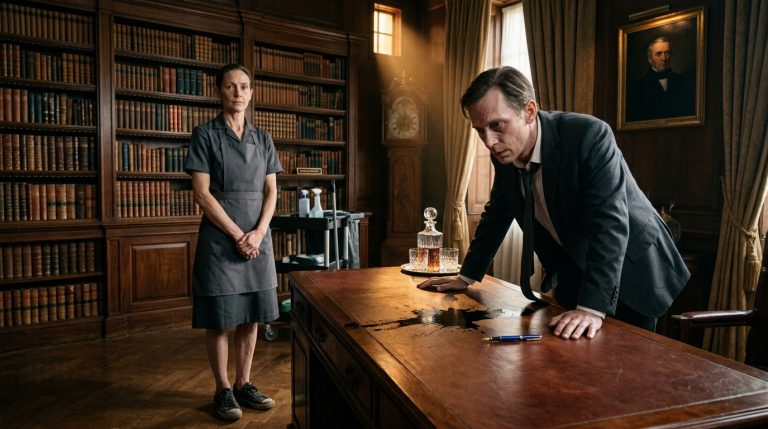
Jessica felt the tremors through the soles of her shoes—a rhythmic, deep-seated pulse that traveled up from the sub-floors and rattled the very fillings in her teeth. It was a sensation she had learned to interpret over the last two weeks: not a quake, but a stutter in the building’s mechanical soul. She steered her cleaning cart around a cluster of panicked residents hurrying toward the elevator bank, their designer suitcases sounding like thunder on the polished Italian marble.
“It’s getting worse, Mom,” Khloe whispered. She was standing by the floor-to-ceiling glass, her small hand pressed flat against the pane. She wasn’t looking at the fleeing guests. She was looking at the way the palm trees on the coast swayed in the rising evening breeze.
“Don’t touch the glass, honey,” Jessica murmured, her voice strained. She wiped a smudge off the brass railing, her eyes searching the corridor for a supervisor. She needed to finish the lobby, to be the shadow they expected her to be, but the building was making it impossible to remain invisible. The very air felt heavy, charged with a frequency that made the hair on her arms stand up.
Khloe pulled her hand back, but her brow remained furrowed. She pulled her worn sketchbook from her bag, her pencil moving with a desperate, scratching speed. She wasn’t drawing the lobby; she was drawing the wind.
“It’s not the ground,” Khloe murmured, almost to herself. She didn’t look at the cracks appearing in the plasterwork—the ones the insurance adjusters were busy documenting as seismic damage. She watched the way the wind caught the building’s exterior fins. “They think it’s the sand shifting, but they’re not listening to the shape of the air.”
Jessica sighed, a weary sound that seemed to pull at her chapped skin. She didn’t have the energy for her daughter’s puzzles tonight. She only had the fear of the eviction notice that would surely follow the building’s failure. If the tower fell, they fell.
A sudden, sharp pop echoed through the lobby—the sound of a high-tension cable snapping somewhere deep within the structure’s mid-section. The lights overhead flickered, dying for a heartbeat before surging back to a sickly, jaundiced yellow. A woman in a silk evening gown screamed, dropping her clutch, and the sound was swallowed instantly by the building’s low, persistent moan.
Khloe’s gaze snapped toward the ceiling. Her eyes, usually so soft and observant, were suddenly hardened with a terrifying clarity. She reached out and grabbed her mother’s wrist, her grip surprisingly strong for a girl of twelve.
“Mom, look at the chandelier,” Khloe said, her voice rising above the ambient groan. “It’s not swinging because of the wind outside. It’s moving because of something we’re building into the wall.”
Before Jessica could reply, the lobby doors burst open, and a man in a bespoke suit—the kind that cost more than their yearly rent—strode in, surrounded by a phalanx of security guards. It was Khaled Alfahim. He looked less like a developer and more like a king whose palace was crumbling around his ears.
He stopped, his eyes scanning the chaos, and landed on them—the woman with the mop and the girl with the sketchbook. He didn’t see people; he saw an interruption.
“You,” he barked, pointing directly at Jessica. “Clear this lobby. I need this space for the engineers, not for—”
He cut himself off, his eyes shifting to Khloe, who hadn’t stepped back. She was still staring at the wall, her pencil hovering over the paper, her eyes mapping the invisible tension in the steel beams.
“Do you have something to say, child?” Khaled asked, his voice dripping with a predatory, cold amusement. “Or are you just waiting to be fired?”
CHAPTER 2: The Boardroom Storm
The silence Khaled Alfahim demanded did not come. Instead, it was filled by the building’s groan—a sound like a giant inhaling through a straw.
Jessica felt her knees lock, the mop handle vibrating against her palms. She didn’t look at Khaled; she looked at his shoes—impossibly polished, devoid of the grit and dust that coated her own tired boots. Beside her, Khloe hadn’t moved. The girl’s hand was still clenched around her sketchbook, her knuckles white. She was looking at the ceiling, not at the billionaire, as if she could see the very bones of the tower shifting behind the plaster.
“I asked a question,” Khaled repeated, his voice dropping into that smooth, lethal register that had dismantled competitors in Tokyo and New York. He wasn’t shouting. He didn’t have to. The security guards tightened their perimeter, their shadows falling over mother and daughter like a closing cage. “Is the child a mute, or is she merely waiting for the building to collapse before she deigns to speak?”
“She’s just a girl, sir,” Jessica managed, her voice trembling despite her effort to keep it level. She stepped forward, an instinctive barrier between Khloe and the man’s razor-sharp focus. “She’s frightened. We’ll leave. We won’t disturb your meeting.”
“Frightened?” Khaled let out a short, hollow laugh that didn’t reach his eyes. He turned his head, gesturing to the lobby’s main floor where the architects and structural engineers—men in grey suits holding stacks of seismic data—were huddled around a tablet. “These men are frightened. They have billions of dollars in potential losses and enough degrees between them to wallpaper the lobby. They are frightened because their math has failed them.”
He stepped closer, invading Jessica’s space with the subtle scent of expensive cologne and ozone. “And yet, your daughter stands here, drawing lines on a piece of cheap paper, seemingly unmoved by the chaos. Either she is a savant, or she is a distraction. And in this tower, we have no room for either.”
Khloe finally looked down, her gaze meeting Khaled’s. It was a terrifyingly calm observation, the kind of look a doctor might give a patient whose symptoms are obvious. “It’s not the ground,” she said, her voice small but resonant, carrying perfectly through the lobby. “The building isn’t shaking because the foundation is weak. It’s shaking because it’s being played.”
A stifled cough came from the group of engineers near the elevators. Khaled’s smile vanished, replaced by a tight, thin line of irritation.
“Played?” Khaled asked.
“Like a musical instrument,” Khloe continued, her focus drifting back to the wall. She tapped the concrete, a dull, resonant thud. “The vibration is constant. It follows the wind currents. If you look at the stress charts for the foundation, you won’t find the cause. You’re looking for a crack, but you should be looking for a note.”
Khaled turned slowly to his lead architect, Preston Finch, who had been hovering at the edge of the phalanx. Finch looked like he hadn’t slept in a week. His tie was loose, his hair disheveled. He stared at Khloe with a mix of exhaustion and dawning, irrational annoyance.
“She’s a child, Mr. Alfahim,” Finch said, his voice raspy. “The resonance is clearly seismic. We’ve logged every micro-tremor. We’ve accounted for the underground aquifers. Her ‘musical’ theory is nothing more than a misunderstanding of structural acoustics.”
Khloe didn’t argue. She just turned the page in her sketchbook. She had drawn the exterior fins—those elegant, bladelike structures that gave the Oasis Tower its iconic, twisting silhouette. She pointed to them. “The wind goes through, not just around. And when it hits the blades, they don’t just stand there. They catch the air. It’s a whistle.”
Khaled looked at the drawing, then back at the girl. The atmosphere in the lobby shifted; it was no longer about a cleaning crew being in the way. It was about the fragility of his own image. He felt the weight of the cameras that were always hidden in the lobby, recording his every move for the board of directors. He couldn’t afford to be seen bullying a child, but he couldn’t afford to have this ‘circus’ continue, either.
“Very well,” Khaled said, his voice suddenly sharp, a command rather than a request. “You seem so certain of your ‘whistle.’ My morning meeting is in ten minutes on the 120th floor. If you are so convinced that your observation holds more weight than the findings of the top architectural firms in the world, then come. Prove it. But be warned: the boardroom is where we settle truths, not where we indulge fantasies.”
He turned on his heel, his entourage trailing him like a wake of dark water. He didn’t wait for a response. He expected them to follow—or to run.
Jessica felt the blood drain from her face. “Khloe, no,” she whispered, grabbing the girl’s shoulder. “We are walking out of here. We are going home.”
“Mom, he’s going to close the building,” Khloe whispered back, her eyes wide with a frantic, quiet intensity. “If they keep trying to fix the foundation, the structure will fatigue. They’ll force an evacuation, and you’ll lose your job, and we’ll have nothing left. I have to show them.”
“You’re twelve!” Jessica hissed, the reality of the situation crushing her. “You don’t talk to men like that! You don’t walk into boardrooms!”
“I have to,” Khloe said, pulling her arm away. She looked at her mother, her expression so resolute it stopped Jessica’s breath. “He’s listening to the wrong story, Mom. And I’m the only one who knows how to tell the right one.”
As Khloe began to walk toward the elevators, following the path of the billionaire, Jessica had no choice. She reached out, straightened her apron with a trembling hand, and followed her daughter into the elevator. The doors slid shut with a soft, final hiss, sealing them into the upward-climbing cage, leaving the trembling lobby behind for the suffocating silence of the penthouse level.
The ride was agonizingly smooth. Khloe stood at the back of the car, her eyes closed, her hand pressed against the metal wall, feeling the vibrations through her fingertips. The building hummed—a low, rhythmic thrumming that felt less like mechanical operation and more like a heartbeat, growing stronger, more insistent, as they rose higher.
“It’s louder up here,” Khloe muttered.
“Don’t,” Jessica begged, though she knew it was useless.
The elevator dinged. The doors opened to the 120th floor—a space of dark mahogany, filtered light, and the cold, oppressive scent of absolute power. The boardroom waited.
CHAPTER 3: The Silent Observation
The boardroom air was thin, chilled to a clinical degree that stood in sharp contrast to the desert heat radiating through the floor-to-ceiling windows. Khloe stepped out of the elevator, her sneakers feeling clumsy and loud against the seamless expanse of white-flecked obsidian flooring.
Khaled Alfahim stood at the head of the long, mahogany table, his back to them as he stared out over the vast, shimmering sprawl of Dubai. The room was already occupied. Men in charcoal-grey suits were scattered across the space, their faces etched with the fatigue of a losing battle. Papers were strewn everywhere—topographic maps, seismic data, stress-test logs that formed a chaotic geography of failure.
No one looked up as they entered, but the tension in the room thickened, a tangible weight that made it hard to draw a full breath. Khloe felt the building’s groan vibrate through her heels. It was stronger here—a low-frequency shudder that seemed to pull at the very marrow of her bones.
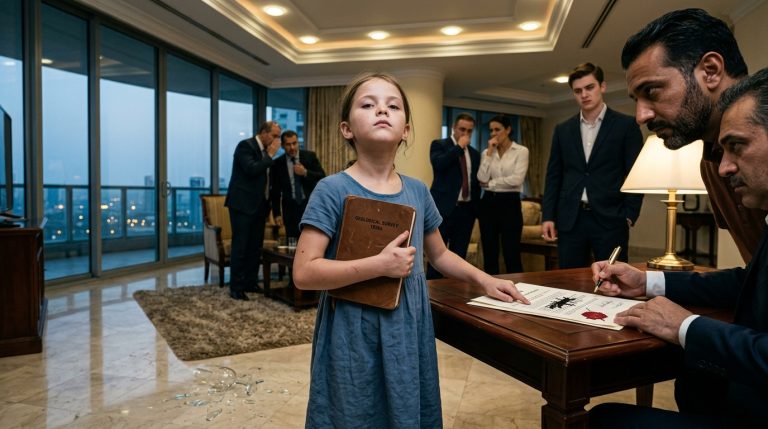
She didn’t move toward the table. Instead, she followed a small, subtle observation. On the edge of the mahogany surface, a half-full crystal glass of water had been left behind. It sat near a pile of discarded engineering reports. As the building pulsed, the water didn’t just ripple; it danced. The surface of the liquid was perfectly still until the hum spiked, then fine, concentric lines formed—a precise, geometric spiderweb of motion.
Khloe walked toward it, her movements slow and deliberate. She ignored the way the investors and engineers turned to watch her, their expressions a mixture of condescension and annoyance. She reached the table and leaned in, her eyes locking onto the glass.
“It’s not erratic,” she whispered.
“What did you say?”
Khaled had turned. He was watching her, his arms crossed over his chest, his expression unreadable. He had moved from the window, his presence now dominating the center of the room.
Khloe didn’t look at him. She reached out and touched the mahogany surface, feeling the vibration transfer through the wood. She closed her eyes. Her grandfather’s voice, a gravelly, phantom comfort, echoed in her mind: Don’t look at what it is. Look at what it does.
“The shaking isn’t coming from the ground,” Khloe repeated, opening her eyes. She pointed to the glass. “If it were a seismic event, the ripples would be chaotic. They’d hit the sides of the glass and bounce back in a mess. But these are constant. They’re rhythmic.”
Preston Finch, the architect who had been dismissive in the lobby, let out a scoffing laugh. He stood up, his face flushed with the indignity of being corrected by a child. “A glass of water? This is your grand diagnostic tool? We have seismographs buried a hundred meters into the bedrock, young lady. We have satellite-linked sensors. We know the building is shaking. We just don’t know why.”
“You’re looking for a beast,” Khloe said, her voice small but surprisingly firm in the vast room. She looked at Finch, her blue eyes devoid of the fear he expected to see. “You’re looking for a crack or a shift or something big enough to move a skyscraper. But the vibration isn’t big. It’s just… persistent.”
She looked back at the glass. A discarded coffee cup nearby, resting on a leather coaster, began to rattle against the mahogany. It wasn’t a violent shake; it was a rhythmic, high-pitched chatter that moved in sync with the water’s ripples.
“Listen,” she commanded.
The room went quiet. Not the polite silence of a meeting, but the hollow, expectant silence of a tomb. Khloe tilted her head, her gaze shifting to the windows, then back to the vibration of the cup.
“There’s a note,” she said. “The building is playing a note.”
“A note?” Finch repeated, his voice dripping with sarcasm. “The building is a billion-dollar feat of engineering, not a piano.”
“It’s a harp,” Khloe corrected. She walked to the window, pressing her small hand against the cool, thick glass. She could feel the wind pressing against the exterior—not a gust, but a steady, relentless stream of air sweeping off the desert. “It’s a harp, and you’ve tuned it so tightly that the wind can’t help but play it.”
Khaled stepped forward, his eyes narrowing. He looked at his engineer, then back at the girl. He didn’t see the child anymore; he saw a disruption. A variable he hadn’t accounted for.
“How do you know that?” Khaled asked, his voice low.
“Because my grandfather taught me,” Khloe said, her gaze drifting toward the shimmering, twisting fins that lined the building’s exterior. “He said that when you build something to look like a sculpture, you sometimes forget that it also has to live in the wind. You built a statue, but you forgot about the air.”
She didn’t know the physics yet—she couldn’t name the vortex street effect or explain the fluid dynamics of the carbon-fiber blades—but she knew the feeling. She knew the way a string felt when it was pulled to its breaking point. And right now, the Oasis Tower wasn’t just a building; it was a symphony of tension, screaming for a release that none of the experts in the room were even looking for.
Khloe looked at the discarded blueprints covering the table. She wanted to see them. She needed to see the spacing of those fins. But she knew that if she asked, they would deny her. She had to be more than a cleaner’s daughter; she had to be a mirror.
She turned back to Khaled, her heart hammering against her ribs. She was terrified, but she stood her ground. “If you don’t believe me, look at the frequency of the glass. You don’t need a seismograph to tell you what the tower is doing. You just need to see how the water moves.”
The room remained stagnant. The hum seemed to grow, a low, tectonic groan that vibrated through the floorboards. Finch gripped the back of his chair, his knuckles white. He looked at the glass, then at the blueprints, his brow furrowed in a flicker of doubt.
Khloe stepped away from the window, her pulse a frantic rhythm in her ears. She had planted the seed. Now, she had to wait to see if they were arrogant enough to ignore it, or desperate enough to take the bait.
CHAPTER 4: The Blueprint Disclosure
Khloe did not look away from the blueprints. The sheets were massive, spread out like the skin of a giant, covered in the intricate, cryptic language of structural engineering. To the executives in the room, they were a record of investment; to the engineers, a record of failure. To Khloe, they were a set of instructions, a story waiting to be read.
She stepped closer, her hand hovering just inches above the paper. She could see the intricate lines marking the exterior cladding—the decorative fins that curved with a mathematical precision that defied nature.
“Mr. Finch,” Khloe said, her voice quiet but carrying clearly through the stillness of the boardroom. She didn’t look at him; her eyes were scanning the elevation drawings. “You designed these to be identical, didn’t you? Every fin is spaced precisely to maintain the tower’s sculptural profile.”
Preston Finch straightened, his face hardening as he approached the table. He leaned down, his shadow falling across the plans. “Of course they’re identical. It’s an aesthetic requirement. The visual rhythm of the tower is why it won the international design competition. Symmetry is the bedrock of architecture, child. Something you obviously wouldn’t understand.”
“It isn’t about understanding,” Khloe replied, her finger tracing a line on the paper—a faint, dotted blue line denoting the wind flow simulation. “It’s about what the wind does when it sees symmetry. If you give the wind a uniform path, it builds energy. It’s just like my grandfather’s guitar strings. If they’re all tuned to the same pitch, they don’t just stay silent—they harmonize.”
She looked up at him, her blue eyes intense. “You didn’t build a building. You built a resonant chamber.”
A sudden, sharp movement caught her eye. Khaled Alfahim had moved from the window. He was standing a few feet away, his arms still crossed, his eyes studying her with a disturbing, predatory focus. He wasn’t looking at the blueprints anymore; he was looking at her, as if trying to calculate the worth of a mind that could see past his own obsession with perfection.
“Dr. Reed,” Khaled said, his voice cutting through the tension like a blade.
The older woman, who had remained silent in the corner of the room, stepped forward. Her presence was like a sudden drop in temperature. She looked at the drawings, then at Khloe, then at the half-full glass of water still trembling on the mahogany.
“Mr. Finch,” Reed said, her voice calm and authoritative, “I believe the young lady is asking to see the aerodynamic data. The actual wind tunnel reports. Not the summaries, but the raw, unfiltered data.”
“That data is proprietary,” Finch blurted, though his voice lacked conviction. He looked at Khaled, who remained silent, his gaze fixed on Khloe.
“Provide it,” Khaled commanded.
Finch’s shoulders slumped. He gestured to his assistant, who scrambled to the computer terminal at the end of the room. The massive overhead screen flickered, casting a pale, cold light across the boardroom. A 3D wireframe of the Oasis Tower appeared, rotating slowly in the void.
Khloe stepped back, her heart racing. As the screen populated with data, a sudden wave of nausea washed over her—a memory, vivid and overwhelming. She was back in her grandfather’s dusty workshop, the smell of sawdust and stale tobacco filling the air. He was holding a piece of scrap steel, demonstrating how the shape of a wing changed the flow of air. “Don’t look at the whole, kiddo. Look at the edges. Everything happens at the edges.”
She shook the memory away, focusing on the screen. The data was a dizzying array of numbers, but she didn’t need to read the digits. She looked at the heat maps—the colors representing wind pressure. The red zones, the areas of highest stress, were perfectly aligned with the placement of the decorative fins.
She felt a strange sensation in her chest, a mixture of fear and triumph. She reached out, touching the screen as the wireframe spun. “See?” she said, her voice barely a whisper. “The pressure is highest here. And here. It’s not a uniform load. It’s a rhythmic, pulsed strike. Every time the wind hits one of these, it sheds a vortex. And because they’re all in a line, the tower is catching them all at once.”
She was mapping the unseen. The room felt smaller now, the air heavy with the realization that the “impossibility” they had been fighting for three months was just a matter of geometry.
Finch was leaning in, his face inches from the screen. He was running his own mental calculations now, his lips moving in a silent, frantic rhythm. The arrogance that had anchored him was beginning to fray, replaced by the crushing weight of a professional epiphany. He stared at the fins, then at the wind flow lines, and his expression crumbled.
“It’s not seismic,” Finch muttered, his voice barely audible. “It’s… it’s harmonic amplification.”
Khaled looked from the architect to the girl. He didn’t look happy. He looked cornered. He had built this tower to be a testament to his own vision, and now, that vision was being dismantled by a child with a sketchbook and a memory of a dead man’s lessons.
“Can it be fixed?” Khaled asked. His voice wasn’t directed at Finch. It was directed at Khloe.
Khloe looked at the blueprints, then at her mother, who was standing by the door, her eyes wide with a mixture of terror and fierce, quiet pride. She knew that if she answered, there was no going back. She would be an active participant in this, no longer just a shadow in the halls.
“You don’t have to tear the tower down,” Khloe said, her voice steady. “You just have to stop the song.”
She reached for the digital marker, her hand steady, and began to draw on the screen—a series of small, simple shapes, breaking the rhythm of the fins. It was a chaotic, ugly pattern, the antithesis of the symmetry Khaled loved, but it was the only way to save what he had built.
CHAPTER 5: The Harmonic Diagnosis
The building answered Khloe’s diagnosis with a roar.
It wasn’t a mechanical failure this time; it was a structural shudder that started in the tower’s midsection and traveled upward, a violent, kinetic ripple that made the mahogany table groan and the crystal water glass jump, spilling a fine mist of liquid across the blueprints. The lights flickered, casting long, frantic shadows across the faces of the men in the room.
“It’s happening again,” Preston Finch gasped, clutching the edge of the table as the floor beneath them tilted, just a fraction, then corrected itself. “The resonance is peaking. The vortex shedding—if she’s right about the blades—it’s hitting the structural limit.”
Khloe didn’t wait for permission. She grabbed the digital marker again, her heart thumping a frantic, irregular rhythm in her chest. She needed to explain why the baffle pattern had to be random. She turned to the screen, her movements sharp, urgent.
“If you make the pattern uniform, you just move the problem,” she said, her voice rising to cut through the building’s low, ominous rumble. “You have to create interference. You have to make the wind fight itself.”
She began to sketch, a frenzy of black lines across the wireframe. She wasn’t an architect, and she wasn’t an engineer—not by title—but she understood the physics of the fight. She knew how to break a cycle. She drew the baffles in a sequence that defied the elegant, sweeping curves of the tower, a jagged, broken line that looked like a scar on the building’s surface.
“There,” she said, breathlessly. “Randomized spacing. If the wind hits one fin, the next one is shielded by the baffle, and the one after that is vibrating at a different frequency. You don’t have to change the tower. You have to break the unity of the song.”
Khaled Alfahim stood dead center in the room, his eyes fixed on the chaotic pattern she had drawn. For a man who had built his life on order, on the absolute perfection of lines and the cold, hard logic of the market, Khloe’s drawing was offensive. It was a ruin. It was a masterpiece of disorder.
“You’re suggesting I cover my masterpiece in… scars?” Khaled’s voice was a low, dangerous growl. He stepped toward the screen, his gaze tracing the jagged, uneven baffles. “Do you realize what that would look like? It would turn a piece of sculpture into a… a construction site.”
“It’s either that,” Khloe said, her voice tight, “or you let it tear itself apart.”
The building shuddered again, harder this time. A heavy glass vase on a side pedestal tipped, sliding slowly across the marble floor with a screeching, metallic sound before shattering into a hundred jagged diamonds. Jessica, who had been standing by the door, took a step forward, her hand reaching for her daughter, but she stopped. She saw the light in Khloe’s eyes—not the fear of a child, but the absolute, crushing focus of a person who had solved a puzzle and was waiting for the world to catch up.
Dr. Reed, who had been studying the data with a grim, analytical intensity, finally spoke. “Mr. Alfahim, she is correct. The harmonic dampening isn’t about structural reinforcement; it’s about fluid dynamics. If we install these baffles, we aren’t just changing the look of the tower—we are changing its physics. We are forcing the wind to dissipate its energy before it can feed the vibration.”
“And if she’s wrong?” Khaled demanded, turning on Reed. “If we go through the expense of retrofitting, if we close off the floors, if we alter the design, and the humming continues?”
“Then you’ve lost a few million more,” Reed replied, her voice cold. “But if you don’t, you’ve lost the building.”
The building groaned, a deep, percussive sound that felt like the tower was settling into its own collapse. The floor beneath them swayed, a sickening motion that reminded everyone in the room that they were hundreds of feet in the air, suspended on a skeleton of steel that was currently screaming.
Khaled stared at the screen, at the jagged lines of the baffle pattern. He looked like a man watching his reflection shatter. For a long, painful minute, he didn’t move. The silence of the boardroom was filled with the sound of his ragged breathing.
Then, he turned to his assistant. “Rashid. Get the staging team on the line. I want the carbon-fiber components fabricated. Now. I want this done.”
“The pattern?” Rashid asked, glancing at the screen.
“Do it exactly as she’s drawn it,” Khaled said, his voice stripped of its usual veneer of polish. He turned back to Khloe, his eyes dark, unreadable. “You realize what this does, don’t you? You’re not just solving a problem. You’re changing my vision.”
Khloe didn’t blink. She felt the vibration in her feet, the way the tower was fighting against its own design. “I’m not changing it, sir. I’m just making it survive.”
She turned away from the screen, her legs feeling heavy, the adrenaline beginning to ebb, leaving behind a profound, bone-deep exhaustion. She saw her mother moving toward her, the look in Jessica’s eyes a mixture of awe and terror. They were still standing in the eye of the storm. The baffles weren’t installed yet, and the wind was still rising, the desert night bringing a fresh, steady gust that threatened to push the tower to its limit.
The struggle wasn’t over. They were caught in the transition, the dangerous space between a disaster and a fix. Khloe gripped her mother’s hand, the reality of the situation sinking in: they had won the argument, but the tower was still humming, and the night was still young.
CHAPTER 6: The Engineered Solution
The wind on the 82nd floor was not the gentle breeze that stirred the palms below; it was a physical force, a relentless, invisible hand that grabbed at Khloe’s harness and tugged at her custom-fitted hard hat. She stood on the edge of the high-tech platform, a narrow steel stage suspended against the sheer obsidian glass of the Oasis Tower. Below her, the city was a scattering of blurred lights, a distant constellation that meant nothing. Up here, there was only the sound of the wind screaming through the fins.
“Hold that bracket steady!” the German lead engineer shouted, his voice barely audible over the gale. He was clipped into the railing, his face a mask of focus as he aligned the first of the carbon-fiber baffles against the sleek, black blade of the tower’s exterior.
Khloe reached out, her gloved fingers trembling slightly—not from fear, but from the raw, vibrating energy of the structure. She could feel the whistle in her marrow, a high-frequency tension that hummed through the steel platform and up into her boots. It was the note of the tower, the note that had nearly brought the skyscraper to its knees.
“It’s not aligned,” Khloe yelled back, pointing to the gap between the baffle and the fin. “The flow is still catching the edge. If you don’t break the seal, the vibration won’t dissipate.”
The engineer glanced at her, his eyes narrowed behind his protective goggles. He was a veteran of a dozen such projects, a man who built things to last, yet he deferred to the twelve-year-old girl with a trust that bordered on the irrational. He nudged the baffle two millimeters to the left.
“Now?” he roared.
Khloe pressed her palm against the fin. The vibration felt like an angry insect trapped under the metal, a frantic, high-speed thrumming that threatened to shake the bracket loose. She guided his hand, her own fingers tracing the exact point where the air would break. “There. Now.”
The impact of the bolt driver was a sharp, percussive sound that seemed to cut through the roar of the wind. Rat-a-tat-tat. As the screw bit into the composite, the metal beneath her palm shuddered, and then—for a fraction of a second—it shifted. The high-pitched whine that had been the tower’s hallmark dropped a full octave, turning into a dull, flat thud.
“We got it,” the engineer said, his voice breathless with a sudden, giddy relief. He looked at Khloe, a grin breaking across his dust-streaked face. “One down. Three hundred and ninety-nine to go.”
Khloe didn’t grin back. She felt the change in the structure—a momentary shift in the way the wind moved across the surface. It was working, but the complexity of the pattern she had drawn—the “scars” she had called them—was immense. Every baffle had to be perfect, every placement calculated to create that precise, chaotic interference.
As they moved the platform to the next section, Khloe noticed something that sent a chill through her despite the warmth of her heavy jacket. A maintenance worker was watching them from a nearby access hatch, his face partially obscured by a dust mask. He held a tablet, his eyes fixed not on the baffle installation, but on the data coming in from the interior sensors. He didn’t look like he was checking the work; he looked like he was monitoring a failing heart.
Khloe turned away, but the image lingered. Why was a maintenance worker watching the sensors? That was the engineers’ job, or Dr. Reed’s. The suspicion was a cold, sharp prickle at the base of her neck. She pushed the thought aside, forcing herself to focus on the next fin. They were three hundred feet in the air, suspended by a wire, fighting a war against a ghost of physics.
“Khloe! Grab the next segment!”
She reached for the baffle, the material rough and abrasive against her gloves. The wind tugged at her, the tower swaying in a wide, slow arc that made her stomach turn. She focused on the rhythm of the work: Measure, align, drill, seal. It was a meditative, brutal process. Every baffle they installed was a piece of the puzzle she had solved in the quiet of the boardroom, a physical manifestation of her own theory.
But as the night deepened, the atmosphere on the platform changed. The wind speed increased, the desert gusts turning into a sustained, heavy pressure that made the tower groan in a way that felt deeper, more visceral than before. The vibration wasn’t just in the fins anymore; it was in the entire floor they were standing on.
“The resonance is shifting!” the engineer shouted, his voice cracking. “The tower is trying to compensate for the new damping!”
Khloe felt it too. The tower was fighting back. It was an organism, a massive, engineered entity that didn’t want to be changed. The vibrations became irregular, jerking the platform against its cables. Khloe gripped the railing, her eyes scanning the tower’s surface.
She saw it then—a ripple in the glass, a tremor that ran through the entire midsection of the tower. It wasn’t the fins. It was the load. By changing the fins, they were redistributing the stress across the entire structure. The tower was finding a new frequency, a new note to play.
“We have to stop,” Khloe said, her voice sharp. “We’re creating a harmonic shift in the secondary load-bearing frame. If we keep going at this rate, we’re going to snap the connection points.”
The engineer looked at her, his eyes wide. “We can’t stop. Khaled wants the south face completed by dawn. If we stop, we’re fired.”
“If we don’t stop, the tower is going to shake itself to pieces!” Khloe yelled.
She looked toward the penthouse levels, toward the boardroom where Khaled was watching, waiting for the miracle. She realized then that they were in a race against the very structure they were trying to save. Every baffle they installed was a success, but the tower was a battlefield, and the enemy was shifting its position. They weren’t just installing parts; they were playing a game of chess against a billion-dollar monster.
CHAPTER 7: The Evening Test
The platform lurched, a sickening, bone-jarring drop of six inches that sent a spray of sparks showering into the darkness below. Khloe slammed into the safety railing, the metal biting into her chest as the wind whipped her hair into a tangled, freezing shroud. Beside her, the lead engineer had lost his grip on the heavy carbon-fiber baffle; it tumbled away, a black, blade-like shadow that vanished into the void before disappearing into the city’s glowing grid.
“It’s failing!” he shouted, his voice hoarse with terror. He was fumbling with his safety tether, his eyes wide as the entire section of the tower’s exterior shell began to oscillate in a violent, high-speed blur. “The secondary frame is overloaded! We’ve created a nodal point at the eighty-second floor!”
Khloe didn’t move. She stared at the tower’s edge. She saw the problem with terrifying clarity. They had disrupted the airflow, but in doing so, they had forced the vibration to relocate. The energy hadn’t disappeared; it had concentrated, pooling into the rigid joints where the decorative fins met the main support structure. The tower was reacting like a wounded animal, its frame twisting to find a new equilibrium.
“We have to bypass the secondary support!” Khloe screamed, grabbing the engineer’s harness to steady him. “The baffles are doing their job, but the load is dumping into the joints! We need to create a flex point!”
“Are you insane?” he roared, the metal platform screeching against the glass track as it swayed precariously. “If we release the tension, the fin will snap!”
“If we don’t, the whole floor collapses!” Khloe looked up, her gaze tracing the line of the tower’s skin toward the penthouse. She saw the lights of the boardroom, a small, brilliant square of calm in the midst of the building’s chaos. She knew Khaled was watching, his entire empire riding on the success of these final hours. If the tower failed now, the collapse would be total—not just structural, but a catastrophic failure of reputation and reality.
She reached into her tool belt, her gloved fingers searching for the small pneumatic tensioner they used for alignment. “We don’t need to break the fin,” she said, her voice dropping into a desperate, focused calm. “We need to modulate it. We need to turn the fin into a shock absorber.”
She lunged for the next bracket, the wind fighting her every step of the way. The tower shuddered again, a percussive boom that vibrated through the glass, and Khloe felt a hairline fracture spiderweb across the window beside her. The sound was like a gunshot in the dark.
“Khloe, get back!” the engineer yelled, but she was already on her knees, the tensioner pressed against the primary anchor bolt of the fin.
She began to turn the manual override, her muscles straining as the metal resisted her. She felt the tower’s vibration—a powerful, rhythmic beat—transferring into the tool, the friction so intense that her gloves began to smoke. She was trying to introduce a mechanical “slip” into the rigid mount, a microscopic movement that would allow the fin to flex rather than resist.
The tower screamed. It was a high, piercing note that made her ears ring, a sound that defied the laws of structural engineering. It was the sound of a billion-dollar monument being forced to its knees.
“Hold it!” Khloe commanded, her hands locked on the tool.
The vibration intensified, a frantic, rattling shake that felt like the world was vibrating to pieces. She closed her eyes, the image of the blueprint burned into her mind. She visualized the stress lines, the way the pressure was building behind the glass, and she turned the wrench one last, decisive notch.
A sudden, sharp click echoed against the tower’s skin. The high-pitched whine abruptly died, replaced by a deep, low-frequency hum that sounded almost like a sigh. The oscillation slowed, the platform steadying as the tower’s skin absorbed the load and flexed in response.
The silence that followed was heavy, absolute, and terrifying.
Khloe slumped against the platform railing, her breath coming in ragged, freezing gasps. The engineer was staring at her, his face pale, his hands shaking so violently he had to hook them into his belt. For a long, heart-stopping moment, they just hung there, suspended against the obsidian cliff of the tower, waiting for the building to wake up again.
The hum didn’t return. The wind whistled, but it was just wind—a natural, chaotic, unmusical sound.
“We did it,” the engineer whispered, his voice cracking with disbelief.
Khloe didn’t speak. She looked at her hands, the thick, heavy gloves scorched by the friction of the tool. She had done it, but as she looked toward the top of the tower, she felt a profound sense of foreboding. They had stabilized the physical crisis, but they had also exposed the structural weakness. The tower would stand, but it was no longer the perfect, impenetrable monument Khaled had intended. It was a flawed, breathing thing, now held together by the very “scars” she had created.
The maintenance worker she had seen earlier was gone from the access hatch, but his presence lingered—a ghost in the machine. Khloe shivered, the cold finally sinking through her layers. She knew that as soon as she stepped off this platform, everything would change. The tower was quiet, but the truth was beginning to make a sound of its own.
CHAPTER 8: The New Foundation
The sunrise arrived not as a dramatic event, but as a slow, creeping gilding of the desert horizon. Inside the 120th-floor boardroom, the light hit the polished surfaces of the mahogany table, revealing the fine, microscopic dust of construction and the scattered, discarded blueprints that had defined their desperate struggle.
Khloe stood near the window, her hands thrust deep into the pockets of her jacket. She was exhausted—a deep, marrow-aching weariness that made the air feel thick and hard to breathe. The tower was quiet. The low-frequency groan that had haunted the structure for months was gone, replaced by the soft, ambient hum of the life-support systems. It was a sound of normalcy, a sound of peace, but to Khloe, it sounded like a victory earned in the dark.
Khaled Alfahim sat at the head of the table. He was still, his hands resting on the armrests of his chair, his gaze fixed on the screen where the wireframe model of the Oasis Tower now glowed with a steady, stable green. He didn’t look like a titan of industry anymore. He looked like an old man who had finally realized that his monument was, at its heart, as fragile as the people he had spent his life stepping over.
“You knew,” he said, his voice barely a rasp. He didn’t look at her; he looked at the wireframe. “You knew the moment you walked in. You didn’t just guess, Khloe. You saw the architecture of the flaw.”
“I saw what it was doing,” Khloe said, her voice soft. “You were trying to make it perfect. You thought if you just built it big enough, strong enough, and symmetrical enough, it would stand forever. But perfection isn’t a state of being, Mr. Alfahim. It’s a balance. And you forgot to leave room for the wind.”
Khaled let out a long, shuddering breath, a sound that seemed to deflate the tension that had held him upright for the last twenty-four hours. He turned his head, his eyes meeting hers. There was no arrogance left—only a stark, raw vulnerability that made her chest ache. “I built this to be a monument to my success. I thought that by imposing my will on the skyline, I could… outlast the messiness of things. The doubt. The failure.”
“Things break,” Khloe said, repeating a lesson her grandfather had taught her in the dusty, quiet corners of his workshop. “That’s how you know they’re real.”
The boardroom doors opened, and Jessica stepped in, followed by Dr. Reed and Rashid. The atmosphere shifted—the sharp, transactional tension of the last few days began to dissolve, replaced by the mundane, rhythmic reality of a building that needed to function again. Rashid approached the table, laying down a leather-bound folder.
“The trust documents, sir,” Rashid murmured, his voice respectful, almost reverent. “And the contract for Director Hayes.”
Khaled looked at the folder. He reached out, his hand hovering over it, then pushed it toward Jessica. “Director Hayes. It sounds strange, doesn’t it?”
Jessica took the folder, her hands steady. She looked at Khloe, then at the man who had once treated them as part of the lobby’s background. “It sounds like a beginning,” she said, her voice clear and dignified.
Khloe walked to the center of the room, her gaze falling on the small crystal glass of water that had become their accidental diagnostic tool. It was still there, sitting on the mahogany. She picked it up. The water was perfectly still, a flawless, translucent surface reflecting the orange light of the dawn.
She walked over to the desk near the window—the place where the architectural model of the tower had once stood, the one Khaled had sneered at. She placed the glass on the desk, right in the center of the wood. It was a small, fragile, and absolutely perfect object in a room designed for power.
“You don’t have to change the tower anymore,” Khloe said, turning to look at Khaled one last time. “You just have to maintain it. If you keep listening, it will keep standing. That’s the only promise it can make.”
Khaled stood up, a slow, deliberate movement. He looked at the glass, then at the girl who had saved his legacy by breaking his pride. He walked toward the window, looking out over the city he had helped define. “I think,” he said, “I have been listening to the wrong things for a very long time.”
As he spoke, the first staff of the morning began to move through the lobby downstairs—the sound of footsteps, the chime of elevators, the distant, muffled voice of the city starting its day. It was the sound of a world that didn’t care about the ego of its builders, a world that just kept turning, kept breathing, and kept standing, as long as you understood the forces that pressed against you.
Khloe felt her mother’s hand on her shoulder, a warm, grounding pressure. She didn’t feel like a hero. She didn’t feel like a genius. She felt like a girl who had helped fix a broken thing. And as she looked out at the horizon, she realized that the tower was no longer screaming. It was finally, quietly, at rest.