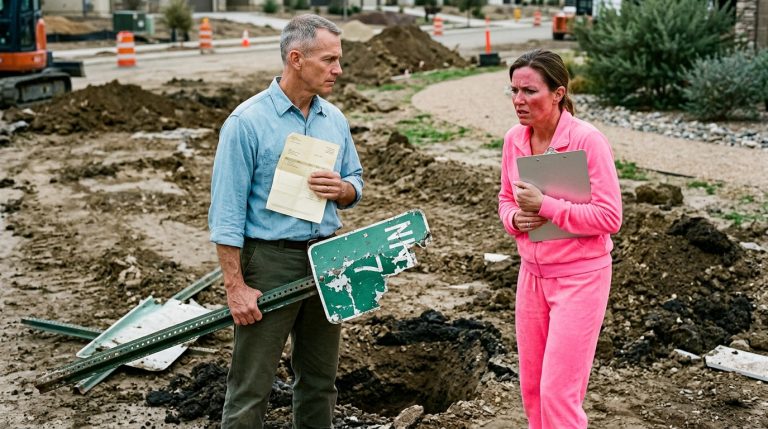
The Architect of Silence: How a Combat Engineer Dismantled a Tyrant’s Kingdom One Document at a Time
CHAPTER 1: THE BORDERLINE
The morning was brittle, the kind of quiet that precedes a pressure drop. I stood at the edge of the berm, the twenty-foot wall of earth I had spent my retirement savings to construct, and felt the weight of the silence. It wasn’t the peaceful silence of nature; it was a pressurized, waiting silence.
Then, the clicking of sensible heels on gravel. Karen.
She didn’t just walk; she occupied space. She stood at the invisible divide where my fifteen acres ended and the Lakeside Meadows subdivision began. Her floral-print mumu was a gaudy splash of color against the deep, earthy greens of the woods. She held a clipboard like a shield, her eyes small, darting, and utterly devoid of anything resembling doubt.
“This entire monument to your inadequacy is coming down, Mr. Caldwell,” she said. Her voice was thin, sharp, and carried that grating, melodic quality of someone who practiced her speeches in the mirror. “I will personally see to it that a bulldozer reduces this dirt pile to dust, and I will bill you for every single glorious second of it.”
I didn’t turn around immediately. I kept my gaze fixed on the backstop—forty feet of packed earth, engineered to stop anything short of an anti-tank round. I had spent twenty-five years in the Army Corps of Engineers learning how to build things that were meant to last under fire. I knew exactly how much force it would take to compromise this structure. She, on the other hand, had absolutely no idea what she was looking at.
I finally turned, slowly. I adjusted my ball cap, making sure my face remained a flat, neutral line. My internal HUD was already active, assessing her: posture, grip, tone. She was projecting dominance because she felt insecure. She wasn’t here because of the shooting range; she was here because she had lost control of the boundary.
“Karen,” I said. My voice was steady, stripped of any inflection that could be interpreted as fear or anger. “You’re standing on private property. Again.”
“I am standing on the edge of a violation,” she countered, pointing her pen at the berm. “Article Nine, Section Four. You’ve bypassed the Architectural Review Committee. You’ve ignored the aesthetic guidelines. You have turned this ridge into a fortress of hostility.”
I looked down. At the base of the fence line, near the treeline, I spotted them. Small, orange-flagged survey markers. They hadn’t been there yesterday. Someone had walked my line under the cover of darkness. My pulse didn’t spike, but my focus narrowed. This wasn’t just a neighborly dispute about noise or safety.
Someone was trying to redraw the map.
“The survey markers, Karen,” I said, pointing at the orange flags. “Who authorized those? They’re inside my deeded land.”
She scoffed, a quick, dismissive sound. “The HOA is conducting a community boundary harmonization project. We’re correcting inconsistencies.”
“There are no inconsistencies in my deed,” I said. I felt the cold, familiar clarity settling into my chest. The same sensation I used to get when reading a terrain map before a midnight insertion. The variables had changed. She wasn’t just here to complain; she was here to signal the start of an encroachment.
“Your deed is a piece of paper, Jack,” she hissed, taking a step closer, her face reddening. “But the HOA is the law of this community. And if you think you can hide behind your retired status, you are very mistaken.”
She turned and marched away, her heels crunching with aggressive rhythm. I watched her go, then looked back at the survey markers. A piece of plastic, a flag, and a threat. She thought she was leading. She didn’t realize that in an engineering project, the moment the enemy marks the site, they reveal their intentions.
I reached into my pocket, pulled out my own small, pocket-sized transit level, and began to measure. As I checked the alignment of the new stakes, I realized with a jolt of metallic dread that they weren’t just aimed at the range. They were perfectly aligned to bisect my living room.
CHAPTER 2: THE ENGINEERING OF DEFENSE
The cold, aluminum frame of the transit level bit into my palm, a familiar, grounding sensation. I didn’t move. I stood in the humid silence, the kind of silence that usually preceded a storm, my gaze fixed on the plastic orange flags. They were cheap, flimsy, and utterly audacious. A surveyor’s stake is a declaration of intent; it is the physical manifestation of a claim. And someone had just claimed my property lines were negotiable.
My mind, conditioned by decades of navigating the volatile geometries of forward operating bases, began to process the coordinates. The trajectory of these new markers didn’t just suggest a mistake. It suggested an engineering strategy. If these stakes remained in place, and if the local county records office were to be “updated” by a well-connected HOA board, my house would technically be encroached upon by an easement that didn’t exist.
I walked the line, the tall grass whispering against my boots. My pace was measured. I didn’t want to show frustration; frustration is a loss of structural integrity. I moved with the slow, deliberate purpose of a man checking for mines. At every ten-foot interval, I checked the angle against the original, iron-pinned markers that Silas, my country attorney, had verified a decade ago.
The new stakes were off by exactly three degrees. Three degrees was enough to slice off a hundred-foot wedge of my northern acreage, the exact wedge that protected the natural depression where my shooting range sat.
I heard the heavy, rhythmic thrum of an engine on the main road—a heavy-duty truck. I stopped, not looking up. I knew the cadence. It was the sound of a commercial rig, something heavier than the usual neighborhood SUVs. My eyes tracked the vibration through the ground, feeling the weight of the vehicle as it slowed down near the access point to the subdivision.
I turned back to the house. Sarah was standing on the porch, her arms crossed, watching me. She knew. She didn’t need to see the stakes to know that the air had changed. She’d spent enough years on military bases, waiting for me to come home, to recognize the look of a man who had just identified a threat.
“Jack?” she called out, her voice barely carrying over the wind. “The mail came. It’s an envelope from the county planning office.”
I walked toward the porch, the transit level still in my hand. I didn’t say anything until I reached the steps. The envelope was thick, the kind that held blueprints or formal notifications. I took it from her, feeling the weight.
“They’re moving faster than I thought,” I said. My voice was a low rasp. I set the transit level on the porch railing. The edge of the tool was sharp, catching the sunlight. “They’re not just harassing me, Sarah. They’re attempting a legal annexation under the guise of a boundary correction.”
“How can they do that?” she asked, her eyes searching mine for an anchor. “The deed is clear. Silas made sure of it.”
“Deeds are only as strong as the records they’re kept in,” I replied. I opened the envelope. Inside were the forms for a “Zoning Variance Petition,” already partially filled out by the HOA board. It claimed that the “unimproved parcel” at the northern edge of the Lakeside Meadows development was causing drainage issues for the community’s main trail. It requested a temporary easement to “re-grade” the land.
The “drainage issues” were a fabrication. The natural creek boundary on the north side was perfectly stable. But if they got the easement, they would have the legal right to bring heavy machinery onto my land. Once the machinery was there, the “re-grading” would inevitably destroy the berm, the range, and the very structure of my sanctuary.
I looked back at the woods, at the hidden, quiet space I had carved out of the forest. The realization hit me then—this wasn’t just about the HOA. The engineering of this attack was too precise. Whoever was behind the board was using municipal procedures to bypass property law.
“I need to talk to Silas,” I said, my voice hardening. “And I need to see exactly who at the county planning office signed off on these petition forms.”
I went inside, the legal pad on my desk waiting. I didn’t reach for a phone. I reached for my records binder. If they wanted to play with maps and stakes, they were going to find out that I was the one who wrote the book on topography. Every inch of this land was mapped in my mind, every corner, every elevation, every drainage pattern.
I sat down and began to draw. Not a map of the land as it was, but a map of the lie they were building. I plotted the stakes, the “drainage issue” claims, and the timeline of the HOA’s sudden interest in my acreage.
The silence of the house felt heavy, charged with the energy of a machine starting up. I was no longer a retiree in a faded ball cap. The transition was complete. My hands moved with a cold, steady precision, mapping the defensive lines. I was a combat engineer again, and the enemy had just made their first tactical mistake: they had assumed I would wait for them to come to me.
I looked at the drawing. I could see the weakness in their plan. They were betting on speed and intimidation, hoping I wouldn’t notice the discrepancy in the zoning forms. But they hadn’t counted on the fact that I had the original county survey—the one that defined the drainage basin as a protected riparian zone. If I played this right, I could make their petition not just a failure, but a catalyst for an investigation into the developer’s own land-use permits.
I stood up, the chair scraping sharply against the hardwood floor. Sarah was standing in the doorway, her expression unreadable. She walked over and put a hand on my shoulder.
“You’re not going to let them touch the range, are you?”
“I’m going to do better than that,” I said, looking toward the window, toward the line of trees where the orange flags fluttered in the breeze. “I’m going to make sure they regret every single stake they drove into my dirt.”
I picked up the phone. It was time to pull the first thread.
CHAPTER 3: THE FIRST SALVO
The phone didn’t ring so much as it cut through the air, sharp and demanding. I didn’t reach for it instantly. I stared at the sketch on my desk—the map of the lies Karen and her board were constructing—and let the sound repeat twice. In the military, you learned that when an enemy made a move, you didn’t react; you counter-measured.
I picked up the receiver. “Silas. You’ve seen the petition.”
“I have, Jack,” the old attorney’s voice was as dry as parchment, but beneath the weariness, there was a familiar edge. “It arrived at my office an hour ago. They’re trying to use a ‘Maintenance Easement’ as a wedge. It’s a classic play, but they’re clumsy. They’re citing a drainage statute from the 1980s that was superseded by the state’s 2004 Planned Community Act.”
“They’re betting on me not knowing the statutes,” I said, leaning back in my chair. My gaze drifted to the window, watching the late afternoon shadows stretch across the yard. The orange flags were still there, defiant and artificial. “They also sent a thick envelope of ‘violation notices.’ They’re trying to build a narrative of non-compliance before the hearing.”
“That’s exactly what they’re doing,” Silas agreed. “They want to build a dossier of ‘nuisance’ to justify a county-ordered abatement. If they convince the board that your shooting range is a public hazard, they can strip your land use rights. I’ve already pulled the subdivision’s original charter, Jack. There’s something… odd.”
I felt my focus sharpen. “What is it?”
“The Lakeside Meadows development project wasn’t just funded by a private equity firm. It’s registered under a subsidiary that’s been folded into three different holding companies in the last five years. And one of those holding companies? It’s currently in talks with the county for a high-density utility expansion—a sewer main project that would need to cut exactly through your northern woods.”
My blood went cold. The “drainage issue” wasn’t just a petty excuse to get the machinery onto my land; it was a front. If they could force a re-grading, they could clear the easement path and hand the land over to the utility contractors for pennies.
“Keep that quiet, Silas,” I said, my voice barely above a whisper. “If they know we’ve connected those dots, they’ll accelerate the timeline.”
“I’m ahead of you,” Silas replied. “I’m filing a formal objection on the basis of the riparian protections in the original deed. But Jack? You need to document every time someone sets foot on your property. If they cross that line again, it’s not just a trespassing issue. It’s a breach of peace.”
I hung up and sat in the silence for a long time. The house felt smaller, the walls closing in as the scale of the threat expanded. It wasn’t just Karen and her gnomes anymore. It was a corporate apparatus using local bureaucracy as a blunt instrument.
I stood up and went to my workshop. I needed to document the perimeter, but not with a clipboard. I grabbed a high-resolution camera and a set of surveyor’s markings. I needed evidence that was undeniable—date-stamped, geotagged, and precise.
As I stepped onto the back porch, I noticed the smell of ozone and wet earth. A storm was building over the ridge. I moved toward the range, my boots crunching on the gravel. When I reached the property line, I stopped.
The orange flag nearest the creek had been moved. It was no longer at the three-degree offset I’d measured earlier. It had been driven deeper, and someone had spray-painted a bright white ‘X’ on the adjacent tree—a mark for removal.
I felt a sudden, sharp spike of adrenaline, followed by the cold, calculating calm of the engineer. They were getting bolder. They weren’t waiting for the legal process; they were creating facts on the ground.
I knelt, the damp grass soaking into the knees of my trousers, and took the photo. The ‘X’ was fresh, the sap still oozing from the bark. I didn’t reach out to touch it. I recorded the distance from the nearest iron pin, the azimuth, and the exact time.
As I straightened, I saw a movement in the trees on the opposite side of the creek—the edge of the Lakeside Meadows common land. A figure was watching me. It was too far to identify, just a shadow against the deepening grey of the woods, but it remained perfectly still.
I didn’t yell. I didn’t rush. I simply stood there, my camera held in plain sight, and stared back. I held the gaze until the shadow turned and disappeared into the brush.
They were monitoring me. They were waiting for me to react, to shout, to swing a hammer, to do something that would justify their “hazard” claims. But they didn’t know who they were playing against. I wasn’t just a homeowner. I was someone who understood the logistics of a battlefield.
I walked back to the house, my pace steady and unhurried. As I stepped inside, Sarah was waiting in the kitchen, her eyes searching my face.
“What was it?” she asked.
“They marked a tree for removal,” I said, putting the camera on the table. “They’re trying to force an incident. They want me to confront them so they can call the sheriff and get an injunction.”
“Are you going to?”
“No,” I said, walking to the desk to log the photos. “I’m going to do exactly what a combat engineer does when the enemy marks the line. I’m going to reinforce the position.”
I picked up the legal pad again. I had the utility expansion lead, the illegal stakes, and now, the unauthorized markings. It was a start. But I needed a way to monitor the perimeter without being on it. I needed to see them before they saw me.
I looked at my pile of spare equipment in the corner of the workshop—old security sensors, wiring, and high-intensity motion lights from my years in the field. They weren’t just parts; they were the tools of a controlled perimeter.
The house grew darker as the storm finally broke, rain lashing against the windows. But the tension in my chest was gone, replaced by a singular, focused intent. If they wanted a war of attrition, they had picked the wrong man. I began to map the sensor array. Tonight, the woods would stop being a passive border and would become an intelligent, guarded line.
CHAPTER 4: THE RECONNAISSANCE PHASE
The solder hissed, a tiny plume of acrid smoke rising into the air as the connection bonded. I held the iron steady, my hand unmoving, the muscle memory from three decades of field repairs taking over. The sensor board in front of me was a fragile thing, a cobweb of copper and silicone, but it was the first piece of my new perimeter.
Rain drummed a frantic, irregular beat against the corrugated tin roof of the workshop, masking the sounds of the night. The storm had intensified, turning the woods into a dark, swirling maze of shadow and water. Perfect for reconnaissance. If they were planning to move in—to pull those marked trees or encroach further—they would choose the cover of a storm.
As I clamped the board into a weatherproof casing, a memory surfaced, unbidden and sharp. A night in the Hindu Kush, 2008. We were holding a position on a ridge, the wind howling, the darkness so absolute it felt physical. I remembered the weight of the perimeter sensors in my pack, the tactile reality of wiring a zone that you knew was going to be tested before dawn. It wasn’t about the technology; it was about the psychological edge. You didn’t just need to stop the enemy; you needed them to know that the ground they were standing on was no longer theirs to command.
I blinked, pulling myself back to the present. The workshop was warm, smelled of oil and burnt flux, and I was miles away from the mountains. But the instinct remained. I finished the casing, checked the seal, and picked up my radio.
I moved out into the rain. The air was cold, biting against my skin, but I welcomed the sensation. It kept me alert. I navigated the familiar terrain toward the northern boundary, my boots silent on the sodden earth. I didn’t use a flashlight. I moved by the memory of the land, by the way the trees leaned and the ground sloped beneath my feet.
When I reached the spot where the white ‘X’ had been marked, I stopped. The woods felt hollowed out, empty. I began to install the sensor, hiding it within the hollow of a rotting stump, angled to cover the approach from the creek. It was a sophisticated piece of kit—motion, heat, and vibration. It would send a silent alert to the receiver I’d rigged in my bedroom.
As I worked, I heard it. A snap of a dry branch, distinct and unnatural against the steady drum of the rain. It wasn’t the wind.
I froze. I stayed perfectly still, my hand resting on the casing of the sensor, my ears tracking the frequency of the sound. Another snap, closer this time, moving toward the creek. Someone was out here.
My heart didn’t race. The adrenaline remained locked in its compartment, a fuel source I didn’t need yet. I shifted my weight, sinking lower into the mud until I was all but invisible against the dark bole of a massive oak.
The figure appeared a moment later, a dark, hooded shape moving with a reckless disregard for silence. They carried a heavy bag—tooling equipment, likely—and they moved toward the ‘X’ tree. As they drew closer, the moonlight broke through a fracture in the storm clouds, illuminating the face for a split second.
It wasn’t a contractor. It was Frank, one of the HOA board members—the one who had supposedly been a “no” vote.
He reached the tree and began to work, his movements jagged, frantic. He pulled a heavy-duty portable drill from his bag and began to bore into the bark, aiming to damage the tree, to make it appear diseased or structurally unsound. He was creating the evidence for the “hazard” claim.
I watched him, my jaw tight. The betrayal wasn’t surprising—I had long suspected that the “internal opposition” on the board was a facade—but seeing it confirmed was like a cold wash of clarity. They were playing a game of manufacturing truth.
I pulled my camera out, the digital zoom catching the grain of his coat, the brand of the drill, the purposeful way he attacked the wood. I held the shutter down, the silence of the sensor-capture masking my presence.
He worked for ten minutes, damaging the tree just enough to ensure its eventual decay, then gathered his tools and turned to leave. He paused for a moment, looking back toward my house, a strange, hesitant expression on his face. For a heartbeat, I thought he might be experiencing some kind of remorse, but then he shook his head, tucked the drill away, and vanished back into the shadows of the subdivision.
I didn’t move for another twenty minutes. I stayed in the dark, watching the creek, letting the rain wash away the remnants of my presence.
When I finally climbed the steps of my back porch, my clothes were heavy with water, and my skin was numb with cold. Sarah was waiting in the kitchen. She looked at my face and didn’t need to ask.
“It was someone from the board,” I said, peeling off my sodden jacket.
“Who?”
“Frank.”
She went pale. “But he voted against Karen. He was the one who—”
“He was the one who made sure the board’s ‘dissent’ was recorded, so they could claim their process was democratic,” I said, walking to the desk. I pulled the memory card from my camera and inserted it into the laptop. “They’re playing a long game, Sarah. They’re manufacturing the evidence that the trees are dying, the drainage is failing, the whole property is a disaster.”
I opened the folder of images. They were crisp, clear, and damning.
“They’re not just trying to annex the land,” I said, pointing to the screen. “They’re trying to build a case that the land itself is a liability to the community.”
“What do we do?”
I looked at the photos, then out at the dark, stormy woods. I had the evidence. I had the connection between the board and the utility expansion. The board was now, officially, a hostile entity, and I had the proof of their sabotage.
“We don’t do anything yet,” I said. “We let them keep building their case. We let them think they’re winning. Because the more evidence they plant, the more we have to bring them down when the time comes.”
I felt a grim, hard satisfaction. The perimeter was now secure, the sensors were active, and I knew exactly who the architect of the sabotage was. I walked over to the range and looked at the work I had done, the engineering I had invested. They thought they were the ones who controlled the rules, but they had forgotten one fundamental truth: an engineer always builds a backdoor into their own system. And tonight, I had just found the one they were using.
CHAPTER 5: THE FEDERAL CATALYST
The house groaned. It was a deep, structural sigh—the sound of an aging brick rancher settling into its foundation—followed by the sudden, heavy silence of an electrical grid losing its pulse. The blue light from the laptop screen vanished, plunging the kitchen into an absolute, suffocating dark.
I didn’t move. I kept my hand where it had been, hovering over the mouse, and let my eyes adjust. Outside, the storm had reached a fever pitch, rain drumming against the roof like buckshot. But the silence inside was different. It wasn’t the silence of a power outage; it was the silence of a disruption.
I reached for the small, low-profile flashlight clipped to my belt. I didn’t click it on. I felt for the edge of the table, moved to the wall, and checked the breaker panel inside the mudroom. All the switches were in the ‘on’ position.
This wasn’t an accident. A power failure at this specific moment, when I was processing the evidence of Frank’s sabotage, was a targeted maneuver. They were testing the response time of the perimeter.
I eased open the back door, the metal handle cold and slick with condensation. I stepped onto the porch and stayed low. The darkness was thick, but I could see the faint, rhythmic pulse of the sensor indicator in the trees—a tiny, shielded infrared light that told me the system was still running on its internal battery.
Then, the receiver on my belt vibrated.
A silent alert. Someone had crossed the creek boundary.
I moved. Not with speed, but with the fluid, deliberate motion of a man who knew the ground he stood on better than the back of his own hand. I didn’t head for the intruders; I headed for the flank. I moved through the shadows of the tool shed, keeping my silhouette low against the berm of the range.
The rain was a freezing curtain, but I didn’t feel the cold. I felt the tactical geometry of the yard. I was the architect of this space, and I knew exactly where the blind spots were.
Two figures were moving toward the house, their silhouettes barely visible against the grey wash of the storm. They were moving with purpose, focused on the front entrance. They weren’t there to steal; they were there to intimidate, or perhaps to plant something.
As they neared the porch, the beam of a high-intensity spotlight—the kind used by law enforcement—swung across the front lawn, but it wasn’t coming from me. It was coming from the road.
Two dark sedans had pulled into the driveway, their high beams carving through the rain like searchlights. Special Agent Miller and his partner. They were out of their vehicles before the engines had fully died, their movements sharp and professional.
The two figures by my porch froze, caught in the blinding intersection of the police lights.
“Federal agents! Get on the ground! Now!” Miller’s voice cut through the storm, absolute and non-negotiable.
I stayed in the shadows, watching. The two figures—Frank and a man I didn’t recognize—dropped to the mud, their hands behind their heads. The “federal investigation” I had triggered was no longer a theoretical threat. Miller was making good on his promise to look into the source of the false reports.
I emerged from the darkness of the shed, my movements calm, deliberate. I walked into the light of the driveway, my hands visible, empty.
Miller saw me, and the tension in his shoulders dropped a fraction, though his hand remained close to his sidearm. “Mr. Caldwell. We were hoping to catch them in the act.”
“You caught them,” I said, looking down at Frank, who was face-down in the mud, his breathing ragged.
“We’ve been tracking the digital signature of the anonymous calls for weeks,” Miller said, his eyes scanning the yard, then lingering on the infrared blink in the trees. “It wasn’t just your property. They’ve been using the same infrastructure to harass a half-dozen other homeowners who were holding out on the development deals. It’s a pattern of racketeering.”
“Racketeering,” I repeated, the word tasting of lead.
“They were manufacturing ‘violations’ to force buyouts,” Miller explained, his voice hard. “Karen was the public face, but the board? They were the muscle. And Frank here? He was the one managing the site prep for the utility contractors.”
I looked at Frank. The man who had sat in the clubhouse, shaking his head at Karen’s madness, was now shivering in the mud, the mask of the community advocate stripped away.
Miller’s partner began cuffing them, the sound of the steel ratchets clicking into place. It was a cold, efficient sound.
“We have enough to bring them in,” Miller said, stepping closer to me. “But there’s more, Jack. We found a link between the holding company and the HOA’s management firm. This goes higher than the board. It goes to the developer himself.”
The revelation should have felt like a victory, but it hit me with a dull, heavy thud. If it went to the developer, this wasn’t just a local dispute. It was a multi-million dollar operation, and I was just one small, stubborn obstacle in the way of a massive corporate project.
They loaded Frank and his accomplice into the back of the sedans. The rain continued to fall, steady and indifferent.
Miller looked at me for a long moment, then nodded. “Get some sleep, Mr. Caldwell. We’ll be in touch.”
As the sedans reversed and pulled away, the house felt strangely exposed. The silence returned, but it was no longer the silence of a hidden sanctuary. It was the silence of a target.
I walked back inside, the floorboards cold beneath my feet. I sat at my desk and looked at the laptop. The photos were still there, the digital ghosts of a neighborhood betrayal. I hadn’t solved the mystery; I had only peeled back the first layer of a much larger, darker reality.
I looked at the transit level on the desk. My hands were shaking, not from the cold, but from the sudden, terrifying awareness of how much I had risked. I had fought for this place, for the right to be left alone, but in my obsession, I had made this land the center of a corporate crosshair.
I needed to know more. I opened the browser and, using the encrypted channels Silas had provided, I began to dig into the holding companies Miller had mentioned.
The deeper I went, the more the pieces started to align into a shape I hadn’t expected. This wasn’t about the shooting range. The range was just a convenient way to justify an environmental survey, which would inevitably lead to the condemnation of the land.
I was looking at a map of my own destruction. And for the first time, I felt the cold, creeping weight of the thought: had I built this range because I wanted a hobby, or because I had been looking for a reason to fight?
CHAPTER 6: THE STRATEGY OF LEVERAGE
The cursor on the screen blinked—a rhythmic, pulsing heartbeat in the quiet of the workshop. I traced the highlighted utility path with my finger. It cut through my northern acreage like a surgical incision, perfectly aligned with the spot where I had spent months laboring over the berm. It wasn’t random. It was engineered.
My breathing felt shallow, restricted. I looked at the wall of maps, photos, and legal filings I had pinned up over the last few weeks. It looked like the workspace of a man coming apart, not an engineer solving a problem. For the first time, I felt the sharp, cold prickle of doubt. Was this really about the land? Or had I, in my desperate need to remain relevant, to keep being the person who solved problems under fire, manufactured a war where there was only a bureaucratic headache?
I stood up, the chair legs scraping against the concrete, and walked to the window. The rain had subsided to a thick, clinging mist. The woods were black, impenetrable. I stared at the dark trees, trying to find the sensor I’d placed by the creek. I couldn’t see it, but I could feel its presence—a silent, watching eye I had installed to protect a perimeter that perhaps didn’t need guarding to this degree.
My phone vibrated. A text from Silas.
“The county planning board moved the hearing up. Tomorrow morning, 0800. They’re bypasssing the public comment period. They’ve labeled it an ’emergency utility infrastructure necessity.’ You need to be there, Jack.”
I stared at the screen. Tomorrow. The timeline had accelerated.
I turned back to the desk. If they were rushing the hearing, they were desperate. That meant the utility project wasn’t just a plan; it was a deadline. They needed that easement cleared before the end of the fiscal quarter, or their financing for the high-density build would evaporate.
I picked up the file labeled ‘The Developer.’ I started to read, not for errors in law, but for the personality behind the operation. The developer, a man named Sterling, was known for his ‘aggressive clearance’—a euphemism for bullying landowners until they settled for pennies or were forced out by litigation.
He didn’t just want my land; he wanted the precedent. If he could take my standalone parcel, he could force the rest of the neighboring properties into the HOA fold, doubling the density of the entire Lakeside Meadows project.
My phone rang. An unknown number. I answered it, my voice flat.
“Mr. Caldwell?” The voice was polished, smooth—the sound of someone who had never had to dig a trench or worry about the structural integrity of a berm. “My name is Sterling. I think we’ve reached a point where we can be… productive.”
“I’m listening,” I said, my grip tightening on the receiver.
“Your shooting range. It’s an impressive feat of engineering. Truly. But it’s a liability. My legal team is preparing a motion for the hearing tomorrow that will focus on the environmental runoff from the lead-saturated berm. The EPA will be involved within forty-eight hours. You know what that means for a private citizen.”
It was a threat, clean and clinical. He wasn’t even pretending to care about the HOA anymore.
“The berm is engineered for 100% containment,” I said, my voice steady. “I have the geological survey. The water table is unaffected.”
“Surveys can be re-evaluated, Jack. Or perhaps, they can be ‘lost’ during a bureaucratic transition. You’re a man who understands infrastructure. You know that when the machine wants to move, it doesn’t care about the integrity of the soil beneath it. Sell the parcel at market rate, and I’ll ensure the range is professionally decommissioned rather than bulldozed. You walk away with your retirement intact.”
“And if I don’t?”
“Then we make sure you spend the rest of your life in depositions. We’ll drain your resources, your reputation, and your peace of mind until you’re begging for the bulldozer.”
He hung up.
I stood in the center of the workshop, the silence of the room suddenly overwhelming. He was right. He had the money to litigate until I was bankrupt, the connections to make the county look the other way, and the patience of a predator.
I looked at my hands. They were calloused, scarred—hands that had built bridges and reinforced walls under fire. But here, in this war, the weapons weren’t concrete and rebar. They were the very things I had tried to use against Karen: the rules, the filings, the process.
I walked to the range shed. I opened the door and stepped inside. The air smelled of metallic oil and damp earth. I looked at the massive earthwork, the structure that was now at the heart of everything.
I had built this to be a fortress of legality. I had followed every code, every permit. But they were changing the rules of the game in real-time.
I realized then that I had been fighting the wrong war. I was fighting for the shooting range, for the land, for the ‘rightness’ of my position. But Sterling didn’t care about the rightness. He cared about the asset.
I sat down on the bench. I needed a new perspective. I needed to stop acting like a defender of a position and start acting like the engineer who could redesign the entire field. If they wanted to condemn the land based on environmental impact, then I would give them something that made the environmental impact look like the least of their worries.
I reached into the storage locker and pulled out the original survey of the land, the one I had ignored for weeks because I was too focused on the HOA. As I unfolded it, the moonlight through the shed window fell on a faint, handwritten note in the corner—an addendum added by the original surveyor thirty years ago.
It wasn’t a drainage note. It was an geological anomaly. A cave system, running beneath the northern ridge.
If that cave system was verified, the land wasn’t just a parcel. It was a restricted, protected geological site. Sterling couldn’t build on it, he couldn’t re-grade it, and he certainly couldn’t dig a sewer main through it.
I felt a sudden, sharp clarity. The range was the decoy. The cave was the reality. And if I could prove it existed by 0800 tomorrow morning, I wouldn’t just defend the position. I would make the entire project collapse under its own weight.
I stood up, my heart racing, not with fear, but with the cold, precise excitement of a plan coming together. I had hours. And in those hours, I had to be the engineer I was always meant to be.
CHAPTER 7: THE CLUBHOUSE CLIMAX
The air in the tunnel was thick, tasting of ancient dust and damp limestone. I swept the beam of my flashlight across the walls. The survey map had been precise: a junction leading to a cathedral-sized cavern, the geological proof needed to stop Sterling’s development cold. But all I found was a collapsed wall of shale, the debris fresh.
Someone had been here first.
I didn’t panic. Panic was a waste of oxygen and focus. I knelt in the dark, my breath visible in the beam of my light, and examined the shale. It wasn’t a natural collapse. The fracture points were clean, created by a localized thermal charge—the kind of work done by someone with the right equipment and a clear objective. They weren’t just taking my land; they were erasing the geological evidence that protected it.
I checked my watch. 0645. I had fifteen minutes to get back to the surface and to the community clubhouse before the hearing started. I was covered in grit, my hands raw, and I had nothing to show the planning board but my own word.
I scrambled back through the narrow crawlspace, my shoulders scraping against the unforgiving stone. When I finally burst out into the pre-dawn air near the creek, the world seemed impossibly bright. I ran toward the clubhouse, my lungs burning, the weight of the night’s failure pressing against my ribs.
The parking lot was already filling up. Sterling’s black SUV sat prominently at the entrance, a shark in the water. I didn’t stop to clean myself up. I pushed through the double doors of the clubhouse, the smell of stale coffee and bureaucratic dread hitting me instantly.
The room was packed. Karen sat in the front row, looking remarkably composed, her presence a silent challenge. Sterling stood by the podium, speaking in low, modulated tones to the county planning commissioner. He looked up as I entered, his eyes scanning my mud-stained clothes with a look of bored contempt.
I took my seat in the back, the silence of the room turning toward me. I felt the gaze of the neighbors, the ones who had been intimidated for months. They didn’t see a hero; they saw a man who looked like he’d been dragged through a construction site.
“The meeting will come to order,” the commissioner announced, his gavel sounding like a final verdict. “We are here to discuss the Lakeside Meadows Utility Infrastructure Petition.”
Sterling stepped to the podium. He didn’t use notes. He spoke with the ease of a man who owned the room. “The necessity is clear. Our environmental assessment, verified by independent experts, shows that the current topography—specifically the area containing the illegal shooting structure—is a major source of watershed contamination. To ensure the safety of this community, we must stabilize the grade.”
He projected a series of charts onto the screen. They were masterpieces of statistical manipulation. He had everything: the water tests, the soil samples, the photos of my berm. He had built a fortress of evidence.
When he finished, the commissioner turned to me. “Mr. Caldwell, the floor is yours for your final statement.”
I walked to the front. The room was deathly quiet. I looked at the commissioner, then at Sterling, then at the community. I had no cave map. I had no geological proof.
“Mr. Sterling speaks of environmental stability,” I began, my voice steady, though my hands were still trembling from the cold of the cave. “But he fails to mention the geological anomaly beneath the northern ridge. A cave system that, if disturbed, would compromise the entire foundation of the Lakeside Meadows development, not just my property.”
Sterling didn’t even flinch. “Baseless speculation, Commissioner. Mr. Caldwell is an engineer, yes, but he’s clearly operating under extreme stress. We’ve had the land surveyed three times. There are no cavities. The geological report is attached as Exhibit C.”
I had nothing. The moment of truth had arrived, and the evidence was missing. But as I stood there, looking at Sterling, I realized something. His confidence wasn’t just arrogance. It was the confidence of a man who knew he had successfully buried the proof. He had gone into the cave. He knew the system existed.
I leaned into the microphone. “If there is no cave system, Mr. Sterling, then why did your crew use a thermal charge to collapse the access point in the northern ridge at 0400 this morning?”
The room went still. Sterling’s expression didn’t change, but his fingers, resting on the edge of the podium, tightened.
“I have no idea what you’re talking about,” he said.
“The acoustic signature of the blast was recorded by my perimeter sensors,” I lied, the bluff feeling like a cold weight in my chest. “The state police were notified of the seismic activity. I imagine they’re reviewing the site right now.”
It was a gamble—a desperate, final move. But I saw the flicker in Sterling’s eyes. He didn’t know if I had the recordings or not. He didn’t know if the state police were actually there.
“Commissioner,” I said, “I move that this hearing be stayed pending a site inspection by the state geological department.”
The commissioner hesitated, his gaze shifting between Sterling’s calm facade and my mud-stained intensity. Sterling started to speak, but the commissioner cut him off.
“If there’s any possibility of a structural compromise to the development, we can’t move forward.”
Sterling’s composure cracked, a jagged line appearing in his armor. He leaned toward the commissioner, his voice a harsh whisper. But it was too late. The doubt had been planted. The machine had stalled.
I walked back to my seat, my heart hammer-thumping against my ribs. I hadn’t won, but I had stopped the bulldozer. The look on Sterling’s face told me all I needed to know: I had touched a nerve that went deeper than the land. I was no longer an obstruction; I was an adversary he could not easily discard.
The hearing was adjourned. As the room erupted into murmurs, I didn’t wait to talk to anyone. I walked out into the bright, harsh morning sun, the taste of dust still in my throat. I had a few hours before the truth of my bluff was exposed. In those hours, I had to find the proof I had missed, or the bulldozer would be back by noon.
CHAPTER 8: THE FINAL GRADE
The silence in the clubhouse was not an absence of sound; it was a physical weight. Sterling’s face, usually a mask of polished confidence, had curdled into something uglier—a mixture of disbelief and genuine, unfiltered rage. He looked at me, then at the commissioner, and finally at the room full of homeowners who were beginning to realize that the man in the expensive suit was nothing more than a common saboteur.
I stood by the podium, my hands still caked with the red clay of the ridge, and for the first time in months, I felt the sharp edges of my obsession begin to dull. I hadn’t come to win a fight; I had come to stop a machine.
“Commissioner,” Sterling said, his voice now ragged. “This is an absurdity. We are talking about a cave that doesn’t exist, predicated on a lie.”
“Then you won’t mind an inspection,” I replied, my voice steady. I felt a strange, detached calm. The bluff had worked, but it had also opened a door I couldn’t close. I knew the cave existed—I had touched the shale, felt the cold breath of the earth—but if the inspection proved it was unstable or small, the bluff would be exposed.
The commissioner nodded slowly. “State geological team is on-site. They’ll be at the ridge by noon.”
Sterling didn’t wait. He didn’t offer a polite exit. He turned on his heel and strode out of the clubhouse, his entourage scrambling to keep up. I watched him go, then turned to the room. The homeowners were looking at me—really looking at me—for the first time. They didn’t see the “gun guy.” They saw the man who had stood up to the machine, the man who had turned his own obsessive perfectionism into a weapon for their collective defense.
I walked out of the clubhouse and into the midday light. Sarah was waiting by the truck. She didn’t say a word, just reached out and took my hand. Her touch was warm, grounding.
“You’re shaking,” she said softly.
“I’m fine,” I lied. I looked back at the ridge.
By noon, the geological team had arrived. I guided them to the site, my heart drumming a frantic beat against my ribs. I led them to the collapsed access point, to the shale and the debris. I stood back, a spectator in my own war, as they began to clear the blockage.
It took hours. The sun beat down on the red clay, the heat rising in shimmering waves. As they pulled back the final layers of stone, a cool, dark wind exhaled from the earth. The cave wasn’t just a cavity; it was a vast, sprawling system, ancient and untouched. The geologist pulled back, his face pale.
“It’s massive,” he whispered. “This would have been a catastrophic collapse if they had started the sewer main. The whole ridge would have sunk.”
Sterling was finished. By three o’clock, the county had issued a permanent stay on the development project. By five, the news of the attempted sabotage was all over the local station. The developer’s reputation, built on years of aggressive expansion, was shattered overnight.
I walked home as the sun began to dip behind the trees, the light turning the world into shades of amber and gold. I reached the northern boundary, the orange stakes still visible in the grass. I pulled one out, then another. They felt light, meaningless.
I walked to the range. The berm was still there, a testament to my obsession, to the thousands of hours I had spent here, refining my aim, ensuring my marksmanship was perfect. I touched the earth, the grit of the clay under my fingernails.
I looked at the house, at the life I had built here. I had spent months treating this property like a fortress, acting as if the world were an enemy to be kept at bay. I had pushed Sarah away, focused only on the threat, on the tactical defense of my sanctuary.
Sarah came up behind me, wrapping her arms around my waist. She didn’t say anything, just leaned her head against my back.
“I thought I was defending the land,” I said, my voice barely audible. “But I think I was just hiding. I was trying to rebuild the military, trying to keep a war going because I didn’t know how to exist in peace.”
“You did what you had to do, Jack,” she whispered.
“I did what I knew how to do,” I corrected her. I pulled a small, rusted hand trowel from my pocket—a tool I had used to level the ground when I first started the range. I knelt in the dirt and began to repair a small erosion rut near the base of the berm, the rhythmic, manual labor settling the chaos in my mind.
The victory felt strange, a quiet, hollowed-out peace. I had saved the land, but the cost was a mirror I had been forced to look into. I had wanted a legacy, but a legacy wasn’t a bunker, and it wasn’t a shooting range. It was the life I was living, right here, in the quiet aftermath.
I finished the repair, brushed the dirt from my hands, and stood up. I looked at the range—a professional, state-of-the-art facility—and realized it no longer felt like a monument to my inadequacy. It was just earth. Just soil. Just a place.
I walked back toward the house with Sarah, leaving the range behind in the deepening shadows. The wind moved through the trees, a soft, natural sound, devoid of sirens, devoid of threats, devoid of the mechanical thrum of the machine.
For the first time in twenty-five years, I wasn’t waiting for the next order. I wasn’t waiting for the next deployment. I wasn’t waiting for the enemy to strike.
I was just home.
The house lights flickered on, a warm, steady glow against the encroaching twilight. I stopped at the porch, looked back at the woods one last time, and let out a long, slow breath. The silence, finally, was exactly what I had wanted all along.