The Chief Surgeon’s Silent Verdict: The Night My Disowned Past Bled Out On My Operating Table
CHAPTER 1: COLD STEEL
The surgical steel of the scrub sink was ice against my knuckles.
I didn’t look at the mirror. I didn’t look at the warped reflection of the woman who had spent five years being dead to Hartford, Connecticut. I just listened to the steady, wet friction of the chlorhexidine brush scraping beneath my fingernails, counting the strokes out of pure habit.
The pager against my hip had clipped the silence at exactly 3:07 a.m.
“Chief, ambulance is two minutes out,” Linda said, her shoulder hitting the swinging door of the trauma bay just hard enough to rattle the clipboards. “Single female, mid-thirties, unrestrained driver. Blunt abdominal. She’s dropping her pressures fast.”
I rinsed. The water ran hot, steam rising to cloud the low stainless-steel rim, but my fingers stayed numb. I didn’t tell Linda that I had already swiped through the intake iPad at the central desk. I didn’t tell her that the emergency contact line read Gerald Ulette, Father.
I just clicked my heavy stainless-steel pen—once, twice—and tucked it into my scrub pocket.
The double doors exploded open. The scent of wet asphalt, iron, and engine heat flooded the sterile corridor as the stretcher rattled through, three paramedics leaning their weight into the frame. Beneath the oxygen mask, the face was grey, framed by damp, dark hair that looked exactly like mine.
“Pressure is eighty over forty,” the lead medic shouted, his boots squeaking violently on the linoleum. “Large-bore IVs are wide open. We lost breath sounds on the left.”
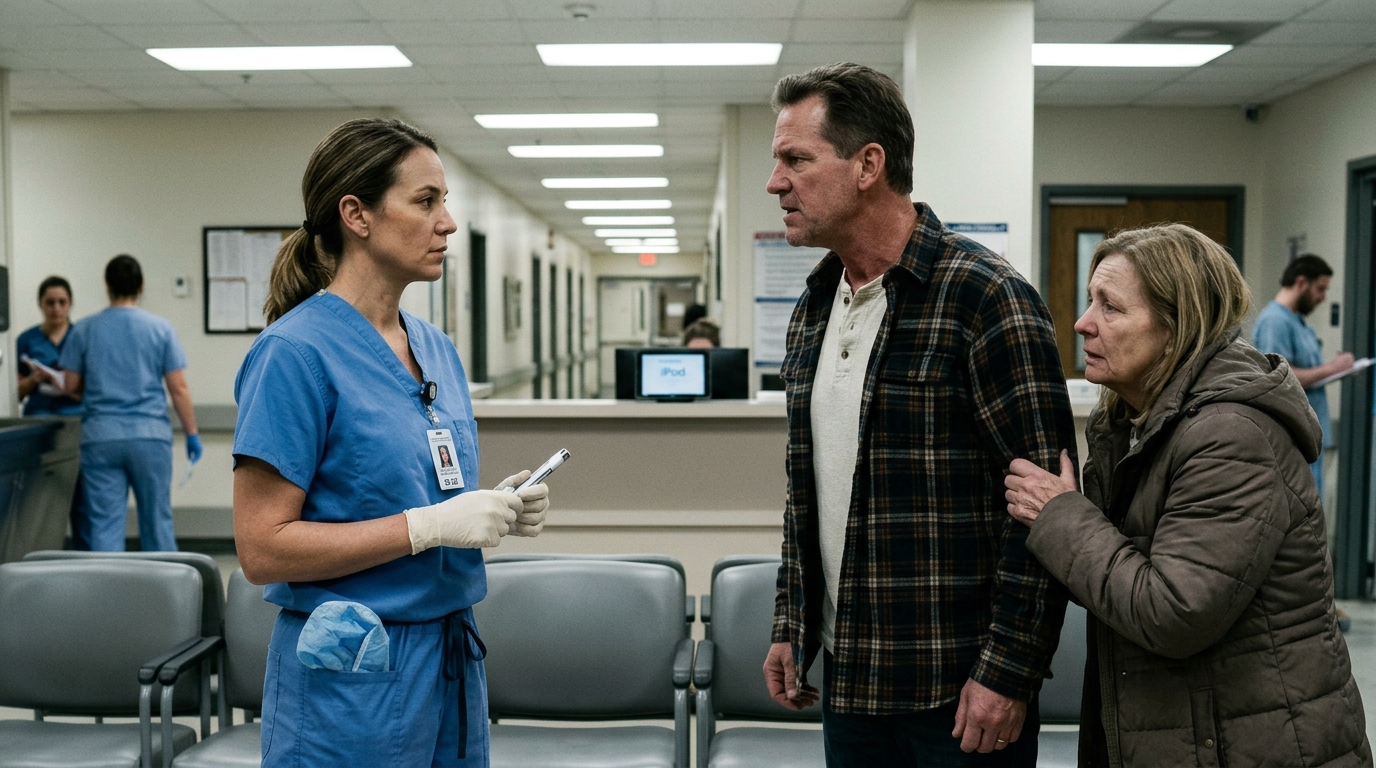
Behind the rolling metal tower of the stretcher, two people stumbled into the bright light of the admittance bay.
Jerry Ulette wore a flannel shirt thrown over an undershirt, his jaw set in that rigid, aggressive line I had spent eighteen years trying to read like a weather report. Diane was half a step behind him, her winter coat buttoned crookedly over a fleece bathrobe, her fingers dug into the fabric of his sleeve with a desperate, white-knuckled grip.
“That’s my daughter!” Jerry’s voice hijacked the hallway, booming against the concrete pillars. “Where are you taking her? I need the chief. Get me whoever is running this floor right now!”
Carla, the triage nurse, stepped into his path with both palms flat out, her small frame blocking the entrance to Bay Two. “Sir, you need to wait behind the red line. The trauma team is already moving.”
“I don’t care about the line,” Jerry snapped, his chest expanding as he tried to use his height, the old factory manager reflex kicking in before he could even process the smell of the room. “Monica is all we have. You hear me? She’s all we have! Get the doctor!”
I stood three feet away, gowned and gloved, the blue sterile wrap covering my chest.
My badge hung exactly at his eye level. Dr. Irene Ulette, MD, FACS, Chief of Trauma Surgery.
Jerry’s eyes dropped from Carla’s face to the plastic card. The word Chief seemed to hit him first, his shoulders stiffening as he prepared to demand compliance. Then his gaze slid three inches to the left, tracking the letters of the surname.
The silence that followed didn’t belong in a level-one trauma center. It was the heavy, suffocating silence of a kitchen table in Hartford, five years deep and cold as gravel.
Diane looked up from his arm, her mouth parting as the fluorescent lights caught the lines around my eyes. Her hand shifted, her fingers clamping down onto Jerry’s forearm with a sudden, violent force that twitched his sleeve. She didn’t scream. She didn’t call my name. She just made a small, wet sound in the back of her throat, her slippers shifting unsteadily on the grey floor.
“Prep the major tray,” I told Linda, my voice flat, dry, and perfectly level. I didn’t look back at them. I didn’t look at the four fingers dug into Jerry’s flannel. “Page Patel to standby for the liver variance. We have thirty minutes before she goes into arrest.”
“Irene?” Diane’s voice was a ragged whisper behind me, breaking against the squeak of the stretcher wheels.
I reached for the scalpel.
“Linda, clear the bay,” I said, my thumb finding the groove in the handle. “Family stays in the hall.”
CHAPTER 2: THE INDIFFERENT BLADE
The skin parted clean. There was no room for the ghosts of Hartford in Bay Two, not when the suction tube was already clouding with bright, arterial warmth.
“Retractor,” I said, my voice cutting through the steady hum of the anesthesia monitor.
Linda slipped the cold metal instrument into my palm, her movements sharp and synchronized to my cadence. On the other side of the draped table, the resident, Dr. Kimura, held the suction tip steady, his jaw rigid under his mask as he stared down at the macerated tissue of Monica’s upper quadrant.
The steering column had done its work with terrifying efficiency, compressing the spleen into a dark, ruptured mass that leaked into the retroperitoneal space with every cycle of the ventilator.
“Spleen is completely devitalized,” I noted, my fingers working blindly in the tight, wet space behind the stomach, feeling for the splenic artery. “Get the heavy clamps. We’re taking it out.”
“BP is sliding, Chief,” the anesthesiologist called out from behind the blue screen. “Eighty over thirty-eight. I’m starting the third unit of packed cells.”
“Hold the pressure steady,” I muttered, my thumb pressing down against the lower border of the pancreas to isolate the vessel. “Kimura, clear the field. I can’t see the hilum.”
The metal teeth of the clamp clicked precisely twice—the exact same rhythm as the stainless surgical pen resting inside my scrub top.
I didn’t think about Monica’s voice telling our parents I had ruined the family name. I didn’t think about the five years of missed phone calls or the wedding invitation that had been sent back to Oregon in a crisp, unopened envelope. Right now, she wasn’t the sister who had hunted my credentials from a keyboard in Stamford; she was simply a grade-three liver laceration that required twelve structural horizontal mattress sutures before the hepatic vein tore completely.
“Scalpel,” I said, adjusting my posture as my shoulder muscles began to burn against the heavy overhead lights.
Kimura leaned in, his breath catching slightly as I guided the needle through the friable tissue of the liver capsule, the resistance thick and stubborn. “You’re bypassing the primary lobe repair, Dr. Ulette?”
“If I stitch the primary lobe now, the internal pressure will blowout the posterior wall within twenty minutes,” I stated, my tone dry, blunt, and stripped of any cinematic drama. “We pack the bed, control the vena cava, and sew the laceration from the inside out. Common sense, Kimura. Use it.”
The clock on the wall shifted to 5:12 a.m.
My fingers were stiff inside the latex, the biological toll of the three-hour extraction beginning to dump adrenaline into my own veins. I could hear the muffled, frantic pacing of a man’s boots out in the hallway beyond the scrub room door—Jerry’s unmistakable, heavy heel-strike that used to signal an impending storm in our Hartford kitchen.
I ignored it, pulling the final structural knot tight against the bleeding liver wall until the monitor’s frantic pitch finally leveled into a steady, rhythmic bounce.
“Vitals are stabilizing,” the anesthesiologist breathed, a visible slackening appearing in his shoulders. “One-ten over seventy. You pulled her back, Chief.”
I dropped the needle holder into the metal tray with a sharp, echoing clang.
“Close her up, Kimura,” I said, pulling the bloody gloves from my hands with a single, practiced snap that left my skin cold under the air conditioning. “I’ll be in the waiting room.”
CHAPTER 2: PRECISION UNDER PRESSURE
The heat of the water turn my skin bright pink, but I didn’t back away from the scrub sink.
My knuckles were white where I gripped the edge of the basin. In the distorted reflection of the mirror, my eyes looked hollow, framed by the dark shadows of a thirty-six-hour shift.
“Irene.” Dr. Patel pushed through the double doors, his mask hanging loose around his neck. He didn’t look at my face; he looked straight at my hands. “I can take the primary. You don’t have to carry this. Legally, you’re clear to step back.”
“She has a grade-three liver laceration and a shattered spleen, Sanjeev,” I said, my voice cutting through the hiss of running water. “You’re a brilliant general surgeon, but I’ve done forty of these repairs this year alone. She dies on the table if we lose ten minutes swapping leads.”
“She’s your sister.”
“She’s a chest cavity full of arterial blood.” I kicked the knee-switch to turn off the water and held my dripping forearms up. “And right now, that’s the only thing that matters.”
Patel held my gaze for two seconds, searching for a crack in the armor. When he didn’t find one, he gave a single, curt nod and held the OR door open with his shoulder.
Inside, the operating room was a cold, bright island of stainless steel and blue drapes. The steady, frantic beep of the heart monitor filled the room—one hundred and thirty beats a minute, threadlike and failing.
“Scalpel,” I said, stepping up to the table.
The tray clicked. The cold weight of the handle settled into my palm, familiar and absolute.
There was no room for memory here. No room for the cold kitchen table in Hartford, no room for the returned letters, no room for the five years of silence.
“Suction,” I ordered, leaning over the incision site. “Clamps. We have active bleeding from the splenic artery.”
“BP dropping,” the anesthesiologist called out over the hum of the ventilator. “Eighty over forty. We’re pumping red cells, but she’s leaking faster than it goes in.”
“I see it,” I grunted, my forearms straining as I positioned the retractors.
The physical reality of the work took over. Blood was thick, slick, and heavy. It pooled in the cavity, obscuring the torn tissue of the liver. My fingers moved by instinct, finding the pulse of the damaged vessel, applying pressure with precise, calculated force.
“Suture, 3-0 Prolene,” I demanded.
“Your hand, Chief,” Nurse Linda whispered from across the table.
I looked down. A tiny, involuntary spasm was twitching in my left thumb—the muscle exhausted from holding the clamp steady against the resistance of torn tissue. I pressed my wrist firmly against the frame of the operating table, locking the joint in place through sheer leverage.
“I’m fine,” I said. “Tie that off. Now.”
For two hours, the world shrank to a six-inch field of vision under intense halogen light. Every breath was a deliberate choice. Every stitch was a boundary drawn against death.
“Bleeding controlled,” Patel breathed, wiping a bead of sweat from his forehead with his shoulder. “Vitals stabilizing. One-ten over seventy.”
I placed the final mattress stitch in the liver capsule, pulling the thread taut until the tissue blanched slightly, then tied the knot. Three tight throws. Snip.
“Closing,” I announced, my throat dry as sand.
As I laid down the needle driver, my eyes drifted for a fraction of a second to the small personal effects bag sitting on the lower shelf of the prep cart. The paramedics had cut away her clothes, dumping her jewelry into a clear plastic sack.
Lying on top of her folded coat inside the bag was a worn silver locket.
The latch was bent slightly open from the impact. Peeking out from behind a glossy headshot of Monica was a tiny, yellowed piece of newsprint—the corner of my high school valedictorian photo, torn out and folded tight.
My breath hitched in my chest.
She hadn’t just erased me. She had kept a piece of the casualty in her pocket.
“Chief?” Linda looked up, holding the sponge count tally. “You want to handle the skin staples?”
I peeled off my blood-stained outer gloves, tossing them into the biohazard bin with a soft thud.
“No,” I said, stepping back from the table as my back muscles screamed in protest. “Finish closing, Sanjeev. I have to go talk to the family.”
CHAPTER 3: THE WAITING ROOM VERDICT
My parents sat in the center row of vinyl chairs, stiff and gray under the lights.
My father surged up first, his work boots thudding against the floor. “Doctor! How is—”
He stopped dead three feet away. His eyes dropped to my chest, tracking the dark blue plastic badge, then hitched upward to my face. A sudden muscle twitch seized his right eyelid, his jaw locking tight as he tried to reconcile the image in front of him.
“She’s out of surgery,” I said, my voice clinical, level, and entirely devoid of heat. “She sustained a ruptured spleen and a grade-three liver laceration. I removed the spleen and repaired the liver tissue. She is stable in the ICU.”
My mother pushed herself up from the chair, her hands trembling so violently her slippers nearly slipped out from under her. “Irene… oh, God, Irene…”
She reached out, her arms opening in a frantic, instinctual arc to wrap around my shoulders.
I took one precise step backward.
Her hands froze in the empty air between us. The rejection was sharp, quiet, and absolute.
“Mr. and Mrs. Wulette,” I said, leaning lightly against the door frame to keep my exhausted knees from locking. “You can see her in an hour.”
“Mr. and Mrs.?” My father’s throat cleared with a harsh, rasping drag. “Irene, what is this? What are you doing in these scrubs? Monica told us—”
“—Monica told you I dropped out,” I interrupted, pulling the surgical penlight from my pocket and rolling it slowly over my thumb. “She told you I was living on the street. She told you I refused to speak to you.”
“She had proof!” my father snapped, the old reflexive irritation flaring in his posture, trying to reclaim the room. “She showed us messages!”
“I don’t care what she showed you.” I clicked the penlight once. The small white beam flashed onto his leather belt. “Look at me. Look at where I am standing. Look at who just kept your eldest daughter breathing.”
My mother covered her mouth with both hands, a choked sob tearing out of her throat. She looked at my blood-smeared apron, at my scrub cap tucked into my pocket, at the quiet respect of two passing nurses who nodded to me as they walked by.
“You didn’t drop out,” she whispered, her voice cracking down the middle. “You never dropped out.”
“I sent calls. I sent Ruth,” I said simply. “You blocked my number. You turned away the only sister who actually earned her way into a room like this.”
My father opened his mouth to bark another defense, but the words withered on his tongue. There was no paper for him to challenge, no email for him to delete, no digital trail for Monica to manipulate.
Standing right here in front of him, covered in his other daughter’s blood, was a reality he couldn’t argue away.
“You didn’t even check,” I said, turning toward the corridor. “That’s the part you’ll have to live with.”
CHAPTER 5: THE MASTER LAYOUT
The heavy glass door slid open with a muted hiss, the mechanical wheeze of Monica’s ventilator filling the sudden breach. Jerry stepped into the room, his eyes instantly tracking the cream-colored Stamford envelope resting on the tray table.
His jaw didn’t drop; instead, the skin around his mouth hardened into a gray, defensive mask as he looked from the corporate seal back to my face.
“I told you down in the hall, Irene,” he said, his voice dropping to a low, warning rumble that didn’t vibrate the glass but filled the space between the monitors. “This isn’t the place. Your mother is outside trying to pull herself together.”
“She can stay outside,” I said, my fingers pressing the flat tip of my stainless surgical pen against the metal tray until the steel clicked once. “Because this isn’t about Monica’s lies anymore, Jerry. It’s about yours.”
Monica shifted on the mattress, a sharp gasp catching in her throat as she tried to pull herself upward against the restraints. —”Dad, don’t listen to her, she took that out of my personal file, she’s trying to—”
“Be quiet, Monica,” I said without looking at her, my voice cutting her off with absolute clinical finality.
I picked up the envelope, pulling out the single folded sheet inside—not the medical device logistics contract, but the attached internal corporate verification sheet from three years ago.
“Three years ago, your manufacturing plant faced a state tax audit on dependent educational deductions,” I stated, the plain, blunt reality of the words hanging in the sterile air. “The state required physical proof of enrollment for both daughters. The audit document was mailed directly to your house in Hartford, signed by the state treasury, listing my active surgical residency at Mercyrest.”
Jerry’s hand tightened on the chrome bed rail, his knuckles turning the color of old paper as the biological toll of the realization hit his frame. He didn’t blink. He didn’t look at the paper.
“You knew,” I whispered, the dry wit completely gone from my tone, replaced by an architectural chill. “You knew I hadn’t dropped out. You knew I was in residency right here in Connecticut three years ago, but admitting that meant admitting you let Monica erase me for two entire years before that. You chose the pride of your own decision over your daughter’s life.”
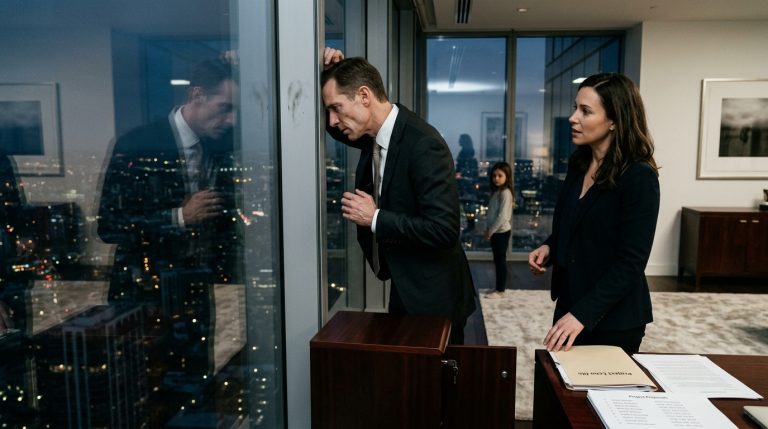
Jerry’s shoulders stiffened, his chest expanding as he tried to look down at me with the old authority that had governed the house in Hartford. —”You don’t know the pressure we were under, the family name—”
“The family name was a lie you maintained because you were too cowardly to tell your neighbors you were wrong,” I said.
I didn’t let him finish. I executed a sharp jump-cut, leaving the sterile white walls of the ICU behind.
The ballroom of the Hartford Marquis Hotel pulsed with the muted clinking of crystal and the low, collective drone of two hundred hospital administrators.
I stood at the main podium under the heavy warmth of the stage spotlights, the black fabric of my dress perfectly still against the polished wood. In the third row, Nathan sat with his arms folded, his calm eyes locking onto mine with a steady, unblinking reassurance.
Directly in the back row, at the very edge of the service doors, sat Jerry and Diane.
They had been given the seats I arranged—isolated, exposed, forced to sit under the high chandeliers while the master of ceremonies read the clinical metrics of the liver reconstruction that had kept their golden daughter breathing.
Jerry sat rigid, his tie pulled slightly loose from his collar as if the silk were choking him, his face flushed an unnatural red under the ballroom glare. Diane had both hands clamped tightly in her lap, her chin trembling as she stared up at the stage, cornered by the undeniable reality of the daughter they had spent five years trying to forget.
“Five years ago, I was told to stay out of the family’s sight,” I said into the microphone, my voice echoing off the high, mirrored walls with a clear, unyielding resonance. “I was told my choices had embarrassed the name. But excellence isn’t negotiated in secret; it is built brick by brick, in the dark, without permission.”
Jerry’s eyes snapped to mine from across the length of the room, his jaw locking in a desperate, silent fury as the entire room rose into a standing ovation around him.
He didn’t applaud. He couldn’t. The trap had closed completely, and the weight of his own silence was the only thing left in the room.
CHAPTER 5: THE UNSPOKEN AUDIT
Ruth didn’t glance at the IV drip, and she didn’t look at the monitor.
She walked straight to the center of the small room, her coat unbuttoned, her eyes locked onto my father.
“I’ve been waiting five years to have this conversation, Jerry,” Ruth said, her voice dropping into a register so quiet it forced the whole room into silence. “And I’m not waiting another minute.”
Monica tried to turn her head away on the pillow, her breath coming in ragged, shallow hitches. “Aunt Ruth, please… I’m in pain…”
“You’re in a bed your sister kept you alive to sit in,” Ruth replied without breaking eye contact with my father. “Shut your mouth, Monica.”
My mother took a half-step forward, her hands hovering near her cardigan buttons. “Ruth, this isn’t the time—”
“—Five years ago, Irene called me from a hospital hallway in Portland,” Ruth said, cutting her off cleanly. “She didn’t ask for money. She didn’t ask for a place to sleep. She asked why her own father called her a liar and hung up on her.”
Dad’s jaw tightened, his fingers curling into tight fists inside his flannel pockets. “She dropped out. Monica showed us—”
“—Monica told you what you wanted to hear because it was easier than admitting you favored one child over the other since middle school,” Ruth stated, taking a step toward my father until she was standing toe-to-toe with him. “When Irene graduated residency, I stood in that courtyard alone. I was the only Wulette in the bleachers.”
“You… you went?” My mother’s voice was barely a whisper, her lips trembling.
“I went. I took the photo. I held her diploma,” Ruth said. Her eyes flicked over to Monica, hard as granite. “And four years ago, Monica texted me. She told me to keep my mouth shut about Irene being a surgeon because it would ‘upset Mom and Dad’s peace of mind.'”
My father turned slowly toward the bed. His chest heaved once, a heavy, jagged rattle. “You knew?”
Monica didn’t answer. She pressed her lips together, her nostrils flaring as she stared fixedly at the ceiling tiles, refusing to meet his eyes.
“She knew,” Ruth said. “And you two let it happen. Not because Monica was a genius liar, Jerry, but because believing her meant you didn’t have to face what you did to your youngest daughter.”
The silence in the room wasn’t clinical anymore; it was heavy, suffocating, and absolute.
Layer two didn’t leak; it burst wide open. My parents hadn’t just been duped—they had traded five years of my life for the comfortable lie that they were blameless.
“You missed her wedding, Jerry,” Ruth added, her voice cracking for the first time. “Nathan’s father walked her down the aisle. You don’t get those five years back. None of you do.”
My father stood frozen in the center of the room, looking down at his own calloused hands as if seeing them for the first time.
“What have we done?” he rasped out, the words barely carrying across the small space between us.
I stepped back out into the hallway, pulling my penlight from my pocket and setting it firmly back into my scrub top. “You made your choice five years ago. Now you have to live in it.”
CHAPTER 6: FOUR PLATES ON NEUTRAL GROUND
My husband, Nathan, poured a stream of dark coffee into a mug, his hand resting light and reassuring against the small of my back as he passed.
Outside, the doorbell echoed down the front hallway.
I set down the cloth towel, walked to the front entrance, and pulled the door open.
My parents stood on the porch in their heavy winter coats. My father held a small carton of orange juice in both hands, his fingers stiff from the cold. My mother gripped a tin of cookies against her chest, her knuckles pale under her knit gloves.
“Hi, Irene,” my mother said, her voice small, tentative, and stripped of all the old theatrical certainty. “We brought… well, we just wanted to drop these off.”
“Come in,” I said, holding the door open. “Coffee’s hot.”
They stepped inside, kicking the wet snow off their boots onto the mat. My father looked around the hallway, his eyes taking in the framed photos on the wall, the coat rack, the quiet warmth of a house he had never set foot in before.
He cleared his throat, a low, hesitant sound. “Can I… do you need help setting up?”
“The plates are in the cupboard to the right,” I told him, pointing toward the kitchen counter.
He walked over slowly, opened the cabinet door, and pulled out four plates. He held them carefully by the edges, counting them out loud under his breath. “One… two… three… four.”
He placed them on the table, spacing them out with meticulous, trembling precision.
My mother set the cookie tin next to the coffee pot, stepping up behind me near the stove. She didn’t throw her arms around me. She didn’t demand a dramatic movie reconciliation. She just rested her forehead gently against my shoulder for three quiet seconds, letting out a long, shuddering breath.
“We’re going to counseling, Irene,” my father said, standing behind the table, his hands resting on the back of a wooden chair. “Dr. Rena’s office in West Hartford. We start Thursday.”
“Good,” I said, setting the skillet on the burner. “That’s a start.”
“And Monica… she’s looking for her own therapist,” my mother added softly. “She knows she has to answer for what she did. All of it.”
“She has to answer to herself first,” I said, flipping a piece of toast in the pan. “I don’t hold a grudge, but I hold the key to my own front door. If you want a place at this table, it stays like this. Real. Consistent. No shortcuts.”
My father looked at the four plates sitting on the dark wood, then up at me. He didn’t argue. He didn’t make an excuse. He just gave a single, firm nod.
“Four plates,” he whispered. “Four.”
I pulled the coffee pot off the burner and poured a cup, hand steady, my mind quiet, and for the first time in five long years, completely at peace.