The Echo of the Iron Heart: A Testament to Quiet Dignity and the Weight of Grace
CHAPTER 1: The Threshold of Power
The garage was twelve acres of manicured silence wrapped in a climate-controlled shell. It was a space designed to intimidate, a forty-foot expanse of polished concrete that felt less like a workshop and more like a cathedral dedicated to the god of excess.
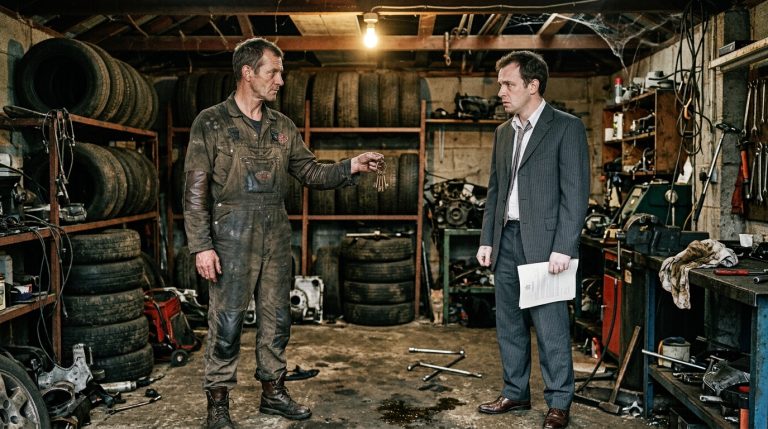
Harlan stood near the bay door, his frame framed by the sharp, angular light of the afternoon sun. He laughed, a short, clipped sound that carried the weight of decades of absolute dominion. “Fix this engine, and the garage is yours,” he said, his voice echoing off the rows of muscle cars that looked like perfectly preserved artifacts of a life lived in high gear. He was dangling the keys to a kingdom, but he was doing it with the absolute certainty that no one could ever reach the handle.
I didn’t answer. I didn’t reach for the keys. I didn’t even look at the keys.
My attention was pulled toward the center of the floor, where the 1968 big block sat, a dormant beast of Detroit iron. It looked tired, coated in a fine layer of dust that had gathered over eight years of stillness. It was a monument to failure, a trap laid by a man who collected humilitations the way others collected stamps. Harlan’s grin widened, his eyes scanning me for the twitch of greed or the frantic spark of ambition that he’d seen in the twelve men before me. He wanted a spectacle. He wanted the theater of a man scrambling for a prize he couldn’t grasp.
I set my canvas bag down on the floor. The leather was worn, the strap frayed at the edges, a stark contrast to the sterile, clinical precision of Harlan’s environment. The sound of the bag hitting the concrete was soft, muffled, yet it seemed to strip the pretension from the room.
Harlan’s laugh stalled, then died completely. He blinked, the rhythmic movement of his eyelids suggesting a flicker of confusion. He had expected an argument, a request for terms, a display of professional vanity. Instead, he got the silence of a man who didn’t recognize the existence of the game. I felt the familiar weight of the tools inside my bag, their cold steel pressing against each other. They weren’t weapons, but they were the only language I had for a world that had forgotten how to listen.
I walked to the engine, my boots leaving soft impressions on the pristine floor. The scent of stagnant oil and stale air rose to meet me—a faded texture of a machine meant to run, not to be a display piece. I ran my hand along the block, feeling the cooling metal, and for a fleeting moment, I could hear the ghost of its rhythm. Harlan was still standing there, his arms crossed over his chest, his jaw tightened in an unspoken question. He was waiting for me to ask him why. He was waiting for me to justify my presence.
I didn’t look back. The information gap between us was widening with every heartbeat, a chasm of intent he couldn’t cross. I had entered his world, but I had brought my own, and in that moment, the power didn’t belong to the man with the millions; it belonged to the man who knew what the engine wanted to say.
CHAPTER 2: The Language of the Wrench
Harlan did not leave the garage immediately. He lingered, his presence a heavy, synthetic pressure that sat just behind my shoulder. I could feel his gaze—not on me, but on the equipment I had brought. Twelve engineers had come through here before me. They had arrived with laptops, diagnostic sensors, and cases of sterile, factory-grade implements that looked more like surgical theater gear than tools for a machine.
My bag, now resting on the edge of the workbench, looked like an intrusion of reality into a dream.
I knelt, ignoring the fact that Harlan was still standing by the bay door. I pulled out a ratchet, the metal cool and reassuring under my palm. It wasn’t polished chrome; it was worn, the handle smoothed by years of friction. As I laid my tools out on the concrete, I noticed Douglas, Harlan’s right-hand man, standing near the back wall. He wasn’t looking at the cars. He was watching the way I placed the tools.
I reached for a specialized tensioning bar, an old piece of iron I’d fabricated myself a decade ago. It didn’t look like anything a manual would recognize. Douglas took a step forward, his eyes narrowing. He was looking at the way I ignored the expensive diagnostic port Harlan had insisted on having installed. The previous men had spent hours hooked up to that port, feeding digital data into a screen, waiting for the car to tell them its own story.
I didn’t need the car to talk to me through a monitor. I needed to hear it through the resistance of the metal.
I began to strip the housing. The bolts were seized, rusted into a stubborn, singular mass by the neglect of eight years. I didn’t reach for a power drill. I reached for a penetrating oil and a brass mallet. I tapped the casing—a rhythmic, dull thud-thud-thud—that sounded out of place in the sterile, air-conditioned cathedral. Harlan’s laughter was long gone, replaced by a tense, vibrating silence.
“You’re not using the diagnostic suite,” Harlan said. His voice was too loud, a deliberate attempt to reclaim the frequency of the room.
I didn’t stop. I kept the pressure on the bolt, feeling the micro-vibrations travel up my arm. “The machine is tired, Harlan,” I said, my voice low. “It doesn’t need a translator. It needs to be understood.”
“It’s an engine,” he retorted, walking a slow, predatory circle around the workbench. “It’s a series of combustion chambers and pistons. It’s binary. It works or it doesn’t.”
I finally looked up. His face was a map of calculated certainties. He had spent his life buying outcomes, and he couldn’t grasp the idea that some things simply refused to be purchased. I looked at the bolt. It was the heart of the resistance. I applied steady, unyielding pressure, not with a sudden jerk, but with a slow, grinding patience that forced the metal to yield.
Click.
The sound was sharp, a release of tension that seemed to echo through the entire forty feet of concrete. Douglas flinched. Harlan stiffened, his fingers curling into his palms. I didn’t celebrate. I didn’t look at them to gauge their reaction. I simply set the bolt aside and reached for the next one.
I could feel the shift. It was a subtle, invisible movement in the air—the moment when the space stopped being Harlan’s personal museum and started being a workshop again. He wanted to maintain the distance, the superior vantage point of the landlord, but the physical act of the work was pulling him into the gravity of the process. He didn’t want to care, but he was already leaning in, his gaze tracking the placement of every component I pulled from the dark, oil-choked depths of the engine.
The faded textures of the garage—the dust motes dancing in the high, clinical light, the smell of ancient oil, the frayed edges of Harlan’s composure—began to feel like a cohesive, living thing. I wasn’t just fixing a motor. I was unwinding a knot that had been tied tight for nearly a decade.
I worked for six hours without a break. By the time the shadows in the high windows began to lengthen, I had reached the primary cylinder bank. I could see the internal fouling now, the decay that had silenced the machine. It was a mess of neglect, a testament to what happens when you treat an engine like an object of status rather than a mechanism of purpose.
I glanced up. Harlan was still there, though he had stopped circling. He was leaning against a pillar, his coffee long cold in his hand. He wasn’t watching me anymore; he was watching the engine, his expression lost in a flicker of genuine curiosity that he clearly resented.
“You’re making a mess,” he said, though there was no heat in it.
“It’s not a mess,” I replied, wiping a smudge of grease from my forearm with a rag. “It’s a diagnosis.”
I went back to the work. The sun dipped below the horizon, and the garage lights hummed to life, casting long, sharp shadows over the floor. I didn’t notice the time until my stomach gave a sharp, reminder-twinge. I hadn’t eaten since dawn. I moved to sit back on my heels, taking a long drink of water, and that was when I caught Douglas looking at me again. He didn’t look away this time. He just stood there, the clipboard hanging limp at his side, as if he were waiting for something to happen—something he hadn’t seen in all his nineteen years of serving the man who thought he owned the world.
The tension wasn’t dissipating. It was merely changing form, settling into the foundation of the building like a slow, deep-seated tremor. I knew what Harlan was thinking. He was counting the cost of his own doubt. He was realizing that I wasn’t just a mechanic passing through; I was the first person in his life who didn’t care whether he was impressed or not.
And that, more than anything I could have said or done, was the real beginning of the change.
CHAPTER 3: The Currency of Indifference
The night did not bring rest to the garage. It brought a shift in the temperature, a cooling of the polished concrete that made the air feel thin and sharp. I didn’t leave. I didn’t have anywhere else to be, and this machine—this 1968 iron puzzle—required a presence that didn’t drift. I pulled a moving blanket from the storage rack in the corner, spreading it out near the base of the workbench. It smelled of old dust and warehouse storage, a far cry from the expensive, sterile climate-control that Harlan thought was the peak of human achievement.
My tools were arranged in a pattern that made sense only to me, a sequence of weight and size that felt like a conversation with the engine. Every wrench, every driver, had its place. I lay on the blanket, staring up at the underside of the heavy block, the shadows dancing in the dim auxiliary lighting. My mind drifted, unbidden, to a garage in another city, years ago—a place where the roof leaked and the coffee was always burnt, but where the work had meant something to people who couldn’t afford to pay. It was a memory of simple, brutal utility. I shook it off. The past was a ghost, and ghosts didn’t fix 427-cubic-inch engines.
Douglas appeared in the doorway just as the first grey light of morning began to bruise the sky through the high, reinforced windows. He wasn’t carrying a clipboard this time. He held a steaming paper cup and a small, grease-stained paper bag. He walked toward me with the caution of a man entering a cage, his boots echoing with a hollow, rhythmic thud against the polished floor.
He set the coffee and a breakfast sandwich on the corner of the workbench. He didn’t speak. He just stood there for a moment, watching me as I slid out from under the engine, my hands coated in a thick, dark layer of history.
“He sent the money,” Douglas said, his voice quiet, almost an apology. “The envelope. He wants you to go.”
I looked at the envelope resting on the workbench. It was thick, heavy, the kind of weight that usually defined a man’s future in this part of town. I didn’t reach for it. I picked up the coffee instead, the heat seeping into my cold palms. It was black, bitter, and exactly what I needed.
“Tell him the engine isn’t ready,” I said.
Douglas watched me, his eyes searching my face for the lie, for the hidden ambition, for the moment I would blink and ask for more. He was looking for the flaw in my armor, the point of leverage he could use to force me into the mold that Harlan had created for everyone around him. He didn’t find it.
“He’s not used to people who don’t want what he’s selling,” Douglas murmured, more to himself than to me.
“Then he’s had a very limited life,” I replied. I turned back to the engine.
Douglas lingered, his eyes lingering on the engine block, now partially disassembled. The way I had organized the removed components—not in rows, but in groups by functional impact—seemed to baffle him. He walked over, his curiosity finally overriding his instruction to observe. He pointed to a small, worn gear. “Why there?”
“Because that’s where the failure started,” I said, moving the gear into a pool of light. “The previous engineers looked for the explosion. They looked for the catastrophic break. They didn’t look for the wear. They didn’t see that this part had been fighting against its own friction for years. It was tired, Douglas. It didn’t break because of an accident. It broke because it was neglected.”
I saw the recognition hit him. He wasn’t just talking about a gear anymore. He was looking at the way Harlan ran his life, the way he managed his property, the way he kept everyone in his orbit off-balance. I didn’t say it. I didn’t have to. The truth was written in the grease and the silence of the room.
Douglas left without another word, taking the unopened envelope with him. I watched him go, the door clicking shut behind him with a final, clinical sound. I was alone again, but the silence had changed. It was no longer the silence of a tomb. It was the silence of a surgery.
I picked up the wrench, the weight of it familiar and grounding. I wasn’t here to win a game of brinkmanship with a man who thought money was the only currency worth trading. I was here to make the heart of this machine beat again, and in doing so, I was going to show him exactly what he had been missing for all these years. I went back under the hood, the work becoming a meditation, the friction of the metal echoing the friction in my own mind. Each turn of the bolt, each adjustment of the tension, was an act of quiet defiance against the noise of Harlan’s world. I was patient. I was thorough. And I was waiting for the moment when the machine would have no choice but to acknowledge the care I was putting back into it.
CHAPTER 4: The Cracking of the Facade
The flicker started in the overhead halogens, a rhythmic, staccato dimming that made the polished concrete floor look like it was breathing. It was a failure of the infrastructure—a power spike caused by the aging grid on the edge of the property, or perhaps just the sheer, stubborn refusal of this cathedral to keep the light on for an intruder. I didn’t reach for a flashlight. I stayed under the hood, my fingers tracing the lines of the fuel rail, the metal cold and unyielding.
Then, the whine came—a high-pitched, metallic protest from the wall panel near the bay door. It was the sound of a system under strain, a symptom of the same decay that had killed the engine eight years ago. Harlan’s pride was powered by a fragile, over-engineered facade that wasn’t built to last; it was built to impress.
I slid out from under the engine, my knees popping on the concrete. The garage was bathed in a dull, amber glow as the emergency lights flickered to life. I stood up and walked toward the wall panel. It was a mess of high-end, proprietary circuit breakers that required a specialist to even look at. I didn’t need a specialist. I needed to see what was burning.
I pulled the panel cover off, the screws groaning as they resisted the turn. The air smelled of ozone and scorched plastic. Beneath the sleek surface, the wires were a tangled, scorched nest. The previous maintenance teams hadn’t been fixing the garage; they had been patching the symptoms.
“Something wrong?”
Harlan’s voice cut through the dark. He was standing in the shadows by the far workbench, his silhouette a sharp, jagged edge against the dim lights. He hadn’t left the property. He had been watching, lurking in the periphery, waiting for me to hit a wall he couldn’t pay me to climb over.
“Your infrastructure is failing, Harlan,” I said, my voice flat. “You’ve been pouring money into the finish, but you neglected the foundation. The engine didn’t die because it was broken. It died because the system it lived in stopped providing what it needed to survive.”
Harlan didn’t laugh this time. He walked closer, his leather shoes making no sound on the floor. He stopped a few feet away, looking at the charred wires inside the panel. The orange glow of the emergency lights reflected in his eyes, making them look hollow, sunken.
“I’ve spent millions on this place,” he said. He sounded tired. It was the first time I’d heard that tone from him—the vulnerability of a man who suddenly realizes his fortress is built on sand.
“You spent millions on a mask,” I replied, grabbing a pair of needle-nose pliers from my bag. “You don’t need a specialist. You need to strip it back to the wire and start over.”
I went to work, the task mundane compared to the engine, but equally essential. I felt Harlan’s gaze on me, heavy and probing. He wasn’t looking at the wires anymore. He was looking at the way I moved, the way I didn’t hesitate to tear into the heart of his expensive, fragile world. He was seeing the mirror I was holding up to him, and for the first time, he couldn’t look away.
The work took an hour. Every minute was a struggle against a system designed to resist repair. The breakers clicked, fought, and finally held. The lights stabilized, the halogens overhead humming back to their full, clinical intensity, exposing every crack and imperfection on the floor. Harlan squinted, shielding his eyes as if the sudden clarity was physically painful.
He looked around the garage. The muscle cars, the imports, the custom steel workbench—it all looked different under the harsh light. It looked lonely.
“Why are you doing this?” he asked, his voice barely a whisper. “You could have taken the money. You could have walked away weeks ago.”
I closed the panel and wiped my hands on the rag. “I told you. I’m not here for the money.”
“Then what? What is it you want from me?”
I looked at him, really looked at him, past the billionaire persona and the cold, calculated defensive walls. I saw the tremor in his hands, the way he stood—shoulders hunched, as if he were bracing for a blow that never came. He was terrified, not of losing his garage, but of being empty.
“I don’t want anything from you, Harlan,” I said. “I’m just finishing the job.”
I turned back to the engine. I wasn’t just fixing a machine. I was clearing the path. I had reached the core of the engine now, the final, hidden blockage that had stumped everyone before me. It wasn’t a mechanical flaw. It was an obstruction—a small, deliberate piece of debris that had been inserted into the intake. Someone had killed this engine on purpose.
My fingers touched the edge of the object. It was hard, metallic, a signature of the person who had been guarding this garage for nineteen years. I felt a chill that had nothing to do with the climate-controlled air. The decoy was falling away, and the truth, heavier and more complex than I’d expected, was beginning to surface. I didn’t pull it out. Not yet. I needed to see how far this went before I let the rest of the world know what I’d found.
CHAPTER 5: The Sound of the Impossible
The air in the garage had become heavy, saturated with the scent of ozone and the residue of burnt plastic. I stood slowly, my joints stiff, and held the object up to the light. It was a locking pin, custom-machined and deliberately placed to create a cascade of pressure failures within the intake. It wasn’t an accident. It was an insurance policy against the engine ever running again.
Harlan stared at the pin, his face losing its practiced mask of indifference. He took a reflexive step back, his heel catching on the concrete edge of the workbench. For a second, he looked smaller, diminished by the reality that his grand, controlled world had been sabotaged from within—not by an enemy, but by the very structure he had relied on for protection.
“Where did that come from?” Harlan asked. His voice was brittle, lacking the polished resonance of a man who owned everything he looked at.
I didn’t answer immediately. I walked to the edge of the workbench and laid the pin down. It caught the halogen light, a tiny, innocuous sliver of steel that had silenced a legend. I looked at Harlan, letting the silence draw out, letting him feel the weight of his own sudden exposure. He was realizing that his isolation wasn’t a choice; it was a cage.
“It was in the intake,” I said. “Whoever put it there knew exactly where to touch to kill the heartbeat of this room.”
Harlan’s hand went to his throat. He looked around the garage as if seeing it for the first time—the pristine cars, the climate-controlled stillness, the rows of tools he had never touched. He looked at the shadows in the corners, the places where his staff moved with the quiet efficiency of ghosts. The paranoia, long dormant, was waking up in his eyes, a sharp, feverish light that mirrored the breakdown of the electrical panel an hour before.
“Douglas,” he whispered, the name catching in his throat.
I stayed silent. I didn’t want to be the one to tell him the truth. He needed to see it for himself, to recognize the pattern of the betrayal that had been sitting right beside him for nineteen years. Harlan’s hands were shaking now, a fine tremor he couldn’t suppress, and he leaned heavily against the steel workbench. He was a man watching his anchor slip.
“I didn’t see him,” I said, “but I saw the work. It wasn’t the work of a technician, Harlan. It was the work of a guardian.”
Harlan moved then, a sudden, erratic burst of energy that belied his age. He turned and marched toward the back of the garage, his movements jagged, uncoordinated. I followed, not because I was concerned for him, but because the narrative we had been writing for the last few days was reaching its turning point. He bypassed the office, heading for the small, utilitarian utility room where the staff kept their supplies—the forgotten, dusty corner of the estate.
I watched him fling the door open. Inside, the space was cramped, lined with shelves that held the boring, essential tools of maintenance. He shoved aside a shelf, the wood scraping harshly against the concrete, and fell to his knees, clawing at a floorboard that looked slightly uneven.
I stood in the doorway, the ambient light of the garage casting a long, dark silhouette over him. He pulled back the board to reveal a small, locked metal box. It was the only thing in this room that didn’t belong. He fumbled with a key he pulled from his ring, his breathing ragged, and the lid sprang open. Inside weren’t secrets, or money, or blueprints. They were logs—years of records, dates, and names of every specialist who had been paid to fail, every bribe issued, and every whisper of dissent that Douglas had neutralized on Harlan’s behalf.
Harlan picked up the ledger, his fingers trembling as he flipped through the pages. He was reading the chronicle of his own manufactured failures, the history of his own ego being fed by the very man he trusted most.
“He did it for me,” Harlan muttered, his voice cracking. “He told me he was protecting the collection.”
“He was protecting his relevance, Harlan,” I said, my voice cutting through the hollow space. “And he kept you exactly where he wanted you—bored, isolated, and reliant on his version of the truth.”
The realization hit Harlan with the force of a physical blow. He collapsed against the shelving, the ledger falling from his hands. He wasn’t the predator he’d spent forty years pretending to be; he was the prey. I walked over and picked up the ledger, closing it with a soft, final thud.
I didn’t offer a hand. I didn’t offer comfort. That wasn’t what he needed. He needed to sit with the wreckage of his own design. I turned and walked back to the engine. The work wasn’t finished. I still had to put it back together, and now, I had to do it knowing that the silence of this garage was filled with the echoes of a truth that was about to be laid bare.
I picked up my tools, the weight of the steel against my palm feeling different now. The mystery of the engine was gone, replaced by the much larger, much darker mystery of what happens when a man finally wakes up in a life he doesn’t recognize. The engine was cold, but the garage felt like it was starting to burn. I began the reassembly, every movement deliberate, every bolt tightened to the precise, necessary tension. The end was coming, and I was the only one in the room who knew how the final turn of the key would sound.
CHAPTER 6: The Quiet Debt
The sound was impossible. After eight years of silence, the 1968 big block didn’t just turn over; it breathed. The garage, once a sterile vault of frozen time, was suddenly filled with the rolling, visceral rhythm of a heartbeat. I stood back, my hands still greasy, and watched as the exhaust note leveled out into a steady, confident purr.
Harlan stood by the bay door, his figure framed by the encroaching twilight. He didn’t move. He didn’t reach for his coffee, and he didn’t offer the empty, practiced laughter that had defined his existence for decades. He was listening to the sound of something he had failed to protect, something that had finally been given the grace to exist again.
“It’s running,” he said. His voice was raw, stripped of the bravado that usually acted as his armor.
I turned the ignition panel off. The engine died, but the silence that followed was different. It wasn’t the heavy, suffocating silence of a grave; it was the quiet of a room after a conversation that needed to happen. I wiped my hands on the rag one last time and dropped it onto the workbench.
“It was never about the engine, Harlan,” I said, my voice cutting through the stillness. “You didn’t need a mechanic. You needed to stop being the one who decided what was broken and what wasn’t.”
I walked toward the bay door. I wasn’t leaving with the garage, and I wasn’t leaving with a payout. I was leaving with the weight of the work finished. Harlan followed me, his steps hesitant, his posture lacking the stiff, predatory tension that had characterized our first meeting. He stopped as we reached the gravel driveway, the cool evening air washing over us.
“You changed things,” he said. He wasn’t looking at me; he was looking toward the dark expanse of his property, toward the organizations he had begun to support, toward the world he had spent his life ignoring. “I don’t know how to do this. The, the checks, the… the letting go.”
“You don’t have to know how,” I replied, pulling on my jacket. “You just have to keep doing it. That’s the only way the weight gets any lighter.”
He looked at me then, and for the first time, there was no distance in his eyes. There was only a profound, exhausted clarity. He reached into his pocket and pulled out the small, brass pocket watch—the one I’d noticed sitting on his desk days ago, forever frozen. He looked at it, then with a slow, deliberate movement, he wound it. The ticking was soft, a small, insistent sound that marked the resumption of time. He pressed it into my hand.
“I don’t need to keep the time anymore,” he said.
I took the watch, the brass cool and heavy. I didn’t refuse it. It wasn’t a bribe; it was a testament. I turned and walked toward my bike parked by the gate. I didn’t look back to see him standing there, a man finally unburdened of his own ego, finally allowed to exist in a world he hadn’t built to suit himself.
The ride home was quiet. The city felt different, softer at the edges, the frantic rhythm of the traffic less like a conflict and more like a shared flow. I thought about the engine, the way it had resisted, and the way it had eventually yielded to the right kind of care. Harlan had spent forty years building a monument to his own importance, but he’d discovered that the only thing that lasted was the quiet, invisible work of helping someone else stay on their feet.
I pulled into my own space—a simple, rented garage on the edge of the city. I parked the bike and stepped inside. The air was cool, smelling of iron and dry earth. I took the watch from my pocket and set it on my own workbench, right next to my tools. It was still ticking.
The garage wasn’t a cathedral, and it wasn’t a vault. It was just a place to do work. I felt a deep, resonant peace in the realization. I had walked into a stranger’s life, dismantled the cage he’d built for himself, and left him with the tools to live in the open. The debt, if there had ever been one, was paid in full. I reached out and flicked the light switch, plunging the room into the quiet, starlit dark, and for the first time in a long time, I didn’t feel the need to look over my shoulder. The world was spinning, the time was moving, and everything was exactly where it needed to be.