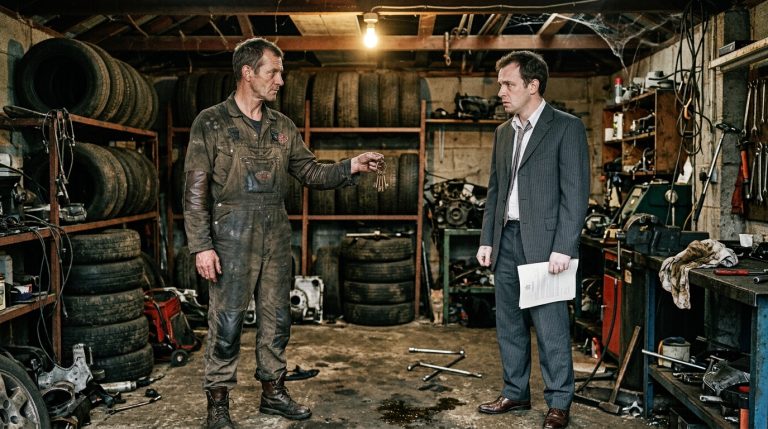
The Iron Ledger: How One Old-Timer’s Wrench Keeps the Gears of Empire Turning
CHAPTER 1: THE SILENT HUMVEE
The Humvee sat in the center of the bay like a beached whale, its armor plating radiating a dry, dusty heat that shimmered in the stagnant air. It was a monolith of matte green, a relic designed for survival that now found itself defeated by a flickering cursor on a technician’s laptop.
Arthur Corrian stood a few paces away, his push broom propped against his hip. He didn’t look at the screen. He looked at the floor, where a faint, dark smudge of oil had bled out from the transfer case—a slow, weeping wound the young men in their crisp coveralls were too busy to notice.
“Anything, Pops?”
The voice belonged to Torres. It was brittle, a sharp instrument wielded by someone who had spent his life reading schematics instead of feeling the vibration of a chassis under load. Torres didn’t look at Arthur; he was staring at the diagnostic readout, his forehead beaded with sweat.
Arthur didn’t answer immediately. He let the silence stretch, listening to the wheeze of the base air circulation system and the frantic, rhythmic tapping of keys from the three engineers huddled over the open engine bay. They were a flurry of motion—clean, precise, and entirely useless.
“The engine control module isn’t your ghost, son,” Arthur said finally, his voice a low, gravelly rumble that seemed to catch on the dry air. He shifted his grip on the broom. “You’re chasing a logic fault. It’s a clean answer, but it’s the wrong one.”
Torres spun around, his face flushing the color of a fresh bruise. “This is a restricted area, old man. Your job is to keep the concrete clear of debris, not to provide unsolicited feedback on military hardware. We have a general arriving in twenty-four hours. This vehicle is dead, and the diagnostic says it’s the ECM. We’re replacing it. Move along.”
Arthur didn’t move. He felt the weight of the floor beneath his boots—the same concrete he’d walked for forty years, the same grit that worked its way into the seams of his soul. He looked at the Humvee again. He didn’t see the armor or the electronics. He saw the relay, tucked deep in the wiring harness near the firewall. It was a cheap, plastic-cased component, battered by heat cycles and time. It was failing because it was tired, just like the men who ignored it.
“You swap that ECM, you’ll be out six thousand dollars and three hours of labor,” Arthur said, his eyes tracing the line of the harness. “And when you’re done, she’ll still be as dead as she is now.”
Torres took a step toward him, his hand half-raised in a dismissive gesture. As he reached out, the air in the motorpool seemed to buckle, the humidity briefly replaced by the sharp, electric ozone of a desert firefight. Arthur felt the phantom vibration of a rattle-can wrench in his palm, the desperate, frantic need to bypass a fried circuit before the next mortar round found the range.
The memory vanished, leaving him back in the dusty, quiet bay, the smell of grease replaced by the heavy, suffocating scent of impending failure. He realized then that the system wasn’t just broken; it was designed to ignore the very things that kept it alive.
“I’m warning you,” Torres said, his voice trembling with a mix of exhaustion and ego. “One more word, and I call the MPs. You’re a security risk, not a mechanic.”
Arthur stared at the Humvee, watching a single, microscopic vibration in the wiring near the firewall—the relay, shuddering one last time before it went dark for good.
CHAPTER 2: THE COST OF THE STARE
The Humvee sat in the silence like a grave marker, its silence more profound for the frantic energy radiating from the three engineers. Torres’s face was a map of rising panic masked by brittle aggression. He hadn’t moved since his dismissive gesture; he was locked in the posture of a man who suddenly realized he was standing on a trapdoor.
Arthur held his position, his boots rooted to the oil-stained concrete. He could see the pulse jumping in Torres’s neck, a rhythmic, frantic thrum that echoed the failing relay he had described. The boy was terrified, not of the machine, but of the crowd that had begun to pool around the bay—mechanics, supply sergeants, and soldiers who knew exactly what a dead command vehicle meant for their morning schedule.
“I’m going to count to three,” Torres snapped, though his voice had lost its edge, replaced by a jagged, sharp desperation. He reached for his radio, his fingers fumbling against the plastic casing. “I’m calling the MPs, Arthur. You are trespassing. You are obstructing mission-critical maintenance. If you think your age is a shield, you are sorely mistaken.”
Arthur didn’t blink. The sensory world shifted—the hum of the motorpool lights darkened, replaced by the low, guttural vibration of a Bradley fighting vehicle struggling to turn over in a sandstorm. The smell of the bay, stale and chemical, dissolved into the sulfurous tang of an IED blast. He was back in the sand, his hands bloody, his multi-tool a sliver of cold steel against a maze of scorched wires. He remembered the look on the young Captain’s face—the same blank, hollow-eyed stare Torres was currently wearing. That captain hadn’t understood the machine either. He’d only understood the command.
The memory was a ghost that tried to pull Arthur into the earth, a weight of iron and ash. He forced himself to breathe, the intake of dusty air stinging his lungs, grounding him back in the hum of the motorpool. He had to keep his feet. If he broke, the entire chain of logic he was building would collapse.
“You call them, son,” Arthur said, his voice quiet, carrying effortlessly through the stillness of the bay. “You call the MPs, and you tell them you’re having trouble with a relay.”
One of the other engineers, the redhead with the freckled face, shifted his weight. He looked at his laptop, then back at the Humvee, then finally at Arthur. He saw the specific, deliberate way Arthur held his broom—not as a tool, but as a staff of office.
“Torres,” the redhead muttered, stepping away from the hood. “He’s not a janitor, man. Look at him. He’s not even sweating. We’ve been at this for six hours. He hasn’t broken a sweat.”
“Stay out of this, Davis,” Torres hissed, his thumb hovering over the call button.
“No,” Davis said, his voice rising, drawing the eyes of the gathered soldiers. “He told us it was a relay. We checked the relays. We checked them twice. But we checked them while they were cool, Torres. What if he’s right? What if it’s heat-soaked? If we call the MPs and he’s right, we’re the ones who are going to be explaining to the General why we sat on a working vehicle for twelve hours.”
The tension in the air tightened, vibrating like a piano wire. Torres looked around. He saw the gaze of the senior logistics NCO, Gunnery Sergeant Evans, who stood at the edge of the bay with his arms folded, a shadow of cold judgment in his eyes. Evans wasn’t moving. He wasn’t helping. He was waiting.
Arthur felt the internal logic click into place. The confrontation wasn’t about the Humvee anymore; it was about the fear of the unknown. These boys were built to trust the software—to trust the screen that promised them data. The machine was secondary. The status was everything. If the screen said it was the ECM, it was the ECM, and reality had to conform to that digital decree.
Arthur took a half-step forward. The movement was slow, deliberate, the friction of his heavy boots against the concrete sounding like a warning.
“The machine doesn’t care about your liability forms, son,” Arthur said, his gaze pinning Torres to the spot. “You want to protect your career? Stop protecting your ego. Your diagnostic isn’t a map; it’s a mirror. It shows you exactly what you expect to see.”
Torres’s hand trembled on the radio. He looked at the Humvee, then at the diagnostic screen, which flickered with a persistent, mocking Error Code 402. He looked at Arthur, and for a split second, the veil of his arrogance slipped, revealing the terrified, inexperienced boy beneath the tactical gear. He was standing on the edge of a precipice, and he knew it. He had bet everything on the machine being broken in the way the manual said it was broken. If he was wrong, he wasn’t just incompetent; he was obsolete.
“Move,” Torres commanded, though it sounded like a plea.
“I’m not moving,” Arthur said, his voice a steady, granite anchor. “But I am going to walk away. You can call the MPs, you can report me for trespassing, and you can watch this vehicle stay dead until the General walks through that door. Or, you can take your hand off that radio and let me show you why your software is failing you.”
The silence that followed was absolute. Even the distant clatter of a wrench in the neighboring bay had ceased. Every person in the motorpool was watching the hinge point of the entire day—the moment where the pride of the new age collided with the quiet, rusted wisdom of the old. Torres breathed, the sound ragged in the humid air, his eyes darting between the radio and the old man who stood before him, as immovable as the steel he’d spent a lifetime keeping alive.
CHAPTER 3: THE FREQUENCY OF SILENCE
Torres’s thumb rested on the PTT—Push-To-Talk—button of the radio. He didn’t press it. The plastic casing felt slick under his sweat-dampened skin, and for a heartbeat that stretched into an eternity, the only sound in the bay was the rhythmic, metallic ticking of the Humvee’s cooling engine block.
Arthur didn’t move. He stood perfectly still, his weight evenly distributed on the oil-stained concrete. He wasn’t watching the radio; he was watching Torres’s pupils, tracking the involuntary dilation of a man caught between the desperate need for authority and the dawning realization of his own obsolescence.
“The MPs are a five-minute drive from the main gate, Torres,” Gunnery Sergeant Evans said from the shadows of the tool crib. His voice was casual, almost conversational, but it carried the serrated edge of a blade. “They’re going to ask for a report. You sure you want to open that file with a ‘janitor’ complaint? Or do you want to double-check the schematic one more time?”
Torres’s thumb twitched, but he didn’t depress the button. The silence of the radio was more incriminating than any shouting match could have been. It meant the power had shifted. The engineers, who moments ago had been a united wall of credentials, were now fractured. The redhead, Davis, had already turned back toward the engine, his head tilted at an odd angle as if trying to listen to the machine’s own internal language—a gesture he had picked up, consciously or not, from watching Arthur.
“I’m just… following protocol,” Torres muttered, though the words lacked conviction. He pulled his hand away from the radio as if the device had suddenly become white-hot. He looked at Arthur, his gaze searching, desperate for a way to climb down from the ledge he had built for himself. “If I don’t follow the manual, I’m liable. You understand that, right?”
Arthur finally moved, walking toward the engine bay with a measured, heavy gait. He reached the side of the vehicle and looked at the diagnostic laptop still perched on the hood. The screen was a bright, sterile glow, listing a cascade of errors that looked like a digital obituary.
“The manual is for when things happen the way they’re supposed to,” Arthur said, reaching out to tap the screen with a calloused fingernail. The plastic casing of the laptop was cold, devoid of the mechanical life he was used to. “But machines don’t read manuals. They live in the real world. They live in the dirt and the heat and the stress. You’re trying to govern a machine with logic, but it only understands physics.”
Arthur bypassed the engineers and reached deep into the engine bay, his hand disappearing into the dense, grease-coated cluster of wires near the firewall. He didn’t need a light. He felt the heat radiating from the relay block—a localized, intense warmth that shouldn’t have been there. It was a subtle, physical discrepancy that the sensor suite had ignored because it didn’t register as a ‘fault’ on their digital map.
“Davis,” Arthur said, his voice quiet. “Give me a pair of needle-nose pliers. Not the precision set. The heavy ones.”
Davis didn’t hesitate. He grabbed the tool and pressed it into Arthur’s palm. The transfer of the tool was quick, efficient, and devoid of the previous animosity. Arthur took the pliers and worked them into the tight gap of the relay housing. He wasn’t rushing. He moved with the precision of a surgeon, his hands steady despite the decades of work that had gnarled his knuckles.
“Torres,” Arthur said, his eyes fixed on the wiring. “When you’re done here, look at the manifold intake. Not the sensor. The casting. Run your finger along the underside of the coolant passage. You’ll find a crack. It’s small, maybe the width of a hair, but it’s there. That’s why your coolant sensor is screaming. It’s not a faulty sensor. It’s a systemic structural failure.”
Torres blinked. “That… that’s impossible. That would trigger a cascade of secondary warnings that the system would have caught.”
“The system is only as smart as the people who programmed its parameters,” Arthur said, his voice dropping into that low, gravelly rumble that seemed to vibrate in the humid air. He gave a sharp, expert tug on the relay, and the small black cube clicked free. He pulled his hand out, the hot component held securely in the jaws of the pliers. “If you only look for what you’re programmed to see, you’ll never see the truth.”
He laid the relay on the metal workbench. It was scorched, the plastic housing warped and bubbling—the physical proof of the rot that was hidden behind the Humvee’s pristine armor.
“Get your supervisor, Torres,” Arthur added, finally meeting the young man’s eyes. “Not to call the MPs. But to show him this. Tell him the whole fleet is failing, and if you keep relying on these diagnostics to tell you what’s broken, you’re going to be walking to the front lines.”
Torres looked at the relay, then at the engine bay, then at the radio. The radio remained silent, a dead piece of equipment in a world that was suddenly, terrifyingly, very much alive. The shift was palpable; the motorpool, once a place of sterile, bureaucratic routine, now felt like a front-line repair station, heavy with the weight of consequence. Arthur’s revelation about the intake manifold had cast a long, dark shadow over everything they thought they knew about their job.
CHAPTER 4: THE THUNDER OF THE CONVOY
The silence did not last. Before Torres could even draw a full breath, the air outside the bay began to churn. It wasn’t the rhythmic idling of base traffic; it was the sharp, percussive whoop of a high-priority escort convoy tearing across the concrete tarmac. The frequency was unmistakable, a low-slung vibration that rattled the loose steel plates on the motorpool floor.
Arthur didn’t flinch. He simply shifted his weight, his eyes tracking the way the light shifted in the bay as a series of heavy silhouettes blocked the entrance. Gunnery Sergeant Evans straightened, his expression hardening from cynical amusement into professional vigilance. Torres, however, looked as though he had been struck. He dropped the rag he had been holding, his fingers trembling as he smoothed his grease-stained coveralls, a futile attempt to regain a veneer of composure.
Three black Suburbans rolled to a screeching, synchronized halt in the mouth of the bay, their doors opening with the sharp, mechanical bark of trained soldiers exiting a vehicle. The base commander, Colonel Peterson, stepped out first, followed closely by Colonel Wallace. They were dressed in full uniform, a stark contrast to the grime and diesel-soaked air of the motorpool. Behind them, a four-man honor guard moved with such deliberate, synchronized precision that the dust kicked up by their boots seemed to settle in perfect patterns.
The entire motorpool had effectively ceased to function. The mechanics in the neighboring bays had frozen, tools suspended in mid-air, watching as the command staff ignored the formal protocol of the administrative offices and headed straight for the central bay.
Torres tried to step forward, his voice a tight, strangled croak. “Sir, I didn’t mean for—”
Colonel Peterson didn’t even glance at him. The commander’s gaze was locked on the small, unassuming figure of Arthur Corrian. The distance between them seemed to vanish as Peterson closed the gap, his polished boots clicking against the oil-stained floor like a gavel hitting a bench. When the commander came to a halt, he didn’t address the broken Humvee or the failed diagnostics; he snapped his hand up in a salute so crisp it sounded like a whip crack in the still air.
“Mr. Corrian,” the commander said, his voice carrying the weight of command, yet stripped of its usual bureaucratic sharpness. “It is an honor to see you again, sir.”
Arthur returned the salute with a slight, tired inclination of his head. He didn’t look like a legend; he looked like a man who was tired of explaining the obvious to people who refused to listen. “Colonel,” he replied, his voice a gravelly baseline under the tension of the scene.
Colonel Wallace, standing just behind the commander, was already looking at the Humvee, his expression a mix of relief and barely contained fury. He moved past the honor guard, his eyes sweeping over the scattered laptops and the useless tangle of diagnostic cables that Torres and his team had laid out. He stopped when he saw the scorched relay resting on the workbench, a small, black, and utterly damning piece of evidence.
“This,” Wallace said, gesturing to the relay, his voice quiet but dangerously heavy, “is the reason our command vehicle is dead?”
Arthur nodded. “It’s a symptom, Colonel. Not the cause.”
Torres, standing in the periphery, seemed to shrink. He looked around for his supervisor, but the senior staff was already moving in to cordon off the area. Gunnery Sergeant Evans had stepped in, effectively sidelining the young engineer with a single, icy stare that communicated a career-ending amount of disapproval.
“Step aside, Torres,” Evans said, his tone devoid of room for argument. “You’ve done enough for one day.”
Colonel Peterson turned his attention to the Humvee itself, his eyes moving with a systematic, professional coldness. He wasn’t looking at the armor; he was looking at the way the vehicle sagged, the way the suspension had begun to weep under the weight of its own neglect. He looked back at Arthur, and for a moment, the two men stood in a bubble of shared history—a memory of dust, fire, and the desperate, makeshift repairs that had kept a generation of soldiers alive.
“The directive for the general’s inspection,” Peterson began, “is in twenty-four hours. We were told there was no path to recovery for this unit.”
“There is,” Arthur said, reaching out to tap the engine block. “But it’s not in the software. And it’s not in the supply chain. It’s in the steel.”
The atmosphere in the bay shifted again. The shame that had been radiating from the engineers was replaced by a cold, sharp-edged realization: the entire base, and the entire infrastructure they operated, was built on a series of assumptions that were now being dismantled, layer by layer. Wallace picked up the scorched relay, turning it over in his gloved fingers as if it were a live grenade. The silence that followed was heavy, absolute, and filled with the terrifying prospect that the systems they trusted were nothing more than a thin, fragile veneer over a rotting, mechanical truth.
CHAPTER 5: THE CRACK IN THE CASTING
Colonel Wallace’s gaze moved from the black, scorched plastic of the relay to the hulking green silhouette of the Humvee. The motorpool seemed to press in on him. The air, heavy with the metallic tang of diesel and the dry, suffocating heat of the desert, felt like an interrogation room. Arthur remained in the bay, his posture relaxed, his gnarled hands resting lightly on the edge of the workbench. He watched Wallace with the patience of a man who knew that the truth, no matter how deeply buried under bureaucratic convenience, would always exert its own gravity.
“You’re suggesting,” Wallace said, his voice dropping into a low, dangerous frequency that made the nearby honor guard shift subtly, “that the entire diagnostic suite—the same suite that costs millions in annual software licensing and maintenance—is effectively blind to the most critical failures in the fleet?”
“It’s not blind, Colonel,” Arthur replied, his voice a gravelly rumble. “It’s distracted. It’s calibrated to flag the errors that follow the rules. But steel doesn’t care about the rules. Steel gets tired. It gets brittle. And it cracks in places the software isn’t told to look.”
Arthur reached out and took the scorched relay from Wallace’s hand, placing it back on the bench. He then pointed to the engine block, deep in the shadows of the fire-wall. “The fuel system was the decoy, Colonel. Your engineers were so focused on the logic of the fuel pressure that they didn’t hear the irregular vibration of the intake manifold. That’s where the real failure is hiding.”
Torres, who had been standing to the side like a man watching his own funeral, took an involuntary step forward. “That’s impossible, sir. The manifold is a high-tensile casting. It shouldn’t crack under these duty cycles.”
Arthur turned to him. His eyes were pale, devoid of malice, yet filled with a terrifying depth of experience. “Everything cracks if you push it past its limit long enough, son. You’ve been running these engines on the ragged edge of their thermal capacity for years. You’ve been looking for software ghosts while the metal has been slowly tearing itself apart.”
Colonel Wallace didn’t respond immediately. He walked toward the Humvee, his boots clicking with rhythmic finality. He reached into the engine bay, ignoring the grease that would surely stain his dress uniform, and ran a finger along the underside of the intake manifold. He moved with a practiced, heavy deliberation. A few seconds passed, then his finger stopped. He pulled his hand back, and even in the dim light of the bay, Arthur could see the smear of coolant on the Colonel’s glove—a dark, viscous stain that shouldn’t have been there.
“It’s weeping,” Wallace whispered, the realization hitting him with the force of a physical blow. He looked back at Arthur, his face pale. “If this were to go critical during the general’s inspection… if this manifold failed on the line…”
“It wouldn’t just be an engine failure, Colonel,” Arthur finished, his voice steady. “It would be an investigation into why an entire fleet of vehicles was being driven into a known structural failure point. It would be the end of the maintenance contract, and likely the end of several careers.”
The silence in the bay grew heavy, suffocating. The reality of the situation was no longer a technical debate; it was a political, tactical, and moral catastrophe waiting to unfold. The “decoupling” of the software from reality had reached a breaking point. Torres looked at the coolant on Wallace’s glove, then at the diagnostic laptop, which still showed a healthy, green status indicator for the manifold. The disparity was so glaring, so absurd, that it bordered on the grotesque.
“We have twenty-four hours,” Peterson said, his voice coming from the edge of the bay. He had been watching the scene unfold with the same detached, icy professionalism he had used to evaluate tactical reports. “If the fleet is in this condition—if the software is actively masking these structural failures—then we aren’t just looking at one dead Humvee. We’re looking at a systemic, fleet-wide decommissioning.”
“Unless,” Arthur said, the word hanging in the air like a blade.
“Unless what?” Wallace asked, his eyes locked on the old man.
“Unless you stop trying to fix the software,” Arthur said, reaching for his tool pouch. “And start fixing the metal.”
The air in the motorpool seemed to thin. They were no longer in a repair bay; they were standing in the middle of a collapsing architecture. The shift in perspective was complete. The engineers were no longer just incompetent; they were the unwitting caretakers of a catastrophe. Arthur stood amongst them, the only one who could see the cracks in the world, holding the tools that could—for now—keep the structure from falling down completely. The stakes had elevated from a disciplinary action to a race against time, and for the first time, Torres looked at the old janitor not with arrogance, but with a dawning, frantic sense of dependency.
CHAPTER 6: THE ARCHITECTURE OF COLLAPSE
Colonel Wallace did not wipe the coolant from his glove. He stared at the smear of thin, chemical blue-green against the white of his dress uniform, a stark violation of the military discipline he had maintained for twenty years. The silence in the bay was no longer respectful; it was heavy with the realization that the rot they had unearthed wasn’t just a maintenance issue. It was a failure of the culture itself—a culture that had traded the hard, tactile reality of mechanical maintenance for the frictionless convenience of digital diagnostics.
“Gunny,” Peterson said, his voice clipped and devoid of any warmth. “I want the command staff and every lead contractor in this room in thirty minutes. Close the motorpool. No one leaves. No one communicates with the regional command office until we decide how we’re going to handle this.”
Gunnery Sergeant Evans snapped to attention, his movements efficient and grim. He turned to the crowd of onlookers—the mechanics, the junior soldiers, and the remaining engineers—and began to bark out orders. The motorpool, once a place of humming activity, turned into a pressure cooker.
Torres remained motionless by the workbench, his gaze fixed on the scorched relay Arthur had left behind. He looked like a man watching the foundation of his life be dismantled. The pride he had held onto, the arrogance of his degree and his “objective” data, had been rendered meaningless by the smear of coolant on a Colonel’s glove.
Arthur didn’t watch the chaos. He moved toward his janitor’s cart, his movements slow and deliberate, as if the weight of the moment were physically settling into his bones. He reached for a rag, his fingers brushing against the cold, iron surface of a heavy-duty wrench stashed near the bottom of his cart. The touch triggered a sudden, vivid dissonance—the clanging of a hull breach, the shouting of a commander he had served under decades ago in a different, hotter, more unforgiving desert. The smell of burning insulation flooded his senses, a phantom scent of cordite that made the modern, climate-controlled motorpool feel like a hollow shell.
He wasn’t in the motorpool anymore. He was back in the Bradley, the taste of metallic dust on his tongue, the frantic, screaming need to bypass a fried fire-suppression circuit that was actively trying to kill the crew. He had succeeded then, just as he had succeeded now, but the victory had never felt like a triumph. It had felt like holding back a tide with a single, rusted bolt.
Arthur blinked, the memory receding like a receding wave. He looked up to find Torres staring at him. The young man’s expression had shifted from defiance to a raw, unadorned vulnerability.
“Why?” Torres asked, his voice barely audible over the distant shouting of the soldiers outside the bay. “Why would they build a system that lies to us? Why would the contractors, the designers, the commanders… why would they let it get this bad?”
Arthur didn’t offer a platitude. He picked up his broom, the bristles dry and stiff. “Because it’s easier to manage a simulation than it is to manage reality, son. A simulation doesn’t have cracks. It doesn’t get tired. It doesn’t bleed. They didn’t lie to you; they built a mirror that only showed them the world they wanted to see. And you, and your degree, and your diagnostics—you were just the operators of the mirror.”
Arthur moved toward the bay exit, but Torres reached out, his hand hovering uncertainly before dropping. “What happens now? If the Colonel finds out the rest of the fleet is compromised…”
“Then the machines stop,” Arthur said, not looking back. “And for the first time in a long time, someone is going to have to get their hands dirty to make them run again.”
He walked out of the bay and into the humid, darkening evening. The base was alive with the sound of movement—trucks idling, orders being shouted, the frantic shuffling of a command structure that had suddenly realized its armor was made of paper. The wind kicked up, smelling of dry earth and impending rain. Arthur felt the phantom weight of the multi-tool in his pocket, a steady, grounding pressure. He had spent his life in the gaps between the machines and the men, the silent, invisible witness to the slow, inevitable erosion of the systems they worshiped.
He looked up at the darkening sky, the stars obscured by the artificial glare of the base floodlights. He wasn’t a janitor, and he wasn’t a hero. He was a caretaker of broken things, and as the sirens began to wail—a low, mournful call that signaled the start of an emergency base-wide lockdown—he realized that the hard part wasn’t the repair. The hard part was going to be convincing the survivors that they had been living in a dream.
CHAPTER 7: THE ARCHITECTURE OF DISSENT
The sirens turned the base into a labyrinth of noise. Every streetlamp seemed to hum with a predatory intensity, and the shadows of the hangars stretched out like long, skeletal fingers across the cracked asphalt. Arthur walked at a steady, rhythmic pace, his broom still tucked under his arm—a ridiculous, grounding prop in a world that was suddenly shedding its skin. He could feel the eyes of the military police patrols sweeping past the perimeter, their searchlights cutting through the humid darkness, frantic and aimless. They were looking for a threat, but they wouldn’t find it. The threat wasn’t an intruder; it was the machinery beneath their feet, the very concrete and steel that they had trusted to hold them upright.
He made his way toward the motorpool’s side entrance, where the shadows were deepest. He wasn’t surprised to find Torres waiting in the recessed doorway. The young engineer looked small, his crisp coveralls stained with more than just engine grease now. He was trembling, his hands jammed into his pockets, his gaze fixed on the ground.
“They’re tearing it apart, Arthur,” Torres whispered as Arthur approached. “The Colonel, the logistics officers… they’re pulling the diagnostic logs from every vehicle in the motorpool. They’re finding the same ghost in every single one of them. The intake manifolds. The hidden stress fractures. The system isn’t just blind—it was programmed to ignore the signs.”
Arthur didn’t slow down. He stopped beside the boy, the smell of damp earth and cooling asphalt rising around them. “It wasn’t programmed to lie, Torres. It was programmed to keep the fleet moving. When you have a mission that requires constant motion, you learn to overlook the things that don’t fit the schedule. You stop seeing the crack, and you start seeing the ‘acceptable variance.’”
“But this isn’t variance,” Torres said, his voice rising, a sharp, ragged sound against the wail of the sirens. “This is an expiration date. We’ve been driving these machines on a scaffold that’s already collapsed.”
Arthur leaned his broom against the corrugated metal wall. He reached into his pocket and pulled out his multi-tool, the worn steel catching the pale, intermittent flickers of the nearby emergency lights. He didn’t open it; he simply held it, the weight of it a silent testament to the manual labor that had once defined the backbone of the force.
“You wanted to know why they built it this way,” Arthur said, his voice dropping to a gravelly, intimate register. “They built it because they were afraid. They were afraid of the cost, afraid of the time it would take to actually maintain these things, afraid of the question, ‘Why does this machine need so much care?’ So they gave you a box that tells you everything is green. As long as the light is green, the budget stays, the deployment schedules remain, and the commanders keep their stars.”
Torres looked up, his eyes wide and haunted. “And what happens when the light turns red? What happens tomorrow, when the General comes to inspect a fleet that’s fundamentally, structurally broken?”
“Then,” Arthur said, his gaze shifting to the glowing red strobe of the emergency light atop the motorpool, “the people in charge are going to have to decide if they want to keep the light, or if they want to keep the machine.”
The weight of the silence that followed was broken only by the distant, rhythmic thud of boots—a patrol approaching the motorpool entrance. Arthur moved toward the darkness behind the bay, signaling for Torres to follow. They retreated into the shadow of a parked supply truck, the metal side of the vehicle radiating a dry, dusty heat.
The patrol passed, their flashlights dancing over the very spot where they had been standing seconds before. Arthur watched them, his heart rate steady, his breathing slow. He felt no fear, only a cold, clinical curiosity. He had been in this position before, in deserts and jungles where the survival of the unit depended on ignoring the commands of people who sat in offices, thousands of miles away.
“Stay quiet,” Arthur cautioned, his voice barely a breath. “The truth is a dangerous thing to carry around on a base like this. Especially tonight.”
“What are you going to do?” Torres asked.
Arthur looked at the Humvee visible through the bay window—the vehicle they had ‘repaired,’ the vehicle that was now the only one on the entire base that was actually capable of moving without falling apart. “I’m going to finish the job,” he said. “And tomorrow, when the sun comes up, we’ll see if the General is looking for a report, or if he’s looking for a machine that can actually do the work.”
He stepped away, leaving Torres in the shadow of the truck. He walked back toward the bay, his footsteps silent on the concrete. He had one more thing to do—a final, subtle adjustment to the manifold that would hold the crack just long enough for the inspection, just long enough for the lie to be revealed as a necessity, and for the truth to be felt in the heat of the engine. The architecture of their defense was failing, and he was the only one with the hands left to hold it together for one final, damning demonstration.
CHAPTER 8: THE FINAL DIAGNOSTIC
The morning light crawled over the horizon, a flat, grey smear that offered no warmth to the base. The motorpool was unnaturally silent. The lockdown had stripped the usual chatter of soldiers and the thrum of machinery, leaving only the sound of distant, purposeful footsteps. Arthur stood by the command Humvee, his hands buried deep within the intake manifold. He felt the cold, jagged edge of the crack he had been nursing for the last ten hours—a microscopic failure that he had strategically reinforced with a high-heat epoxy. It would hold under the pressure of an inspection, but it would not hold under the stress of a real-world mission. That was the point.
The sound of a heavy convoy rolling into the motorpool entrance cut through the tension. This was not the quick, aggressive arrival of the command staff. This was the slow, rhythmic procession of the general’s transport. Arthur stepped back, wiping his hands on a rag, his face a mask of neutral concentration. Torres stood nearby, his knuckles white as he gripped a diagnostic tablet. He looked hollowed out, a man who had seen the bottom of the well and found only dust.
“It’s ready,” Arthur said, his voice quiet. He didn’t look at the engineers or the Colonel. He looked at the machine.
General Vance stepped out of the lead Humvee. He was an older man, his uniform immaculate, his eyes carrying the weary weight of someone who spent his life reviewing the reports of other men’s wars. He moved toward the command vehicle with a practiced, measured gait, flanked by Colonel Peterson and Colonel Wallace.
“Mr. Corrian,” the General said, acknowledging Arthur with a brief, respectful nod. He turned his attention to Colonel Peterson. “Report.”
Peterson didn’t hesitate. He gestured to the Humvee. “General, we’ve conducted a top-to-bottom audit of the vehicle’s systems. We found a critical discrepancy between the diagnostic output and the mechanical reality of the platform. We have a full assessment ready for your review.”
The General walked up to the vehicle, his gaze sweeping over the open engine bay. He looked at the intake manifold, then at the diagnostic tablet Torres held. The screen was steady, reporting a nominal status.
“It says it’s green,” the General noted, his voice flat. “Is it green?”
“It’s reporting green, sir,” Wallace said, stepping forward, his voice tight. “But the casting is compromised. The entire fleet is reporting green because the software is designed to prioritize mission readiness over mechanical longevity. We’ve been running the entire motorpool on a phantom status.”
The General stood perfectly still, the silence stretching until it felt like it might snap. He looked at Arthur, then back at the machine. He had been a maintenance officer in his youth; he knew the scent of a lie. He reached out and touched the manifold, feeling the slight vibration of the engine that Arthur had just turned over. It wasn’t the smooth, rhythmic hum of a healthy diesel engine. It was the frantic, jagged vibration of a metal casting straining against its own flaws.
“How long has this been the case?” the General asked, his gaze fixed on Arthur.
“Long enough to build an entire culture around the light, General,” Arthur said, his voice uninflected. “We’ve been maintaining the system, not the hardware. We’ve been keeping the software happy, while the metal has been dying in the dark.”
The General looked at Peterson, his expression unreadable. For a heartbeat, the future of the entire base hung in the balance—the prospect of a massive, public decommissioning, or the quiet, brutal work of rebuilding from the ground up. Then, the General turned back to the vehicle. He reached out and tapped the fender.
“Fix it,” the General said. “If this is the status of the entire fleet, then you have until the end of the month to provide me with a breakdown of every single critical failure that the diagnostics are masking. I want the truth. Not the report. The truth.”
He turned and walked away, his entourage scrambling to follow. The motorpool seemed to exhale. The tension that had held them all in a vice grip broke, leaving behind a sudden, quiet exhaustion. Torres slumped, his breath coming in a long, ragged sigh. He looked at Arthur, his eyes shining with a strange, new clarity.
“We’re going to have to tear down the entire fleet,” Torres said, the realization sinking in. “Every single vehicle.”
“Yes,” Arthur said. He picked up his broom and his tool pouch, his movements slow and deliberate. He felt the weight of the years pressing down on him—the decades of maintenance, the thousands of machines he had coaxed back to life, the silent, invisible work of keeping the gears of the world turning.
He walked out of the bay, the morning sun finally cresting over the hangars, casting long, sharp shadows across the concrete. He reached the corner of the motorpool and stopped, looking back one last time at the Humvee. It was a machine that was fundamentally broken, yet for one moment, it was running exactly as it was meant to. He felt a quiet, profound sense of peace. He had done his part. He had bridged the gap between the ghost in the machine and the cold, hard reality of the world.
He began to sweep the concrete, the steady, rhythmic shuck-shuck of the bristles against the grit a soothing, familiar sound. He was an old man, a custodian of ruins, and as the base began to wake up around him—not to the sound of sirens, but to the slow, heavy start of honest work—he knew that for the first time in a long time, the world was finally on the right track. He turned his attention to the dust, his focus absolute, his purpose restored, one clean, honest motion at a time.