The Iron Screen and the Gray Horizon: A Radar Operator’s Lonely War Against Impossible Odds
CHAPTER 1: THE GREEN GLOW
The air inside the Calais bunker smelled of stale tobacco and hot vacuum tubes.
Verer Hoffman stared at the greenish phosphor glow of the Würzburg screen, watching a solitary blip crawl across the grid.
Outside, the seven-meter parabolic dish hummed against the damp Channel wind, its gears grinding with a heavy, oiled rhythm that vibrated straight through the concrete floor.
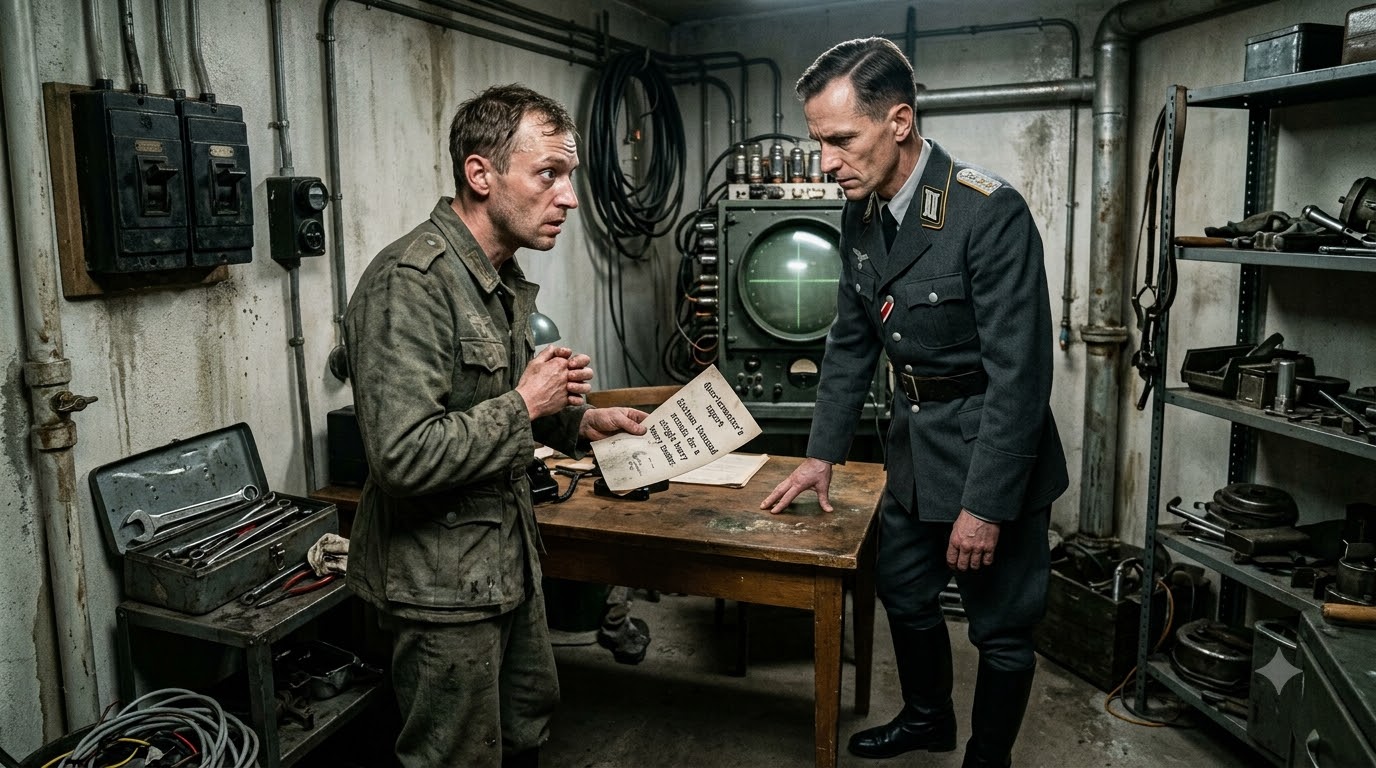
On the scarred wooden desk beside him sat the quartermaster’s report, its corners curling from the humidity.
Sixteen thousand rounds for a single heavy bomber.
Hoffman turned the brass calibration knob a fraction of a millimeter, feeling the fine teeth catch and resist beneath his fingers.
The number sixteen thousand sat on the paper like a mathematical insult, mocking every hour he had spent logging elevations and azimuths since forty-two.
A drop of condensation formed on the steel conduit overhead and fell squarely onto the edge of the report, darkening the ink around the printed statistic.
He didn’t wipe it away; he simply picked up the grease-stained brass gauge from the desk, rolling its heavy, cold cylinder back and forth between his thumb and index finger to quiet the irritation rising in his chest.
The receiver hummed softly, a low-frequency drone that fluttered the edges of the green sweep line.
Beside the radar housing, Corporal Meier shifted his weight, his heavy boots scraping loudly against the concrete.
“Another quiet sector, Major,” Meier muttered, wiping his palms down the front of his grease-spotted tunic.
Hoffman didn’t answer immediately, his eyes locked on the steady, unyielding green pulse of the cathode-ray tube.
CHAPTER 2: THE PHANTOM RETURN
Hoffman snapped his hand out, catching the edge of the metal housing as the voltage drop threatened to blow the primary fuse.
“Check the transformer,” Hoffman barked, his voice tight against the hum of the cooling fans.
Meier didn’t move fast enough, his boots sliding slightly on the oil-filmed concrete before he lunged toward the breaker box on the rear wall.
The green line on the Würzburg tube didn’t stabilize; it settled into a rhythmic, doubled pulse that bounced two miles ahead of the actual tracking coordinates.
Hoffman leaned closer, his breath fogging the protective glass of the scope as he watched a secondary echo detach itself from the sweep and drift toward the English coastline.
There was no physical aircraft on that vector, not according to the mechanical windage tables or the regional spotting schedules pinned behind the door.
“The voltage is steady at three hundred,” Meier muttered, his knuckles whitening as he gripped the iron handle of the breaker.
“Then the signal isn’t coming from the grid,” Hoffman replied, his fingers tracing the cold brass of the calibration gauge in his pocket.
The double-echo pulsed again, rhythmic and sharp, mimicking a reflection that had already bounced off an object moving at a velocity the parabolic dish was mechanically incapable of registering.
Hoffman reached out and flicked the frequency selector back one notch, trying to strip away the ghost line with sheer manual resistance.
The screen flared white for a fraction of a second, leaving an acrid smell of hot insulation and ozone hanging in the damp bunker air.
When the green glow returned, the secondary blip had vanished, leaving only a jagged scar burned permanently into the phosphor center.
CHAPTER 3: THE BROKEN CALIBRATION
The wind howling across the French coast drove sleet sideways into the concrete embrasures, freezing instantly against the steel housing of the seven-meter Würzburg dish.
Hoffman hauled his weight against the manual azimuth crank, his shoulder muscles straining against the frozen grease packed solid inside the gear housing.
Behind him, Corporal Meier struggled with a bucket of hot oil and a greasy rag, trying to thaw the locking pin before the moisture turned the entire mechanism into an unyielding block of ice.
“The wind’s shifting the elevation by a full degree,” Meier panted, his breath pluming white in the unheated grease-room.
“It’s not the wind,” Hoffman spat, wrenching the iron handle another half-turn until the gears groaned in protest.
The manual calibration was supposed to compensate for atmospheric drag, but the numbers on his hand-scrawled plotting pad no longer aligned with any known law of ballistic trajectory.
Every time he dialed the correction, the receiver feedback chattered with a harsh, metallic friction that vibrated straight through his heavy wool mittens.
The machine was fighting him, resisting every adjustment as if the air itself had grown a dense, invisible skin that refused to yield to German steel.
“We need a replacement gear assembly from Berlin,” Meier muttered, wiping a soot-stained sleeve across his forehead.
“Berlin isn’t sending us hardware; they’re sending us more paper asking why our shell consumption curves look like an ascending mountain,” Hoffman said, his boots slipping on the frozen puddle near the power lead.
He locked the heavy brass pin into place with a sharp, echoing clang, his knuckles bleeding where the skin had caught against the raw edge of the iron mounting plate.
The Calais sector was blind, and no amount of crank-turning or grease would force the cathode ray to show what was truly moving through the clouds above the Channel.
CHAPTER 4: THE SILENT COLLAPSE
Major Verer Hoffman didn’t reach for the pouch immediately, his fingers staying locked around the edge of the ink-stained wood.
Corporal Meier stared down at the scattered papers, his chest heaving with the damp cold of the bunker as he recognized the high-command stamp on the topmost sheet.
“They’re still asking for more battery reports from the Channel sector,” Meier whispered, his voice cracking slightly under the strain of months of unheeded warnings.
“Let them ask,” Hoffman replied, his tone flat and devoid of the old frustration.
He pulled the heavy brass gauge from his pocket and set it down precisely in the center of the reports, anchoring the fluttering paper against the draft from the door.
The math on the sheets was no longer a mystery; it was a cold, complete accounting of a doctrine built on sand.
No macro-intelligence logs or centralized summaries were needed to explain what every gun crew already felt in their aching arms and empty ammunition stores.
The enemy had bypassed optical uncertainty entirely, locking their fire through a continuous stream of invisible waves and automated calculations that left German steel firing blind into the grey clouds.
Hoffman reached across the desk and closed the metal dispatch box with a dull, final thud that silenced the bunker’s low electrical hum.
There would be no miraculous tactical reversal, no sudden surplus of industrial capacity to bridge the gap before the war’s end.
He turned away from the Würzburg display, leaving the green phosphor sweep glowing emptily against the dark glass as he walked out into the gray Channel dawn.