The Architecture of Silence: A Billionaire’s Redemption Through the Fragile Art of Human Connection
CHAPTER 1: The Weight of Polished Stone
The scream wasn’t just a sound; it was a frequency that bypassed the ears and settled directly into the marrow. In the center of the lobby, Billy was a small, frantic island in a sea of indifference. He curled into himself, his hands clamped over his ears as if trying to physically bolt the doors of his mind against the world.
Robert Hayes stood above, trapped behind the velvet rope of his own status. His charcoal suit, tailored to sharp perfection, felt suddenly like a suit of armor he couldn’t take off. Below, the receptionists had ceased their rhythmic tapping on keyboards, their heads turning in synchronized alarm. Three men in security uniforms paced in tight, useless circles, their radios chirping—a sound that only caused Billy to thrash harder against the cold, unyielding marble.
Linda, the housekeeper, stood by her cart, her knuckles white against the chrome handle. She felt the vibration in her feet, a sympathetic ache that pulled at her own memories of chaos. Beside her, her daughter, Jenny, stood in her worn, fraying sneakers. She didn’t look like a child witnessing a scene; she looked like a surveyor mapping a landscape.
“He’s drowning, Mom,” Jenny whispered. The words were quiet, but they cut through the ambient panic of the lobby.
Before Linda could anchor her, Jenny was in motion. She walked with a strange, liquid grace, avoiding the frantic perimeter the security team had established. She looked neither at the panicked guards nor at the billionaire watching from above. Her gaze was locked entirely on the geometry of Billy’s distress.
“Kid, get back!” a guard barked, his voice booming and heavy.
Jenny didn’t break stride. She pivoted, a subtle shift of weight that made the guard’s grasping hand swipe at empty air. She reached the five-foot mark from the boy and, without hesitating, sat down. The marble was cold, unforgiving, but Jenny smoothed her cotton skirt, opened her backpack, and retrieved a small, yellow plastic bottle.
She didn’t reach for him. She didn’t try to touch the boy who was currently fighting a war with his own nervous system. She simply dipped the wand, raised it to her lips, and exhaled.
The first bubble was erratic, catching the light from the chandelier, turning into a suspended prism. It drifted, indifferent to the shouting men and the panicked radios. When it landed on the edge of Billy’s shoe and vanished into a microscopic damp spot, the silence that followed was total.
Billy gasped. The sound wasn’t the jagged edge of a scream; it was the sharp intake of someone surfacing for air. He opened his eyes, searching the air, and caught a second bubble drifting toward the bridge of his nose.
Robert, watching from the balcony, felt the tension in his own shoulders fracture. He looked down at the girl in the faded denim jacket and realized, with a sudden, sinking dread, that she was doing something his millions had never managed to achieve. She was giving his son permission to exist. But as he turned to signal his assistant to bring them up, he saw the man glancing at a tablet, his thumb hovering over a ‘Send’ command addressed to the Board of Directors—documenting every second of the failure.
The information gap opened. Robert wasn’t just watching his son; he was watching the beginning of his own ruin.
CHAPTER 2: The Glass Fortress
The elevator ride to the penthouse was a study in absolute verticality. Robert stood at the front, his reflection ghosting against the brushed-steel doors, while his assistant, Marcus, stood slightly behind him, his fingers still dancing across the surface of a slim, black tablet. The silence in the small space was surgical. It was a professional silence, devoid of comfort, the kind of stillness that preceded a structural collapse.
Robert’s hand trembled, just once, as he adjusted the silk of his tie. The sensation of his own skin felt foreign, too sensitive, as if the nerves he had spent a lifetime cauterizing had suddenly decided to wake up. He looked at the reflection of his own eyes and saw a stranger—a man who had successfully managed an empire of glass and steel but had failed to notice the foundational cracks in his own kitchen.
As the elevator glided upward, a sudden, intrusive memory spiked through the calm. He remembered a board meeting three years ago. He had sat in this exact suit, his voice cold and commanding, explaining why a quarterly loss was merely a ‘temporary adjustment.’ He had lied to them—lied to himself—with such practiced ease that he hadn’t even felt the sting of it. That negotiation had felt like victory then, but now, trapped in the soaring metal box, it tasted like ash. He had won the numbers, but he had lost the ability to tell the truth to his own son.
The doors chimed—a soft, melodic sound that felt like a bell tolling.
“Mr. Hayes,” Marcus said, his voice clipped and efficient. He didn’t look up from the tablet, but his thumb moved with rhythmic, predatory precision. “The Board is asking for the status report on the child. They are suggesting that perhaps the ‘private accommodations’ at the estate are no longer suitable for his condition.”
Robert stepped out into the hallway, his loafers silent on the plush carpet. He felt the weight of the mansion’s design—the sharp edges of the glass tables, the clinical lighting, the absence of any texture that might soften a hard edge. It was a fortress, just as Jenny had called it. A place built to exclude, not to contain.
“Tell them the status is unchanged,” Robert replied, though his voice lacked its usual steel. He stopped at the heavy oak doors of the playroom. “And tell them I am the one who handles my family, Marcus. Not the Board.”
“Of course, sir,” Marcus murmured. His head remained bowed, but Robert saw the faint reflection of the man’s smirk in the hallway sconce.
Robert hesitated. He reached for the handle of the playroom door, but his hand hovered there, caught by the fading scent of ozone and something softer—a faint, lingering trace of soap. He thought of the bubbles. They were so ridiculously, offensively simple. And yet, the memory of them sent a thrum of something like hope—or perhaps panic—through his chest.
He pushed the door open. The room was bathed in the late-afternoon sun, casting long, geometric shadows across the floor. Billy was there, huddled in a corner behind a tower of plastic blocks, his posture tight and protective. The nanny was standing in the periphery, looking pale and thoroughly relieved to see Robert.
“He’s been quiet,” the nanny whispered, her voice barely audible. “Too quiet.”
Robert nodded, dismissing her with a subtle flick of his hand. He didn’t rush in. He didn’t bark a command. He looked at the floor—the way the sunlight hit the grain of the wood, the way the dust motes danced in the air. He felt the weight of his own presence, a hulking, loud, overbearing pressure in this space of fragility.
He crouched down. It was an awkward, stiff movement, his knees popping against the floorboards. He was a creature of high-backed chairs and pressurized boardrooms, not of rug-level existence. He felt ridiculous, a man of his stature sitting on the floor of a playroom, but the memory of the lobby—the way Jenny had simply sat—stuck to him like a second skin.
“Billy,” Robert said. He kept his voice low, aiming for the register he used when he was reading a contract, trying to strip the urgency out of it. “I’m not here to talk about the Board. And I’m not here to talk about the schedule.”
Billy didn’t move. He kept his face pressed against the plastic blocks, his fingers tracing a jagged line on the carpet.
Robert took a breath, letting the silence expand between them. He realized then that he had spent his life filling every room with his own intent. He had filled the house with noise, with expectations, with the sheer, crushing gravity of being Robert Hayes. He had been so busy building the fortress that he had forgotten to build a way inside.
“I have a bottle,” Robert said to the air, his voice barely a whisper. He pulled the small, yellow plastic cylinder from his suit pocket. He held it up, watching the light catch the translucent plastic. “But I don’t know the trick to it yet.”
He placed the bottle on the rug and pushed it gently forward, an inch at a time, until it rested in the shadow of the block tower. He didn’t look at his son. He kept his gaze focused on the patterns in the carpet, waiting for the ground to stop shaking.
CHAPTER 3: The Broken Vase
The yellow bottle remained on the rug, a small, vibrant trespasser in the sterile, grayscale geometry of the playroom. Billy’s gaze flickered from the plastic cap to Robert’s hand, which still rested, palm-down, on the carpet. Robert felt the friction of the rug against his skin—the coarse, synthetic fibers were a reality he hadn’t touched in years.
Billy crept forward, his movements jerky and cautious, like a small bird venturing near a predator. He was close enough now that Robert could see the fine, transparent beads of sweat on his son’s brow. Just as Billy’s fingers brushed the plastic, the room’s overhead lights flickered once, twice, and then pulsed with a rhythmic, dying amber glow. A low, electronic hum groaned through the walls—a surge in the estate’s security grid.
The sound shattered the fragile, nascent peace. Billy flinched, his hands darting back to his ears, the familiar, reflexive defense against the sudden intrusion of the world.
“System anomaly, sir,” the nanny’s voice piped up from the doorway, tight and jittery. “The security mainframe is cycling. It happens sometimes, but—”
“Quiet,” Robert snapped, though the sharpness wasn’t directed at her. It was a reflex, an old command-structure response he needed to unlearn. He caught himself, his posture softening as he turned back to Billy, who was now trembling. The electronic whine of the system alert was piercing, a high-frequency assault that seemed to be vibrating the very air in the room.
Robert knew he had to act, but he couldn’t play the part of the billionaire owner anymore. He couldn’t issue a directive to the house to stop the noise. He had to be a bridge.
He didn’t stand up. He ignored the flickering lights and the panicked Nanny. He focused entirely on the space between them. He reached into his pocket and pulled out a small, folded piece of paper—the map Jenny had drawn, the one with the labeled feelings. He laid it flat on the rug, smoothing out a crease with his thumb.
“Look,” Robert said, pointing to the blue-shaded square. “Deep water.”
Billy peered through his fingers, his chest hitching. The electronic whine in the walls grew louder, a mechanical shriek that made the nanny cover her own ears. Robert realized the security surge was triggering a feedback loop in the intercom system—the house itself was screaming.
“The house is loud,” Robert admitted, his voice steadying. “But you aren’t the house.”
He reached out—not to grab, not to restrain, but to offer a steadying hand on the rug, palm open. Billy hesitated. The room’s lights dimmed to a graveyard gray. The hum in the walls shifted pitch, becoming a discordant, rhythmic throb. Robert felt the panic rising in his own throat, a tidal wave of frustration at the systems he had installed, the very walls he had built to ‘protect’ his son now serving as the instrument of his agony.
But then, Billy moved. He didn’t come to Robert; he came to the map. He placed his own small, trembling hand directly over the spot Jenny had marked as safe.
“It’s not broken,” Billy whispered, the sound barely audible over the mechanical drone. “It’s just… hurting.”
Robert nodded, a slow, deliberate motion. He reached out and, with the precision of a surgeon, gently slid the yellow bottle across the floor until it sat directly in Billy’s reach.
“Then let’s quiet it down,” Robert said.
Billy gripped the bottle. His knuckles were white, but his focus had shifted. The electronic hum continued to pulse through the room, but Billy’s eyes were locked on the wand. He unscrewed the cap—a deliberate, agonizingly slow process—and dipped the wand. He didn’t blow immediately. He looked at Robert, searching for something—permission, perhaps, or a sign that Robert wasn’t going to turn back into the man who demanded perfection.
Robert remained still, a statue of quiet, waiting for the storm to pass.
Billy raised the wand. He took a breath—a long, shuddering inhalation—and then blew. A single, shimmering bubble emerged, drifting through the dark, flickering room like a silent, defiant star. It bypassed the expensive robots, the cold electronic screens, and the towering plastic shelves. It hovered in the air, a perfect, translucent sphere of peace.
Billy’s shoulders dropped. The mechanical shriek of the security system seemed to dampen, not because the system had fixed itself, but because the room had changed. The focus had shifted from the external threat to the internal act of creation.
“Blue,” Billy whispered, his voice gaining a sliver of strength.
“Blue,” Robert agreed, watching the bubble pop against the edge of a mahogany desk. He felt a profound, aching vulnerability. He was sitting on the floor of his own home, his house failing around him, his board of directors likely plotting his exit, yet he had never felt more anchored. He realized then that the fortress hadn’t kept the danger out; it had only kept the peace from getting in.
The flickering lights stabilized. The hum died away into a dull, manageable drone. The nanny looked on, bewildered, as the billionaire CEO remained anchored to the rug, his expensive suit rumpled, his hair disheveled, watching a ten-cent bubble vanish into the shadows of a room filled with expensive, hollow toys.
“We need more,” Billy said, looking at the bottle.
“I have plenty,” Robert said, and for the first time in his life, he wasn’t talking about money.
CHAPTER 4: The Map of Feelings
The transition from the playroom to the library was not a move; it was an extraction. Robert stood, his socks damp from the spilled soap and his knees aching, yet his movements were deliberate. He didn’t look at the nanny, whose eyes were fixed on the floor in a posture of practiced invisibility. He held the sketchbook that Jenny had left behind—a small, frayed thing, its corners dog-eared and softened by use.
“Stay here,” Robert told the nanny, his voice stripped of the corporate edge he used to employ as a bludgeon. It was simply a request.
He walked down the long corridor toward the library, Billy trailing a few paces behind. The estate’s architecture, which he had once viewed as a testament to his own success, now felt like a series of obstacles. The grand, echoing halls were cold, the marble floors demanding a rigid, heavy-footed gait that Robert consciously softened, trying to mimic the ‘deer-like’ step Jenny had mentioned.
Inside the library, the air was thick with the scent of vellum and dust. It was the heart of his intellectual life, a room where he had drafted mergers and plotted expansions. Tonight, it felt like an archive of a stranger’s life. Robert moved to the mahogany desk, intending to lay the sketchbook down, but his eye was caught by a discrepancy.
A file folder—thin, gray, and starkly out of place—sat on the edge of the leather blotter. It was not his. He never kept loose folders on the blotter.
Robert hesitated, his hand hovering over the paper. He glanced back at Billy, who was currently tracing the patterns of a Persian rug near the fireplace. The boy was in his own world, safe for the moment. Robert flipped the file open.
Inside were dates. Meticulous, timestamped logs of every ‘episode’ Billy had experienced over the last six months. But these weren’t medical notes. These were surveillance summaries. August 12: Subject agitated, 14:02. Performance impacted. September 04: Subject prone to self-isolation. Management capability questionable.
The coldness that washed over Robert had nothing to do with the library’s temperature. It was a freezing, sudden clarity. The Board hadn’t just been observing; they had been building a dossier. This wasn’t concern for his son. This was the opening move of a corporate coup, and they were using Billy’s trauma as the wedge to dismantle his legacy.
He closed the file, his heart hammering against his ribs. The library’s shadows seemed to lengthen, the books on the shelves standing like silent, judging witnesses. He had been so obsessed with ‘fixing’ Billy, with making him fit into the gray-scale aesthetic of his own life, that he hadn’t noticed the walls were closing in on him from the outside.
“Dad?”
Billy was standing at the edge of the desk, looking up. The boy’s eyes were clear, almost searching.
“I’m here,” Robert managed, his voice sounding thin. He tucked the folder into a drawer, the motion sharp and final. He had to pivot. He couldn’t fight them in the boardroom with facts and figures—that was their territory. He had to win this on the rug.
“Jenny said we need a map,” Billy said, clutching the yellow bubble bottle.
Robert took a breath, forcing his pulse to settle. He walked to the center of the room, pulling a chair out and dragging it to the floor. He sat down, crossing his legs in a way that felt increasingly natural.
“You’re right,” Robert said. He picked up a pencil and a fresh sheet of paper from the desk. “We need a map. But not of the house, Billy.”
He began to sketch, his hand moving with a fluidity he hadn’t felt in years. He didn’t draw rooms. He drew circles. He drew connections—lines representing the moments he had actually been present, the moments he had actually listened.
“Here,” Robert said, pointing to a small, central circle. “This is when you spoke.”
Billy knelt beside him, his gaze focused on the paper. For twenty minutes, they worked in a shared, quiet intensity. The library, once a place of strategic dominance, became a sanctuary of shared vulnerability. Robert saw the way Billy colored, the way he hesitated before choosing a shade—choosing the colors that felt right, not the ones that looked ‘correct.’
As they finished, the room grew dark, the twilight bleeding into the tall, floor-to-ceiling windows. Robert looked at the map, then at his son. He realized the file in the drawer was still there, a ticking clock of corporate sabotage, but as he watched Billy carefully draw a green star next to their progress, the threat felt distant.
He wasn’t just defending a legacy anymore. He was protecting a small, fragile, and absolutely essential piece of life that had nothing to do with his title.
“What do we label this room?” Robert asked, his voice soft.
Billy looked around the vast, imposing space, his eyes lingering on the heavy desk and the leather-bound books.
“The Blue Room,” Billy whispered. “Because it’s deep enough to hide in.”
Robert nodded, reaching out to touch his son’s shoulder. The weight of his hand was light, practiced, and, for the first time, entirely devoid of the need to possess or control.
CHAPTER 5: The Gala Gambit
Robert didn’t leave the library until the sun had fully abandoned the estate, leaving the room in a state of bruising purple twilight. He stood by the window, the file tucked into his suit jacket, a heavy, dead weight against his ribs. Billy was asleep on the sofa—a rare, peaceful outcome—but the peace felt fragile, a thin veneer of paint over rotting wood.
The Hayes Foundation Gala was waiting. Outside, the limousine idled, a black, predatory shape against the gravel. Robert checked his watch; the board members would already be arriving at the hotel. His own internal map, the one he had drawn with Billy just hours ago, felt hopelessly naive in the face of the encroaching storm.
He didn’t wake Billy. He left the nanny with a series of quiet, grounded instructions, his voice stripped of the corporate barking that usually characterized his interactions with the staff. “Keep the doors locked,” he said. “If anything—anything—feels wrong, call Linda. Not me.”
The drive to the hotel was a blur of refracted city lights against the tinted glass. Robert found himself obsessively smoothing the file inside his jacket. His mind, frayed by sleep deprivation and the sheer, exhausting work of being human, began to play tricks. He looked at his hands and they seemed to tremble, not from fear, but from a strange, buzzing energy. He wondered if the Board’s surveillance was even real, or if he was spiraling into the same sensory overload he had spent years trying to ‘fix’ in his son. Was he inheriting the condition, or simply finally succumbing to the pressure of the lies?
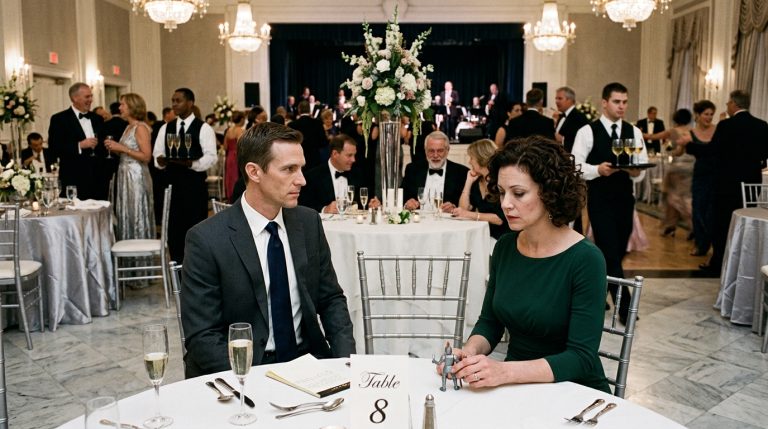
When he reached the hotel lobby, the transition was jarring. The air was thick with the scent of expensive perfume, dry champagne, and the sharp, antiseptic smell of the floor polish he hated. The lobby was a mouth, just as it had been that day in the lobby, but tonight it was full of sharp teeth: the guests, the investors, the Board members.
Marcus, his assistant, was waiting by the stairs. He looked sharp, his suit a shade of gray that seemed to blend perfectly into the walls. “They’re waiting, sir,” Marcus said, his eyes scanning Robert’s face for a weakness. “The Chairman is quite concerned about your… extended absence.”
“I was occupied,” Robert said, his voice flat. He felt the file against his ribs, a physical reminder of the betrayal he was about to confront.
“Indeed,” Marcus replied, a note of mock sympathy in his tone. “The Gala is an important night for the Foundation’s image. We need the narrative to be… precise.”
Robert walked past him, his feet moving with that rhythmic, intentional step he had practiced on the library rug. He wasn’t a billionaire today; he was a father, and he was a target. He walked into the ballroom, the grandeur of the space feeling suddenly, suffocatingly small.
He saw the Board members gathered near the podium, their expressions tight with professional concern. Among them was the Chairman, a man whose face had been chiseled by decades of ruthless acquisition. He saw Robert and began to move forward, a predatory drift across the floor.
“Robert,” the Chairman said, reaching out to grasp Robert’s forearm. His touch was dry, cold. “We were worried you wouldn’t show. We have some… adjustments to the presentation. In light of the recent, er, domestic challenges.”
Robert felt the trap snap shut. He looked around the room. He saw the security team—the same men who had stood uselessly while Billy screamed—now positioned at every exit, their radios muted but their gaze fixed on him.
“Domestic challenges?” Robert repeated, his voice dangerously quiet.
“The reports are quite clear, Robert,” the Chairman said, lowering his voice to a conspiratorial hiss. “We’ve seen the logs. The child is unstable. The family environment is compromised. We are prepared to offer you a graceful exit. We’ll take the lead on the Foundation’s restructuring.”
The room seemed to tilt. The music—a light, airy string quartet—began to sound discordant, the notes stretching and warping. Robert felt the V-4 variance of his own mind pushing against him, the reality of the file in his pocket clashing with the polite, suffocating smiles of the men around him. He thought of the map he and Billy had drawn, the fragile, green-starred goal of connection, and he realized with terrifying clarity that the Board hadn’t just been watching Billy; they had been waiting for Robert to care enough to be distracted.
He reached into his jacket. Not for the file—not yet—but for the small, yellow bubble bottle he had started carrying as a talisman. He gripped it in his pocket, the hard plastic biting into his palm.
“Graceful,” Robert said, his gaze fixed on the Chairman. “I don’t think that word means what you think it means.”
He stepped toward the podium, the ballroom falling into a sudden, expectant silence. He had arrived at the climax of his own making, and for the first time in his life, he didn’t care about the consequences of the fall. He only cared about the room.
He stepped up, the lights blindingly bright, and looked out over the sea of faces—the people he had spent his life trying to impress, now nothing more than a blurred, noisy landscape of judgment. He took the bottle from his pocket and set it on the lectern. It looked ridiculous—a bright, cheap, plastic thing against the polished oak.
“Ladies and gentlemen,” Robert began, his voice ringing through the cavernous space, “I’d like to tell you a story about how to build a fortress.”
CHAPTER 6: The Unraveling
The darkness was not merely an absence of light; it was a physical weight. One moment, the ballroom was a stage of aggressive scrutiny, the air thick with the scent of expensive perfume and the predatory anticipation of the Board. The next, the world vanished. The chandeliers overhead died with a collective, sickening pop, followed by the hiss of cooling gases, and then a profound, terrifying silence that swallowed the murmurs of the crowd.
Robert stood frozen at the podium. His hands were still gripping the edges of the oak, his knuckles aching from the pressure. In the pitch black, the sounds of the room amplified—the rustle of silk gowns, the sharp intake of breath from the woman in the front row, the frantic, muffled scuffle of security guards trying to navigate the sudden void.
He didn’t move. He knew the Board would be reaching for him. The moment he had mentioned the “fortress,” he had declared war, and the darkness was the battlefield they had been waiting for.
“Stay calm,” a voice boomed from somewhere in the dark—the Chairman. It was a command disguised as leadership, but beneath it, Robert heard the tremor of genuine anxiety.
Robert eased his grip on the podium and stepped back. He felt the cold air of the ballroom against his skin. He needed to find the exit, but not the one the security team was guarding. He needed to find the path he and Billy had mapped—a path not of steel and status, but of simple, human navigation.
He moved with agonizing slowness, his arms outstretched. His fingers brushed against the rough velvet of a curtain, then the cold, hard surface of a support pillar. He was a man who had navigated complex mergers and hostile takeovers, yet here, in the dark of his own hotel, he felt entirely adrift.
“Robert?”
The voice was Marcus’s, his assistant. It was close, too close. Robert felt the rush of displaced air as Marcus moved through the dark toward the podium. Robert pressed himself against the pillar, his heart hammering against his ribs like a trapped bird.
“I know you’re here, Robert,” Marcus whispered, the voice devoid of its usual sycophantic polish. It was cold, clinical, and stripped of pretense. “The Board isn’t interested in the Foundation anymore. We just want the keys to the legacy. Hand over the override codes for the estate’s security grid, and we’ll let you fade away quietly. We don’t need a scandal. We just need the infrastructure.”
Robert realized then that the coup wasn’t about Billy’s health. It was about the proprietary technology embedded in the Hayes estate—the very system that had been malfunctioning, the one that controlled more than just locks and lights. It was a grid that could monitor and manipulate data across the entire city. The Board wanted the keys to the city, and they were using his own son’s trauma to pry them out of his hands.
“You’ll never get them,” Robert said, his voice a low, steady rumble in the dark.
“We don’t need you to give them to us,” Marcus replied. “We only need you to be declared incompetent. The file you have in your jacket? It’s a nice touch. But it won’t survive the night.”
A scuffle broke out near the center of the room—a table overturned, a glass shattering against the floor. The sound was a jagged tear in the tension. In the confusion, Robert lunged away from the pillar, moving toward where he remembered the service entrance. He wasn’t running; he was sliding, his feet keeping contact with the floor, his mind mapping the room’s geometry based on the memory of the lights.
He felt a hand brush his shoulder—a guard. He dropped low, his shoulder driving into the man’s midsection with a sudden, desperate kinetic energy. The guard grunted and stumbled, his weight shifting, and Robert kept moving, his breath coming in short, sharp hitches.
He reached the heavy, fire-rated door of the service hallway. It was locked, but Robert knew the override. He didn’t use a key; he pushed his palm against the scanner, a remnant of a system he had designed himself, a backdoor he had kept secret even from the Board.
The light flickered, a faint, dying red pulse, and the magnetic lock clicked open.
He slipped into the hallway, the cool, sterile air of the service sector a stark contrast to the humid, suffocating darkness of the ballroom. He didn’t pause. He ran, not toward the lobby, but toward the basement, toward the physical heart of the hotel’s grid.
He had to get to the server room. He had to wipe the access logs before Marcus and the Chairman realized he had slipped the net.
As he descended the stairs, the darkness began to lift, replaced by the flickering, dying emergency lights that bathed the stairwell in a sickly, jaundiced yellow. He stopped on the third landing, his chest heaving, his tie ripped and hanging loose. He looked at his hands. They were shaking again, but this time, he didn’t try to stop them. He didn’t try to ‘fix’ them. He embraced the friction, the exhaustion, the raw, unadorned truth of his own panic.
He wasn’t a billionaire. He was a man with a broken son, a failing legacy, and a secret that was finally, brutally, coming to light. He reached into his pocket and touched the yellow bubble bottle. It was still there. A small, ridiculous, plastic piece of reality.
He was going to finish this. Not for the Board, and not for the Foundation. He was going to finish this for the boy who had taught him that the only way to survive the dark was to breathe through it.
CHAPTER 7: The Archive of Echoes
The basement was a cathedral of cooling fans and blinking LEDs, a stark, neon-lit contrast to the opulent, dying world of the ballroom upstairs. Robert pushed through the heavy steel door, his lungs burning. The air down here was frigid, recycled, and carried the sharp, ozone-tinged scent of raw electricity.
He didn’t head for the main terminal—that would be the first place the security team would sweep. Instead, he moved toward the legacy node, a dust-covered rack tucked into the building’s deepest foundation. This was the original Hayes node, a relic from his father’s era, the point where the physical architecture of the estate was hard-wired into the digital infrastructure of the city.
As he stepped across the grated floor, the V-2 phantom hit him with the force of a physical blow. He heard his father’s voice—not a memory, but a haunting, structural echo. The house has to hold the weight, Robert. If you don’t build it to withstand the pressure, the foundation breaks.
He had spent his life trying to live up to that mantra, constructing a life of rigid, unyielding perfection. But as he reached the legacy rack and pulled a small, manual diagnostic tool from his kit, the reality of the ‘noise’ Billy experienced finally coalesced. It wasn’t just sensitivity. It was a shared, inherited exhaustion—the same psychic weight Robert had been carrying since he was six years old, sitting in this very basement while his father obsessed over the grid. The trauma was the legacy. The noise was the inheritance.
He tapped into the node, his fingers working with a precision born of desperation. The screen flickered to life—a cascade of green, archaic code. He wasn’t just looking for the Board’s surveillance logs anymore. He was looking for the root.
He scrolled through the directories, his eyes burning. There it was: Project Echo.
It wasn’t a corporate initiative. It was a behavioral study, initiated decades ago, designed to monitor the ‘subject’—his father, then himself, and finally, Billy—for signs of structural failure. The Board hadn’t just been planning a coup; they had been waiting for the ‘Hayes instability’ to reach its peak so they could finally claim the estate as a controlled asset. The coup was the endgame of a thirty-year experiment.
“You shouldn’t have come down here, Robert.”
The voice came from the shadows behind the cooling racks. Marcus stepped out, his suit impeccably neat, his expression one of tired professional disappointment. He held a small, black remote—the override trigger.
“I’ve spent years managing your reputation,” Marcus said, walking forward. “I really did hope you’d just sign the transfer. But you always had to be the hero, didn’t you? Even when you were tearing your own house down.”
“It’s not a house,” Robert said, his hands still working the terminal, his focus entirely on the command line. “It’s a cage.”
“And you’re the one who kept the door locked,” Marcus countered. He gestured to the racks. “The Board is already triggering the remote wipe. In three minutes, the Hayes Foundation will be nothing more than a history of mismanagement and a series of tragic, inherited mental breakdowns. You, your son… you’ll be the footnote that justifies the acquisition.”
Robert felt the walls of the basement hum. The servers were spinning up—a frantic, high-pitched mechanical wail that mimicked the exact frequency of Billy’s sensory overloads. It was the house, screaming in unison.
Robert didn’t look at Marcus. He finished the entry. He wasn’t trying to stop the wipe; he was redirecting the data. He was taking every file, every log of Project Echo, every proof of the Board’s surveillance, and he was broadcasting it—not to the press, but to every public-facing screen in the Hayes hotel network.
“What are you doing?” Marcus asked, his voice suddenly sharp with alarm.
“I’m opening a window,” Robert replied.
He pressed the final key. The basement lights surged, turning a brilliant, blinding white. The cooling fans roared to life, a deafening, unified sound that vibrated through the floorboards.
“You’ve just destroyed everything,” Marcus hissed, lunging forward.
Robert didn’t flinch. He let go of the terminal and reached into his jacket pocket. He didn’t pull out a weapon. He pulled out the yellow bubble bottle.
“No,” Robert said, his gaze fixed on the flashing screens that were currently streaming the Board’s dirty secrets to every lobby, every room, and every elevator in the hotel chain. “I’m just finally letting the noise out.”
The impact of the data hit the hotel’s system like a physical shockwave. The hum in the basement stopped abruptly, replaced by the distant, muffled sound of a hundred televisions flickering, the startled exclamations of guests in the lobby, and the sudden, frantic, dissonant chaos of a legacy coming apart.
Robert stood amidst the dying servers, the air in the basement finally, miraculously, still. He had lost the empire. He had lost the suit, the title, and the fortress. But for the first time since he was a child, the silence wasn’t a weight. It was just space.
CHAPTER 8: The Open Horizon
The basement was cold, but the light was gentle. Robert stood in the center of the server racks, watching the dust motes dance in the amber glow of the rising sun. The data had done its work; the hotel screens were flooded with the transcripts of Project Echo, exposing the systematic surveillance of his own bloodline to the world. Marcus had already fled, his bravado dissolving the moment the first log hit the public network.
The Payoff was visceral. Upstairs, he could hear the muffled, frantic energy of a hotel staff trying to manage the impossible—the sudden, public realization that the Hayes empire was built on the wreckage of a family. He did not go to them. He did not need to.
He walked to the basement exit, his legs heavy with the exhaustion of a man who had walked through fire and found, surprisingly, that he was still made of flesh and bone. When he pushed the door open, the air of the estate greeted him—damp, smelling of earth and the coming autumn. The fortress was still here, the iron gates standing as a reminder of his past, but as he crossed the gravel, he felt no compulsion to maintain the walls.
He found Billy in the library, curled on the rug, sunlight spilling over his hair. Jenny was sitting next to him, showing him a new drawing. They weren’t looking at the screens. They were looking at a small, plastic tray of soapy water.
The Antagonist’s downfall was not a sudden explosion; it was the slow, inevitable erosion of the image he had spent his life crafting. The Chairman would be facing the consequences, the legal machinery of the state already churning, but Robert did not check his phone to monitor the stock price. He let it sit on the mahogany desk, a useless, dark stone.
He approached them, his footsteps slow and deliberate. He saw the way Billy looked up—no fear, no flinching, just a quiet, expectant calm. Robert sat down on the floor, the rough texture of the rug a welcome, grounding sensation against his palms. He took the yellow bubble bottle from his pocket, the plastic worn and scratched.
“I finished the job,” Robert said softly.
Billy looked at the bubble wand, then at his father. He reached out and, with a steady hand, dipped the wand into the tray. He blew, and a bubble drifted into the library’s quiet air, perfectly iridescent, catching the morning light.
“The noise is gone,” Billy whispered.
“It is,” Robert said. He picked up a fragment of the map they had drawn—the piece labeled The Blue Room—and carefully smoothed it out. It was torn, creased, and smudged with dirt, but it was the only document that mattered. He took a pair of scissors from the desk, not to cut, but to trim the fraying edges of the paper, a small, symbolic act of repair.
The denouement was long and slow, a settling of the world into a state of atmospheric peace. There would be lawsuits, there would be a public stripping of his assets, and there would be a long, difficult process of rebuilding a life without the shield of his billions. But as he sat there, watching Billy chase the bubbles through the dusty light, Robert realized he had achieved the only form of poetic justice that ever meant anything: he had survived his own legacy.
He looked at Jenny, who was watching him with the kind of ancient, knowing gaze that made him feel like a student again. She didn’t offer praise; she simply handed him a green crayon.
“The horizon needs more grass,” she noted.
Robert smiled—a real, spontaneous movement that creased the tired skin around his eyes. He took the crayon, the wax cool and firm, and began to add to the drawing.
They sat there for hours, the three of them, in the house that had once been a museum of his own ambition, now repurposed into a workshop for the living. There was no grand speech, no triumphant exit to a cheering crowd. There was only the sound of crayons on paper, the soft breath of bubbles, and the feeling of the earth beneath them, finally still. The open horizon was not a destination; it was simply the ability to look forward without fear, one steady step at a time.