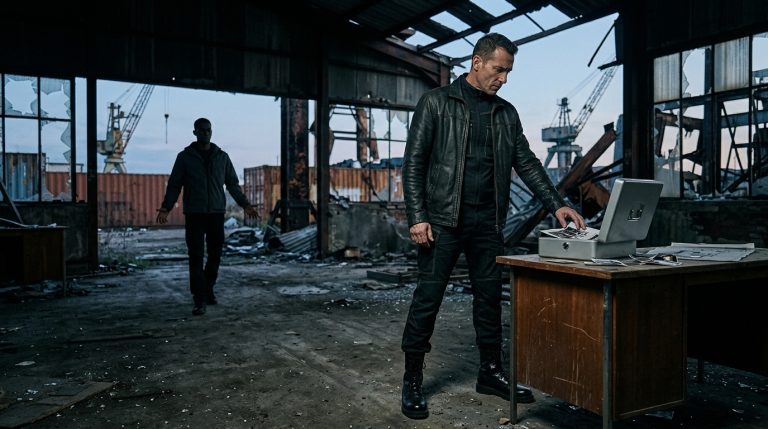
A Billionaire’s Empire Trembles When a Forgotten Signal from the Past Shatters His Controlled Reality
CHAPTER 1: The Sound of Glass
The marble floor was cold, a clinical white expanse that did nothing to numb the heat radiating from James Anderson’s chest. He didn’t walk; he prowled. The sound—that rhythmic, metallic clack-clack-dash—was an infection in the pristine silence of his estate. It wasn’t just noise; it was an intrusion into the one quadrant of his life he had spent seventeen years sanitizing: his son’s autonomy.
He pushed the study door open without a breath of warning.
The room smelled of dead paper and old, trapped air. Matthew was on the floor, his frame long and gangly, looking less like an heir and more like a captured bird. Beside him, the girl—the maid’s daughter, Sophie—held a ruler like a weapon. The movement stopped the moment the door hit the oak frame.
James didn’t speak immediately. He looked at the girl. She didn’t scramble. She didn’t drop her eyes. That was the first shift in the air pressure. Most people wilted under his gaze; she merely pivoted, her attention moving from the pencil to his throat, as if measuring the distance for an incision.
“Mathematics,” James said, his voice flat, the kind of monotone that signaled a pending termination. “You are failing trigonometry, Matthew. The tutors tell me you are brilliant, yet you perform like a saboteur.”
Matthew stood slowly. He didn’t look like a failure; he looked like a soldier waiting for the order to charge. His hand was clenched, fingers white around a legal pad. “It isn’t a game, Dad. If you’re looking for a distraction to buy, keep looking. This isn’t for sale.”
“It’s Morse,” James said, stepping into the room. The floor creaked under his weight. “A relic for the obsolete. Why are you wasting oxygen on a dead language?”
Sophie finally spoke, her voice barely a whisper, yet it carried the weight of a stone dropped in a well. “It’s not dead, Mr. Anderson. It’s just waiting for someone who knows how to listen to the things that don’t want to be heard.”
James felt the sting of it—a sharp, cold itch under his skin. He reached for the legal pad on the floor. Matthew lunged, a sudden, jagged movement, his shoulder slamming into James’s chest with the desperation of a man fighting for his life. James didn’t stagger. He caught his son’s wrist, the force of his grip leaving red marks on pale skin.
“You are an Anderson,” James hissed, his face inches from his son’s. “You will not embarrass this house with this… nonsense.”
“You built a mausoleum,” Matthew snarled, his eyes shimmering with a dark, terrifying clarity. “You think you’re in control because you bought the locks. But you didn’t hear what she just told me.”
James looked down at the pad. The dots and dashes were frantic, desperate. He looked past his son to the girl. She was watching him, not with fear, but with a cold, hollow pity that sent a tremor of real terror through his heart. She wasn’t just a child. She was holding a mirror to the rot he’d been hiding for years.
He didn’t see a prank. He saw a code. A signal. And suddenly, he realized the sound wasn’t coming from the room—it was vibrating through the entire foundation of the house, a warning pulse that something was finally, irrevocably, coming apart.
CHAPTER 2: The Shadow Ledger
The air in the study felt pressurized, the silence heavier than before, as if the room itself were holding its breath. James stood by the mahogany desk, the legal pad still clutched in his hand. His fingers traced the jagged graphite marks—the dots and dashes that had fractured his evening. The rhythm played over in his mind, a persistent, invasive heartbeat.
He needed the Signal Manual. He knew, with a terrifying, intuitive certainty, that it was in the house. It hadn’t been touched in three decades.
He didn’t call the staff. He didn’t summon Emily. He moved to the built-in shelves lining the north wall—a library of status symbols, leather-bound biographies of men who had conquered markets, and treatises on fiscal dominance. He ignored them. His eyes traveled to the lowest shelf, where the shadows pooled. There, hidden behind a stack of neglected, dust-mottled engineering journals, sat the dark blue volume.
As he pulled it free, a memory struck him with the force of a physical blow—the smell of lilies and cold rain. His father’s funeral. He hadn’t thought of it in years. William Anderson had been buried with the same quiet, devastating resignation he’d carried in life. James had been twenty, armored in a tailored black suit, his grief replaced by an obsession with the company’s share price. He remembered looking at his father’s casket and feeling nothing but a profound sense of wasted potential. Now, staring at the spine of the manual, he wondered if he had been looking at a man who was relieved to finally stop fighting.
He sat at the desk, the banker’s lamp casting a harsh, green-tinted glow over the workspace. He opened the manual. The pages were brittle, yellowed, and thin. He placed the legal pad beside it.
Protect him.
He decoded it slowly, his analytical mind fighting the mounting dread. If Matthew was involved in something that required such cryptic communication, it wasn’t just teenage rebellion. It was a strategy. A move in a game James hadn’t even known was being played.
His eyes scanned the translation. He looked for patterns—financial codes, stock symbols, the language of the boardroom. He needed to find the leak. He assumed this was about the firm; he assumed someone, perhaps a rival, was using the boy to siphon secrets, using the girl as a courier. It was the only explanation that fit the world James occupied.
He reached for his phone, punching in a sequence that accessed his private ledger. He began to cross-reference the timestamps of the tapping he’d heard with the market fluctuations of the past forty-eight hours.
Clack-dash. Dot.
He transcribed the marks from the pad. He wasn’t translating for meaning; he was searching for coordinates. He was looking for a destination. But as the letters began to form, they didn’t align with any financial metric.
B-U-R-D-E-N.
James froze. The word hung in the pool of green light. He leaned back, the leather of the chair groaning. He had spent his life removing burdens—liquidating assets, trimming staff, dissolving dependencies. This was something different.
The tapping sound echoed again, faint but distinct, traveling through the ventilation shafts from the west wing. Matthew was still awake. He was still signaling.
James stood up. The ledger on his screen was forgotten. He crossed the room, his footsteps silent on the rug, and moved toward the hallway. He didn’t know what he was looking for, but he knew he was being watched. He could feel it—a shifting in the peripheral vision of his life.
He moved toward the west wing, his jaw tight. He would catch his son in the act. He would demand the cipher key. He would tear this “game” down, brick by agonizing brick, until he found the source of the rot. He reached the end of the corridor, his hand hovering over the handle of Matthew’s bedroom door, but he stopped.
A faint, metallic scraping came from the kitchen area. Someone was moving down there—someone moving with the careful, practiced silence of a ghost.
James didn’t go into his son’s room. He pivoted, his body shifting into the tactical, predatory stance he used when closing a hostile takeover. He headed for the stairs, his eyes narrowing. If the leak wasn’t just in the study, it was in the house. And he was going to find out exactly who was holding the pen.
The house seemed to shrink around him, the grand architecture suddenly feeling like a cage. He wasn’t the master of this space anymore; he was a tenant in a war zone he had yet to map.
CHAPTER 3: The Surveillance Shift
The hallway stretched before him, a gallery of portraits showing Anderson men who had stared down history and won. But tonight, the eyes of the painted ancestors seemed to track his hesitation. James moved with a predator’s economy, his footsteps muffled by the thick, hand-woven carpets. The kitchen was a cavern of stainless steel and industrial refrigeration units—a space designed for efficiency, not secrets.
When he reached the threshold, the room was empty, illuminated only by the clinical, moonlight-blue glow of the refrigerator’s digital display. The scent of floor cleaner—sharp, lemony, and acidic—stung his nostrils. He checked the pantry. Empty. The service entrance? Locked, the deadbolt still engaged.
Yet, the scuffing sound had been real. He moved to the island, his hand brushing against a cooling silver goblet that had been left out. It was damp, condensation beaded on the surface like cold sweat. Someone had been here. Recently.
A sudden, jarring thought fractured his focus: the layout of the mansion. He had lived here for two decades, yet as he scanned the perimeter, a detail felt wrong. The hallway leading to the staff quarters—it felt longer, the geometry of the architecture slightly distorted, as if the house were expanding or contracting to hide its own inhabitants. He blinked, the sensation of vertigo washing over him. It was the lack of sleep, he told himself. The high-stress variables of the Tokyo deal, combined with the inexplicable presence of the maid’s daughter, were warping his perception.
He had to stabilize the environment. If he couldn’t control the variables, he would remove the variables entirely.
James walked to the house’s master control panel, hidden behind an unassuming walnut panel in the butler’s pantry. He keyed in his authorization. The screen flickered to life, showing the grid of his empire’s headquarters, but he bypassed the corporate firewalls, tunneling deep into the local security sub-server.
He didn’t just want to see the footage; he wanted to create a perimeter. He initiated a full lockdown. Every magnetic lock on every external door engaged with a dull, heavy thud that resonated through the floorboards. He silenced the central heating, forcing the house into a cooling stasis. If anyone was moving in the dark, they would have to contend with the sudden absence of white noise.
As the house went quiet, James pulled his phone from his pocket and bypassed his personal assistant, calling the chief of security directly.
“Robert,” James said, his voice stripped of all warmth. “I want a complete sweep of the west wing. Do not wake the boy. I want you to isolate the staff quarters. Every exit, every window. I want a digital audit of every communication device on the premises. I don’t care about privacy; I care about containment.”
“Sir, is there a security breach?” Robert’s voice was grainy, waking up in the middle of his shift.
“There is an unauthorized pattern in the house,” James replied, ignoring the question. “Clear the logs. I want to know who has been moving between the garage and the main building since 18:00 hours.”
He ended the call, his thumb hovering over the screen. He looked back at the kitchen. The silence was absolute now, oppressive. He realized then that he wasn’t just securing his assets—he was building a containment cell. And he was the primary occupant.
He moved toward the west wing again, his pace measured. He had to be sure. He passed the grand staircase, his shadow elongated and distorted by the sparse, moonlight-infused lighting. The house was no longer a monument to his success; it was a puzzle, and for the first time in his career, he didn’t have the key. He reached the door to the staff quarters, his hand reaching for the security override.
He didn’t knock. He triggered the release and pushed the door open, ready to confront the phantom. What he found wasn’t a spy or a saboteur. It was the absence of a life. The room was perfectly, unnervingly tidy. Too tidy. It looked like a hotel suite that had never been occupied. The girl’s books, her small personal effects, the remnants of her mother’s routine—everything was gone, stripped away as if they had never existed.
James stepped inside, the air in the room stale and cold. He turned his flashlight on, the beam cutting through the gloom. On the nightstand, there was nothing but a single, small piece of paper. He picked it up with a trembling hand. It was a fragment of a page, torn from a ledger.
He turned it over. On the back, in faint, precise pencil, were three sets of coordinates—not financial, not geographical, but serial numbers. He recognized them immediately. They were the registration numbers of the original Anderson shipping fleet, a company his father had sold to a conglomerate over thirty years ago.
His heartbeat surged, a frantic, irregular rhythm that matched the tapping he had heard in the study. This wasn’t a leak; it was an excavation. Someone wasn’t trying to rob him. They were trying to resurrect the past. And the past, he realized, was never buried deep enough. He shoved the paper into his pocket, his resolve hardening into something colder, more dangerous. He wasn’t just going to find out who was signaling; he was going to force the house to give up its dead.
CHAPTER 4: The Shadow Ledger
James stepped out of the staff quarters, his pulse a frantic, irregular drum against his ribs. The hallway was unnervingly silent, the air still, yet he could feel the house reacting to him, the floorboards groaning under the weight of his suspicion. He walked back to his office, his mind partitioning the evidence like a forensic accountant. The registration numbers. The shipping fleet. They were artifacts of a time when the Anderson name stood for innovation, not just market consolidation.
He locked his office door, the bolt sliding home with a finality that made the room feel like a vault. He pulled the paper fragment from his pocket and laid it on the obsidian desk. He didn’t turn on the overhead lights; he kept the banker’s lamp on, its green cone of light focused tightly on the slip of paper.
He didn’t search for a cipher this time. He knew what to look for. He pulled the ledger of the 1990 liquidation from his private safe. He began to compare the coordinates. The numbers didn’t point to shipping lanes; they pointed to land deeds—tracts of property in the Pacific Northwest, long sold off in the early nineties, during the chaotic reorganization of the company.
He found a discrepancy. One tract of land, located on the border of a defunct government research facility, hadn’t been sold. It had been transferred. To a shell company that dissolved six months after his father’s death.
“Damn it,” he hissed, the sound sharp in the quiet room.
He reached for the ledger, his thumb catching on a slight irregularity in the spine. He felt a seam. He grabbed a letter opener from the desk, its handle cool and weighted, and carefully pried the leather binding away from the frame. There, tucked deep within the glue and stitching, was a roll of microfilm.
He stared at it, the plastic glinting in the low light. This was the leak. This was what the tapping had been guiding him toward. He felt a cold, jagged anger, but beneath it, a sliver of curiosity that he couldn’t repress. He walked to the back of the room, where a vintage microfiche reader stood—a relic of his father’s era that he’d kept for aesthetic purposes. He hadn’t used it in a decade.
He threaded the film, his hands steady, though his focus was blurred by fatigue. The machine whirred to life, a low, mechanical hum that seemed to vibrate through his teeth. He turned the focus dial.
The image flickered into view: a scan of a document. It wasn’t financial. It was a letter.
To my son, if the name ever means more to you than the man who carried it.
James felt the room tilt. He read on, his eyes scouring the lines of his father’s handwriting, neat, precise, and haunting. It was a breakdown—not of stocks, but of a soul. The letter detailed a systematic failure of the Anderson fleet, a hidden disaster involving the transport of hazardous research materials that the government had scrubbed from the public record. His father hadn’t just been a signalman; he had been a witness. And the weight of that witness had been the “burden” he had carried until he couldn’t carry it anymore.
James looked at the next frame. It was a list of names—the officers who had gone down with the ships, the men his father had tried to save. And at the bottom, a note: The system is a machine that devours its own components. Do not become part of the mechanism.
He leaned back, the hum of the reader filling the silence. The decoy secret—the idea that this was about siphoning money or corporate sabotage—evaporated. This wasn’t about the current market. It was about an ancient, systemic rot that had been the foundation of his father’s grief and, ultimately, his destruction.
His phone buzzed on the desk, vibrating across the obsidian surface. He picked it up. It was Robert.
“Sir, we have eyes on the maid’s car. They’ve pulled over at the regional transit station. They’re buying tickets, sir. For a train headed north.”
James didn’t respond for a long beat. He looked at the screen, at the words Protect him captured in the cold light of the microfiche.
“Let them go,” James said.
“Sir?”
“Do not approach them. Do not intercept. Just watch. And Robert… maintain distance. Absolute distance.”
He hung up, the silence of the office returning, heavier than before. He stood and walked to the window, looking out at the vast, darkened lawn. He realized the tapping hadn’t been a demand for money or a threat to his reputation. It had been a hand extended from the grave, a warning to stop the machine before it devoured the only thing he had left—his son.
He didn’t feel like a billionaire anymore. He felt like a boy, standing in the shadow of a man he had spent his life dismissing as a failure. He had been so busy building the empire that he hadn’t noticed he was standing on a foundation of sand. And now, the tide was coming in.
He turned away from the window, his gaze settling on the doorway. He needed to talk to Matthew. Not as an Anderson to an heir, but as a man to a witness. He moved toward the door, his steps heavy, the realization finally settling in: the game wasn’t about control. It was about survival.
CHAPTER 5: The Confrontation
The silence of the house had been aggressive; the sudden darkness was absolute. When the power died, the microfiche reader sputtered and expired with a sharp, electronic pop, leaving James in a pitch-black office that suddenly felt like a tomb. His first instinct was kinetic—a predatory pivot, his hands instinctively fanning out to find a surface, a weapon, a perimeter.
He didn’t panic. Panic was a luxury he had excised from his psychological profile years ago. But the coldness that settled into his joints was primal. The house had shifted; the familiar dimensions of his office now felt distorted in the dark. He reached for the desk, his fingertips grazing the cold obsidian. The microfilm was gone—or rather, he couldn’t feel it where he’d left it.
He moved toward the door, his movements measured, deliberate. He knew the path—five steps to the oak panel, three more to the handle. He reached out, expecting the resistance of the wood, but found only the cold, unforgiving edge of a bookshelf.
He stopped. His breath hitched in his throat. He had miscalculated the layout by a foot. How? He had built this room. He knew every millimeter of its construction. And yet, the space felt wrong, the geometry subtly skewed, as if he were walking through a mirror image of his own life.
Clack. Dash. Clack.
The sound didn’t come from the hallway. It came from inside the room. It was metallic, sharp—the sound of a small tool striking the edge of the glass display case that housed his father’s old signal key.
James didn’t shout. He held his breath, his eyes straining to catch the faintest flicker of movement. He was being hunted in his own sanctuary. He moved toward the sound, his hand finding the edge of the display case. The glass was cool, but it was empty. The signal key was gone.
“Matthew,” James whispered. His voice sounded thin, stripped of its boardroom resonance. “I know you’re here. This—whatever this is—it’s over. I saw the microfilm.”
There was no answer. Just the soft, rhythmic scrape of leather against the floorboards near the window. James lunged, his hands grasping for a jacket, a shoulder, a throat. He collided with the velvet curtain, the fabric tangling around his arms, blinding him for a heartbeat. He tore himself free, spinning, ready to strike, only to hit the back of his father’s high-backed leather chair.
The chair was spinning. Slowly. A deliberate, controlled rotation.
“You didn’t see everything, Dad,” a voice spoke from the shadows near the balcony door. It wasn’t Matthew. It was a voice that belonged to the past—hollow, resonant, and disturbingly calm.
James froze. The voice triggered an avalanche of buried memories: the smell of pine, the sound of rain on a tin roof, the weight of a hand on his shoulder that never quite felt like a grasp. “Who is that?” James demanded, his heart hammering against his ribs.
“You spent your life trying to erase the burden,” the voice continued, stepping into the sliver of moonlight filtering through the balcony door. It was a man, tall and gaunt, his silhouette framed against the gray night. “You thought the money would sanitize the history. You thought if you stripped the name of its context, it would stop haunting you.”
James reached into his pocket, his hand hovering over the microfiche fragment. He felt the sharp edge of the film. “You’re a ghost,” James said, his voice hardening. “You’re a psychological phantom of my own making.”
“I’m the consequence of your momentum,” the man said. He moved closer, the moonlight revealing features that were a terrifying, aged reflection of James’s own face—the same high cheekbones, the same sharp, angular jaw.
James stepped back, his back hitting the desk. “You died. You died in that study.”
“I stopped being a man,” the figure corrected, his tone detached. “But the machine… the machine kept running. Matthew found the ledger, James. But he didn’t find the truth about the shipping fleet. He found the truth about what you’ve been doing to keep the ships afloat.”
The world suddenly narrowed for James. The financial sabotage he had been hunting—the decoys, the leaks—it hadn’t been an external attack. It had been an internal audit. Matthew wasn’t being manipulated; he was performing an execution.
“The foundation,” James breathed, the pieces locking into place with a sickening thud. “You didn’t want the foundation to help veterans. You wanted it to be the graveyard for the evidence.”
“I wanted it to be a clean exit,” the figure said, his silhouette blurring as he reached for a switch. The office lights flickered on, buzzing with a dying intensity.
James squinted, the sudden brightness stinging his eyes. He wasn’t looking at a phantom. He was looking at his son. Matthew stood there, his face pale, his hands trembling as he held the signal key. But behind him, in the doorway, stood Robert, the chief of security, his hand resting on the holster at his hip.
The security audit hadn’t revealed a ghost. It had revealed a betrayal. The house hadn’t been shifting; it had been occupied.
“It’s not a game, Dad,” Matthew said, his voice devoid of the rage from their last encounter, replaced by a cold, weary finality. “It’s a liquidation. And you’re the last liability.”
James realized then that he had failed. Not in the boardroom, not in his investments, but in the most fundamental way. He had built a legacy based on the silence of the dead, and the dead had finally decided to speak through the only person who would listen. He wasn’t the hunter. He was the asset being written off.
CHAPTER 6: The Broken Cipher
The light in the office was a sickly, flickering yellow, casting long, erratic shadows that seemed to dance in rhythm with the sudden pounding of James’s own heart. He stood frozen, his eyes locked on Matthew’s face. The boy’s expression wasn’t one of malice; it was a terrifyingly calm, practiced neutrality that mirrored James’s own board-meeting mask.
“You’re a liability, Dad,” Matthew repeated, the words landing like leaden weights. “Not to the shareholders. To the truth. You’ve spent three decades polishing the Anderson name, but you’re just the curator of a museum of rot.”
Robert, the chief of security, didn’t move, his hand a permanent fixture on his holster. He was a man James had hired for his ability to see threats before they materialized, yet here he was, the primary instrument of James’s isolation. James felt a tremor of fury—not at the gun, but at the sheer, clinical efficiency of the betrayal.
“Is this the plan, then?” James asked, his voice steadying, reclaiming the icy precision that had defined his career. “You walk in here with a hired hand, you steal my ledger, and you think the world simply pivots to your narrative?”
“There is no narrative,” Matthew said, stepping forward. He held the signal key out, a small, unassuming piece of metal that seemed to vibrate with the weight of the secrets it had unlocked. “There’s just the sequence. You taught me that, didn’t you? Everything is a series of variables to be optimized. You optimized yourself right out of the loop.”
James looked at the desk, at the microfiche reader that had revealed his father’s final testament. He realized then that the decoy—the financial sabotage he had spent the last two chapters hunting—was just a tactical diversion. Matthew hadn’t been trying to destroy the shipping fleet records; he had been trying to prevent James from releasing them. The foundation wasn’t a cover-up for past crimes; it was a lifeboat for the future, meant to provide a clean exit for the family before the government’s historical audit caught up to the Anderson legacy.
His son wasn’t a rebel. He was a pragmatist, a mirror image of the man James had desperately tried to mold.
“If you kill me,” James said, his gaze shifting to Robert, “you inherit a collapse. The records in that ledger are keyed to my biometric signature. If I don’t initiate the daily authorization, the firm enters an automatic freeze. The government will be at the front gate in four hours.”
Matthew’s eyes flickered, the first sign of genuine uncertainty breaking through his mask. “That wasn’t in the logs.”
“That’s because you didn’t learn to listen,” James said, stepping into the boy’s personal space. “You learned the code, Matthew, but you never learned the stakes.”
The atmosphere in the room shifted, the tension turning from cold calculation to a sharp, electric volatility. James felt the weight of his father’s watch in his pocket—a heavy, mechanical pulse that seemed to count down the seconds of the standoff. He realized that this wasn’t just about survival; it was about the final, brutal transaction of their relationship.
“Robert,” Matthew snapped, his composure fraying. “Check the terminal.”
“I’m not doing it, sir,” Robert said, his voice flat, professional. “Not until he explains the override.”
James watched the power dynamic shatter. The “equal intellect” he had championed was now his greatest enemy. He was trapped in a room with his own creation, both of them waiting for the other to blink. James glanced at the balcony door—the only exit not blocked by Robert. It was a long drop, a gamble of physics he hadn’t calculated for.
“We aren’t finishing this here,” James said, his voice a low, dangerous growl. He reached into his pocket, his hand closing around the fragment of microfilm. “You want the legacy, Matthew? You want to be the one to curate the end? Then come outside. We’ll see how well you handle the wind.”
He moved toward the balcony, not waiting for permission. He stepped out into the night, the air biting at his skin, the sounds of the city below—a chaotic, unoptimized mess—rising up to meet him. He felt the cold iron of the railing under his grip. He had been optimized out of the loop, but he was still the architect. And if he was going down, he was going to take the entire, rotting structure with him.
CHAPTER 7: The Reckoning
The balcony railing was a freezing streak of steel against James’s palms, the city lights below blurring into a chaotic, uncaring smear of neon. Behind him, the office door was a glowing threshold of betrayal. Matthew stepped out onto the balcony, his silhouette framed by the harsh, yellow light of the interior. He moved with a terrifyingly fluid grace, the signal key still clutched in his hand like a conductor’s baton.
Robert remained in the doorway, a silent, armored sentry, his silhouette motionless.
“You think you’re protecting a legacy, Dad,” Matthew said, his voice carried away by the gusts of wind, making it sound ghostly, disconnected from the flesh-and-blood boy standing ten feet away. “But all you’ve done is build a monument to a ghost. Grandfather didn’t leave a manual for success. He left a blueprint for an exit.”
James turned, his grip on the railing white-knuckled. He felt the fragment of microfilm in his pocket—the physical anchor to the truth he had finally grasped. “I’m not protecting the legacy anymore, Matthew. I’m destroying the machine.”
“It’s too late for heroics,” Matthew replied, his calm fracturing just enough to reveal the raw, jagged hurt beneath. “You didn’t listen to the code when it was just tapping on a wall. You didn’t listen when I tried to show you the cracks in the foundation. Why start now?”
James looked at his son—really looked at him—and saw not an enemy, but a mirror. The arrogance, the cold analytical rigor, the desperate need for control—they were all his own traits, amplified by a generation of bottled-up resentment. Matthew wasn’t trying to steal the kingdom; he was trying to burn it down so he wouldn’t be forced to rule over the ashes.
“I heard you,” James said, his voice cutting through the wind. “I heard you from the moment you started tapping. I just didn’t want to believe that my own son would recognize the smell of sulfur before I did.”
Matthew paused, his hand hovering over the key. “The sulfur?”
“The shipping fleet. The ‘hazardous materials’ my father tried to bury.” James reached into his pocket and produced the scrap of microfilm, holding it up like a white flag. “He didn’t just witness it, Matthew. He participated in the early stages of the cover-up. He was the one who signed the manifests. The burden he carried wasn’t just guilt; it was the weight of a co-conspirator.”
The revelation hung in the air, the wind swirling it around them. Matthew took a half-step back, his composure finally collapsing. The signal key slipped from his fingers, clattering onto the metal grate of the balcony with a hollow, ringing sound that seemed to signal the end of the entire performance.
“That’s a lie,” Matthew whispered.
“Is it?” James challenged, stepping toward him, ignoring the warning posture Robert took in the doorway. “Look at the registration numbers on that manifest. Look at the company signatory. He didn’t sell the fleet to save the family. He sold the fleet to cover the bodies.”
Matthew’s knees buckled slightly. The cold certainty that had fueled his betrayal evaporated, leaving him exposed and vulnerable. James moved in, his movements no longer predatory but paternal, a gravity pulling them back into a shared orbit of history. He grabbed Matthew’s shoulder, the contact sharp and grounding.
“We are both prisoners of this name,” James said, his voice barely audible over the howl of the wind. “I spent my life building a fortress to hide the history, and you spent yours trying to weaponize it. We’re both just trying to survive the blast radius.”
Robert lowered his hand from his holster, the tactical urgency of the room dissipating into a heavy, suffocating silence. Matthew looked at his father, his eyes wide and vacant, the cold mask fully dissolved. He wasn’t a revolutionary anymore. He was just a boy who had finally realized the enemy wasn’t the man in front of him, but the history they both shared.
The silence stretched, broken only by the distant, rhythmic thrum of the city. James realized he had shattered the Layer 1 decoy, but the Layer 2 truth—the pact of silence his father had forced upon their bloodline—was now the only thing left to confront. He let go of Matthew’s shoulder and turned toward the open office door. The reckoning hadn’t ended with a shot or a shout; it had ended with the realization that they were the only two people left in the world who knew the cost of the Anderson name.
CHAPTER 8: The Quiet Empire
The wind on the balcony had dropped, leaving the world suspended in a breathless, static hum. James watched as Matthew’s hands stopped trembling. The boy leaned back against the stone facade, his breathing leveling out into a rhythmic, almost mechanical cadence. Robert had backed away into the shadows of the office, the gun in his hand now hanging loosely at his side, a relic of a conflict that no longer existed.
“You knew,” Matthew whispered. It wasn’t an accusation; it was a surrender. “You knew the fleet wasn’t sold. You knew the bodies were still under the ledger.”
“I knew the cost,” James replied, his voice raspy, the iron of the night air coating his throat. “I didn’t know the math. I spent thirty years believing that if I simply increased the revenue, the guilt would eventually reach a zero-sum balance. I was wrong.”
He reached out, his hand steadying against the railing. Below, the city sprawled out—a grid of lights and lives, all of them governed by the same invisible, crushing machinery that had fueled the Anderson fortune. He looked at Matthew, seeing not the boy he had tried to mold, but the man he had inadvertently broken. The revelation of the shipping manifest hadn’t just exposed a crime; it had exposed the hollowness of their entire existence.
James walked back into the office, his movements slow, deliberate. He went to the desk and pulled the microfiche fragment from his pocket, laying it next to the signal key. “We’re going to empty it,” James said.
“Empty what?”
“The empire. The foundation. Everything.” James picked up the phone. He didn’t call his board. He didn’t call his lawyers. He dialed the contact for the regional district attorney—a man he had spent years funding to ensure silence. “I’m going to provide the testimony. I’m going to provide the manifests. And then, we’re going to walk away.”
Matthew watched him, his face a landscape of conflicting emotions—disbelief, hope, and the deep, abiding fear of a man who has lost his floor. “They’ll strip us,” Matthew said. “They’ll take the name. They’ll take the house. We’ll be nothing.”
“We’ve been nothing for thirty years,” James countered, the bitterness in his voice finally giving way to a strange, flat peace. “We’ve just been expensive. Being nothing might actually be a relief.”
The following weeks were a descent into a dismantling. James didn’t fight the audits. He didn’t contest the seizure of assets. He sat through depositions with a chilling, clinical transparency that terrified his legal team. He spoke about his father, about the shipping manifests, about the systematic, generational erasure of the men who had died in the dark. He spoke until the record was full, until there was nothing left to hide.
The house grew quiet. The vast, sterile halls emptied of staff. The luxury vehicles were carted away. James spent his final day in the mansion walking through the rooms he had once viewed as statements of power. They were just rooms now—hollow shells of glass and stone.
He returned to the study, the place where the tapping had begun. He found the signal key on the desk. He picked it up, its cold weight a reminder of the rhythm that had finally set them free. He heard footsteps behind him. Matthew stood in the doorway, wearing a simple jacket, a small duffel bag slung over his shoulder.
“The car is waiting,” Matthew said. His voice was steady. He didn’t look like a billionaire’s heir anymore; he looked like a person.
James nodded. He reached over to the wall and pulled down the framed photograph of his father—the young soldier in the crisp, hopeful uniform. He looked at the face, the eyes that had hidden so much. He didn’t feel shame anymore, only a profound, exhausted empathy. He placed the photograph face-down on the desk and picked up the signal key.
“One last tap?” James asked, a ghost of a smile touching his lips.
Matthew stepped forward and placed his hand over his father’s. Together, they struck the key against the edge of the desk. Dash-dash-dash. A final, clear signal into the silence of the house.
They walked out the front door, leaving it standing open, the lock mechanism disengaged. Outside, the morning was gray, cold, and entirely new. They didn’t look back at the mansion. As they walked toward the waiting car—a modest, unremarkable vehicle—James felt the weight of the name slipping from his shoulders. For the first time in his life, he didn’t know who he was, and for the first time in his life, he felt absolutely, terrifyingly alive. The empire was silent, the secrets were in the hands of the law, and the burden was finally, irrevocably gone.