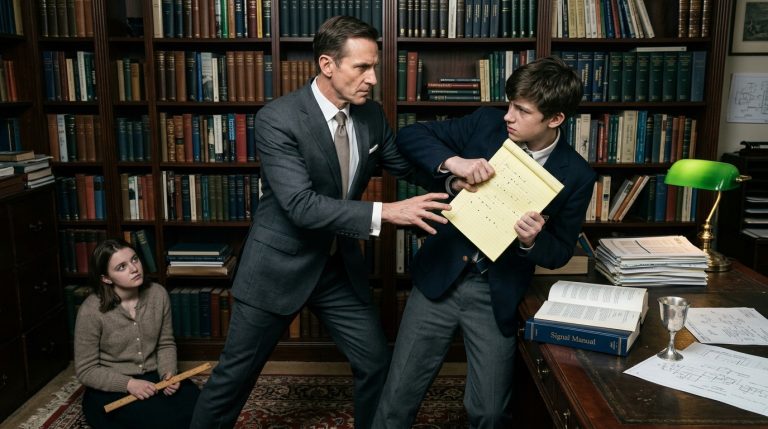
The Weight of Ink and Honor: How One Child’s Quiet Truth Restored a Shattered Legacy
CHAPTER 1: The Glass Cage
The air in the penthouse was too thin, filtered through expensive vents and recycled until it lost all its natural warmth. Below the floor-to-ceiling glass, the city was nothing more than a blurred tapestry of golden lights and mechanical movement—a world that felt miles away from the marble stillness of the room.
Ava pressed herself further into the corner, the rough, familiar texture of her great-grandfather’s journal against her palm serving as her only anchor. Her mother, Helen, moved between the men with a ghost-like efficiency, her footsteps swallowed by the deep pile of the rug. Every time Helen passed the massive mahogany table, her back stiffened, a silent, rhythmic tension that spoke of years spent avoiding notice.
At the center of the table, Mr. Alistair Finch sat with the easy grace of a man who owned the atmosphere itself. He leaned forward, his silver hair catching the recessed lighting, a smile fixed on his face that never quite reached his eyes. Before him lay the parchment, a document that shimmered with the promise of ancient history and quarter-billion-dollar mineral rights.
“Shik Tar, my friend,” Finch said, his voice as smooth as polished stone. “You are not just buying a title. You are buying the continuity of your ancestors.”
The Sheik sat in his leather chair, a man carved out of silence and deep-seated weariness. He didn’t look at his guests; he looked at the parchment. He was a man who wanted, more than anything, to believe that the past could be bought back, restored to a state of pristine perfection.
Ava watched them. She didn’t see the suits or the flash of the expensive watches. She saw the light hitting the document. She saw the way the ink didn’t shimmer with the soft, diffused dullness of iron gall, but sat with a hard, aggressive crispness. It was too perfect. It was a lie, and it was screaming in the silence of the room.
The Sheik reached for his pen. It was a heavy, gold-plated instrument, the tip hovering inches above the crimson wax seal.
Wait, Ava thought, her pulse thumping against her ribs. Don’t touch it.
The room felt pressurized, as if the air itself was waiting for the ink to stain the paper. Finch leaned in, his gaze predatory, his hand hovering near the edge of the deed. A young associate of Finch leaned toward a colleague, his whisper slicing through the stillness.
“Can you believe it? Bringing a child into a room like this,” the man sneered, glancing toward Ava with open contempt. “Some people just have no sense of decorum.”
The words were cold, but as they hit her, Ava felt the sting of her great-grandfather’s voice in her mind: Dignity is a fortress, little star.
The Sheik’s pen moved. The nib grazed the paper, leaving a tiny, dark mark.
Ava looked down at the small side table beside her, where a single, crystal water glass sat—fragile, thin-rimmed, and precariously close to the edge. Her hand trembled. If she moved, she would be seen. If she stayed, the lie would be sealed.
She leaned forward, her shoulder brushing the table. The glass tipped. The sound of it hitting the marble wasn’t a crash; it was a detonation in the quiet air. Every head in the room snapped toward her, and in that sudden, frozen silence, Ava felt the terrifying weight of a thousand secrets about to be unraveled.
CHAPTER 2: The Shattered Silence
The sound of the glass striking the marble was a sharp, clinical fracture—a single note that severed the thick, expensive tension of the room. Ava stood rooted to the spot, the remnants of the glass scattered like diamonds at her feet. The air in the penthouse, previously heavy with the scent of lemon polish and calculated ambition, now felt ionized, charged with the sudden, jagged reality of the collision.
Every head in the room had snapped toward her. She felt the weight of their collective gaze—a physical pressure that threatened to pin her to the Persian rug. Mr. Finch’s face, which had been a mask of smooth, predatory triumph only seconds ago, was now twisted into a jagged snarl of pure fury. His hand was still outstretched, a pen suspended over the parchment, trembling slightly.
“What is the meaning of this?” Finch barked. His voice lacked its previous silk-like polish, revealing the sharp, ugly edges of a man accustomed to total control.
Ava looked up, forcing her chin to remain level. The gaze of the Sheik, Shik Tar, felt different from the others. It was not filled with the immediate, reflexive disgust of the investors or the hot, brittle rage of Finch. It was a dark, weary search, as if he were trying to find the source of the fracture in his own grand design.
Helen rushed forward, her face drained of color, her apron rustling like dry leaves. “I am so sorry, sir!” she cried, her voice thin and desperate. She reached for Ava, her hands fluttering in frantic, protective movements. “Ava, move, come away now.”
Ava didn’t look at her mother. She couldn’t. To look at Helen was to see the fear of homelessness and the exhaustion of two lifetimes’ worth of labor. Instead, she let her focus slide toward the mahogany table. She saw the ink on the document, the way the light hit it. It looked like a bruise on the pale, yellowed skin of the parchment.
“Dignity is a fortress, little star,” her great-grandfather’s voice echoed in her mind, clear and steady, cutting through the static of her panic. She felt the phantom weight of his calloused hand on her shoulder, a memory that tasted of old library dust and peppermint. “Do not let the words of small men breach its walls.”
“It was an accident,” Ava said. Her voice sounded strange to her own ears—quiet, yet strangely resonant in the cavernous room.
Finch let out a sharp, incredulous laugh. “An accident? We are in the middle of a quarter-billion-dollar negotiation, and you think this is a time for accidents? Get her out of here, Tar. This is a house of business, not a playground for servants.”
The Sheik didn’t answer immediately. He stared at the spot where the glass had shattered. The liquid pooled on the marble, dark and reflective, mirroring the harsh, recessed lighting of the ceiling. He looked at the document, then back at the girl, his eyes lingering on the worn leather-bound book clutched tightly against her chest.
“Everything has a rhythm, Mr. Finch,” the Sheik said, his voice a low, gravelly rumble. “Even a meeting. The girl has broken the rhythm.”
“She’s a child, Tar!” Finch snapped, his composure rapidly disintegrating. He stood up, the chair scraping harshly against the floor. “She’s a distraction. Look at them—everyone is looking at her, not at the history we are reclaiming here. If you let this continue, you lose the gravitas of the moment.”
The investors around the table began to murmur, their faces tight with annoyance. One of them, a man with a large, flashy ring, gestured dismissively toward the kitchen area. “Just clear the mess and get the girl out. This is embarrassing.”
Ava felt her heart hammering against her ribs like a bird trapped in a cage. She knew the mechanics of this game now. They were trying to isolate her, to turn her into a piece of clutter that could be swept away. But she knew something they didn’t. She knew the secret of the parchment.
She took a slow, deliberate breath, letting the scent of the room—the sharp, synthetic smell of the floor polish and the deep, rich smell of the old leather—fill her lungs. She had to stay. If she left, the Sheik would sign that paper, and the forgery would become a part of history, its lie cemented forever by his signature.
“It’s not just an accident,” Ava said.
The room went dead silent. Finch froze, his hand tightening around the pen until his knuckles turned a translucent white. The Sheik leaned forward, his gaze locking onto hers with a sudden, piercing intensity that made the surrounding men seem to vanish.
“What did you say?” the Sheik asked.
Ava looked at the document on the table. It seemed to vibrate in the silence. She felt the familiar, grounding weight of her great-grandfather’s journal beneath her fingers. She knew she was standing on the edge of a precipice, but for the first time, she wasn’t looking down. She was looking at the truth.
“The water glass,” Ava whispered, gesturing toward the shards. “It doesn’t matter. But the document… that matters.”
The Sheik’s eyes widened, a flicker of something—uncertainty, perhaps, or a desperate, buried hope—crossing his weary face. He looked at the document, then back at Ava, as if he were waiting for her to justify the intrusion.
“And why,” the Sheik asked, his voice now dangerously soft, “does a piece of paper in my home concern you, child?”
Ava took one final step forward, crossing the line from the shadows into the harsh, uncompromising light of the table. “Because you’re being cheated, sir. And it’s the most obvious lie I’ve ever seen.”
CHAPTER 3: The Language of Truth
The room didn’t just go quiet; it seemed to hold its breath. Mr. Finch’s face had lost its predatory grace, replaced by a pasty, sweating discomfort that made him look suddenly, jarringly older. He stared at Ava as if she were a ghost, his lips parting and closing with no sound emerging, like a fish pulled from the water.
“A lie,” the Sheik repeated. His voice wasn’t loud, but it possessed a gravity that pulled everything toward it. He didn’t look at Finch anymore; he looked only at the small girl standing at the edge of his table, her chin tilted up with a defiance that seemed too heavy for her slight frame to carry. “You speak with the weight of a scholar, yet you have the hands of a child who works for her bread. Explain yourself.”
Helen took a shaky step forward, her hands hovering near Ava’s shoulders as if to pull her back, but she stopped, paralyzed by the raw intensity emanating from the Sheik. “Ava, please,” her mother whispered, the tremor in her voice a testament to the sheer terror of the moment. “Just tell him you’re sorry.”
But Ava couldn’t be sorry. The words were there, burning in her throat, shaped by the hundreds of hours she had spent in the company of her great-grandfather’s journals. She reached up and placed her small, calloused fingers directly onto the vellum. She didn’t press down—she didn’t dare—but she traced the edge of the parchment with a reverence that seemed to insult the men around the table.
“Look at the edges,” Ava said, her voice growing stronger, finding its rhythm. She pointed to a section of the deed where the material seemed overly smooth, lacking the organic, inconsistent pull of hand-scraped animal hide. “Real vellum is uneven. It’s skin, not plastic. If you hold it to the light, you can see the thin patches where the scraper skipped. This… this is too consistent. It’s a machine-made sheet, aged in tea or chemicals.”
Finch found his voice, a sharp, ragged sound that cracked the stillness. “This is absurd! You are listening to a maid’s daughter who plays with old books? She’s a child, Taric! She’s hallucinating. She’s trying to sabotage a deal she doesn’t understand.”
The Sheik didn’t blink. He kept his dark, weary eyes locked on Ava. “Continue,” he commanded, a single word that dismissed Finch entirely.
Ava took a breath, the scent of the room’s high-end, sterile atmosphere making her head swim. She forced herself to think of her great-grandfather’s study, the way he would hold a lens up to a page and show her the hidden, microscopic flaws that told the real history.
“The ink,” she said, her finger moving to a line of elegant, flowing Arabic script. “It’s sitting on top of the fibers. True iron gall ink eats into the paper over time. It creates a halo, a burn, because it’s acidic. This ink is modern. It’s carbon-based. It hasn’t bitten into the page because it doesn’t have the chemistry to do it. It’s just… floating there.”
A ripple of movement passed through the men at the table. Kareem, the Sheik’s advisor, leaned in, his brow furrowed, his eyes darting from Ava’s pointing finger to the document. He pulled a jeweler’s loupe from his pocket, his movements clinical and precise.
“And the seal,” Ava added, her voice dropping to a near-whisper, an instinctual move her great-grandfather had taught her—the softest voice is the most difficult to ignore. “The most important part. The calligrapher was very good. They got the style right. They used a beautiful Cufic script. But they made a mistake that only someone who doesn’t understand the evolution of the language would make.”
She tapped the heavy, crimson wax seal. “The letter FA. In the 17th century, in this specific region, the script didn’t use a dot to differentiate the character. It used an inverted V-shape. The dot was a later standardization—almost a century later. They copied the style, but they didn’t understand the history of the letters.”
The silence that followed was absolute.
Kareem had pressed his loupe against the seal, his breath hitching. He stood motionless for a long moment, the color slowly draining from his face. He looked at the Sheik, his expression a complex mix of professional shock and growing, dawning horror.
“Excellency,” Kareem murmured, his voice sounding hollow. “The girl… the girl is correct.”
Finch’s chair tipped back as he stood up so violently that it rattled against the marble. “This is a conspiracy! A setup! You’ve had this girl trained, haven’t you, Taric? You’ve been looking for a way out of the contract—”
“Quiet,” the Sheik said. The word was cold, absolute, and final. He stood up, towering over the mahogany table. He looked at Finch, and for the first time, there was no weary sadness in his eyes—only a terrifying, razor-sharp clarity.
He didn’t move toward Finch. He moved toward Ava.
He stopped directly in front of her, his presence looming. Ava didn’t back away. She stood her ground, her small, faded blue dress a stark contrast to the opulence of the penthouse. The Sheik reached out, his hand hovering for a second before he gently, almost tentatively, took the worn journal from her hand.
He opened it to a random page. He saw the elegant, careful sketches of seals, the marginalia in a firm, soldierly hand, the notes about paper thickness and chemical reactions. He closed the book and looked at her, his expression unreadable.
“Your grandfather,” the Sheik said, his voice barely audible over the hum of the room’s climate control. “He was a soldier?”
“A soldier for history,” Ava replied.
The Sheik turned slowly to his bodyguards, his gaze shifting to the door. “Do not let Mr. Finch leave this room,” he said, his voice as steady as iron. “And Kareem—get the university on the line. I want Professor Alfahim. I want him to see this seal, and I want him to see it now.”
As the advisors scrambled to obey, the Sheik looked back at Ava. The room was fracturing around her, the investors whispering in panicked clusters, Finch clutching the back of his chair, his mask of charm entirely shredded. In the center of it all, Ava felt a strange, cold peace. She hadn’t broken the room; she had simply stopped the lie from being told.
But as the Sheik gestured for her to stay, she saw something else—a small, dark shadow moving near the far door, a movement that had nothing to do with the Sheik’s guards. A realization stirred in her chest: she had identified the fake, but she hadn’t yet identified the reason why someone had gone to such impossible lengths to plant it in this room. The mystery was only just beginning to unfold, and for the first time, she felt the terrifying weight of what it truly meant to be a witness to history.
CHAPTER 4: The Falling House
The penthouse transformed. It wasn’t a sudden explosion of violence, but a systematic contraction of space. The Sheik’s bodyguards, men who had previously been shadows in the background, shifted with a silent, synchronized efficiency. They didn’t draw weapons, but their posture alone was a wall—impenetrable, immovable, and cold. The doors to the penthouse didn’t just close; they clicked with the finality of a heavy vault bolt sliding home.
Mr. Finch backed away from the table, his movements jerky and uncoordinated. His expensive silk tie, once a symbol of his impeccable aesthetic, now looked like a noose, slightly askew. He looked at the guards, then at the investors, who were standing in a tight, panicked knot near the windows. He seemed to be calculating the distance to the floor-to-ceiling glass, but even a desperate man could see that the heights were as impossible as the escape.
“You are making a mistake, Taric!” Finch shouted, his voice cracking. He tried to reclaim his poise, squaring his shoulders, but the effect was ruined by the frantic darting of his eyes. “You are letting a child dictate your business affairs based on myths and stories. Think of the legal implications. The lawsuits. My reputation—”
“Your reputation,” the Sheik said, his voice quiet, “is currently being disassembled by the facts.”
Ava watched from her corner, her hands clasped tightly behind her back to hide their tremor. She saw the way Finch’s fingers twitched toward his inner breast pocket, a rhythmic, nervous movement. He was reaching for his phone, for a lifeline, for a way to reach someone who could override the physical trap of the room. A bodyguard, a man with a face like polished stone, saw the motion. He stepped forward, his hand extending in a palm-up gesture that was both polite and absolute.
Finch froze. He pulled his hand away from his coat as if the fabric were searing hot. The room felt like a pressure cooker, the air growing thick with the scent of his rising panic. Ava observed the investors—George, the heavy-set man who had been the first to distance himself, was now staring at Finch with a look of profound betrayal.
He’s hiding something else, Ava realized. The thought was a sudden, chilling insight. It wasn’t just the deed. The way Finch’s eyes flickered toward the study doors, the way he hesitated when the Sheik mentioned the university—it wasn’t just the fear of being caught in a forgery. It was a fear of what else might be found.
She took a cautious step forward, careful to avoid the jagged pieces of the water glass that still littered the marble. The Sheik noticed her movement, his gaze softening slightly as he looked at her.
“Stay close, child,” the Sheik said, his tone no longer that of a host, but that of a guardian. “This is not a place for you to be alone.”
“I see it,” Ava whispered, so quietly that only the Sheik could hear. She pointed toward the leather briefcase Finch had so reverently placed on the mahogany table earlier—the one that had held the deed. “He isn’t just worried about the contract. He’s worried about what else is in that bag.”
The Sheik followed her gaze. His eyes narrowed. He looked at Kareem, who was already moving toward the briefcase with a look of professional curiosity. Finch’s reaction was instantaneous; he surged forward, a desperate, clumsy lunge intended to intercept the advisor.
“Don’t touch that!” Finch screamed, his composure completely shattered.
It was a mistake. The guards intercepted him in a fluid, calculated motion, not with punches, but with the overwhelming force of mass and leverage. Finch was pressed back against the wall, his arms pinned. He looked smaller, suddenly—a man stripped of the illusions he had spent years crafting.
Kareem opened the briefcase. He didn’t just pull out the deed folder. He pulled out a thick, unmarked ledger, bound in cheap black plastic, and a small, nondescript digital drive.
Finch went silent. His struggle stopped, his body going limp as if the fight had been drained from him by the sight of the objects. He stared at the ledger, his face a mask of absolute despair.
“It’s not just the land deed, is it?” the Sheik asked, stepping closer to his advisor. He took the ledger from Kareem, his fingers tracing the cheap, utilitarian cover.
Finch didn’t speak. He stared at the floor, his breathing ragged and shallow.
The penthouse felt as if it were shrinking. The luxury, the view, the vast space of the living room—it all felt like a set piece, a stage being dismantled piece by piece. The investors were backing away, creating a wide, empty circle around Finch. They were no longer his partners; they were the jury.
Ava stood near the Sheik, the weight of the moment pressing into her chest. She realized then that the decoy—the deed, the elaborate calligraphic forgery—had been the shield. It was the “big lie” meant to distract everyone, to draw them in with the promise of wealth so that they wouldn’t look at the small, mundane, and truly dangerous truths hidden in a black plastic ledger.
“Kareem,” the Sheik said, his voice cold, devoid of any mercy. “Call the authorities. Not the local police. The financial crimes division. I have a feeling we are going to find a much larger story than a simple land claim.”
As the advisors moved to comply, the room felt like it was spinning. Ava looked at the Sheik, then at the ledger, and finally at Finch, who had collapsed into a chair, his head in his hands. The house of cards wasn’t just falling; it was disintegrating. She felt a surge of exhaustion, a sudden, heavy toll for the adrenaline that had been powering her since the moment the glass shattered.
She looked at her mother, who was watching from the doorway, her face pale, her hands clasped together in prayer. They were safe, but they were no longer invisible. By speaking the truth, Ava had irrevocably altered the landscape of this room, and she knew, with a sudden, sinking certainty, that there was no way to go back to being the girl who simply polished the silver.
CHAPTER 5: The Sanctuary
The transition from the penthouse to the library was a descent into a different kind of world. The private elevator hummed with a low, rhythmic vibration, the polished dark wood panels closing out the city’s harsh glare. Ava stood beside the Sheik, his presence surprisingly muted here, stripped of the armor of his status. Beside her, Helen held her hand, her palm damp with a mixture of residual fear and an awakening wonder.
When the doors opened, the air changed. It wasn’t the ozone and lemon-scented sterility of the penthouse; it was thick with the scent of beeswax, old paper, and the dry, sweet smell of leather that had aged for centuries. It was a smell Ava knew deep in her bones—it was the smell of her great-grandfather’s study, a sanctuary of lost things.
The library was a cathedral of knowledge. Two stories of shelving stretched toward a vaulted ceiling, the books packed with an organic, uneven density that made the room feel alive. A spiral staircase of iron, worn smooth by years of touch, curled into the shadows of the upper gallery. In the center, the Persian rug provided a soft island of color amidst the dark wood.
The Sheik walked forward, his posture changing. The stiffness of the morning had vanished, replaced by a slow, thoughtful stride. He didn’t look back to see if they were following; he simply moved toward the center of the room, toward the large, glass-topped display case that sat like an altar in the middle of the space.
“This is where I hide,” the Sheik said, his voice quiet, almost vulnerable. “Up there, in the penthouse, I am a businessman. I am a target. I am a commodity. Here, I am a custodian.”
Ava approached the display case. Inside, resting on velvet that had faded to a deep, dusty plum, lay the artifacts she had only ever seen in the pages of books. A clay tablet, a fragment of an Egyptian scroll, and finally, the dagger—the hilt jeweled, the metal ornate.
“Is this the one?” Ava asked, her finger hovering over the glass.
The Sheik nodded. “My family relic. A 12th-century warrior’s blade. It has been the cornerstone of my heritage for three generations. It was authenticated by the best. The British Museum, the royal collectors—everyone agreed it was the perfect embodiment of my ancestry.”
Ava leaned closer, her eyes scanning the hilt. She felt the sudden, familiar itch in her fingers, the instinctual urge to look past the object and into the history of its making. She remembered her great-grandfather’s notes on “marriages”—the way the unscrupulous would take the genuine, battle-hardened steel of a lost age and marry it to the decorative, high-profit ornamentation of a later, more commercial period to craft a “complete” narrative for a buyer.
“May I?” she asked.
The Sheik looked at her, his eyes searching. For a moment, the weight of his family’s story hung in the balance. He had just survived a quarter-billion-dollar lie; the thought of losing another pillar of his identity seemed almost too much to bear. But then, he unlocked the case. The soft click of the mechanism was loud in the stillness of the library.
Ava reached in and carefully lifted the dagger. The weight was surprising—the blade was heavy, balanced, and cold, but the hilt felt lighter, almost hollow. She turned it over, angling it toward the warm, amber light of a desk lamp.
“Look at the filigree,” she murmured, her voice steady. “The flow of the metal. It’s exquisite, but it’s too uniform. It was cast, not worked by hand. And the way it meets the guard…”
She held the dagger up, letting the light catch the join. There, almost invisible to the naked eye, was a microscopic hairline gap—a sign that two different pieces of history had been forced together, not by a craftsman of the 12th century, but by a restorer centuries later.
“It’s a marriage,” Ava said softly. “The blade is real. It’s beautiful, ancient steel. But the hilt… it was added later. Probably in the 17th century, to make it look more ‘royal’ for a trade mission. They didn’t lie about the steel, but they lied about the story.”
She placed the dagger back on the velvet. She expected the Sheik to be angry, or to recoil as if she had stained his heritage. Instead, he let out a long, slow breath—a sound of profound, release. He leaned back against the display case, a strange, half-smile appearing on his face.
“A marriage,” he repeated, looking at the dagger not with pride, but with a new, sober understanding. “I spent my life defending that hilt. I spent fortunes having it appraised, verified, and protected. And it was all just a story told to justify a price.”
He looked at Ava, then at Helen. The exhaustion was still there in the lines around his eyes, but the defensive hardness was gone. “I was so desperate to be a king of my own history that I allowed myself to be fooled by someone who knew exactly what I wanted to hear. Finch knew. He understood my vanity better than I did.”
“You weren’t fooled,” Ava said, her voice gentle. “You were just looking for the right story.”
“And you,” the Sheik said, “have shown me that the truth is far more interesting than the story.”
The library felt different now. The books on the shelves didn’t look like static monuments anymore; they looked like living, breathing threads of a history that was far messier, and far more honest, than anything he had displayed in the penthouse. Ava felt the library’s silence settle over her, a deep, comfortable quiet that whispered of millions of words yet to be read, and millions of truths yet to be found.
She turned to her mother, who was watching them with a look of awe and relief. The fear had finally ebbed, leaving behind the quiet, steady strength that had carried them through the hardest years. They were here, in the center of the Sheik’s sanctuary, and for the first time, the future didn’t feel like a locked room. It felt like a threshold.
CHAPTER 6: The Foundation
The morning sun filtered through the high, arched windows of the library, catching the dust motes as they danced in the shafts of light. It was a stark, golden contrast to the sterile, artificial brightness of the penthouse where this had all begun. Ava stood at the center of the Persian rug, her great-grandfather’s journal open in her hands. The pages were worn and soft at the edges, a familiar topography of notes and sketches that now felt like a map for the work to come.
The Sheik stood by the display case, his hand resting on the glass. He had spent the last hour working with Kareem and the university experts, their voices a low, steady murmur in the background. The air no longer smelled of trapped secrets; it smelled of potential. On the desk, the ledger recovered from Finch’s briefcase lay open, its pages a detailed confession of a decade’s worth of deceit. The “marriage” of the dagger was just one leaf on a sprawling, ugly tree of fraud that Finch had cultivated.
“It is over, Ava,” the Sheik said, his voice quiet, lacking the weary heaviness that had defined their first meeting. “The authorities have his records. His network is dismantled. He will not be selling lies to anyone again.”
Ava nodded, her eyes tracing the familiar script on the page before her. “He wanted it to be easy,” she said. “He wanted to believe that history was just something you could buy, like a painting or a stock.”
“And he almost convinced me,” the Sheik admitted. He walked over to her, his gaze resting on the journal. “I wanted a legacy that was perfect. I wanted to be able to point to an object and say, ‘This is who I am,’ without any mess, without any mistakes. But history is made of mistakes. It’s made of the things we try to hide, and the things we accidentally break.”
He picked up a heavy, fountain pen—not the gold-plated, expensive one from the penthouse, but a simple, workhorse pen that he kept at the library desk. He turned to a fresh sheet of heavy, textured paper. “We are going to start the foundation today. The Sergeant Michael Peterson Foundation for Historical Integrity.”
Ava watched as he began to write. He wasn’t signing a contract this time; he was drafting a mission statement. It wasn’t about ownership or mineral rights; it was about the slow, patient labor of verification. It was about the “dot on the letter FA”—the tiny, overlooked detail that separated a fragile truth from a comfortable lie.
“We will document everything,” the Sheik continued, his focus intense. “Every piece of the collection, we will subject to the same rigor you applied today. We will not be collectors anymore. We will be researchers.”
Helen walked into the frame of Ava’s vision, carrying a tray with tea. She stopped beside her daughter, her movements fluid and confident. She looked at the library, at the shelves, and then at the Sheik, a small, knowing smile touching her lips. The “maid” was gone; in her place was a curator who knew the pulse of the room, who understood that the true value of the library was the order and care she brought to it. She placed the tray on the table and rested a hand on Ava’s shoulder, a firm, grounding touch.
Ava felt the weight of the last few days settle—not as a burden, but as a foundation. She took the pen from the Sheik and added her own name to the bottom of the document. The ink was dark, fresh, and permanent.
“What do we do first?” Ava asked.
The Sheik pointed to the display case, then to the shelves that lined the walls. “We start with the things we think we know. We pick them apart. We check the provenance. We check the chemistry. We ensure that every story told in this room is one that can stand the light of day.”
The work would be long. It would be tedious, and it would likely lead to more disappointments as they found more “marriages” and more forgeries. But as Ava looked around the library, she didn’t see the crushing pressure of a secret she had to hold. She saw the quiet, steady beauty of an archive that was finally, truly, its own master.
She reached out and touched the spine of a book—an original volume of 17th-century travelogues that had been shelved improperly. She slid it out and set it straight, aligning it with the others. It was a small act, a minor correction in a vast room, but it felt right.
The Sheik watched her, then looked at the ledger, then at the document of their new foundation. The “perfect” heritage he had once craved was gone, replaced by something much more durable: the truth. He stood up, his posture straight, his shadow long and steady against the warm wood of the library floor.
“Let’s begin,” he said.
Ava opened her great-grandfather’s journal to a blank page. The sunlight hit the paper, turning it into a bright, clean slate. She picked up her pen, ready to document the next discovery, ready to be the soldier for history that he had trained her to be. Outside, the city continued its mechanical, hurried life, but in here, in the quiet heart of the library, the world was finally in alignment.