The Iron Boundary: A Gritty Tale of Sovereign Blood, Rusted Earth, and the Siege of Harmony Creek
CHAPTER 1: THE LINE IN THE DUST
The sun over Harmony Creek didn’t shine; it beat down through a haze of dry prairie dust, baking the galvanized skin of my grain silo until the air around it shimmered with the smell of hot iron and grease.
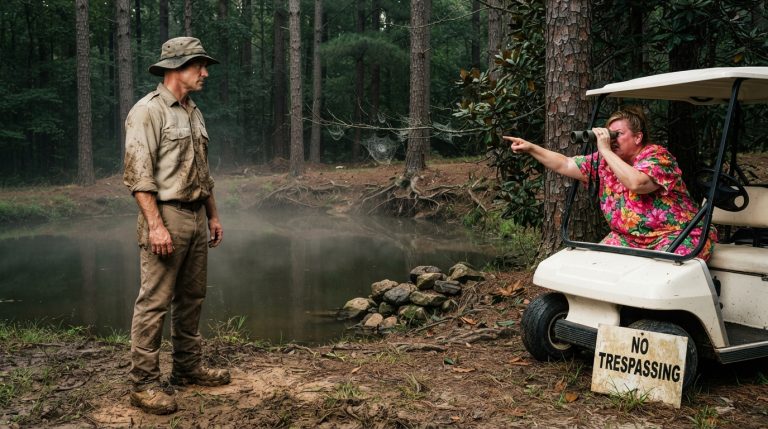
Karen Thompson stood on the absolute edge of my property, her orthopedic sneakers sunk into the dry, cracking clay right where my unpaved tractor track met the aggressively green, irrigated sod of the Meadows subdivision. She held her plastic clipboard like a weapon of pure administrative spite, her fingers tapping against its sun-bleached edge.
“It’s Covenant 7.4, subsection B,” Karen said. Her voice had the grating, mechanical rhythm of a rusted hinge. She didn’t look at me; her eyes were fixed on the silver dome of the shelter behind me, tracing the vertical seams I’d welded by hand. “Non-conforming industrial silhouette. This is an residential zone now, Thorne. You’re under our charter.”
I didn’t answer right away. I let the silence settle between us, heavy as the dry summer heat. I reached down, my calloused fingers brushing the rough, flaking rust of my perimeter fence. The iron was orange and rough, leaving a dry stain on my palm that smelled of old machinery and parched earth.
“The county cleared the permits, Karen,” I said, my voice low, matching the steady, low-frequency thrum of my old diesel tractor idling fifty yards away. “It’s sunk fifteen feet into the bedrock, anchored to steel-reinforced concrete. It’s not an eyesore. It’s a fort.”
“It’s a violation,” she countered, thrusting a cream-colored envelope toward me. The paper was stiff, thick, and covered in a fine layer of blown dirt that gritted against my thumb as I took it. “Fourteen days to begin dismantle, or the daily fines begin. Five hundred dollars a day. The board doesn’t tolerate non-compliance.”
She turned, her floral print dress snapping in the hot wind as she marched back to her electric golf cart, its tiny tires crunching loudly on the dry gravel of the boundary road.
I looked down at the envelope, then at my boots. Right beside the ancient, rusted surveyor’s pin that marked my southwest corner, the dry earth had been disturbed. A neat, circular plug of clay had been bored out and packed back down with fresh, dark mud. Peeking through the cracked soil was a brand-new orange survey cap, clean and free of rust.
I knelt, my joints popping like dry twigs, and cleared the dirt with a fingernail. The plastic head wasn’t a county marker. It was stamped with a fresh serial number: VHG-A44.
The dry wind shifted, carrying the faint, chemical bite of sulfur from the dry creek bed. I rubbed the orange plastic between my thumb and forefinger, feeling the sharp, unweathered edge.
Karen thought she was fighting a stubborn veteran over a piece of scrap metal. But she had just stepped onto my land, and under this rusted soil, the ground was already moving.
CHAPTER 2: THE SHADOW OF PRAIRIE RIDGE
The orange plastic of the VHG-A44 survey cap felt unnaturally slick against my dirt-caked fingers, a synthetic intrusion into the dry, honest clay of my boundary line. I stayed on one knee for a long second, watching the dust settle into the deep tread of Karen’s golf cart tracks. The chemical scent of sulfur didn’t belong here—not on ten acres that had spent fifty years growing switchgrass and winter wheat. It was a smell I knew from base camps near old oil fields, the sulfurous rot of deep-well drilling.
I stood slowly, my joints dry and protesting, and rubbed the orange dust off my thumb onto my jeans. The cream-colored envelope was tucked under my arm, stiff and heavy with the threat of five-hundred-dollar daily fines. I didn’t open it. The paper didn’t matter; the numbers on it were just noise designed to make me look down at my boots instead of looking at what was happening to the horizon.
I turned back toward the grain silo. The twenty-five feet of corrugated steel above ground caught the harsh prairie light, its zinc-coated ribs casting long, jagged shadows across the dry grass. To anyone driving down the county road, it was just a metal tube—a relic of an agricultural life this subdivision was slowly swallowing. But as I walked toward the heavy hatch at the base, the ground beneath my feet felt solid, anchored by the six-foot slab of reinforced concrete buried beneath the dirt.
I pulled the heavy brass key from my pocket. It was cold, notched with deep grooves that had worn smooth from a year of carrying it in my pocket. The padlock on the steel shroud was a heavy commercial model, grimy with industrial grease that smelled of graphite and cold oil. I clicked it open, the sound flat and sharp in the quiet afternoon, and swung the protective shroud aside.
The door was a three-inch-thick plate of military-grade steel, salvaged from an old bunker facility and set into a reinforced concrete collar. I gripped the heavy iron wheel in the center, my shoulder muscles tightening as I threw my weight against the leverage. The seal broke with a deep, pressurized hiss—a sudden exhale of cool, subterranean air that carried the clean smell of dry concrete, rubber gaskets, and the faint, sweet scent of stored grain.
In the army, we called it the “survivor’s draft.” It was the same air that greeted us when we cracked open the underground command posts after the artillery had finished chewing up the surface.
I stepped onto the steel ladder and climbed down into the cool darkness, my boots clanging against the heavy rungs. The transition from the blinding prairie heat to the fifty-five-degree cellar was like stepping into a tomb. I reached for the manual breaker panel on the concrete wall, my fingers finding the cold iron toggle in the dark. I threw it.
With a low, mechanical hum, the bank of deep-cycle marine batteries in the corner came to life, feeding a soft, amber glow to the LED strips running along the curved ceiling.
The shelter was fifteen feet wide and forty feet deep, a subterranean fortress built to withstand an EF5 tornado or a direct mortar strike. I walked past the neat rows of heavy plastic crates—provisions, water filters, medical kits—all organized with the quiet precision of a logistics officer who had seen what happens when the supply lines snap.
I stopped at the main ventilation manifold. The heavy steel pipe ran up through the concrete ceiling, connecting to the blast-proof intake valves hidden inside the silo above. I reached up and checked the manual pressure gauge. The needle was steady, resting exactly on the green line, but as I touched the cold iron of the valve, a memory flared—the sharp, copper taste of blood and plaster dust in my mouth as we dug a family out from under three stories of collapsed masonry in Prairie Ridge.
That house had been built to code. It had possessed the correct permits, the approved vinyl siding, and the manicured lawn Karen Thompson prized so highly. But when the wind came, the wood frame had sheared off its foundation like wet cardboard, leaving nothing but a pile of splinters and a cellar that had filled with suffocating clay.
I tightened my grip on the ventilation valve until my knuckles turned white. My silo wasn’t an eyesore. It was the only thing on this ten-acre ridge that wouldn’t blow away when the sky turned green.
I reached into my pocket, pulled out the heavy cream envelope, and tossed it onto the steel work table in the center of the room. It landed with a soft, hollow slap next to my schematics. Karen thought she was playing a game of bureaucratic chicken, using her board and her petty rules to force me out. But as I looked at the blueprints of my shelter, my eyes drifted back to the orange plastic survey marker I’d left in the dust by the fence line.
VHG-A44.
I needed to find out who owned those letters. And I needed to find out why they were digging in my dirt.
CHAPTER 3: THE KANGAROO COURT
The plastic survey marker was still a cold weight in my memory as I gripped the glass door of the Meadows Community Clubhouse. The transition from the dry, wind-swept gravel of my road to the air-conditioned vacuum of the lobby felt like crossing a hostile border. The air here was thin, smelling of synthetic lavender and damp carpet, a sterile mask meant to cover the rot of a poorly built foundation. I could hear the high-pitched, irritating hum of a failing fluorescent ballast somewhere in the ceiling, a rhythmic buzz that set my teeth on edge as I carried the thick oak-colored leather portfolio containing my county permits under my arm.
The meeting room was laid out like a military briefing, but without the discipline. Five plastic folding tables had been pushed together to form a shallow horseshoe. At the center sat Karen Thompson. She had changed her floral mumu for a stiff, bone-colored linen suit that looked like cardboard. Her hair was sprayed into a rigid helmet that didn’t move when she looked up, her eyes narrowing as the heavy door clicked shut behind me.
To her right sat Gerald, the treasurer, nervously wiping his spectacles with a stained microfiber cloth, his hand shaking so subtly that the metal frames rattled against the laminate table. The other three board members looked like hostages to Karen’s schedule—one was knitting a gray wool sleeve that trailed on the carpet, while the two men on the left sat with their arms crossed, their expressions vacant but primed to mirror whatever posture Karen assumed.
“You’re late, Mr. Thorne,” Karen said, her knuckles resting on a neat stack of cream-colored agenda sheets. “We have three landscaping assessments to clear before the executive session.”
“The notice said seven o’clock,” I replied, my voice flat, keeping the steady, unhurried cadence I used during safety briefings. I didn’t sit in the metal folding chair they had placed ten feet back from the tables. Instead, I walked straight to the horseshoe, the rubber soles of my work boots squeaking against the polished linoleum. “I don’t plan on wasting my time or yours. Let’s talk about the silo.”
“The non-conforming outbuilding,” Karen corrected, her voice rising to pierce the low hum of the ceiling light. “We’ve received your appeal. The board has reviewed the documents you sent via certified mail. While we appreciate your… history, the rules of the Meadows are uniform. Section 7.4 leaves no room for personal interpretation.”
I unzipped the leather portfolio, the heavy brass teeth of the zipper rasping in the silent room. I pulled out the original three-view blueprints of the bunker, the thick blue sheets still smelling of dry ammonia and county ink, stamped with the bold red seal of the County Emergency Management Agency. I laid them flat across the table, right over Karen’s pristine agenda.
“This is the structural schematic,” I said, pointing to the cross-section of the subterranean chamber, my rough, scarred finger tracing the six-foot concrete foundation. “It’s not an outbuilding. It’s a reinforced shelter built to FEMA-361 specifications. The twenty-five feet of steel above ground is the blast-resistant intake stack. If a storm like the twenty-two tornado hits this ridge again, this room is the only place within three miles that will remain pressurized.”
Gerald leaned forward, his eyes tracking the red county seal. He reached out a hand, his fingers twitching toward the blue paper, but Karen’s clipboard slapped down on the table with a sharp crack that made him flinch back.
“The county has no jurisdiction over our aesthetic standards, Mr. Thorne,” Karen said. She didn’t look at the blueprints. Her hand remained flat on the clipboard, her manicured nails digging into the plastic edge. “A bunker is not an approved residential structure. If we allow you to keep an industrial cylinder on your lot, what stops the next resident from putting up a commercial radio tower? Or a drilling rig?”
The word slipped out of her before she could catch it—a tiny, sharp detail that made my eyes drift down to her folder. Tucked under her official board agenda was a yellow legal pad, and written in her tight, cramped handwriting at the top of the page was a single line: Vanguard Hydrology – Access Prep.
I kept my face completely blank, my army training locking my jaw in place. I didn’t look at her eyes; I looked at the way her thumb had tightened against the side of her pen, the plastic flexing under the pressure. She wasn’t worried about my silo ruining the view. She was worried about what was underneath it.
“The bylaws are the bylaws,” the knitting woman muttered from the end of the table, her needles clicking together in a dull, metallic rhythm without her looking up.
“Exactly,” Karen said, her posture stiffening as she reclaimed the room. “The board has voted. The application for an aesthetic variance is denied. The daily assessments of five hundred dollars will continue to accrue starting tomorrow morning. If the structure is not dismantled within fourteen days, the association will seek an injunction to enter the property and remove it at your expense.”
I looked at the four board members. Gerald wouldn’t meet my eye, his gaze fixed on the sterile white surface of the table. The two men on the left simply nodded in unison, their movements small and mechanical. They were a wall of beige plastic, built to shield something much larger than a homeowner’s association dispute.
“I understand,” I said slowly. I didn’t argue. I didn’t raise my voice. I reached down, rolled up the heavy blueprints, and slid them back into the leather case, the brass zipper teeth biting together with a clean, definitive snap. “We’ll be in touch.”
I turned and walked toward the exit, the heavy glass door swinging shut behind me, cutting off the sterile chill of the room as I stepped back into the heavy, dust-laden heat of the evening.
CHAPTER 4: DIGGING IN THE DIRT
The glass door of the clubhouse clicked behind me, sealing the sterile scent of lavender inside and leaving me alone in the suffocating prairie dusk. The night air was heavy, tasting of dried clay and diesel. I did not go back to the farmhouse. Instead, I cut across the gravel drive toward Art Donovan’s place, my boots keeping a steady, marching cadence on the hard-packed shoulder.
Art’s house sat on the very edge of the division, a modest brick bungalow that refused to look like the rest of the beige boxes. His front yard was a wild tangle of native switchgrass and purple coneflowers that Karen had repeatedly cited as “unruly vegetation.” Under the dim porch light, the native plants looked dark, dry, and unyielding.
I didn’t knock. I tapped the rusted iron knocker once and pushed the door open. Art was sitting at his kitchen table, a massive oak slab piled high with manila folders, tax records, and three empty mugs stained with dry coffee rings. The room smelled of old paper and the copper tang of his well water.
“They denied it,” I said, setting the leather portfolio containing my blueprints onto the corner of his desk. “Unanimous. Karen didn’t even look at the FEMA specs.”
Art did not look surprised. He reached up, adjusting his reading glasses, his liver-spotted hand steady. “She couldn’t. If she acknowledges the county permits, she acknowledges the county’s superior jurisdiction. She needs your land inside her boundary lines, John.”
“It’s not about the view,” I said, pulling a metal stool close to the table. The iron frame scraped against the linoleum with a sharp shriek. “She had a yellow pad on her table. Written at the top was Vanguard Hydrology – Access Prep. And I found an orange survey cap driven right next to my corner pin today. It was marked VHG-A44.”
Art’s hand froze over a thick binder of HOA financial statements. He slowly took off his glasses, letting them dangle by their black cord. “Vanguard Hydrology. They’re a sub-outfit. They handle underground utility tracing and deep-aquifer testing for the natural gas sector.” He dragged a heavy ledger across the oak table, his fingernail tracing a column of figures. “Look at this.”
I leaned over the paper. The ledger was the HOA’s annual budget for the “Community Beautification Fund,” which had grown by forty percent in the last three years. The entries were written in a neat, clinical hand, but as I looked closer, the ink on several lines was slightly darker, as if written with a different pen or added after the fact.
“Every major expenditure for the last eighteen months is a direct, non-bid disbursement to Frank Thompson Landscaping,” Art muttered, his voice dry as paper. “Frank is Karen’s brother-in-law. His business address is registered to an abandoned warehouse in Prairie Ridge. They’re billing the association for ‘drainage maintenance’ and ‘soil stabilization’ along your northern property boundary.”
I reached out, my calloused index finger tracing a specific line. A disbursement of twelve thousand dollars for “grade stabilization” had been recorded on the exact day I completed excavation on the silo. “There’s no grade stabilization on my boundary. It’s a dry ditch. The only thing they’ve done out there is run survey transits.”
My thumb smudged a line of black ink at the bottom of the ledger sheet. It was fresh—or at least, fresher than the rest. Beneath the entry for Frank Thompson Landscaping was a faint pencil notation, partially erased but still visible against the faded white paper. It was a wire transfer routing number, followed by three letters: VHG.
The pieces were shifting. The decoy was simple: Karen was hiding her embezzlement behind the landscaping invoices, using her brother-in-law’s firm to drain the HOA’s reserves for personal gain. But the real target wasn’t just the beautification fund. The orange pin on my boundary, the yellow pad on her desk, the secret routing codes—they were prep work for something buried much deeper than a financial ledger.
“She’s using the fines to break you financially so you’ll sell,” Art said, his voice dropping as he tapped the wire code. “But she isn’t just stealing the neighborhood’s dues. She’s clearing a path for Vanguard.”
I stood up, the metal stool scraping the floor once more. The room was silent except for the steady, rhythmic drip of a rusty faucet in the sink. “Then we don’t just fight the citations. We dig into Frank’s bank records. If she wants a war over the soil, we’re going to show her exactly what’s buried in it.”
CHAPTER 5: THE COUNTY SHIELD
The dry paper scratch of Art’s pencil faded as I gripped the steering wheel of my Ford F-250. The cab of the truck smelled of old straw, grease, and dried mud, a working interior that didn’t apologize for its mileage. I turned the ignition, the cold steel of the key grinding against the cylinder until the starter caught with a heavy, physical shudder that rattled the dashboard. I backed out of Art’s driveway in the low gear, my headlights cutting yellow lanes through the suspended prairie dust as I headed toward the county road.
But as I cleared the first mile markers near the dry creek bed, the engine began to miss. A violent, rhythmic knocking vibrated through the floorboards—the unmistakable drag of a fuel injector choking on contaminated line pressure.
I pulled off onto the shoulder, the gravel crunching dryly under the tires. I didn’t curse; I popped the hood release, stepped down into the parched roadside grass, and walked into the heat of the radiator. The wind carried a faint sulfur trail from the creek bed, mixing with the hot oil of the engine block. I grabbed a rag from the side box and unscrewed the fuel filter housing. Deep in the sediment bowl, floating in the yellow diesel, were tiny black specks of rubber grit—evidence of a dry-rot seal breakdown in the auxiliary tank. I used a pocket knife to scrape the debris from the screen, my hands getting slick with cold fuel that smelled of kerosene and old iron.
I wiped my fingers on my jeans, locked the housing back down, and climbed back inside. When the key turned this time, the block smoothed out, the low-end torque returning with a heavy, satisfying hum. I pulled back onto the blacktop, my jaw set as I drove toward the county emergency office.
By ten the next morning, the dry autumn light was blinding, reflecting off the white hood of Chief Miller’s official Ford Expedition as it pulled down my long gravel driveway. Behind it, a marked van from Channel 8 news crawled over the ruts, its satellite dish folded like a sleeping metal beetle on the roof.
I stepped out of my workshop, wiping my hands on a clean grease rag, my eyes tracking a third vehicle that was currently tearing down the boundary road. It was Karen’s electric golf cart, her knobby tires squealing on the packed clay. She had Gerald crammed into the passenger seat, his white fingers white-knuckling the grab bar as the cart bounced over the drainage ditch.
“You can’t be here,” Karen declared before the cart had even come to a full stop. She jumped out, her clipboard raised like a small, plastic shield, her shoes kicking up a cloud of dry, gray dust that settled on the polished black toe of Chief Miller’s boot. “This is private property under the jurisdiction of the Meadows HOA. This inspection is non-sanctioned.”
Chief Miller stepped out of his vehicle with the slow, calculated weight of a retired Marine colonel. He didn’t look at the clipboard. He looked at the dust on his boots, then looked up, his face a hard block of weathered granite that had survived thirty years of desert sun and military logistics.
“Ma’am,” Miller said, his voice flat, cutting through the thin hum of the golf cart’s electric motor. “I am the Emergency Management Director for this county. I am here at the written invitation of the property owner to assess a registered civil infrastructure asset. If you or your associate attempt to obstruct this proceeding, I will have the county sheriff clear this road in five minutes.”
Gerald’s face went the color of dry plaster. He reached out and grabbed the sleeve of Karen’s linen jacket, his hand twitching. “Karen, don’t. The camera is on.”
The Channel 8 operator had already stepped out of the van, the heavy black lens of his camera resting on his shoulder, its red recording light glowing like a hot coal in the midday glare.
Karen’s mouth snapped shut, her teeth clicking together with a dry, ceramic sound. She looked at the camera, then at Miller’s unblinking stare, and slowly stepped back, her fingers clutching her clipboard so hard the plastic began to bow.
I walked past them, my boots crunching on the gravel, and reached for the heavy iron handle of the silo’s outer hatch. The metal was hot from the sun, but as I pulled it, the three-inch steel plate swung open on its greased hinges without a single sound, exposing the cool, concrete throat of the bunker below.
“Chief,” I said, gesturing toward the ladder. “Let’s look at the bedrock.”
CHAPTER 6: THE PAPER AVALANCHE
The heavy iron handle of the silo outer hatch was hot under my palm, but the three-inch steel plate slid smoothly on its greased hinges, releasing a cool draft of deep-earth air. Chief Miller nodded once, his boots clanging down the vertical iron ladder with slow, deliberate rhythm. Behind us on the surface, the golf cart’s electric motor whined in the dry wind as Karen and Gerald remained frozen under the unblinking lens of the Channel 8 news camera. I followed the Chief down, sealing the hatch only halfway to let the midday sun cut a sharp, dusty beam into the concrete throat of the bunker.
“Solid rock anchorage,” Miller muttered, his fingers tracing the thick, grey concrete collar. He tapped the pressure manifold, his knuckles making a dull, dense sound against the heavy-walled piping. “You didn’t cut corners on the reinforcement, Thorne. I’ve seen municipal shelters in this state built with half this steel.”
“I saw what Prairie Ridge looked like when the load-bearing joints sheared,” I said, leaning my shoulder against the damp limestone wall of the lower chamber. “If you don’t anchor to the bedrock, the soil just acts like a dry fluid. It rolls right over the structure.”
Miller spent forty-five minutes examining every weld, every backup battery line, and the manual intake crank. He didn’t speak much—military habits don’t fade—but his deputy’s clipboard was covered in dense, penciled notes by the time we climbed back toward the bright prairie glare.
When my head cleared the steel rim of the hatch, the world had changed. The news crew was packing their cables, but Karen had already departed. In her place, tucked under my heavy-duty battery charger on the workshop bench, was a fresh stack of white papers, weighted down by a rusted iron nut.
I walked over and picked them up. The dry heat of the wind gritted against the sheets as I flipped through them.
Karen hadn’t stopped. She had doubled down.
The top sheet was a notice for a fifty-dollar daily fine because my perimeter barbed-wire fence was six feet and one-half inch tall in the creek-bed dip—exceeding the standard six-foot maximum. The second was a twenty-five-dollar daily citation because my mailbox was “faded black,” which did not match the newly approved “midnight black” standard of the 2021 architectural addendum. The third was a hundred-dollar daily assessment for parking my muddy Ford F-250 in my own gravel driveway, categorized under the covenant prohibiting “commercial-grade vehicles” in residential sightlines.
The total was now six hundred and seventy-five dollars a day, piling up like dry shale in an unstable chute.
“She’s trying to bury you before the county board can certify the structure,” Art Donovan’s voice came from the shadow of the tractor shed. He stepped out, his faded denim shirt damp with sweat, holding a small pair of metal calipers he’d been using to check the fence-line stakes. “She knows the news report will air at six. She’s trying to create a legal paper trail of non-compliance so long that the county will hesitate to partner with you.”
I rubbed my thumb over the flaking red paint of my tractor’s hitch. The iron was dry, hot, and smelled of old lubricants. “She’s desperate, Art. A woman doesn’t measure a mailbox color unless she’s running out of room to hide.”
“We need the bank records from Frank Thompson Landscaping,” Art said, his voice dropping as he leaned against the rusted tire rim of my disc harrow. “If we can prove the money from the beautification fund is going directly from the HOA accounts into his personal logging equipment, her legal authority evaporates. But she’s blocked my formal requests twice now.”
I looked out across the dry, rolling pasture toward the Meadows subdivision. A line of identical beige roofs baked under the pale sky, silent and uniform. Beneath them, the land rights of Aquifer Lease 44-A were already being mapped out by people who had never stepped in this mud.
“Then we don’t ask,” I said, folding the citations and slipping them into my back pocket. My hand brushed the hard, cold edge of the brass key to the bunker. “If she wants to play the administrative game, we’ll let her write her papers. But we’re going to find out where Frank keeps his ledgers. And we’re going to do it before the next storm system rolls off the Rockies.”
CHAPTER 7: THE GATHERING GREEN
The dry paper of the citations in my back pocket stiffened as the wind died to an absolute, unnatural silence. It was the kind of silence that doesn’t feel peaceful—it feels heavy, like the sudden drop in pressure inside a diving bell. My skin prickled. I looked up through the open rafters of the tractor shed, watching the pale prairie sky curdle. Within seconds, the thin blue haze dissolved, replaced by a deep, bruised hue that shifted from charcoal to a sickening, oily shade of copper green.
“John,” Art Donovan said, his boots crunching on the dry gravel as he stepped backward out of the shed’s shadow. He didn’t have his glasses on; his eyes were fixed on the western horizon, where a low, rotating wall of dark vapor was slowly dropping toward the ridge line. “The air’s dead. The humidity just spiked twenty percent in two minutes.”
“Get inside, Art,” I said, my voice cutting through the rising, low-frequency hum that had begun to vibrate through the dry earth. “It’s dropping over the creek bed.”
My weather radio inside the workshop began to shriek, the high-pitched emergency tone screaming three long bursts before the mechanical voice broke through the static: Tornado warning for Harmony Creek. Take immediate shelter.
I didn’t run. I moved with the steady, measured pace of an engineer who had spent half a lifetime preparing for structural failure. I crossed the yard to the silo entrance, my fingers wrapping around the cold iron rim of the hatch. The metal had gone cold under the green shadow of the sky. I threw the door back, letting it swing on its greased hinge with a heavy, hollow boom that echoed down the fifteen-foot concrete shaft.
My phone in my pocket began to buzz—a continuous, frantic vibration. I pulled it out, my thumb slick with sweat against the glass screen. It was Jessica Miller, her voice almost buried under the roar of a siren winding up in the distance.
“John—we’re in the car, we just crossed the culvert—Leo is terrified—the sky is completely black—”
“Drive straight to the tractor pad, Jessica,” I said, keeping my tone level, matching the flat cadence of a radio check. “The hatch is pinned open. Get the kids down the ladder. Don’t look at the sky.”
I hung up, my eyes tracking the first heavy drops of rain as they hit the hot dust, turning the parched clay into small, smoking craters. Another vehicle was coming down the county road—a late-model luxury sedan, its tires squealing against the asphalt as it took the turn too fast, sliding sideways into my driveway before the engine cut out with a wet, heavy cough.
Karen Thompson scrambled out of the driver’s seat. Her immaculate hair-helmet was already coming apart in the wind, long grey strands plastering themselves across her face like wet spiderwebs. She didn’t have her clipboard. She was holding a plastic-wrapped folder to her chest, her expensive leather flats slipping on the wet gravel as she stumbled toward her own house on the neighboring lot.
But as she reached her front steps, a sound like an incoming artillery shell tore through the valley—the dry, violent splintering of wood under immense torque.
The massive white oak in her front yard, the very tree she had charged to the HOA beautification fund for “preventative root care” under Frank Thompson Landscaping, gave way at the base. The wood sheared with a deafening crack, the crown of the tree collapsing directly onto her front porch, crushing the frame and sealing her front door under a mountain of splintered limbs and heavy bark.
Karen shrieked—a raw, thin sound that was instantly swallowed by the rising roar of the wind. The air was moving now at eighty miles an hour, stripping the shingles off her roof like dead scales. Her eyes, wide and white with panic, scanned the empty yard and locked onto me, standing in the shelter of my steel cylinder.
“Please!” she screamed, her hand reaching out through the driving rain, her fingers twitching against the wind. “John—please!”
I didn’t hesitate. I stepped out from the metal shroud, the cold water stinging my face as I walked to the edge of the concrete pad. I grabbed her arm—her sleeve was wet, the cheap fabric slick under my grip—and hauled her toward the open hatch.
“Down!” I shouted over the freight-train howl of the vortex dropping behind the ridge. “Get down the ladder!”
She tumbled down the shaft, her shoes clattering against the iron rungs as she fell into the cool, concrete quiet below. I looked back once at the western horizon, where the rotating column had become a solid black wall of pulverized soil and timber, and then I descended, pulling the three-inch steel hatch shut behind me. The heavy locking dogs slid into their concrete sockets with a clean, definitive thud that locked out the world.
CHAPTER 8: THE SECURING OF THE FOUNDATION
The heavy iron locks settled into their concrete collars with a cold, ringing weight, leaving the subterranean chamber in a dense, quiet vibration. Outside, the world was being stripped to the bedrock; inside, there was only the low-frequency hum of the marine batteries and the sound of thirty-eight people breathing in the dim amber light.
Karen Thompson sat on a plastic packing crate near the drainage sump, her fingers digging so hard into her wet plastic folder that her knuckles showed white. Her wet clothes clung to her like a second skin, smelling of mud and decaying oak leaves.
“It’s gone,” she whispered. Her voice had lost its mechanical, bureaucratic edge, reduced to a dry rattle. “The house. The records. Everything.”
I stood near the central work table, my hand resting on the smooth, cold iron of the manual ventilation crank. “The records in your house don’t matter anymore, Karen. Art has the backup ledger sheets from the community office. He has the bank transfers to Frank Thompson Landscaping.”
She flinched as if I’d struck her with a tool. She didn’t look up, but her shoulder began a small, rhythmic twitch against the concrete wall.
“The landscaping funds were just the surface,” I continued, my voice flat, keeping the steady, unhurried cadence of an after-action review. “You weren’t trying to beautify the Meadows. You were trying to drive me off this ten-acre ridge because my deep-well rights block the commercial run-off easement for Aquifer Lease 44-A. The contract with Vanguard Hydrology Group is registered in your brother-in-law’s name.”
Karen’s head snapped up. Her lips parted, dry and flecked with gray clay, but no sound came out. The absolute silence of the room was broken only by the steady, rhythmic drip-drip of water dripping from her hair onto the concrete.
“It was a legal seizure,” she finally stammered, her gaze darting toward the silent neighbors huddled near the storage lockers. Gerald was looking at the floor, his face completely pale. “The annexation… the board had the right. The community needed the infrastructure.”
“You sold the water out from under the people who elected you, Karen,” Art Donovan said, stepping out from the shadow of the air scrubber. He held his reading glasses in his hand, his thumb tracing the wire frame. “Vanguard Hydrology Group paid the initial lease fee into an escrow account controlled by Frank’s firm. We found the routing numbers on the back of the land-office receipts. It wasn’t an annexation. It was a private trade.”
The engine of the storm above us began to recede, the deep vibration in the concrete floorboards slowly settling into a light tremor. For ninety seconds, the fury of the atmosphere had tested every weld, every steel bolt, and every yard of cement I’d poured into this ridge. The bunker had held. The foundation was intact.
Twenty minutes later, the manual pressure indicator clicked back to the green zero. I gripped the heavy iron wheel of the inner hatch and rotated it, the steel dogs retracting with a sharp, hydraulic scrape.
When the hatch swung open, the scent of parched dirt was gone, replaced by the raw, metallic smell of ozone, wet clay, and splintered pine. I climbed the iron rungs first, my boots sinking into the thick, wet grit that had washed over the top rim.
The landscape was desaturated, wiped clean by the rotating column. The beige houses of the Meadows subdivision looked like hollow husks, half of their neat vinyl siding stripped away to reveal the raw, yellow plywood beneath. But the old farmhouse was still standing, its tin roof dented but anchored.
Near the boundary road, Karen’s electric golf cart lay on its side in the ditch, its plastic chassis cracked and half-buried under a drift of wet gray silt.
Art Donovan stood beside me, his hand resting on the damp, cold steel of the silo’s exterior rib.
“The county prosecutor is going to want those ledger sheets before the municipal court opens on Monday,” Art said quietly, his eyes tracking a sheriff’s patrol vehicle as it crawled over the debris on the county road, its red and blue lights reflecting off the wet gravel.
“They’re on my work table,” I said.
I walked toward the barn, my boots heavy with the clay of the ridge. The wind had died down to a light breeze that smelled of clean water and turned earth. I picked up a hand trowel from the tractor seat, walked back to the southwest survey pin, and knelt in the mud.
With three clean cuts, I dug out the bright orange plastic cap of the VHG-A44 marker. The synthetic plastic felt cheap and flimsy in my hand. I tossed it into the scrap iron bin behind the shed, where it landed with a dull, hollow click against a pile of rusted bolts.
I reached down and gripped the old iron survey stake—the rusted pin that had marked this boundary for fifty years. It was rough, brown with age, and completely unyielding. I wiped the wet clay from its head with my thumb, feeling the deep, honest grain of the metal beneath the rust.
The storm had passed, and the ground was finally still.