The Lake That Bit Back: A Quiet War Over Forty Acres of Memories and Ownership
CHAPTER 1: THE SNAP OF THE BOX
The morning mist on Pine Ridge Lake was thick, gray, and smelled faintly of cold pine needles and the damp, metallic tang of the coming fall. I stood at the edge of the water, the gravel beneath my boots shifting with the familiar, grinding weight of twenty-three years of habit. My line was out, a thin silver thread vanishing into the dark, glass-still surface, but my mind was elsewhere. It was locked onto the woman in the pink cardigan watching me through high-end glass, three hundred yards up the hill.
The deputy’s cruiser had left ten minutes ago. Charlie Morrison had looked about as comfortable as a man trying to hold a live coal in his bare hand. “Sorry, Theo,” he’d muttered, his eyes darting toward the picture window of the McMansion on the ridge. “She filed the complaint. I have to ask you to leave.”
He had to ask. He didn’t want to. I’d complied because it was too early to start the fire, and because a man who moves too fast in a chess game is usually the one who gets checkmated.
I reached down and gripped the handle of my tackle box. The plastic was weathered, scratched from years of use, a sharp contrast to the pristine, white vinyl fence Margaret had erected last week to “beautify” the shoreline. I watched her silhouette move. She wasn’t just watching; she was documenting. She held her phone up, the camera lens catching a glint of the rising sun. Every move I made was being recorded, indexed, and filed away for a war she thought she was winning.
She wanted a trespasser. She wanted a problem resident who would fold under the pressure of HOA fines and corporate-speak.
I turned my back on her house and walked toward the boat launch, the gravel crunching with a rhythm that felt like a heartbeat. The air was sharp, biting at my lungs, and for a fleeting second, the coldness reminded me of the day they told me about Sarah. The world had gone quiet then, too, but the silence had been different—it hadn’t felt like a weapon.
I reached the spot where I usually hauled my skiff onto the shore. There was a new sign bolted to a metal stake, its laminate surface gleaming with an aggressive, artificial gloss: PRIVATE HOA PROPERTY. MEMBERS ONLY.
I paused, my fingers brushing the edge of the tackle box. If I walked away, I was acknowledging her authority. If I stayed, I was giving her the ammunition she craved for the Sheriff’s department. I looked down at the lock of the tackle box. My pulse was steady, a slow, calculated beat.
I didn’t need to shout. I didn’t need to argue. I just needed to verify what was written in the soil beneath our feet. I looked up toward her window one last time. She was still there, the binoculars pressed to her face, waiting for me to reach for my license, waiting for me to plead, waiting for me to break.
I didn’t break. I just let the tackle box snap shut again, the sound reverberating across the water, louder and more deliberate than the first time. I didn’t see the figure in the window move, but I felt the shift in the air—the sudden, sharp spike in her tension as she realized I wasn’t leaving out of fear, but out of choice.
I started toward my truck, but as I reached for the door handle, I noticed something in the mud near the base of her new fence. A surveyor’s stake, partially uprooted, marked with a set of coordinates that didn’t align with the county’s current boundary map. It was a small, discordant detail—a physical error in her rigid, corporate reality.
A ghost of a smile touched my lips. She was a compliance officer, and she had just made a clerical error. That was the first thread I needed to pull to unravel her entire world.
CHAPTER 2: THE PAPER TRAIL
The surveyor’s stake didn’t look like much—just a jagged, yellow-tipped piece of pine driven into the soggy earth—but in the soft, gray light of the dawn, it was a glaring contradiction. My boots sank into the mud, the sensation of cold, wet earth seeping through the leather, but I didn’t care. I crouched, my joints popping in the silence, and brushed the dirt away from the markings.
Margaret’s fence was new, expensive, and placed with the kind of aggressive precision that screamed corporate boardrooms. But the coordinates etched into the stake near the property line told a different story. They were off by thirty feet. It wasn’t a minor variance; it was a fundamental misreading of the 1965 geological survey markers that dictated the boundaries of this entire inlet. She hadn’t just built a fence; she’d built it on a foundation of professional negligence.
I stood up, wiping my hands on my jeans, the grit staining my palms. The silence of the morning was heavy, broken only by the distant, lonely call of a loon and the metallic tick-tock of my truck’s cooling engine.
I didn’t head home. Instead, I drove to the county courthouse. The town was still waking up, storefronts shuttering open with the rattle of chains and the hiss of coffee machines. The courthouse itself was a brutalist block of limestone, built in the fifties with a deep distrust for sunlight. It smelled of floor wax, old paper, and the stale, lingering scent of bureaucracy.
Joyce Miller was already behind the desk when I pushed through the heavy oak doors. She looked like she’d been sitting there for forty years, a permanent fixture amidst the stacks of yellowing folders and the hum of the overhead lights. She peered over the top of glasses that were thick enough to warp the perspective of the entire room.
“Theo,” she said, her voice dry as parchment. “You’re early. Usually, you’re on the water at this hour.”
“The water’s been gated,” I said, leaning against the counter. The wood was cold and smooth, sanded down by decades of elbows. I pulled the small, muddy notebook from my pocket, the one I used to track my catches, and pushed it across the counter to her. “I need to look at the original property filings for the Pine Ridge sector. Specifically, the boundary surveys for the last two decades.”
Joyce took the notebook, but her gaze didn’t leave my face. She pulled her glasses down to the tip of her nose. “That’s a deep hole you’re looking to dig, Theo. You know what happens to people who start asking questions about the Windham property. She’s got the whole board of commissioners under the impression that she’s the neighborhood savior.”
“She’s a compliance officer who can’t read a survey stake,” I replied. I didn’t raise my voice; the anger was a cold, hard stone in my gut, settled and heavy. It didn’t need to be loud. “I don’t want an argument. I want the public record.”
She sighed, a slow sound that seemed to carry the weight of the building, and then stood up, her keys jingling at her waist. She led me into the stacks—rows of metal filing cabinets that stretched into the shadows of the back room. The air here was cooler, devoid of the morning humidity, smelling of dust and ink.
For three hours, we didn’t speak. I poured over maps that hadn’t seen the light of day since the late nineties. I traced lines with a graphite pencil, cross-referencing every plot, every easement, and every historical deed. The discrepancy was there, right in the center of the Pine Ridge Lake sector: a mistake in the 1995 consolidation report that had been carried over, unchallenged, for thirty years. Margaret had used that mistake to justify her claims, building her fortress of rules on a shifting, illegal foundation.
But there was something else. A flicker of something buried deeper. While Joyce was busy filing a stack of tax returns, I found it—a reference to a sub-lot that didn’t appear on the master development plan. It was listed as a ‘Resource Preservation Zone,’ dated back to the mid-forties. It wasn’t a standard zoning term. It looked like an old mining claim designation, the kind that came with rights to the land beneath the surface, not just the dirt on top.
“Joyce,” I called out, my voice barely above a whisper. “What is this?”
She walked over, her shadow stretching long and thin across the linoleum. She adjusted her glasses, focusing on the faded, handwritten annotation at the bottom of the map. Her expression didn’t change, but her grip on her clipboard tightened.
“That?” she said, pointing a trembling finger at the ink. “That’s not a zoning file, Theo. That’s a remnant. Back in the day, the mining companies bought everything. They thought there was copper under the water. When they realized there wasn’t, they abandoned the claims, but the deeds? They stayed in the holding companies.”
“And the holding companies?”
“They went through a bankruptcy liquidation in the late seventies. Most of those assets were sold off in bundles,” she whispered. “I remember the firm. Blackstone. Blackstone and Associates.”
The air in the room seemed to thin. I felt a sudden, sharp clarity, the kind that comes right before a storm breaks. My grandfather’s name was on the ledger, not just as a resident, but as a primary lien holder for the entire basin.
“She’s trying to fine the owner of the lake for trespassing,” I muttered, the irony tasting like ash in my mouth.
Joyce looked at me, her eyes unblinking behind the thick lenses. “If you’re what you say you are, Theo, you’re not just a resident. You’re the landlord. And you’ve been letting a tenant run a protection racket on your property for six months.”
I closed the folder, the snap of the metal binder echoing against the quiet cabinets, sharp and final. I had the paper trail. Now, I needed the evidence of her overreach—the physical proof that she was operating outside the law.
I walked back out into the bright, harsh glare of the afternoon sun, feeling the weight of the folder beneath my arm. Margaret was probably still in her house, watching her monitors, convinced she had me cornered. She had no idea that I had just stopped being the fisherman and started being the owner of the water she was trying to steal.
CHAPTER 3: THE MIRROR GAME
The asphalt of the county road was slick with a thin sheen of afternoon drizzle, the tires humming a low, monotonous drone that did little to soothe the tension in my shoulders. Beside me, the manila folder sat like a dormant weapon. I didn’t open it. I didn’t need to. Every page—every skewed property line and forgotten mining clause—was etched into my mind with the clarity of a blueprint.
As I turned onto the gravel drive leading toward the lake, I saw him. The kid. He was wearing a tactical vest that looked two sizes too big, standing by the boat launch with a handheld camera, his face a mask of bored, adolescent intensity. He was doing exactly what Margaret wanted: monitoring the perimeter, treating a local fisherman like an insurgent.
I didn’t swerve. I didn’t speed up. I pulled the truck into my gravel lot, the crunch of stone beneath my tires sounding unnaturally loud in the damp air. I left the engine running for a moment, watching him through the windshield. He caught sight of me, panicked slightly, and raised the camera. Click. He was documenting the “trespasser.”
I stepped out, my boots hitting the mud with a deliberate, rhythmic thud. The kid shifted his weight, his eyes darting toward the McMansion on the ridge. Margaret was at the window again. I could see the reflection of the gray sky on the glass, but behind it, a shadow moved. She was watching, directing, orchestrating the dance.
“Morning,” I called out, my voice cutting through the mist.
The kid flinched. He stood his ground, though his hands were shaking just enough to make the camera lens wobble. “You can’t be here, Blackstone. HOA rules. Private property.”
I walked toward him, not in a hurry, but with the steady pace of someone who knew exactly where the property line ended and the truth began. I stopped ten feet away. Up close, I could see the lack of polish in his performance—the way he looked for cues from the house, the way he hesitated when he spoke. He wasn’t a professional; he was a temp. A disposable piece of Margaret’s corporate-style compliance.
“HOA rules,” I repeated, letting the words hang in the air. “Which ones? The ones regarding the depth of the water, or the ones regarding the arbitrary placement of plastic fences?”
“I don’t know,” he mumbled, looking back at the house. “I just do what I’m told.”
“That’s the problem with compliance, son. It assumes the person giving the orders actually knows what they’re doing.”
I moved past him, my gaze fixed on the shoreline. As I walked, I took note of where he was standing. He was positioned on a rise that, according to the records I’d just scrutinized, sat squarely within the 1958 grandfathered access easement. If he was here, he was standing on property that couldn’t be gated, let alone patrolled by an unlicensed security firm.
For a split second, a thought flickered in my mind, sharp and intrusive: was Margaret truly this incompetent, or was she pushing me into a physical confrontation to justify a more aggressive police response? The way she operated—the PowerPoints, the vocabulary, the tactical escalation—it felt like a script. But was she the writer, or was she just as trapped in this suburban theater as the rest of us? I looked up toward her window. The glass was dark, mirroring the clouds. It was impossible to read her intentions, and for a moment, I felt the unsettling sensation of looking into a mirror that didn’t quite reflect my own face. She was a ghost of corporate efficiency, devoid of the human warmth that defined this place.
“You’re taking pictures,” I said, pointing to his camera. “Make sure you get the light right. You’ll want a high-resolution image of the boundary marker I installed this morning.”
The kid looked down at his camera, confused. “What boundary marker?”
I didn’t answer. I kept walking, heading toward the water. My tackle box felt heavy in my hand—a grounding weight. I didn’t cast my line today. I didn’t come for the fish. I came to be seen. I stood at the edge of the water, a solitary figure against the backdrop of the McMansions, letting her watch, letting her record, letting her build her case.
She wanted a fight? I would give her a theater performance. I stayed there for twenty minutes, not moving, not fishing, just staring at the horizon. I could feel her focus, a physical pressure on my skin. She was analyzing my stillness, trying to figure out why I wasn’t protesting, why I wasn’t angry.
She couldn’t understand that anger was a reactive emotion, and I was long past reactive. I was structural.
I turned back toward the truck, leaving the kid standing in the rain, his camera still dangling from his neck. As I climbed back into the driver’s seat, I glanced once more at the house on the ridge. The shadow at the window had moved, replaced by the harsh, unblinking glare of a security camera lens. She was doubling down.
I started the truck, the engine roaring to life, and drove back to my cabin. The folder sat beside me, the paper inside still crisp, still potent. I had the ground under my feet. Now, I needed to see how far she would stretch before she snapped.
CHAPTER 4: THE STRUCTURAL DECAY
I didn’t park the truck in the garage. I left it out on the gravel, exposed to the light drizzle, and walked straight to the back porch. The wood was slick with moisture, a dark, bruised gray. I sat there for a long time, watching the lake. The security kid was gone, likely retreating to the warmth of his car, but the cameras—those black, unblinking eyes—remained fixed on the water.
Margaret’s power wasn’t just in the legal threats; it was in the perception of inevitability. She had convinced eight neighbors that this lake was a failing investment, a sinking ship that only she could pilot. To dismantle her, I couldn’t just produce a document; I had to break the illusion of her necessity.
I poured a cup of coffee, the steam curling into the damp air, and picked up the phone. It was time to start the quiet work.
I called Dale Pemberton. He had been the HOA treasurer for six months, a man who had spent forty years in banking, presumably valuing the stability of ledgers over the volatility of personal vendettas. He answered on the third ring, his voice guarded, professional.
“Blackstone. I assume this is about the trespassing notice,” he said.
“It’s about the books, Dale,” I replied. I kept my tone level, stripped of the jagged edge I’d used on the kid at the boat launch. “I’ve been looking at the property filings for the Pine Ridge sector. You’re a banker. You know what happens when a fiduciary body operates without a state-registered incorporation charter.”
There was a long silence on the other end. I could hear the background noise of his life—a television playing low, the sound of a dishwasher humming—the mundane reality that he was risking for Margaret’s crusade.
“The HOA is legitimate, Theo. We filed under the regional community development umbrella,” he said, though the conviction in his voice was thinner than it had been a week ago.
“You filed a request,” I corrected him. “You never completed the registration. The county never issued a tax identification number. You’ve been collecting dues, Dale. Do you know what the legal term for collecting mandatory fees under a false corporate entity is? I’m sure your banking background could provide a definition.”
The silence returned, but it was different this time. It wasn’t the silence of defiance; it was the silence of calculation. He was running the numbers. He was realizing that the protection Margaret had promised—the legal shield—was actually a lightning rod.
“That’s a serious accusation, Theo,” he said, but the professionalism had cracked.
“I’m not accusing, Dale. I’m informing. I’ve got the files from the clerk’s office right in front of me. I’m planning on taking them to the commissioners on Tuesday. I just thought, given your history, you might want to consider your position before you’re listed as a co-defendant on a restitution filing.”
I didn’t wait for him to respond. I hung up. It wasn’t a threat; it was a courtesy. I wanted him to see the abyss before I pushed, because I needed him to be the one who pulled the floor out from under her.
I spent the next two hours mapping the neighborhood. I didn’t need to visit everyone. I needed to visit the ones who were most vulnerable to Margaret’s “aesthetic standards.” I walked the perimeter, not to fish, but to talk.
I stopped at Frank Martinez’s garden. It was a modest, beautiful mess of vegetable rows and trellises that had stood for decades. Frank was out there, his back hunched, pulling weeds with a slow, deliberate persistence.
“She’s coming for the tomatoes next, Frank,” I said, leaning against his fence.
He looked up, his face lined with the deep, permanent creases of a man who’d spent his life working in the sun. “She sent a letter, Theo. Said the vegetable garden was a ‘visual blight’ on the community profile. Wanted it ripped out by the end of the month.”
“She doesn’t have the authority, Frank. She never did.” I leaned in, keeping my voice low. “She’s built a cage out of paper and intimidation. The cage is coming down. I just need you to hold on for three more days.”
He wiped his hands on his apron and looked at the lake. “I’m tired, Theo. The fighting… it’s not for me.”
“It’s not fighting,” I said. “It’s maintenance. You’re protecting your home, just like you’ve always done.”
I left him there and continued walking, circling the lake. I didn’t run into Margaret, which was part of the plan. I wanted to be a presence—the ghost in the machine—slowly moving through her territory, letting her see that her “members only” reality was becoming porous.
By the time I returned to my cabin, the sun was beginning to dip below the ridge, casting long, bruised shadows across the water. The security cameras whirred as I walked toward my door, their red lights blinking like synchronized heartbeats.
I sat on my porch and watched them. They were expensive, sophisticated, and entirely useless. They saw the movement, but they didn’t understand the intent.
I opened the manila folder again. I looked at the names of the original mining company partners, the men who had owned this water before the McMansions and the vanity plates had arrived. They had looked at this landscape and seen a resource to be preserved, not a community to be leveraged.
I felt a strange sense of alignment with them. They were gone, lost to time, but they had left a lock on the door. Margaret was just a temporary nuisance, a frantic, high-heeled storm that would eventually pass. But the land? The land remained.
I watched the red light of the nearest camera, fixed on the path I took to the water. I stood up and walked directly toward it, stopping just before the sensor triggered. I looked straight into the lens, my face a mask of absolute, glacial calm. I didn’t smile. I didn’t scowl. I just let her know that I was there, and that I was patient.
The house on the ridge remained dark, but the camera whirred, tracking me with an mechanical, jerky motion. She was watching. She was worried. And the decay had only just begun.
CHAPTER 5: THE DEEP DIVE
The road to the state capital was a ribbon of gray, unraveling through forests that had already begun to turn the bruised colors of late autumn. Inside the truck, the heater groaned, a mechanical rattle that sounded like dry bones shifting. Beside me, the folder—thick, heavy, and smelling of the damp courthouse archives—was a physical presence. It was more than paper; it was a cold, hard assertion of fact that stood against everything Margaret Windham had built.
I drove for four hours, the landscape blurring into a monotonous cycle of pines and highway signage. My knuckles were white against the steering wheel. I kept seeing Sarah’s face in the passing shadows of the trees—a ghost of a memory, soft and warm—but I pushed it aside. This wasn’t the time for ghosts. This was for stone and law.
When I arrived at the state archives, the air was stagnant, heavy with the scent of ozone and aging pulp. It was a cathedral of forgotten things. I checked in with a clerk who didn’t look up, his fingers moving across his keyboard with the frantic energy of a beetle, and then retreated into the restricted stacks.
I needed the Thompson Mining records from 1943. They were housed in a row of fireproof cabinets that required a specialized key. As I thumbed through the ledger, the sound of my own breathing felt amplified, echoing against the metallic walls.
1943. Copper. Perpetual extraction.
The ledger was written in an ornate, flowing script—the handwriting of a different century. I turned the pages, the paper dry and brittle as dried leaves. As I reached the section detailing the lakebed acquisition, a sudden wave of nausea washed over me. I remembered the way Sarah used to laugh at this lake, how she’d wade in at dusk when the water turned the color of hammered silver. A memory, unbidden and sharp, pierced through the methodical logic I had constructed: the way her hand felt in mine, the ghost of her perfume—lavender and rain.
I gripped the edge of the metal table until my fingers ached. The archive room wasn’t just cold; it was absolute zero. I couldn’t afford to be haunted. Not now. I forced myself to look back at the ink, at the legal syntax that had defined my grandfather’s life and, in turn, mine.
I found it on page eighty-two.
Conveyance of mineral and subsurface water rights granted to T. Blackstone Sr. in perpetuity. Said rights to include access to shorelines for the purposes of maintenance, extraction, and recreational utility.
It was a fortress of language. It didn’t just give me the right to fish; it gave me the right to the very ground that Margaret’s McMansion sat upon if I so chose.
As I sat there, a sudden realization crystallized in my mind, cold and hard: she had already tried to move against me. I checked my phone—no service in the deep stacks—but the intuition was screaming. She wasn’t just waiting for me to leave. She was waiting for me to fail.
I pulled my phone out of my pocket, walking briskly toward the exit. The moment the bars appeared on the screen, the notifications flooded in. Three missed calls from Betty Kowalski. A frantic text from the Martinez family. Theo, she’s bringing in a contractor at dawn to remove the docks. She has the sheriff on speed dial.
The rush of adrenaline was sudden, a spike of heat in the cold archive air. I didn’t head for the exit; I headed for the copier. I needed three sets of everything. I needed the deed, the mining record, and the legal brief that Attorney Bennett had helped me draft.
As the machine hummed, producing the copies with a rhythmic, mechanical pulse, I looked at the image in the glass. For a second, the reflection superimposed itself—my face, pale and strained, against the background of a legal war I hadn’t asked for, but which I now owned.
Margaret had overplayed her hand. She thought I was a nuisance, an outlier to be corrected. She didn’t realize that by moving for the docks, she was triggering a massive, irreversible property law violation. She was forcing the state to recognize the deed.
I gathered the documents, securing them into the folder. The walk back to the truck felt like a march. The sun was setting, casting the parking lot in a long, dark shadow. I started the engine, and as I pulled onto the highway, I didn’t look back at the state capital. I drove toward the dark, toward the lake, and toward the inevitable collision that was now only hours away.
She wanted to be the architect of Pine Ridge? Fine. I would show her exactly what it meant to be the landlord.
CHAPTER 6: THE FALSE SUMMIT
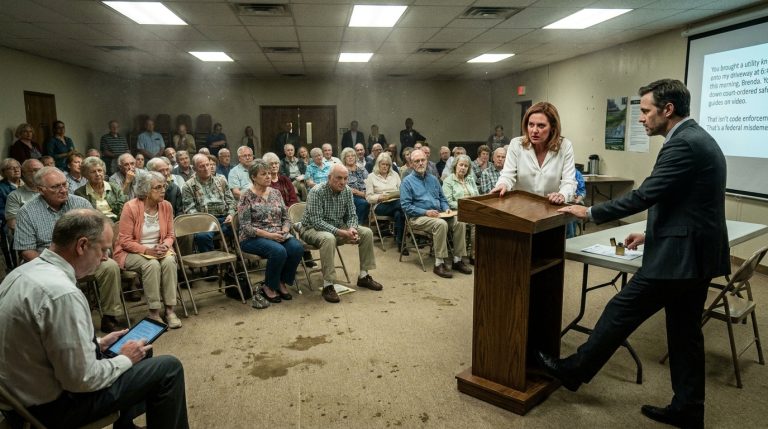
The community center smelled of floor wax and the stale, lingering scent of a thousand cheap coffees. It was a space designed for bingo nights and local bake sales, not for the high-stakes theater Margaret Windham had engineered. I pushed the double doors open, the heavy steel hinges groaning.
Inside, the room was buzzing. Margaret had orchestrated the space with the surgical precision of a corporate takeover. She was standing at the front, draped in a cream-colored blazer, her hair pulled back into a knot so tight it looked like it was pulling the skin of her face into a permanent, strained smile. She had rows of chairs set up, and at the front, a projector screen displayed a PowerPoint title in bold, aggressive font: PINE RIDGE LAKE: PROTECTING OUR ASSETS.
As I walked down the center aisle, the chatter died down. I could feel the eyes of my neighbors—people I’d known for decades—tracking me. Some looked away, burdened by the weight of the social pressure Margaret had applied; others, like Betty Kowalski, offered a small, stiff nod.
I scanned the rows. The layout was strange. There was an empty space in the front row, a missing chair where the township attorney was supposed to sit. It was a small discrepancy, a missing piece of the puzzle, but it registered immediately. She hadn’t just invited the supporters; she had curated the audience to exclude anyone who could offer a dissenting legal voice.
I found a seat near the back, near the door. My folder was heavy against my side.
“Thank you all for coming,” Margaret began, her voice projected through a wireless mic, smooth and devoid of any human tremor. “We are at a crossroads. Pine Ridge Lake is an investment, a sanctuary, and currently, it is under threat from individuals who prioritize their own habits over our collective security.”
She clicked a remote. A photo of my truck appeared on the screen, followed by a grainy, zoomed-in shot of me on my dock.
“Some call it fishing,” she said, pacing the length of the podium. “We call it unauthorized industrial use of a common resource. Our enforcement measures have been met with hostility, but I want to assure you—we are acting in the best interests of your property values.”
She was building the narrative, brick by brick. She was setting the trap, expecting me to stand up and shout, to lose my temper, to give her the footage she needed for her police report.
She turned, her eyes locking onto mine in the back of the room. She knew I was here, and she smiled—a thin, jagged line of teeth. “And to those who think they can hide behind archaic loopholes or personal history, I want to say: the law is written in the present tense.”
I didn’t move. I didn’t speak. I sat with my hands folded, letting the silence around me grow thick and uncomfortable. She waited for a reaction, but I gave her nothing. I watched her posture—the way she gripped the podium, the slight, involuntary twitch of her jaw. She was vibrating with the intensity of her own performance.
“We have prepared a resolution,” she continued, her voice rising, losing some of its corporate polish as she leaned into the rhetoric. “Effective immediately, the Pine Ridge HOA will implement a zero-tolerance policy. Trespassers will be identified, reported, and prosecuted to the fullest extent of the law. We are here to bring order to chaos.”
Her supporters began to murmur, a low, rhythmic sound of agreement. Dale Pemberton, sitting near her, kept his head down, staring at his hands. He looked like a man trapped in a burning building who hadn’t yet found the exit.
I looked at the screen again. The slides were impressive—charts of declining property values, liability statistics, and “before and after” photos of the lake that were clearly manipulated to make the natural shoreline look neglected. She was a master of the decoy, painting a picture of decline to justify the imposition of her rule.
But beneath the surface of her presentation, I could see the cracks. She was sweating. Despite the air conditioning, a bead of moisture traced a path down her temple. She was terrified that I might have something to say, something that would break the spell she had cast over the room.
The “Emergency Meeting” was reaching its crescendo. She called for a vote on the enforcement resolution, her eyes darting to the door, checking to see if the sheriff’s deputy had arrived. She wanted this done. She wanted the validation, the stamp of communal approval that would make her actions “official” before the real law could catch up to her.
I felt the folder in my lap. It was the only truth in the room.
I knew the moment I stood up, the entire room would shift. She was playing a game of chess, expecting me to play by her rules, but she didn’t realize the board was already mine. I was the one who held the deed to the lakebed. I was the one who had the history.
She opened the floor for questions, her eyes scanning the room, daring someone to challenge her. Her gaze landed on me again, lingering for a second too long.
I began to stand, the chair scraping loudly against the concrete floor. The sound was like a thunderclap in the quiet room. Every head turned. Margaret froze, her finger hovering over the remote for the next slide.
“I have a question, Margaret,” I said. My voice was calm, steady, and loud enough to fill the space.
She stiffened, her hand dropping to the podium. “Mr. Blackstone. Keep it brief. We are here to vote on the community’s future.”
“It’s about the property records,” I said, stepping into the aisle. “And why you’ve been charging fees for access to land you don’t even own.”
The air in the room didn’t just change; it vanished. The silence was absolute. Margaret’s face went white, the blood draining away to leave her looking like a marble statue in a blazer. She opened her mouth to speak, but for the first time since she had arrived in Pine Ridge, she had absolutely nothing to say.
The game was over. The trap was sprung.
CHAPTER 7: THE COUNTY RECKONING
Margaret’s face, only seconds ago a portrait of polished authority, fractured. It wasn’t a sudden collapse; it was a microscopic erosion. Her jaw tightened, a hard ridge of muscle beneath the skin, and she looked down at the podium as if the words on her notes had suddenly shifted into a language she couldn’t read.
“Mr. Blackstone,” she said, her voice dropping into a register so cold it scraped the air. “You are disrupting a sanctioned community assembly. I suggest you sit down before I have you escorted out.”
She glanced toward the back of the room, her eyes searching for the deputy she’d positioned by the doors. But Deputy Charlie Morrison wasn’t looking at her. He was standing with his arms crossed, his gaze fixed on the commissioners at the front of the room, his expression unreadable. He had seen the deed copies I’d handed him earlier, and he knew enough about the Blackstone family history to realize that Margaret had been playing a dangerous game with the wrong piece of real estate.
I walked toward the front. The room felt like a pressurized cabin, every eye following me, the floorboards groaning under my boots. I stopped before Commissioner Williams, who was currently peering at the documents I’d placed on his desk—the brittle, yellowed maps and the heavy, notarized seals of the 1958 transfer.
“Commissioners,” I said, my voice cutting through the thick, stagnant air. “Ms. Windham’s entire presentation relies on one fundamental premise: that the HOA has the authority to regulate this lake. That premise is false.”
Margaret stepped down from the dais, her movements jerky, erratic. “This is a private property dispute, not a public forum! You’re misrepresenting the facts, Theo! You’re trying to bully the committee into ignoring years of community management!”
“Community management?” I turned to face her. “You’ve been charging families like the Martinezes and the Kowalskis for the privilege of accessing their own shoreline. You’ve been filing false police reports to intimidate veterans who have lived here longer than you’ve been drawing a paycheck.”
“I am protecting the value of this lake!” she snapped, her voice finally losing its practiced, corporate sheen. She looked desperate, the veneer of the ‘Compliance Officer’ stripping away to reveal the frightened, grasping woman beneath. “Without the HOA, this place becomes a slum! It becomes a collection of rusted trucks and untrimmed lawns!”
“It becomes a home,” I corrected.
Commissioner Williams cleared his throat, the sound a sharp, authoritative crack in the room. He tapped the deed with his pen. “Ms. Windham, Mr. Blackstone has provided the original Thompson Mining survey records, notarized by the state archives. These records clearly indicate that the subsurface and water-usage rights for the Pine Ridge Lake basin were conveyed in perpetuity to the Blackstone estate.”
He looked up, his expression hardening. “If these documents are accurate—and my staff has already verified the seals—then the Pine Ridge HOA not only lacks the authority to regulate these waters, but its current activities constitute a criminal trespass on private land.”
The room inhaled. It was a sharp, collective sound. Margaret looked around, her eyes wide, searching for a face that would offer her an anchor, but her supporters were shrinking into their seats. The matching navy blazers that had looked like symbols of power five minutes ago now looked like a uniform of defeat.
She turned back to me, her breathing ragged. “You… you knew. You knew this the whole time. You let me build it. You let me spend the money on the fence, the security, the lawyers… you let me do it just to watch me burn.”
“I let you show yourself,” I said, my voice steady, feeling none of the triumph I had expected. It wasn’t about the win. It was about the silence that was coming. “I didn’t force you to bully Betty. I didn’t force you to file those complaints against Frank. You chose to use your power to hurt people who couldn’t fight back. You didn’t just pick a fight with me, Margaret. You picked a fight with the history of this place, and it’s a lot older and tougher than you.”
“This isn’t over,” she whispered, her voice trembling. “I’ll sue. I’ll take this to the state court. I’ll ruin all of you.”
“You can try,” Deputy Morrison said, stepping forward from the back of the room. He reached out and touched his radio. “But right now, Ms. Windham, I’m going to need you to come with me to fill out a report regarding these trespassing claims. The commissioners have requested an immediate halt to all HOA operations.”
The photographer in the back, the one she’d hired to document her coronation, clicked the shutter one last time—the sound sharp as a needle—as Charlie took her by the arm. She didn’t fight. She walked toward the doors with a stiff, unnatural gait, her eyes fixed on the floor, her legacy of charts and PowerPoint slides left discarded on the projection screen.
The room remained silent as the double doors swung shut behind them. I turned toward the commissioners, but the weight in my chest had finally shifted. The battle was over. The lake was mine, but more than that, it was ours again.
I looked at Betty, who was sitting in the middle row, her hands clasped tightly in her lap. She caught my eye, and for the first time in months, her face broke into a tentative, weary smile. The structure of the room, the tension, the fear—it was all evaporating. The only thing that remained was the hard, cold truth that the lake was free.
CHAPTER 8: THE SETTLEMENT
The silence that descended upon Pine Ridge Lake the following morning was not merely the absence of noise; it was a physical weight, like the air after a long-delayed thunderstorm. I walked down to the water’s edge, my boots crunching on the gravel, and found the world fundamentally altered. The white vinyl fence—that sterile, aggressive scar on the shoreline—was gone. In its place, the ragged, natural brush of the lakefront pushed back, reclaimed by the wind and the damp earth.
I knelt by the spot where the main security camera had been anchored. All that remained was a rusted bolt embedded in the wood of my dock, a small, jagged piece of iron that felt like a relic from a war that nobody truly wanted. I took a wrench from my jacket pocket—the same one I’d used to maintain the dock for twenty years—and turned the bolt. It resisted at first, locked by oxidation and time, but then gave way with a sharp, satisfying screech of grinding metal.
I held the bolt in my palm. It was cold, heavy, and useless. I dropped it into the dark, still water, watching the ripples spread until they touched the distant reeds.
The path ahead was quiet. I walked the full length of the shoreline, the walk that Frank Martinez had been denied for months. I reached his garden first. The gnome he’d kept on the porch, the one Margaret had mocked as a blight, was back in its place, peering out from beneath a bed of overgrown kale. Frank was there, too, sitting in a plastic chair, his face turned toward the sun.
“Morning, Theo,” he said, not standing. He didn’t have to anymore.
“Morning, Frank,” I replied. I sat on the edge of his porch, the wood worn smooth by age. We didn’t talk about the meeting. We didn’t talk about the HOA or the lawyers or the cold, corporate fury that had nearly torn this place apart. We just sat, watching the light play across the surface of the water, a pattern of gold and deep, mossy green.
The lake belonged to us again, but it was different. It felt fragile now, like a piece of pottery that had been shattered and glued back together—the cracks were still visible, but they made it stronger. It was the Kintsugi of a community.
I spent the rest of the day in a slow, methodical rhythm of restoration. I repaired the broken step on Betty’s porch, the wood grain rough and smelling of pine sap. I checked the moorings on the Martinez boat, tightening the fraying ropes until they were taut and secure. It wasn’t glorious work, but it was necessary. It was the “sovereign protector” labor that this land required, the kind that reminded you that ownership was just a legal word for a commitment to stay and look after things.
By evening, the neighbors began to drift toward the boat launch. There was no formal invitation, just a shared, silent recognition that we were finally breathing again. Betty brought a thermos of coffee, the steam rising into the cooling air, and we sat on the dock, the wood planks vibrating with the gentle lap of the water.
“Do you think she’ll come back?” Betty asked, her voice quiet. She was clutching her mug with both hands, her knuckles reddened by the cold.
“No,” I said. I looked out at the McMansion on the ridge. It sat silent, the windows dark. It was just a house now, stripped of its power, stripped of the woman who had tried to project her own fear onto the rest of us. It was already for sale; a realtor’s sign had been hammered into the lawn earlier that afternoon. “She was never part of the lake. She was just passing through.”
We finished the coffee as the sky shifted from lavender to a deep, bruising indigo. The loons began their evening call, a hollow, haunting sound that echoed off the hills. It was the same sound I had heard for twenty-three years, the same sound Sarah had loved.
I stood up, my legs stiff, and walked to the edge of the dock. I looked down at the dark water. I knew, with a certainty that settled deep in my bones, that this wouldn’t be the last time we faced a storm. People like Margaret—people who couldn’t see the value of a place without trying to optimize it, fence it, or tax it—would always exist.
But I also knew that we had learned how to hold the line.
I reached into my pocket and felt the smooth, cool weight of the old mining deed—now a copy, stored safely in my desk—but the knowledge of it was enough. I had the foundation. I had the history. And most importantly, I had the community that had survived the pressure.
I walked back up the gravel path, the crunch of stone under my boots feeling like a steady, rhythmic pulse. The air felt thin and clean, the scent of iron and wet earth a reminder of the bedrock that had stood here long before we arrived and would remain long after we were gone.
I reached the cabin, the light in the kitchen warm and inviting, a golden beacon against the encroaching night. I paused at the door, taking a deep, slow breath of the night air. The war was over. The lake was settled. I didn’t need to be a soldier anymore; I could just be the man who lived on the edge of the water.
I turned the key, the lock clicking into place with a sound that felt like a quiet, final period at the end of a long, exhausting sentence. I stepped inside, the house quiet, the shadows long, and for the first time in months, I didn’t reach for my files. I didn’t reach for my lists of evidence. I walked to the window, watched the moonlight catch the ripples of the lake, and finally, simply, rested.