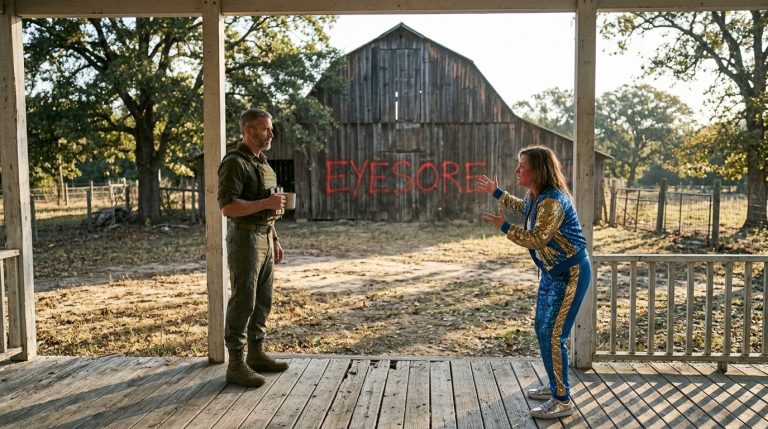
The Riverbed Covenant: A Major’s Tactical Defense of Legacy Against a Suburban Tyrant’s Erosion
CHAPTER 1: THE FIRST TRESPASS
The river didn’t care about bylaws. It moved over the granite, cold and indifferent, the same way it had moved when my great-grandfather carved his mark into the valley floor. Karen Miller, however, cared a great deal. She stood on the embankment, a pastel-colored obstruction in the morning mist, her clipboard clutched to her chest with the white-knuckled intensity of a true believer.
“This is now a designated community recreation area, Major Callahan,” she said. Her voice was thin, sharpened by the kind of arrogance that only breeds in the isolation of a gated estate. “Your exclusive fishing privileges have been revoked. You have five minutes to pack your equipment.”
I didn’t turn. I watched the line, a delicate, translucent filament connecting me to the hidden depths of the water. My hands, calloused and steady, continued their work. I reeled, the gear of the spool singing a soft, mechanical song that served as the only rational response to her intrusion. Behind me, I could hear the crunch of her sneakers on the damp, river-worn stones. She was close now, her perfume—something floral and cloying—fighting the clean, metallic scent of wet silt and rushing water.
“Did you hear me, Major?”
“I heard you, Karen.” I kept my eyes on the surface. A trout broke the water a few yards downstream, a silver flicker against the dark current. “I’m just deciding if your voice is louder than the river. It’s a close competition.”
“This is not a joke,” she snapped, a rustle of paper as she tapped her clipboard. “The River’s Edge Estates bylaw 7.4-C is very clear. You are trespassing on shared community space. If you are not gone by the time I walk back to that ridge, I will be calling the local authorities to ensure you are forcibly removed.”
I finally turned, slowly. I leaned back against the weathered oak that marked my western boundary, letting the fishing rod drop to the muddy bank. The morning sun was just cresting the hill, casting a long, jagged shadow that seemed to stretch from my feet directly to her throat. She looked satisfied, her face a taut mask of suburban power, a woman who had never spent a day in the field but was an expert in the theater of control.
“Karen,” I said, my voice as flat and hard as the granite beneath her boots. “You’re standing on a survey line that predates your existence, your house, and your entire association. You aren’t just wrong; you’re wandering into a jurisdiction you don’t understand.”
She scoffed, a quick, dismissive sound that didn’t reach her eyes. She turned away, clutching her clipboard like a shield. She didn’t look back as she marched up the slope toward the cookie-cutter mansions on the ridge, her silhouette shrinking against the sky.
I looked down at the river, then at the dirt where her heel had pushed into the soil. I saw the edge of a rusted iron stake—the original marker from 1888—partially exposed by the recent rains. It was bent, weathered, and forgotten by everyone but me. I knelt, pushing the silt away with my thumb, revealing the faint, stamped ‘C’ on the metal. The land was still mine, but the war for it had just arrived, and the iron was starting to rust.
CHAPTER 2: THE PAPER BULLET
I stared at the letter on my kitchen table, the light from the overhead window catching the dust motes dancing in the air. The oak beneath my hands, a legacy from a different century, felt solid and unyielding, a stark contrast to the hollow threats printed on the heavy stationary. I didn’t reach for the opener. I didn’t need to. I knew the cadence of these things—the formal language, the bolded fines, the pseudo-legal jargon meant to induce a specific, localized heart rate spike.
I moved to the kitchen island, where my grandfather’s old drafting lamp still held a steady, amber glow. My movements were slow, methodical. I wasn’t feeling anger, not yet. This was a logistical problem, and logistics require a cool head. I unfolded the notice. It was crisp, the edges sharp enough to slice skin. Bylaw 7.4-C. The fine was a hundred dollars—a pittance in the real world, but a signaling shot in hers.
As I read the fine print, a memory surfaced, unbidden and cold. It was the smell of a command tent in a landscape far from the Whisper Wind, the damp canvas pressing in against the desert heat. We had been trying to map a supply route that required navigating through a series of interlocking, contradictory local jurisdictions. The complexity was suffocating. I remembered sitting there for hours, cross-referencing maps, realizing that the local power brokers were building hurdles not to stop us, but to test if we were strong enough to dismantle them.
The HOA covenants, a thick document that had sat collecting dust in my study, suddenly felt like a map of that desert. I walked into the study, the floorboards creaking under the weight of my boots. I pulled the covenant binder from the shelf. It was a bloated, self-important collection of rules that tried to legislate the color of mailboxes and the height of grass. It was a document built on the assumption that everyone who read it was inherently afraid of being ‘out of compliance.’
I opened the binder. My eyes didn’t look for the rules; they looked for the map. There it was—the plat map, encased in a yellowing plastic sleeve at the back. My property was a jagged, defiant shape on the edge of the blue-tinted development. I traced the boundary with my fingertip. It was marked clearly: Parcel 7B, Not A Part.
I sat back, the leather chair groaning. The absurdity of it was almost surgical. She was fining me for trespassing on land that was excluded from her jurisdiction by the very document she was using to enforce her will. It was a failure of due diligence, a catastrophic oversight born of pure, unchecked ego. She hadn’t bothered to read the fine print of her own kingdom.
I leaned forward, the smell of old paper and dust filling my lungs. I needed to be certain. I reached for the bottom drawer of the metal filing cabinet. The lock turned with a familiar, mechanical resistance. Inside, the fireproof safe was a heavy, comforting presence. I dialed the combination—my father’s birthday—and the door swung open.
Inside lay the 1888 deed. It was fragile, a piece of history that felt like it might crumble if I gripped it too tightly. The ink, written in elegant, flowing script, was still legible, standing as a testament to a time when land was defined by stone markers and riverbanks, not by bylaws. I spread it out alongside the HOA’s plat map.
The contrast was striking. One was a document of sovereignty, born of labor and clear, physical boundaries; the other was a document of managed aesthetics, born of a need for control.
I sat there for a long time, just looking at the two papers. The house was quiet, the only sound the steady ticking of the clock in the hallway. I realized then that I wasn’t just defending a fishing spot. I was defending the principle that some things exist outside of a committee’s reach. My phone sat beside the deed, its screen dark. I looked at it, contemplating the next move. Colonel Marcus Thorne. He hadn’t been on my mind for years, not since the days when we had to negotiate through the wreckage of crumbling infrastructure to get supplies to where they were needed most. But the logic of this conflict demanded a professional.
I needed to know if the HOA’s jurisdiction was as hollow as the plat map suggested. I needed to verify the surveyor’s markers, the ones Karen’s people would undoubtedly try to move or obscure if they felt their ‘territory’ was threatened.
I picked up the phone. The screen glowed, the light harsh in the dim study. I opened my contacts, scrolling past old names and defunct numbers until I found him. My thumb hovered over the call button. If I made this call, there was no going back to the quiet, solitary life I’d envisioned. The war would be official.
I looked at the deed once more. The ink seemed to pulse in the lamplight. I pressed the call button, listening to the first long, hollow ring echoing through the empty house.
CHAPTER 3: RECONNAISSANCE
The voice on the other end wasn’t the boisterous, unfiltered man I remembered from the tent in Fallujah. It was sharpened, clinical, and possessed of a judicial calm that made the air in my study feel suddenly thin. Marcus Thorne didn’t ask how I was doing; he didn’t need to. He went straight to the logistics of the conflict. I held the deed in my free hand, the brittle edges of the parchment digging into my skin, while I paced the short length of the room.
“Jack,” he said, the word carrying the weight of a decade’s professional distance. “If you are calling me about an HOA dispute, you are either bored, or you are dealing with a person whose appetite for control has exceeded the bounds of the law. Which is it?”
“Both,” I replied. I looked out the study window, toward the ridge where the oversized beige boxes of River’s Edge Estates loomed over my land. “It started with a fishing spot, Mark. Now, it’s a systematic attempt to erase a hundred and thirty years of property history based on a bylaw written last Tuesday.”
There was a pause—the kind of silence that usually preceded a tactical shift. “Send the documents,” he said, his voice dropping an octave. “All of them. If she is pushing through changes without a quorum, she is playing with fire, and she is burning the house down to keep herself warm. But understand this: when you pull the thread on an organization like this, you don’t just expose the tyrant. You expose the machinery that allows them to function.”
We talked for ten minutes—long enough to confirm that my assessment of the legal landscape was accurate, and short enough to keep the tension from dissipating. When I hung up, the silence of the house felt heavier, charged with the intent of the coming fight.
I didn’t stay in the study. The paper was an anchor, but to understand the scale of the threat, I needed to see the machine. I grabbed my jacket and stepped out into the afternoon.
The path from my homestead up to the ridge was an incline that I had traversed a thousand times as a boy, but today, it felt like moving between two different planets. My land was a landscape of memory—old growth, rough stone, the unruly, living edge of the river. As I climbed toward River’s Edge, the world changed. The grass became a uniform, manicured green that looked like it had been trimmed with scissors, not a mower. The trees were spaced at identical intervals, their trunks wrapped in plastic guards. It was a place where nature had been processed, packaged, and filed away for future reference.
I walked the perimeter of the Estates, my boots silent on the pristine asphalt of the cul-de-sacs. I felt like a ghost, an anomaly in a place built for total visual agreement. I saw the residents—people moving with a hurried, practiced efficiency, their gazes never quite meeting mine. There was a subtle texture of anxiety here, a faint tremor in the fabric of the neighborhood that felt entirely artificial.
I found myself near the back of the development, near lot twelve. The property was a perfect, beige mirror image of the house next door. It belonged to Eleanor Gable. I knew her only by name, a name I had seen on the county tax rolls years ago, but today, she was out in her garden. She was working on a bed of roses, her movements slow and deliberate. She wasn’t pruning; she was tending, her hands steady as she touched the thorns.
I didn’t mean to stop, but the way she leaned on her shovel—a sudden, weary slump of the shoulders—triggered something in me. I paused at the edge of her property line, where the mulch gave way to the wilder brush of the woods.
“The aphids are bad this year,” I said, my voice quiet, cutting through the sterile silence of the street.
Eleanor looked up, startled. Her face was lined with a history of its own, but it was the flicker of genuine fear in her eyes that registered first. She checked the street—a reflexive, scanning movement—before she allowed herself to nod.
“They are, Major,” she replied, her voice soft, barely reaching me. “But it’s not just the aphids. Everything here feels… managed. Sometimes I think if a petal falls in the wrong direction, I’ll get a notice.”
I didn’t offer comfort; I offered observation. “I’ve seen the notices, Eleanor. They aren’t about the gardens.”
She stepped closer to the edge of the lawn, keeping her voice low. “She’s everywhere, Jack. Karen. She watches the street like it’s a theater. I feel like we’re all just props in her play, and if we don’t say our lines perfectly, she changes the script.”
I looked at the house—the oversized windows, the perfectly arranged shutters, the absolute absence of a single, stray leaf. It wasn’t a home; it was a demonstration. And I realized then that my war wasn’t just about the river. It was about the fact that Karen Miller had replaced the messy, beautiful reality of life with a brittle, curated performance that she demanded everyone else subscribe to.
I thanked her for the time, a brief, tactical exchange that left me with a clearer picture of the front lines. As I walked back down the slope toward the river, I felt the grit of the path under my feet, the smell of damp earth rising to meet me. The contrast was the key. My land was allowed to be broken, to be worn, to be real. Theirs was a fragile construct, and it was only as strong as the fear that held it together.
I reached the riverbank just as the light began to turn, a deep, bruised purple stretching across the water. I stood there, the cool air settling into my lungs, and listened to the river. It flowed over the stones, persistent, eroding, and completely uncaring about the rules that were being printed on expensive, heavy card stock just a few hundred yards away. The reconnaissance was done. I knew the nature of the beast, and I knew exactly where the first strike had to land.
CHAPTER 4: THE SURVEYORS GAMBLE
The heat radiating off the asphalt was thick, shimmering in waves that distorted the pristine, beige geometry of the Estates. Henderson, the surveyor, was a man carved from leather and long hours in the sun, but even he looked unsettled by the atmosphere. Karen Miller stood behind him, her clipboard held like a weapon, her posture rigid as she directed him to place a secondary stake—one that would have effectively encroached five feet onto my property line. She was trying to rewrite history with a piece of sharpened wood and a hammer.
I didn’t wait. I stepped off my porch, the dry grass crunching beneath my boots, and crossed the invisible threshold. I wasn’t there to argue; I was there to observe the integrity of the work.
“That stake is misplaced, Henderson,” I said. My voice was low, carrying across the quiet street with the practiced authority of a command.
Karen whipped around, her face flushed with a blotchy, uneven heat. “Major, you are trespassing! This is a private, authorized survey. You are interfering with community business.”
“It’s not business if it’s based on a fiction,” I said, ignoring her and focusing entirely on Henderson. The surveyor looked up, wiping a bead of sweat from his forehead with the back of a calloused hand. He looked between Karen’s manicured, trembling rage and my own steady presence. He was a professional, and professionals possess an instinct for when the ground beneath them is becoming unstable.
“I’m following the markers provided by the association president,” Henderson said, his voice flat. He reached for his theodolite to adjust the leveling, but as he shifted his weight, the heavy tripod groaned. A metal locking collar, stressed by the uneven tension of the ground she had forced him to work on, sheared off with a sharp, piercing ping. The entire instrument listed violently, the lens assembly narrowly missing the gravel.
The silence that followed was absolute.
Henderson stared at the ruin of his gear, his face draining of color. It wasn’t just a broken tool; it was an interruption of the process. I seized the vacuum of that moment. I didn’t rush. I walked forward until I was within reach of the tripod’s wreckage.
“That tool is precision equipment, Henderson,” I said, my tone shifting to a clinical, dispassionate analysis. “It requires a stable foundation. You’re trying to measure reality using a baseline that doesn’t exist, and the equipment is failing under the pressure of the falsehood.”
Karen stepped forward, her mouth set in a hard, white line. “He is doing his job! If you have a grievance, take it to the board, but you will not sabotage this survey.”
I turned to her, and for the first time, I let the full weight of my gaze settle on her. I didn’t see a neighbor anymore; I saw a logistics failure. “The board doesn’t know what you’re doing, Karen. I’ve spoken to Chen. I know about the email, the lack of a quorum, and the history you’re trying to bury. You aren’t just surveying a boundary line; you’re attempting to manufacture a legal reality that will hold up in court. That’s not surveying. That’s fraud.”
The word hung in the air, heavy and blunt. Henderson looked at me, his eyes wide. He began packing his gear, his movements quick, jerky, and filled with a sudden, urgent desire to be anywhere else.
“I’m not a part of this,” Henderson muttered, barely loud enough for her to hear. He grabbed his case, leaving the broken tripod where it lay. “You have a boundary dispute, ma’am. This is a court matter. I’m out.”
“You work for me!” Karen screamed, the facade of the suburban queen finally fracturing. She looked manic, her hair slightly disheveled, the clipboard finally clattering to the dust. “You don’t get to walk away! I have a contract!”
“The contract is null if it requires an illegal act,” I said, stepping between her and the retreating surveyor.
As Henderson’s truck pulled away, kicking up a cloud of dry, abrasive dust that coated the pristine beige of her property, Karen stood alone on the edge of the road. She looked smaller than she had a moment ago, the weight of her own construct settling on her shoulders. She turned to me, her eyes darting around as if searching for an audience, for a resident to come to her aid, but the street remained eerily silent. The identical houses stared back at us with blank, unblinking windows.
“You think you’ve won something,” she hissed, her voice trembling. “You’ve just ensured that this will go to a legal review. And when I’m done, you won’t just be fined. You’ll be gone.”
“Legal review is exactly what I want, Karen,” I said, turning my back on her to head home. “Because that’s where the facts finally get to speak for themselves.”
I walked back down the path, the metallic friction of the day’s tension slowly beginning to drain from my muscles. I hadn’t resolved the war, but I had stripped the antagonist of her most dangerous tool—the veneer of professional legitimacy. She was standing in the middle of her own broken trap, and for the first time, the neighborhood was watching from behind their curtains. The escalation had reached its peak, and now, the gravity of her own lies would do the rest of the work. I didn’t need to do anything else today but wait. The machine she had built was beginning to grind itself to pieces.
CHAPTER 5: THE TRIBAL GATHERING
The walk to the clubhouse felt different than my earlier reconnaissance. Before, I had been an observer, a man measuring the perimeter of a threat. Now, I was the messenger, carrying the physical weight of fifty envelopes in my courier bag, each one a sharp, undeniable truth meant to puncture the manufactured quiet of River’s Edge. The air was cool, smelling of impending rain, and the neighborhood felt tense, as if the houses themselves were bracing for the impact of what was about to happen.
I started at the edge of the development, slipping each letter into the slots of the identical front doors. I didn’t look at the houses—they were just boxes for people who, until now, had been living in a state of carefully curated fear. I focused on the rhythm: reach, slide, step. Reach, slide, step. It was a logistical task, one that echoed the precision of my days in the Corps. By the time I reached the middle of the development, the sun was beginning to dip, casting long, fractured shadows across the lawns.
As I approached the clubhouse, I noticed a piece of paper caught in the door frame—a thick, blue-backed document that looked like it had been dropped in haste. I picked it up. It was a partial copy of a previous HOA meeting agenda, dated three years ago, from a county three towns over. My eyes caught a name: Karen Miller, Chairperson. It was a shred of a trail, a physical discrepancy that hinted at the ‘why’ behind her behavior. She wasn’t just a product of this neighborhood; she was a serial occupant, moving from one community to the next, leaving the same structural damage in her wake. I tucked the paper into my pocket, the texture of it—rough and slightly damp—a tangible piece of the puzzle I had only just begun to see.
The clubhouse itself was an island of fluorescent light in the gathering dusk. I didn’t enter immediately. I stood on the porch, listening to the muffled sounds of people arriving inside. Voices, initially quiet and strained, were growing in volume, mingling into a chorus that lacked the uniform, polite tone I’d come to expect from the residents here. They were talking—really talking—and the sound was messy, unscripted, and entirely human.
I pushed the door open. The atmosphere hit me like a physical wave. The room was packed. People stood in tight, agitated clusters, clutching my letters like lifelines. Mrs. Gable was in the front, her posture no longer slumped, but upright and defiant. She was showing a letter to a neighbor, her finger tracing the circled map.
I moved to the back of the room, my presence unnoticed at first. The board members were at the front, their faces pale under the harsh lighting. They looked like people who had been handed a script they hadn’t written and didn’t know how to perform. I watched them, noting the way David Chen’s eyes kept darting to the side door, the one that led to the office where Karen usually held her private consultations.
The room went quiet when Karen herself entered. She moved through the crowd with her usual, practiced gait—head held high, clipboard pressed to her chest—but the performance failed to land. No one moved to make way for her. No one offered the polite, deferential nods that usually accompanied her progress. Instead, there was a visible, collective shift, a silent movement of bodies away from her, as if she were a contagion.
She reached the front, the gavel clattering on the table as she prepared to take her seat. She looked out at the room, her eyes widening as she saw the letters held by almost everyone in the chairs. The sight clearly shocked her, but her recovery was instant, a reflex of defensive aggression.
“This is an unauthorized gathering,” she announced, her voice too loud for the room’s acoustics. “I want everyone who hasn’t been invited to leave this clubhouse immediately.”
No one moved. Not a single person.
I took a step forward, my boots sounding loud against the polished laminate of the floor. Every head turned. The weight of the room shifted. I didn’t need to speak to feel the change—the silence wasn’t fear anymore; it was anticipation. I had planted the seeds of the insurgency, and now, I was watching the community bloom in real-time. The board members looked at me, then at Karen, and for the first time, I saw the hesitation in their posture. They were no longer her subordinates. They were just people, and they were beginning to realize that the power she held was only as durable as their willingness to grant it.
I stood by the back wall, my hands resting on the strap of my courier bag. I didn’t need to say a word. I had already given them the truth in black and white, and now, they were going to use it. The tribunal was about to begin, and I had done my part. The rest was up to the collective will of a neighborhood that had finally decided to reclaim its own story.
CHAPTER 6: THE TRIBUNAL
I didn’t move from the back of the room as Karen slammed the heavy oak door behind her. The sound echoed, a final, punctuating note to the collapse of her administration. The clubhouse, usually a sterile vessel for polite community chatter, felt charged with a heavy, honest electricity. Karen’s exit hadn’t just removed a person; it had excised a ghost.
David Chen stood at the front, his hands gripping the edges of the podium until his knuckles turned white. He looked at the room, then at me. There was no need for grand speeches; the evidence was taped to the walls, pinned to the corkboards, and held in the hands of every resident who had been fined for the ‘crime’ of existing in their own homes.
“The motion for a vote of no confidence is carried,” David said, his voice finding a steady rhythm. “Effective immediately, the chair is vacant. We will move to appoint an interim committee.”
The rest of the meeting was a blur of efficiency—a stark contrast to the months of manufactured complexity Karen had forced upon us. As the residents organized, I slipped out of the side exit to get some air. The night was cooling, the air thick with the promise of rain. I walked down toward the riverbank, the path familiar beneath my feet even in the dark.
I found Marcus Thorne waiting by the fence line where the wire had been ripped away. He was leaning against the old oak tree, his suit jacket draped over his arm.
“She’s gone, then?” he asked, looking toward the ridge where the lights of the McMansions flickered like cold, distant stars.
“She’s done,” I corrected. “She didn’t just lose a vote, Mark. She lost the illusion. Once people see behind the curtain, you can’t put the stagecraft back together.”
We walked in silence for a long moment, the only sound the steady, rhythmic gurgling of the Whisper Wind. The river was the same as it had been for a century—unyielding, persistent, and entirely indifferent to the pettiness of men and women who thought they could own it.
“You know what this means, don’t you?” Mark said, his tone softening. “She’ll move to the next place. She’ll find a new community, a new set of bylaws to exploit, and a new group of people who are too polite to question her until it’s too late. That’s the reality of what we uncovered. She isn’t just a neighbor; she’s a predator who specializes in the architecture of suburban law.”
“She can try,” I said. “But the paper trail is out there now. Between the county investigation into the fraudulent survey and the pattern of abuse we’ve documented, her next victims will have a head start.”
I reached the spot where the ugly wire fence had once scarred the land. The ground had been raked over by the crew, but there was still a faint depression in the soil, a memory of the barrier. I knelt and touched the earth, the cool, damp texture grounding me. This was the work—the slow, necessary labor of stewardship. I reached into my pocket and pulled out the old iron stake I had cleared earlier, pushing it back into the ground until the ‘C’ was flush with the surface. It was a small gesture, a symbolic repair of the damage.
Mark watched me, his expression unreadable in the dim light. “You fought for a fishing spot, Jack. You ended up saving a community.”
“I fought for the land,” I said. “The community was just a byproduct of holding the line.”
We stood there as the first drops of rain began to fall, pattering against the leaves and the river’s surface. It was a cleansing sound. The battle hadn’t been won with a dramatic charge; it had been won by a commitment to the truth, by showing up, and by refusing to let the noise of the bureaucracy drown out the reality of the deed.
The next few months were a slow, deliberate settling. The HOA, now under the stewardship of David Chen, became the boring, functional body it was always intended to be. The fines were refunded, the bird feeders stayed, and the swing sets remained in the yards, vibrant splashes of color against the beige.
I spent my mornings by the water, just as I had always planned. The orchard needed tending, the fences required repairs, and the river continued to carve its path through the valley. My grandson, Leo, often came with me, his own small rod in hand. We didn’t talk much about the war. We didn’t need to. We sat in the quiet, watching the water, the lessons of the land passed down in the silence between casts.
I realized, as I watched him learn to read the current, that the real victory wasn’t the removal of a tyrant. It was the fact that the river was still here, moving over the stones, indifferent to the names on the deeds and the titles on the clipboards. It was the stewardship that mattered—the knowledge that we were just passing through, temporary keepers of a legacy that belonged, in the end, to the water itself. And that, in the quiet aftermath of the storm, was more than enough.