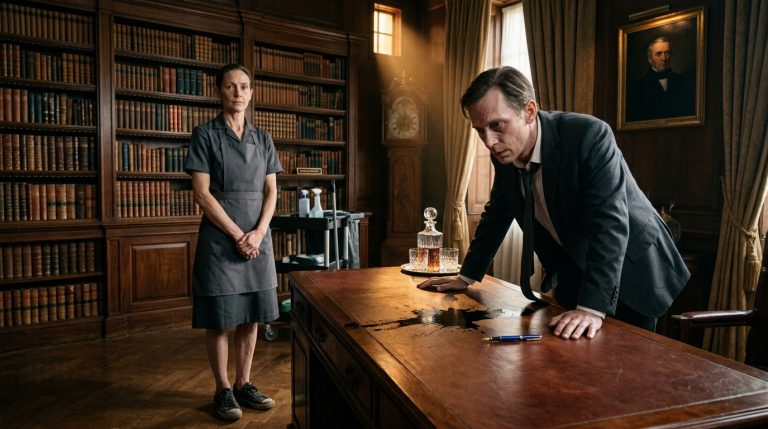
The Architect of Sight: A Young Heir’s Journey to Reclaim His Humanity Through Hidden Truths
CHAPTER 1: THE WEIGHT OF THE MIST
The morning was a bruise of purple and gray, hanging heavy over the Connecticut hills. Caleb stood where the asphalt of the private drive met the main road, the soles of his shoes damp from the unmanicured grass. He didn’t check his watch; he didn’t have one anymore. The weight on his wrist, a platinum complication that cost more than the average person earned in a decade, had been claimed by his father’s “privilege audit.”
He felt lighter, yet somehow, he felt the gravity of the world for the first time. The silence was not the curated stillness of the Montgomery library, but a raw, breathing quiet.
A bird—some common sparrow, he realized with a start—pecked at a cluster of gravel near his toe. He watched it, his breath hitching. The way its head snapped, the frantic, purposeful rhythm of its movement, was fascinating. He had spent seventeen years looking at the world as a background, a blurry smear of landscapes designed to frame his presence. Now, the background was sharpening, and it was terrifying.
The yellow bus appeared around the bend, a lumbering, oversized beast of steel and diesel. It didn’t belong in his world. It was a jagged intrusion of reality. As the doors hissed open, the smell of damp wool and stale air rolled over him. He stepped up, the metal stairs groaning under his weight.
Every head turned. He saw Kyle Jennings in the middle row, the boy’s eyes widening behind his expensive frames, a smirk already curling his lip. But Caleb didn’t flinch. He didn’t look for the VIP seat near the front. He walked to the very back, feeling the vibration of the road through the seat—a constant, rhythmic hum that reminded him he was moving, even if he didn’t know where to.
He pulled a small, worn paperback from his jacket pocket. It wasn’t his school textbook. It was the book Clara had left for him on the library table. He didn’t open it to read; he simply ran his thumb over the frayed edges of the cover.
The bus hit a pothole, a bone-jarring impact that sent a ripple of dust into the morning light. He watched the dust motes dance, suspended in a shaft of sun that pierced the tinted window. For a second, he saw it: the complexity of the light, the way it caught the impurities in the air, transforming the mundane into something intricate.
His phone was gone. His car was a memory. And yet, for the first time in his life, he wasn’t bored. He was terrified, and he was awake.
A flicker of movement caught his peripheral vision. He turned, looking out at a passing fence line. There, etched into the wood, were initials—faded, weathered, and carved with a knife. He realized then that he had walked past this road a hundred times and never once seen the story etched into the landscape.
The bus slowed, the brakes shrieking in a high, dissonant wail. They were arriving. The realization hit him like a physical blow: he had to walk into that school, not as a name on a building, but as a boy with no status to hide behind.
He didn’t know what the day would bring. He only knew that the mirror of his pride had been shattered, and in the broken shards, he was finally beginning to see the shape of something real. He stood up as the bus lurched to a halt, the door opening to reveal the gates of Northwood.
He stepped out, and the wind, cold and sharp, caught his hair, smelling of rain and turned earth. He was here. He was nobody. And for the first time, he was ready.
CHAPTER 2: THE ANCIENT OAK
The bus doors exhaled a final, hissing gasp of compressed air, and Caleb stepped onto the pavement. The silence that followed was not the absence of sound, but a heavy, expectant quiet. The sprawling, manicured lawns of Northwood Preparatory Academy stretched out before him, dotted with students in their polished uniforms—a tapestry of wealth and expectation. For the first time, he didn’t belong to the pattern. He was a loose thread.
He adjusted his bag. It felt lighter than it should have, or perhaps it was just the absence of his phone and the weight of his own sudden transparency. He walked toward the main entrance, his boots—sturdy, unremarkable things he’d grabbed from the mudroom—finding purchase on the gravel. Every step felt like a calibration.
He didn’t look for his usual circle. He didn’t look for the mocking glint in Kyle Jennings’s eyes. He kept his gaze focused on the path ahead, the texture of the walkway shifting from smooth concrete to the weathered stone of the older science wing. His mind kept pulling him back to the previous evening—the brief, sharp exchange with his father, the way the air in the study had felt thin, charged with a history he hadn’t yet learned to read.
He reached the center of the lawn, where the ancient oak stood. It was a massive, gnarled sentinel, its branches wide and sweeping, casting long, fractured shadows across the dew-soaked grass. He stopped. This was where she said to be.
Clara May was already there. She was hunched over, her hands buried in the rich, dark soil at the base of the trunk. She wore a heavy denim apron over a plain sweater, her blonde hair pulled back so tightly it seemed to sharpen the angles of her face. She didn’t look up as he approached.
“You’re early,” she said, her voice barely rising above the rustle of the leaves.
“I didn’t want to be late,” Caleb replied, his voice sounding strange to his own ears—less guarded, more direct.
“Punctuality is just the baseline, Caleb. It doesn’t mean you’re here yet.” She stood up, brushing dirt from her knees. She held up a small, weathered glass jar. “Look at the bark. Tell me what you see.”
Caleb crouched. He looked at the oak. It was old—fissured, grey, covered in patches of lichen that looked like spilled map ink. He looked closer, searching for the “secret” she kept hinting at. At first, there was only the rough, unyielding texture of the wood. Then, he noticed a tiny, almost microscopic indentation near a root. It was a perfectly circular hole, rimmed with a fine, orange dust. Beside it, a single thread of spiderweb, vibrating in the wind.
He leaned in, his nose inches from the bark. “It’s a burrow,” he said, realization dawning. “Something lives in the wood.”
“And?” Clara May prompted, her blue eyes fixed on his face.
“And it’s not random. The hole is positioned to catch the drainage from the main branch when it rains. It stays dry even in a storm.” He looked up at her, a jolt of excitement sparking in his chest. “It’s designed.”
“Everything is designed, Caleb. Everything has a purpose. You’ve just spent your whole life refusing to look closely enough to find it.” She handed him the jar. “Your job today isn’t to study the tree. It’s to sit with it. For one hour. No phone, no music, no thinking about your classes or your father. Just see what happens in this patch of earth.”
She turned and began walking back toward the estate, leaving him alone in the shadow of the oak. He sat down, the ground cold and damp beneath him. He felt the familiar itch of restlessness—the impulse to check his pocket, to find a distraction, to retreat into the numbness he’d curated for years.
He gripped the edges of the jar until his knuckles turned white. He breathed in the scent of damp earth and decaying leaves—the smell of a world that didn’t care about his last name. He forced himself to be still.
Minutes stretched into an eternity. His legs began to cramp, and the silence of the garden began to weigh on him. He watched a beetle struggle over a pebble, its shell a brilliant, iridescent green that he’d never bothered to notice before. He watched the way the light filtered through the oak’s canopy, painting shifting patterns on his sleeves.
He realized with a start that he was holding his breath. He let it out slowly, his shoulders dropping. As the tension left his body, the world around him seemed to expand. He heard the distant, rhythmic chime of the school bell, but it felt miles away. He heard the wind whispering through the grass, a soft, hushed language.
He saw it then—not the tree, but the system. The way the oak drew water, the way the lichen utilized the tree, the way the insects serviced the lichen. It was all connected. A vast, intricate architecture of survival, happening beneath his nose.
He reached out and touched the bark. It wasn’t just wood. It was history. It was a chronicle of every storm, every drought, every season this tree had endured. He wasn’t just looking at a plant; he was looking at an archive.
His father’s cold, demanding voice drifted into his mind, but he didn’t reach for his usual defensive sarcasm. He simply acknowledged the memory, felt the sharp, jagged edge of the pressure, and then let it pass like a cloud over the sun. He wasn’t a victim of his father’s legacy anymore. He was a student of the ground he stood on.
He sat there until the sun climbed high enough to turn the dew into a field of diamonds, his pulse slowing to match the steady, enduring rhythm of the world around him. He didn’t know what Clara May’s next lesson would be, but as he stood up, his knees stiff and his mind clear, he knew one thing: he wouldn’t be late for that, either.
CHAPTER 3: THE SYMPHONY OF STRESS
Caleb stood at the edge of the kitchen, his senses still vibrating from the hour of silence under the oak. The transition felt like walking through a heavy curtain. One moment, he had been listening to the slow, ancient language of roots and soil; the next, he was assaulted by the brutal, percussive reality of the Montgomery estate’s heart.
The kitchen was a cavern of stainless steel and industrial steam. It was an environment of hard edges and high friction. Jean-Pierre, the head chef, was a man whose presence felt like a temperature spike. He moved with a kind of erratic, focused violence, his white apron already stained with the day’s labor.
Caleb hesitated. Usually, he would have bypassed the kitchen entirely, moving through the servants’ corridor as if the staff were part of the architecture—necessary, but invisible. Today, however, he remembered Clara May’s directive. He didn’t just walk; he watched.
“You,” Jean-Pierre barked, not looking up from a pot of bubbling reduction that sent a wave of acidic, caramelized heat into the air. “You are in the way. Move or find a task.”
Caleb didn’t retreat. He stepped to the side, his eyes tracking the flow of movement. He saw the junior chef, a boy named Leo, struggling with a heavy tray of copper pots. Leo’s hands were shaking—a fine, persistent tremor born of fatigue and fear.
“I’ll take those,” Caleb said, his voice steady.
Leo blinked, stunned. “Mr. Montgomery, you don’t—”
“I said I’ll take them.” Caleb took the tray. It was heavier than he expected, the metal cold and biting against his palms. He didn’t carry them like a prince; he carried them like a tool. He walked them to the wash station, his movements calculated. He felt the weight shift, the friction of the metal against his sweater, the way the kitchen’s humidity made the air feel thick and tangible.
He turned back, and that was when the V-3 variance struck. A steam pipe near the prep table hissed violently, a rogue valve failing under pressure. A cloud of scalding white vapor exploded into the room, obscuring the space and causing the staff to stumble. Plates rattled, and a sharp cry rang out as a chef dropped a knife—a bright, silver arc that clattered across the floor.
Panic flared. The rhythm of the kitchen, usually a metronome of efficiency, shattered.
Jean-Pierre began to shout, his voice thin and desperate, orders firing like blanks into the mist. The kitchen was unraveling.
Caleb felt the surge of his old self—the desire to run, to distance himself from the mess, to retreat to his room. But then he remembered the oak. He remembered the stillness.
He didn’t run. He closed his eyes for a heartbeat, filtering out the shouting, the clatter, the screech of metal. He listened to the room.
Thump-thump-thump. The prep cook was still chopping, rhythmic and oblivious.
Hiss. The valve was still blowing, but the sound was weakening.
Click. The stove dials being turned off—the sound of someone reacting, but incorrectly.
Caleb moved through the fog. He reached the valve, his hand finding the rusted, heated handle by touch alone. He didn’t think about the heat; he thought about the mechanism. He turned it, the metal resisting, groaning against his grip. With a final, sharp twist, the hissing subsided. The steam began to clear.
He stepped back, wiping his wet hands on his pants. The kitchen had gone deathly quiet. Jean-Pierre was standing a few feet away, his chest heaving, his face pale. He looked at Caleb, then at the pipe, his eyes darting to the floor where the knife lay.
“You,” the chef said, his voice dropping from a shout to a low, jagged rasp. “You have never been in my kitchen before today.”
“I haven’t,” Caleb admitted, his heart hammering against his ribs.
“Why did you touch the pipe? You could have been burned.”
“It was the only way to stop the noise,” Caleb said, his voice clear. He looked at Leo, who was still frozen by the prep table. “The team was off-balance. I just… I saw the fix.”
Jean-Pierre studied him for a long, uncomfortable moment. There was no gratitude in the man’s eyes, only a begrudging, sharp curiosity. He turned back to his stove, tossing a handful of herbs into the pot with a flick of his wrist. “Do not think this makes you a chef, boy. Get out before you break something else.”
Caleb turned, his blood pumping with a high, clean adrenaline. He walked back toward the library, but his path was diverted. He caught sight of Clara May near the pantry, her back to him. She was holding a ledger, her posture rigid. She didn’t turn, but he saw her shoulders drop—just a fraction of an inch—as if she had been waiting for the noise to stop.
He realized then that the kitchen wasn’t just a place of food. It was a pressure cooker, and she had known it. She was testing his reaction to the chaos, to the way the “Montgomery world” handled a crisis.
He didn’t speak to her. He walked past, the smell of burnt sugar and industrial cleaner clinging to his clothes. He felt the phantom heat of the steam pipe on his skin—a reminder that his new way of seeing didn’t just provide clarity. It provided engagement. It forced him to be a part of the friction.
He reached the library and slumped into a chair. His hands were still trembling, not from fear, but from the exertion. He looked at the books—the leather-bound volumes he had spent years ignoring. He picked one up, not to read the words, but to feel the texture of the binding, the weight of the paper.
He understood now. The “Way of Seeing” was not about observing the world from a distance. It was about stepping into the mess and finding the mechanism. He closed his eyes, the image of the steam pipe and the broken valve replaying in his mind, and for the first time, he started to map the connections.
If the kitchen was this volatile, what about the rest of the estate? What about his father’s study? He hadn’t just cleaned a pipe; he had begun to clean the house.
CHAPTER 4: THE ARCHIVE OF AMBITION
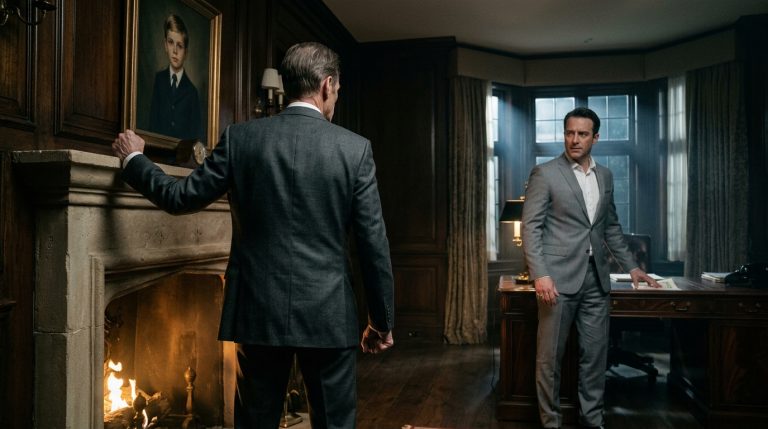
Caleb pushed the door to his father’s study open, the heavy brass handle cool and solid in his grip. The air inside was different—stagnant, thick with the scent of old paper and furniture wax. It was a space designed to intimidate, a shrine built to house the achievements of a man who equated existence with production.
He didn’t walk to the desk. He stayed in the doorway, letting his eyes adjust to the dim, amber light cast by a single shaded lamp.
The silence here was not the healing silence of the oak tree. It was a stifling, preserved quiet. He looked at the walls, at the framed magazine covers and the plaques of corporate acquisition. Before, he had seen these as the architecture of a god. Now, through the lens Clara May had forced him to adopt, he saw them as a desperate map of a man trying to convince himself that he had earned his place.
He moved toward the bookshelf, his footsteps muffled by the thick, ornate carpet. He reached for a small, unadorned frame near the bottom shelf—the one Clara had pointed out, the young Harrison standing in front of a ruined garage.
He took it off the shelf. Without the protective glass barrier, the photo felt fragile, almost crumbling. He studied the young Harrison. The boy was holding a jumble of wires and a circuit board, his posture awkward, his eyes searching for something that wasn’t in the frame. Caleb realized he had seen that same search in his father’s eyes just yesterday—not a look of triumph, but a look of intense, fearful hunger.
A sudden, jarring thought seized him: his father had not built this empire to be powerful. He had built it to be visible, because he was terrified that if he stopped moving, he would simply cease to exist.
A floorboard creaked in the hall. Caleb tensed, but he didn’t put the photo back. He kept it in his hand, feeling the weight of the moment. He walked to the desk, his gaze scanning the surface. There were no papers—Harrison kept a clean workspace, a testament to his obsession with order. But there, tucked into the side of the leather blotter, was a thin, navy-blue folder.
It wasn’t a corporate document. It was stamped with the Northwood Prep logo—an old, internal evaluation.
Caleb opened it, his fingers brushing against the crisp, heavy stock of the paper. It was his own file. He saw the dates, the scathing remarks, the dismissive comments from teachers who had long ago written him off. And then, he saw the final page.
It was a handwritten note, not from a teacher, but from his father.
“He is a hollow echo of the name. If he cannot be forged in the fire of competition, he will remain brittle. I cannot afford for him to break, but I do not know how to fix a flaw I created.”
The words hit Caleb with the force of a physical strike. His father hadn’t been attacking him; he had been mourning him. He had been so convinced that his own methods of “hardening” a person were the only way to ensure survival that he had been systematically destroying the very thing he wanted to protect.
Caleb felt a flicker of the old anger—the resentment toward the man who had turned his home into a training camp. But it didn’t ignite. It was doused by the sheer, pathetic reality of the admission. His father was just as trapped as he was, a man blinded by his own narrative, unable to see the son standing right in front of him.
He heard the heavy, deliberate thud of his father’s footsteps in the corridor.
Caleb didn’t put the folder back. He stood up, the navy-blue paper held in his hand, the old photograph of the garage still resting on the desk. He felt the phantom weight of the steam pipe in his hand from the kitchen, a reminder of the kitchen’s chaos, and he realized the study was exactly the same: a mess, just under a layer of expensive polish.
He didn’t hide. He didn’t retreat. He stood his ground, the silence of the room now his own, waiting for the door to open. He wasn’t the failing student who had walked into the study a month ago. He was the one who had finally opened his eyes to the architecture of the cage.
The door swung open, and Harrison Montgomery stepped in. His frame looked smaller in the dim light, the tailored suit hanging slightly loose. He froze when he saw Caleb, his eyes flickering toward the photo on the desk, then to the folder in Caleb’s hand.
For a heartbeat, the mask of the titan slipped. A flash of raw, human exhaustion crossed his father’s face—not anger, not judgment, just the look of a man who was tired of playing the part.
“Caleb,” he said, his voice flat, stripped of its usual, sharp demand.
“I saw the file,” Caleb replied, his voice calm, the resonance of the oak tree’s stillness keeping his heart rate steady. “I saw what you wrote.”
He held out the folder, but his father didn’t take it. He stood there, the distance between them feeling less like a room and more like an entire history of unspoken needs. Caleb realized then that the decoy was gone. The academic success, the grades, the school bus—it had never been the point. The point was the bridge. And he was the only one who could build it.
CHAPTER 5: THE WEIGHT OF THE TRUTH
Harrison Montgomery didn’t move. He stood, his hand frozen in mid-air, caught between reaching for the folder and turning away to hide the tremor in his fingers. The study, once a sanctuary of absolute order, now felt like a room where the air had been sucked out, leaving only a vacuum of raw, exposed history.
“You read it,” Harrison said, his voice a ghost of the man who commanded boardrooms.
“I read it,” Caleb confirmed. He placed the folder on the mahogany desk, the sound of paper hitting wood echoing like a gunshot. “You were right, Dad. I was brittle. But you were wrong about the cause. I wasn’t brittle because I lacked competition. I was brittle because I was being pressed into a shape that wasn’t mine.”
Harrison finally looked up. His gray eyes, usually sharp and piercing, were unfocused, darting over Caleb’s face as if searching for the boy who had once been there, only to find someone entirely foreign. “You speak with the confidence of someone who has nothing to lose.”
“I have everything to lose,” Caleb countered, stepping closer. The scent of furniture wax and old paper, once nauseating, now seemed like a strange, neutral environment. “I have the possibility of a real relationship with you. And I have the truth about why I was failing. You were trying to build a duplicate, not a son.”
Harrison sat down slowly, his movements stiff, as if his joints were made of rusted iron. He ignored the folder, staring instead at the old photo of the garage. “I grew up with a man who measured love in production quotas, Caleb. I thought if I pushed you hard enough, you’d find the core of that same drive. I didn’t want you to be soft. The world doesn’t reward soft people.”
“The world doesn’t reward people who refuse to see, either,” Caleb said, his voice softening, channeling the memory of the oak tree’s endurance. “You taught me that success is the only currency. But you never taught me how to manage the bankruptcy that comes when you’re wrong.”
The silence stretched. It was a volatile, fragile thing. Caleb felt a sudden surge of doubt—the V-4 variance shifting his perception. Was he actually accomplishing something, or was this just a new form of arrogance, another way to assert himself over his father? The doubt was a cold, acidic feeling in his stomach, but he didn’t let it pull him back. He stayed present, focusing on the texture of the desk, the cool polish under his fingertips.
“What do you want, Caleb?” Harrison asked, his voice barely audible.
“I want the truth about Northwood,” Caleb said, his focus sharpening. He thought of Clara May, of her mother, of the quiet dignity in their house. “I know this isn’t just about me. I’ve started to look at the school’s archives, the way the foundation funds are managed. There’s a pattern here—a way of creating scapegoats when the numbers don’t add up.”
Harrison flinched. The reaction was subtle—a tightening of the jaw, a slight narrowing of the eyes—but to Caleb, it was an illumination.
“You don’t want to go down this path,” Harrison said, his voice hardening back into the CEO’s tone. “The structures that hold this world together are built on compromise. If you start pulling at the threads, the entire thing might unravel.”
“Then maybe it’s time for a new weave,” Caleb said.
He didn’t wait for a rebuttal. He turned and walked to the door. He felt the weight of his father’s gaze on his back—a heavy, expectant pressure. He had planted the seed, but he knew the harvest wouldn’t be easy. The “Way of Seeing” was not just a tool for personal growth; it was a weapon for uncovering the rot in the very foundation of his life.
He walked out into the corridor, the lights flickering overhead. The path ahead wasn’t clear, but for the first time, it was his own. He wasn’t walking toward the next class or the next assignment. He was walking toward a confrontation, a reckoning that would force him to choose between the safety of the Montgomery name and the integrity of the truth Clara May had trusted him to find.
His phone, which he had finally been allowed to keep, buzzed in his pocket—a notification from an unknown sender. He didn’t check it. He kept walking, the rhythm of his own heartbeat the only guide he needed. The bridge was built, but it led into the dark.
CHAPTER 6: THE ARCHIVE OF LIES
The archives of Northwood Prep were located in the sub-basement of the science wing, a place where the air felt heavy and stagnant, smelling of wet concrete and long-forgotten paper. Caleb descended the concrete stairs, his footsteps echoing too loudly in the confined space. He didn’t have his father’s keys, but he had the lock-pick he’d fashioned from a spare set of wires he’d salvaged from the greenhouse’s irrigation system—a small, pragmatic improvisation that felt like a testament to Clara May’s influence.
He entered the room. Rows of towering metal shelves stretched into the gloom, packed with decades of student records, financial ledgers, and maintenance logs. The only light came from a single, flickering fluorescent tube that hummed with a low, electrical buzz.
He moved to the section marked Foundation Audit: 2020-2022.
His hands were steady as he began to sort through the folders. The paper was dry, brittle to the touch—faded textures of a past that had been meticulously buried. He wasn’t looking for a confession; people like the Montgomerys and the Jennings didn’t write confessions. He was looking for the dissonance—the numbers that didn’t balance, the dates that overlapped, the administrative “corrections” that smelled of desperation.
He found it in a folder buried behind a stack of property tax assessments. It was a ledger of private donations to the school, cross-referenced with a series of hardware procurement orders. The numbers were astronomical, far exceeding the cost of any actual science wing or facility upgrade.
He scanned the names. The payments were funneled through a shell company—a familiar name he recognized from his father’s own corporate records. It wasn’t just a simple case of embezzlement; it was a systemic laundering process, a way to move capital through the school to bypass SEC oversight.
As he worked, the V-1 variance manifested in a sudden, sharp sound—the rhythmic clack-clack-clack of a printer firing up in the adjacent, supposedly abandoned office.
Caleb froze. He dropped the folder, his heart hammering against his ribs. He crouched behind a rack of files, his breathing shallow. The sound stopped, replaced by the heavy, deliberate tread of shoes on concrete.
Someone was here.
He didn’t move. He watched through the gap in the shelving. A figure appeared at the far end of the row—a man in a dark suit, his face obscured by the shifting light of the flickering bulb. It was someone from the administrative office, someone he’d seen shaking hands with his father.
The man held a stack of papers and a small, portable burner phone. He wasn’t browsing; he was purging. He moved with a practiced, efficient cadence, pulling files from the shelf and tossing them into a heavy-duty shredder tucked into the corner.
Caleb felt a surge of cold, visceral fear. This was it. The “Way of Seeing” wasn’t just about understanding the world; it was about realizing that some people were actively trying to keep it blind. He felt his resolve fracture. The weight of what he was doing—the sheer, dangerous magnitude of the conspiracy—made his head spin. He was just a boy, an heir with a new perspective, standing against a machine that had been churning since before he was born.
He saw the man pull a familiar navy-blue folder from the shelf. The same series as his own.
The man paused, looking at the label, and for a moment, he looked directly toward Caleb’s hiding spot. Caleb pressed himself into the cold metal of the shelf, the vibration of the shredder’s motor humming through his bones.
He realized then that he couldn’t just walk away. If he left now, the evidence would be gone, and the cycle of corruption would remain unbroken. But if he stayed, if he made a move, he was committing to a path that had no turning back.
He glanced at his phone—no signal. He was alone, in the dark, with a man who was clearly prepared to do whatever was necessary to keep the books balanced.
He didn’t wait for the man to move closer. He reached into his bag, pulling out the small, heavy flashlight he’d brought—a tool for illumination, now a potential defensive asset. He waited for the man to turn his back, to lean into the shredder’s bin.
The rhythm of the machine was his cover. He moved, his boots silent on the concrete, his body low, his mind focused not on the danger, but on the pattern of the man’s movement. He was the architect of his own survival now. He felt the cold air of the basement on his face, the grit of the archive dust in his throat, and he knew, with a sudden, sharp clarity, that the “Kintsugi” of his life—the repairing of his own broken edges—had brought him to this exact moment.
He was not a child of privilege anymore. He was a witness. And the witness was about to speak.
CHAPTER 7: THE SHATTERED FACADE
The shredder’s motor groaned, a low, mechanical growl that seemed to vibrate through the concrete floor. Caleb held his breath, his knuckles white around the flashlight, his mind racing through the calculations he’d learned in the garden and the kitchen. He knew the man in the suit; he was Marcus Thorne, the Northwood Administrator, a man who built his entire reputation on the polished surface of academic excellence.
Thorne turned, his eyes narrowing as he caught the glint of the flashlight in the gloom. He didn’t look like a perpetrator; he looked like a man annoyed by a minor inconvenience.
“Mr. Montgomery,” Thorne said, his voice smooth, professional, and entirely devoid of fear. “I assume you’re lost. The student wing is on the upper level.”
Caleb stepped out from the shadows. The flashlight beam cut through the dusty air, a harsh white line that illuminated the stacks of shredded paper at Thorne’s feet. “I’m not lost, Marcus. I think I found exactly what you’re trying to erase.”
Thorne didn’t flinch. He slowly set the burner phone down on a shelf, his movements unhurried. “You think you’ve discovered something grand, don’t you? A little rebellion against the establishment? Your father is a pragmatist, Caleb. He understands that for a structure to stand, there must be a foundation. And foundations, by their very nature, are dirty.”
“Foundations aren’t dirty,” Caleb said, his voice rising, steady and resonant. “They’re just hidden. But what you’re doing? This is just rot.”
Thorne moved with surprising speed. He lunged for the file still sitting on the desk, but Caleb was faster. He didn’t fight—he didn’t try to tackle the man or engage in the kind of physical clash he’d seen in movies. He moved around him, his training from the garden—the Way of Seeing—allowing him to predict the man’s trajectory. He grabbed the folder and sprinted for the stairs.
“You won’t get far!” Thorne shouted, his voice echoing off the concrete walls.
Caleb scrambled up the stairs, the air in his lungs burning. He burst through the basement door into the main corridor of the science wing. It was late; the halls were empty, the light from the overhead tubes flickering in long, distorted rows.
He didn’t head for the exit. He headed for the main terminal in the registrar’s office. If he could upload the evidence to the public server, the truth would be immutable.
He reached the office, slammed the door, and locked it. His hands were shaking now, the adrenaline of the basement finally giving way to a bone-deep exhaustion. He shoved the folder into the scanner, his fingers fumbling with the controls.
Then, the door handle rattled. A heavy, insistent thud.
Caleb looked up. Through the frosted glass of the office door, he saw a shadow—a familiar silhouette. It wasn’t Thorne. It was his father, Harrison Montgomery.
He unlocked the door. Harrison stood there, his coat dusted with snow, his face pale and unyielding. Thorne was behind him, looking smug and composed.
“Caleb,” Harrison said, his gaze fixed on the folder. “Stop this.”
“I can’t, Dad,” Caleb said, his voice cracking, but his eyes were clear. “I saw what Thorne did. I saw how he used the system to destroy people like Susan’s brother. And I saw that you let him.”
Harrison looked at Thorne, then back to his son. The silence in the office was absolute. The V-2 variance hit him—a sudden, piercing memory of the young Harrison in the garage, the man who had traded his integrity for a seat at the table, thinking it was the only way to stay alive.
Harrison stepped into the room, his shadow stretching across the floor. He walked past Thorne, ignoring the administrator’s protest. He looked at the folder, then at the scanner. He reached out, his hand hovering over the power button.
“If you do this,” Harrison said, his voice a low, jagged whisper, “everything we have—the house, the company, the legacy—it will be exposed. They will tear us apart.”
“Maybe it needs to be torn apart,” Caleb replied.
He didn’t flinch. He didn’t blink. He reached out and pressed the button. The scanner began to hum, the document feed pulling the evidence into the digital ether.
Harrison didn’t stop him. For a long, agonizing moment, he just watched the light of the scanner pulse, a rhythm of light and shadow, the steady, unavoidable heartbeat of the truth. Thorne reached for the machine, his face twisted in a mask of fury, but Harrison caught his arm.
The grip was iron. “Leave him,” Harrison said, his voice empty of all power, all ambition, all ego.
As the upload bar crawled toward completion, Caleb felt the world shift. The facade hadn’t just cracked; it had disintegrated. He looked at his father—really looked at him—and saw not a titan, but a man finally standing in the light, the darkness of his own choices laid bare. The price of the truth was everything. And as the computer screen flashed “Upload Complete,” Caleb knew he had never owned anything more valuable.
CHAPTER 8: THE GARDEN AT DUSK
The monitor flickered, the “Upload Complete” text glowing with an eerie, steady blue light that reflected in Harrison Montgomery’s eyes. He didn’t turn away. He didn’t try to shut down the system. He stood perfectly still, his hands resting on the back of a leather chair, his knuckles white. The titan who had built an empire on rigid, uncompromising walls watched as those walls were dismantled by his own son.
“It’s done,” Caleb whispered. His voice didn’t shake. He felt a profound, aching lightness in his chest.
Thorne, who had been hovering near the door, opened his mouth to protest, but the words died in his throat. He looked at Harrison, seeking the familiar mask of corporate resolve, but found only a man who had finally put down a heavy, invisible burden. Thorne turned and left, his footsteps muted as he retreated from the ruin of the conspiracy he had orchestrated. He wouldn’t be back. There was nothing left to salvage.
Harrison walked to the window. Outside, the sky was deepening into a bruised purple, the first stars beginning to prick through the twilight. “You didn’t just upload files, Caleb,” he said, not looking back. “You exposed the mechanism. The foundation I built was never just money. It was fear. Fear of being small, fear of being forgotten. I thought if I kept enough people in my debt, I would never have to be small again.”
“You weren’t small,” Caleb said, walking to stand beside him. “You were just alone.”
The confession hung in the air, stripped of the usual, transactional nature of their conversations. Harrison turned, and for the first time, he didn’t look at Caleb as an heir or a liability. He looked at him as a person. He reached out, his hand hesitating for a moment before resting on Caleb’s shoulder. It was a heavy, awkward gesture, one that carried the history of seventeen years of silence, but it was real.
“What happens now?” Harrison asked.
“We face it,” Caleb said. “The news, the fallout, the restructuring. We don’t hide behind the lawyers or the shell companies. We admit what happened, we clear the names of the people who were used as scapegoats, and we start over. Not as a dynasty, but as a company that does work.”
Harrison nodded, a slow, deliberate movement. The poetic justice was undeniable—the man who had spent his life controlling the narrative was now at the mercy of the one he had inadvertently created by trying to force his son into his own image.
Over the following weeks, the house changed. The staff didn’t move like ghosts anymore. The tension that had once been a physical weight in the hallways dissipated, replaced by a quiet, steady rhythm of repair. The lawsuits were settled, the public apologies were made, and the Montgomery Foundation underwent a radical, transparent overhaul.
Caleb spent his afternoons in the garden with Clara May. They didn’t talk about the corporate restructuring or the shifting headlines. They talked about the garden, about the way the soil needed to be turned, about the cycles of growth and decay. He found himself repairing the things he had ignored—the old stone fountain that had been left to crumble, the trellises that had sagged under the weight of neglected roses.
He took the small, weathered trowel—the one Clara had given him—and worked at the earth until his hands were rough and calloused. It was the “Cool Down,” a period of settling that felt like peace. The manor was still grand, still wealthy, but it felt less like a prison and more like a home.
One evening, as the sun began to dip behind the hills, painting the lawn in long, golden strokes, Caleb found his father sitting on the porch. He was holding a book—not a financial report or a strategic manual, but a simple, worn copy of the same Roman philosophy book Clara May had shown him in the library.
Caleb sat beside him, the scent of lavender and damp grass filling the air. He didn’t reach for his phone. He didn’t check the news. He just looked out at the garden, at the tiny, intricate life that continued to thrive, completely indifferent to the chaos of the world beyond the gates.
“I didn’t think it would be this quiet,” Harrison said, his voice softer than Caleb had ever heard it.
“Quiet is where you hear the things that matter,” Caleb replied.
He leaned back, watching a bird return to the nest in the oak tree. The cycle was complete. The “Way of Seeing” had been passed from the sergeant to the granddaughter, from the granddaughter to the heir, and finally, from the heir to the father. He had replaced the iron cage of his inheritance with a garden of his own making, and for the first time, he was not the heir to a fortune. He was the author of his own story.
The house stood tall in the dusk, no longer a monument to ambition, but a sanctuary of endurance. The secret was out, the truth was settled, and for the first time in his life, Caleb Montgomery didn’t want to be anywhere else.