A Father’s Architecture of Retribution: Dismantling the Beige Kingdom, One Bylaw at a Time
CHAPTER 1: The Clubhouse Confrontation
The smell of the Harmony Creek community clubhouse was a potent mixture of industrial-grade floor wax and the lingering, stale aroma of burnt coffee. It was a sterile, beige purgatory. I watched Karen Miller’s face as she stared at the schematics I’d laid out on the folding table. My hands, calloused and steady, didn’t tremble. I had built bridges in war zones; I knew how to hold a position.
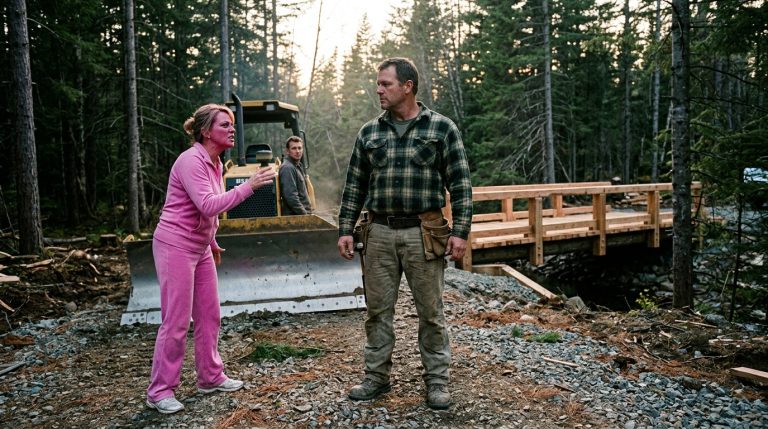
“Mr. Riley,” Karen said, her voice dropping into a tone of practiced condescension. She didn’t bother to look at the photos of the treehouse. She simply pushed them aside with one manicured finger, as if they were trash. “We aren’t here to discuss engineering. We are here to discuss compliance. The board has already reached a decision regarding the ‘aerial platform.’ It is non-compliant. Period.”
The two men beside her leaned in, their expressions synchronized in that same dismissive, smug mask. They were soldiers in her tiny army, trained to reinforce the perimeter of her beige kingdom.
“The covenants require approval for permanent structures,” I said, keeping my voice level, though beneath my skin, that cold fire was beginning to burn brighter. “My schematics demonstrate that this structure is load-balanced, modular, and detachable. It is, by every definition of the word, a recreational assembly, not a permanent building. You have no legal basis for this demand.”
“I am the president of this association,” Karen snapped, her eyes narrowing. She tapped a heavy, gold-plated pen against the table, the metallic clicking rhythmic and irritating. “And I say it is a permanent structure because it is anchored to an oak tree that has stood for eighty years. It changes the footprint of your lot. It is a blight. It diminishes the aesthetic integrity of this entire block.”
I noticed something then, a small detail that didn’t fit the picture she was trying to paint. As she shuffled a stack of papers to reach for the ‘Notice of Violation,’ I saw a signature at the bottom of the board’s minutes from the previous week. It wasn’t just hers. It was a stylized, jagged initial I recognized from a project file I’d seen in a real estate trade magazine—the signature of a commercial developer currently eyeing the expansion of the industrial park three miles over.
Why would a corporate developer be signing off on an HOA playhouse dispute?
“You’re quoting the aesthetic clause, Karen,” I said, leaning in. I didn’t raise my voice. I didn’t need to. I watched the way her pulse jumped at the base of her throat. “But Article 12, Section 9 clearly states that no enforcement action can be taken without a majority vote of the five-member board. There are only four of you sitting at this table. Where is the fifth?”
The silence in the room suddenly turned absolute. One of the men sitting beside her shifted in his chair, his eyes darting toward the exit. Karen’s smirk faltered for the first time, and the granite in her eyes seemed to crack. She reached for the microphone to drown me out, but the system let out a piercing, high-pitched screech of feedback that forced everyone in the room to wince and cover their ears.
In that moment of chaotic noise, I saw her hand dive into her purse and pull out a sleek, modern smartphone, her thumb hovering over a text message thread that had nothing to do with lawn maintenance.
CHAPTER 2: The Paper Trail
The feedback died down, but the vibration remained in the hollows of my teeth. Around the room, the other residents shifted uncomfortably, their eyes darting between me and the board. I didn’t look at them. I kept my gaze locked on the gold-plated pen in Karen’s hand. Her knuckles were white, her grip so tight it looked painful.
“The fifth seat is currently vacant, Mr. Riley,” she said, her voice strained, the veneer of command fracturing. “And your pedantry regarding procedural nuance does not alter the fact that your structure is a violation of the community’s aesthetic standard. We are done here.”
She stood up, the chair scraping sharply against the linoleum—a sound that pulled me back to a site in Kandahar, a half-finished bridge, a mistake in the schematics that had nearly cost a convoy their lives. I remembered that cold, sinking feeling of realizing the foundation was wrong before the first pillar was ever poured. My mind flickered to the signature on the document I’d seen: J. Sterling.
I didn’t argue. I didn’t raise my voice. I simply leaned forward, gathered my schematics, and slid them into my leather folio. I knew exactly what she was: she was a guard dog who had forgotten who the master was.
“I’ll expect the official minutes of this meeting by morning, Karen,” I said, my tone flat, stripped of all emotion. “Including the notation of the missing board member and the record of my formal appeal.”
I walked out of the clubhouse without looking back. The transition from the air-conditioned, sterile interior to the humid Florida night felt like walking into a steam box. My truck was parked at the far edge of the lot, a shadow against the manicured hedges. As I walked, the smell of damp earth and blooming jasmine hung heavy, but underneath it, I caught the faint, metallic scent of ozone—the smell of a storm front moving in, or perhaps just the lingering charge from the clubhouse electronics.
Once I was behind the wheel, I didn’t start the engine immediately. I opened my folio and pulled out the printout of the board minutes I had managed to pull from the HOA portal earlier that week. I turned on the interior light, the yellow glow reflecting off the paper. I traced the jagged ‘J. Sterling’ signature with my thumb. My pulse was steady, counting off the seconds like a metronome.
I was an engineer. I didn’t deal in gossip or neighborhood politics; I dealt in load-bearing realities. If Karen Miller was working for a developer, the treehouse wasn’t the target. It was the probe. They were testing the perimeter, seeing how much pushback they’d get before they moved to the real objective: the land itself.
The weight of the house on my back, the years of savings, the peace I’d promised Sarah and Leo—it all rested on the integrity of the ground beneath us. If there was a sinkhole in the moral foundation of this neighborhood, I needed to find the edges of it before it collapsed.
I started the truck, the engine turning over with a low, reliable rumble. As I pulled out of the parking lot, my headlights swept across the clubhouse exit, catching a black sedan idling in the shadows. It wasn’t Karen’s beige monstrosity. It was something darker, something newer. As I passed, the driver didn’t look my way, but I saw the glow of a cigarette ember, a tiny, burning star in the dark.
I didn’t turn toward home. I took the turn toward the public library, the only place where the municipal records—the real property deeds and the incorporation papers for the developer—would still be accessible to a civilian. I needed to see the original land acquisition survey for Harmony Creek. If I was going to fight this, I needed to know exactly who owned the dirt beneath my feet, and more importantly, how they had managed to sew themselves into the very fabric of our HOA.
The road ahead was empty, the streetlights flickering in a rhythmic sequence that felt too deliberate. I gripped the steering wheel, the leather cool and firm under my palms. I was no longer an observer of the local rules; I was a saboteur of the system. Karen Miller thought she was the hammer. She had no idea she was about to be dismantled by the very blueprints she’d tried to ignore.
CHAPTER 3: The Neighborhood Canvas
The library air was filtered, stale, and unnervingly quiet. I sat at a partitioned oak desk, the wood scarred by decades of student frustration. Before me lay the original plat map of Harmony Creek, a large, yellowing sheet of vellum that felt like brittle skin under my fingertips. I didn’t rush. I’d spent my career understanding that the most catastrophic structural failures weren’t caused by sudden impacts, but by slow, overlooked stress fractures.
I unfolded the map. The subdivision layout was precise, a grid of cul-de-sacs and carefully delineated parcels. I tracked the lot numbers until I reached 412 Live Oak Lane. Then, I began to backtrack. I followed the chain of ownership through the archives, pulling original incorporation documents and subsequent deed transfers from the county records.
My suspicion had been a spark in the dark; now, as the names emerged, it was becoming a steady flame.
Harmony Creek wasn’t just a neighborhood; it was a shell corporation. The initial land purchase had been brokered by a holding company called ‘Apex Horizon LLC.’ I recognized the name—it was a subsidiary of the very commercial developer whose logo I’d mentally tagged back at the clubhouse. As I cross-referenced the dates, the timeline became clear. The HOA covenants weren’t designed for community maintenance. They were a sophisticated mechanism for attrition. By imposing impossible standards, the board could force out original owners who lacked the resources for endless legal battles, allowing the developer to buy up adjacent lots at pennies on the dollar, eventually consolidating enough land for their high-density project.
I checked the signature again on the incorporation papers for Apex Horizon. It was a clean, professional script—no jagged initials here. But when I looked at the notary stamp on the original HOA formation document, I saw it: the same signature I’d seen in the clubhouse minutes.
Karen Miller wasn’t just a neighbor playing queen. She was an employee.
I closed the ledger. The sound was a dull thud that seemed to echo through the empty aisles of the library. My hands were steady, but the cold fire in my gut had sharpened into a focused, clinical rage. I didn’t need to shout, and I didn’t need to throw a punch. I just needed to start turning the lights on.
I walked out of the library, the automatic doors sliding open with a smooth, whisper-quiet efficiency that felt entirely too clean. The night air was heavy with the scent of ozone—the storm was getting closer. I pulled my phone out and started a contact list. Not of friends, but of names I’d overheard, seen on mailboxes, or read about in local news blurbs—the ‘retired retirees’ who hated the pool rules, the young couple who were constantly being fined for having a ‘non-approved’ bicycle trailer.
I needed an alliance. Not one based on friendship, but on shared interest.
As I drove toward home, I passed the local coffee shop, the ‘Daily Grind,’ a place where the morning crowd gathered to complain about the HOA. I pulled into the lot. I didn’t have a plan to save the neighborhood—that would come later. Right now, I just needed to seed the ground. I grabbed a pen and a notepad from my passenger seat and started drafting a flyer. No emotional appeals. No talk of ‘castle’ or ‘childhood.’
Just facts: The HOA board had been operating with a vacant seat for three months in direct violation of the bylaws. They were utilizing funds from the ‘maintenance reserve’ for administrative expenses that were never disclosed in the annual audit. And there was a direct legal link between our HOA president and a developer seeking to rezone our land.
I finished the draft and looked at it. It was clean, dry, and damaging.
My phone vibrated in the cup holder. A message from Sarah: Leo is worried. He asked if the treehouse will still be there tomorrow.
I looked up at the dark sky. The first few drops of rain hit my windshield, large and heavy, creating tiny, distorted lenses through which the world seemed fragmented.
“It’ll be there,” I whispered to the empty cab.
I put the truck in gear and headed home, but not to sleep. I spent the next three hours in my garage, working under the harsh glow of the hanging shop lights. I didn’t work on the treehouse. Instead, I started cataloging every ‘non-compliant’ item in the neighborhood—the slightly-off-shade garden gnomes, the rusted mailbox flags, the unapproved paint colors on the garage doors.
If Karen Miller wanted a war of compliance, she was going to have one. I wasn’t just going to defend my treehouse; I was going to provide every single resident in Harmony Creek with the ammunition they needed to hold the board to the exact, agonizing standard they had forced upon me. I was building a barricade of bureaucracy, and by the time I was finished, the board wouldn’t have enough time in the day to enforce a single rule without tripping over their own broken regulations.
The storm broke then, rain lashing against the garage door in a rhythmic, violent cadence. I stepped back, looking at my list, feeling the weight of the work. This wasn’t about the wood and nails of the treehouse anymore. It was about the integrity of the whole structure. And as I turned off the shop lights, leaving the garage in shadow, I knew the board had no idea what kind of pressure they had just applied.
CHAPTER 4: The Bylaw Loophole
The morning mist clung to the lawns of Harmony Creek like a shroud, dampening the sound of my truck as I idled in front of the Miller residence. It was a standard, two-story model, just like mine, but the facade was perfectly, aggressively beige. I sat there, the engine ticking as it cooled, and watched.
My list—the one I’d compiled in the garage—sat on the passenger seat. I wasn’t here to harass Karen; I was here to map the terrain. Every violation I found, every deviation from the neighborhood’s own “Code of Aesthetics,” was a leverage point. And the neighborhood was full of them, provided you knew how to look through the eyes of an engineer.
I stepped out of the truck, the morning air biting at my skin. I moved toward the corner house, the one owned by the Henderson family. They’d been fined twice in the last month for having a “non-conforming” mailbox post. I walked up to the edge of their lawn, my eyes tracking the line of sight from the street to the house. There it was: a drainage pipe, tucked subtly behind a row of boxwoods. It was an extension, likely installed to fix a chronic flooding issue caused by the HOA’s own poorly graded swales.
Technically, any modification to the exterior drainage required ARC approval. It was an unauthorized structure. If the HOA wanted to play by the book, this was the first page they’d have to write on.
I took a picture, the shutter click muted by the distant sound of a lawnmower. I didn’t feel like a villain. I felt like a surveyor, documenting the rot in a structure that had been allowed to fester.
A shadow moved in the window of the house across the street. I recognized the silhouette: Mr. Abernathy, a man who had lived in Harmony Creek since the ground was broken. He was a retired professor of logistics, and he had been, until recently, the most vocal proponent of the board’s “fiscal responsibility.” I walked over to his driveway, my movements measured and calm. He came to the door before I even knocked, his eyes narrow and suspicious.
“Riley,” he said, his voice a dry rasp. “I heard about the clubhouse. You made a scene.”
“I made a record, Mr. Abernathy,” I replied, standing on his porch with my hands buried in my jacket pockets to keep them from clenching. “The record is important because the board isn’t just enforcing rules. They’re managing a liquidation.”
He scoffed, but he didn’t pull away. He looked at the folder I held—the one containing the incorporation documents for Apex Horizon LLC. I didn’t hand it to him. I just let him see the logo, the one that matched the signature on the clubhouse minutes.
“The HOA doesn’t have a surplus,” I said, my voice low. “They have an operational deficit, and they’re using our fines to bridge the gap until the developer can trigger the zoning change for the north lot. Once that goes through, your property value isn’t going to rise—it’s going to be annexed by an industrial park. And the treehouse? It’s just a distraction. A way to get me to waste my time and money fighting a battle that doesn’t matter, while they prepare the foundation for the real project.”
Abernathy went still. The skepticism in his face didn’t vanish, but it shifted, turning into a cold, academic interest. He looked at the folder, then at me. “You’re an engineer, Riley. You’re telling me this is a structural issue?”
“I’m telling you the foundation is cracked, and the people holding the flashlight are the ones who put the pickaxe to the concrete,” I said. “I’m not asking for your help to save my treehouse. I’m asking for your help to audit the board’s books. If we find the transfer history, we can file an injunction. We can freeze the board’s assets and force an emergency election. We stop the bleeding, or we watch the whole community get paved over.”
He leaned against the doorframe, his gaze drifting toward the clubhouse in the distance. He was a man who spent his life thinking in systems, and the system I was describing was starting to make a terrifying amount of sense to him.
“I have the old ledger,” he said softly, his eyes finally meeting mine. “The one from when the HOA was first formed. I kept it because I didn’t trust the transition board, but I never had a reason to look until now. If you’re right… if the land acquisition was a set-up…”
“Then the bylaws aren’t laws,” I finished for him. “They’re a paper cage. And I have the tools to pick the lock.”
He nodded, a sharp, decisive movement. “Come inside. Let’s look at the original survey.”
As I stepped across the threshold, I felt the familiar weight of a project beginning to take shape. I wasn’t fighting Karen anymore. I was fighting the architecture of a lie. And for the first time since this started, I could see the stress points where the entire structure was destined to fail.
The rain began to fall in earnest, a steady, rhythmic drumming against the roof that sounded like the ticking of a clock. Time was running out, but for the first time, I felt like I was the one holding the watch.
CHAPTER 5: The Unexpected Guest
The house plunged into absolute shadow. For a heartbeat, there was only the sound of rain hammering against the shingles and the sharp, intake of breath from Abernathy beside me. I didn’t reach for my phone; I stayed still, letting my eyes adjust to the absence of light. In the military, you learned to map a room by the sound of its inhabitants, but here, the silence was different. It was heavy, weighted with the secrets we had just unearthed from the 1990s incorporation files.
“Stay here,” I said, my voice barely a whisper. I moved toward the kitchen, guided by the familiar layout of these floor plans—every house in Harmony Creek was a mirror of another. My hand found the wall, the cool, smooth texture of the drywall beneath my fingertips, until I hit the edge of the granite countertop.
The power flicker hadn’t been a surge; it had been a systematic kill. The streetlights outside, which had been flickering earlier, were now dead. The entire block was a black hole.
I crept toward the window, peering through the blinds. The rain was torrential now, turning the street into a dark, swirling river. A vehicle was idling near the curb, its lights off, but I could make out the silhouette—the same black sedan I had seen outside the library. It wasn’t just patrolling; it was waiting.
I retreated back into the living room, my boots silent on the carpet. “We’ve been flagged,” I said, catching Abernathy’s eye in the dim ambient light of a distant lightning flash.
He didn’t panic. He was a man of logistics, and he moved with a deliberate, terrifying calm. He crossed to a heavy oak bureau and pulled out a small, portable ledger—a secondary record of HOA payments that never made it into the official database. “If they know we have this,” he said, tapping the spine, “they don’t want to enforce a rule. They want to bury the evidence.”
The doorbell rang—a long, persistent chime that didn’t sound like a neighbor. It was a rhythmic, calculated pressure.
I gestured for Abernathy to stay back, moving toward the entryway. I wasn’t an intruder in my own neighborhood, but the tension in my muscles was that of a man preparing for a breach. I checked the peephole. Outside, standing on the porch, was a man in a high-visibility rain jacket, his face partially obscured by the brim of a cap. He wasn’t a resident. He held a clipboard, his posture stiff, the classic “official business” stance that provided the perfect cover.
I opened the door, just a crack, the safety chain taut. “We’re closed for the night.”
The man looked up, his eyes meeting mine. They were calm, utterly devoid of the frantic energy that defined people like Karen. “Mr. Riley. I’m with the utility company. We had a reported breach in the primary junction box near 412. I need to verify if your surge protection was bypassed during the power failure.”
He was good. The terminology was designed to sound authoritative, a logic loop to force me to open the door and invite him in to ‘assess the damage.’
“I didn’t report an outage,” I said, my voice cold. “And I don’t recall seeing a service truck. You’re parked at the curb, not the service easement.”
He didn’t flinch. He didn’t even blink. He just adjusted his grip on the clipboard, and for a second, I saw the edge of a document peeking out from behind the cover—not a work order, but a parcel map of our subdivision. “The outage is neighborhood-wide, sir. We’re doing a proactive sweep. If you don’t allow access, we’ll have to mark the property for a mandatory inspection tomorrow morning.”
The threat was implicit. A ‘mandatory inspection’ was the HOA’s nuclear option—the way they bypassed the ‘homeowner privacy’ clause to enter a property and ‘remediate’ violations on their own terms.
“Come back when you have a permit and a supervisor,” I said, and I closed the door. I didn’t wait for his reaction. I locked it, slid the bolt, and turned back to Abernathy.
“They’re moving faster than I anticipated,” I said, my mind already running the calculations. “They aren’t playing by the HOA manual anymore. They’re moving into open intimidation.”
Abernathy looked at the ledger in his hands, then at the door. “If they’re willing to use ‘utility’ cover to get inside, what are they hiding in the books, Jack?”
“Something that makes the treehouse a footnote,” I said. I pulled my phone out, the screen glowing in the dark, and checked the encrypted file I’d started building—a list of every resident who had been pressured by the board. It was time to switch from defense to offensive data collection. We didn’t need to fight them at the door; we needed to expose the architecture of their influence before they could tear the roof off our homes.
I looked at the window again. The sedan was still there. They were waiting, watching, and counting on our fear to keep us compliant. But they had made a fatal error in their assessment: they assumed we were just homeowners. They didn’t realize they were dealing with an engineer who understood exactly how to make a structure collapse by pulling the right support beam.
“Get your boots on,” I said, my voice steady. “We aren’t staying here. If they want to inspect the neighborhood, let’s give them something to look for.”
CHAPTER 6: The Cracks in the Mask
The rain had tapered to a fine, relentless mist that clung to the windows of my truck. Beside me, Abernathy was unnervingly quiet, his hands resting on the leather-bound ledger as if it were a shield. We were parked three streets over from the clubhouse, tucked behind a thick row of pines. This was the ‘administrative’ sector of Harmony Creek—the homes where the board members lived, separated from the rest of us by wider driveways and manicured, silent lawns.
“If we’re going to force a quorum,” Abernathy said, breaking the silence, “we need the proxies. But the board has been systematically gathering them for months. They own the majority by default.”
“Not if the proxies are invalid,” I replied. I was watching the Miller residence through the gaps in the trees. Karen was pacing her living room, her silhouette illuminated by the glow of a laptop screen. She wasn’t just working; she was frantic. I could see the way she clutched her hair, the sharp, angular movements of someone whose structure was beginning to fail under pressure. “Proxy votes are only valid if they’re notarized against the current covenant rules. If I can prove that the board’s recent amendments were never properly filed with the county—which I suspect they weren’t—the entire foundation of their authority vanishes.”
I pulled out my tablet, the screen dimmed to the lowest setting. I had been cross-referencing the county clerk’s records for the last two hours. There was a glaring discrepancy: the ‘2026 Amendment to Article 7’ that gave the board such sweeping, arbitrary power over ‘aerial structures’ and ‘community aesthetics’ was missing the mandatory clerk’s seal. It was a phantom rule, a piece of paper with no legal weight that they had been using to terrify the residents.
“She’s scared,” I said, pointing to the window.
“She’s a puppet, Jack,” Abernathy corrected, his voice weary. “Look at the car.”
A dark sedan had pulled up to the Miller driveway. It was the same one I’d seen at the library. A man stepped out—not the ‘utility worker’ from earlier, but someone wearing a sharp, charcoal-gray suit that looked entirely out of place against the backdrop of our mundane, taupe-colored suburb. He didn’t carry a clipboard. He carried a leather briefcase, the kind that held heavy decisions.
The sight triggered a sharp, cold spike of adrenaline in my chest. I felt my grip tighten on the steering wheel, my knuckles turning white. This was the moment where the ‘neighborhood dispute’ bled into something far more clinical. The developer wasn’t sending a fixer to handle the HOA; they were sending a closer to finalize the transition.
I watched them interact through the glass. Karen stood by the door, her posture brittle, almost pleading. The man in the gray suit didn’t look at her; he simply pointed toward the street, toward my house—or rather, toward the section of the map where my lot sat. He was giving instructions, and Karen was accepting them like a subordinate receiving a combat order.
My pulse began to hammer in my ears, a rhythmic, driving beat. I saw my own reflection in the window, but it didn’t look like mine anymore. It looked like the man I was before I retired—the one who saw the world in terms of structural integrity and sabotage.
“They’re going to trigger the annexation move tomorrow at the emergency meeting,” I said, my voice dropping to a dangerous, low register. “They think that if they present a ‘unanimous’ board vote, the county will rubber-stamp the zoning change.”
“We can’t stop them at the meeting,” Abernathy said, his gaze fixed on the man in the suit. “They have the security, the proxies, and the legal team.”
“We don’t need to stop them at the meeting,” I said, my decision forming with the hard, cold finality of poured concrete. “We need to expose the illegality of the board before they even walk through those doors. If the board is compromised, the vote is invalid.”
I put the truck in gear, but I didn’t head for home. I headed for the main entrance of the subdivision—the site of the massive, stone-clad ‘Harmony Creek’ monument. It was the heart of our community, the place where the HOA spent thousands in landscaping fees to maintain an illusion of grandeur.
“What are you doing?” Abernathy asked, his voice tight.
“I’m finding the crack,” I said. “If I can prove that the development company has been using HOA funds to subsidize their own land acquisition, we don’t just have a bylaw dispute. We have a fraud case. And fraud isn’t something you can handle with a clipboard and a beige sedan.”
As we drove, the neighborhood seemed to shift around me. The quiet, manicured streets felt like a stage set—a painted backdrop that was beginning to peel away to reveal the raw, rusted iron of the greed underneath. My hands didn’t shake. I was an engineer. I knew that the best way to bring down a structure wasn’t to push against the walls; it was to remove the primary support. And right now, Karen Miller was the only thing holding up the facade.
The rain intensified, a curtain of gray that obscured everything except the path ahead. I was moving toward a failure point, and for the first time in months, I felt perfectly at peace with the destruction to come.
CHAPTER 7: The Quorum of Shadows
The clubhouse was bathed in the harsh, flickering glare of emergency work lights. Rain lashed against the large glass windows, distorted by the wind, making the interior look like a submarine submerged in a turbulent, dark sea. I stepped out of the truck, the cold air hitting me like a physical blow. Beside me, Abernathy clutched the ledger to his chest, his face set in a grim, tight line.
“There’s only one way into the main meeting room,” I said, my voice barely audible over the gale. “The security door is electronic, keyed to the board’s master fob. If they know we’re coming, they’ll have already locked the system.”
“Then we don’t go through the door,” Abernathy replied, his eyes scanning the building’s exterior. He pointed to a service hatch near the pool pump room—an old, rusted access point that hadn’t been updated since the neighborhood was built. “That leads to the HVAC crawlspace. It’s tight, but it vents directly into the ceiling plenum above the board room.”
I nodded. It was a classic engineering oversight: a service route designed for efficiency that had become a structural vulnerability.
We moved low along the side of the building, the mud slick under our boots. Every shadow seemed to stretch and pulse with the wind, and for a terrifying second, I felt the phantom weight of the bridge I’d once designed, the one that had buckled under the weight of unforeseen structural stress. I pushed the memory down, focusing on the cold, biting reality of the task. We reached the hatch, and I pulled a heavy-duty screwdriver from my belt—the same tool I’d used to finish the treehouse. The screws turned with a groan of oxidized metal, and the hatch swung open, exhaling a puff of damp, stale air.
The climb was grueling, a crawl through tight, dust-choked space where the only light came from the occasional flash of lightning outside. We moved in silence, the rhythm of our breathing synchronized with the heavy pounding of the storm above us. Finally, I reached the grate that overlooked the board room.
I carefully unlatched the vent cover and shifted it, creating a narrow, unobstructed view of the room below.
It was a stark contrast to the chaos outside. The board room was bright, quiet, and occupied. Karen Miller sat at the head of the long folding table, her face pale, her movements jittery. To her right sat the man from the charcoal-gray suit—the fixer—and flanking them were the two men I’d seen earlier, their faces set in stone. They weren’t discussing lawn maintenance. They were reviewing a set of high-density zoning maps, the colors stark and final against the beige tabletop.
“Look at the ledger,” Abernathy hissed in my ear.
I looked. The man in the suit was sliding a check—a cashier’s check—across the table toward Karen. It wasn’t a donation to the HOA. It was a private payout, the sort that didn’t appear in public filings. Karen stared at the check, her hand hovering over it, but she didn’t pick it up. She looked sick.
“Everything is prepared, Karen,” the man in the suit said, his voice crisp and devoid of emotion. “The emergency motion will be moved, seconded, and passed within five minutes of the meeting start. We have enough proxies to ensure there is no dissent. You just need to ensure the minutes are certified by the end of the night.”
“The residents… they’re going to realize what’s happening once the bulldozers arrive,” Karen whispered.
“The residents are irrelevant,” the man replied. “By the time they realize the legal shift in land designation, the developer will have already broken ground. You’ve done your part. Sign the papers, take the payout, and leave the logistics to us.”
The room seemed to tilt. The decoy secret—that this was just a dispute over power—shattered instantly, replaced by the jagged, ugly truth. They weren’t just manipulating the neighborhood; they were stealing it, stripping the assets, and leaving the homeowners with nothing but a worthless tract of land they didn’t even own anymore.
I reached out, my fingers brushing the edge of the grate. I felt a surge of cold, focused clarity. The “arbitrary” violations, the fines, the intimidation—it had all been a diversion to keep us focused on the minutiae of the fence height and the mailbox color while they dismantled our rights in the dark.
“They’re moving to the vote,” Abernathy whispered, his voice trembling with a mix of fear and righteous anger.
I didn’t wait. I didn’t need to hear another word. I shifted my weight, feeling the structural support of the ceiling joists under my knees. I had the ammunition we needed, and the board was about to discover that the only thing stronger than their rules was the truth, provided it was delivered with enough force to shatter the floor beneath them.
I tapped Abernathy on the shoulder, signaling for him to follow. We weren’t going to wait for the vote. We were going to interrupt the process, and we were going to make sure that the entire community heard exactly what kind of ‘Harmony’ was being sold in their name.
CHAPTER 8: The Public Exposure
The drop was only five feet, but it felt like jumping into a void. I hit the carpeted floor of the board room with a controlled roll, coming up in a crouch behind the heavy mahogany side-table. Abernathy followed, landing with a muffled thud that was masked instantly by the thunder rolling outside.
The room was electric with tension. Karen Miller had her pen poised over the emergency motion, her hand shaking so violently the nib hovered just inches from the paper. The man in the gray suit leaned over her, his shadow stretching across the table like a stain.
“Sign it, Karen,” he commanded, his voice devoid of any pretense now. “The proxies are verified. The motion is ready. Just finish it.”
I stood up, the chair behind me scraping against the floor—a sound that cut through the room like a blade.
Every head snapped toward me. Karen’s face went translucent with shock. The fixer didn’t react, but his eyes shifted, cold and calculating, as he took in the dirt on my jacket and the heavy, damp ledger in my hand.
“Mr. Riley,” the fixer said, his voice smooth as glass. “You are trespassing. This is a private session of the Harmony Creek board.”
“This is a crime scene,” I said, my voice steady, projecting to the back of the room where the minute-taker sat, frozen. I walked toward the table, every step measured. I laid the ledger down next to the unsigned motion. “I have the original incorporation documents and the 2026 audit. I know about Apex Horizon. I know about the unregistered payouts. And I know that this ’emergency motion’ isn’t authorized by the homeowners—it’s authorized by a developer who’s been buying your influence, Karen.”
Karen gasped, her eyes darting between me and the ledger. “Jack… you don’t understand. It’s for the community. We had to fix the budget—”
“You didn’t fix the budget,” I said, cutting her off. I turned to the two other board members, who were looking at the ledger with expressions of dawning, horrified comprehension. “You liquidated it. You sold out your own neighbors to pave over their homes for a developer who won’t even acknowledge you exist once the paperwork is signed.”
The fixer stepped forward, his posture shifting into a predatory stance. “You have nothing, Riley. Those are just papers. The proxies are already filed with the county. By tomorrow morning, the rezoning will be active.”
“The proxies are invalid,” I said, pulling the tablet from my jacket. I tapped the screen, and the document projection hit the wall. It was a high-resolution scan of the missing clerk’s seal—or lack thereof. “The amendment you’re using to consolidate this power was never filed. It’s a phantom document. Any action taken based on this amendment is legally void. And the moment I send this scan to the County Registrar and the local press, every single contract you’ve signed in the last six months becomes an asset to be seized.”
The room went deathly silent. The minute-taker looked down at her laptop, her fingers hovering over the keys. The two board members stood up, moving away from Karen and the fixer, their allegiance shifting in the face of exposure.
The fixer looked at me, his mask of professional indifference finally slipping. Beneath it was a naked, biting malice. “You think one man can stop a corporate acquisition? You’re a retired engineer with a treehouse. You have no leverage.”
“I have the truth,” I said, looking him dead in the eye. “And I have a neighborhood that’s about to wake up. That’s enough leverage to bury you.”
Karen stood up, her face a mask of grief and realization. She looked at the check—the heavy, expensive piece of paper that was supposed to be her ticket out of the mess she’d created. With a trembling hand, she picked it up, tore it in half, and let the pieces fall onto the mahogany table.
“It’s over,” she whispered, her voice cracking.
The fixer reached for his briefcase, his movements sharp and final. He knew when a structure had been compromised. He didn’t say a word to her. He didn’t even acknowledge the board members. He simply turned and walked toward the exit, his suit sharp, his posture rigid, but the authority he had wielded only minutes ago was gone, evaporated in the face of the evidence I’d laid out on the table.
I stood there, the weight of the last few weeks pressing down on my shoulders, but the cold fire in my gut had finally burned itself out, leaving behind a hard, crystalline resolve. The board room, once a chamber of control, was now just a room. The shadow of the developer was retreating.
Abernathy moved to the table, pulling the emergency motion toward him. He looked at me, a silent, grim smile touching his lips. “We have a lot of work to do, Jack. The audit is just the beginning.”
“I know,” I said.
I looked back at the door through which the fixer had disappeared. The rain was still falling, but for the first time in a long time, the neighborhood felt like mine again. I reached out and rested my hand on the table, feeling the solid, unyielding grain of the wood. The structure held.
CHAPTER 9: The Last View from the Lookout
The board room remained in a state of suspended animation. The fixer was gone, but his absence left behind an atmosphere of thin, cooling air. Karen stood by the table, her hands resting on the shredded check. The two other board members were whispering by the door, their eyes avoiding hers, their distance a quiet, final judgment.
I walked over to the windows. The storm had passed, leaving behind a sky of bruised purple and the distant, rhythmic dripping of water from the eaves. I didn’t turn back to them. I stood in the silence, listening to the weight of the moment settling into the foundations of the room.
“You can’t undo the zoning change just by tearing up a check, Karen,” I said, my voice cutting through the quiet.
She turned to me, and for the first time, I saw her not as a barrier, but as a person who had spent years shrinking herself to fit into a role that was never designed for her. “I know,” she whispered. Her voice lacked the sharp, jagged edge of her former authority. “But it was never about the money for me. It was about… being the one who decided.”
“You decided to betray the very people you were elected to protect,” I replied, turning to face her. “You thought you were saving the neighborhood by making it ‘perfect,’ but all you did was strip it of its soul to make it a more profitable asset for someone else.”
I reached into my bag and pulled out the final piece of the puzzle—a formal, notarized affidavit from the county clerk’s office confirming the lack of the amendment’s seal. I placed it on the table in front of her. “This is the resignation paper. It’s also a confession of administrative negligence. If you sign this, you relinquish your seat, and we keep this out of the criminal courts. If you don’t, I hand everything I have to the District Attorney by morning.”
She looked at the paper. She looked at the empty chairs, the discarded proxies, the shattered remnants of the beige kingdom. She picked up the pen—the gold-plated one she’d used to issue the violation for my son’s treehouse—and signed it. Her hand was steady now. It was the only decisive act she had performed in years.
She left without a word, a ghost in her own clubhouse.
The next three days were a whirlwind of activity, but it was the kind of labor I understood: technical, focused, and restorative. We held an emergency town hall, but this time, it was held on the lawn of the community center, not in the sterile, beige purgatory of the clubhouse. I stood at the front and presented the audit. We didn’t need a fiery speech; the numbers spoke for themselves. The neighborhood, once fractured by suspicion and arbitrary enforcement, turned its collective gaze toward the real architect of our insecurity.
The developer, faced with the threat of a full-scale legal audit and the loss of their primary local lever, folded within forty-eight hours. They withdrew their zoning application, and the ‘Harmony Creek’ project was shelved indefinitely.
A week later, the sun was high and clear, casting long, sharp shadows across the lawn. I was in the backyard, working with a torque wrench on the final bolt of the treehouse. The wood was solid, the connections secure, the integrity of the structure absolute.
Leo was up in the periscope deck, his voice ringing out through the trees, full of the kind of unadulterated joy that can only exist when the world feels safe. “Dad! I can see the whole neighborhood from here!”
I climbed the ladder, the rungs solid beneath my feet, and sat down on the deck next to him. The view was expansive—the canopy of the live oak, the familiar sight of the houses, the quiet, mundane reality of a neighborhood that was finally allowed to just exist, without the threat of a hammer waiting to pound it flat.
Sarah joined us a few minutes later, bringing up a pitcher of lemonade. We sat there in the silence, the wind rustling through the leaves, the weight of the past month finally dissipating. I reached out and adjusted the angle of the periscope, ensuring it was locked tight. It was a small, mechanical repair, a symbol of everything I’d fought to protect.
I looked at Sarah, then at my son, and finally out at the horizon, where the trees met the sky. I wasn’t an engineer of grand, geopolitical bridges anymore, but I had built something that held, something that was grounded in the truth of the earth. The conflict was over. The structure was sound. And for the first time in a very long time, I didn’t need to look for the next crack. I just needed to sit and watch the light move through the trees.