A Sanctuary of Cedar and Grace: Restoring the Lost Harmony of the Whispering Pines Estates
CHAPTER 1: The Threshold
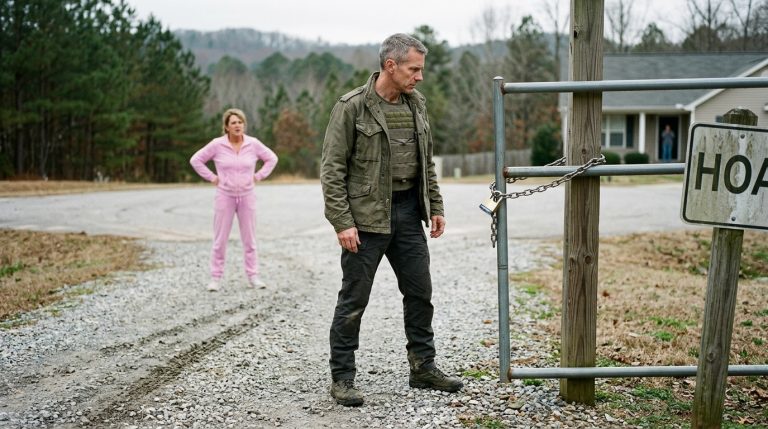
The world outside my window had been one of soft morning light and the quiet, steady breath of the pines. Now, it was a theater of war. I stepped off my porch, the gravel crunching underfoot with a sound that felt too loud, too final. The diesel fumes hung heavy and stagnant in the air, a chemical intrusion that burned the back of my throat.
Karen didn’t look at me; she looked through me, her eyes fixed on the bridge. That bridge wasn’t just cedar and hemlock. It was the span between Sarah’s struggle and her freedom—a gentle, sweeping arc I had designed to accommodate her walker, a sanctuary of hand-pegged joinery that had cost me months of physical labor and every ounce of my focus. It was the one place on our five acres where the terrain didn’t mock her limitations.
“Ten seconds,” I said. My voice was a low, resonant anchor, steadying the air around us. I’d used that tone in places where silence meant survival, and it worked just as effectively here in the manicured grass of the suburbs.
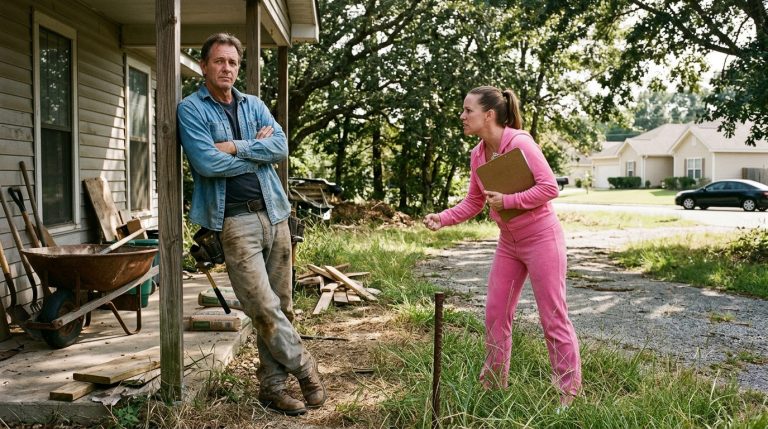
Karen snapped her head toward me, her face a flushed, angry magenta. “You are an eyesore, Sterling. A blight on the community’s architectural integrity. Section 7, subsection B—it’s coming down.”
She was waiting for me to panic. She was waiting for me to shout, to match her frantic, high-pitched energy. Instead, I stood perfectly still. I looked at the bulldozer operator—a man whose face was pinched with genuine, human discomfort—and then back to the HOA president. The vibration of the engine seemed to settle into my own heartbeat, a slow, calculated pulse of icy resolve.
I pulled my phone from my pocket. I didn’t rush. I didn’t stutter. My thumb hovered over the screen, and I watched the moment the realization dawned on her: I wasn’t going to fight her with words. I was going to fight her with the law, with the deed in my safe, and with the cold, hard facts of the property line.
But as I looked toward the house, I saw Sarah. She was leaning against the window frame, her posture rigid. She wasn’t just watching the machinery; she was watching me. Her gaze wasn’t filled with fear of the bulldozer; it was filled with the quiet, devastating knowledge of what this bridge meant to her, and what would happen if I failed to hold this line.
The engine revved, a mechanical shriek that echoed off the trees. Karen laughed, a dry, barking sound. She was so convinced of her own righteousness that she had missed the most critical detail of the morning: the way the light caught the grain of the bridge’s cedar, glowing like something eternal.
I took one more step forward, planting my heels into the earth. I was the guardian of this path, and the silence that followed my next word would be the first true move in a game she wasn’t prepared to play.
“If you move that blade,” I said, my voice cutting through the diesel haze, “you won’t just be trespassing on a man’s property. You’ll be crossing a threshold you can never uncross.”
The operator’s eyes darted toward me, a silent, frantic question hanging in the air. I held his gaze, steady and unblinking. I had built the bridge to give my wife the world back, and I would be damned if I let a woman in a pink tracksuit turn it into kindling.
CHAPTER 2: The Paper Siege
The sudden absence of the bulldozer’s roar left a vacuum in the morning air, a ringing silence that pressed against my eardrums. Karen stood motionless for a beat, her face transitioning from the bright, flushed magenta of fury to a pale, tight-lipped mask of calculated spite. She didn’t retreat; she simply inhaled, a sharp, ragged sound, and turned toward the bulldozer operator. She didn’t say a word to me. She didn’t need to. Her eyes, narrowed into thin, glittering slits, promised that the war had moved from the physical to the bureaucratic, a terrain where she felt far more comfortable wielding her influence.
She marched back to her white SUV, the gravel crunching under her feet with a rhythmic, impatient violence. I remained by the bridge, my boots planted, watching the dust kick up as she slammed the vehicle door. The engine fired—a clean, modern purr that lacked the soul of the heavy machinery she’d tried to weaponize—and she peeled away, leaving me alone with the quiet rustle of the pines and the steady, insistent thrum of my own pulse.
I didn’t move. I couldn’t. The moment she left, the adrenaline that had kept my shoulders squared began to drain away, leaving behind the dull, persistent ache of a forty-year-old body that had been pushed a little too hard.
My phone vibrated in my pocket. A notification: an email from the Whispering Pines HOA. The subject line was chilling in its clinical precision: Notice of Violation – Section 7, Subsection B, Paragraph 4.
I walked toward the house, each step heavy. The transition from the open air to the interior of my living room felt like passing through a veil. The house was cooler, the air smelling of stale coffee and the lemon-oil polish Sarah used on the floors. She was sitting in the armchair by the window, her hands clasped tightly in her lap, her knuckles white. She looked up as I entered, and for a fleeting second, I saw the reflection of our old life—the fear, the, don’t you dare leave me look from the months following the accident.
“She’s gone for now,” I said, my voice sounding hollow in the quiet room.
Sarah nodded, a small, brittle movement. “She’s not going to stop, Jack. You know that. She sees the bridge as an extension of you, and she hates that she doesn’t own it.”
“She doesn’t own any of this,” I replied, pulling the folder of documents from the sideboard. I opened the binder—the one I had labeled with a sharpie, a piece of industrial-grade armor.
As I sat down at the table, I flipped open the clear plastic sleeve containing my original survey maps. My fingers brushed the rough, textured surface of the heavy cardstock. Suddenly, the living room walls seemed to recede. The smell of lemon polish faded, replaced by the acrid, metallic sting of dust in the Helman Province. I saw the flash of an IED, the way the light had warped around the edges of the blast. My breath hitched. It was a phantom sensation, a psychological ghost triggered by the simple act of reviewing a file. I forced my hand to stop shaking. I was not there. I was here. I was home.
I focused on the grid lines of the property map. Every inch was documented. I began to draft the response, my pen moving with the methodical, rhythmic precision of a soldier logging a mission. I didn’t reach out to Karen. I reached out to the law. I cited the municipal ordinances, the county survey records, and the explicit lack of jurisdiction the HOA held over this side of the creek.
It was the first of many. Over the next few hours, the process became my world. The tactile reality of the paperwork—the weight of the certified mail receipts, the clean, professional sharpness of the printed statutes—became a shield. I wasn’t just writing letters; I was building a barricade.
I looked up to see Sarah watching me, her expression shifting from worry to a quiet, steady resolve. She walked over, leaning on her cane, and placed a hand on my shoulder. Her touch was soft, like the fraying edge of a well-worn fabric.
“We built this for us,” she whispered.
“We did,” I said.
“Then we don’t let them take it.”
The second notice arrived before the sun had even begun to dip behind the tree line. Another cream-colored envelope, embossed with the gold logo of the estate. It felt heavy in my hand, far heavier than a few sheets of paper should have been. I didn’t open it immediately. I placed it in the binder, behind the first, a growing archive of suburban malice.
The siege had begun. I knew the rules now; she would aim for my wallet, then my reputation, and finally, my peace. She was counting on me being a transient, a renter in spirit if not in name. She was counting on me to eventually fold under the weight of the fines. But as I sat there, the binder open, the ink on my response still wet, I knew she had miscalculated one thing: she had assumed I was fighting to defend a bridge. I wasn’t. I was fighting to defend the ground that allowed my wife to see the meadow. And that was a fight I had been preparing for my entire life.
I walked to the kitchen, the floorboards groaning under my weight. I needed coffee. I needed to keep the machinery of my defense moving. As the machine hummed, I stared out at the back of the property, at the dark silhouette of the bridge spanning the creek. It looked solid. Unmoving. It was the only truth in a world that was suddenly filled with shadows and paper threats.
I wasn’t just an engineer anymore. I was a guardian, and the binder on the table was my weapon. I checked the lock on the back door, a habit, and turned back to the stack of files. The war of attrition had started, and I was ready to see who had the longer reach.
CHAPTER 3: The Neighborhood Gathering
The grill had gone cold, the embers beneath the metal grate turning into a fine, grey ash. Sarah moved through the yard with a grace that felt like a quiet defiance, her hand resting on the back of a patio chair as she navigated the grass. Our guests—the Garcías, a retired colonel, and a scattering of others who had lived here long enough to see the neighborhood change—were clustered in small, uneasy groups.
The air was still, heavy with the impending dusk. My eyes scanned the perimeter of our five acres. The bridge, now bathed in the soft, bruised purple of the setting sun, looked more like an anchor than a structure. It held the space, a testament to the fact that we were still here, still standing, even as the cream-colored envelopes continued to accumulate in my office like falling leaves.
“They’re afraid,” Sarah murmured, standing beside me. Her voice was barely a ripple in the cooling air. She was watching Margaret, who was holding her garden gnome as if it were a talisman, her gaze darting toward the entrance of the subdivision where Karen Miller’s home stood as a silent, monolithic warning.
“Fear is a habit,” I said, my gaze shifting to the Garcías. They were huddled near the edge of the creek, their toddler’s plastic slide—the target of a ridiculous, vindictive fine—sitting nearby, a splash of garish, defiant primary green against the natural tones of the woods. “Karen made it the currency of the neighborhood. It’s going to take more than one afternoon to devalue it.”
I felt the weight of the binder in my head—a mental inventory of every threat, every fine, every piece of documentation. But tonight, the paper didn’t matter. Tonight was about the fabric of the community. I watched as the colonel approached me, his shoulders set with the stiff, ingrained posture of a man who had spent his life in service. He didn’t speak immediately; he just looked at the bridge, then at me.
“I served in the Air Force, Jack,” he began, his voice a low, gravelly rasp. “I’ve seen bureaucracies that could swallow a man whole without him ever realizing he was being digested. That woman? She’s not managing an estate. She’s running a fiefdom. And you’re the first person who decided not to kneel.”
“I’m not a hero, Colonel,” I said, keeping my tone light, though the familiar, icy coil of resolve tightened in my gut. “I just wanted to build a path for my wife.”
“The best revolutionaries always start with something personal,” he replied, his eyes flickering toward the entrance of the woods.
I looked at the others. It was an odd, disjointed collection of people—a retired military man, a young couple trying to raise a family, a woman who doted on lawn ornaments. They were isolated, disconnected by years of Karen’s calculated divide-and-conquer tactics. I realized then that my war against the HOA was being mirrored in their own smaller, sharper battles. We were an army of individuals, each wounded by the same petty malice.
As the light faded, the texture of the evening began to shift. The warmth of the afternoon was replaced by a creeping dampness rising from the creek. The fading textures of the lawn chairs, the worn wood of the patio, the frayed edges of the Garcías’ lawn decor—it all felt like a snapshot of a place under siege. I felt a surge of protectiveness, not just for the bridge, but for this fragile, tenuous connection that was forming in the shadows of my backyard.
I moved toward the cooler, my movements deliberate. I needed to keep them here. I needed them to see that this wasn’t just a party—it was a council of war.
“The bridge is open,” I announced, my voice carrying over the low murmur of the group. “If anyone wants to see the meadow, it’s a good night for it. The light’s fading, but the view is worth it.”
It was a small invitation, but it broke the tension. People began to drift toward the structure. I watched them cross the planks, their feet creating a rhythmic, hollow sound that seemed to drown out the distant, imagined roar of Karen’s bulldozer. They weren’t just crossing a creek; they were reclaiming a piece of their world that had been labeled ‘inaccessible’ by a woman who hadn’t walked it in years.
I stayed back, letting Sarah move among them. I noticed then that the atmosphere had changed. The hushed, paranoid whispers had stopped. They were talking about property lines, about the validity of the covenants, about the ridiculousness of the fines. They were sharing their stories, weaving them together into a single, cohesive narrative of grievance.
It was in this moment that Arthur Henderson, the quiet, meticulous man I had barely spoken to, drifted toward me. He didn’t have the posture of the colonel or the vibrant energy of the Garcías. He looked like what he was: an accountant who had spent his life staring at numbers until the numbers began to tell him the truth about the world.
“The numbers aren’t adding up, Mr. Sterling,” he said, his voice as dry as autumn leaves. He didn’t look at me; he looked at the clubhouse in the distance. “There’s a discrepancy in the emergency egress project. The cost, the vendor, the timeline… it’s not an architectural failure. It’s a financial one.”
He stopped, his eyes meeting mine for the first time. There was no fear in them—only a cold, surgical curiosity. “I’ve been watching the books. If you’re going to fight her, don’t fight her over the bridge. Fight her over the ledger. That’s where her power actually lives.”
The realization hit me with the force of a physical blow. The bridge wasn’t the goal. The bridge was just the distraction. Karen hadn’t wanted to tear it down because of its appearance; she wanted it gone because it was a tangible, immovable object that blocked the path of a project she needed to hide. The emergency gate wasn’t an exit. It was a smokescreen.
I looked at the bridge, then back at Arthur. The scent of the cooling fire seemed to sharpen, the smoke stinging my eyes. I had been fighting a war of attrition, one letter at a time, thinking I was defending my home. But I was looking at the wrong layer of the conflict. Karen wasn’t just a petty tyrant—she was a frightened architect of a failing reality, and she was going to burn the entire neighborhood down to keep her secret buried.
“What do you need?” I asked, my voice barely audible over the rustle of the trees.
Arthur pulled a small, folded spreadsheet from his jacket pocket and handed it to me. “I need you to keep doing exactly what you’re doing. Keep her looking at you, keep her focused on the bridge. While she’s busy trying to bulldoze your life, she won’t notice me taking apart hers.”
He turned and walked away, disappearing into the twilight like a phantom. I stood alone in the dark, the spreadsheet heavy in my hand, the weight of a far larger, more complex truth settling into my chest. The game had just shifted, and for the first time, I felt the sharp, cold edge of true danger.
CHAPTER 4: The Ledger of Lies
I stood in the center of my office, the heavy, black three-ring binder splayed open on the desk like an autopsy subject. The house was silent, save for the rhythmic, ticking crawl of the grandfather clock in the hall. Sarah was asleep in the next room, her breathing steady, a sound that usually grounded me but now felt like a fragile barrier between our sanctuary and the storm I was inviting inside.
I turned the page to the section Arthur Henderson had annotated. His handwriting was precise, almost calligraphic, a sharp contrast to the chaotic, coffee-stained receipts Karen had submitted as ‘Community Outreach Analysis.’ I ran my thumb over the edge of the paper—it felt thin, fragile, the kind of paper that tore easily under tension.
The discrepancy was tucked into the ‘Infrastructure Maintenance’ sub-ledger. Karen had authorized a payment of fifteen thousand dollars to a vendor called ‘Pines Development Solutions’ for the grading and excavation of the new emergency gate. I stared at the line item, my pulse hammering a dull rhythm against my collarbone.
I knew that road. I’d walked it a dozen times, checking the drainage for my own property. The grading had been done by a local crew I recognized, a team that charged a fraction of what this invoice claimed. And the company name—Pines Development Solutions—wasn’t a construction firm. A quick, late-night search on my laptop had linked the registration to an LLC in a neighboring county, and the registered agent was listed as one ‘Marcus Miller.’ Karen’s brother-in-law.
It was so mundane it almost felt pathetic. No grand master plan, no sophisticated embezzlement scheme—just a siphon, a steady drain of community dues into a private account to pay for a ‘gate to nowhere.’
The front door latch clicked, a sharp, metallic sound that made me spin around. I stood frozen, the ledger clutched in my hand, staring at the darkened hallway. Nothing. Just the wind, shifting against the siding of the house. I let out a breath I hadn’t realized I was holding. I was losing my edge, letting the paranoia of the situation bleed into my own baseline perception.
I sat back down, the chair creaking in the stillness. I needed to move. I needed to act. But the caution ingrained in me—the training that had saved my life in the province—urged a different path. Don’t rush. The target is moving; let them overextend.
I spent the next two hours mapping the flow of money. I created my own spreadsheet, pulling every invoice Karen had signed in the last eighteen months. It was a mosaic of avarice. Every ‘aesthetic violation’ fine she had collected—every twenty-five-dollar gnome penalty, every hundred-dollar grass height fee—was being siphoned directly into this slush fund. She was taxing the neighbors’ obedience to fund her own family’s expansion.
The weight of it was suffocating. I felt the grit of the paper under my fingertips, a dry, sterile sensation that seemed to cling to my skin. I wasn’t just fighting a neighbor; I was documenting a parasite.
I picked up the phone. My thumb hovered over the contact for Miss Davis, the attorney who had looked at my binder and seen a ‘target-rich environment.’ It was past midnight, but I didn’t care. I needed to know if I had enough. I needed to know if this thread—this simple, forged invoice—was enough to pull the whole tapestry down.
The call connected on the second ring. “Mr. Sterling,” her voice was crisp, immediate, completely devoid of sleepiness. She must have been up, anticipating the escalation. “I assume you found something.”
“I found the heart of it,” I said, my voice steady, stripped of emotion. “It’s not about the bridge, Miss Davis. The bridge was just an obstacle to the emergency gate. And the emergency gate isn’t an exit. It’s a cash register.”
There was a silence on the other end, the kind of silence that suggests a shark is beginning to circle. “Tell me everything.”
I laid it out. The invoices, the shell company, the relationship to the brother-in-law, the pattern of the ‘aesthetic fines’ being re-routed into the construction budget. As I spoke, I watched the shadow of the bridge fall across the lawn, a long, dark finger pointing toward the entrance of the subdivision.
“Mr. Sterling,” she said, her voice dropping to a low, predatory register. “You haven’t just found a financial discrepancy. You’ve found a smoking gun that’s going to turn the insurance companies into your strongest allies. If she’s been using HOA funds for private gain, and that money was insured under a policy we’ve already notified, you haven’t just won the legal battle. You’ve effectively burned her entire protective structure to the ground.”
“How long?” I asked.
“Do nothing,” she commanded. “Do not reach out to the board. Do not talk to your neighbors. Let her keep building. Let her keep forging. The more she piles on top of this lie, the harder she’s going to hit the ground when it finally gives way.”
I hung up the phone and leaned back in my chair. The room felt smaller, the air thick with the smell of old paper and dust. I looked at the binder one last time. It was no longer a record of my defense; it was a roadmap for her destruction.
I looked out the window again. The bridge was still there. It didn’t look like a battlefield anymore. It looked like a witness. It had stood through the noise, through the threats, and through the frantic, desperate lies of a woman who had forgotten what a home was supposed to be.
I turned off the desk lamp. The sudden darkness was absolute. I stood up, my legs stiff, and walked to the door of the bedroom. Sarah was still breathing in that slow, steady rhythm, the sound of peace in a house that felt like it was sitting on a fault line. I lay down, but I didn’t close my eyes. I watched the ceiling, listening to the house settle, waiting for the dawn. The war was nearing its end, and for the first time, I wasn’t just planning for the conflict—I was planning for what came after.
CHAPTER 5: The Inspection
The sound hit me before the visual did—a low-frequency thrumming that bypassed the ears and settled directly into the marrow of my bones. It was the sound of professional, state-sanctioned weight. As the fire engine lurched toward the edge of my property, the ground shuddered, the tires biting into the dirt track I had spent months grading and maintaining.
I was already at the edge of the creek, my boots sinking slightly into the soft bank. Sarah stood beside me, her hand gripping my forearm, her knuckles pale. Behind us, from the direction of the HOA clubhouse, Karen’s white SUV came tearing down the lane, the tires spitting gravel with a frantic, uncoordinated energy. She didn’t look like the woman who had stood on my lawn a week ago, confident in her pink tracksuit. She looked haggard, her movements sharp and jagged, like a clockwork toy with a stripped gear.
Chief O’Connell swung out of the command SUV, his uniform crisp, his movements economical. He didn’t look at Karen. He looked at the bridge. He looked at the joinery, the footings I had poured with such agonizing, prayerful patience, and the way the hemlock cedar held its own against the weight of the encroaching woods.
“Mr. Sterling,” he said, his voice a gravel-and-iron register that required no amplification. “I received a formal request for an assessment. Safety and emergency egress protocols.”
“Chief,” I said, nodding. “You’re looking at it.”
Karen arrived, her SUV sliding to a halt in a cloud of dust. She stepped out, her face a mask of desperate, trembling authority. “Chief! You have no jurisdiction here. This is private property within a managed estate. This… this eyesore is a violation of our bylaws, and I demand its immediate removal before you proceed with any assessment of our emergency route.”
O’Connell turned to her, his gaze slow, deliberate, and entirely unimpressed. “Ma’am,” he said, the word clipped, “I am the Fire Chief for the town of Northwood. My jurisdiction is public safety. If you’re claiming this road is your emergency egress, then the status of this bridge is my business. Not yours.”
He signaled to his driver. The fire engine crept forward, a hulking mass of red steel, its front bumper looming over the bridge like a challenge. The engine idled, a low, mechanical growl that made the very air seem to vibrate. My heart was in my throat. I had built the bridge to spec—four times the weight-bearing requirement for a passenger car—but this was a heavy rescue rig.
The driver nudged the engine onto the first plank. The wood didn’t groan. It didn’t shift. It simply took the weight, the architecture of the hemlock responding with a stubborn, ancient strength.
“See?” Karen shrieked, her voice cracking. “It’s going to collapse! It’s unstable!”
The engine crawled further, the middle of the bridge bowing slightly under the immense, concentrated mass of the front axle. O’Connell walked alongside it, his eyes tracking the deflection, his clipboard ready. He was looking for a break, a fissure, a sign that the mortar and tenon was failing. But there was nothing. The bridge sat as it had been built—anchored to the bedrock, a stubborn, human-made thing that refused to surrender to the brute force of the machine.
The engine cleared the midpoint. The rear wheels followed. When the last tire rolled onto the solid ground of the meadow, O’Connell slapped the side of the truck. “Stop.”
The engine killed its ignition. The silence that rushed in was sudden, absolute, and filled with a new kind of tension.
O’Connell walked back to the center of the span. He ran his hand over the railing, the same railing Sarah touched every morning. He looked at me, then at Karen. “Ma’am,” he said, his voice carrying clearly across the water. “This is not a toy. It is a critical piece of infrastructure. As of this report, this bridge is certified for emergency vehicle access.”
Karen stumbled back, her hand flying to her mouth. The blood drained from her face, leaving it the color of stale parchment. The truth wasn’t just a legal setback; it was the structural collapse of her entire charade. She had built her power on the idea that she could define reality, that she could label this bridge as ‘wrong’ and make it so. But reality had just driven a fire truck across it.
I saw the change in her then—the way her shoulders slumped, the way her eyes darted toward her car, not to escape, but to find a weapon, a threat, anything. She looked at me, and for a heartbeat, we were the only two people in the world. She saw me not as a renter, but as the man who had seen through her.
“This isn’t over, Sterling,” she whispered. Her voice was thin, reedy, the sound of a closing trap. “I will not let you destroy what I’ve built.”
“You didn’t build this, Karen,” I said, my voice quiet, devoid of malice. “You only managed it. And you did a terrible job.”
O’Connell tapped his clipboard. “I have a report to file, Ms. Miller. And I suggest you contact your board. Because if I find out this route was intentionally neglected to justify this… conflict… the state is going to have a very long, very loud conversation with your insurance carrier.”
He didn’t wait for her response. He simply climbed back into his command vehicle, leaving her standing there, a small, brittle figure on the edge of the meadow, the red engine looming over her like an accusation. I stood by the bridge, the air still tasting of ozone and cedar, and I knew: the decoy secret was dead. The real game had just begun.
CHAPTER 6: The Meadows Promise
The days that followed Karen’s departure were not defined by shouting matches or the frantic scratch of pens on legal documents. They were defined by a profound, almost surreal quiet. The neighborhood, once vibrating with the high-frequency tension of enforced compliance, seemed to settle into itself like a house that had finally been relieved of a shifting foundation.
I found myself back in the workshop, but the frantic, precision-engineered energy of the ‘war’ had evaporated. I was working on a small project—a simple nameplate, carved from the same hemlock-cedar scraps I’d used for the bridge’s structural supports. The scent of the wood—warm, spicy, and deeply familiar—filled the room. It was the smell of home.
Sarah came to the door, her walk steady. She didn’t use the cane today. She stood in the doorway, the golden, late-afternoon sun filtering through the rafters behind her, creating a soft, haloed effect. She watched me for a moment, her eyes tracing the line of the chisel as it bit into the wood.
“They’re holding the meeting tonight,” she said.
I looked up, wiping a stray shaving of cedar from my palm. “The audit review?”
“Arthur says it’s going to be a formality now. The insurance investigators finished their sweep. Karen’s accounts were frozen two hours ago.”
I set the chisel down. The final piece of the puzzle—the Layer 2 reality I had been slowly peeling back—wasn’t just the embezzlement. It was the fact that she had been trying to build a ‘gated community’ in a place that never wanted walls, using the money of people she viewed as obstacles rather than neighbors. It was a failure of vision, but also a failure of the heart.
We walked down to the bridge together. The air was crisp, the kind of autumn evening that smelled of dried leaves and woodsmoke. We didn’t talk about the litigation, or the fines, or the way the neighbors had started waving again when we drove past. We talked about the garden, about the way the pond in the back meadow looked when the dragonflies gathered.
When we reached the bridge, I stopped. I held the nameplate—The Sarah Grace Crossing—and picked up the hammer. I had spent so much of this journey viewing the bridge as a defensive structure, a rampart against the tide of HOA malice. But as I hammered the last nail into the crossbeam, I realized it was exactly what Sarah had called it at the very beginning: a path.
She reached out, her fingers brushing the carved letters, then the wood itself. “You fought for this, Jack. You didn’t just fight for the bridge. You fought for the quiet.”
I stood there, leaning against the railing, feeling the vibration of the creek below. The water was clear, unencumbered, flowing over the stones that had once been the insurmountable barrier to her recovery.
The payoff wasn’t the look on Karen’s face when she lost. It wasn’t the vindication of a fire chief’s report or the satisfaction of a balanced ledger. The payoff was the way Sarah stood now—her balance sure, her gaze fixed on the meadow ahead, not on the obstacles behind.
Poetic justice had arrived, not in a thunderstorm of litigation, but in the slow, inevitable return of a community to its own standards. Karen Miller had been defeated by her own methods; she had tried to force the world to fit a narrow, rigid box, and in the end, the world had simply moved on without her.
The cool-down of the aftermath was a tactile thing. It was the feeling of sitting on the bench I’d installed, watching the shadows stretch across the grass. It was the way the house didn’t feel like a bunker anymore, but like a place where the doors could stay unlocked.
I reached out and took Sarah’s hand. Her palm was warm, the texture of her skin familiar and grounding. We stood there until the light died completely, the first stars beginning to puncture the velvet canopy of the evening.
There was no need for grand speeches or final reckonings. The antagonist had removed herself, the structure was secure, and the path was clear. I thought back to the binder on my desk—the black armor that had saved us. I would leave it there, a monument to a time when we had to fight to be who we were.
But tomorrow, I would go to the workshop. I would pick up the tools again, not to defend, but to build. The bridge was solid. The meadow was waiting. And for the first time in a long time, the only thing we had to fear was the quiet, and we had finally learned how to hold that, too.
The arc of the bridge felt right under my feet—an intentional, human-made connection that refused to break. I squeezed Sarah’s hand, she squeezed back, and together, we turned away from the creek and walked toward the house, leaving the shadows behind.