The Mechanic of Order: A Sergeant Major’s Tactical Defense Against Suburban Decay and Bureaucratic Tyranny
CHAPTER 1: The First Salvo
The air at the property line always tasted different. On my side, it was rich with the scent of pine needles, wet clay, and the heavy, sweet rot of fallen oak leaves. Just twenty feet across the gravel of the fire road, the Oakidge Estates side tasted like manicured turf and chemical fertilizer. It was a sterile, curated scent, the smell of a place where nature was kept in a straight jacket.
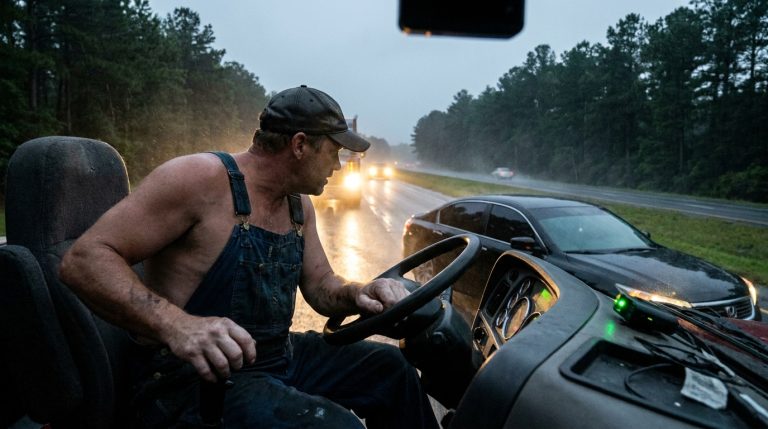
I stood over the engine block, the hood of the John Deere propped open like a metal wing. My hands were steady, despite the way the woman’s voice still vibrated in the air. She stood at the edge of the gravel, her pink tracksuit looking like a neon bruise against the muted greens of the woods. She wasn’t just standing there; she was vibrating with the kind of indignant energy that usually preceded a tactical deployment.
“Did you hear me, Mr. Callahan?” she demanded, her jaw set with a terrifying, suburban rigidity. “I have the police on speed dial, and the HOA board is already drafting the paperwork for an immediate impoundment.”
I didn’t answer. I wiped a streak of dark, viscous oil from a rocker arm, the motion slow and deliberate. Twenty-five years in the Corps had taught me that silence was the most effective weapon in an arsenal of one. When you stop speaking, the other person feels the sudden, uncomfortable vacuum. They fill it with more noise, more threats, and—eventually—the truth.
She crossed her arms. Her face was a masterclass in controlled fury, the skin around her eyes tight, a vein pulsing rhythmically near her temple. She looked less like a neighbor and more like a sentry guarding a fortress of beige stucco.
“This is not a junkyard,” she snapped, gesturing at the tractor. “This is a residential community, and we have standards. The low-frequency rumble of that diesel engine is an assault on our property values. You are a public nuisance.”
I finally looked up. I didn’t see a person; I saw a variable. Her posture, the way she clutched her phone, the strategic positioning at the edge of the fire road—it was all posturing. She wanted me to react. She wanted an angry shout, a defensive gesture, something that would give her the moral high ground in whatever meeting she planned to hold later.
“Ma’am,” I said, my voice dropping into that flat, non-negotiable register that used to make young recruits stand a little taller. “I am operating agricultural equipment on agriculturally zoned property. I am well within my rights. If you want to discuss local noise ordinances, I suggest you consult a surveyor before you start making threats.”
Her eyes narrowed. She didn’t like the mention of the surveyor. It was a probe—a small, sharp prick of logic applied to a balloon of indignation.
“Don’t you threaten me with lawyers,” she hissed, taking a half-step forward. “I know who you are. I know what you think you can get away with. But this is my home, and I will not let a relic from the past destroy the quality of life I’ve worked years to curate.”
She turned on her heel, the fabric of her tracksuit swishing as she marched back toward the manicured lawns of Oakidge. She didn’t look back, but the way she gripped her phone told me the war wasn’t coming; it had already arrived.
I turned back to the engine. The diesel was cold, but the metal felt hot under my touch. As I reached for a wrench, I noticed something that made the hair on the back of my neck stand up—a fresh, neon-yellow plastic stake driven into the gravel, exactly three feet onto my side of the property line. It hadn’t been there when I started the engine this morning.
The woman in the pink tracksuit was already maneuvering for ground I hadn’t yet realized I owned.
CHAPTER 2: The Audit of Doctrine
I stood over the stake for a long minute, letting the silence of the woods press back against the irritation spiking in my chest. The morning sun was beginning to climb, casting long, lean shadows through the ancient oaks that lined the fire road. My boot heel hovered over the yellow plastic. It was a cheap, injection-molded thing, the kind used by surveyors to mark temporary plots, not permanent property lines. Its placement was tactical—a classic psychological maneuver designed to provoke a physical reaction.
If I pulled it, I was the aggressor. If I left it, I was tacitly accepting the claim.
I didn’t touch it. Instead, I turned back to the John Deere. The internal combustion engine, usually a source of comfort, now felt like a liability. If I kept it running, I was feeding into the “nuisance” narrative. I reached for the ignition key and silenced the machine. The loss of that low-frequency thrum made the morning feel suddenly, dangerously quiet. The woods seemed to hold their breath.
I wiped my hands on the red rag, folded it neatly—a habit from twenty years of maintaining weapons—and started walking toward the house. My gait was steady, the stride of a man who measured his territory by feet and inches rather than perception. As I moved, I kept my eyes on the perimeter. The boundary wasn’t just a fence line anymore; it was a front line.
Inside the kitchen, the house was cool, smelling of stale coffee and the dry, dusty scent of old paper. I moved straight to the desk. I didn’t need to look at the view out the window to know she was watching. People like Karen operated on a specific frequency of surveillance; they believed that if they stared hard enough at a situation, it would eventually bend to their will.
I pulled the binder from the drawer—the one I’d put together the night after she first approached me. It wasn’t just a collection of documents; it was a tactical analysis of the Oakidge Estates Homeowners Association. I opened it to the section marked “Jurisdiction.”
My property, according to the tax maps and the original survey from the mid-nineties, pre-dated the Oakidge development by fifteen years. The “undeveloped parcel” label on their master plat wasn’t a mistake; it was an acknowledgment of my sovereignty. But Karen was operating on the assumption that she could rewrite reality through sheer bureaucratic volume.
The violation notice sat on top of the pile, a heavy-bond paper weight. I started reading it again, not for the tone, but for the mechanics of the language. Noise Ordinance 7.4b. Article 9.2a. The specificity was the trap. If I fought her on the noise, I’d be arguing about decibels. If I fought her on the storage, I’d be arguing about the definition of “unsightly.”
I leaned back, the wooden chair creaking under my weight. She was trying to pin me down with local rules that didn’t apply. It was a classic “shock and awe” campaign. She wasn’t trying to win a legal argument; she was trying to force me to expend resources—time, money, and mental energy—to defend my existence.
My phone vibrated on the counter. A text message from an unknown number. “The tractor is a violation of neighborhood aesthetic standards. Please move it to the garage by sunset or we will be forced to escalate.”
I didn’t reply. I just looked at the timestamp. She was fast. She wasn’t just watching from her window; she was tracking me. I walked to the kitchen window and peered through the blinds, just enough to see the back of the Oakidge houses. A flash of pink moved behind a set of curtains two doors down. She wasn’t just patrolling; she was waiting for a reaction.
I needed to move, but not against her. I needed to move against the foundation of her authority. If she wanted to play by the rules, I would give her a curriculum that would make her head spin. I picked up my keys. The trip to the county clerk’s office was overdue. I needed certified copies of the original plat, the exact wording of the covenants, and the specific easement filings for that gravel road.
As I walked out to my truck, the sky began to darken with a sudden, localized front of gray clouds—the kind of sudden Virginia storm that could turn a gravel road into a muddy sluice in twenty minutes. I’d have to leave the tractor under the shed canopy. If the mud started washing out the road, it would create an entirely different set of headaches with the county.
I paused at the door, glancing back at the fire road. The yellow stake was still there, a bright, insolent smear of color in the dull gravel. A raindrop hit the windshield, then another, heavy and fat. I started the engine, the roar of the V8 truck drowning out the rising wind. I wasn’t leaving out of fear. I was leaving to gather the ammunition. By the time I got back, the rain would have hit the ground, and we would see how well her “standards” held up against the weight of the water.
CHAPTER 3: Establishing the Perimeter
The county clerk’s office was a sanctuary of yellowing paper and institutional dust. Dolores, the clerk I’d dealt with during my initial transition to civilian life five years ago, sat behind a desk cluttered with file folders. She had the tired, efficient eyes of a woman who had seen every dispute from property lines to probate battles, and she didn’t seem surprised to see me back.
“Sergeant Major,” she said, nodding at the stack of forms I’d placed before her. “You’re looking for the master plat for Oakidge again?”
“Everything related to the eastern boundary,” I said, my voice quiet against the hum of the office’s air conditioning. “And any maintenance agreements filed alongside the primary subdivision documents. I need to be precise.”
Dolores sighed, pulling a heavy, leather-bound ledger from the shelf behind her. The process was slow. I watched as she unfurled a massive, blueprint-style map across the table. It was a grid of neat, suburban squares bordering a rougher, more organic landscape—my property. My finger traced the line where the two worlds met. The fire road wasn’t just a lane; it was marked as a permanent easement, a strip of land that belonged to the public trust for emergency access.
I spent the next two hours cross-referencing the documents. I needed to know exactly who was responsible for the upkeep. The fine print in the HOA covenants—the same ones Karen had cited in her aggressive letters—was internally contradictory. They claimed total authority, but the municipal filings told a different story. As I flipped through the pages, I noticed something strange. The budget audits for the last three years had been signed off by the board, but the invoices listed for “general maintenance” and “community improvements” didn’t match the descriptions of the work actually being done on the ground.
There was a recurring payment to a company called “Suburban Solutions” for consulting. I copied the registration details. It was a shell company; I could smell the rot on it from here. It was the kind of bureaucratic loophole that only someone who viewed the rules as a personal plaything would use. Karen wasn’t just enforcing standards; she was running a private tax on the neighborhood, and she was doing it through the very office of compliance she used to threaten me.
My phone remained silent in my pocket, a stark contrast to the buzzing activity in my head. I didn’t want to alert her. Not yet. I wanted to build the entire fortress of facts before I fired a single shot. I left the clerk’s office with a thick folder of certified documents, the physical weight of them in my satchel feeling like a direct retort to the flimsy yellow plastic stake she’d driven into my land.
The rain had let up by the time I reached my truck. The air outside was thick, smelling of wet earth and impending humidity. I drove back home with the windows down, letting the cool wind scrub the scent of the office out of my clothes. When I pulled up to the driveway, the sky was a bruised, low-hanging purple.
I checked the security cameras I’d mounted earlier that afternoon. The first one was on the oak tree overlooking the tractor shed; the second on the barn. I sat in the truck for a moment, reviewing the footage on my tablet. There, at 2:14 PM, a figure had approached the property line. It was George, the HOA treasurer. He wasn’t aggressive like Karen; he looked anxious, pacing the fire road, glancing at my shed, then at the yellow stake. He stopped, leaned down, and adjusted the stake so it was perfectly perpendicular to the ground, almost like he was trying to clean up after her mess.
He didn’t touch the tractor, but he lingered long enough to look over his shoulder, as if expecting her to emerge from the brush. It was a nervous, guilty kind of observation. He wasn’t the enemy, but he was a witness to her instability.
I didn’t get out of the truck. I sat there in the dark, watching the feed. If Karen was already pushing the other board members to do her dirty work, she was feeling the pressure of her own lies. I needed a way to bridge the gap between George’s anxiety and the truth I’d found in the clerk’s office. I didn’t need to fight her on her terms. I just needed to let her own board see what she was doing with their money.
I took the folder out and laid it on the passenger seat. The “Suburban Solutions” contract was the key. If I could get this in front of someone who actually cared about the community—someone like the people who lived in those beige boxes—the entire facade would collapse.
I leaned my head back against the seat and looked toward the house. The windows were dark, but I knew the pattern. I knew where the cracks were. I started the engine, pulled the truck into the shed, and began my own quiet logbook entry. Every hour, every observation, every small, calculated move in this chess game. Karen was counting on me to be an old man with a tractor. She had no idea she was playing against a man who’d spent half his life mapping enemy positions before the first shot was fired.
CHAPTER 4: The Reconnaissance Walk
The streets of Oakidge Estates were a study in aggressive uniformity. Every driveway was swept clean of debris; every mailbox sat at the exact same height above the curb. As I walked, my boots made a muffled, rhythmic thud against the pristine asphalt—a sound that felt too loud, too heavy, and entirely too industrial for this curated sanctuary. I kept my head forward, but my eyes were scanning the edges of the properties, looking for the telltale signs of the friction I knew existed beneath the surface.
I had dressed for the occasion—plain work pants, a neutral-toned jacket, and the calm, unassuming demeanor of a man who belonged to the land, not the development. I passed a row of houses where the paint was so fresh it seemed to radiate its own light. Then, I saw the rosebushes.
Mrs. Gable was there, just as I had anticipated from my earlier observations. She was kneeling on a foam pad, her hands encased in heavy-duty leather gloves as she meticulously pruned the deadwood from a climbing rose. She didn’t look up as I approached, her focus entirely on the plant, as if the roses were the only thing in the neighborhood that didn’t demand an audit.
“You’re cutting them too close to the main stem,” I said quietly, stopping ten feet away.
She froze. The shears remained open, hovering near a thorn-laden branch. Slowly, she stood up, brushing the dirt from her knees. Her eyes, magnified by wire-rimmed glasses, flicked toward the neighboring houses before settling on me. She recognized me. The man with the tractor.
“They’re a variety that needs a hard prune,” she said, her voice thin but steady. “Otherwise, they get leggy and lose their shape. Karen thinks they should look like lollipops. I prefer them to look like roses.”
“Particular woman,” I remarked, leaning against the edge of a brick planter that looked as if it had been built to code.
Mrs. Gable let out a sharp, brittle laugh. She looked over her shoulder again, the movement habitual—a reflex born of living under a microscope. “Karen thinks everything in this world has a ‘correct’ shape, Sergeant Major. If you don’t fit it, you’re just deadwood to be clipped.”
She moved toward me, her voice lowering. “She’s been asking about you. At the last board meeting, she called you a ‘structural integrity risk.’ She’s got the neighborhood patrol scheduled to do extra loops past your property line starting tomorrow.”
I felt the familiar, cool detachment of a combat briefing settling over me. The “patrol” was just another layer of the pressure campaign—the illusion of legal surveillance meant to induce paranoia. It was the same tactic I’d seen used in places where the lines were drawn in concertina wire, not flowerbeds.
“Let them patrol,” I said. “They’ll find nothing but a man maintaining his equipment.”
“They’re not looking for the equipment,” she whispered, stepping closer to the hedge. “They’re looking for a reason to break you. George—our treasurer—he’s terrified. He knows the books don’t look right, but he’s afraid of what Karen will do to his reputation if he speaks up. She holds the records, Jack. She holds all of it.”
The mention of the records sent a ripple of confirmation through me. My visit to the county clerk’s office had already suggested as much. The shell company, the consulting fees, the complete lack of oversight—it was all concentrated in the hands of one person. Karen wasn’t just a president; she was a gatekeeper of evidence.
“Tell me about the meetings,” I said, keeping my tone conversational, as if we were just two neighbors discussing the weather. “The ones where she presents the budget. Does she ever let anyone else look at the original invoices, or does she just present the summaries?”
Mrs. Gable’s expression tightened. “Always the summaries. She claims the originals are ‘confidential proprietary documents’ for the HOA’s legal protection. She keeps them in that garage of hers, inside a series of heavy plastic bins. She treats them like the nuclear codes.”
I nodded, the plan forming with the cold, hard logic of a tactical sequence. I didn’t need to break into her house. I didn’t need to force a confrontation. I just needed to leverage the suspicion that was already beginning to ferment in the minds of people like Mrs. Gable.
“You’re a history teacher, aren’t you?” I asked.
“Retired,” she said, confused by the shift.
“Then you know that the most effective way to end a tyranny isn’t to fight the tyrant directly,” I said, a slight, humorless smile touching my lips. “It’s to document the truth until the weight of it becomes impossible for the supporters to ignore.”
She looked at me, a flicker of something—hope, or perhaps just cold, calculated defiance—igniting in her eyes. “What are you suggesting?”
“I’m suggesting that you start asking for the originals,” I said. “Not as a complaint. As a concern. Tell the other residents that you’re worried the board’s liability insurance won’t cover them if the audits are based on summaries. Scare them with the math, Mrs. Gable. Fear of financial loss is a much stronger motivator than an appeal to ‘neighborhood standards.'”
She gripped her pruning shears until her knuckles turned white. “She’ll come for me, Jack. If I start questioning the books, she’ll start fining my garden hoses.”
“She’s already coming for you,” I said gently. “She’s already clipped your roses.”
I left her there, standing in the shadow of the perfectly manicured hedges. As I walked back toward the boundary of my land, the air felt different. I wasn’t just a man waiting for an escalation anymore; I was a catalyst. The reconnaissance was complete. I knew where the cracks were, and I knew exactly how much pressure it would take to turn them into a fracture.
CHAPTER 5: The Flimsy Barrier
The transition back to my own property felt like stepping out of a sanitized laboratory and into the raw, unrefined earth. My pace was measured, but my senses were dialed into the rhythm of the woods—the rustle of dry leaves, the distant call of a crow, and the sudden, jarring absence of the ambient suburban noise I’d just left behind.
As I reached the fire road, the stillness shattered.
There, blocking the twenty-foot wide gravel expanse where it met my line, were two metal posts driven deep into the soft soil. They weren’t there an hour ago. Stretched between them was a heavy, rusted chain, the kind used to secure logging equipment. A brand-new padlock glinted in the dying afternoon light. Wire-tied to the center of the chain was a sign, its plastic surface reflecting the harsh light: NO TRESPASSING – PROPERTY OF OAKIDGE HOA.
I stopped. My boots crunched into the gravel, the only sound for a hundred yards. I didn’t reach for the chain. I didn’t reach for the posts. I simply stood there, my breathing steady, allowing the tactical reality to sink in.
Karen had gone past the letters. She had moved from bureaucratic harassment to a direct physical claim on the one piece of land that defined the legal boundary between her kingdom and my own. It was a blunder of spectacular proportions, a move so clumsy and aggressive that it felt like a desperate man’s final gambit in a losing game. She was trying to force a collision.
I took out my phone, the screen cool against my palm, and began to document. I filmed the posts, the chain, the sign, and the way they encroached upon the designated easement. Every movement was slow, deliberate—the muscle memory of a man who knew that evidence was a weapon. As I worked, I felt the familiar weight of the “predator-prey” dynamic. I was the prey, in her eyes, an old man with a noisy machine. She was the predator, the self-appointed guardian of the beige gates. But she was operating with the blind arrogance of someone who had never had to justify her actions in a court of law.
A shadow passed over the ground. I didn’t look up, but I felt the presence before I heard it. A car door slammed down the street, followed by the quick, purposeful gait of someone walking toward the road.
“Mr. Callahan!”
The voice was thin, strained. I turned to find George, the HOA treasurer, standing twenty feet away. He was holding a clipboard, his face a map of conflicting anxieties. He looked at the chain, then at me, then back at the chain, as if he were waiting for it to spontaneously combust.
“George,” I said, my voice neutral. “You’re out late.”
“I… I was told to document this,” he stammered, tapping his clipboard. “The board… we were told this was a security measure for the subdivision.”
“And what does the board think about blocking a fire access easement, George?”
He blanched. The mention of the easement seemed to hit him like a physical blow. He looked down at the gravel, his shoes shifting restlessly. “Karen said the easement was void because the parcel wasn’t developed. She said the county records were outdated.”
“She told you that?” I kept my voice low, probing. “And you believed her? Did you look at the filings yourself, or did you just take the word of the woman who handles the bank accounts?”
His head snapped up. The question landed squarely on the nerve I’d been aiming for since my visit to the county clerk. His eyes darted toward the neighboring houses, his voice dropping to a harsh, fearful whisper. “She doesn’t show us the original filings, Jack. She says it’s a security risk. If you’re wrong about this… if this really is an emergency route… she’s put us all in a position of extreme liability.”
“She hasn’t put you in a position, George,” I said, stepping closer, the weight of my calm acting as a fulcrum for his panic. “She’s built a cage for you. And when the fire marshal comes out to inspect this, she won’t be the one they’re looking for. She’ll be the one in the beige house, watching from behind the curtains while the board takes the heat.”
I could see the gears turning—the sudden, terrifying realization that his status as treasurer made him a target, not a partner. He looked at the chain again, and for the first time, I saw the disgust on his face. It wasn’t directed at me. It was directed at the situation he’d allowed himself to be dragged into.
“I have to go,” he said, turning abruptly. “I need to talk to the others.”
I watched him walk away, his steps losing their rhythm, his posture hunching under the sudden weight of the information. I turned back to the barricade. The rain was coming, a dark wall of clouds moving in from the west. The barrier was flimsy, a pathetic, rusted line in the dirt, but it had served its purpose. It had forced the internal rot of the HOA board into the open.
I checked the time. The transition was beginning. Karen had tried to wall me in, but she had only succeeded in walling herself off from the last remaining shreds of loyalty she commanded. I stood there for another moment, the smell of ozone sharp on the air, and felt the first cold, heavy drops of the storm strike the metal chain, listening to the hollow, lonely sound of rust against iron.
CHAPTER 6: The Pinsir Movement
The rain didn’t fall. Instead, the sky turned a bruised, metallic color, holding its breath in a way that made the hair on my arms stand up. I stood at the edge of the fire road, the chain still hanging between the posts like a rusted, broken grin. My phone buzzed again. An email notification. It was a digital PDF, formatted with the kind of aggressive, multi-font header only a hobbyist printer could love.
NOTICE OF INTENT TO LIEN: OAKIDGE ESTATES HOA.
I opened it. The language was thick with the pseudo-legalese of a man who’d spent too much time on Internet legal forums. It demanded payment of four thousand dollars, citing the same jurisdictional fallacies I’d spent all week deconstructing. I didn’t feel rage. I felt a cold, sharp satisfaction. This was the move I needed. The paper trail was now complete; she had moved from local harassment to a written, documented threat of property seizure based on a lie.
I didn’t answer the email. I simply stood by the fire road, watching the gravel path, waiting. Five minutes later, a white SUV—the county Fire Marshal’s vehicle—rounded the corner, its tires crunching heavily into the wet grit. The vehicle came to a slow, deliberate halt about twenty feet from the chain.
Chief Miller stepped out. He was a man who moved with the economy of someone who had spent decades dealing with the aftermath of avoidable disasters. He didn’t look at the houses. He didn’t look at me. He walked straight to the barricade, his eyes scanning the chain, the padlock, and the “NO TRESPASSING” sign with the clinical detachment of an investigator.
“Mr. Callahan,” he said, his voice carrying clearly over the dead-still air.
“Chief,” I replied, standing my ground near the property line.
“I received an anonymous report,” he said, gesturing at the obstruction. “Safety hazard. Blocking an emergency access route. You happen to know who put this up?”
“I believe the HOA president considers it a private security measure,” I said.
He looked at the sign, then back at the chain, and a tight, humorless smile touched his lips. “Private security doesn’t trump the fire code, Sergeant Major. And in this county, blocking an access route is a Class 1 misdemeanor.”
He pulled a digital camera from his belt and began to photograph the setup. He was methodical. He took a wide shot, then a macro of the lock, then a series of shots showing the lack of clearance for a fire apparatus. He was building the case for me, and he didn’t even know it.
“I’m going to need to speak with the president of this association,” he said. He didn’t need to ask where she lived; he already had the plat map in his hand.
“She’s two houses down,” I said. “The one with the rosebushes that don’t look like lollipops.”
I followed him at a distance, watching the tactical execution. As Miller approached the house, the front door swung open before he even reached the steps. Karen was there, her expression a mix of defensive outrage and genuine surprise. She was wearing a different tracksuit today—a severe charcoal gray—and she looked like a woman who had been spending her morning drafting threats.
“Can I help you?” she asked, her voice shrill.
“Fire Marshal Miller,” he said, holding up his badge. “I’m here about the obstruction on the fire road.”
She went rigid. “That is private HOA property. We have the right to secure it against intruders.”
“Ma’am, you have the right to secure your property, but you do not have the right to violate the state fire code,” Miller said, his voice dropping into that dangerous, calm register I recognized instantly. “That road is a recorded easement. If I have to bring a crew out here with bolt cutters, the HOA will be billed for every second of their time, and you’ll be facing a hearing with the county prosecutor.”
Karen looked past him, her eyes locking onto mine. For a second, the mask slipped. I saw the fear—not the fear of an old man with a tractor, but the fear of someone who realized they had walked into a crossfire they couldn’t control. She wasn’t just losing the battle for the road; she was losing the ability to pretend she was the law.
“This is ridiculous,” she hissed, though the volume had dropped. “He’s the one who’s been disrupting the peace with that antique machinery!”
“The machine is irrelevant,” Miller said, his eyes hard. “The obstruction is the crime. You have twenty-four hours to remove it, or my department will return to do it for you, and we won’t be using a key.”
He turned and walked back to his vehicle. I stood by the edge of the lawn, watching Karen. She didn’t move. She stood on the threshold of her perfectly manicured life, holding the door open as if it were a shield, while the reality of the situation began to settle into the silence between us. She had tried to create a wall, but she had only succeeded in creating a marker—a target for the very authority she thought she could command.
I walked back toward my house. I didn’t look back again. I reached the porch, sat down in the wooden rocker, and listened. Within moments, I heard the heavy, rhythmic sound of a garage door closing, followed by a frantic, high-pitched argument drifting through the open windows of the neighborhood. The fracture was widening. The board members were starting to realize that the “president” had just invited the county government into their private finances.
I picked up my logbook and a pen. Target compliant. Pressure applied. The next step wasn’t mine to take; it was the board’s. And by the look on Karen’s face, I knew they were already looking for the exit.
CHAPTER 7: The Tribunal
The clubhouse was not designed for this many people. It was a sterile, multipurpose room with drop-ceiling tiles and thin, utilitarian carpet that always smelled of lemon-scented industrial cleaner. Tonight, however, the air was different. It was heavy, humid, and vibrating with the low-frequency murmur of two hundred people who had spent months simmering in the quiet resentment of arbitrary fines and petty, rule-bound tyranny.
I walked through the double doors, my presence causing a ripple in the crowd. There was no hostility—not anymore. There was a strange, watchful expectancy. They knew I was the “hostile outsider,” but they also knew I was the one who had stopped the chain from crossing the fire road. I walked toward the front, my boots marking a steady, rhythmic path across the floor.
At the front of the room, the HOA board sat behind a long, folding table. Karen was at the center. She wore a navy blue pantsuit that looked like a uniform of authority, but her face was a mask of pale, brittle control. Beside her, George sat with his hands locked tight on the table, his knuckles white, his gaze fixed on a point somewhere near the back of the room. He wouldn’t look at me. None of them would.
I took a seat in the front row, right next to Mrs. Gable. She didn’t speak, but she gave a single, almost imperceptible nod.
“We are here,” Karen began, her voice amplified by the cheap, crackling microphone, “to address the… ongoing disruptions to our community standards and the uncooperative behavior regarding our established covenants.”
She tried to project command, but the room was already against her. When she finished her opening, the floor was opened for comments. It was not a debate; it was an autopsy. One by one, residents took the microphone. It started with the small things—the garden hoses, the paint samples, the arbitrary aesthetic strikes—but it grew, shifting from annoyance to a collective, simmering fury. They weren’t just complaining about rules; they were documenting a systematic abuse of power.
I watched Karen from the front row. She was writing notes, her pen scratching against a legal pad with a frantic, rhythmic intensity. She was looking for a scapegoat, for a way to turn the focus back on me, to frame the entire evening as a coordinated attack by the “outsider.”
But then, the forensic accountant stood up.
He didn’t need a microphone. He walked to the front, placed a projector on the table, and clicked a button. The screen behind the board lit up with a series of spreadsheets. It was the “Suburban Solutions” contract—the one I’d pulled from the county records. The names, the registration dates, the routing numbers—all of it laid bare in black and white.
“The audit of the HOA’s financial records,” the accountant said, his voice flat and clinical, “reveals that nearly twenty percent of all ‘community management’ expenses have been routed to shell entities with no verifiable service history or physical office.”
The room went completely silent. It was a vacuum of sound so absolute that the hum of the projector seemed like a roar. I looked at the board members. George was staring at the screen, his mouth slightly open, a look of dawning horror replacing his earlier anxiety. The others were looking at Karen.
Karen didn’t look at the screen. She stood up, her face a mask of incandescent, trembling rage. “This is a fabrication! These documents were illegally obtained and taken out of context! This entire meeting is a coup organized by residents who refuse to abide by the rules of this community!”
She grabbed the microphone, her voice peaking into a shrill, distorted feedback. “I have worked for years to maintain the value of your homes! I have kept this place safe and orderly while all of you sat back and complained about the minor inconveniences of living in a civilized society!”
She wasn’t just losing control; she was dismantling her own foundation. She was accusing the very people whose money she had stolen. I watched the room react. It wasn’t anger anymore—it was a cold, clarifying realization. They didn’t see a president defending her honor; they saw a thief caught in the act, trying to scream her way out of the truth.
I didn’t need to speak. The movement had started without me. Mrs. Gable stood up, and then Tom, and then half the room. It wasn’t a riot; it was a mass departure. They weren’t fighting her; they were ignoring her. They were walking out to form their own consensus, leaving Karen to scream at a half-empty room of terrified, disassociated board members.
I stayed in my seat until the room was mostly clear. Karen was still at the podium, the microphone still screeching, her eyes wild as she looked from the screen to the retreating backs of her neighbors. She looked at me then, her gaze locking onto mine with a final, desperate burst of venom. She knew. She realized that it wasn’t the documents that had defeated her; it was the fact that she had finally run out of people who were afraid of her rules.
The hammer had fallen. The tribunal was over.
CHAPTER 8: The Quiet Aftermath
The departure of Karen Miller was not marked by a dramatic exit or a final, venomous confrontation. It was marked by the hum of a moving truck at four in the morning, a sound so mundane it was almost insulting. I stood on my porch, a cup of black coffee in my hand, watching the white box truck pull away from the beige-stucco house two properties down. There were no lights on in the street. No neighbors came out to watch. It was as if the neighborhood itself was collectively holding its breath, waiting for the house to be properly hollowed out before it dared to wake up.
I turned my back on the retreating lights and looked toward the fire road. The chain and the posts were gone. Two days ago, a county-contracted crew had arrived at dawn—not to issue a fine, but to perform the first stage of the maintenance contract I had secured. They had pulled the posts, leveled the gravel, and left the road graded and clean. It was a simple, functional, and deeply satisfying piece of civil engineering.
My John Deere 790 sat idling nearby. Its diesel engine provided a steady, low-frequency thrum—the heartbeat of the property. I climbed into the seat, the worn leather cushion familiar and grounding. My hands, still bearing the faint, ingrained lines of grease and work, moved with practiced efficiency over the controls.
Today was maintenance day. The county contract wasn’t just a legal maneuver; it was a responsibility. I shifted the tractor into low gear and began the slow, rolling crawl down the length of the easement. The grader blade bit into the gravel with a satisfying, rhythmic scrape, smoothing out the washboards left by the storm.
Halfway down the road, I saw Tom. He was walking his dog, a golden retriever that bounded through the grass at the edge of the Oakidge lawn. When he saw me, he didn’t give the cautious, sidelong glance he used to. He stopped, waved, and then walked right up to the edge of the road.
“Running smooth?” he called out, his voice light.
I pulled the lever to lift the blade, bringing the tractor to a halt. “Smooth enough. The drainage is holding up.”
“The new board meeting is tonight,” he said, leaning against his knee. “Mrs. Gable’s got the whole thing agenda-mapped. Transparency, budget reviews, the works. It feels… quiet. For the first time in three years, it actually feels like a neighborhood instead of a project.”
“Quiet is good,” I said. “Quiet is what I came here for.”
“I think we all did,” he replied. He hesitated for a moment, then looked at the tractor. “You know, the house next to Karen’s is going on the market next week. A few of us were talking. We’d rather have a neighbor who knows how to fix a fence than someone who cares about the color of the paint.”
I smiled—a slow, genuine movement of the muscles I hadn’t used for anything but tactical observation in months. “I’ll consider it. But for now, I think I’ve got enough land to keep me busy.”
Tom laughed and continued his walk. I watched him go, the dog sniffing at the base of the ancient oak trees that marked our border. The boundary didn’t feel like a line anymore. It felt like a threshold—a place where two worlds, once locked in a collision of bureaucracy and ego, had finally found a way to coexist.
I finished the run, the gravel settling into a perfect, uniform path behind me. When I reached the end of the road, I pulled the tractor back into the shade of my barn. I killed the ignition. The silence that rushed back into the space was not the oppressive, watchful silence of the surveillance days. It was a rich, living silence, filled with the sounds of insects in the grass and the distant wind in the leaves.
I spent the next hour cleaning the tractor. I wiped down the engine block, cleaned the treads of the tires, and carefully tucked the red rag back into my pocket. My movements were slow, deliberate—a meditation. I wasn’t just cleaning a machine; I was closing the loop. The conflict had been a test of tactical patience, but the resolution was a testament to the fact that some things—a farm, a community, a life—could still be rebuilt if you were willing to put in the time.
I walked back toward the house as the sun began to dip below the tree line, painting the sky in deep, honest shades of orange and violet. I stopped at the porch and looked at the fire road one last time. It was clear. It was functional. It was part of the landscape.
I had come here looking for a quiet place to transition back to the world, and somewhere along the way, I’d stopped transitioning and started living. I pushed the door open, the scent of fresh air and drying earth following me inside. The war was over. The order had been restored—not the fragile, artificial order of a control freak, but the slow, stubborn, enduring order of the land itself.