Iron Shadows and Invisible Pulses: The Night the Old Sea Wars Died Off Guadalcanal
CHAPTER 1: THE BLIND HORIZON
Salt dried in stiff crusts across the bridge wings of the Kirishima. The air smelled of heavy fuel oil, damp steel, and the wet chill of the open Pacific.
Lookouts pressed their foreheads against rubber eye-cups, straining against a void so absolute it felt physical. Every muscle in their necks remained locked in rigid tension.
Vice Admiral Kondo stood near the chart table, his fingers tracing the cold edge of a brass divider. He trusted what his men could see with their own eyes.
Generals and admirals had mastered this darkness for centuries. It was a reliable shield for those disciplined enough to respect its limits.
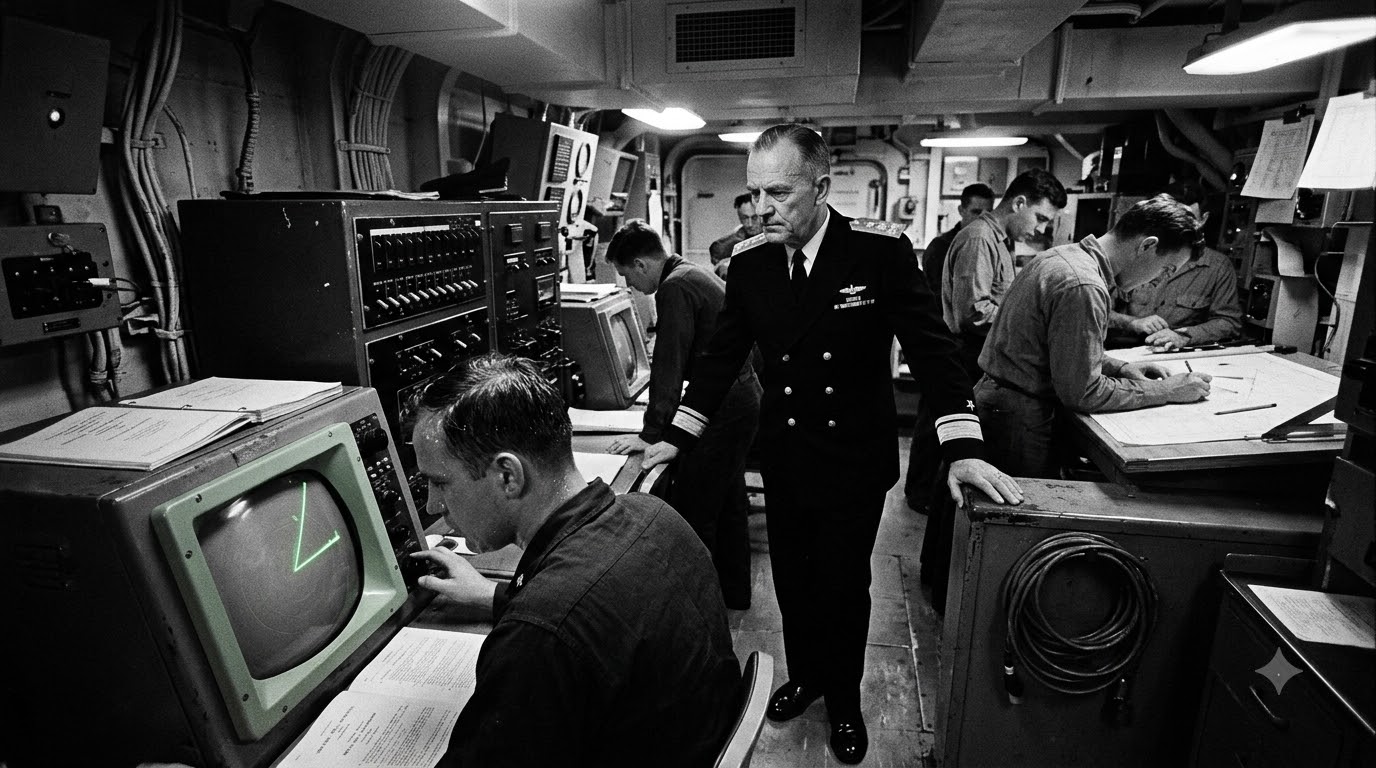
Miles away in the interior compartments of the USS Washington, the air smelled of hot vacuum tubes and ozone. Operators stared into small glowing hoods, watching the quiet pulse of a green sweep.
There was no romance in the screens, only the dull hum of circuitry and the dry click of toggle switches. The machinery cared nothing for tradition or courage.
It registered mass, distance, and bearing with cold indifference. The distance between the two converging forces shrank by a mile every single minute.
On deck, the heavy steel plating absorbed the low thrum of turbine engines deep below. The men on both sides waited for a dawn that was still hours away.
Only one side knew the dark had already been stripped away.
CHAPTER 2: THE ELECTRONIC PULSE
The cathode ray tube threw a pale green wash across the operator’s sweat-slicked forehead. Every wire inside the console vibrated with a steady, high-pitched whine that cut through the low rumble of the engine spaces.
There was no romance in the scope, only a clean, rhythmic sweep cutting across a graduated faceplate. A single green arc painted the interior glass before fading into gray phosphorescence.
The range scale was locked at twenty miles. Beyond that invisible perimeter, the ocean remained a vast, empty stretch of ink.
The operator adjusted a brass tuning knob by a fraction of a millimeter, letting his thumb feel the fine knurled ridges. A sharp, needle-thin green spike suddenly bit into the sweep line at eighteen thousand yards.
It was not a shadow. It was not a cloud of spray caught in a searchlight beam. It was a solid mass returning radio frequency energy across the black water.
In the combat information center below decks, the air tasted stale, heavy with copper and hot vacuum tubes. Officers leaned over the plotting board with grease pencils ready.
There was no frantic shouting, no dramatic countdown through a megaphone. There was only the quiet scratch of wax on a paper grid marking an enemy course that didn’t know it was being watched.
The distance between the converging fleets shrank by another mile in less than sixty seconds. The green blip on the scope lengthened, resolving into multiple distinct nodes of heavy displacement.
The operator didn’t look up to check the bulkhead clock. He simply watched the pulse strike the metal hulls and echo back through the void.
On the bridge above, Admiral Lee kept his gaze fixed on the glowing indicators rather than the dead blackness outside the viewport. Trusting a machine in the dark went against every instinct forged by salt and sunlight.
Yet the machine was calm, precise, and completely indifferent to human doubt. It registered the Japanese cruisers not as ghosts or rumors, but as mathematical coordinates waiting for an answer.
The sweep line kept turning, relentless and unblinking, sweeping away the last ancient illusion that night belonged to those who simply stared into it.
CHAPTER 3: THE SHATTERED FORMATION
Searchlights lashed across the water like white whips, tearing holes in the heavy Pacific night. Tracers arced upward in crisscrossing ribbons, illuminating frantic sprays of foam where destroyers collided with the chaos of close-range combat.
In the center of the melee, friendly steel and enemy metal blurred into a singular, deafening roar of muzzle blasts and tearing plate.
Officers shouted over screaming intercoms as the screen indicators flickered erratically under the electronic noise of nearby shell impacts.
We can’t tell who is firing in this mess— Dennis yelled, his forearm braced against a vibrating steel stanchion to keep his footing as the deck lurched sideways.
The radar data was clear, but visual confirmation at point-blank range threw the entire screen into dangerous ambiguity.
Trace lines crossed and tangled on the plotting grid as friendly hulls veered into the line of fire to shield damaged decks.
Every man on the bridge felt the suffocating squeeze of the trap closing from both sides. The destroyers absorbed the brunt of the kinetic fury, buying precious minutes with burning hulls and shredded rigging.
Behind the chaos, hidden deep in the dark water where no searchlight reached, the heavy guns remained silent and locked on coordinates.
The air grew thick with cordite and hot engine exhaust, stinging the eyes of men who had no view of the ocean outside.
The tactical picture shifted in seconds from ordered tracking to raw, desperate survival.
CHAPTER 4: THE SILENT COLLAPSE
The sixteenth-inch shells left the muzzle in a blinding sheet of white fire, instantly plunging back into absolute blackness.
Aboard the distant flagship, no lookout saw the barrels lift, and no observer caught the flash across the horizon.
The heavy armor-piercing rounds crossed eight thousand yards of open water in seconds, striking home with a dull, concussive shudder.
Fires broke out across the targeted deck, fed by fuel lines and ruptured compartments that no damage control party could reach in time.
Steering failed completely, leaving the massive hull spinning helplessly in circles while its guns fired wildly at empty ocean.
Admiral Kondo stared into the dark void from the bridge, his hands locked tightly onto the polished brass rail.
We are answering a ghost— a senior officer muttered, his voice tightening as another silent blow hammered the structural ribs below.
There was no enemy silhouette to target, no searchlight beam to trace back to its origin, and no traditional battle left to fight.
The strategy built on decades of disciplined night vision crumbled under the cold mathematics of electronic data.
Orders went out across the encrypted circuits to reverse course and abandon the mission entirely.
The ships turned away from the invisible wall of fire, withdrawing into the gray morning mist as the shattered wreck slipped beneath the waves.
On the American side, the machinery hummed quietly in the interior compartments, its cooling fans blowing a steady draft across the panels.
The crew kept their stations, maintaining watch over screens that showed only open water and fading echoes.
War had changed its shape forever in twelve brief minutes, leaving behind an empty sea and a silent, permanent dawn.