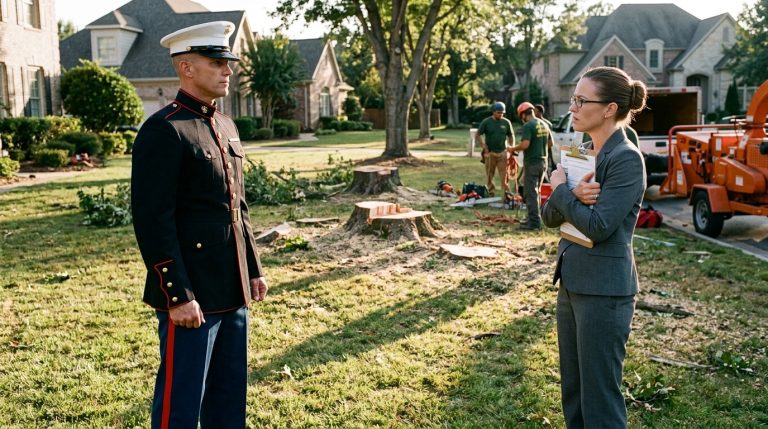
A Sovereign Defense: The Calculated Dismantling of a Suburban Tyrant and the Preservation of Truth
CHAPTER 1: THE LINE IN THE DIRT
The humidity of the Virginia afternoon was a physical weight, but it was nothing compared to the stifling presence of Karen Miller. She stood on the edge of the grass, her posture rigid, her face a carefully constructed mask of suburban disapproval. In her hand, she clutched a clipboard as if it were a tactical asset, her knuckles white against the dark plastic.
“Your little dirt hole is a public nuisance and a structural liability, Mr. Caldwell,” she said, her voice smooth, rhythmic, and entirely devoid of human warmth. “We’re having it filled with concrete by Friday. The special assessment will be reflected in your next dues statement.”
Mark didn’t move. He kept his hands at his sides, his breathing steady, rhythmic. Years of managing forward operating bases had taught him the value of the pause. He looked past her, toward the root cellar. The fieldstone was weathered, the mortar crumbling in places, but it was solid—an immovable object in a landscape of vinyl-sided conformity.
“It’s a root cellar, Karen,” he said, his voice flat. “It’s been there since 1860.”
She didn’t blink. She tapped a perfectly manicured nail against the clipboard, the sound sharp and invasive. “It’s a hole in the ground that violates Section 4, Subsection B. It is an unapproved, unsightly structure. It compromises the aesthetic integrity of Liberty Crossing.”
She said integrity as if it were a commodity she held in an account. Her sneakers, pristine white, remained firmly on the HOA-approved asphalt of the street, while her gaze sliced into his yard like a scalpel. She wasn’t just here to issue a notice; she was here to claim territory.
Mark felt the cold spike of adrenaline, not the frantic kind, but the calculated, crystalline focus that arrived before a breach. He saw the way her gaze flicked to the cellar, the smug twitch of her lip. She wasn’t just enforcing a rule; she was enjoying the sensation of having the power to erase his history.
“I’m not filling it, Karen,” Mark said. The silence that followed was heavy, the kind that demands a reaction.
Karen smiled then, a small, thin movement of her mouth that never reached her eyes. “That’s not how this works, Mark. You don’t have a choice.” She turned on her heel, her tracksuit rustling, and walked toward her SUV. She left the silence hanging in the air, but as she reached for her door handle, she paused, glancing back at him. “Friday morning. Be ready.”
She didn’t see the way Mark’s eyes tracked her, measuring the distance, the arrogance of her stride, and the exact position of the SUV. She drove away, and for a moment, the only sound was the drone of a distant lawnmower and the rustle of leaves against the stone of the cellar. Mark looked down at the grass, where her sneakers had pressed indentations into the soil. He walked over and stepped on the marks, erasing them, his jaw tight. The trap was set, but she had walked into it with her eyes wide open. He reached into his pocket, his fingers finding the key to the cellar, and looked at the heavy timber door. There was a new, disturbing weight in the air—not the heat, but the realization that this was no longer a disagreement. It was a siege.
CHAPTER 2: THE PAPER SIEGE
The silence in the farmhouse was different after Karen Miller left. It wasn’t the peaceful, restorative quiet Mark had spent three years cultivating; it was a static-charged, tense hum. He stood by the kitchen window, watching the dust motes dance in a sliver of late afternoon sun, his hands resting on the cool, worn wood of the sill. Every instinct from his days in the Corps screamed at him to act, to neutralize the threat, but he kept his breathing shallow and steady. A frontal assault was a grunt’s mistake. He had learned in the field that the most effective way to break an opponent wasn’t to meet their force with his own, but to ensure they ran out of resources before he even began to sweat.
He moved to the dining room, where his grandfather’s heavy oak desk stood like an altar to a more deliberate time. He pulled out the chair—the wood groaned in a familiar, grounding pitch—and sat down. The surface of the desk was scarred with years of use, a map of another man’s life. As he smoothed his hand over the grain, a sudden, intrusive memory surfaced: his grandfather’s steady, calloused hand guiding his own as they filed down a jagged edge on a piece of fence-post metal. Work the problem, Mark, the ghost of his grandfather’s voice seemed to echo in the quiet. Don’t let the metal fight you. You shape the metal.
The urgency of the HOA’s threat—the concrete, the special assessment, the Friday deadline—pressed against his chest, but he treated it like a tactical challenge. He pulled a fresh stack of paper from the drawer and opened his laptop. He didn’t write an angry rebuttal. He didn’t draft a petition. He began to build a weapon.
For the next three days, Mark transformed the dining room into a command post. The air grew heavy with the scent of laser-printer toner and stale coffee. He worked with the clinical precision of an engineer, treating the HOA’s covenants not as laws, but as mechanical constraints to be dismantled. He researched every zoning statute, every county ordinance, and every clause in the Meadows at Liberty Crossing’s bylaws.
He took high-resolution photographs of the root cellar—macro shots of the fieldstone joints, the timber framing, the way the earth sloped to allow for natural drainage. He didn’t just photograph; he analyzed. He drafted a soil stability report, citing local geological data that proved the cellar wasn’t a “liability,” but a perfectly executed piece of 19th-century ground-retention engineering. He drafted a formal, ten-page architectural critique that used the HOA’s own language to describe the cellar’s “vernacular historical harmony.”
Every page he turned, every graph he plotted, was a brick in a wall he was building between himself and Karen Miller. He wasn’t just defending a hole in the ground; he was creating a bureaucratic obstacle so dense, so meticulously referenced, that to reject it would require the HOA board to willfully ignore documented reality.
He stopped only when the hunger became a distraction, or when the shadows stretched too far across the floor. During one of these rare breaks, he walked out to the cellar. The air was cool near the entrance, smelling of damp earth and deep, undisturbed history. He ran his hand over the rough-hewn stone lintel. It felt solid, permanent. Karen wanted to fill this with concrete, to bury the history he felt obligated to protect. She saw a weed in her garden; he saw the roots of his own integrity.
By the end of the third day, the three-ring binder sitting on the oak desk was a massive, three-inch-thick testament to his commitment. He had indexed it, tabbed every reference, and drafted a cover sheet that looked like it had been pulled from a government archive. It wasn’t just an application; it was a manifesto of malicious compliance.
Mark closed the laptop and sat back, the weight of the binder staring back at him. He could feel the tension still coiling beneath his skin, but it was sharper now, focused. He had his plan. He had his evidence. And tomorrow, he was going to walk into their sterile, scent-filled office and lay the weight of his compliance on their counter, watching the exact moment the realization hit them that they were dealing with someone who knew how to wage a war they hadn’t even begun to understand. The trap wasn’t just set; it was primed, waiting for the first touch of the board’s arrogance to trigger the mechanism.
CHAPTER 3: THE KANGAROO COURT
The scent of potpourri was suffocating, a sickly sweet attempt to mask the underlying odor of stale coffee and administrative rot. Mark stood at the laminate counter, his hand still lingering on the spine of the binder, feeling the solid, unforgiving weight of the work he’d put into it. The clubhouse conference room was a beige box, a space designed to strip the personality out of any dispute. It was an environment Karen Miller clearly felt empowered by, her presence expanding to fill the sterile room.
Karen sat at the head of the long table, the gavel resting in front of her like a judge’s hammer. Beside her sat Brenda, looking nervous and glancing toward the door, and Gary, who wore his usual air of forced importance, his polo shirt collar stiffly pressed. When the doors had opened, they had clearly expected a compliant, defeated veteran. Instead, they got the binder.
Karen’s gaze darted to the thick, tabbed volume, her eyes narrowing as she processed its bulk. “What is this, Mark?” she asked. Her voice was thin, sharpened with a sudden, twitchy suspicion.
“My application for the Architectural Review Committee,” Mark replied. He kept his tone level, devoid of any inflection that could be interpreted as aggression. “As requested. I’ve ensured it exceeds every submission requirement listed in the covenants.”
Gary reached out, his hand hesitant before he grabbed the binder. He grunted, surprised by the heft, and began to flip through it. The sound of pages turning—stiff, professional bond paper—cut through the awkward silence of the room. He bypassed the historical summary, flipping straight to the engineering diagrams, his brow furrowing as he stared at the complex schematics of the timber framing. The silence stretched, becoming brittle.
Karen watched him, her jaw set. She didn’t look at the evidence. She didn’t look at the photographs. She looked only at Mark, her eyes burning with an irritation that went beyond the cellar itself. This was a challenge to her authority, a disruption of the streamlined, beige-colored machine she had built.
“This is excessive,” she stated, waving a hand toward the binder as if it were a pile of trash. “The committee doesn’t require a thesis to see that a stone hole is a liability. It’s an eyesore, Mark. It ruins the aesthetic harmony of Liberty Crossing.”
“Did you review the structural report, Karen?” Mark asked, his eyes locked onto hers. He didn’t blink. He didn’t shift his stance. He stood there as he had stood in briefing rooms, a man who had provided the data and was waiting for the decision to be made on the merits of the evidence.
“We don’t need a soil stability report to know what we see with our own eyes,” she shot back, her voice rising in pitch. She looked to Gary, who was still staring blankly at an architectural cross-section. “Gary, tell him. The committee has reached a decision, haven’t we?”
Gary looked up, clearly caught off-guard. He hesitated, his eyes flickering toward Mark’s steady stare, then back to Karen’s icy glare. “The… the committee has considered the request,” he stammered. “And the visual non-conformity is… well, it’s undeniable.”
Mark felt a cold, sharp satisfaction. He didn’t need them to agree with him. He needed them to be exactly who they were: dismissive, arrogant, and allergic to the truth. By refusing to read the documents, by ignoring the expert analysis he had provided, they weren’t just denying a request; they were documenting their own negligence.
“So,” Mark said, his voice quiet, drawing the attention of everyone in the room. “The committee is denying the application without having reviewed the engineering data or the historical context. Is that for the record?”
Brenda shifted uncomfortably in her chair, the legs scraping against the laminate floor—a jarring, high-pitched screech. She looked like she wanted to be anywhere else. Karen, however, was past the point of caution. She reached out and rapped the gavel against the table, a sharp, ugly sound that echoed in the boxy room.
“The application is denied,” she said, her voice dripping with a finality that sounded more like a desperate command than a legal ruling. “The remediation order stands. You have fourteen days, Mr. Caldwell. Compliance is not optional.”
Mark leaned forward, just an inch, his eyes still locked on hers. He didn’t thank them. He didn’t argue. He simply gave a slow, deliberate nod. “Understood,” he said. He turned on his heel, his boots sounding heavy and real against the synthetic carpeting of the clubhouse. As he walked toward the door, he could feel their eyes on his back—Karen’s confusion, Gary’s lingering anxiety, and the quiet, mounting dread he had successfully planted. The trap had been triggered; the rejection was official, and now, the path was clear to lay the real evidence on the table.
CHAPTER 4: THE EXCAVATION
The silence in the farmhouse attic was absolute, a stark contrast to the aggressive, clipped tones of the HOA conference room. Mark crawled across the floorboards, his headlamp cutting through a thick, swirling tapestry of dust motes. The heat up here was stifling, smelling of aged cedar, dry wood pulp, and the sharp, metallic tang of history long forgotten. Every movement he made felt heavy, the physical exhaustion of the past week finally settling into his shoulders, but his mind remained needle-sharp.
He reached the corner where the steamer trunk sat, a dark, hulking shape against the eaves. It was an antique piece, reinforced with brass fittings that had long since tarnished into a dull, oxidized brown. He hesitated for a micro-second, his hand hovering over the latches—a momentary flash of caution. This was his great-grandfather’s legacy. He pried the stiff latches, the sound of metal protesting against metal echoing through the small space, and the lid groaned open.
Inside, beneath layers of moth-eaten wool that crumbled at his touch, lay the lifeblood of the property. He didn’t rush. He pulled out the documents, layer by layer, feeling the brittle texture of yellowed paper. He worked by the single, focused beam of his headlamp, shifting through farm logs and crop records until his fingers brushed against the manila folder labeled in his grandfather’s unmistakable, neat cursive: The Seller.
As he flipped through the letters, the room seemed to drop in temperature. His gaze landed on the correspondence with Dr. Alistair Finch. The words were a slow-burn ignition, detailing the Caldwell Station—a safe harbor for people who had walked through hell to find a sliver of dignity. Mark read the entries twice, his breath hitching, the implications crystallizing with the precision of a military briefing.
Suddenly, a crack of thunder shook the farmhouse, the sound rolling across the hills of the Shenandoah Valley and vibrating through the floorboards beneath him. The pressure outside was dropping fast, a violent summer storm rolling in, but inside the attic, the air felt frozen. He reached the bottom of the folder and found it: the thick, embossed card stock certificate. United States Department of the Interior, National Park Service.
The seal felt cold against his fingertips. October 12, 1978. His grandfather had done it. He had secured the land, shielded it, and then quietly, humbly, tucked the truth away, trusting the weight of history to speak for itself. Mark felt a sudden, sharp pang of regret that he hadn’t known sooner, followed by a cold, unwavering resolve. Karen Miller wasn’t just threatening a root cellar; she was threatening a federal monument. She was about to commit a felony in his backyard.
The storm broke outside, the first heavy, deliberate drops of rain slamming against the shingles above his head with a rhythmic, percussive force. Mark packed the folder into his jacket, tucking it against his chest. He backed out of the cramped space, moving slowly, deliberately. The floorboards creaked under his weight, the sound of the house itself seeming to acknowledge the shift.
He descended the attic stairs, his boots hitting the wood with a steady, military cadence. When he reached the main floor, the rain was coming down in sheets, blurring the view of the lawn outside. He walked into the kitchen and moved to the window, watching the deluge batter the pristine, manicured hedges of the neighbor’s property. The rain felt like a cleansing force, washing away the petty bureaucracy of the last few days.
He didn’t make an angry call. He didn’t reach out to the neighbors yet. He walked to the dining room and sat at the oak desk, pulling his phone from his pocket. He didn’t need to shout; he needed to be precise. He dialed the number he had looked up earlier, the Virginia State Historic Preservation Office.
“Arthur Vance,” a voice answered, calm and scholarly.
“Mr. Vance,” Mark said, his voice steady, the cold calm of a master sergeant settling over him. “My name is Mark Caldwell. I have something you need to see, and I believe the federal government is going to be very interested in what my neighbors are currently planning.”
He waited as the call connected, watching the rain carve deep, muddy rivulets into the dirt around the root cellar. The HOA wanted to fill it with concrete. Let them try. The game had just changed, and for the first time, he was no longer playing by their rules—he was playing by the laws of the United States.
CHAPTER 5: THE CONCRETE GAMBIT
The rumble began as a low-frequency vibration in the floorboards—a heavy, mechanical thrum that Mark had been expecting for the last three days. He stood on his front porch, his jacket zipped tight against the lingering dampness of the storm that had broken over the valley hours ago. The air was crisp, smelled of wet earth and impending confrontation. He watched the end of the driveway, his hands steady, his pulse a calm, disciplined rhythm.
The canary-yellow concrete truck rounded the corner, its massive drum rotating with a slow, hypnotic persistence. Behind it, as expected, came Karen Miller’s white SUV, a beacon of suburban pretension. It pulled into the curb with a sharp hiss of tires on gravel, and Karen stepped out. She didn’t look like a woman managing a community; she looked like a general surveying a battlefield she intended to scorch. Her fuchsia suit looked jarring against the muted grays and browns of the rain-washed morning.
Mark waited until she was halfway up his driveway before he moved. He didn’t rush. He stepped off the porch, his boots making a soft crunching sound on the gravel, and met her at the designated property line. Beside her, Brenda and Gary trailed like nervous conscripts.
“Your time is up, Mr. Caldwell,” Karen said, her voice cutting through the quiet morning air. She didn’t acknowledge his presence so much as treat him like an obstacle to be cleared. She pointed toward the root cellar, her finger rigid and accusatory. “Apex Concrete, do your work. Fill the pit. Grade the slope. I want that eyesore gone before the afternoon. I don’t care what you have to do to make it fit.”
The truck driver, a hulking man with a weary face, hopped down from the cab. He looked at the root cellar, then at the sprawling, peaceful homestead, and finally at Mark. He hesitated.
Mark didn’t raise his voice. He reached into his inner pocket and pulled out the binder, the physical weight of it grounding him. “Sir,” Mark said, his tone low and carrying with the authority of someone who had commanded far more than a residential street. “I need you to stop right there. The structure you are about to destroy is a federally registered historical site. If you drop a single yard of concrete into that cellar, you are not just violating a covenant—you are committing a felony under United States Code Title 54.”
The driver froze, his hand on the hydraulic control. He looked from Mark to Karen, his eyes widening.
Karen’s face went a shade of mottled red that seemed to pulse. “He’s lying!” she shrieked, the thin veneer of her civility snapping. “He’s an unstable man, he’s creating a public nuisance, and you are under contract to this association. Do your job!”
Mark opened the binder to the laminated copy of the certificate. He didn’t wave it in her face; he held it steady, open, like a shield. “I’ve been in touch with the State Historic Preservation Office,” Mark continued, his gaze drifting from the driver to Gary and Brenda, who were now standing three paces back, clearly calculating their own personal liability. “They are aware of this site. They are aware of this order. If you proceed, I assure you, the fallout will not be contained to this neighborhood.”
The driver retreated, stepping away from the control panel. He raised his hands, shaking his head. “Whoa. Nobody told me about federal protection. I’m just paid to deliver the mix, not go to federal prison. I’m not touching this until I talk to my dispatcher.”
Karen spun on Mark, her eyes wide with a frantic, cornered energy. “You think you can stop this with a fake piece of paper? You are a blight on this community! You are the reason property values here are stagnant! I have the authority of the Board, and I will have you evicted if I have to spend every cent of the HOA’s reserve funds to do it.”
Mark didn’t flinch. He watched the way her hands were shaking, the way she was hyperventilating, the way her grip on her phone had gone white-knuckled. She was fighting for her control, but the battlefield was shifting beneath her. Gary took another step backward, his face drained of color, his eyes darting toward his own car. He was done. He was realizing that he was no longer an enforcer of community standards; he was an accomplice to a federal crime.
“The authority of the board doesn’t supersede the laws of the country, Karen,” Mark said, his voice quiet, almost compassionate in its coldness. “The game is over.”
As he spoke, he heard the distinct, crisp sound of a siren in the distance—not a frantic wail, but the purposeful approach of the County Sheriff’s office. He hadn’t called them, but Mr. Vance had. The clock was ticking, and as Karen looked toward the sound of the approaching cruiser, the last, fragile illusion of her suburban empire finally began to fracture.
CHAPTER 6: THE UNRAVELING
The county cruiser pulled up with a precision that bordered on surgical, the lights casting rhythmic, strobing pulses of blue and red against the wet asphalt of the driveway. Karen Miller’s face, which had been a mask of furious, pulsating crimson just seconds ago, went deathly pale. She turned, her movements jerky and uncoordinated, as if the reality of the situation were finally collapsing under the weight of her own arrogance.
Two deputies stepped out of the vehicle, their movements unhurried, grounded in the quiet confidence of state-level authority. Sergeant Miller, a man with eyes that had seen enough small-town vendettas to recognize the smell of one from a mile away, didn’t look at the crowd. He looked at Mark. He looked at the binder still open in Mark’s hand. He looked at the concrete truck, which was already idling with its chute retracted, the driver clearly eager to be anywhere else but in the blast radius of this disaster.
“Mr. Caldwell?” the Sergeant asked, his voice low and professional.
“Yes, Sergeant,” Mark replied, his voice devoid of the rage that had powered him for the last week. He felt a profound sense of tactical exhaustion, a quiet, hollowed-out calm. “I believe there’s been an attempt to destroy a registered National Historic Site.”
The younger deputy stepped forward, taking the binder from Mark. He flipped through it, his eyebrows rising as he hit the certificate of registration. He showed it to the Sergeant, who glanced at the embossed seal, then turned his gaze toward Karen. The silence that followed was absolute, save for the rhythmic thrum-thrum of the concrete truck’s engine and the distant, dying patter of rain on the roof of the farmhouse.
Karen tried to speak, but her words were brittle, shattered pieces of her previous bluster. “It’s… it’s a violation. The covenants. I have the authority of the board. This man is a nuisance—he’s sabotaged the community standards—”
“Ma’am,” the Sergeant interrupted, his voice cutting through her panicked stuttering like a blade. “Based on the documentation I’m seeing, what you’re calling a covenant violation is a federally protected piece of American history. If you move one more inch toward that structure with construction equipment, you won’t be dealing with an HOA grievance. You’ll be facing the Department of Justice.”
Gary and Brenda, standing a few yards back, seemed to shrink into the damp grass. Gary’s phone dropped from his hand, clattering against the gravel—a sharp, final sound that signaled the end of their regime. Karen, cornered and stripped of every weapon she’d wielded against the neighborhood, simply stood there, trembling. Her fuchsia suit, so carefully chosen for this “victory,” now looked like the costume of a defeated character in a play that had just been shut down mid-performance.
The rest of the morning was a blur of calculated motions. The concrete truck departed, its departure marked by the hiss of air brakes and the slow, grinding turn of its wheels. The deputies took statements, but they were perfunctory—the evidence in the binder was too overwhelming to require anything else. Gary and Brenda were questioned and then dismissed, their faces masks of pale, dawning horror as they realized they were now individual defendants in a conflict that had spiraled far beyond their control.
By noon, the driveway was clear. The storm had fully broken, leaving the sky a washed-out, brilliant blue. Mark walked down to the cellar entrance. The stone was cool, damp, and perfectly unmoved. He ran his hand over the lintel, a quiet act of repair and recognition. He wasn’t thinking about the lawsuit to come or the recall meetings that would inevitably follow. He was thinking about his grandfather—about the quiet, unassuming man who had understood, decades ago, that this land held something worth protecting.
He walked back to the farmhouse and sat on the porch. Arthur Abernathy and the GarcAs were standing by the mailbox, watching the street. There was no triumph in their faces, only a heavy, settled relief. The air felt different—sharper, cleaner.
The payoff wasn’t a victory parade. It was the simple, profound ability to sit on his own porch and watch the afternoon sunlight play across his land, knowing that the structural integrity of his life had been restored. Poetic justice, he realized, wasn’t about watching the antagonist suffer; it was about the restoration of order, the repair of the damage they had tried to inflict. He looked at the root cellar, then at the garden that needed weeding, and finally at the quiet, unfolding potential of the weeks ahead. The fever had broken. The silence that remained was no longer heavy or suffocating—it was the quiet of a homestead, finally, firmly, his own. He stood up, the porch boards groaning softly under his feet, and walked inside, closing the door on the past.