The Silent Ten Days That Broke American Military Doctrine and Rewrote the Rules of Survival
CHAPTER 1: THE WEIGHT OF STEEL
The grease on the rifle bolt had gone tacky from humidity, smelling faintly of stale oil and rotting leaf mold. I worked the slide once, dry and quiet, feeling the metal grind against grit that never seemed to wash out of the uniform. Around me, the base camp at New Dat hummed with the familiar, deafening roar of diesel generators and clattering mess kits.
To any newcomer, it sounded like progress. To me, after ten days of absolute, unbroken silence in the triple canopy, it sounded like a screaming siren.
My boots stuck slightly to the red mud baked hard by the afternoon sun. I didn’t look up when a jeep crunched past on the perimeter road, kicking up a fine orange dust that settled immediately on my sweat-stained collar.
A voice cut through the ambient noise, sharp and impatient.
“Captain. Headquarters wants a full breakdown on those contact coordinates before sundown.”
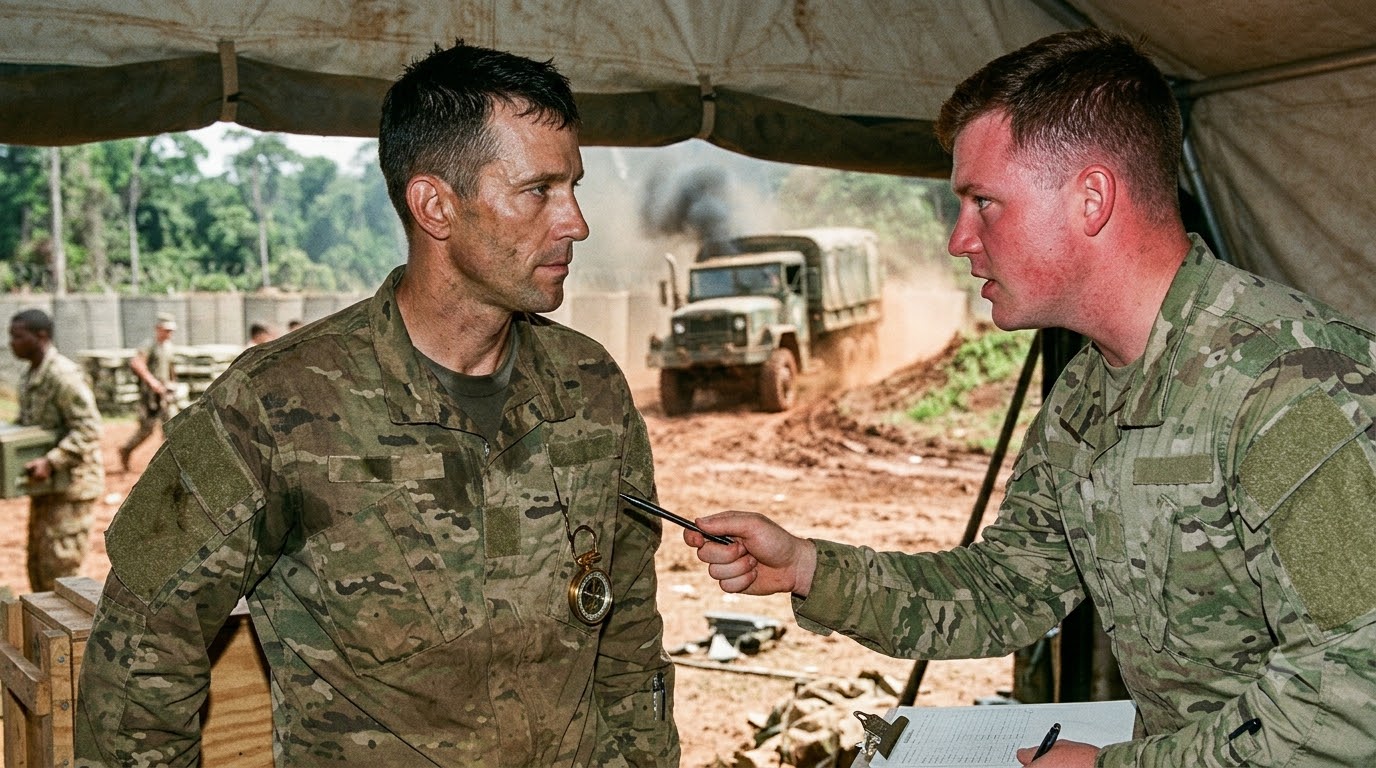
I turned slowly, keeping my weight balanced over my heels. Major Vance stood near the command tent, a clipboard tucked under one arm, his crisp fatigues looking entirely too clean for a fire base.
“There were no contacts, Major,” I said, my voice sounding rusty in my own ears after days of communicating only through subtle pressures on a forearm.
Vance frowned, dropping the clipboard against his thigh. “None? You were out past the Song Rai river for ten solid days with the Australians. You’re telling me you walked through a known transit zone and found nothing?”
I reached into my pocket, my thumb finding the smooth, worn edge of my brass compass. I didn’t pull it out. I just pressed my thumb hard against the metal until the edges bit into my skin, grounding myself against the rising irritation.
“We found plenty,” I said quietly. “We just didn’t announce ourselves to the entire province while we were doing it.”
Vance crossed his arms, his eyes narrowing in cold skepticism. “The brass doesn’t pay for silence, Captain. They pay for body counts. If your patrol isn’t engaging, you aren’t doing the job.”
CHAPTER 2: THE TENDAY VOID
A thumb pressing hard into the cold edge of a brass compass was the only thing keeping my nails from biting into my palm as Major Vance shifted his weight in the red mud. He expected a briefing, a stack of grid coordinates, and a body count to justify the fuel burned by the transport choppers.
Instead, he got a man who hadn’t spoken out loud in ten days and had no intention of starting now just to satisfy a clipboard.
“I’m waiting, Captain,” Vance said, leaning closer, his breath smelling of stale chicory coffee and base-camp canteen water. “The division commander wants to know why your team bypassed the sector three checkpoint.”
I didn’t blink. I didn’t adjust my posture. Out in the deep green, a single unnecessary twitch of a shoulder blade could draw a sniper’s round from forty meters away; down here in the rear echelon, it just drew an irritated sigh from a desk officer who treated the jungle like a chessboard.
“We bypassed checkpoint three because the trail was fouled,” I said, my voice deliberately flat. “A battalion of regular infantry had just stomped through it with heavy boots, tin cups clinking on web gear, and radios squawking at full volume. They left a scent trail and a noise signature a blind guerrilla could track from a mile away.”
Vance scoffed, stepping back and waving a hand toward the perimeter fence where a platoon was stacking crates with loud, echoing metallic thuds. “They were securing the sector. That’s how a modern army operates. We project power. We don’t creep around like ghosts in the ferns.”
“And that’s why Sector Three has been a graveyard for our patrols every Tuesday for the last six months,” I replied, the brass compass casing biting deeper into my thumb joint.
The memory of the past ten days wasn’t romantic; it was a grueling exercise in absolute erasure. We hadn’t moved at three kilometers a day like the textbook manuals demanded, blundering through the undergrowth with machetes and bravado.
We moved at one hundred meters an hour. Sometimes fifty.
Every single footfall was calculated, weighed, and placed with agonizing deliberation on rotting logs or bare stone to avoid snapping dry twigs that echoed like pistol shots in the canopy. The Australians hadn’t taught us a secret martial art or handed us a new gadget; they had stripped away our noise, our arrogance, and our frantic need to be heard.
Vance tapped his clipboard against his knee, a sharp, rhythmic sound that grated against my nerves. “You sound like you’re defending the enemy, Captain. I’m giving you one more chance to hand over those logs. If you refuse to report your intelligence properly, I’ll write you up for insubordination and pull your team off line.”
I looked past his shoulder, watching a supply truck grind its gears as it tried to climb the muddy incline near the motor pool, black smoke belching from its exhaust.
“Write whatever you want, Major,” I whispered, the subtext hanging heavy between us without a single raised voice. “But out there, your paperwork won’t stop a bullet fired by someone who’s been watching you arrive for the last two hours.”
CHAPTER 3: THE BROKEN COMPASS
A thumb releasing the brass compass, leaving a white crescent indentation in the skin, offered the only physical anchor against Major Vance’s rising demand for paperwork. The clipboard hit the wooden field desk with a sharp smack that startled a fly resting on the edge of a map case.
“You think you’re the first smart guy to walk out of the bush and look down your nose at the command structure, Captain?” Vance leaned over the table, his face flushing a mottled red against the humid heat. “We run a war here, not a philosophical seminar. If you can’t produce standard grid reports, I’ll find someone who can.”
I didn’t step back. The memory of the deep jungle—where a single raised voice meant an immediate ambush—made his shouting sound hollow, almost childish.
“Your standard grid reports are based on phantom maps,” I said, my voice dropping an octave, forcing him to strain to hear it over the generator hum outside. “The enemy isn’t standing in the open waiting for your artillery grid. They’re watching every supply convoy that rattles down that road with headlights blazing in broad daylight.”
Vance snatched up his clipboard again, his knuckles whitening around the plastic edge. “That convoy system feeds three thousand men. We use trucks because we have them. That’s called logistics.”
“It’s called a neon sign,” I replied.
The air between us grew thick with the heavy scent of damp canvas and stale sweat. Vance jabbed a pen toward my chest, his professional veneer entirely fractured by the calm refusal to yield.
“You’re walking a very fine line of insubordination, Captain. The division wants results, and right now, all I’m getting from your sector is attitude and empty notebooks.”
“You want results?” I reached out, my fingers tapping once against the cold steel casing of the compass still resting in my pocket. “Then stop sending patrols out like marching bands. Clear the transit routes by moving at one hundred meters an hour, or stop sending men out at all.”
Vance let out a harsh, incredulous laugh, turning away to pace the length of the cramped tent. “One hundred meters an hour. The general would court-martial me before lunch if my men moved that slow.”
“Then the general will keep burying platoons on Tuesdays,” I whispered.
CHAPTER 4: THE SILENT LESSON
Fingers tightening around the cold metal zipper of a map case inside the stifling command tent were the only defense against the rising tide of administrative fury. Major Vance slammed his palms down on the table, rattling a stack of requisition forms.
“You’re missing the point entirely, Captain. We can’t afford to crawl through the brush like turtles when an entire brigade depends on swift movement.”
“The brigade is moving too fast to stay alive,” I said, my voice dropping into that flat, dangerous register learned in the deep green.
I didn’t blink as I watched a bead of sweat trace a slow, jagged path down the side of Vance’s temple, pooling right above his collar. He hated being checked, and he hated even more that he couldn’t find a regulation in his manual to cover a man who refused to shout back.
“We tested it,” I continued, unzipping the map case a fraction of an inch to let my thumb brush the brass compass inside. “Ten days without a single spoken word. No radio chatter bouncing off the tree trunks. No boots clattering over dry branches like falling timber.”
Vance crossed his arms, his mouth tightening into a hard, white line. “And what did that buy you? A few bruised knees?”
“It bought us zero casualties,” I snapped, the quiet absolute finality of it cutting straight through his bluster. “While your conventional patrols were walking straight into the same pre-sighted ambush zones every Tuesday afternoon, we watched them from twenty yards away. They never knew we were there. Neither did the enemy.”
The generator outside sputtered, dropping into a low, stuttering drone before roaring back to full power. Vance stepped closer, his boots grinding against the dirt floor of the tent.
“If I sign off on this slow-patrol nonsense, the colonel will have my stripes before sundown.”
“The colonel can keep his stripes,” I replied, leaning forward until our eyes locked across the cluttered desk. “Or he can keep writing letters home explaining why another platoon vanished because they sounded like a brass band marching through a graveyard.”
CHAPTER 5: THE UNSEEN THRESHOLD
A thumb rubbing a smooth brass casing while staring down an angry superior officer offered the only steady anchor in a room thick with bureaucratic panic. Major Vance did not drop his gaze, but his jaw clenched so hard a muscle twitched violently near his ear.
“You think you’re untouchable because the Australians patted you on the back,” Vance muttered, leaning back and yanking a thick dossier from his bottom drawer. “Well, headquarters just reviewed your operational logs from last month. They noticed a distinct lack of engagement reports.”
I didn’t blink. The trap had sprung exactly where the institutional mindset always left itself exposed: an obsession with paperwork over reality.
“We didn’t engage because we didn’t have to,” I said, my voice cutting through the hum of the overhead electric fan. “We gathered intelligence, mapped their transit tunnels, and walked back out without losing a single man. That’s reconnaissance.”
Vance tossed the dossier onto the table, pages fluttering against the metal surface. “HQ calls it dereliction of duty. They want a full inquiry into why your unit is operating outside standard tactical doctrine.”
The friction in the room spiked, thick and suffocating. Vance was leaning hard on his final piece of leverage—the threat of a court-martial, weaponizing the standard command structure to break a protocol he refused to understand.
“Go ahead and call the inquiry,” I replied, stepping closer until the edge of the desk pressed against my thighs. “Bring in the casualty reports from Sector Three while you’re at it. Let’s ask the division why every conventional sweep ends in an ambush while five men moving at a hundred yards an hour walk right past them untouched.”
Vance’s face darkened from a mottled red to a pale, furious grey. He opened his mouth to issue another threat, but the words caught in his throat as he realized the sheer weight of what an open inquiry would actually expose.
CHAPTER 6: THE DUST AND THE GRAY
A hand resting flat on the cold metal surface of a field desk felt the faint, steady vibration of the base camp generators winding down outside. Major Vance didn’t pick up his clipboard. He simply stared at the open dossier, his fingers twitching against the seam of his trousers as the reality of the casualty statistics finally settled into the stale air of the tent.
“The general won’t accept these numbers,” Vance muttered, his voice stripped of its previous authority, reduced to a dry, tired rasp.
“The general doesn’t have to accept them,” I said, keeping my tone level and devoid of triumph. “The jungle already accepted them. That’s the only metric that ever mattered.”
Vance opened his mouth to launch one final, desperate counter-move—a threat to withhold supply allocations, a procedural loophole to punish the insubordination—but he stopped. He looked past my shoulder at the red dust settling quietly across the motor pool outside, where the trucks sat idling with their headlights turned off.
The institutional armor of loud firepower, rapid deployment schedules, and rigid command post metrics had finally hit a wall it couldn’t shout down.
“Get out of my tent, Captain,” Vance whispered, not looking up.
I didn’t argue. I didn’t gloat. I turned on my heel, the rubber soles of my boots scraping quietly against the packed dirt floor as I walked back out into the humid afternoon glare.
The base camp noise was still there, but the rhythm of it had shifted. Further down the perimeter road, a patrol was prepping for a movement, checking their gear not with flashy bravado, but with the quiet, methodical focus of men who had finally learned how to listen.
I pulled the brass compass from my pocket, letting my thumb rest against the cool, worn metal casing one last time.
The needle settled dead center, steady and true in the dusty gray light.