The Echo of a Promise: A Journey Through the Weight of Kindness and Human Connection
CHAPTER 1: THE TERMINAL PULSE
The morning air at Phoenix Sky Harbor tasted like nothing so much as recycled anxiety. It was sharp, cold, and smelled of jet fuel and high-grade burnt coffee. Seven-twelve a.m.
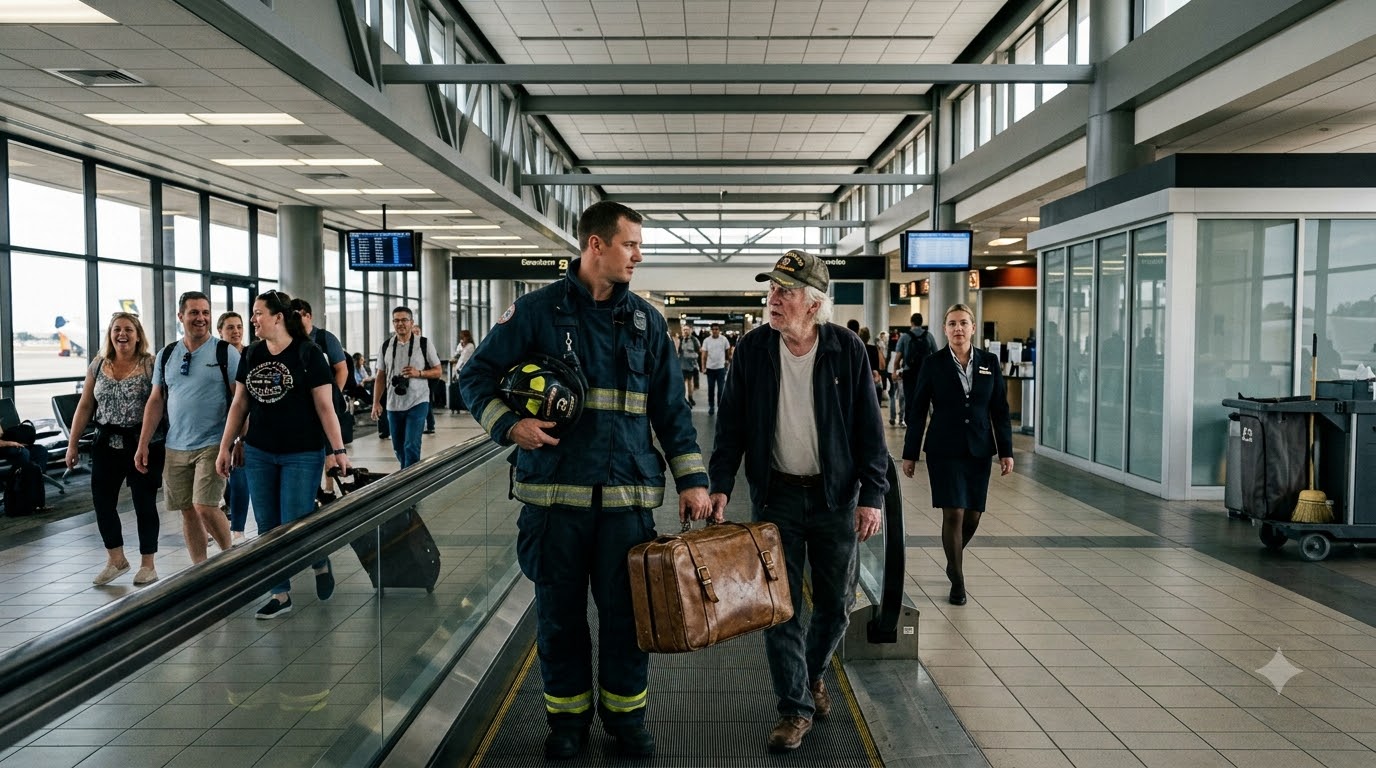
Jason Miller checked his phone again, the screen’s light glaring against his palm. His flight to Flagstaff was boarding in thirty-three minutes. He was a firefighter, used to the gut-deep knowledge of how quickly a structure could turn, how easily a window of safety could close. He moved with that same precision now—a blur of navy jacket and scuffed boots carving a path through the static of tourists and suits.
He had a promise. Ten years old, a metal ribbon, and the bright, terrified excitement in his son Aiden’s voice. That was the only thing that mattered.
Then, he saw him.
It wasn’t a person, not at first. It was a glitch in the terminal’s geometry. A hunched figure, stationary while the sea of travelers flowed like a river around a jagged stone. Jason slowed, his internal clock screaming at him to keep moving, to ignore the anomaly, but his feet, trained for decades to stop where others stepped over, betrayed him.
The man was older, his hair a shock of white beneath a faded cap—a Vietnam emblem, frayed at the edges. He held a ticket like it was a map to a land that no longer existed, turning the paper over and over with hands that shook with a tremor far deeper than age. At his feet sat a suitcase that felt like an intrusion: battered leather, brass buckles dull with the oxidation of years, a texture that screamed of attics and slow, dusty afternoons. It looked out of place among the hard, synthetic surfaces of the terminal. It looked, Jason realized with a tightening in his chest, like something being left behind.
Jason took a breath, the air burning his lungs. He had time. He had maybe three minutes before the threshold of missing his own flight became absolute.
“Sir?” Jason’s voice was the only steady thing in the terminal’s roar.
The man looked up. His eyes were pale blue, flickering with a terrifying, quiet confusion. He wasn’t just lost; he was unmoored.
“I’m looking for C-22,” the man whispered, the paper crinkling in his grip. “They move the gates, don’t they? I think… I think I’ve been walking for an hour.”
Jason reached out, his hand hovering near the man’s elbow, careful not to startle him. As he did, he noticed something in the man’s eyes—a fleeting, phantom shadow of a young man in a jungle, standing in the dark, waiting for a signal that never came.
“I’m Jason,” he said, and then, before he could stop the words from spilling out, he heard his own voice commit the error that would cost him his flight. “Let me see that, Walter.”
The man went still, his shoulders squaring under his threadbare coat, but his gaze didn’t leave Jason’s. “How did you know my name?”
Jason froze. He hadn’t seen a tag. He hadn’t checked a bag. He just knew.
CHAPTER 2: THE WEIGHT OF CEDAR AND OLD LEATHER
Jason stared at the man. The terminal around them didn’t just fade; it turned translucent, a blur of motion and sound that felt increasingly distant. He hadn’t seen a bag tag, hadn’t glanced at an ID, and yet, the name “Walter” had felt less like a guess and more like a resonance, a vibration in his own marrow that matched the man’s posture.
“You have a patch,” Jason said, his voice sounding hollow to his own ears. He pointed toward the frayed, muted fabric on the man’s cap. “I’ve seen that before. My grandfather. He wore a jacket with that same emblem.”
Walter blinked, the confusion in his eyes giving way to a sharper, more piercing clarity. He shifted the battered suitcase, the leather creaking—a dry, skeletal sound that cut through the sterile hum of the airport floor. “Your grandfather?”
“He didn’t talk about it,” Jason murmured. The memory surged, unbidden and cold: the smell of gun oil and mothballs emanating from his grandfather’s nightstand, the way the man would hold a small metal disc in his palm for hours, his thumb tracing the edges until the surface was smooth as glass. It was a phantom sensation, a psychological ghost that had lived in the back of Jason’s mind for twenty years. “He just… he carried it. The weight of it. I see that same weight in how you hold that bag, Walter.”
Walter didn’t respond immediately. He looked down at his suitcase, his knuckles white against the dark, cracked leather. The silence that stretched between them was heavier than the rush of travelers around them. For a second, the terminal’s mechanical, overhead chime felt like the distant thud of a closing door.
“The bag,” Walter said, his voice dropping to a gravelly whisper, “holds nothing but clothes and a few papers, Jason. But it is heavy. You are right about that. We spend our lives trying to put things down, but the things that matter—the promises, the lost faces—they never really leave our hands.”
Jason looked at his watch. 7:17 a.m.
The pressure of the upcoming flight to Flagstaff, of Aiden’s expectation, of the shiny metal medal waiting for his boy, began to prick at his consciousness. He was a firefighter. He knew better than anyone that you didn’t linger in a structure that was already buckling. And yet, he couldn’t turn away. The man’s pale blue eyes were anchored to his, demanding a level of presence he hadn’t prepared to give.
“I have a flight,” Jason said, the words feeling clumsy. “I promised my son…”
“A promise,” Walter interrupted, his tone gentle, almost forgiving. “That is the heaviest thing of all. I have spent fifty years carrying a promise made in a mud-drenched trench to a man who never came home. I know what it costs to keep them.”
Jason took a step back, the toe of his boot catching the edge of a floor tile. The interaction felt increasingly less like a chance encounter and more like a collision. He had identified the man’s name without being told, and now, he felt the strange, terrifying tug of an obligation that had nothing to do with him—or perhaps, everything to do with his own inheritance of silence.
“C-22,” Jason said, forcing his mind back to the mechanics of the terminal. He grabbed the handle of the suitcase. The leather was surprisingly rough, cold, and felt strangely dense, as if it held more than just clothing. “If we’re going to get you there, we need to move. The gates in this sector are a labyrinth.”
Walter let go of the handle, his fingers trembling slightly as they curled into his palms. “I don’t wish to be a burden, son.”
“You’re not a burden,” Jason said, pulling the suitcase into the flow of the terminal’s traffic. As he began to walk, he felt the gaze of a passing flight attendant, her expression neutral and detached, as if they were nothing more than scenery in a machine designed for speed.
He didn’t look back at the flight information board. He didn’t look for his own gate. He focused entirely on the uneven, lopsided rhythm of Walter’s walk—a cadence that suggested a long-ago injury, a physical scar that synced perfectly with the psychological ones.
“Tell me about him,” Jason said, his voice low, matching the murmur of the crowd. “Your friend. The one you made the promise to.”
Walter leaned slightly into Jason’s arm, his weight a subtle, persistent gravity. “He wasn’t just a friend. He was the anchor. When the world turned to smoke, he was the only thing that kept me from drifting into the gray. And today, I am going to tell him that I finally finished what we started.”
Jason nodded, though a shiver traced his spine. The airport lights seemed to flicker, a momentary dip in the power that left them in shadow for a fraction of a second. In that darkness, he didn’t see the terminal anymore; he saw his own future, a quiet, inevitable path he hadn’t chosen, but one he realized he was already walking.
“We’ll get you there,” Jason promised.
He didn’t know if he was talking to Walter, or to the ghost of his own grandfather. He only knew that the clock was ticking, and the distance to C-22 felt like it was expanding with every step they took.
CHAPTER 3: THE MOVING WALKWAY
The moving walkway beneath their feet hissed, a rhythmic, mechanical pulse that vibrated through the soles of Jason’s boots. It was a conveyor belt for the weary, a steady, unidirectional flow that seemed to pull them deeper into the terminal’s belly. Walter stood to his right, his hand resting lightly on the black rubber handrail. He looked smaller here, framed against the vast, glass-walled expanse of the concourse where the morning sky was shifting from amber to a pale, clinical blue.
Jason kept his gaze forward. Every few seconds, he checked the monitors lining the ceiling. The distance to the C-gates was increasing, not decreasing. The sheer scale of the terminal—this sprawling, concrete organism—felt like it was intentionally misdirecting them.
“You said your grandfather was in Korea,” Walter said suddenly, his voice thin, barely audible over the hum of the belt.
Jason glanced at him. The older man was staring at his own reflection in the darkened glass of a closed kiosk. “Yes. He never talked about the cold, but I remember his hands. He couldn’t hold a glass of water without them shaking, especially in the winter.”
“The cold,” Walter repeated, his eyes darkening. “It’s a different kind of silence, isn’t it? In the jungle, the silence is thick, pulsing. In the cold, the silence is… hollow. It strips you down until there’s nothing left but the person standing next to you.”
A sudden, sharp chime cut through the air—a piercing, synthesized note that signaled an update. Jason’s heart hammered against his ribs. He looked up, his pulse spiking as he read the glowing red text scrolling across the nearest board: FLIGHT UA1184 GATE CHANGE. DEPARTURE TERMINAL D, GATE D16.
“D16,” Jason muttered, his voice taut. “That’s all the way back across the main hub.”
He felt a heavy, sinking sensation in his gut. His own flight—the one he was supposed to be on—would have been boarding by now. He had already missed it. The realization settled over him with a strange, numb clarity, but there was no time to mourn the lost hours. He had to pivot. He had to maintain the rhythm.
He stepped off the moving walkway, his momentum carrying him forward as he reached for Walter’s arm. “They’ve changed it again, Walter. We’re heading to Terminal D.”
Walter didn’t protest. He simply nodded, his face tight with a grim, quiet endurance. As they turned back into the heavy flow of the crowd, Jason felt the environment push back. A group of tourists blocked their path, their laughter oblivious and grating; a janitor’s cart swerved, forcing them to pause.
Jason felt his patience fraying at the edges. He watched the way Walter’s right leg dragged, just a fraction, every time they had to adjust their stride. The old man was exhausted. His skin, under the harsh overhead fluorescent lights, had taken on a translucent, waxen quality.
“We’re going to get there,” Jason said, though he was really trying to convince himself.
“I don’t mind the walking,” Walter said, his breath hitching slightly. “It’s the waiting that’s hard. When you wait, you think. And when you think, you remember.”
“What do you remember right now?” Jason asked. He kept his voice low, steady—the voice he used when speaking to someone trapped in a high-pressure situation.
Walter paused at the base of the escalator, his gaze fixed on the endless stream of people rushing upward. “I remember a morning just like this. Before the world broke. We were young, and we thought the war was just a chapter in a book we were writing together. You don’t realize until you’re old that the book is finished before you even turn the first page.”
Jason felt a pang of profound sadness, not just for the man, but for the universal truth of the words. He tightened his grip on the leather suitcase. The material was warm now, heated by the friction of his hand, and he noticed a small, hand-stitched repair on the base—a bit of thick, dark twine that had held the leather together for years. It was a sign of maintenance, of someone who refused to let things fall apart.
“Your son,” Jason began, then stopped. “Does he know about the promise?”
Walter’s expression shifted, a flicker of something guarded crossing his eyes. “Thomas? Thomas is a man of the future, Jason. He looks at the horizon. He doesn’t look at the dirt beneath his boots. He loves me, I know that. But he doesn’t understand why I’m here. To him, I’m just an old man chasing a ghost.”
“He’s wrong,” Jason said firmly.
“Perhaps.” Walter’s smile was faint, almost invisible. “But he is the one who keeps me tethered to this life. He’s the reason I’m still standing here.”
Jason looked at the terminal’s ceiling, at the crisscrossing steel beams that held the roof aloft. It was all so rigid, so calculated, and yet, here they were—two men, two ghosts, navigating a labyrinth of cold steel.
“Terminal D,” Jason whispered. He could see the signage now, a bold blue ‘D’ marking the corridor.
He didn’t know why he felt so committed to this. He had broken his promise to Aiden. He was stranded, exhausted, and running on empty. And yet, as he steered Walter toward the ramp, he felt a strange, inexplicable sense of purpose. The machine of the airport was cold, but the connection he felt to the old man—the shared inheritance of silence—was the only thing in the building that possessed any warmth.
They began the long climb up the ramp toward Terminal D. Jason didn’t look at his phone. He didn’t think about his son. He only thought about the next step, the weight of the leather suitcase, and the man beside him who had traveled through fifty years of silence just to keep his word.
CHAPTER 4: THE FIRST GATE CHANGE
They crested the top of the ramp and spilled out into the concourse of Terminal D. The change in atmosphere was instantaneous; the air here felt different—stale, recycled, and somehow thinner. The concourse stretched out in a long, unbroken line, polished floor reflecting the harsh white glow of overhead LED arrays.
Jason kept a firm grip on the suitcase handle. The leather was slick with the sweat of his own palm now, a testament to the mounting pressure. Walter’s pace had slowed to a tentative shuffle. Every time his right foot hit the floor, his shoulder hitched, a reflexive wince that he tried to hide by staring intently at the floorboards.
“D16,” Jason murmured, scanning the signage. “It’s a long walk, Walter. How are you holding up?”
Walter drew a sharp, whistling breath through his nose. “I’ve walked longer, son. Mostly in mud, not in a glass-and-steel cathedral. The surface is the hardest part. It doesn’t give. It just demands.”
They passed a series of boarding gates. At D12, a flight to Seattle was loading; a line of passengers stood in a queue that looked like a wall of impatient, shifting silhouettes. Jason guided Walter toward the edge, avoiding the crowd, his eyes constantly tracking the flight monitors.
As they walked, Jason noticed something strange about the environment—a repetitive, glitchy flicker on one of the smaller departure screens. It blinked GATE D16 in a frantic, pulsating rhythm before fading to black. It felt like a warning.
“We need to be careful,” Jason said, his voice lowering. “The information in this terminal… it’s not as static as it should be.”
Walter looked at him, his pale blue eyes searching Jason’s face. “You feel it too, then? The machine trying to push us out of the cycle?”
Jason didn’t answer. He couldn’t articulate why the airport felt like an adversary, but the sense of being monitored by the architecture itself was becoming hard to ignore. He felt the weight of his own phone in his pocket—an anchor to the world he had abandoned for this quest. It hadn’t buzzed in ten minutes. No updates from the school, no messages from Mark. It was as if the phone knew that the time for logistics had passed.
They reached a point where the concourse veered sharply to the left, toward a quieter section of the terminal. The noise here was muffled, dampened by the absence of crowds. A row of vending machines hummed with a low-frequency drone that seemed to vibrate in Jason’s teeth.
Walter stopped, his chest heaving. He leaned against the cool, glass partition of a closed newsstand, his face drained of color.
“Take a minute,” Jason said, his own pulse steadying. He stood as a sentry, watching the empty corridor.
“I remember,” Walter whispered, his voice cracking. “The day I left. It wasn’t in a place like this. It was in the dark, on the back of a truck, and the air smelled of rain and burnt rubber. I didn’t know then that I was leaving behind the only version of myself that was ever truly whole.”
Jason looked at the older man. The Faded Texture of the moment—the way the light caught the dust motes dancing in the sterile air—felt deeply intimate.
“Why did you come back here, Walter? Why now?”
Walter reached into his coat pocket and pulled out a worn, silver pocket watch. He didn’t open it. He just held it in his palm, his thumb circling the casing. “Because for fifty years, I thought I was the only one who had survived. I thought I was the only one carrying the debt. But yesterday, I found a letter. A letter written by the boy who was standing next to me when the world tore itself apart. He didn’t die that day, Jason. He lived. And he told me where to find him.”
Jason felt a sudden, sharp coldness in the air. The “friend” Walter had mentioned earlier—the one at the reunion—was not a collection of memories. It was a person, waiting at the end of this terminal.
“Where is he?” Jason asked, his voice barely audible.
Walter looked down the long, empty stretch of Terminal D, toward the distant gates that seemed to vanish into the morning haze. “He’s at the end of the line. Where the gates turn into the sky.”
A sudden sound—a heavy, resonant thud from behind a service door—made both men jump. Jason instinctively moved in front of Walter, his firefighter’s instinct for threat assessment taking over. The hallway was empty, yet the sense of being followed, or perhaps being guided, was overwhelming.
“We shouldn’t stop again,” Jason said, his voice regaining its command. He gripped the suitcase. “We’re close. I can feel it.”
Walter pushed himself off the glass, his jaw set in a line of grim resolve. He didn’t complain about the leg, or the distance, or the strange, flickering monitors. He just straightened his cap, checked the position of his coat, and began to walk.
As they moved forward, Jason noticed a reflection in the floor—not just of himself and Walter, but of the empty space behind them. For a brief second, he saw the flicker of a third shadow, a shape that didn’t match the geometry of the terminal. He turned, his heart leaping into his throat, but the corridor was completely empty, bathed in the same, sterile morning light.
They were being watched, or they were being tested. Either way, Jason tightened his grip on the suitcase. He wasn’t going to let go. Not until they reached the gate where the sky waited.
CHAPTER 5: THE SECOND GATE CHANGE
The silence of the corridor felt brittle, like frozen glass waiting to shatter. Jason stood at the spot where the shadow had flickered, his breath coming in shallow, controlled bursts. The air was unnaturally still, the hum of the vending machines suddenly cut off, replaced by a deep, throbbing silence that vibrated in his ears.
“Jason?” Walter’s voice was a soft, trembling ripple in the quiet. He was still standing by the newsstand, his hand gripping the edge of the display case so hard his knuckles had turned bone-white. “What did you see?”
“Nothing,” Jason said, though his heart hammered a frantic rhythm against his ribs. He forced his muscles to relax, shifting his weight. “Just a trick of the light. The monitors… they do strange things here.”
He turned back to the older man, but as he did, he caught sight of his own reflection in a polished brass directory. He looked haggard, his eyes bloodshot, his movements stiff. It was the face of a man who had been running for too long, a face he barely recognized. He shook his head, a violent, sharp movement meant to clear the cobwebs, but the sense of unreality only deepened.
“We have to keep moving,” Jason insisted, his voice rising a fraction higher than he intended.
They started walking again, the rhythm of their footsteps sounding strangely hollow, as if they were walking inside a cavern rather than a modern terminal. As they neared the junction that led toward Gate D10, the overhead speakers erupted with a garbled, distorted announcement. It wasn’t the calm, synthesized voice from earlier; it was a rough, static-choked rasp, like a radio picking up a broadcast from a different frequency entirely.
Attention… Gate D10… change of status… service maintenance… proceed to D16…
Jason stopped dead. “That makes no sense,” he muttered, turning to Walter. “We just came from D16. They sent us here to D10.”
Walter’s face was ashen, his eyes wide and unfocused. “The loop, Jason. Don’t you see? It isn’t a destination. It’s a circle.”
Jason grabbed Walter’s shoulder, shaking him slightly. “No. No, it’s not a circle. It’s an airport. A massive, confusing, poorly managed airport. We’re just… we’re tired, Walter. That’s all.”
But as he looked at the gate signage ahead, he felt a wave of dizziness. The numbers on the signs seemed to shift, the letters blurring into nonsensical shapes. He blinked hard, rubbing his eyes, but when he looked back, the sign for D10 had vanished entirely, replaced by a blank, white wall.
The panic he had been suppressing surged upward, a hot, choking tide. He had spent his life fighting fires, identifying the path of least resistance, the logical sequence of survival. But this was a different kind of trap. There were no flames to combat here, no structural weaknesses he could exploit. The structure itself was alive, shifting, and hostile.
“I promised Aiden,” Jason whispered, more to himself than to the old man.
“Promises,” Walter said, his voice strangely calm now, a stark contrast to his earlier distress. “Maybe the promise isn’t to be at the stadium, Jason. Maybe the promise is to see this through to the end, regardless of where the end is.”
Jason didn’t want to hear it. He shoved his hands into his pockets, his fingers brushing against his phone. He pulled it out, ready to call for help, to call the airline, to call anyone—but the screen was dead. Not black, but flickering with a strange, pale geometry, a series of lines and arcs that didn’t resemble any operating system he had ever seen.
He stared at it for a long, agonizing moment before slamming it back into his pocket.
“We’re going to the next gate,” Jason said, his voice cold and flat. “Whatever number is on the sign, we’re going.”
They moved forward, their pace quickening despite the exhaustion that radiated from Walter’s every movement. The terminal around them seemed to lengthen, the distance between the gates growing, the ceiling vaulting higher until it felt as though they were walking beneath a vast, dark sky.
They reached the end of the corridor. There was a single, heavy metal door marked with a simple, handwritten sign: AUTHORIZED PERSONNEL ONLY.
Jason didn’t hesitate. He reached for the handle. It was cold—bitterly, dangerously cold. He turned it, expecting the resistance of a locked mechanism, but the door swung inward with a fluid, silent motion.
Beyond it lay not a gate, but a long, narrow bridge, bathed in the soft, ethereal light of a sun that had not yet risen. The air that rushed in smelled of damp earth and cedar—the same scent that lingered on Walter’s suitcase.
“This isn’t the terminal,” Jason breathed, his hand hovering in the doorway.
“No,” Walter said, his voice filled with a sudden, aching peace. “This is where the walk ends.”
Jason took the first step, the ground beneath him firm and solid, yet shifting like a memory. He wasn’t in the terminal anymore. He wasn’t sure he was even in the same world. But he held the leather handle of the suitcase, and he didn’t look back. He had come too far to turn around now.
CHAPTER 6: THE INVISIBLE NETWORK
The bridge was not concrete or tile. It was a latticework of oxidized steel, humming with an almost imperceptible vibration. Outside the railing, the world was a void of swirling gray mist—no tarmac, no planes, no sky—just the infinite expanse of the airport’s own manufactured silence.
Jason felt the sudden, crushing weight of the realization. He had walked through a door, and in doing so, he had stepped off the map of the known world. He gripped the suitcase handle, the leather now feeling like a lifeline, a physical anchor to the man beside him.
“Walter,” Jason said, his voice struggling against the sudden stillness. “Where are we?”
Walter didn’t look at the mist. He kept his eyes fixed on the path ahead, where a faint, singular light glowed in the distance—a soft, golden beacon. “We are where the promises are kept, Jason. We are in the clearing house.”
Jason felt a surge of cold, analytical panic. He looked back, but there was no door. Just a solid, seamless wall of gray steel. He began to search the perimeter, his firefighter training kicking in—looking for a latch, a seam, an emergency release—but the structure was perfect, seamless, and entirely unyielding.
“We need to get back,” Jason insisted, his voice rising, echoing strangely in the thin air. “My son… the stadium… I have to be there.”
“You are there,” Walter said, stopping mid-stride. He turned to face Jason, his pale eyes burning with a sudden, fierce intensity. “Look at the bag, Jason. Truly look at it.”
Jason looked down. The battered suitcase, which he had been clutching for the last hour, was changing. The cracked leather was smoothing out, the brass buckles shining with a new, metallic luster. It wasn’t the bag he had picked up in the terminal. It was a field kit—standard issue from a conflict fifty years gone.
Jason’s hand jerked away as if burned. “What is this?”
“The network,” Walter said, his voice dropping to a whisper. “The terminal isn’t a building, Jason. It’s a repository. Every person who passes through it, every person who is lost, every person who makes a choice—it all gets recorded here. The delay, the gate changes, the exhaustion—it was never meant to stop us. It was meant to filter us.”
“Filter us for what?”
“For the connection,” Walter said. “You didn’t help me because you were a kind man, Jason. You helped me because you were the only one who could hear the signal. The signal that your grandfather left behind.”
Jason felt the ground sway. The mention of his grandfather—the man who lived in the silence of his own nightstand—ripped through his defenses. He thought of the medal, the nightstand, the way his father had never understood the man’s absence.
“My grandfather never came back, did he?” Jason asked, his voice raw.
“He never came back to the world you know,” Walter replied. “He stayed behind to ensure the connection remained open. And today, you walked right into it.”
Jason looked down the bridge toward the light. It wasn’t just a beacon. As he focused, he realized it was a doorway—a wide, open archway that revealed a glimpse of a familiar, green-grassed stadium under a bright, autumn sky. He could hear the faint, muffled sound of a crowd, a voice over a loudspeaker calling out a name. It was the ceremony. It was the moment he had been chasing.
But it wasn’t just a vision. He could see himself—or a version of himself—walking onto the field, lifting his son, Aiden, into his arms.
“I can go there,” Jason whispered, his heart aching with the possibility.
“You can,” Walter said, his voice tinged with a deep, weary sadness. “But you can’t take the suitcase. You can’t take the history. If you go through, you go through alone, and the bridge closes behind you. I will be left here, with the rest of the voices.”
Jason looked at the man. Walter’s shoulders were slumped, his face lined with the accumulated fatigue of half a century. He was the anchor, and he was tired.
“I can’t leave you,” Jason said, the words coming out before he had thought them through.
“You don’t have to,” Walter replied. “But to move forward, you have to choose which promise matters more. The one you made to the boy in the stadium, or the one you made to the man in the terminal.”
Jason looked from the shimmering, golden field where his son stood, to the man who had walked through the fire of fifty years to find him. The static in his head—the airport’s artificial, frantic pulse—faded away, leaving only the sound of his own breathing and the weight of the man beside him.
He knew then that there was no stadium. There was no plane. There was only the choice. He took a step toward Walter, the suitcase forgotten, and reached out, not to take the handle, but to take the older man’s hand.
CHAPTER 7: THE FLIGHT OF THE WHITE JET
The transition was not a movement through space, but a shedding of skin. As Jason gripped Walter’s hand, the oxidized steel beneath them gave way, replaced by the smooth, polished floor of a cabin—the very cabin of the white jet he had imagined moments before. The silence of the bridge was shattered by the low, steady purr of turbines, and the gray mist outside the railing solidified into the crisp, high-altitude blue of a clear October sky.
Jason blinked, his mind struggling to reconcile the sudden influx of sensation. He was sitting in a cream leather seat, the belt buckled firmly across his waist. Beside him, Walter sat with his eyes closed, his breathing deep and rhythmic, as if he were finally, after fifty years, unburdening his lungs of the thick, humid air of the jungle.
“We’re not in the terminal,” Jason whispered. He didn’t say it in fear; he said it in wonder.
“We’re where we need to be,” Walter replied without opening his eyes. His voice sounded younger, the gravel and tremor replaced by a smooth, resonant clarity.
Jason looked around. The cabin was empty, save for them. Through the small, perfectly round window, he saw the clouds—vast, rolling white mountains that drifted beneath them. He felt the plane bank, a gentle, banked turn that suggested a steady hand at the controls.
“Is this the jet?” Jason asked, his voice catching. “The one Thomas promised?”
Walter opened his eyes. They were bright, clear, and devoid of the confusion that had haunted them for so long. “Thomas is the keeper of the logistics, Jason. He builds the paths. But we? We’re the ones who walked them.”
Jason felt a sudden, sharp ache in his chest—a reminder of the stadium, the medal, and the boy who was likely still scanning the bleachers for a face that would never appear. He looked down at his own hands. They were trembling, a faint vibration that he couldn’t stop.
“My son,” he said, the words feeling heavier than they had ever been. “I failed him.”
“You chose the harder path,” Walter corrected him, his tone soft but absolute. “You walked a ghost home, Jason. And in doing so, you paved a way for your own son to understand that his father was someone who stood for more than just a seat in a stadium.”
The jet banked again, sharper this time. Through the window, Jason saw the landscape below—a patchwork of red roofs and small streets that looked like a toy town. Flagstaff. The stadium was a tiny, vibrant green rectangle tucked into the base of the mountains.
“We’re landing,” Jason realized.
The pilot’s voice crackled over the intercom—not a human voice, but a sound like wind rushing through trees. Landing initiated. Arrival secured.
Jason stood, his legs feeling strangely light, as if he were walking on air. He moved toward the front of the plane, toward the cockpit door, but it slid open before he reached it. He didn’t see a pilot. He saw only the reflection of the sky, a vast, open expanse that beckoned him forward.
He didn’t need to fly the plane. He only needed to be there.
He walked to the door and looked down. The stadium was below them, the crowd a sea of color, the cheers a distant, humming resonance. He saw the boy, Aiden, standing near the sideline. And he saw someone else, too—a man in a suit, standing off to the side, looking up at the sky with a face of quiet, expectant relief. Thomas.
“It’s time,” Walter said, standing beside him.
“Are you coming?” Jason asked.
Walter shook his head, a final, graceful movement. “My flight ended fifty years ago, son. I just needed someone to help me check my bags.”
Jason reached out, but his hand passed through Walter’s shoulder as if it were made of light. He wasn’t afraid. The peace that radiated from the older man was like a soft, warm blanket.
“Thank you,” Jason said, his voice thick with emotion.
“No,” Walter replied, his form beginning to dissolve into the golden haze of the cabin. “Thank you for the walk.”
The jet descended. The wheels touched down on the grass, not with a bump, but with the gentle, rhythmic thud of a heart settling into a steady beat. The door hissed open, and Jason stepped out. The autumn air was crisp, scented with pine and dry earth. He walked toward the field, his boots scuffing the grass, the weight of the leather suitcase—now a light, hollow memory—no longer pulling at his arm.
Aiden looked up, his eyes widening, his mouth forming the word Dad.
The world slowed to a crawl. Jason took the final steps, the roar of the crowd rising in a crescendo that felt less like applause and more like a homecoming. He didn’t just see his son; he saw the future, a bright, unbroken path, paved by the kindness he had chosen when the world demanded that he keep running.
CHAPTER 8: THE STADIUM ECHO
The air on the field was not the sterile, recycled breath of the terminal. It was thick with the scent of autumn—dry grass, cooling earth, and the faint, sweet trace of a brewing storm. Jason stood for a moment, his boots planted in the turf, the sensation of grounding himself against the reality he had almost walked away from.
Aiden was running. His small frame was cutting across the green like a beacon, his face a landscape of unfiltered, breathtaking joy.
“Dad!”
The boy collided with him, the impact of small arms wrapping around his waist breaking the last lingering thread of the white jet’s hum. Jason dropped to one knee, the damp grass soaking into his jeans, and pulled Aiden in. He felt the rapid, uneven thud of his son’s heart, a rhythmic anchor that tethered him back to the present. He wasn’t on a bridge between memories. He was here. He was home.
“I told you,” Jason whispered, his voice catching, his hands trembling as he smoothed the hair back from Aiden’s forehead. “I told you I’d be here.”
Aiden leaned back, his eyes searching Jason’s face with a fierce, possessive intensity. “Everyone said you wouldn’t make it. The game was over, the coach said you were probably stuck in the city.”
Jason looked past his son. The stands were emptying, a sea of parents and families drifting toward the parking lot, but there was one figure still standing near the gate. Thomas. He was watching them, his hands pushed deep into the pockets of his suit, his expression unreadable, yet his gaze held a quiet, shimmering recognition. It was as if he, too, could see the shadow of the man his father had been, finally walking through the gate of his own choosing.
Jason stood, holding Aiden’s hand, and walked toward the gate. The grass felt firm beneath his feet, the world coming into sharp, vibrant focus—the peeling paint on the bleachers, the distant silhouette of the mountains, the way the light began to dip, signaling the end of the day.
“Thomas,” Jason said as he approached.
Thomas didn’t speak for a long moment. He looked at Jason, then down at Aiden, then toward the empty field where the white jet had vanished, leaving only a shimmering heat haze that was already dissipating.
“He’s gone, isn’t he?” Thomas asked. His voice wasn’t accusing. It was hollow, the sound of a man who had been expecting this moment his entire life without knowing what it would cost.
“He’s where he needs to be,” Jason replied. He reached into his own pocket, his fingers finding the small, cold metal of the medal he had intended to give Aiden. He looked at it, then at Thomas. “He wanted you to know that the debt is settled. There is no debt. Only the walk.”
Thomas looked at the medal, then up at Jason. For the first time, the guarded, corporate mask slipped. A tear tracked a slow path through the dust on his cheek. He didn’t wipe it away. “He told me, years ago, that he was waiting for someone who could help him find the way back. I thought he was losing his mind.”
“He was finding his way home,” Jason said. “And he took me with him.”
Thomas nodded, a slow, deliberate movement. He reached out and touched Aiden’s shoulder, a gesture of silent, profound connection. “My father was a good man, Jason. But he was a lonely one. Thank you for not letting him be lonely today.”
They stood there as the sun dipped behind the mountains, painting the sky in deep, bruised violets and fading ambers. The stadium lights flickered on, casting long, dramatic shadows across the grass. It was a moment of deep, settling peace. The chaos of the airport, the frantic, shifting gates, the impossible bridge—it all drifted away, replaced by the simple, enduring reality of a father and a son standing in the quiet of a field.
Later, as they walked toward the car, Jason looked back at the field. He felt the weight of the day, a physical exhaustion that reached into his marrow, but with it came a strange, exhilarating lightness. He had kept his promise, but he had done more than that. He had mended a broken line, a legacy of silence that had stretched across two generations.
He reached into his bag, pulling out the small, brass-fitted pocket watch he had somehow carried with him—a weight he hadn’t realized he was holding. He placed it in Aiden’s hand.
“What’s this, Dad?” Aiden asked, his voice sleepy, his hand closing around the cool metal.
“Something to remember that time is a circle,” Jason said, looking toward the distant, glowing lights of the city. “And that it’s always worth stopping to help someone find their way.”
The car pulled away, the engine purring softly in the cool autumn night. Jason leaned back, closing his eyes, letting the fatigue pull him into a deep, dreamless rest. He was done running. He was finally, truly home.