The Silence That Broke Bronzeville: A Story of Betrayal, Cold Steel, and Unforgiving Vindication
CHAPTER 1: THE ALTARS COLD EDGE
Three hundred people stop breathing at the exact same second, and not one of them looks at the groom.
The organ key stays pressed down under the organist’s thumb, holding a single, heavy note that vibrates right through the hardwood floorboards of the church on Martin Luther King Drive. My gold silk dress—the one Tasha helped me select three months ago—feels like a sheet of ice pressed against my spine.
Gloria Jackson doesn’t raise her voice. She doesn’t have to. She simply steps into the center aisle, her polished heel clicking twice against the runner, and turns her phone screen toward my face.
“Explain this, Aaliyah,” Gloria says, her voice as dry as winter pavement.
The screen glows six inches from my nose. It’s a message thread displaying my old studio contact name, paired with a blurred photograph of a woman in a dark parking lot standing beside a man whose face is turned from the light. The timestamp reads three nights ago—the exact hour I was sitting alone in my shop, mixing foundation shades for Saturday’s bridal party.
My thumb moves automatically to the pocket of my skirt, feeling the cold, rigid steel of my silver cuticle pusher. I press the flat metal edge against my nail bed until the sharp pressure anchors my balance.
“That’s not my writing,” I say. My voice doesn’t tremble, but it sounds thin, stripped of all resonance. “I don’t know that man.”
“It came from your number,” Gloria says, her hand holding the phone perfectly still, not a single quiver in her manicured fingers. “My son’s name is on that marquee outside. The Jackson family does not buy damaged goods.”
I turn my head toward Darius. He stands three feet away in his tailored black tuxedo, his hands clasped neatly in front of his waist. He doesn’t look at the screen. He looks at his mother’s shoulder, his jaw tight, running the exact financial and social arithmetic his family taught him to run before he could walk.
“Darius,” I say softly.
“It’s about the family name, Aaliyah,” Darius says to the air between us. He doesn’t step closer. He doesn’t touch my hand. “My mother has to protect the firm.”
Beside him, Tasha steps forward, her face twisted in a look of sudden, profound grief. She dabs the corner of her eye with a folded lace handkerchief—the same handkerchief I lent her at her sister’s graduation four years ago.
“Gloria, please,” Tasha begs, her voice carrying effortlessly to the fourth pew. “There has to be a mistake. Aaliyah would never do something like this. I know her better than anybody alive.”
She reaches out and touches my arm. Through the thin silk of my sleeve, her fingertips feel surprisingly cold, but her grip holds a steady, deliberate pressure that keeps me pinned to the spot.
I look down at her wrist. Beneath the edge of her gold lace cuff sits an out-of-place detail: a faint, dark smear of waterproof body makeup, hastily blended over a fresh red abrasion near her thumb.
My fingers tighten on the steel tool in my pocket.
“Don’t touch the dress, Tasha,” I say quietly.
Darius turns his back first, stepping down from the altar platform to escort his mother toward the double doors. The congregation doesn’t make a sound; they simply part like water, two hundred pairs of eyes sliding from his retreating shoulders directly back to mine.
CHAPTER 2: THE SCENT OF SETTING SPRAY
My right thumb presses harder against the cold steel edge of the cuticle pusher in my skirt pocket, the flat metal biting deep into the pad of my thumb until the pain forces the church’s oppressive silence out of my head.
The heels of my shoes sound like hollow hammer strikes against the pavement of 47th Street. I don’t wait for a cab. I walk the eleven blocks back to Glow by Aaliyah with the heavy gold silk skirt gathered in one fist, kicking through the dry June dust blowing off the curb.
The glass door of my studio doesn’t ring its brass bell when I push it open; the latch is dry, needing the oil I kept meaning to apply three weeks ago. Inside, the room smells of setting spray and the synthetic vanilla candle sitting cold on the glass display case.
I drop the gold dress right on the linoleum behind the counter. It pools there like a dead sunset.
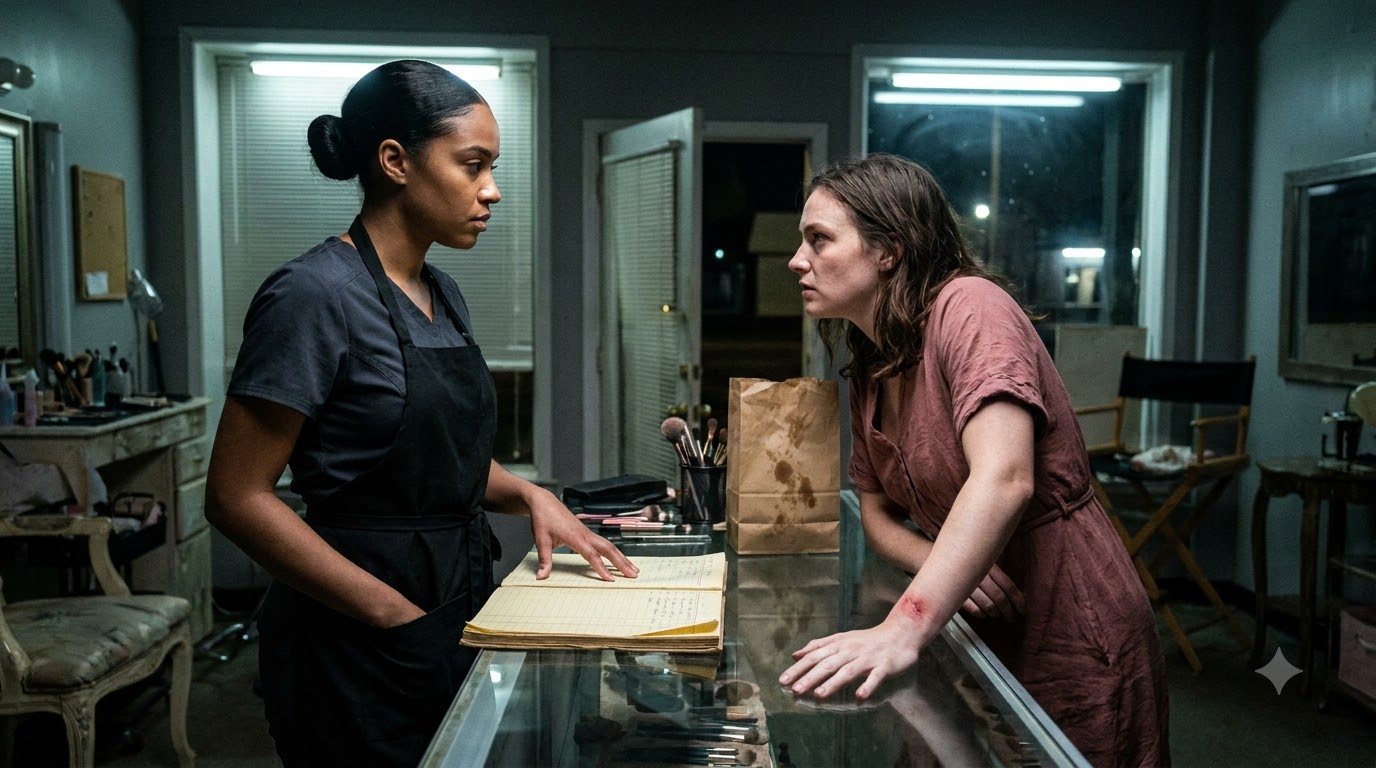
Before I can reach for the light switch, the bell over the side door chiming against the shared wall breaks the stillness. Tasha steps through the connecting frame between our shops, still in her matching dusty-rose maid-of-honor dress. She carries a paper bag from the corner deli, her heels clicking softly on the tile.
“I brought ginger tea,” Tasha says, her voice low, dripping with that smooth, honeyed cadence she uses when a bride starts crying over her veil. “I told Gloria she was out of her mind, Aaliyah. I told her right in the vestibule before they drove off.”
She sets the grease-stained paper bag onto my pristine glass register counter.
“You don’t have to lie in the dark,” I say, staying behind my counter, my fingers tracing the hard edge of the register drawer. “Gloria didn’t get that number off a bathroom wall.”
Tasha sighs, a gentle, helpless sound, and reaches across the glass to touch my arm. She pulls her sleeve down just a fraction of an inch too late, but the flesh around her wrist is clear now—she’s rubbed the concealer completely off, leaving the fresh red mark bare under the harsh fluorescent light from the street.
“People are wicked, Aaliyah,” she says quietly, looking right into my eyes with a soft, steady sorrow. “Bronzeville is full of people who hate to see a woman build something without a man’s permission. You know how they talk.”
“They talk because somebody handed them the paper,” I say.
“I’m your sister,” Tasha whispers, her voice dropping into that tight, emotional register. “Who stood by you when your mama had that stroke? Who sat in the hospital hall with you? I’m the only one on this block who wants to see you win.”
My desk phone rings once. Sharp. Piercing.
I don’t reach for it. Tasha’s eyes flicker toward the black plastic receiver, her lower lip trembling slightly—not from fear, but from the exhausting effort of holding her face in that sympathetic mold.
“Answer it, baby,” Tasha says softly. “It’s probably Darius calling to apologize once his mother calms down.”
I pick up the receiver on the third ring.
“Glow by Aaliyah,” I say.
“Aaliyah? It’s Mrs. Patterson.” The voice on the line is brisk, stripped of the warm familiarity we shared two days ago when I did her daughter’s trial makeup. “We’re going to go in another direction for Saturday’s bridal party. Go ahead and keep the deposit.”
The line goes dead before I can answer.
I set the receiver back down on its cradle. The plastic makes a dull thud.
Tasha lets out a long, trembling breath and reaches into her bag, pulling out a paper cup. “See? People react before they think. But you’ve got me. We still have the shared studio line for the walk-in appointments. We’ll pool the summer schedule like we used to.”
I look at the paper cup, then down at her wrist, where the red abrasion sits raw against her skin.
“The old studio line,” I say softly, the words flat as a board. “The one we set up in 2015.”
“We’ll fix it,” Tasha says, pressing her palm flat against my glass counter, leaving a faint oily smear. “We always fix it.”
She turns and walks back through the connecting door, her rose-colored skirt swishing against the frame. I stand alone in the dark room, listening to the hum of the mini-fridge in the corner, and slowly reach for the old landline ledger tucked beneath the register.
CHAPTER 3: THE GHOST LINE
My fingertips stay resting on the cracked leather cover of the 2015 landline ledger, feeling the stiff pasteboard beneath the grain as the streetlamp outside flickers once through the front window.
I pull the ledger closer across the glass register counter. The yellowed pages smell of damp cellar air and dried ink.
In 2015, when Tasha and I signed the joint lease for our adjacent storefronts, we set up one primary landline for overflow bridal inquiries. It ran through a split box in her back room, tied directly to my original business license. When my studio expanded two years later, I installed my own dedicated line and stopped looking at the joint statements.
I open the back cover where the monthly telecom billing slips are folded into the paper pocket.
My index finger traces down the June invoice from two weeks ago. The line was never disconnected. The primary account holder name reads Glow by Aaliyah, but the secondary billing contact address isn’t our shared shop line on 47th Street.
It lists an apartment on Cottage Grove Avenue. Tasha’s residential address.
I reach for the desk phone, dial the local carrier’s administrative extension, and press the receiver hard against my ear. The mechanical switching clicks ring three times before a representative answers.
“Account verification,” the operator says over the low hum of line static. “Account name is Glow by Aaliyah. What is the listed billing authorization code?”
I glance down at the ledger, reading the four-digit PIN I set up eleven years ago. “4412.”
“Information verified, Ms. Freeman. How can I help you today?”
“I need the outgoing transmission log for the joint studio number ending in 8802,” I say, my voice steady, stripped of all expression. “Specifically for the evening of June 14th.”
“One moment.” The sound of keyboard keys tapping comes through the receiver, rhythmic and sharp. “Yes, ma’am. On June 14th at 8:14 PM, a web-gateway SMS dispatch was authorized through that line’s account portal.”
“Where was the portal accessed from?”
“It was logged in through an IP address associated with the primary billing contact address on Cottage Grove Avenue,” the operator says without pausing. “The message package was sent to six recipients, including a mobile number registered to a Gloria Jackson.”
The air in my throat stays quiet. No gasp. No sudden jolt. Just the cold, clean settling of a weight I’ve been carrying in the dark for three days.
“Send a certified physical copy of that transmission log to my business mailing address,” I say. “Include the account setup documents from 2015.”
“They’ll be mailed out in tomorrow’s dispatch, Ms. Freeman.”
I set the phone down. The brass bell over the side door chiming against the frame tells me Tasha has stepped back through the connecting wall before her shoes even touch my linoleum. She’s holding a small silver tray with two fresh slices of lemon loaf.
“I saw your light was still on,” Tasha says, setting the tray on the glass counter right over the open ledger. “You need to eat something, Aaliyah. You’re going to make yourself sick sitting in the dark.”
I don’t close the book. I don’t move the silver tray. I simply shift my gaze from the yellowed billing slip up to her face.
“The 8802 line is still open, Tasha,” I say softly.
Tasha’s hand freezes two inches above the lemon loaf, her thumb tucked tight into her palm. Her eyes don’t jump to the ledger; they lock directly onto mine, her expression shifting in a fraction of a second from soft concern to a hard, calculating still.
“We set that up for the studio years ago,” she says, her voice flat, the honeyed tone entirely gone. “Why are you digging up old bills?”
“Because Gloria got a text from that line on June 14th at 8:14 PM,” I say. “Sent from Cottage Grove.”
Tasha doesn’t flinch. She steps closer to the glass counter, leaning her weight onto her hands, her knuckles pressing into the glass right beside the silver tray until the skin turns white.
“You think anybody in Bronzeville cares about an IP address on a piece of paper, Aaliyah?” Tasha whispers, her voice low and sharp as a razor edge. “Gloria Jackson already made up her mind. Darius already walked out that door. You can print out all the paper you want, but the story is already told.”
“The paper isn’t for Gloria,” I say.
Tasha lets out a short, dry laugh that doesn’t reach her eyes. “Then who’s it for? You think you can go to the police over a ruined wedding? You think a bank or a court gives a damn about your hurt feelings?”
She reaches out, her manicured nail tapping the glass right over the Cottage Grove address on the bill.
“You’ve always thought you were so clean,” she says, her voice dropping lower, thick with a dark, bitter weight. “Always the good one. Always the one everybody trusts. Let’s see how clean you feel when you try to prove it without a single person on this block taking your word over mine.”
She turns on her heel and walks out, leaving the connecting door wide open behind her.
I reach across the counter, take the paper billing slip from the ledger, fold it neatly into thirds, and slip it inside my skirt pocket right alongside the cold steel of my cuticle pusher.
CHAPTER 4: A LOAN WRITTEN IN DUST
Sitting at my mother’s kitchen table, the folded billing slip rests on the red oilcloth tablecloth next to a worn leather-bound Bible, the overhead light catching a slip of yellowed paper peeking out from beneath the dark cover.
Aunt Ruth sets a heavy ceramic mug of black coffee down in front of me, the liquid sloshing slightly over the rim onto the oilcloth. She doesn’t reach for a napkin. She stands over me, her hands planted square on her hips, her flowered housecoat smelling faintly of camphor and fried cornmeal.
“You need to let this go, Aaliyah,” Aunt Ruth says, her voice thick and gravelly from fifty years on the Southside. “Darius is gone. His mama was never going to let him marry a girl from a block with shared walls anyway. You’re making a spectacle out of nothing.”
I don’t touch the coffee. I reach out and slide the yellowed paper stub out from under the Bible’s heavy binding.
It’s an uncashed cashier’s check stub for eight hundred dollars, dated the fifth of last month. The remitter field is filled in with Tasha’s handwriting, but the payee line is made out directly to Ruth Freeman.
“Eight hundred a month, Aunt Ruth?” I ask, my voice barely above a whisper.
Aunt Ruth’s posture doesn’t soften. Instead, her chin goes up, her shoulders locking tight as she steps closer to the table, her shadow falling completely over the paper stub.
“I helped that girl get her two-flat in 2016 when the bank turned her down,” Aunt Ruth says, her voice hard as brick. “She needed a co-signer with steady income. I gave her my name. That money is my fee for keeping her business afloat.”
“You didn’t just give her your name,” I say, flattening the stub against the table with my palm. “She forged her income documents to get approved, and you found out.”
“And if she goes down, that bank comes after her properties,” Aunt Ruth snaps, her fingers twitching against her housecoat pocket. “And who do you think takes the fall for being listed on those papers? You think your mama’s pension can handle a federal inquiry? You think your little shop survives if this family gets dragged into court?”
She leans over the table, her face inches from mine, the smell of old coffee on her breath.
“Tasha paid for my silence, Aaliyah. She paid so this family wouldn’t get wrecked by her stupid ambition. I took that money to protect us.”
“You took that money so Tasha could keep buying your loyalty while she built a lie around my life,” I say, standing up slowly. The kitchen chair legs scrape sharply against the linoleum.
“You don’t know how the world works,” Aunt Ruth says, her voice rising, shaking with a sudden, desperate rage. “You think being good saves you? You gave her eighteen thousand dollars of your own savings and never asked for a dime back! You were a fool then, and you’re a fool now if you think truth pays the rent!”
“It pays enough,” I say.
I grab the cashier’s check stub from the table, folding it into the same pocket that holds the telecom billing slip and my silver cuticle pusher.
Aunt Ruth grabs my forearm, her fingers digging through my sleeve with a surprising, desperate grip. “If you take this to the church, Aaliyah—if you put this on Tasha in front of Gloria—you destroy everything. You hear me? You won’t have a family left to come home to.”
I look down at her hands, then up into her eyes, seeing the raw, ugly fear staring back at me.
“I lost my wedding on Saturday, Aunt Ruth,” I say, pulling my arm free with a quiet, deliberate motion. “I don’t have anything left to break.”
CHAPTER 5: THE GLASS HOUSE COLLAPSES
Standing at the back podium of the church on Martin Luther King Drive, my fingers grip the smooth mahogany edge of the lectern as three hundred faces turn toward the front, the gold and blue stained-glass light slanting across the sanctuary pews.
The sanctuary microphone gives a faint, high-pitched hum before settling into silence. In the second pew, Gloria Jackson sits erect in her navy suit, her leather handbag resting across her lap like a shield. Beside her, Darius keeps his head rigid, eyes locked straight ahead on the altar cross.
Tasha stands near the side aisle steps, holding a stack of Sunday bulletins, her face frozen in an expression of quiet, practiced sympathy.
“I’m not standing here to ask for my wedding back,” I say into the microphone. My voice hits the vaulted ceiling and drops straight down over the pews, clear and cold. “I’m standing here because a lie told long enough starts acting like the truth.”
I unfold the certified telecom billing record and lay it flat on the wooden lectern, right over the altar cloth.
“On June 14th at 8:14 PM, a message was dispatched to Gloria Jackson’s personal phone,” I say, tapping the paper with my index finger. “It came from a studio number registered under my business name since 2015. But the outgoing web portal was logged in from an IP address assigned exclusively to Tasha Robinson’s apartment on Cottage Grove.”
A low murmur ripples down the center aisle, heads turning toward Tasha.
Tasha’s mouth opens, her bulletin stack shifting in her arms as she takes one step toward the center aisle. “Aaliyah is confused,” she calls out, her voice pitching high, loud enough to ring off the wooden rafters. “She’s grieving her engagement! She brought up old business accounts to deflect from her own mistakes!”
“The carrier certified the IP log under subpoena threat, Tasha,” I say, without raising my voice. “And they certified the secondary account authorization.”
I reach into my pocket and pull out the yellowed cashier’s check stub, setting it down directly beside the phone record.
“Eight hundred dollars a month,” I continue, my eyes moving directly to the front pew where Aunt Ruth sits, her chin pressed tight against her collar. “Moving every fifth of the month from Tasha’s account into my aunt’s hands to keep the bank from reviewing the falsified income documents on her 2016 building loan.”
Aunt Ruth doesn’t look up. Her hands tighten around her purse straps until her knuckles go gray under the church light.
Gloria Jackson turns her head slowly, her eyes sliding away from me and locking onto Tasha with a cold, measuring stare that strips every bit of warmth from the aisle.
“That paper is fake!” Tasha shouts, dropping the bulletins entirely. Paper scatters across the carpeted steps as she strides toward the lectern, her face flushing dark red, her fingers clawing at her own lace sleeve. “She forged it! She’s trying to ruin me because Darius chose me over her! Tell them, Darius! Tell them how she’s lying!”
Darius doesn’t move a muscle. He slowly slides three inches down the pew, away from Tasha, his eyes fixed on the floorboards between his shoes.
“The bank regulators received copies of these records at eight o’clock this morning,” I say, holding my ground at the lectern, my palm resting flat on the mahogany edge. “And civil counsel has already filed the claim.”
Tasha stops three feet from the lectern, her breath coming in ragged, shallow gasps, her mask completely gone as she looks around the room and finds three hundred pairs of eyes looking back at her in dead silence.