A Bridge Across Time: The Silent Echoes of a Promise Kept and a Soul Reclaimed
CHAPTER 1: The Weight of Warm Ceramic
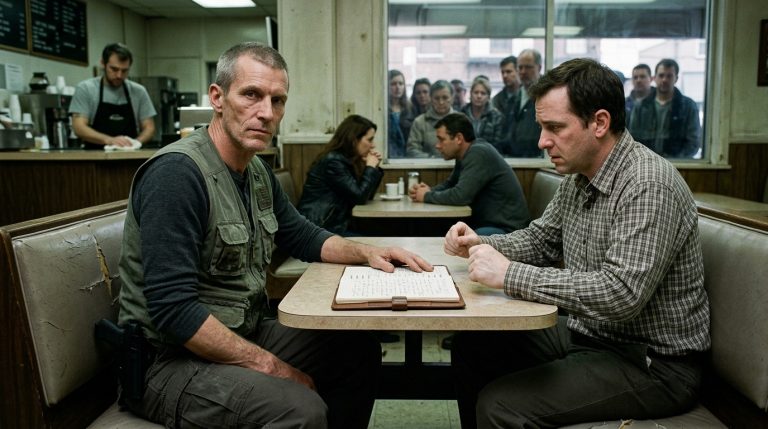
The coffee shop was a sanctuary of amber light and the smell of roasted beans, a sharp, necessary contrast to the gray, sodden atmosphere of the cemetery that still clung to Davies’ skin. He stood by the counter, the fresh ceramic mug heating his palms, his eyes fixed on the solitary figure sitting by the rain-streaked window.
Dale Cooper was smaller than he had seemed in the presence of the General’s entourage. He looked like an anchor that had finally let go of the seabed, drifting now in a world that didn’t quite know what to do with him. He was staring at the rain, his hands wrapped around his own black coffee, his shoulders rounded under the weight of the worn leather jacket.
Davies moved toward the table, every step feeling as though he were walking on eggshells. He felt the phantom pressure of his own hand on Dale’s arm from that afternoon—a memory that now felt like a violation of something sacred. When he reached the table, he didn’t ask for permission to sit; he simply stood there, an intruder in the old man’s orbit.
“Mr. Cooper?”
Dale shifted. It wasn’t the slow, distant movement from the cemetery; this was a deliberate, grounded return to the present. His eyes, the color of denim bleached by too many suns, focused on Davies. There was no recrimination in them, no sharp edge of authority. Just a quiet, observant stillness.
Davies placed the second cup of coffee on the small, scarred table. The ceramic clicked against the wood, a sharp, dissonant sound in the quiet space. He searched for a bridge, some string of words that wouldn’t feel hollow, but everything he had practiced felt scripted and plastic.
“Thank you, sir,” Davies managed, his voice dropping to a register of guarded vulnerability. “For the lesson.”
Dale looked at the coffee, then up at the young Marine, his gaze lingering on the nervous tension in Davies’ jaw. He didn’t offer a platitude. He didn’t tell him it was alright, because the damage done by the world was rarely ‘alright.’ Instead, he reached out with his gnarled, steady hand and adjusted the placement of the saucer, sliding it an inch closer to Davies.
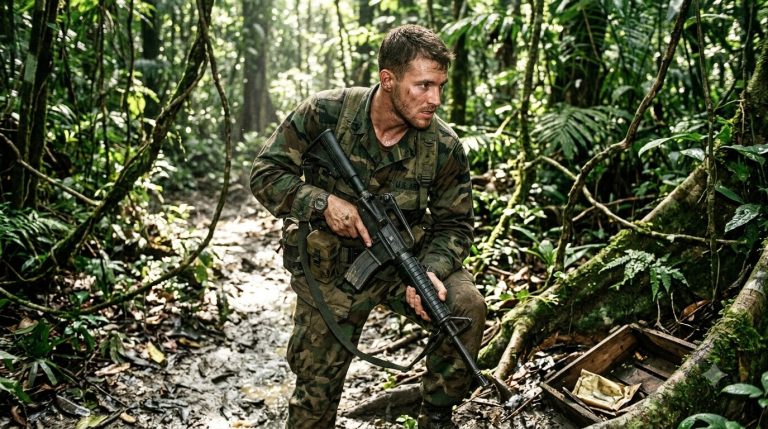
As he moved, a small, frayed scrap of leather—a remnant of the bracelet’s weaving—slipped from his cuff and landed on the table between them. It was nothing more than a piece of debris, yet as Dale looked at it, his expression changed. He didn’t look at Davies anymore. His eyes drifted back to the window, but the focus was gone; he was looking through the glass, through the rain, toward a jungle that had never truly left him.
“The lesson isn’t in what you say, son,” Dale whispered, his voice a dry, papery rustle. “It’s in what you choose to see when you think no one is watching.”
Davies looked down at the scrap of leather. It was so inconsequential, yet it felt like a shard of a shattered life. Then, as he looked back up to ask what he meant, he saw it: a man in a dark suit standing outside in the rain, not looking at the shop, but staring directly at the back of Dale Cooper’s head. The stranger’s hand was pressed against his ear, his lips moving in a steady, rhythmic pulse of communication.
The connection tightened. The cafe, the coffee, the quiet peace—it all felt like a fragile shell about to crack. Dale hadn’t noticed the man, but the way his hand tightened on his mug told Davies that the old man was perfectly aware that his silence had finally drawn a shadow.
CHAPTER 2: The Geometry of Shadows
Dale’s fingers didn’t tremble, but they tightened around the ceramic mug until the knuckles showed white, a stark contrast to the deep, weathered tan of his skin. The man in the dark suit outside—a silhouette blurred by the relentless gray sheet of rain—was an intrusion, a foreign object in the delicate, faded tapestry of his morning.
He didn’t turn to look. He didn’t have to. For fifty years, the shape of surveillance had been burned into his peripheral vision, a phantom limb that ached whenever the air grew too still.
“You should go, son,” Dale said, his voice barely rising above the rhythmic hiss of the espresso machine behind the counter. He kept his eyes fixed on the rain-blurred figure. “That suit out there isn’t here for the coffee.”
Davies froze, his own cup halfway to his lips. He followed the line of Dale’s gaze, his eyes narrowing as he spotted the man—an unremarkable figure in a charcoal trench coat, blending perfectly into the drizzling, muted palette of the street. To any other observer, he was just another person waiting for a bus or shielding themselves from the downpour. To a Marine trained in tactical observation, the man’s stance was wrong. He was anchored, his weight balanced, his attention fixed exclusively on the window of the cafe.
“Who is he?” Davies whispered, the arrogance of his cemetery persona replaced by a cold, sharp alertness. “Do you want me to—”
“No,” Dale interrupted, his voice raspy, a low, tectonic rumble. He finally turned his gaze away from the window and settled it on Davies. The blue of his eyes seemed to swallow the dim light of the cafe, looking through the young man rather than at him. “You’ve spent enough of your life being a wall. Don’t be a sword, either. Sometimes, the most dangerous thing you can be is a witness.”
Dale rose slowly. The wood of his cane bit into the floorboards with a measured, rhythmic thud. He didn’t reach for his coat. He didn’t check his surroundings with the frantic motion of a hunted man. He simply adjusted his flannel shirt, his movements as fluid and quiet as the drifting of dust motes.
He walked toward the exit, ignoring the way Davies stood up, his posture instinctively shifting into a defensive guard. Dale pushed the door open, the bell chiming a bright, cheerful note that felt cruelly out of place against the somber, steel-gray sky.
The rain hit them instantly—a cold, biting spray that smelled of wet asphalt and neglected dreams. The man in the trench coat didn’t move as they stepped onto the sidewalk. He remained a statue in the downpour, his posture shifting only when Dale walked directly toward him.
“I’m not looking for a fight,” Dale said, his voice carrying clearly over the drumming of the rain. “And I’m certainly not looking for a conversation with someone who hides in the shadows to read a watch.”
The man in the suit straightened, his face finally becoming visible under the brim of his hat. He was younger than Dale had expected, with eyes that held the hard, unyielding polish of a career bureaucrat. He didn’t look like a soldier; he looked like a librarian who had been forced to handle dangerous, volatile artifacts.
“Mr. Cooper,” the man said, his voice flat, devoid of any genuine inflection. “General Peterson is… concerned. The events at Arlington were not merely a breach of protocol. They were a breach of a very long-standing, very delicate understanding.”
Dale didn’t stop. He walked past the man, his boots splashing through the shallow puddles, his eyes fixed on the distant, blurred intersection. “Understandings are for people who have something left to lose,” he replied. “I haven’t had anything to lose since 1968.”
The man in the trench coat pivoted, his shoes clicking sharply on the wet concrete as he fell into step behind them. “The General wants to invite you to a conversation. Not a funeral. Not a public display. A private, quiet, and—most importantly—conclusive conversation.”
Davies hung back, his heart hammering against his ribs, watching the exchange. He felt like a ghost haunting his own life, witnessing a hierarchy of power he had never known existed. He saw Dale’s hand stray to the leather bracelet on his wrist, a subconscious, protective gesture.
“Tell the General,” Dale said, not looking back, “that the history he’s trying to keep under wraps is already bleeding into the daylight. He’s late. He’s been late for fifty years.”
He stopped at the corner, the traffic light turning a harsh, electric green. The man in the trench coat reached out, his hand hovering near his jacket pocket—a gesture of forced, administrative containment. Davies moved then, not because he was told to, but because the instinct to shield something fragile, something old, surged up through his training. He stepped between the man and Dale, his body a silent, imposing barrier.
The man in the trench coat paused, his eyes narrowing. He looked at Davies—at the remnants of his uniform, the stiff posture, the unmistakable glint of the Cooper Initiative’s influence—and he retreated a single, tactical step.
“The invitation remains, Mr. Cooper,” the man said, his voice hardening. “With or without your consent, the truth of that cache is being moved. We are simply trying to ensure it doesn’t bury everyone involved when it finally collapses.”
As the man turned and disappeared into the gray curtain of the rain, Dale didn’t sigh. He didn’t show relief. He simply stared at the empty space where the man had been, his hand finally dropping from his wrist. He looked at Davies, and for a fleeting, terrifying second, Davies saw the exhaustion—not the fatigue of age, but the crushing, physical weight of a secret that had been held for half a century.
“He thinks it’s a file,” Dale murmured to the rain. “He thinks it’s just paper.”
He turned and began to walk again, his cane finding the rhythm of the wet street. Davies followed, the heavy realization dawning on him that the funeral hadn’t been the end of the conflict; it had been the opening of the tomb.
CHAPTER 3: The Archivists Invitation
The lobby of the hotel was a cavern of muted marble and soft, filtered light—a place designed to make people feel small and disposable. Dale stepped through the revolving doors, his boots leaving faint, dark prints on the pristine floor. Beside him, Davies moved with a reflexive stiffness, his gaze darting toward the security personnel near the elevators.
They were met not by General Peterson, but by Sarah Jenkins. She was standing near a leather armchair, her posture rigid, a tablet clutched in her hands like a shield. When she saw Dale, the professional mask she wore—the one she had perfected in courtrooms and corporate boardrooms—flickered. She didn’t see an old man in a flannel shirt; she saw the man who had been the anchor of her grand-uncle’s broken stories.
“Mr. Cooper,” she said, her voice softer than it had been when she’d called the General. She gestured toward a private conference room tucked behind a wall of frosted glass. “The General is waiting. He’s… he’s insisted that this remains entirely off the record.”
Dale didn’t acknowledge the room. He stopped in the center of the lobby, the air-conditioned chill raising the hair on his arms. It was a sterile, clean cold, but for a split second, the smell of damp earth and the metallic tang of an M16 barrel barrel pressed against his shoulder flared in his nostrils. The psychological phantom was so vivid he nearly reached for a weapon that hadn’t been in his hand for half a century.
“You’re the granddaughter,” Dale said, his voice flat. It wasn’t a question. He looked at her, searching for the ghost of the man who had braided leather in a rain-filled foxhole. “You have his eyes. But you move like someone who has never had to decide between silence and survival.”
Sarah flinched, a small, involuntary reaction. “I’m a lawyer, Mr. Cooper. I deal in the truth. I deal in what can be proven.”
“Truth isn’t a legal filing,” Dale replied, moving toward the glass door. “It’s what’s left when the paperwork burns.”
Inside the room, the atmosphere was thick with the hum of electronics and the smell of expensive, recycled air. General Marcus Peterson stood by the window, his silhouette dark against the city skyline. He turned as they entered, and for a moment, the four-star general vanished. What remained was a man who looked older, tired, and deeply haunted.
Peterson dismissed the security detail with a sharp wave of his hand. When the door clicked shut, the silence in the room became a physical presence.
“I didn’t bring you here to finish what the guards started at Arlington,” Peterson began, not bothering with pleasantries. He walked toward the polished mahogany table and tapped a single, unmarked manila envelope resting on its surface. “I brought you here because the Cooper Initiative has hit a wall. A wall you built.”
Dale stood by the table, his hand resting on the back of a chair. He didn’t sit. “I didn’t build a wall, General. I just stopped providing the mortar.”
“The cache,” Peterson said, his voice dropping to a gravelly, urgent whisper. “The intelligence records from the 1968 extraction. My aides have been tracking the paper trail for months. We found the ghost accounts in the logistics department, the redirected supply chains. It all leads back to a series of addresses that don’t exist on any map. And it all leads back to you.”
Dale looked at the envelope. He could feel the weight of it, even without opening it. “You think I was hiding tactical intelligence? Enemy troop movements? Codes?” He gave a dry, raspy chuckle that sounded like stones grinding together. “You spent fifty years looking for maps, Marcus. You never bothered to look at the men who didn’t come home.”
“What are you talking about?” Sarah asked, stepping closer. Her professional veneer had completely dissolved.
Dale reached out, his gnarled fingers touching the edge of the manila envelope. “The ‘intelligence’ you’re chasing is a ledger. It’s a list of names. Men who were labeled deserters or MIA because the command structure didn’t want to admit they’d been left behind to cover the retreat. I didn’t hide the cache to keep the enemy from finding it. I hid it so the government wouldn’t find it and bury the truth of their negligence.”
Peterson’s face went rigid. “If those records are authentic, they implicate the entire theater command of that era. They’d destroy the legacy of the Corps.”
“They would have done exactly that,” Dale said, his voice steady, uncompromising. “And they would have taken the benefits of every widow, every child, and every survivor who needed that truth to get what they were owed. I’ve been using my own pension to bridge the gap for decades. Buying the silence of the bureaucrats, paying the medical bills the military ‘accidentally’ lost the paperwork for.”
Sarah looked at the General, then back at Dale. The room felt suddenly too small, the air too thin. She saw the fraying edges of Dale’s leather jacket, the stark, brutal reality of a man who had chosen to become a ghost so that others wouldn’t be forgotten.
“You’ve been funding a private veteran’s support network for fifty years,” she whispered, the realization hitting her with the force of a physical blow. “By using the threat of the intelligence as leverage.”
“And now,” Peterson said, his gaze shifting to the window, “the leverage is losing its grip. The Pentagon is auditing the old logistics chains. They’re going to find the redirection of funds. They’re going to find you.”
Dale leaned over the table, his shadow stretching across the polished surface. He wasn’t the frail old man from the cemetery anymore; he was a relic of a war that had never ended, a guardian of a truth that was finally running out of time.
“Then let them come,” Dale said. “But be warned, General. If you open that envelope, you won’t just be finding a file. You’ll be declaring war on the ghosts I’ve spent half a century protecting.”
The fluorescent lights buzzed overhead, the sound suddenly amplified by the crushing tension in the room. Davies, standing near the door, saw Sarah’s hand tremble as she reached out to the table. She was seconds away from opening the envelope, and in that moment, the entire trajectory of their lives pivoted on the decision to see what lay hidden in the dark.
CHAPTER 4: The Sound of Shattered Trust
The moment Sarah’s fingers breached the seal of the manila envelope, the conference room didn’t just go silent; it groaned with the sudden intrusion of a security override. A high-pitched, oscillating whine pulsed through the walls, followed by the blinding, rhythmic strobe of red emergency lights. The frosted glass door, previously a boundary of privacy, suddenly locked with a heavy, magnetic thud that vibrated through the floorboards.
“Don’t,” Dale said, his voice a sharp command that cut through the alarm. He didn’t look at the General; he looked at the ceiling, his eyes tracing the movement of a hidden camera housing that was swiveling toward them with predatory precision.
Peterson moved, his hand darting to his side as if reaching for a weapon, then stopping short, his face a mask of furious realization. “They’ve locked the grid,” the General hissed, his voice strained. “The moment that seal broke, the server detected an unauthorized access of the archival sub-layer. We’re being scrubbed from the building’s registry.”
Sarah held the envelope, her knuckles white. She looked at the opening, the stark white edge of a photograph barely visible inside. The air in the room was rapidly turning thin, the oxygen being diverted by the fire-suppression protocols now cycling through the ventilation shafts. The scent of ozone, sharp and stinging, filled the small space.
“Sarah, put it down,” Dale said, stepping forward. He didn’t move with the hesitation of an old man; he moved with a sudden, coiled intent. He caught her wrist, his grip surprisingly firm. “If you see what’s in there, you become a liability. In this room, that’s a death sentence.”
“I have the right to know!” Sarah cried, her voice cracking under the pressure of the alarm. “My uncle died for whatever this is!”
“He died for a promise,” Dale countered, his eyes locking onto hers. “And if you open that, you’re not honoring him. You’re just giving them the excuse to bury the rest of the list.”
Outside, the heavy thud of boots began to rhythmically beat against the lobby floor. The hotel’s private security was being bypassed; these were the cold, precise movements of a tactical team. Peterson’s face went pale. He hadn’t just been outmaneuvered; he had been betrayed by the very bureaucracy he had served for thirty years.
“They’re coming for the file,” Peterson said, his voice dropping to a dangerous, low register. “And they’re going to make sure no one leaves this room as a witness.”
Dale turned his attention to the glass wall. He didn’t look for a door; he looked for a weakness. His eyes scanned the room, landing on the heavy, industrial-grade coffee service cart near the corner. He glanced at Davies, who had been standing guard by the door. Their eyes met—a silent, instantaneous communication that bypassed the need for words.
Davies understood. He didn’t ask for permission. He surged forward, grabbing the heavy, silver-plated tray and using it as a battering ram against the reinforced glass. The impact sent a spiderweb of cracks radiating from the center, the tempered material groaning under the force.
“Move!” Davies yelled, his voice tearing through the ambient roar of the alarm.
Dale shoved Sarah toward the gap, his eyes searching the hallway for the tactical team. He saw them—three figures in matte-black tactical gear moving with clinical, terrifying speed toward the conference room. They didn’t shout. They didn’t offer warnings. They simply moved toward the sound of the glass shattering.
Dale didn’t hesitate. He grabbed the manila envelope from Sarah’s hand, shoved it inside his own leather jacket, and clutched his cane like a bludgeon. He was the last one through the breach, the glass slicing through the air behind him like falling guillotine blades. As he tumbled onto the plush carpet of the corridor, he felt the sharp sting of a fragment grazing his cheek.
They scrambled toward the service elevator—a cramped, utilitarian space designed for catering and laundry. Peterson pushed the call button, his hands shaking—the first time Dale had ever seen the General show a crack in his armor.
“We can’t go to the lobby,” Peterson gasped, the red light bathing his face in a gruesome, pulsating glow. “They’ll have the exits sealed. We go to the sub-basement. There’s a maintenance tunnel that feeds into the metro line.”
“And if it’s blocked?” Dale asked, his voice calm, his pulse steady even as the sound of boots grew louder, closer.
“Then we’re dead,” Peterson replied.
The elevator doors slid open with a languid, maddening slowness. Dale looked back down the corridor. The tactical team had reached the conference room. One of them, a man with a visor that masked his humanity, turned and caught Dale’s gaze. There was no recognition, no hesitation—just the cold, programmed intent to neutralize a threat.
As the elevator doors slid shut, cutting off the sight of the approaching hunters, Dale felt the cold, hard corner of the envelope pressed against his ribs. He looked at Sarah, who was leaning against the wall, her breath coming in ragged, shallow gasps, and he realized the decoy secret he had played with for fifty years was gone. The game had shifted. They weren’t just protecting a memory anymore; they were fighting for the survival of the only truth that mattered.
The elevator lurched downward, the cables singing a discordant, metallic tune. Dale gripped his cane, his knuckles aching, and he braced himself. The descent was into the dark, and for the first time since the jungle, he wasn’t sure if they were moving toward an exit or a grave.
CHAPTER 5: The Crucible of Choice
The elevator doors shuddered open, revealing a space that smelled of wet concrete, long-dead electricity, and the slow, rhythmic drip of water against metal. It was a throat of dark, industrial infrastructure, lit only by the occasional, dying yellow bulb that bathed the corridor in a jaundiced, flickering haze.
Dale didn’t wait. He moved out of the elevator first, his cane striking the ground with a sharp, insistent sound that seemed to echo for an eternity. Behind him, Sarah and Peterson emerged, their movements clumsy and breathless. The General’s poise, usually as rigid as a parade-ground salute, had completely eroded. He was sweating, his eyes constantly tracking the shadows behind them.
“This tunnel leads to the service junction under the metro,” Peterson whispered, his voice straining against the oppressive quiet. “If we can reach the junction, we can cross to the commercial side. We’ll be ghosts by then.”
Dale didn’t answer. He was focused on the manila envelope tucked against his chest, the leather of his jacket pressing against it like a shield. His mind was elsewhere, tethered to the humid, suffocating darkness of a jungle canopy that hadn’t existed for fifty years. He was thinking of Michael Miller—not as the man in the casket, but as the boy who had braided the leather band onto his wrist with blood-caked fingers.
They walked in a line, the General leading, Sarah trailing behind, and Dale serving as the anchor. Every flicker of a light, every drip of water, caused Peterson to jump.
“They won’t stop, you know,” Dale said suddenly, his voice echoing off the damp walls. “They aren’t looking for the file anymore, Marcus. They’re looking for the witness.”
“We can fix this, Dale,” Peterson replied, not turning around. “If we get this to the Pentagon archives, if we hand it to the Oversight Committee—”
“You’ll kill them,” Dale cut in, his voice cold and hard as iron. “You’ll hand them the leverage they need to finish what they started in ’68. You think the system wants to be fixed? The system wants to be justified.”
Sarah stopped walking. She reached out and touched Dale’s shoulder, her hand trembling. “Mr. Cooper—Dale. Please. If what you said is true, if this is a list of men… of men who were left behind… then their families deserve to know. My uncle deserved to know. We can’t just keep it hidden in a jacket forever.”
Dale halted. He turned to look at her, and in the flickering yellow light, his face looked like a landscape of scars and deep, indelible shadows. He pulled the envelope out. It was damp now, the paper softened by the humidity of the tunnel. He didn’t hand it to her. He held it, looking at it with a profound, aching tenderness.
“You want to know what’s inside?” Dale asked. He peeled back the flap.
He didn’t give her the folder. He pulled out a single, thin sheet of paper, yellowed and brittle with age. He held it up so the dim bulb could illuminate the handwritten rows of names.
Sarah stepped closer, her eyes scanning the list. She saw names she recognized from the few fragmented, rare stories her uncle had shared. But then, she stopped. Her finger traced a line near the bottom of the page, her breath catching in her throat.
“This name,” she whispered, her voice barely audible over the distant hum of the ventilation fans. “This… this is my grandfather’s brother. The one who went missing in the Ia Drang Valley. He was declared KIA. He was never found.”
“He wasn’t KIA,” Dale said, his voice a whisper of dry leaves. “He was alive when the last transport left. He was alive when they made the call to stop the recovery efforts. And he was alive when they struck his name from the manifest to keep the casualties off the official report.”
The silence that followed was absolute. Peterson stood a few feet away, his back to them, his shoulders hunched. He wasn’t looking back. He was listening.
“The list isn’t just a ledger, Sarah,” Dale continued. “It’s a debt. A debt that the people who own this building—the people who run the departments you look to for justice—have been trying to erase for half a century. If you take this to the committee, they won’t celebrate you. They will dismantle you. They will ensure no one ever believes a word of what’s written here.”
“Then what do we do?” Sarah asked, her voice brimming with a fragile, desperate hope. “We can’t just walk away.”
“We don’t,” Dale said, his eyes hardening as he looked back toward the dark entrance of the tunnel, where the faint, rhythmic sound of tactical boots began to bleed into the silence. “We make sure that when the truth comes out, it doesn’t come from them.”
Peterson finally turned. His face was a map of conflict, the struggle between his lifelong duty and the horrifying reality of what he had spent his career defending. He looked at Dale—really looked at him—and saw, perhaps for the first time, the true scope of the man’s sacrifice.
“They’re close,” the General said, his voice losing its panicked edge, replaced by a cold, resigned clarity. “I’ll hold the junction. I have the security codes for the secondary gate. I can buy you ten minutes.”
“Marcus,” Dale said, a flicker of something like respect crossing his weathered face. “You know what happens if you stay.”
“I spent my whole life protecting the image of the Corps,” Peterson said, his voice firm, final. “It’s about time I protected the soul of it.”
He turned and began to run toward the junction, his dress shoes clicking sharply on the concrete. Dale watched him go, then turned to Sarah. He handed her the envelope.
“Run,” he said. “Get to the metro. Find the person I told you about in the contact list. If you see the shadow of a suit, if you hear the whisper of a name—don’t stop. The list belongs to them now.”
As Sarah turned to flee, she looked back once. Dale was standing in the center of the dark tunnel, his cane gripped like a weapon, his back straight, waiting for the shadows to reach him. He wasn’t afraid. He was exactly where he had been for fifty years—standing between the forgotten and the dark.
CHAPTER 6: The Weight of a Promise Kept
The tunnel grew narrow, the air thickening with the stagnant humidity of the deep underground. Sarah didn’t look back. She couldn’t. Every instinct screamed at her to return to the junction, to add her voice to the fray, but the envelope in her hand—the fragile, yellowed list of the forgotten—was a tether to a reality that demanded survival. Davies followed close behind, his boots making a dull, wet slapping sound against the concrete. They moved in the dark, guided only by the occasional flicker of emergency lights that died as quickly as they hummed to life.
They reached the heavy iron grate of the metro maintenance access just as the distant, rhythmic thunder of the tactical team reached the junction. It was a sound of absolute, institutional violence. Sarah threw her weight against the iron bars, the metal biting into her palms. It groaned, rusted and stubborn, then gave way with a shriek of twisted hinges. They tumbled through, the change in atmosphere instantaneous—the stale smell of the tunnel replaced by the sharp, metallic tang of the metro tracks.
They didn’t stop until they hit the street level, spilling out through a service exit into the bruised, indigo light of pre-dawn. The city was still asleep, indifferent to the storm they had just survived. Sarah fell against the rough brick of an alleyway wall, her chest heaving. Davies stood guard, his eyes searching the mouth of the alley. He looked exhausted, his dress blues stained with grit and grime, a shadow of the pristine Marine he had been only a day before.
“He stayed,” Sarah whispered, the words trembling. “He actually stayed.”
“He bought us the time,” Davies replied, his voice raspy. He looked at the envelope. “We have to finish it. We have to make sure the promise doesn’t die in that tunnel with him.”
They walked in silence for hours, moving like specters through the awakening city. They bypassed the main thoroughfares, keeping to the quiet, gray peripheries. When they finally reached the address on Dale’s contact list—a modest, unassuming brownstone in a quiet residential district—the sun was beginning to bleed over the horizon. Sarah hesitated on the steps. She felt the weight of the list, the names of the men who had been erased from history. She understood now that Dale hadn’t been hiding them; he had been the living repository of their existence.
The door opened to reveal an elderly woman, her hair white and pulled back, her eyes possessing a sharp, piercing intelligence. She looked at Sarah, then at the envelope, and her expression didn’t change. She stepped aside, a silent invitation.
Inside, the house was filled with the quiet, faded textures of a life lived in service to memory. Sarah placed the envelope on a desk covered in organized, hand-written ledgers—the same meticulous, patient work Dale had performed for fifty years. As she opened the file, the truth didn’t come as a sudden revelation, but as a slow, deliberate unfolding. The list was a blueprint for restitution. It contained not just names, but the documented history of the logistical failures and the deliberate silences of the command structure. It was an arsenal of facts designed to force a reckoning.
Sarah realized then that this was the 5-pillar catharsis Dale had intended: a path to restore the dignity that had been stripped from those men. She began to sort the pages, her lawyer’s mind catching the patterns of responsibility. She saw the signatures of the officers who had signed the ‘KIA’ status knowing the men were alive. She saw the evidence of the diverted funds.
The Payoff came as she drafted the initial correspondence to the press and the oversight committees, using the ironclad documentation to trigger an inescapable inquiry. The Poetic Justice was absolute: the very system that had attempted to erase these men was about to be dismantled by the records it had failed to destroy.
As the morning sun hit the desk, Sarah felt a sudden, profound quiet settle over the room. She stood up and walked to the small garden in the back, where a single, weathered bench sat beneath a gnarled oak. She pulled the braided leather bracelet she had taken from the envelope—a second one, smaller, meant for a family member who never received it—and she wound it around the iron arm of the bench.
The Cool Down was a slow, deliberate breath. The city outside began to stir, the noise of traffic and life rising, but here, there was only the gentle rustle of leaves. Symbolic Closure was found in the small, tactile act of leaving the bracelet, a physical acknowledgment of a debt finally paid. Character Arc solidified in the quiet stillness; Sarah was no longer just a lawyer seeking the truth, but a custodian of a legacy.
Davies sat on the steps of the brownstone, his eyes fixed on the horizon. He looked at his hands—the same hands that had blocked Dale at the cemetery—and he closed them into fists, then opened them. The arrogance was gone. There was only the steady, quiet endurance of a man who had finally seen the hero behind the uniform.
Dale Cooper was somewhere in the dark, likely facing the consequences of his actions with the same calm, denim-blue gaze. But the promise was no longer his alone to carry. It was etched into the records on the desk, into the memories of the families who would soon know the truth, and into the soul of the Corps that had finally been forced to remember.
The sun climbed higher, the light turning gold, warm, and forgiving. The list was safe. The silence was broken. And for the first time in fifty years, the ghosts were finally at peace.