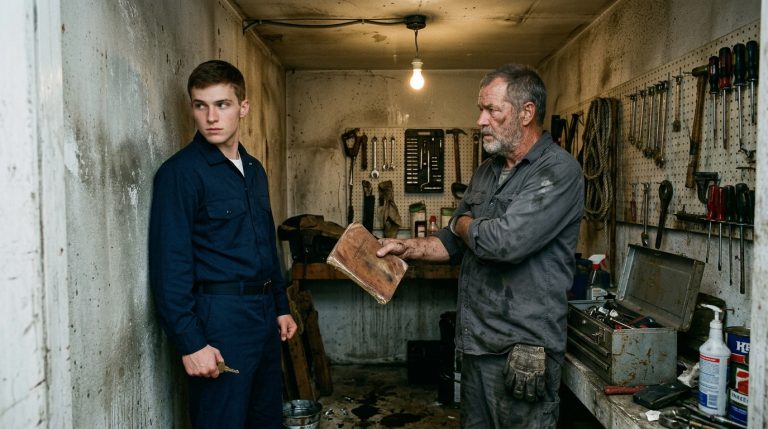
A Fragile Restoration: Marcus Reed and the Ghost of a Buried Truth in Pensacola’s Shadows
CHAPTER 1: The Waterfront Recognition
The Gulf breeze in Pensacola didn’t just carry salt; tonight, it tasted of iron and something long forgotten. Marcus Reed moved with a gait that had been drilled into him over a decade of service—a predator’s rhythm, light on the balls of his feet, silent, efficient. Beside him, Rex was a shadow detached from the dark, his German Shepherd instincts tuned to a frequency Marcus couldn’t hear.
The park was a study in stillness. Gold-hued light bled from the setting sun, turning the water into a sheet of polished bronze. They were meant to be resting, the doctors had said, as if a lifetime of hyper-vigilance could be dialed down like a faulty circuit.
Then, Rex stopped.
It wasn’t a sudden halt. It was a fluid deceleration, a tactical freeze. Marcus felt the leather leash pull taut, an extension of his own nerves. He didn’t speak; he didn’t command. He watched. Rex’s ears were locked on a man sitting on a solitary bench, a hunched silhouette of grey wool and fading light. The man was a study in erosion, but there was a stillness in him—a guarded, calculated posture—that screamed of a life spent avoiding notice.
Marcus stepped closer, the muscles in his legs coiling. He had expected a quiet walk, a chance to reconcile his present with the ghosts of his hometown. He had not expected to find a ghost that still breathed.
“Rex,” Marcus murmured, his voice a low, controlled friction.
The dog didn’t respond. Rex was evaluating. He was measuring the man’s heart rate, the tremor in the hands, the way the spine held against the gravity of age. Marcus stepped into the man’s peripheral vision. The man turned, his eyes—hollowed, weary, but unmistakably familiar—clashing with Marcus’s own.
“Sorry,” Marcus said, his voice flat, testing the distance. “He doesn’t usually stop like this.”
The old man nodded, a motion as dry as parchment. “Dogs notice things.”
The man went to lift his hand, perhaps to gesture or to steady himself against the bench. The frayed sleeve of his coat slipped back. A curved, pale ridge of tissue traced the underside of his wrist.
Marcus stopped breathing.
The air in the park suddenly thinned, replaced by the heavy, suffocating scent of motor oil and hot metal. He was fifteen again, back in the cramped, airless garage behind his father’s house. He could see the flash of a slip, the jagged edge of a chassis biting into skin, the blood blooming like a dark flower. He remembered the calm voice of his father, the way he had dismissed the wound even as he bled.
Marcus stared at the wrist. The man reacted with a frantic, sharp motion, yanking the sleeve down to conceal the scar, but the damage was done. The logic of his life had just shattered.
“Name’s Hank,” the man rasped, his gaze darting toward the water. “Just passing through.”
Marcus felt the truth rising like an incoming tide, cold and undeniable. He reached out, his hand hovering in the space between them, shaking with a controlled rage he hadn’t yet named. He looked at the man—the man he had mourned for twenty years—and the ground beneath his boots felt less like earth and more like a trap door.
“You were never dead,” Marcus said, his voice dropping into a register that signaled no return. “You were just hiding.”
The old man didn’t look at him, but his shoulders rose in a sudden, sharp intake of air—a realization that the hunt was over, and the war was about to begin.
CHAPTER 2: The First Breach
The wind had not changed, but the world had. Marcus stood in the fading golden light, the leash gripped so tightly in his palm that the leather bit into his skin. He was not looking at the sunset anymore. He was looking at the horizon, searching for the flick of a shadow or the glint of a lens. His mind, trained to decompose complex tactical situations into solvable equations, was currently running a diagnostic on the man before him.
Daniel was trembling. It was a rhythmic, involuntary tremor that spoke of a decade-long suppression of adrenaline. He was not a threat, but he was a massive, walking liability.
“Get up,” Marcus said. His voice was a flat, low-frequency command, stripped of all color.
Daniel looked up, his eyes searching Marcus’s face for a son he remembered, but finding only the operative he had become. He pushed off the bench, his movements shaky, uneven. Rex was already at his side, a solid, black-and-tan anchor that seemed to steady the older man. The dog didn’t whine; he leaned his weight into Daniel’s leg, a non-verbal assurance that the threat perimeter was currently being held.
“Where are we going?” Daniel asked. His voice sounded like gravel shifting under boots.
“Out of the line of fire,” Marcus replied, already moving.
They took the path back toward the parking area, avoiding the main trails. Marcus’s focus was surgical. He wasn’t looking for civilians; he was looking for patterns—vehicles that remained parked too long, individuals whose stride didn’t match the leisure of the park. Every rustle in the marsh grass felt like a potential breach.
A memory flared—not from the park, but from that garage two decades ago. The way the light had hit the jagged metal of the chassis, that same precise, cutting angle of the scar on Daniel’s wrist. He remembered the smell of the machine oil, that thick, viscous scent that seemed to coat his lungs. He had spent years trying to wash that smell out of his memories, believing it was the scent of his father’s failure. Now, realizing it was the scent of his father’s silence, the memory felt like a physical blow to his gut. He had to force the thought away, locking it behind a mental bulkhead.
Not now, he told himself. Process, then act.
They reached his truck, a nondescript dark grey SUV parked on the perimeter. Marcus opened the back door. Rex hopped in with practiced grace, and Daniel hesitated, staring at the interior as if it were a luxury he no longer understood.
“Inside,” Marcus commanded.
As they pulled away from the waterfront, the city lights of Pensacola began to flicker to life—a grid of artificial certainty. Marcus kept his eyes on the rearview mirror. No one was tailing them, but that meant nothing. If Victoria was as thorough as Daniel suggested, she wouldn’t be following them in a marked car. She would be waiting where she knew they had to go.
“They’ll know,” Daniel said suddenly, staring out the window at the blurred trees. “She has people. In the office, in the bank, even in the department.”
Marcus didn’t take his eyes off the road. “Let them look. They’re looking for a ghost. You’re not a ghost anymore.”
“You don’t understand, Marcus,” Daniel persisted, his voice rising, thinner now. “This wasn’t just a disagreement. It was a house of cards. I took one brick, and the whole thing threatened to collapse. She didn’t bury me to protect her family. She buried me because I was the only one who saw the foundation wasn’t made of stone.”
Marcus felt a sharp, cold spike of intuition. He had been looking for a simple narrative—a family betrayal, a petty crime. But Daniel’s words pointed elsewhere. A house of cards implied structural instability, not just a personal dispute.
“What foundation?” Marcus asked, his voice barely audible over the hum of the tires.
Daniel went silent, his hands gripping his knees so tightly the knuckles turned white. He looked at Marcus, his face shadowed by the passing streetlights. “The kind that goes all the way to the state house, son. And she owns every floor.”
Marcus gripped the wheel, his knuckles white. The road ahead was dark, but for the first time, he saw exactly where he was going. He wasn’t just bringing his father home; he was walking into a war.
CHAPTER 3: The Tactical Withdrawal
The highway lights flickered overhead, casting rhythmic, strobe-like shadows across Daniel’s face. Marcus didn’t speak. He didn’t offer comfort, and he didn’t ask for further details. The inside of the SUV felt small, a pressurized chamber where the only sound was the steady, rhythmic breathing of Rex in the back and the low thrum of the engine beneath them.
Every instinct in Marcus was screaming for a perimeter check. He kept his eyes on the rearview, his peripheral vision locked onto the vehicles flanking them. A blue sedan was pacing them too consistently in the slow lane; Marcus dropped his speed by five miles per hour, watching in the glass. The sedan stayed level for three seconds, then decelerated. A coincidence, or a tail? In his current state of high-alert, he couldn’t afford the luxury of benefit of the doubt.
“You said she owns every floor,” Marcus said finally, his voice barely rising above the wind noise against the glass. He turned the steering wheel with a gentle, precise motion, taking the exit for the motel in Destin. “What kind of stake does she have that would require a disappearance as thorough as yours?”
Daniel stared down at his hands. He was trying to pull them into a resting position, but the tremor was becoming more pronounced as the reality of the situation took hold. “She wasn’t just managing the books, Marcus. She was the one who designed them. She saw the gaps in the public works projects before the city planners even drafted the contracts. She had a way of moving assets into offshore shells—accounts that looked like they were funding municipal maintenance—while the money was actually just sitting in her own private coffers.”
“And you?”
“I was the auditor,” Daniel whispered. “I was brought in to clean up the books, to make sure the records looked legitimate for the next fiscal review. I thought I was fixing mistakes. I realized too late that the mistakes were the purpose.”
Marcus pulled into the motel lot. It was a nondescript strip of faded concrete under a buzzing neon sign. He didn’t pull into a spot right away. He circled the building once, scanning the perimeter, checking the line of sight from the surrounding darkened businesses. Everything looked dead. He pulled into a spot at the back, furthest from the streetlights.
“Stay,” Marcus ordered.
He got out of the truck, the cool night air hitting him with a sharp, cleansing bite. He walked to the back door, his hand resting instinctively near his waistband. He opened the door, and Rex exited with silent, predatory precision, his head low, ears swiveling to track the silence. Marcus motioned for Daniel to follow. The older man climbed out, his legs unsteady, leaning heavily on the side of the truck.
“You’re not going to be able to stay here long,” Marcus said as they approached the room. “This is a temporary waypoint. Once they realize I’m back in the loop, this will be the first place they check.”
“You shouldn’t have involved yourself,” Daniel said, his breath hitching as he walked. “If they know you’re looking, you become a target. You have a record, a service history. They can use that against you, Marcus. They can make you look like the criminal.”
Marcus didn’t answer. He reached the door, pulled the key from his pocket, and unlocked it with a practiced, fluid motion. He pushed the door open, stepped inside first, and swept the room with a quick, clinical glance. It was empty. Safe.
“I’m already the target,” Marcus said, closing the door and locking the deadbolt behind them. He checked the window blinds, ensuring they were closed tight. “The difference is that I’m the one who knows how to fight back.”
He gestured to the bed. Daniel sat down, the mattress groaning under his weight. He looked small in the stark light of the motel lamp. Marcus stood by the door, his posture rigid, his mind already three steps ahead. He had the documents from Arthur, but they were physical evidence. He needed a digital footprint, something he could store, something he could disseminate if he got backed into a corner.
“I need you to tell me everything,” Marcus said, pulling a chair from the corner and sitting directly across from his father, closing the gap. “Every account number, every shell name, every person you ever spoke to in that office. If we’re going to break this, we don’t do it with accusations. We do it with math.”
Daniel looked up, and for the first time, Marcus saw the flicker of something that might have been pride in his father’s eyes. It was a fragile, guarded thing, but it was there.
“It’s all in my head,” Daniel said. “I never wrote it down. I was too afraid they’d find a paper trail.”
“Then you start talking,” Marcus said, his voice hard, unyielding. “And you don’t stop until I have every piece of the puzzle.”
He watched his father take a deep, steadying breath. Outside, a car drove past, its headlights sweeping across the blinds, casting long, frantic shadows against the wall. Marcus didn’t flinch. He sat, waiting, a soldier once again, prepared to dismantle the foundation of a life he had been told was a lie.
CHAPTER 4: The Confrontation of the Architect
Marcus did not linger. The confession—a fragmented, horrifying map of municipal theft—had turned the motel room from a refuge into a liability. He left Daniel with Rex, the dog serving as both guardian and silent witness, and stepped back into the night. His SUV engine turned over with a low, predatory growl that seemed to vibrate through the soles of his boots. He needed to see her. He needed to measure the distance between the woman who had raised him and the architect of the ruin he had just uncovered.
The drive back to the house was a study in controlled aggression. Marcus didn’t speed, but he drove with a relentless, purposeful momentum that ignored the comfort of the road. His thoughts were a series of tactical blocks, organizing the information Daniel had leaked: shell corporations, non-existent maintenance contracts, the slow, methodical erosion of city funds. It was clean. It was efficient. It was Victoria.
He pulled into the driveway of the house he had once called home. It looked unchanged—the lawn perfectly manicured, the exterior lighting casting soft, inviting pools of warmth on the siding. It was an image of domestic stability, a sharp, jarring contrast to the damp, rotting reality of his father’s existence.
He walked up the porch steps, the wood beneath his feet silent. He didn’t knock. He turned the handle, which gave way under his hand, and stepped into the foyer.
“Marcus?”
Victoria stood at the end of the hall, near the open door of the study. She was dressed in a silk robe, a glass of water held in her hand, her expression one of polite, controlled surprise. She looked as though she had been waiting for him, yet her poise remained perfectly undisturbed.
“You’re home early,” she said, her voice a calm, modulated stream.
“I went for a walk,” Marcus replied, his voice devoid of inflection. He didn’t move toward her. He stood in the entryway, a shadow blocking the light from the door.
Victoria tilted her head, her eyes narrowing slightly—the professional appraisal of a woman who was used to measuring the emotional state of everyone she encountered. “You look like you’ve seen a ghost, Marcus. Sit. I’ll make tea.”
“I saw him, Victoria.”
The silence that followed wasn’t the silence of surprise; it was the silence of a mechanism shifting gears. Victoria’s grip on the glass didn’t tighten, and her face remained a mask of practiced serenity. She turned back toward the study and walked in, leaving the door open behind her. It was an invitation, or a trap.
Marcus followed. The study was a repository of order. Floor-to-ceiling shelves, dark wood, the smell of aged paper and leather. It was the place where she had built her life, and perhaps, where she had dismantled his.
“Daniel was a troubled man, Marcus,” she said, setting the glass on the desk. She didn’t look at him. She smoothed the corner of a document lying on the blotter. “When he left, he was in the middle of a significant decline. I did what I had to do to maintain this family’s reputation, and for your own sake, to ensure your future wasn’t tied to his instability.”
“Embezzlement,” Marcus said, the word hitting the air like a stone. “That’s what you called it. That’s what you told me.”
Victoria finally turned to face him. Her eyes were hard, focused, and utterly devoid of warmth. “It was the truth, as far as it concerned us.”
Marcus moved to the desk. He didn’t look at her; he looked at the document she had been smoothing. It was a standard service contract for a drainage project on the city’s east side. He leaned in, his eyes catching a detail that shouldn’t have been there. The signature at the bottom—a city official’s name—looked fluid, almost perfect, but there was a subtle tremor in the tail of the ‘y’ that Marcus recognized from the documents he had reviewed earlier. A forgery. He didn’t touch it. He simply registered it.
“The money didn’t just vanish, Victoria. It moved.”
“People like Daniel always think they understand the movement of wealth,” she said, her voice dropping, taking on a sharper, more dangerous edge. “They see a ledger and think they’ve found a truth. They haven’t. They’ve only found a distraction. You’re playing with things you don’t understand, Marcus. You’re a Marine, not an accountant. Go back to your leave. Forget you saw a man in a park who’s lost his mind.”
“I’m not forgetting.”
Victoria walked around the desk, stopping just inches from him. The scent of her perfume—crisp, floral, clinical—filled his senses, masking the stale air of the study. She was standing within his personal space, a tactic of intimidation she had used since he was a boy, but the effect was gone.
“If you continue this,” she said, her voice a whisper that carried the weight of a decree, “you won’t just be harming my reputation. You will be actively participating in the destruction of everything you think you’ve been protecting.”
Marcus looked down at her, his expression a wall of cold, unwavering resolve. “Maybe that’s the only way to find out what’s real.”
He turned and walked out of the room, leaving her standing there in the silence of the study. He didn’t look back. As he walked out of the house, his mind was no longer searching for ghosts. It was cataloging the evidence he now knew existed—and the fact that Victoria’s composure was the only thing preventing her reality from shattering completely.
CHAPTER 5: The Paper Trail
Marcus drove the perimeter of the city, avoiding the main boulevards where the streetlights were too bright and the security cameras too numerous. His mind was a locked room, every thought dedicated to the tremor he had seen in the tail of the ‘y’ on the document Victoria had been handling. It was a microscopic error—a ghost of hesitation in a woman who prided herself on absolute precision.
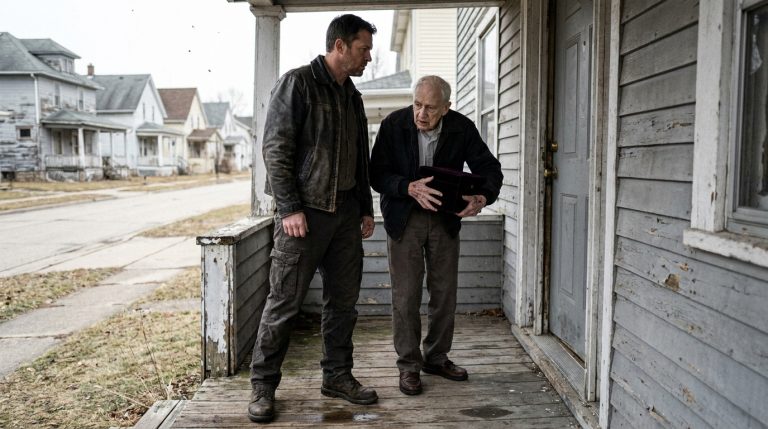
Arthur Penhaligon’s house was a relic of a dying neighborhood. The paint was a peeling skin of grey, and the porch sagged under the weight of decades. Marcus killed the engine a block away and walked the rest of the distance, keeping to the shadows of the overgrown hedges. He didn’t want to be seen, not by the neighbors, not by the occasional patrol car that drifted through the area.
When he reached the front door, he waited. He listened to the house. It breathed with the soft, erratic rhythm of an old man living alone. He knocked—a coded, three-beat rap he had learned when he was a boy, a signal of safe harbor.
The door creaked open, revealing Arthur, clutching a heavy iron cane as if it were a talisman against the night. His eyes, magnified by thick lenses, darted toward the street before he ushered Marcus inside.
“You shouldn’t be here,” Arthur wheezed, his voice thin as dry paper. “The atmosphere in the city is changing, Marcus. People are asking questions about your presence. About your father.”
“They can ask,” Marcus said, closing the door and bolting it. “But they don’t have the files. We do.”
Arthur led him into the back room, a cluttered den that smelled of ozone and stale tobacco. He moved to the filing cabinet in the corner, his movements slow, deliberate. He pulled a thick folder from the bottom drawer. As he handed it to Marcus, he paused, his eyes flickering toward the window.
“I heard a sound,” Arthur murmured. “A vehicle. It stopped two houses down. It didn’t turn its lights off.”
Marcus didn’t ask questions. He moved to the window and peeled the edge of the blind back a fraction of an inch. A black sedan sat at the curb, its engine idling. It was the same model he had seen earlier, the one that had paced him. The driver didn’t get out, but the interior light flickered for a second, casting a pale, cold glow on the profile of a man sitting behind the wheel.
“Stay down,” Marcus commanded. He turned to the file Arthur had handed him. It was a dense collection of financial records—tax filings, property deeds, shell company registries. He flipped through the pages, his eyes scanning for the same handwriting he had seen in Victoria’s study.
He found it. The same fluid, elegant script, the same minute flaw in the tail of the ‘y’.
“Arthur, these documents,” Marcus whispered, his finger tapping the paper. “These signatures. They aren’t just forged. They’re identical copies. Every single one is a clone.”
Arthur shuffled closer, peering through his glasses. “A clone? That’s impossible. They’re filed across different departments, different years.”
“She’s using a master template,” Marcus realized, his breath hitching. “She isn’t just stealing money, Arthur. She’s creating a digital and physical history for non-existent entities, looping them back into the city’s infrastructure budget. Every time the city approves a project, she’s skimming off the top by creating a phantom contractor that’s technically already in the system.”
“But that’s an enormous operation,” Arthur countered, his voice trembling. “It would require cooperation from the bank, from the city auditors, from the legal department.”
“Exactly,” Marcus said, his pulse quickening. “She isn’t just embezzling. She’s leveraged. She’s running the city’s back-end logistics. If she falls, the city’s financial integrity falls with her.”
A sharp rap on the front door shattered the silence of the house. Marcus dropped the file and pulled his sidearm, moving into the shadows of the hallway. Rex, who had been lying perfectly still in the corner, rose with a low, vibrating growl, his hackles raised along his spine.
“Arthur, get to the back,” Marcus ordered, his voice a low, hard line.
“Who is it?” Arthur hissed, clutching his cane so hard his knuckles were white.
“It’s not a visitor,” Marcus said, listening to the heavy, tactical rhythm of the footsteps on the porch. “It’s a cleanup crew.”
The door handle rattled—a violent, testy motion that promised entry, with or without an invitation. Marcus checked his magazine, his eyes fixed on the threshold. The facade of the quiet city was stripping away, and beneath the surface, the machine was starting to bite back. He had the proof, he had the motive, and now, he had the danger. He waited for the door to yield, his resolve hardening into a cold, unbreakable blade of purpose.
CHAPTER 6: The Decoy Unmasked
The door frame splintered with a sound like a gunshot, wood chips spraying into the hallway like shrapnel. Marcus shoved Arthur backward into the shadows of the kitchen, his arm extending to signal Rex to hold. The dog was a coiled spring, his focus absolute, his low, rumbling growl vibrating through the floorboards.
Two men stepped into the foyer. They were professional, wearing dark windbreakers and tactical boots, their movements devoid of hesitation. They weren’t looking for a conversation; they were looking for a target.
“Check the perimeter,” one of them rasped, his voice dampened by a high-collar jacket.
Marcus didn’t wait for them to finish the sweep. He moved from the hallway shadows, his own weapon held low, his eyes locked on the leader’s midsection. He fired once—a controlled, calculated shot intended to disable, not kill—striking the lead man’s shoulder. The man collapsed, his weapon clattering across the floor, but his partner was already pivoting, his own firearm leveled toward the kitchen.
Marcus dove behind the heavy oak table in the living room just as a volley of rounds shredded the drywall where he had been standing. Dust and plaster filled the air, the grit tasting of chemicals and old secrets.
A sharp, intrusive flash of memory hit him—the day in the garage, the smell of blood on his father’s wrist, the way the air had felt thin and toxic right before the world tilted. He shook it off with a brutal, mental exertion. Focus.
He caught a glimpse of the partner’s boots near the entryway. The man was advancing, his footfalls heavy, confident. Marcus counted the rhythm: One, two, three. He rolled out from behind the table, firing two shots in rapid succession. The man recoiled, stumbling back into the hallway as his grip on his weapon failed.
Marcus was on him in a second, pinning him against the wall. The man’s face was obscured by a dark mask, his eyes wide and vacant. Marcus grabbed the man’s vest, pulling him forward.
“Who sent you?” Marcus demanded, his voice a low, lethal hum against the man’s ear.
The man didn’t speak. He reached for a concealed blade on his utility belt, but Marcus anticipated the move, driving his forearm into the man’s throat and pinning the limb. He saw the cold, detached efficiency in the man’s eyes—the look of a drone, a tool that had been wiped clean of identity. This wasn’t an assassin; it was a cleanup crew.
“Victoria,” Marcus stated, the name acting as a key.
The man’s eyes flickered—a millisecond of recognition that confirmed the theory. Marcus didn’t need a confession. He had the confirmation he required. He struck the man once, a precise blow to the temple, and let him slump to the floor.
He didn’t check the pulses. He turned back to the kitchen. Arthur was huddled under the counter, shaking, his cane lying abandoned on the linoleum.
“Are you hit?” Marcus asked, his breathing controlled despite the adrenaline screaming through his system.
“No,” Arthur gasped, his face pale and sweating. “But Marcus—look at what they were carrying.”
Arthur pointed to a metallic briefcase one of the men had dropped in the foyer. Marcus walked over, his boots crunching on the shattered wood of the door. He knelt and flipped the latches.
It wasn’t a hit kit. It was a portable secure-drive console, hooked into a localized satellite uplink. It was designed to wipe digital signatures from a local server. Marcus stared at the screen, which was still glowing a soft, pulsating blue. It was clearing the files—not the files in this house, but the files in the city’s central database.
He realized with a sickening clarity that he had been bait. Victoria hadn’t sent them to kill him; she had sent them to locate the files he had discovered, to track his movements, and to trigger a remote purge of her own digital footprint while he was distracted.
The decoy secret—the embezzlement records he had found—was a trap. It was the “embezzlement” layer she had planted specifically for someone to find, a trail of breadcrumbs that led directly to a controlled environment where the evidence could be deleted, leaving the real laundering operation completely untouched and invisible.
“They aren’t here for us, Arthur,” Marcus said, his voice cold as the grave. “They were here to finish the clean-up. We were the distraction, and we just handed them the keys to destroy every last trace of the truth.”
He stood, his gaze moving toward the front door. The blue light on the console flickered to red, then vanished, indicating the transfer was complete. Victoria had won the first round, and she had done it by using his own pursuit of the truth against him.
He didn’t feel despair; he felt a sudden, sharp, terrifying focus. She had underestimated the one thing she couldn’t account for: the fact that he hadn’t just looked at the files. He had memorized the pattern. And now, he knew exactly where to find the source.
CHAPTER 7: The Realization
The silence in the den was absolute, save for the ragged, uneven breathing of Arthur, who remained huddled in the corner. Marcus stood over the man he had incapacitated, the weight of his sidearm heavy in his hand. The blue glow of the console had faded to a dull, dead black, an empty box that had successfully devoured twenty years of evidence in a few seconds.
“She’s steps ahead,” Marcus muttered, more to himself than to Arthur. “She didn’t just want the files gone. She wanted to be sure I knew that I couldn’t touch the paper trail.”
He holstered his weapon and moved toward the front door, his stride heavy and slightly disjointed. Adrenaline was beginning to retreat, leaving behind a jarring, physical exhaustion. He felt as though the floor beneath his boots was shifting, an instability that made his movements feel imprecise. He had to force himself to check the hallway, the threshold, the dark expanse of the porch before stepping out.
He went to the sedan at the curb. The keys were still in the ignition, dangling like a taunt. He leaned into the driver’s side, his fingers brushing the steering wheel, his eyes scanning the interior. It was sanitized. No registration, no trash, no personal items—nothing that could link the vehicle to a specific owner or a specific office. It was a phantom, designed to exist only for this single act of deletion.
He stepped back, the cool night air stinging his face. The neighborhood was quiet, the houses silent boxes of brick and shadow. He realized then that he had been playing the game exactly the way Victoria wanted. He had spent his time looking at the documents, at the signatures, at the embezzlement. He had been looking at the crime, while Victoria was looking at the structure.
He walked back inside and found Arthur standing, leaning heavily on his cane, his eyes wide and terrified behind his thick glasses.
“They’ll be back, won’t they?” Arthur asked, his voice cracking.
“Not for us,” Marcus said, his voice flat. “They have what they need. We’re an inconvenience now, not a threat. Unless…” He paused, his gaze drifting to the empty filing cabinet. “Unless they know that I can reconstruct the pattern without the files.”
He looked at Arthur, seeing the fear in the older man’s face, and felt a surge of cold, protective instinct. He couldn’t leave him here. If Victoria was willing to send a cleanup crew to Arthur’s house, then Arthur’s survival was no longer guaranteed.
“Pack a bag,” Marcus commanded. “We’re leaving. Now.”
“Where? To the marsh?”
“No. We’re going to the source.”
Marcus grabbed Arthur’s arm, his grip firm, and steered him toward the kitchen. He didn’t know yet exactly how he would force Victoria’s hand, but he knew the nature of the beast he was hunting. She wasn’t an assassin; she was an administrator. Her power was built on the continuity of her systems. If he couldn’t hit her through the records, he would hit her through the one thing she couldn’t afford to lose: her public image.
They exited through the back, the night air clinging to them like damp cloth. As they moved toward the treeline at the back of Arthur’s property, the memory of his father’s garage returned—not as a ghost, but as a map. He remembered the layout of the city’s back-end servers, which his father had described in passing years ago, long before he had become a target. Daniel had been the auditor, and even in his isolation, he had remembered the architecture of the beast.
Marcus stopped, pulling Arthur into the darkness of the trees. He turned to his companion, his face a mask of focus in the dim light of the rising moon.
“Arthur, think back,” Marcus said, his voice urgent. “When Daniel was still in the office, before he disappeared, did he ever mention a secondary site? A disaster recovery location? Somewhere they kept the hard copies that couldn’t be purged remotely?”
Arthur blinked, his brow furrowing as he dug into the archives of his mind. “A site… there was a mention, years ago. Something about a storage facility in the industrial district. Property owned by a shell company. He called it the ‘Vault’.”
“The Vault,” Marcus repeated. The name settled into his mind, a target.
“It won’t be easy to get to, Marcus. It’s high security, monitored, private.”
“It doesn’t have to be easy,” Marcus said, his eyes turning toward the distant, flickering lights of the city’s industrial center. “It just has to be the only place where she hasn’t looked yet.”
He didn’t wait for Arthur to argue. He moved forward, his movements more deliberate, more precise. He was no longer the man who was surprised by the danger; he was the man who had realized that to dismantle a system, you had to be willing to burn down the entire house. He felt the cold iron of his sidearm against his hip, a final, lethal piece of logic in an increasingly chaotic world. He was going to the Vault, and he was going to find the truth, no matter what it cost to hold it.
CHAPTER 8: The Memorial Platform
The industrial district of Pensacola did not sleep; it merely changed its rhythm. The low, guttural thrum of heavy machinery echoed off the corrugated steel of the warehouses, and the air was thick with the scent of ozone and cooling grease. Marcus moved through the labyrinthine alleys, his silhouette swallowed by the massive steel containers that lined the docks. Arthur stayed close, his breath shallow, his cane tapping rhythmically against the asphalt until Marcus caught his wrist, silencing him.
“Stay behind the cover,” Marcus whispered. His eyes were scanning the perimeter. The Vault, as Daniel had described it, was a brutalist block of reinforced concrete, windowless and scarred by the salt air of the Gulf. It was guarded not by men with guns, but by a web of sensors and automated cameras that swiveled with the clinical indifference of a predator.
They had reached the rear loading bay. Marcus crouched near a service hatch, his fingers tracing the edge of the access panel. He didn’t have a key, but he had a memory. Before he had left for the deployment that took him away from Pensacola, his father had given him a tool—a small, nondescript brass key that he had carried on his dog tags for years, never knowing its purpose until tonight. He slid the key into the service port. It clicked, a perfect mechanical alignment.
The hatch groaned inward, revealing a crawlspace filled with the smell of stagnant, chilled air. They climbed inside, the darkness closing around them like a shroud.
“We’re entering the server backbone,” Marcus said, his voice a ghost in the narrow shaft. “If she’s hiding the master ledger, it’s not in the main database. It’s here, on an isolated local rack.”
They emerged into a small, sterile room bathed in the flickering orange light of server cooling fans. Rows of blinking lights stretched into the gloom, a digital heartbeat for a system that controlled the city’s lifeblood. Marcus approached the central console. He didn’t need to be an IT specialist; he needed to be a soldier. He pulled the drive from the console he had taken from Arthur’s house and slotted it into the maintenance port.
The screen flickered. A command line appeared, scrolling through directories at a blinding speed. And then, it stopped. A folder labeled ‘Project Foundation’ sat on the desktop.
Marcus clicked. The files weren’t encrypted. They were mapped.
He didn’t need to understand the complexity of the code. He saw the names: construction firms he recognized, city council members he had grown up watching on the news, and at the center of it all, Victoria’s signature—the same elegant, flawed ‘y’ he had seen in the study. But it wasn’t just embezzlement. The records detailed a complete takeover of municipal land, sold off through shadow companies to developers who were secretly owned by the same firms she managed. She wasn’t skimming; she was cannibalizing the city’s future.
“It’s all here,” Arthur whispered, his eyes wide as he stared at the screen. “Everything. The shell companies, the false land titles, the names of every official on the payroll.”
“It’s the roadmap,” Marcus said, his pulse hammering against his ribs. “The full extent of the operation.”
He hit the download command. The bar began to crawl across the screen, a slow, agonizing progress. Twenty percent. Forty percent.
Suddenly, the room’s ambient temperature plummeted. The servers whirred with an increased, frantic speed, and the flickering lights on the rack turned a steady, warning red.
“Marcus,” Arthur gasped, pointing to the monitor. “Look at the trace!”
The directory was shifting. The files weren’t being deleted; they were being encrypted in real-time, replaced by a looping, corrupted data stream. Victoria hadn’t just secured the facility; she had trapped it. The moment someone accessed the local rack, the system triggered a self-destruct sequence, locking the data behind an unbreakable wall of bit-rot.
“She knew,” Marcus realized, the cold reality hitting him harder than the adrenaline. “She knew someone would eventually come for the Vault. It was never a hiding place. It was a pressure switch.”
The server rack emitted a high-pitched, piercing whine. The screen went blank. Marcus didn’t hesitate. He yanked the drive from the port and grabbed Arthur.
“Move!”
They scrambled back into the crawlspace just as the fire suppression system in the server room activated, flooding the space with a chemical fog that scorched the throat. They hit the cold air of the alleyway, the heavy steel door slamming shut behind them.
Marcus stood in the dark, his lungs burning, his clothes coated in the fine, white dust of the suppression chemicals. He held the drive in his hand. He hadn’t gotten the full ledger. He had gotten a fragment—a single, corrupted file that showed the shell companies, but not the names of the officials. It was enough to prove she was doing it, but not enough to prove who she was doing it for.
He had failed to take her down in one move. But as he looked at the drive, he realized he had something more dangerous than a full confession: he had a lead. And for the first time, he knew exactly how to force her to come to him. He was going to the memorial service, and he was going to expose the existence of the Vault.
CHAPTER 9: The Public Collapse
The morning air at the memorial park was unnaturally still, the kind of heavy, humid quiet that preceded a storm. Marcus parked the SUV at the edge of the lot, the gravel crunching beneath the tires like breaking glass. He didn’t look at Daniel, who sat in the passenger seat, his eyes fixed on the horizon, his hands resting on his knees—the tremor finally gone, replaced by a rigid, unnatural stillness.
“You don’t have to go through with this,” Marcus said, his voice stripped of all inflection.
Daniel looked at him, his gaze clear. “It’s the only way to stop the bleed.”
They walked toward the central podium. The crowd was sparse, a small collection of veterans and city officials gathered under the shade of the oaks. Victoria stood at the front, draped in black, her posture a masterpiece of composed grief. As they approached, the murmurs died down, and a strange, prickling tension began to weave through the gathering.
Victoria turned, her eyes sweeping over them. When they landed on Daniel, her composure held, but Marcus saw the micro-twitch in her jaw—the first fissure in the dam.
“Marcus,” she said, her voice carrying across the silence. “I didn’t expect you to bring him.”
“He has something to say,” Marcus replied, stepping past her to the podium. He placed the encrypted drive on the wooden surface. He didn’t have the full ledger, but he had the fragment—the evidence that the drainage projects weren’t just mismanaged; they were engineered for theft.
He looked at the faces in the crowd. He saw the city councilman, the mayor’s aide, the local developers who had grown fat on the city’s hollowed-out infrastructure. They weren’t just observers; they were the participants.
“Twenty years ago,” Marcus began, his voice ringing with the clarity of a command, “this city was told a story about a man who walked away. We were told it was a crime of greed.”
Victoria took a step forward, her hand reaching toward the podium. “Marcus, stop. This isn’t the time or the place.”
“It’s exactly the time,” Marcus countered, his eyes locked on hers. He didn’t blink. He felt the cold, hard weight of the truth in his chest. “Because the truth isn’t just about a man. It’s about the city he was trying to save.”
He didn’t pull out the drive. He didn’t need to. He simply gestured to the councilman standing in the front row, a man whose family had built the very concrete foundations Victoria had been siphoning. “Ask him about the drainage projects on the east side. Ask him why the budget triples every three years for work that’s never completed.”
The councilman went pale, his eyes darting toward Victoria. The silence stretched, turning from uncomfortable to toxic.
Victoria’s composure finally gave way. She didn’t scream, but her face hardened, the mask sliding off to reveal the predator beneath. “You think you’re destroying me, Marcus? You’re destroying the only system that keeps this city from collapsing. If you push this, if you show them what’s behind the curtain, you aren’t a hero. You’re the one who burns it all down.”
“Then let it burn,” Marcus said.
He signaled to Arthur, who stood at the edge of the crowd with a small, portable projector. Arthur flicked a switch. A series of images beamed onto the side of the memorial stone—copies of the forged signatures, the shell company maps, the undeniable mathematical proof of the phantom contracts.
The reaction wasn’t a roar. It was a suffocating, collective gasp. The realization spread through the crowd like contagion. It wasn’t just embezzlement; it was treason against the city’s own future.
Victoria looked at the images, then back at Marcus. For a fleeting second, he saw not anger, but a profound, chilling recognition. She knew she was exposed, but she was already planning her retreat. She turned away from the podium, walking with the same measured, perfect pace she had always maintained, even as the first shouts of outrage began to break out from the back of the crowd.
“It’s not over,” she said, without looking back.
“It is for you,” Marcus answered.
He looked at Daniel, who stood beside him, watching Victoria disappear into the crowd. The older man’s eyes were finally at rest. The system she had built was fracturing, the truth pouring through the cracks like rising water. Marcus had lost the element of surprise, he had burned his own bridges, but he had finally brought the ghost home. And as the park erupted into a storm of questions and chaos, Marcus stood still, the cold, sharp air of the morning finally feeling like home.
CHAPTER 10: The Unfinished Floor
Victoria did not run. She stood near the edge of the memorial stone, her figure stark against the morning light. As Marcus approached, the remaining officials and onlookers pulled back, creating a vacuum of space around them. There was no longer a need for force; the exposure was absolute. The drive Marcus held contained the digital trail—not just of embezzlement, but of the systematic, state-sanctioned laundering operation she had operated for two decades, funneling city tax revenue into a network of shell accounts that funded political influence far beyond Pensacola.
“You think this is victory?” Victoria asked, her voice barely a breath. She looked at the drive, then at Marcus, her eyes devoid of the cold calculation that had defined her for so long. “You haven’t just exposed me, Marcus. You’ve brought down the entire house. You have no idea what happens when the money stops moving.”
“I know exactly what happens,” Marcus replied. “The truth is revealed.”
He didn’t wait for her to continue. He signaled to the state police cruisers that were already rolling into the lot, their sirens silent but their presence absolute. The final pillar of her defense had been the assumption that she was too integrated into the city’s lifeblood to be extracted without causing a total collapse. She had been right about the collapse, but she had been wrong about the cost. It was a price Marcus was willing to pay.
Two officers moved forward, their presence perfunctory. Victoria didn’t resist. As they placed the cuffs on her, the metallic click echoed sharply through the park—a final, definitive sound. She didn’t look at the crowd, but for one brief moment, her eyes locked with Daniel’s. There was no pity there, only the recognition of two architects of the same cold reality. Then, she was led away, her silhouette diminishing until she was just another figure in the back of a cruiser.
Marcus stood by the memorial for a long time. The denouement of the chaos was slow, a heavy, atmospheric peace settling over the park as the officials dispersed and the crowd trickled out. He felt the exhaustion finally catching up to him, a dull, aching weight in his shoulders that grounded him to the earth.
He walked over to the bench where Daniel sat. Rex was already there, his head resting on Daniel’s knee. Marcus sat down, the wood creaking under his weight. He reached into his pocket and pulled out the old, rusted brass key he had carried on his dog tags for years—the one that had opened the door to the Vault. It was a small, insignificant object, but it represented everything that had been kept in the dark.
He didn’t need it anymore. He walked to the edge of the memorial garden, where the soil was soft and damp, and pressed the key deep into the earth. It was a quiet, final act—a symbolic burial of the past that had nearly consumed them both.
Daniel leaned forward, watching him. “It’s over, Marcus.”
“It’s different,” Marcus corrected. He sat back, looking out over the water. The Gulf was calm, the morning light reflecting off the surface in long, shimmering bands of gold.
He looked at his hands, steady for the first time in weeks. The tremor was gone. He thought of the garage, the oil, the years of silence, and finally, the reality of the work ahead. They had a house to finish, a life to rebuild—not from the foundation of the old one, but from the raw, exposed truth of the present.
Marcus reached over and laid a hand on Rex’s back, feeling the slow, steady rhythm of the dog’s breathing. Daniel sat beside him, not as a ghost, but as a man who was finally present. There were no more secrets to uncover, no more architectures to dismantle. There was only the quiet, the salt air, and the work of moving forward, one step at a time, into a day that was finally, unequivocally, their own.