The Echo of Iron: Bridging the Divide Between Digital Ambition and the Timeless Wisdom of Steel
CHAPTER 1: The Weight of Silence
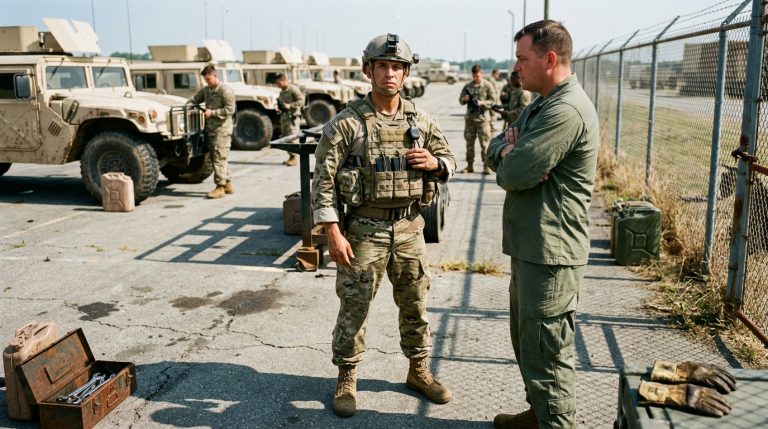
The armory was no longer loud. The frantic, metallic screaming of the M2 Browning had ceased, replaced by a silence so thick it felt like physical pressure against the eardrums. Recruit Davis stood frozen, his hands still trembling—not from exertion, but from the terrifying realization that his entire world of digital maps, automated systems, and high-IQ superiority had just been rendered utterly obsolete by a man who looked like he was made of brittle glass and history.
Thomas had already left, his gait shuffling, the janitor’s jumpsuit swishing against his thin legs like a rhythmic, mocking heartbeat.
Davis stared at the weapon on his table. It was perfectly assembled, a dark, heavy sculpture of Cold War steel. He reached out to touch the charging handle, but pulled his hand back as if the metal were burning. Beside him, his squad-mates didn’t move. They were staring at their own tables—piles of disconnected parts, springs coiled like nervous nerves, back plates resting uselessly on the concrete.
Sergeant Halloway stood in the center of the bay, his gaze fixed on the heavy steel door that had just clicked shut behind the old man. The drill sergeant’s face was unreadable, the usual fire in his eyes dampened by a sudden, contemplative frost.
“Tear them down,” Halloway commanded. His voice wasn’t a roar anymore. It was low, dangerous, and quiet.
“Sir?” someone whispered.
“You heard me,” Halloway snapped, turning to face them. “If you can’t assemble it by feel, you don’t own it. If you don’t own it, you’re just a tourist waiting for the enemy to provide your eviction notice.”
Davis looked down at his own table. He was the golden boy, the one who navigated simulated dogfights with a flick of his wrist. He was used to the machine telling him he was right. Now, the machine remained silent, indifferent to his talent. He felt a sudden, sharp ache in his chest—a hollowness that had nothing to do with the physical fatigue of the last hour.
He moved his hands toward the weapon, his movements stiff and self-conscious. He remembered the sound Thomas had made. Click. Clack. It was a language he didn’t speak.
As he reached for the bolt group, his eye caught a movement on the corner of his workstation. A small, grease-stained piece of paper he hadn’t noticed before was tucked under the edge of the table. He leaned in, his heart hammering against his ribs. It was a fragment of a manual, the edges yellowed and frayed, with a handwritten note in the margins in ink that looked decades old: The metal has a pulse. If you don’t feel it, you’re not listening.
Davis looked up, searching the room for the old man, but the bay was empty. Outside, the base hummed with the distant, steady glow of electronic infrastructure—a world of lights and data that suddenly felt incredibly thin, as if the floor beneath his feet might simply dissolve into static.
He didn’t pick up the part. Instead, he looked at his hands, seeing for the first time the fine, persistent tremor that he had spent his entire life trying to suppress.
CHAPTER 2: The Ghost of the Workshop
The paper felt impossibly fragile between Davis’s grease-slicked fingers. It was yellowed, the kind of brittle that suggested it had been kept in a pocket for decades, absorbing the heat and movement of a life spent in transit. As he stared at the spidery, precise handwriting—The metal has a pulse—the sterile, fluorescent buzz of the armory seemed to recede, replaced by a ghost-scent of sawdust and sharp, ozone-laden air.
He was suddenly ten years old again, standing in his father’s basement workshop. His father, a man who believed that if you couldn’t build it, you didn’t understand it, stood over a workbench cluttered with brass clockwork. “You’re trying to force the gears, Leo,” his father had said, his voice a low rumble. “Stop looking at the blueprint and start feeling the friction. If it fights you, you’re missing the rhythm.”
Davis blinked, the memory fracturing like a glass pane struck by a hammer. He was back in the armory. The present moment rushed back in—the cold, unforgiving reality of the M2 Browning, the distant, muffled sound of Halloway barking orders at the other recruits, and the crushing weight of his own failure.
His hands, which had always been the source of his pride—steady enough to guide a surgical drone through a simulated tunnel at Mach 2—were betraying him. The tremor was back, more pronounced than before. He looked down at the paper once more. It wasn’t just a manual fragment; it was a challenge.
He didn’t return to the group. Instead, he pulled a small, ruggedized tablet from his cargo pocket—the digital extension of his own brain—but the screen remained dark. His fingers hovered over the power toggle. For the first time in his life, he didn’t want the screen to light up. He didn’t want the HUD to overlay the weapon with targeting lines or weight distribution percentages. He wanted to know if the paper was right.
He reached for the bolt group again. This time, he didn’t look at the manual or his mental digital library. He closed his eyes.
The darkness felt heavy, but it was also surprisingly clear. He felt the chill of the steel through his fingertips. He felt the slight, microscopic roughness where the metal met the receiver. It was cold—so cold it was almost tactile, a sharp, biting sensation that seemed to anchor him to the table. He didn’t force the part. He pushed, felt the resistance—the “fighting” his father had warned him about—and stopped. He relaxed his grip, listening to the subtle, almost imperceptible scrape of metal on metal, and waited for the alignment.
“Davis!”
The bark of Halloway’s voice shattered his focus. Davis flinched, his eyes snapping open. The bolt stud sat halfway into the receiver, cocked at an awkward angle.
“Step away from the station,” Halloway said, his boots crunching on the concrete as he marched toward table four. “The armory is cleared for the night. That goes for you, too.”
Davis looked up. The room was nearly empty. His squad-mates were already shuffling toward the barracks, their faces masks of exhaustion and frustration. Halloway stood over him, eyes hard, searching Davis’s face. The sergeant’s gaze flickered down to the paper in Davis’s hand.
“What’s that?” Halloway asked, his voice dropping into that dangerous, low register.
Davis folded the paper quickly, his thumb pressing it into his palm. “Nothing, sir. Just trash.”
Halloway stared at him for a long moment, the silence stretching until it felt like a wire pulled to the point of snapping. Then, the sergeant’s eyes shifted to the weapon on the table. The bolt stud was misaligned, but the foundation—the assembly Thomas had executed so perfectly—remained.
“Thomas Miller isn’t just a janitor, is he?” Davis asked, the question slipping out before he could check it.
Halloway’s expression tightened, the muscles in his jaw twitching. “You’re here to be a soldier, Davis, not an investigator. You want to survive the night? Get to your bunk. And whatever ghost you’re chasing, stop looking for it in the past. The future is coming, and it isn’t going to wait for you to catch up.”
Halloway turned on his heel and walked toward the armory office. Davis watched him go, the paper still burning in his palm. He looked back at the M2. It looked different now—less like a weapon and more like a riddle. He turned away and walked toward the exit, his boots echoing sharply against the concrete.
As he passed the supply closet, the door was slightly ajar. A faint, rhythmic sound drifted out—a steady scrape, scrape, scrape. Thomas was inside, sitting on a crate, his hands meticulously polishing a set of brass casing gauges with an old, frayed rag. The old man didn’t look up, but as Davis passed, Thomas’s voice drifted out, soft and gravelly.
“The rhythm is in the steel, son. But if you keep looking for the shortcut, you’ll never hear the song.”
Davis didn’t stop. He couldn’t. His heart was beating a frantic, uneven rhythm that had nothing to do with the machine. He hurried toward the barracks, the dark hallways of the base stretching out before him like a digital labyrinth that suddenly felt far too fragile to hold his weight.
CHAPTER 3: The Fragile Frequency
The walk to the barracks was a gauntlet of familiar lights, but the architecture of the base had suddenly turned alien. Every flickering security camera, every glowing panel, and every automated door sensor felt like a thin veil stretched over a void. Davis’s boots, usually rhythmic and precise, felt heavy on the concrete, as if he were carrying the weight of the M2 Browning long after he had left the armory floor.
He reached his bunk, the metal frame cold and unforgiving against his back as he sat. His squad-mates were already asleep—or pretending to be. The barracks were filled with the soft, blue-light glow of personal tablets and interface nodes, a sea of quiet activity that usually comforted him. Tonight, it felt like the frantic, nervous twitching of a trapped colony.
He looked down at his own console, the screen currently docked and waiting for his biometric scan. A prompt flickered in the corner: Awaiting Sync. Usually, this was the moment his day settled into order, his performance metrics analyzed, his digital tasks queued up for the morning.
He didn’t sync. Instead, he pulled the piece of paper from his pocket. Under the dim, artificial light of the barracks, the ink seemed to vibrate against the yellowed fibers. If you keep looking for the shortcut, you’ll never hear the song.
He stared at the blank screen of his console. He started to wonder: how much of his own “talent” was actually his own, and how much was simply the machine doing the heavy lifting? He had never failed a simulation because he had never had to look beyond the HUD’s guidance. The machine had been his companion, his teacher, and his crutch. But looking at the paper, he felt a strange, cold vertigo. If the machine were to go dark, what would be left of him?
He stood up, ignoring the questioning glances of a squad-mate in the adjacent bunk, and walked toward the small washroom at the end of the hall. He needed to wash the CLP oil from his hands. It had stained his skin, a deep, persistent brown that wouldn’t easily scrub away—the mark of the work.
Inside the washroom, the fluorescent light hummed at a frequency that made his teeth ache. He turned the tap, the water cold and biting. He scrubbed, but the oil held fast to his fingerprints, clinging to the ridges of his skin. He stopped, holding his hands under the stream, and looked at them in the mirror.
His reflection looked back, tired and questioning. He noticed, for the first time, a small, dark shadow in the corner of his own vision. He blinked, expecting it to be a smudge on the mirror, but it moved when he moved. It was a lingering distortion, the after-image of staring too long at the harsh lights, but it felt like something more. It felt like the machine’s hold on his perception was slipping.
He heard the heavy, mechanical thud of the barracks door opening and closing. Halloway. The sergeant was doing his late-night rounds, his boots marking a slow, deliberate path down the aisle. Davis held his breath, leaning against the cold porcelain of the sink.
“Davis,” Halloway’s voice sounded just outside the washroom. It was muffled, filtered through the thick door, but it carried a weight that made Davis’s skin crawl. “Don’t spend the night contemplating the plumbing. We start at zero-five-hundred. I expect you to have your headspace aligned, and not just the gun’s.”
“Yes, Sergeant,” Davis called back, his voice sounding thin and brittle to his own ears.
He heard Halloway’s footsteps pause. A long silence stretched out, the kind that held an unspoken history. Then, the sergeant spoke again, his voice dropping to a whisper that barely cleared the door. “Thomas isn’t just checking your ability to assemble metal, Davis. He’s checking to see if there’s anything beneath the surface of you recruits that’s actually capable of standing when the lights go out. Make sure there is.”
The footsteps continued, receding until the heavy sound of the barracks door signaled Halloway’s departure.
Davis turned back to the sink. He leaned down, splashing the cold water onto his face. The oil was still on his hands, a faint, metallic scent that he suddenly realized wasn’t just on his skin—it was in his clothes, in his hair, in the very air he breathed.
He looked back at the door. He was beginning to realize that the armory test wasn’t just a physical failure. It was the first sign of a breakdown that went far deeper than a jammed machine. He looked at his tablet, sitting on the counter. He reached out and, with a deliberate, slow motion, flipped it face-down.
He didn’t need the sync. He needed to listen.
He closed his eyes and leaned his forehead against the cold mirror, trying to mimic the stillness he had felt in the dark, back in the armory. He pushed away the digital clutter of his own mind, the pre-programmed tactical scenarios and the rehearsed responses. For a moment, in the absolute, ringing silence of the washroom, he thought he could hear it—a low, rhythmic resonance, not quite a sound, but a vibration beneath the floorboards.
It was the heartbeat of the base, and for the first time, he realized it wasn’t the hum of servers or the ventilation of cooling fans. It was something older, something buried under the miles of cable and synthetic material, pulsing steadily and waiting for the silence.
He opened his eyes, his heart hammering against his chest. He turned off the tap. The barracks were silent now, truly silent. He walked back to his bunk, but he didn’t climb in. He sat on the edge of the frame, staring into the dark, his hands resting on his knees. He began to feel the phantom vibration again—a slow, patient rhythm that seemed to be echoing his own pulse.
The future wasn’t just coming; it was already here, hiding in the dark, and it was demanding that he shed the digital skin he had spent his whole life constructing.
CHAPTER 4: The Stuttering Light
The strobe began without warning. One second, the barracks was a quiet, dimly lit sanctuary; the next, it was a frantic, monochromatic nightmare. The overhead LEDs flickered in a jagged, erratic sequence, turning the entire room into a series of frozen, disconnected moments. Each flash revealed his squad-mates in strange, unnatural postures: one reaching for a tablet that remained dead, another huddled in the fetal position, eyes squeezed shut.
Davis didn’t move. He kept his eyes locked on the space in front of him, tracking the pattern. It wasn’t random. Click. Flicker. Pause. Click. It was the same rhythm he had felt in the floorboards.
“System error,” a monotone voice droned from the ceiling, the base’s automated maintenance AI sounding garbled, as if its own circuits were fraying. “Initiating… secondary… diagnostic…”
The lights died completely. The silence that followed was heavy, broken only by the sharp, intake of fifty lungs suddenly deprived of their digital comfort. Then, the rhythmic thud, thud, thud of Halloway’s boots returned, but this time, he wasn’t just patrolling. He was moving with an urgent, purposeful stride that lacked his usual, measured cadence.
A beam of a standard-issue tactical flashlight cut through the darkness, sweeping across the floor before landing on Davis’s bunk. Halloway looked less like a drill sergeant and more like a man bracing for an impact.
“Davis,” Halloway said, his voice stripped of all pretense. “You still awake?”
“Yes, Sergeant.”
“Get up. Move. Now.”
Davis grabbed his gear—the heavy, cold metal of his training harness—and scrambled to follow the sergeant into the hallway. The strobe effect was even worse in the corridor. The long, narrow path of the barracks hallway was now a tunnel of blinding flashes. As they moved, the wall panels, usually glowing with operational readiness stats, were dark and dead. The base felt like a hollowed-out carcass, its digital nervous system failing one node at a time.
Halloway led him toward the lower levels, away from the barracks and toward the heart of the facility. As they passed the armory, the heavy steel door was already open. Thomas was there, standing in the doorway, his silhouette stark against the flickering emergency lighting. He wasn’t holding his broom. He was holding a heavy, reinforced toolkit that clattered with the sound of cold, hard iron.
“The grid is falling,” Thomas said, his voice low and devoid of its janitor’s shuffle. He looked at Halloway, then at Davis. “They don’t have the training for this, Sergeant. Not yet.”
“They’re going to have to learn,” Halloway replied, his voice tight. “The simulation was supposed to be a test, not an initiation.”
“A test is a choice,” Thomas said, stepping aside to let them enter. “This is an inevitability.”
Davis stood in the threshold, looking into the armory. It was filled with shadows, but the M2 Brownings, stripped down and waiting on their tables, seemed to glow with a faint, reflected light. He felt a chill run up his spine. The air in here wasn’t just cold; it was stagnant, as if the room itself were holding its breath, waiting for the final failure of the digital world outside.
“What’s happening?” Davis asked, his voice echoing too loudly in the hollow bay. “Is this a drill?”
Halloway ignored him, moving to a rack of gear and tossing a heavy, canvas satchel toward him. “It’s not a drill, Davis. It’s a reality check. Look at the consoles.”
Davis looked at the wall of screens that usually displayed the base’s tactical map. They were dead, save for a single, jagged line of static that pulsed in sync with the heartbeat he had heard earlier. He realized with a sickening jolt of clarity that the “blackout” wasn’t a failure—it was a purge. The digital infrastructure wasn’t just going down; it was being erased.
“You wanted to be a soldier, Davis?” Thomas asked, his voice coming from the shadows of the tool rack. He moved closer, the light catching the deep, etched lines in his face. He looked older, tired, but the lethality was sharper than ever. “A soldier knows how to fight when the map vanishes. A soldier knows how to hit a target when there’s no HUD to draw the lines for him. You’ve spent your life looking for the answer on a screen. Now, you’re going to find it in the iron.”
Davis looked down at the satchel Halloway had given him. It was heavy, the weight pulling at his shoulder. He reached inside and felt the cold, familiar texture of the M2’s barrel extension.
“The light’s coming back, Sergeant,” Thomas murmured, his eyes fixed on the ceiling. “But it won’t be ours.”
As if in response, the emergency lights flared to a blinding white, then died, leaving the room in a deeper, more permanent shadow. Davis reached out, his hand finding the edge of a table. He didn’t search for a light switch. He didn’t reach for his tablet. He closed his eyes, his fingers tracing the cold, rough surface of the machine, and for the first time, he didn’t feel the absence of the digital world—he felt the presence of the steel.
The song began again, a low, hummed vibration that seemed to rise up from the floor, through his boots, and into his very bones. It was a rhythm of survival, and for the first time, he found he could match his pulse to it.
CHAPTER 5: The Project Phoenix Logs
The darkness was not absolute. A faint, amber glow still bled from the cracks in the armory’s floor-level maintenance ducts—the only part of the facility that seemed to be drawing its own, independent power. Davis stood frozen, his hand still gripping the table’s edge, his lungs burning with the sharp, ozone-scented air. Across the room, Thomas was a shadow among shadows, his movements fluid as he sorted through the heavy iron tools.
“The satchel, Davis,” Thomas said, his voice cutting through the stillness like a blade. “Open it.”
Davis hesitated, then moved to the center of the bay where a single, heavy wooden crate sat on the floor. He set the canvas satchel down and unbuckled the straps. Inside, nested in oil-stained burlap, was a collection of heavy components—the core housing of an M2 Browning, but with modifications he had never seen in any digital database. There were no sensor ports, no digital feedback loops, no automated maintenance indicators. It was pure, raw mechanics.
“This is the heartbeat,” Thomas continued, stepping into the dim light. His glasses magnified his eyes, giving him an expression of terrifying clarity. “You’ve been trained to fight a war that hasn’t happened yet. You’ve been trained to rely on a nervous system that I built to be fragile.”
“You?” Davis asked, his voice trembling. “What are you talking about?”
Thomas didn’t answer directly. He walked toward a heavy, reinforced steel cabinet tucked into the corner of the bay—a relic from the base’s original construction. He tapped a code into a physical mechanical dial, the clicks echoing sharply against the concrete. The door groaned open to reveal not weapons, but stacks of physical binders, their spines dusted with a fine, grey powder.
“I didn’t just carry the gun, son,” Thomas said, pulling a binder from the stack. “I helped draft the manual for the collapse.”
He tossed the binder onto the table in front of Davis. The cover was stamped with a faded, crimson seal: PROJECT PHOENIX – CONSULTANT: MILLER, T.
Davis flipped it open. The pages were filled with hand-drawn schematics, not of weapons, but of electrical grids, communication relays, and the inherent vulnerabilities of the digital systems the recruits were currently learning to operate. It was a roadmap of failure. Each page documented a specific, calculated point where the network would inevitably collapse under the pressure of its own complexity.
“You’re a consultant,” Davis whispered, his eyes skimming over a list of names—all veterans, all retired, all flagged as ‘Active Advisory Assets.’ “You’ve been here the whole time, watching us.”
“I’m a ghost, Davis. I’m the fail-safe,” Thomas said. “When the grid dies, and the HUDs go dark, and you soldiers are standing in the middle of a ridge with nothing but your own wits, you’ll find out who truly knows how to fight. Most of you will break. You’re built to be extensions of the software. I’m looking for the ones who can survive without it.”
Davis looked up from the logs. The decoy secret—the idea that he was just a recruit being tested—shattered in his mind. He wasn’t being tested for standard combat; he was being selected for a new kind of survival. The realization hit him with the force of a physical blow. The blackout wasn’t a malfunction; it was the start of the exercise.
“Is this why Halloway keeps you here?” Davis asked, his gaze darting to the cabinet. “To see if we can find the truth?”
“Halloway knows as much as he needs to,” Thomas said, his tone cooling. “He’s the enforcer. I’m the architect. You’re the raw material.”
Davis reached out, his fingers brushing the edge of the binder. The paper was rough, the texture of a real, physical world that felt far more substantial than the slick, sterile interfaces he had spent his life navigating. He felt a sudden, sharp pang of betrayal—not just by the military, but by the very foundation of his education. Everything he had been taught was a scaffold, a temporary structure meant to be burned away.
He looked at Thomas. The old man’s hands were steady now, his posture relaxed, the “janitor” mask completely gone. He looked like a man who had been waiting for this exact moment for decades.
“What do I do now?” Davis asked.
“You start by learning the manual,” Thomas said, nodding toward the binder. “And then, you start listening to the steel. The power will come back on, but it won’t be as stable as it was. You have exactly until the next cycle to memorize the schematics. If you’re still relying on your HUD when the lights return, you’re not the one I’m looking for.”
Davis looked at the logs, then back at the shadowed corners of the armory. He realized that the base was no longer a training ground; it was a laboratory. And he was no longer a student; he was a candidate for a reality he wasn’t sure he wanted to inhabit. He picked up the binder, the weight of the paper and the ink-stained secrets feeling like an anchor. He was beginning to understand that the “song” Thomas spoke of wasn’t just about the machine—it was about the man who stood behind it when all the digital lights went out.
He sat down at the table, the faint, lingering smell of the CLP oil grounding him. He opened the first page of the schematic, and for the first time, he let himself read—not as a digital native looking for data points, but as a man looking for a way to survive the coming dark.