A Garden of Consequences: How One Man’s Soil Became the Ultimate Weapon Against Suburban Tyranny
CHAPTER 1: THE FIRST NOTICE
The notification was taped to my front door with the kind of aggressive precision that screamed of a woman with too much time and too little empathy. I peeled the white envelope away, the adhesive tearing slightly at the painted wood. It was a sterile, laser-printed notice: CC&R Section 7, Article 4.
I didn’t open it immediately. I stood on the porch, looking out at the yard. The evening light was slanted, casting long, bruised shadows across the garden. My sunflowers were six inches taller than they had been yesterday, reaching toward the heat like they were desperate to consume it. Behind a screen of raspberry bushes, my cedar compost bin sat in its quiet, dark corner. It was a tidy, slatted structure—an object of pure, aerobic efficiency.
“Smell that, Sarah?” I murmured, though my wife was still inside the house, the muffled rhythm of a biology lecture echoing from her tablet.
I leaned down and pulled back the lid of the bin. A plume of damp, earthy air rose up to meet me—the smell of a forest floor after a storm. It was the scent of life in transition. To me, it was gold. To the architectural control committee, it was apparently a public health hazard.
I stepped off the porch and walked to the property line. The transition was jarring. My grass was a chaotic tapestry of clover, fescue, and dandelion, a living, breathing ecosystem. Karen’s yard, just across the invisible boundary, was a chemically scorched expanse of neon-green turf. It looked like a carpet in a funeral home.
“Mr. Miller.”
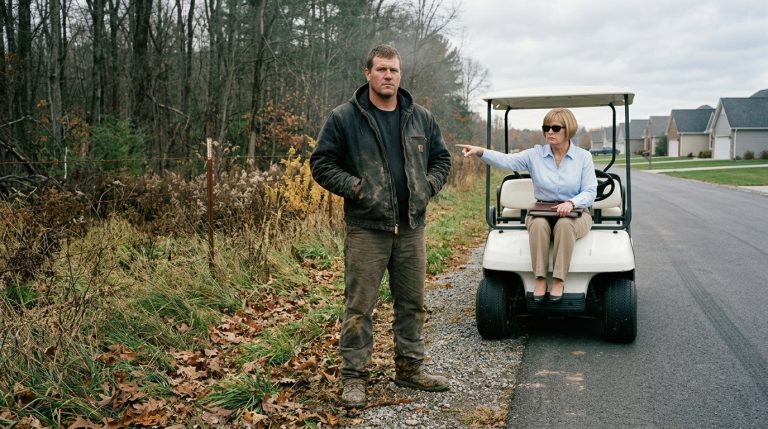
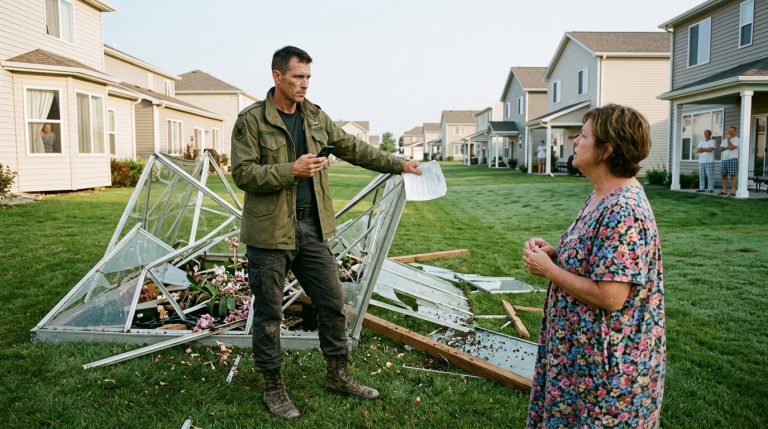
The voice was thin, sharp, and carried with the authority of someone who had never been told ‘no’ in their life. Karen stood on her patio, a floral print muumuu struggling to contain her frame. She held a clipboard like a shield. Beside her, a man in a neon-green polo—the uniform of Emerald Lawns—stood with his arms crossed over his chest, his eyes dead and unblinking.
“I trust you’ve read the notice,” she said. She didn’t wait for an answer. She moved closer to the line, her sensible shoes clicking against the pavement. “We don’t tolerate vermin-attracting structures in Oak Meadow Estates. That bin is coming down by tomorrow morning.”
I didn’t look at her. I looked at the man in the green polo. He wasn’t a landscaper; he was a sentry. I studied the way he stood, his weight shifted to the balls of his feet. He was holding a sprayer nozzle at his side, the brass tip stained with a faint, oily residue.
“It’s a compost bin, Karen,” I said, my voice steady, stripped of any inflection. “It’s part of a closed-loop system for soil health. It doesn’t attract vermin. It builds nutrients.”
“It’s garbage,” she countered, her hand tightening on the clipboard until her knuckles went white. “And you are in direct violation of the aesthetic standards of this community. If that bin isn’t gone, I will ensure that the EPA is notified of the potential for chemical runoff from your—”
She stopped, a small, predatory smile tugging at the corner of her mouth. She didn’t realize the trap she’d just set for herself. She didn’t know that I knew exactly what was in the runoff from her property. I saw the faint, telltale yellowing at the base of her prized hydrangeas—a sign of heavy chemical stress.
“The EPA?” I asked, turning to face her fully. My heart rate stayed locked in its rhythm, slow and rhythmic. I looked at the shadow she cast on the sidewalk. It was long, dark, and misshapen. “You’re worried about chemical runoff, Karen?”
“I’m worried about property values,” she snapped, stepping back toward her house. “And you’re a liability, Alex.”
She turned and walked away, her heels striking the concrete like small gunshots. I remained still, staring at the property line. I touched the brass level in my pocket, feeling the cold weight of the metal against my thumb.
She thought she was bringing the force of the law down on me. She had no idea she was giving me the one thing I needed to finish the map.
CHAPTER 2: THE SUBURBAN FRONT LINE
The silence that followed Karen’s departure wasn’t a true silence. It was a pressurized void, the kind of stillness that precedes a sudden shift in atmospheric pressure. I remained standing on the edge of the property line, the grass beneath my boots acting as the dividing line between two entirely different states of existence. To the west, the chaotic, organic weave of my garden; to the east, the unnatural, sterile uniformity of her chemically-mandated lawn.
My hand still gripped the antique brass level in my pocket. The metal felt colder now, biting into my palm with a sharp, geometric indifference. I stared at the spot where the man in the neon-green polo had been standing. A faint, oily sheen remained on the pavement where his boots had rested. It was a chemical signature, a lazy, unthinking application of product that screamed of incompetence.
Terrain analysis. The thought rose unbidden from the back of my mind, a phantom drill instructor barking orders in a theater I’d left years ago. In the Corps, we assessed every inch of ground for stability. We looked for the lowest point, the path of least resistance where water would inevitably congregate. Now, I looked at the slight, almost imperceptible downward slope of the cul-de-sac.
Karen wanted an EPA investigation. She wanted to bring in federal agents to measure runoff and verify toxicity. She thought she was calling for a wrecking ball to demolish my sanctuary. She didn’t realize that in my line of work, the greatest threat to a structure wasn’t the force applied to it, but the hidden instability of the ground underneath.
I turned and walked toward my back patio. Every step was calculated. I walked with the deliberate, heavy cadence I’d maintained through two decades of deployments. I bypassed the compost bin, giving its cedar frame a soft, respectful tap with my knuckles. It was a sturdy, well-built thing, constructed to withstand the pressure of decomposition, and soon, it would be the centerpiece of a different kind of construction entirely.
Inside the house, the air was still and smelled faintly of the jasmine tea Sarah had been brewing. She was sitting at the kitchen table, her laptop open, the blue light reflecting in her glasses as she graded biology lab reports. She didn’t look up immediately, but I saw her shoulders loosen when I stepped into the room.
“She’s gone?” Sarah asked, her voice soft, devoid of the jagged edge that usually accompanied our dinner conversations.
“For now,” I said, pulling out a chair and sitting opposite her. I placed the brass level on the table. It made a solid, ringing sound against the hardwood surface. “She’s escalating. She’s threatening to involve the EPA over the compost bin.”
Sarah finally looked up, her expression a mix of weary amusement and hardening resolve. “The EPA? For a pile of decaying organic matter? That’s not just a reach, Alex, it’s a delusion.”
“It’s not a delusion,” I corrected, leaning forward, my hands flat on the table. “It’s a miscalculation. She’s looking for a weapon to use against me, and she’s decided that federal oversight is the biggest stick she can find. But she’s relying on the assumption that my yard is the problem.”
I took a breath, feeling the familiar, grounding weight of the task ahead. I needed to move fast, but not erratic. I needed to be precise.
“I need to check the drainage records for the cul-de-sac,” I said. “I need to know exactly how the municipal runoff lines were configured when this subdivision was developed. If she calls the EPA, they won’t just look at my compost bin. They’ll look at the watershed. If I can show them exactly where the chemical runoff is coming from, I can turn her own investigation into a liability.”
Sarah didn’t ask if I was sure. She didn’t offer a platitude about ‘letting it go.’ She just reached into the stack of papers at the corner of the table and pulled out the thick, bound set of neighborhood covenants we’d been studying for weeks. She pushed them toward me, her fingers resting briefly on my wrist.
“The blueprints should be in the municipal annex,” she said. “But the HOA has the original site surveys. They’re legally required to keep them in the archives, even if they never look at them.”
“I’ll get them,” I promised.
I stood up and moved to the window overlooking the yard. The shadows had lengthened further, creeping up the side of my garden shed. I watched the movement of the wind through the leaves of my tomato plants. They were strong, vibrant, and deep-rooted. They were survivors. I was going to make sure they stayed that way, even if I had to dismantle the very foundation of the HOA to do it.
I knew then that the war wasn’t going to be won with noise or confrontation. It was going to be won with data, with blueprints, and with the cold, hard logic of the earth itself. Karen was about to learn that when you dig a hole for someone else, you’d better make sure you know what’s buried in the soil.
CHAPTER 3: THE CLUBHOUSE SIEGE
The walk to the community clubhouse was a study in controlled defiance. The evening air had turned crisp, stripping the humidity from the day and leaving a sharp, metallic edge to the wind that rattled the manicured hedges lining the cul-de-sac. I kept my stride rhythmic, matching the pace I had held for years on patrol—measured, efficient, and entirely unbothered by the suburban spectacle around me.
As I neared the clubhouse, the structure loomed like a beige mausoleum of architectural conformity. It was a soulless, single-story building that emitted a low hum of industrial-grade air conditioning. I reached the double glass doors and paused, my reflection distorted in the tinted pane. I looked like a man who had long ago traded his uniform for denim, but the posture—the slight tilt of the shoulders, the predatory focus in the eyes—remained unchanged.
I pulled the door open. The interior was a blast of recycled, artificially chilled air that smelled of industrial-grade lemon solvent and institutional decay. It was a scent that didn’t belong in a residential neighborhood; it was a scent designed to mask the absence of life.
About fifteen residents were scattered among the folding chairs. They were a curated demographic—bored, resigned, or actively hostile—and they all turned to look as I entered. Karen sat at the long folding table at the front, her posture rigid, her hands folded over a thick, leather-bound binder that functioned as her scepter of office. Flanking her were two women who seemed to exist primarily as visual echoes of her own disdain, and at the far end, Mr. Henderson, the board’s nervous treasurer, who was currently staring intensely at his own cuticles.
I didn’t stop at the back. I walked down the center aisle, the sound of my boots on the industrial carpet sounding like thunder in the hushed room. I felt their eyes tracking me—the curious, the sympathetic, and the judgmental. I kept my gaze fixed on the table at the front.
“Mr. Miller,” Karen said, the syllables clipped and cold. She didn’t look up from her binder, but I saw the slight tension in her neck. “This is a private meeting of the Oak Meadow Estates homeowners association. I don’t recall seeing your name on the agenda.”
I stopped a few feet from the table, placing my hands on the back of an empty chair. The metal frame was cold and unyielding. “I’m here to address the violation notice regarding my compost system,” I said, my voice cutting through the stale air. “I’m here to present the scientific evidence for its function.”
“We’ve already reached a consensus on the ‘science’ of your garbage pile, Alex,” Karen said, finally looking up. Her smile was a thin, predatory line. “It’s a violation. We’ve issued the notice. The fines are accumulating. If you’re here to argue about it, you’re in the wrong place.”
I felt the pulse in my temple—the familiar, rhythmic beat of a tactical situation. I didn’t let my expression change. I reached into my bag and pulled out the folder I had prepared. It was heavy, a collection of documents that I knew would dismantle her argument if I could just get them into the record.
“I’m not here to argue, Karen,” I said, my voice dropping an octave, becoming the calm, authoritative tone I had used to brief officers in the field. “I’m here to submit documentation. I have the OMRI certification for my soil inputs, the technical specifications of the bin design, and a formal request for an independent soil test to determine the presence—or absence—of the ‘noxious’ elements you allege are present.”
Mr. Henderson looked up then, his eyes wide and blinking rapidly behind his spectacles. He shifted in his seat, his hand hovering uncertainly over the ledger in front of him. Karen, however, didn’t even glance at the folder. She slapped her hand down on the binder.
“This is not a court of law, Mr. Miller. We aren’t interested in your papers. We are interested in maintaining the standards of this community. Your ‘science’ is a threat to our property values, and I will not allow you to turn this neighborhood into a research project for your whims.”
“It’s not a whim,” I said, my voice cutting off her tirade. “It’s sustainable land management. And for the record, the CC&Rs state that I have a right to a formal hearing before the board for any disputed fine. I am formally invoking that right, effective now.”
The silence that followed was heavy and absolute. Even the hum of the air conditioner seemed to drop away. Karen stared at me, her face flushing a dark, mottled red, while the other board members exchanged quick, panicked glances. I could see the cracks forming in her authority. They were afraid of the paperwork. They were afraid of the formal process because they had been operating entirely outside of it.
I didn’t look away. I watched her struggle to find the next move, the mask of the autocrat flickering for a fraction of a second. She wanted to throw me out, to use the security she had cultivated to silence the disruption. But she couldn’t. I had invoked the bylaws, the very weapon she had used to terrorize others.
“Very well,” she hissed, the words barely audible. “We will schedule a hearing. But let me be perfectly clear, Mr. Miller: you will bring nothing but the documentation requested, and you will do it in a civilized manner. If you persist in this… amateur theatrical display, I will have you removed.”
I nodded slowly, satisfied. I hadn’t come here to win the war tonight; I had come to establish the rules of engagement. I had forced them to acknowledge the process. As I turned to leave, I caught a glimpse of Mr. Henderson’s notepad. He had been scribbling frantically, not the meeting minutes, but a series of numbers that looked suspiciously like budget allocations.
I walked out of the clubhouse, the cool evening air hitting my face like a reprieve. My pulse was steady, my mind already running the next sequence of actions. I had the hearing. Now, I just needed to make sure the evidence I presented was undeniable.
CHAPTER 4: THE ARCHITECTURE OF DRAINAGE
The walk from the clubhouse to the perimeter fence of the nature preserve was a lesson in the architecture of neglect. Oak Meadow Estates was designed for the appearance of perfection, but beneath the manicured turf and the symmetrical rows of houses lay a hidden system of pipes and culverts that told a far more chaotic story. I didn’t head straight home. Instead, I took a detour through the service alley that ran behind the main row of houses—the ones that sat on the lowest elevation of the subdivision.
The air here was cooler, damp with the scent of stagnant water and rotting vegetation. I clicked on a high-lumen tactical flashlight, the beam cutting a sharp, clinical path through the darkness. My boots crunched on gravel and dry leaves. I wasn’t just walking; I was scanning. I was looking for the junction points, the manhole covers, and the drainage grates that linked our artificial suburban paradise to the wider environment.
I reached the service alley access point behind the cul-de-sac. This was where the surface runoff from the uphill properties—Karen’s property included—was supposed to be collected and channeled into the municipal storm system. I knelt by the heavy, cast-iron grate, the metal cold and slick with dampness. I reached into my pack and pulled out a small, flat-head pry bar, hooking it under the edge of the iron.
With a controlled, steady pull, I lifted the grate. The smell of ammonia and stagnant, chemical-laced sludge drifted up. I shone my light down into the dark, narrow tunnel. It was a mess. Debris had clogged the intake screen, and the water level was high, stagnant, and oily. My flashlight beam danced over the slick surfaces, catching the iridescent sheen of some chemical residue floating on the water’s surface—a rainbow of toxic waste that had no business being here.
My brain was already calculating the velocity and the volume. This wasn’t just bad design; it was a physical manifestation of the HOA’s mismanagement. They were spending thousands on the aesthetic appearance of the clubhouse while allowing the very utility systems that protected the community to decay into a health hazard.
I moved to the next junction box, a few yards down the alley. Here, I found the irrigation control valve for the community’s “managed” greenspace. I noticed something immediately. The valve was set to manual override, tilted at an angle that forced the sprinkler system to run for nearly double the required time, regardless of rainfall or soil saturation. It was a small, almost imperceptible misalignment, but it explained the constant, spongy quality of the turf in the common area. It was creating unnecessary runoff, forcing more volume through a compromised drainage system, effectively pushing any chemical contaminants from the uphill lawns directly into the storm drains.
It was a perfect, self-defeating cycle of waste and neglect. Karen wasn’t just managing a neighborhood; she was running a machine that was actively poisoning the local watershed to maintain a superficial, chemically-sustained facade.
I stood up, wiping my gloves against my jeans. I felt a surge of cold, calculated satisfaction. I didn’t need a lawyer to see the truth of this; I just needed to show the right people what was happening under the surface. I pulled out my phone and took a series of high-resolution photos of the clogged intake, the chemical sheen, and the misaligned valve, making sure the time-stamp and location data were active.
My phone vibrated in my hand. A message from Marcus. “Heard about the hearing. Good work. Henderson is calling around. He sounds panicked.”
I smiled to myself, a thin, tight expression in the dark. Panic was good. Panic was the first sign of a system breaking under its own weight. I tapped out a brief, cryptic reply: Stay the course. I’m gathering the final pieces of the evidence.
As I stood there in the dark service alley, I realized the full scale of what I was looking at. It wasn’t just about my compost bin anymore. It was about the entire, fragile, and deeply corrupt architecture of the HOA. They had built their authority on a foundation of rules, and I was slowly, methodically, and legally tearing those foundations apart.
I turned back toward my house, the tactical flashlight extinguished. The walk home felt different. The houses didn’t look like sanctuaries anymore. They looked like components of a failing machine, and I was the one who had finally found the off-switch. I reached my driveway just as the porch light flickered to life. Sarah was waiting in the doorway, her silhouette framed by the warm, soft light of our home.
I took a final look at the quiet, darkened houses of Oak Meadow Estates. The war was no longer in the clubhouse. It was here, in the shadows, in the infrastructure, and in the documents that were about to end the reign of a woman who thought she could define reality through intimidation.
CHAPTER 5: THE WATERSHED RECKONING
The first drop hit the dry, parched soil of the driveway with the heavy, percussive sound of a bullet. Within seconds, the sky turned a bruised, electric purple, and the deluge began—a wall of water that transformed the subdivision into a blurred, watery landscape of greys and deep, slick blacks. Sarah stepped back, her hand moving to the light switch, but I caught her gaze, a silent command passing between us. I wasn’t going inside.
I pushed back into the rain, the cold water instantly soaking through my jacket, turning my clothes into a heavy, clinging second skin. This was the variable I had been waiting for. A controlled environment was one thing, but a real-time storm was the ultimate test of my assessment. I needed to see exactly how the water behaved under pressure.
I moved along the side of the house, my boots finding purchase on the slick, mud-streaked concrete. The rain was deafening, a relentless drumbeat against the aluminum siding, but I tuned it out. I focused entirely on the movement of the water. As expected, the slope of my garden directed the overflow toward the back-patio drainage trench, a system I had reinforced with gravel and graded with mathematical precision. My runoff was clear, slow, and contained.
But as I reached the property line, the situation on Karen’s side of the fence was a disaster. The runoff from her lawn was a fast, turbid river of brown silt and oil. I watched it pool at the base of her pristine, chemically-treated shrubs, then surge over the curb, dragging a thick, unnatural-looking froth with it. It wasn’t just water; it was a carrier, a liquid conveyor belt for the concentrated chemicals her lawn-care service had been pumping into the earth for months.
I followed the flow, staying in the shadows of the houses, my tactical flashlight held low. The water gathered speed as it hit the storm drain in the cul-de-sac. It was exactly as I had calculated. The entire uphill neighborhood’s drainage converged here, and the volume of it—coupled with the sheer toxicity of the runoff—was pushing the storm drain to its breaking point. The iron grate I had pried open earlier was now vibrating, a metallic chattering sound as the water surged upward, choked by the debris I had observed.
The failure was total. The system was overwhelmed, and instead of channeling the waste, it was spilling it directly into the local watershed through the overflow valve. This was the moment I needed. This was the proof.
I pulled out my phone, the screen slick with rain, and activated the camera. I didn’t need to get close; I just needed the visual confirmation. I zoomed in on the overflow, capturing the exact moment the sludge crested the barrier. I was so focused on the shot that I didn’t notice the sudden beam of a spotlight cutting through the rain until it hit me directly in the eyes.
“Miller! Get off the property!”
The voice was Karen’s, shrill and amplified by the storm. She was standing on her back deck, a high-powered work light in her hand, illuminating the rain-lashed scene like a stage. She didn’t look like an autocrat now. She looked frantic, her hair plastered to her face, her muumuu flapping violently in the wind. She had clearly been watching from her window, and the sight of me near the storm drain had triggered a desperate, visceral reaction.
“You have no business here!” she screamed, her voice cracking. “I’ve called the police! You’re trespassing, you’re interfering with… with HOA property!”
I didn’t answer. I didn’t run. I calmly finished the recording, hit save, and turned to face her. The rain was streaming down my face, but I felt a strange, cold clarity. She had given me exactly what I needed—an attempt to interfere with the documentation of an environmental crime.
“The EPA might find this interesting, Karen,” I shouted back, my voice steady despite the roar of the wind.
She surged forward, starting to descend the stairs of her deck, her hands shaking as she fumbled with the light. But she slipped, her feet losing traction on the rain-slick wood. She grabbed the railing, but it gave way with a sickening, splintering sound, and she fell hard onto the wet, muddy grass of her perfect lawn. The light she had been holding tumbled into the runoff, flickering and dying as it hit the water.
I stood there for a heartbeat, watching her scramble to her feet, her face a mask of mud and pure, unadulterated terror. She wasn’t fighting for her yard anymore; she was fighting to keep her world from collapsing. She looked toward me, her eyes wild, and for the first time, I didn’t see a villain. I saw a woman who had built her entire identity on a set of rules that were now actively betraying her.
I didn’t move to help, and I didn’t move to confront. I simply turned and walked back toward my house, the mission accomplished. The evidence was secured. The storm had done its work, and the truth had been washed out into the open. The HOA’s infrastructure was a failure, and now, everyone—including the EPA—would know why.
I reached my back door and stepped inside, the sudden, warm silence of the house jarring. Sarah was waiting, her face pale as she saw me, dripping with mud and rain. I didn’t say a word. I just set my phone on the kitchen table and looked at the screen, the playback showing the exact, undeniable evidence of the toxic spill.
“It’s done,” I said, my voice quiet in the room. “The evidence is absolute. Now, we wait.”
CHAPTER 6: THE PAPER TRAIL WEAPONIZED
The screen of my phone went dark, but the image remained seared into my mind: the frothing, chemical-stained water surging past the overflow point. I sat in the dim light of the kitchen, the house around me quiet, save for the muffled, rhythmic drumming of the rain against the windowpanes. My hands, still slightly damp and trembling from the adrenaline of the encounter, lay flat on the table.
Sarah moved quietly beside me. She didn’t ask questions; she just slid a fresh mug of tea toward me, the steam curling into the cool air. She had seen the footage. She knew what it meant.
“She’ll try to claim you tampered with the site,” Sarah said, her voice low and steady. “She’s desperate, Alex. Desperate people make erratic choices.”
“Let her,” I replied, my voice raspy. “Tampering implies I had access to a municipal storm system that’s been neglected for years. If she goes down that path, she’s admitting the infrastructure is a failure she’s responsible for managing. Every argument she makes is a new nail in her own coffin.”
I pulled the laptop toward me, the screen casting a pale, clinical light over the table. I began to organize the files—the photos, the time-stamped videos, the copies of the CC&Rs, the meeting minutes, and the research Marcus had provided regarding the kickback scheme involving Emerald Lawns.
As I tagged each file, a phantom memory flickered in the periphery of my mind—a bridge project in a remote valley, years ago. We had rushed the foundation to meet a deadline, ignoring the subtle, uneven settling of the silt-heavy soil. A month later, the first heavy rain had washed the entire support structure into the river. I remembered the feeling of helplessness, watching all that work dissolve into mud. I had promised myself then that I would never again ignore the variables, never again skip the foundational analysis for the sake of speed.
I shook the thought away, focusing back on the screen. This wasn’t a bridge; it was a reputation, a legal status, and a home. The principles, however, remained identical. The HOA was a structure built on unstable ground, and I was identifying the precise fault lines that would cause the whole thing to tilt.
I drafted the formal notice. I didn’t hold back. I laid out the environmental findings, the pattern of targeted harassment, and the documented conflict of interest regarding the lawn-care contract. I CC’d the local environmental compliance office, the state’s contractor licensing board, and every board member’s personal email address. I hit ‘Send’ on the batch at exactly 2:00 a.m.
The silence after the click felt heavy, a deliberate pause before the inevitable reaction. I stood up and walked to the window, watching the rain finally begin to taper off. The street lights flickered, casting long, wavering beams across the puddles.
“What now?” Sarah asked from the doorway.
“Now, we see who crumbles first,” I said. “The board members are already starting to panic. Marcus told me Henderson called him tonight, asking for advice. They know they’re exposed. If they don’t force Karen out before the next hearing, they’re all going down with her. They have to decide if their loyalty to her agenda is worth their own financial and professional future.”
I felt a hollow exhaustion settling into my bones, the kind that only comes after hours of high-stakes, concentrated labor. My muscles ached, but my mind was still firing, tracking the potential counter-moves. Karen would try to discredit the evidence—she would call it doctored, or claim it was taken outside of jurisdiction. She would try to isolate me, using the very rules she had weaponized against others to try and keep this out of the public record.
But she couldn’t. The evidence was already sitting in the inboxes of three different regulatory agencies. She couldn’t retract the truth once it was in the hands of people whose job was to enforce it.
I walked back to the table and closed the laptop. The house felt smaller, tighter, as if the walls were leaning in. I looked at the brass level still lying on the table, a constant reminder of the balance I was fighting to restore.
“Sleep,” I said, catching Sarah’s worried expression. “We’ve done everything we can for tonight. The rest is just waiting for the reaction.”
I turned off the kitchen lights and walked through the dark hallway to the bedroom, my footsteps silent on the floorboards. I was a man who had built my life on precision and patience, and I knew that sometimes, the most effective weapon in an engineer’s arsenal wasn’t the explosive charge—it was the quiet, steady pressure applied to the exact right point until the entire structure simply gave way. Tomorrow, the pressure would reach its limit.
CHAPTER 7: THE CLUBHOUSE COLLAPSE
The buzzing of the phone in the dark was rhythmic, a persistent, metallic vibration against the nightstand. I reached out, my fingers finding the device in the gloom. The screen flickered to life, the harsh blue light washing over the room. It was Marcus. A flurry of messages, timed at 3:00 a.m.
“They’re meeting,” the text read. “Without her. Henderson is leading it. We need to be there.”
I sat up, the sheets pooling around my waist. The house was still, but the air felt charged, as if the lightning from the storm had left a residue of static electricity in the walls. I didn’t need to wake Sarah; she was already stirring, her eyes opening as the light hit the ceiling. She watched me for a moment, the tension in the room palpable.
“They’re meeting,” I said, my voice heavy with the gravity of the situation.
“Then it’s over,” she replied, her voice soft but sure.
I dressed in the dark, the movements mechanical and precise. I felt the weight of the phone in my pocket—a heavy, data-laden talisman that held the keys to the entire neighborhood’s future. By the time I reached the clubhouse, the sun was just beginning to bleed into the horizon, a thin, jagged line of pale yellow behind the grey clouds of the retreating storm.
The clubhouse was a hive of quiet, frantic activity. The parking lot was full, the cars huddled together in the damp, morning gloom. I didn’t enter through the main doors. I used the side entrance, moving through the hallway with the stealth of a man who knew every blind spot of the building’s layout. I found Marcus standing near the door to the main meeting room, his arms crossed over his chest, his expression grim.
“They’re in there,” he whispered, gesturing toward the door. “Henderson is talking. He’s laying it all out—the budget discrepancies, the Emerald Lawns contract, the EPA findings. He’s turning on her, Alex. He’s saving his own skin.”
I leaned in, pressing my ear to the heavy, sound-dampened door. Henderson’s voice was audible, trembling but insistent. He was reading from a ledger, listing the specific financial irregularities that pointed toward Karen’s kickback scheme. The other board members were interjecting, their voices panicked, high-pitched, and clearly desperate to distance themselves from the accusations.
“She told us it was standard practice!” one of the women shouted. “She said it was a community-approved vendor!”
“It was never approved,” Henderson retorted, his voice gaining a sudden, dangerous edge. “I checked the minutes. There’s no record. None of this was voted on. She acted entirely on her own, and we were just the rubber stamp.”
The sound of a gavel banging rhythmically against the table cut through the room. “I move for an immediate suspension of the president’s authority, pending a full forensic audit,” Henderson announced.
The door to the meeting room swung open before I could move, and Karen stepped out. She stopped dead when she saw us. Her face was a mask of shock, her hair disheveled, and she was carrying the same leather-bound binder she had used to terrorize the neighborhood. She looked small, defeated, and utterly out of her depth. When she saw me, her expression shifted to one of pure, unadulterated hatred, but there was no fire behind it—only fear.
“You,” she whispered, the word barely audible.
“It’s over, Karen,” I said, my voice flat. “The documents are in the hands of the EPA and the state authorities. There’s no path back from this.”
She tried to push past me, but Marcus stepped forward, his massive frame blocking the doorway. She didn’t try to fight. She simply slumped, the weight of the binder slipping from her fingers and landing on the carpet with a dull, heavy thud. She looked around the hallway, her eyes darting to the closed doors of the clubhouse, to the windows, to the empty, uncaring beige walls.
“They’re turning on me,” she said, her voice hollow, as if she were talking to herself. “They were all part of it. They benefited too. Why are they doing this to me?”
“Because they don’t want to go to jail,” I replied.
The sound of the door opening again drew our attention. Henderson stood in the threshold, his face pale, his eyes wide as he looked at the scene in the hallway. When he saw Karen, he didn’t apologize. He didn’t offer a hand. He just looked at her with a detached, cold indifference.
“The motion carried, Karen,” he said, his voice devoid of emotion. “You are suspended. Security is on their way to remove your access to the clubhouse and the accounts. I suggest you leave now before the rest of the board comes out.”
She looked at him, then back at me, then finally at the heavy, dark windows of the clubhouse. She walked away, her footsteps echoing in the long, silent hallway, until the front doors clicked shut behind her, leaving us in a vacuum of silence.
I didn’t watch her leave. I looked at Henderson, then at Marcus. The battle was won, but the architecture of the neighborhood was forever changed. We had dismantled the tyranny, but now came the harder work of building something that would actually endure.
CHAPTER 8: RESTORING THE EQUILIBRIUM
The silence of the clubhouse was no longer oppressive; it was empty, waiting to be filled with something new. Marcus and Henderson stood a few paces back, their faces drawn, the frantic energy of the last few hours replaced by a hollow, inevitable exhaustion. They were waiting for me to lead, to confirm that the structure we had dismantled was truly gone.
I looked at the leather-bound binder that Karen had dropped. It lay on the floor, its spine cracked, pages spilling out in a chaotic, disorganized fan. I reached down and picked it up. It wasn’t just a record of rules; it was a physical manifestation of a flawed, ego-driven logic that had been allowed to fester because no one had the courage to look beneath the surface. I flipped through the pages—violation notices, manufactured complaints, the fraudulent lawn-care contract—all of it now rendered powerless.
“What do we do with this?” Henderson asked, gesturing toward the binder.
“We bury it,” I said, my voice steady. “But not before we enter it into the public record as evidence for the state authorities. It stays in a safe place until the auditors arrive.”
Marcus nodded, his jaw set. “The community meeting is tomorrow night. We’ll present the audit results and the EPA report. We’ll show them exactly what happened and how we’re going to ensure it never happens again. The new bylaws are ready to be voted on.”
I felt a quiet, internal shift—a leveling of the scales. The chaos of the last few weeks was finally settling into a predictable, manageable pattern. I stepped out of the clubhouse and into the early morning light. The air was clean, washed by the storm, and the world seemed sharpened, the colors of the grass and the trees vibrant and clear.
I walked home slowly. My house stood at the end of the cul-de-sac, its porch lights reflecting in the damp asphalt. As I reached my driveway, I saw Lily standing near the garden, a small, rain-soaked trowel in her hand. She looked up as I approached, her face bright with a simple, uncomplicated joy.
“Daddy, the tomatoes are still standing,” she said, pointing toward the garden.
I stepped into the garden. The plants were battered, a few of the heavier vines drooping under the weight of the water, but they were upright. They had weathered the storm because they were rooted in soil that was deep, healthy, and nurtured with patience. I knelt down beside one of the tomato stalks, carefully using my fingers to straighten a bent support stake. The physical act of repair—the tactile sensation of the wood, the wet soil, and the steadying of the vine—was the final piece of the process.
Sarah joined us, wrapping an arm around my shoulders. She didn’t say anything, but her presence was a steadying weight, a constant in a world that had been tilted by someone else’s greed.
“It’s peaceful,” she whispered, looking out toward the neighborhood.
“It is,” I agreed.
The HOA would continue, the lawns would be mowed, and the community would move on, but the dynamic had shifted. We had proven that a single, disciplined effort could force an entire system to account for its own corruption. The truth had acted like a root system, slowly finding its way through the cracks of the foundation until it finally forced the structure to shift.
I looked at my hands, stained with earth, then at the garden that had been the catalyst for the entire war. I had fought to protect it, but in the process, I had realized that the garden was more than a sanctuary; it was a standard. It was a reminder that if you tend your own ground, respect the environment, and remain vigilant against the encroachment of rot, the structure will hold.
The neighborhood would be different now. The fear was gone, replaced by a tentative, growing sense of ownership. People were already beginning to talk to one another, not through notes on doors or sterile notices, but through the shared experience of having reclaimed their own space.
I took the brass level from my pocket and set it down on the top of the raised bed. The bubble sat perfectly in the center, a tiny, suspended point of absolute balance. My work here was done. The equilibrium was restored, and for the first time in months, I didn’t need to look for a fault line. I just stood in the morning light, felt the cool dampness of the earth, and listened to the sounds of a neighborhood finally waking up to its own potential.