The Weight of the Needle: How One Master Chief’s Quiet Mercy Reshaped a Fractured Command Structure
CHAPTER 1: THE BOILING POINT
The silence in the rigging facility was heavy, a suffocating blanket of coastal humidity and unspoken resentment. Lieutenant Davies, his academy-polished uniform a glaring contrast to the grease-stained reality of the work floor, stood rigid. His hands, though shaking slightly with an adrenaline spike he couldn’t quite contain, were planted firmly on his hips.
I want a two-inch margin on the log stitch, not two and a quarter, Davies barked again. Are you listening, or is your mind already somewhere else?
Glenn Patterson didn’t look up. At seventy-three, his hands were gnarled maps of a long life, but they retained a surgical, terrifying steadiness. He kept his eyes fixed on the parachute canopy spread across his table, a life-saving puzzle he had solved in the dark of submarines and the freezing winds of the North Atlantic. He took a slow, deliberate sip from his thermos. The liquid was bitter, scalding, and exactly what he needed to anchor himself against the noise.
Davies closed the distance, his boots clicking sharply on the polished concrete. He was a man who lived in the theater of command, constantly searching for an audience to validate his authority. He snatched up Glenn’s logbook, his thumb flicking through the pages with a dismissive, violent energy.
Every entry was a model of absolute precision, written in a tight, decades-old script. Davies didn’t see the history; he only saw a target. He tossed the book back onto the table with a flick of his wrist.
The book collided with the old thermos.
The coffee spilled, a dark, spreading stain that raced across the steel surface toward the pristine orange nylon of the canopy. The air in the facility turned brittle. The younger riggers stopped breathing. A quarter-inch of spilled liquid on that fabric was a failure of the highest order.
Glenn’s hand moved.
It was a blurred flicker, an impossible snap of muscle memory that ignored the limitations of his age. He caught the thermos before it could tip further, his fingers shielding the parachute from the encroaching flood. He didn’t blink. He didn’t curse. He simply pulled a rag from his pocket and began to mop up the mess with the methodical, rhythmic movements of a man who had cleaned far worse things than spilled coffee.
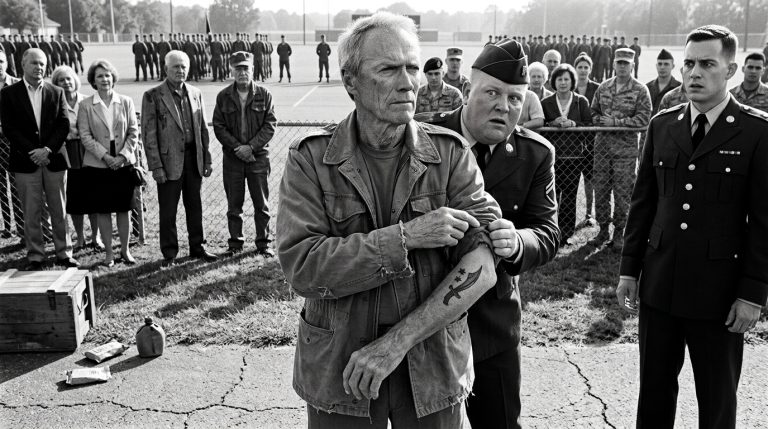
The infuriating silence of the man broke Davies. The Lieutenant felt the eyes of the crew on him, felt his own power evaporating in the face of this impossible calm. He had to draw blood. His gaze darted, frantic, until it landed on a small, faded patch of blue-black ink visible just above the collar of Glenn’s work shirt.
What is that? Davies sneered, his voice dropping to a sharp, venomous register. A jailhouse mark? A souvenir from a drunken night you’re too senile to remember?
Glenn didn’t answer, but the air in the room shifted. He didn’t see the Lieutenant’s face anymore. He saw the torpedo room, the dim red emergency lighting, and the makeshift needle—a guitar string and a motor—biting into his own skin. He saw his brother, Marcus, holding the ink-stained rig, his eyes filled with the same desperate, quiet resolve.
Glenn looked up, his gaze suddenly piercing, cutting through the Lieutenant’s bluster with a terrifying, ancient weight.
You have no idea what you’re looking at, boy, Glenn said, his voice a low, gravel-strewn whisper that stopped the Lieutenant cold.
CHAPTER 2: THE ANCHOR IN THE STREAM
The silence that followed Glenn’s words wasn’t empty; it was pressurized. It settled over the rigging floor, thick and heavy as the fog rolling off the coast. Lieutenant Davies had been leaning in, his face a map of righteous, misaligned fury, but he stumbled back half a step as if he’d been shoved by an invisible hand. The mockery that had been bubbling in his throat died, strangled by the sheer, unblinking intensity of the old man’s gaze.
Glenn didn’t move. He didn’t rise to his full height, he didn’t puff his chest, and he didn’t offer a rebuttal. He simply returned his focus to the parachute canopy. His hands, marked by years of salt and sun and the micro-scars of a thousand needles, resumed their work. The sound of the nylon—a crisp, rhythmic shushing—filled the sudden void where the Lieutenant’s shouting had been.
Across the room, the other riggers had ceased their pretense of activity. Senior Chief Petty Officer Mike Romano had his hand frozen on a rigging tool, his knuckles white. He watched the scene with a tightening in his chest. He knew the look in Davies’ eyes. It was the frantic, flickering light of a man who realizes, in the span of a heartbeat, that he has miscalculated the depth of the water he just dove into.
Davies’ chest heaved. He looked around, seeking some validation from the younger sailors, but they were averted, their heads down, their movements studiously invisible. He was alone in the center of the bay, exposed. The heat in his face faded into a sickly, pale sheen. He opened his mouth to speak, but the words were gone. He had expected a defensive explosion, a justification, or a plea. He hadn’t expected the wall of indifference that Glenn had erected.
The facility’s heavy bay doors groaned as they rattled in the sudden, sharp gust of wind sweeping in from the airfield—a small, jarring reminder of the outside world that felt entirely disconnected from the vacuum inside the rigging room.
Lieutenant, a voice called out, sharp and low.
Davies spun around, relieved for the interruption, until he saw the figure standing near the entrance. Captain Reynolds was not yet there, but the arrival of a junior aide had brought the static of real authority into the room. The aide didn’t look at Davies. He looked at the floor, then at the clock on the wall, his face devoid of emotion.
The Captain is requesting an immediate update on the rigging timeline for the upcoming insertion cycle, the aide announced, his voice flat. He’s in the secure brief, and he wants to know if the equipment will be ready, or if there are… complications.
Davies stiffened, the word ‘complications’ hanging in the air like an accusation. He looked back at Glenn, whose head was bowed over the canopy. The old man was threading a needle, his movements agonizingly slow, deliberate, and final.
There are no complications, Davies said, his voice straining to regain its usual metallic edge. He smoothed his uniform, though his hands still possessed a tremor he couldn’t quite mask. Everything is proceeding exactly according to protocol.
The aide didn’t nod; he simply waited. The silence was the real test. It forced Davies to acknowledge that the power he felt he possessed—the power to terminate, to revoke, to judge—was being filtered through a lens he hadn’t accounted for: the reputation of the man he was trying to break.
Glenn finished the stitch, knotted the thread with a snap that echoed like a pistol shot, and finally looked up. He didn’t look at the aide. He looked directly at Davies. His eyes were not angry. They were tired. It was the look of a man who had seen the same type of fear in a dozen different uniforms across half a century.
Tell the Captain the gear will be ready, Glenn said, his voice quiet but carrying perfectly through the room. Tell him the margin is two inches, exactly as it needs to be to keep the man wearing it alive.
Davies felt his throat constrict. He wanted to retort, to assert his seniority, to command the old man to show him the respect he felt he was owed. But as he looked at Glenn’s neck, at that faded, cryptic trident tattoo that seemed to pulse with the dim light of the facility, he saw something else. He saw the potential for a mistake that would never be fixed. He saw the reality that his own frantic need for perfection was not a virtue; it was a fragility.
He didn’t speak. He turned on his heel, his pace uneven, and walked toward the back office. The aide followed him, a silent shadow.
Romano exhaled, a long, shaky breath that barely cleared his lungs. He walked over to Glenn’s station, his movements slow, deliberate. He didn’t speak for a long time. He just stood there, watching the old man pack the next section of the chute.
He’s going to come back, you know, Romano said softly. He’s going to try to double down because he doesn’t know how to do anything else.
Glenn didn’t stop. He pushed the needle through the heavy nylon, his grip steady.
Then he’ll learn, Glenn replied. Or he won’t. Either way, the work gets done. The wind outside picked up, rattling the corrugated metal of the roof, a constant, low-frequency hum that reminded them of the sheer scale of the world they were all trying to serve. Glenn paused, his hand resting on the fabric. For a split second, his gaze drifted to the coffee thermos, still sitting exactly where he’d placed it.
He wasn’t thinking about the Lieutenant. He was thinking about the needle he had held in that dark, submerged torpedo room, and the promise that had kept him upright for fifty years. He was thinking about how many more stitches it would take to ensure the next man came home.
CHAPTER 3: THE UNMASKING
The door to the rigging facility clicked shut, the sound muted and heavy, sealing away the quiet, rhythmic shushing of the parachute canopy. Lieutenant Davies walked down the long, industrial corridor toward the administrative block, his stride forced and unnatural. Beside him, the Captain’s aide paced with a terrifying, rhythmic precision. Every click of the aide’s heels against the linoleum felt like a countdown.
Davies’ mind was a chaotic blur of justification. He had been right—the margin was off, or it would be, if the riggers were allowed to slack off. That was the logic. He had to believe in that logic, because the alternative—that he had just made a fool of himself in front of a man whose legend was whispered in the highest circles of the service—was too dizzying to contemplate.
They turned a corner into the command wing, where the air was suddenly colder, sanitized by heavy-duty ventilation systems. The fluorescent lights hummed at a pitch that set Davies’ teeth on edge. They reached the ante-room of Captain Reynolds’ office. It was a space designed for intimidation: glass partitions, pristine hardwood, and the absolute absence of clutter.
Wait here, the aide said, his voice devoid of even a tremor of unprofessionalism.
Davies stood in the center of the room. He looked at his reflection in the glass of a framed map on the wall. He looked young. Too young. His uniform, so crisp this morning, suddenly felt like a costume that didn’t fit. He tried to organize his thoughts, to draft the opening line of his report. He would focus on the maintenance protocols, the potential for catastrophic failure if standards were lowered—the very arguments that had propelled him to the top of his class at the academy.
He glanced down at the portable computer terminal on the desk near him, left open by a departing officer. The screen was a flicker of live data, a feed from the logistics network. His eyes, conditioned by years of obsessive study, scanned the list of upcoming gear deployments. He froze.
The entry for the next SEAL insertion cycle was flagged. In bright red, a system error code blinked: Deviation Audit Required – Packing Lead: Patterson, G.
Davies leaned in, his pulse thumping in his ears. It wasn’t a failure code. It was a manual override, a flag for a ‘Master-Grade Inspection.’ He had spent weeks scouring the logs, looking for any slip-up, any thread he could pull to prove his own vigilance. But as he looked at the audit history, he realized the ‘deviation’ wasn’t a mistake. It was a deliberate, hyper-precise calibration that exceeded standard naval requirements by a factor of ten.
The ‘old man’ hadn’t been failing to meet the standard. He had been creating a new one, one so advanced the base’s automated systems couldn’t even parse the data.
Davies felt the blood drain from his face. The fear he had been projecting onto Glenn—the fear of failure, the fear of the catastrophic outcome—was actually his own. He was staring at the technical evidence of his own incompetence. He had been so obsessed with the ‘two and a quarter inch’ rule that he hadn’t realized the man at the table was operating on a level of physics and intuition that Davies hadn’t even begun to study.
The door to the inner office creaked open.
Lieutenant, a voice commanded.
Davies turned. Captain Reynolds stood in the doorway, his silhouette framed by the harsh light of his office. He didn’t look angry. He looked disappointed, which was, in its own way, far more devastating. Beside him stood Master Chief Thorne, the Fleet Master Chief, whose expression was a slab of granite.
Davies stepped into the office. The room felt smaller than he remembered. He wanted to speak, to point to the terminal, to explain that he had been trying to uphold the integrity of the mission, but the words withered.
You have been questioning the integrity of the rigging department, Lieutenant, Reynolds said, his voice low, measured, and dangerous.
Davies nodded, his mouth dry. I… I was concerned about the margins, sir. I felt that the protocol was being… interpreted loosely.
Thorne stepped forward, the floorboards groaning under his weight. He didn’t raise his voice. He simply held up a file—a thin, gray-bound folder with no markings. He tossed it onto the desk.
Do you know what this is, Lieutenant?
Davies looked at it. He didn’t answer.
This is the history of the trident, Thorne said, his voice raspy. Not the one on the uniform, but the one earned in the dark. You saw the ink on Master Chief Patterson’s neck and you thought it was a mark of a misspent youth. You didn’t see the man who helped write the manual you used to pass your exams. You didn’t see the man who carried his team out of the North Atlantic when the rest of the world thought they were ghosts.
Davies felt the weight of the room pressing down on him. The ‘decoy’—his belief that he was the guardian of standards—wasn’t just crumbling; it was being revealed as an empty shell. He had mistaken his fear for morality.
I didn’t know, sir, Davies whispered, the words sounding hollow even to his own ears.
Reynolds walked to the window, looking out over the airfield where the transport planes sat, massive and silent in the dusk. He didn’t turn around.
That is the problem, Lieutenant. You didn’t know. And because you didn’t know, you chose arrogance over curiosity. You chose to break a man who has spent his entire life building the very foundation you stand on.
Reynolds turned, his face shadowed, his eyes reflecting the cold light of the monitors. We are going to fix your perspective, Davies. But not through a reprimand. A reprimand is just a stamp on a piece of paper. You are going to learn what those stitches mean. You are going to learn what it costs to ensure a man comes home.
Davies felt a shiver run down his spine. The path he had mapped out for his career—the fast-track promotions, the command potential—was evaporating. But as he looked at the Master Chief’s steady gaze, he realized that for the first time in his life, he wasn’t looking at a subordinate. He was looking at someone he had to earn the right to serve.
CHAPTER 4: THE COLLAPSE OF THE SHIELD
Lieutenant Davies remained standing in the center of the Captain’s office, his muscles locked in a rigid, involuntary brace. The room seemed to shrink around him. The hum of the ventilation, once a background annoyance, now roared in his ears like a gathering storm. He watched the back of Captain Reynolds’ head—a silhouette against the gray, overcast sky beyond the glass—and felt the foundations of his world cracking.
He had spent his life convinced that the world was composed of hierarchies: the competent and the incompetent, the leaders and the failures. He had positioned himself firmly in the former, armed with the sharp, clean logic of the academy. But the folder sitting on the desk was a physical weight, a testament to a history he hadn’t even been capable of imagining. He looked at the edge of the file, at the nondescript gray cardstock, and saw in it the reality of a life that couldn’t be measured by margins or log-book entries.
Davies reached out, his hand trembling, and pushed the folder back toward the center of the desk. He didn’t want to open it. To read it would be to confirm the total erosion of his own identity.
I didn’t think, Davies said, his voice cracking. The admission was painful, a jagged piece of glass in his throat. I thought I was protecting the team.
Master Chief Thorne stepped forward, his boots hitting the hardwood with the finality of a gavel. Protecting the team? Thorne’s voice was low, devoid of malice but dripping with the weight of experience. You weren’t protecting anyone, Lieutenant. You were protecting your own ego. You saw an old man doing work that made you feel small, so you tried to tear him down to make yourself feel big again.
The words struck Davies with physical force. He looked down at his hands. They were clean, free of the grease and the scars that adorned Glenn’s. They were the hands of a man who had never held anything more dangerous than a pen and a digital stylus.
He closed his eyes for a split second, and the sterile office vanished. He was back on the rigging floor, the cold metallic smell of the steel tables replacing the scent of floor wax. He saw Glenn’s hand again—that impossible, blurred speed—snatching the thermos. He felt the phantom vibration of that moment, a reminder that the old man possessed a quiet, latent velocity that Davies couldn’t even dream of possessing.
A sudden memory, sharp and unbidden, spiked through Davies’ mind: a cold, winter night during his first field exercise. He had ordered a jump, ignoring the pilot’s warning about crosswinds. He had wanted the record, the ‘fastest insertion.’ When they landed, scattered and injured, he had blamed the winds. He had blamed the gear. He had never once blamed his own calculation. The realization hit him like a physical blow to the sternum. He had been a danger to his men from the very start, hiding behind the shield of his own ‘perfectionism.’
Captain Reynolds finally turned. His face was a mask of cold, uncompromising authority.
You’re not being reassigned, Davies, Reynolds said. The words hit like stones. You are being relieved of all operational duties effective immediately. You will spend the next three weeks in the rigging facility. You will not be in command. You will not be auditing. You will be learning. You will work under Master Chief Patterson. You will do whatever he tells you to do. If he tells you to scrub the floor, you scrub it. If he tells you to count threads, you count them until you understand that every single one of them represents a life.
Davies’ breath caught in his throat. He was an officer. He was a product of the highest naval standards. The indignity of the sentence was absolute.
Sir, he tried to protest, the instinct of the academy training kicking in, but he stopped. He looked at Thorne’s eyes, then at the map on the wall. He realized that this wasn’t punishment. This was the only chance he had to avoid becoming a hollow man.
I understand, sir, Davies managed.
Thorne didn’t smile. He merely gestured toward the door. Get to the rigging floor. The Master Chief is waiting.
Davies walked out of the office, his legs heavy, his uniform feeling like lead. As he navigated the hallway, he didn’t look at his reflection. He didn’t check his watch. He kept his head down, watching his boots move against the floor, each step a reluctant surrender to the reality he had ignored for so long.
He reached the bay doors of the rigging facility. He hesitated. The sound from within was the same quiet, rhythmic shushing of nylon. He pushed the door open. The air inside smelled of coffee and long-enduring work. Glenn Patterson was still at his table, his back to the door, a needle moving through the fabric with the same hypnotic rhythm as before.
Glenn didn’t turn around. He didn’t acknowledge the Lieutenant’s presence. He simply continued his work, the thread snapping taut with a sound that felt like a bridge being built across a vast, dark canyon.
Pick up a rag, boy, Glenn said, his voice not turning, not rising, just existing in the space. The floor needs cleaning.
Davies stood still for a moment, the silence between them stretching into a physical barrier. He was supposed to be the one giving orders. He was the one with the commission. He looked at the broom leaning against the wall, its bristles worn and gray. He reached out, his hand gripping the wood, and for the first time in his life, he didn’t look for the logic behind the task. He just walked toward the spill on the floor.
He knelt. He began to work. And in the silence of the facility, the only sound was the scrape of the broom and the steady, rhythmic stitch of a man who had already mastered the world that Davies was only just beginning to see.
CHAPTER 5: THE BRIDGE
The fluorescent hum of the rigging facility had become the soundtrack of Lieutenant Davies’ new life. For three weeks, he had lived in a world of raw texture: the abrasive bite of nylon cord, the slick metallic sheen of stainless steel tools, and the incessant, meditative repetition of stitches. His uniform, once his primary shield, was long since folded away; he wore the heavy, grease-stained work shirt of a contractor. He had learned the language of the floor—not the language of commands and rank, but the language of friction and tension.
The bell above the door of the off-base coffee shop jingled, a sharp, crystalline sound that cut through the muffled roar of the wind outside. Davies pushed his way in, his shoulders hunched. He was tired—a deep, marrow-level exhaustion that no amount of sleep could touch. He spotted Glenn sitting in the corner, a newspaper spread out before him, a steaming cup of black coffee at his elbow.
Davies felt a surge of the old instinct—the need to stand tall, to project the authority of a graduate of the Academy—but it died as quickly as it had risen. He was just a man in a shop now. He walked over to the table and stopped.
Glenn looked up. His eyes, clear and unnervingly observant, didn’t hold the judgment Davies had spent his entire life fearing.
Have a seat, son, Glenn said, his voice as steady as the rhythmic pull of a rigging tool.
Davies sat. The chair was wooden, slightly uneven, and it scraped against the floor with a sound that felt loud in the relatively quiet room. He had rehearsed a thousand apologies, a thousand explanations about his need to ensure mission success, his fear of the variables he couldn’t control. But as he looked at the Master Chief’s hands—resting calmly on the newspaper—all the words felt like paper-thin shields.
I… I wanted to apologize, Davies began, his voice raspy. Not for the protocol. For how I treated you.
Glenn didn’t interrupt. He didn’t offer a platitude. He let the silence hang, a space for the Lieutenant to fill with whatever honesty he could muster.
I spent my whole career thinking that if I just held the line tight enough, I could stop the world from breaking, Davies admitted, his eyes fixed on the condensation dripping down the side of his own lukewarm coffee. But I was the one who was broken. Every time I thought I was ‘perfecting’ the mission, I was just ignoring the cost. I didn’t see the people. I just saw the statistics.
He looked up, meeting Glenn’s gaze. The memory of the trident tattoo—the makeshift ink, the submarine’s red emergency lighting, the terror of that night—seemed to flicker in the air between them, a ghost of a sacrifice Davies hadn’t even known existed.
You weren’t just packing parachutes, Davies continued, his voice finding a new, steadier resonance. You were keeping a promise. I was just trying to keep my seat at the table.
Glenn took a slow, deliberate sip of his coffee. He looked out the window, where the low, gray clouds of the coast hung over the base.
The promise is the work, Glenn said quietly. It isn’t about being right. It isn’t about the grade. It’s about the fact that if you don’t do it with your whole heart, someone else pays for your ego. You wanted perfection, Lieutenant. But perfection is a static thing. What we do… what we live for… it’s about endurance. It’s about the fact that we’re all tied together by the same fragile threads.
Davies felt the weight of his own hubris finally lift, replaced by a strange, hollow clarity. He thought back to his ‘fastest insertion’ exercise, the one that had left his team scattered. He had always blamed the environment. Now, looking at the man across from him, he realized he had been looking for a reason to avoid seeing himself.
I think I’m ready to understand, Davies said. Not the protocol. The cost.
Glenn nodded, a slow, solemn movement of the head. He reached into his coat pocket and pulled out a small, metallic object—a rigging tool, worn smooth from decades of use. He slid it across the table. It clinked against the ceramic surface.
You’ve been cleaning the floor for three weeks, Davies. That’s the preparation. Now, you learn to see.
Davies picked up the tool. It was cold, heavy, and balanced perfectly in his palm. He looked at it, feeling the texture of the wear-and-tear on the grip. It was a bridge—not to a rank, not to a promotion, but to a reality he had spent his life trying to outrun. For the first time, he didn’t feel the urge to lead. He felt the profound, grounding desire to serve.
CHAPTER 6: THE ECHO OF THE TRIDENT
The walk back to the base was shorter than it had any right to be, or perhaps Davies was simply moving with a purpose that stripped away the perception of distance. He still carried the rigging tool Glenn had given him. It felt less like a piece of steel and more like a compass. When he pushed through the bay doors of the rigging facility, the air felt different—thicker with purpose, humbler.
Glenn was exactly where he had left him, his back to the door, hunched over the same sprawling, intricate web of nylon. The room was bathed in the late-afternoon sun, long, amber beams of light cutting through the dust motes that danced in the air.
Davies didn’t announce himself. He walked to his own station, set the tool down with a soft click, and picked up a length of cord. He began to work. He didn’t look for the fastest way to complete the task; he looked for the most deliberate. He mimicked the rhythm he had watched for three weeks: the steady pull, the precise knot, the unwavering tension.
After an hour of rhythmic, silent labor, Glenn stood up. The old man’s joints groaned, a sound that in any other context would have seemed a sign of weakness, but here sounded like the shifting of bedrock. He walked over to Davies’ station.
Davies held his breath, his hands steady as he finished a stitch. He waited for the critique, the sharp observation on his form, but none came. Instead, Glenn looked at the parachute canopy.
That’s good, Glenn said. It’s tight. It’s true.
Davies looked up. He saw the faded trident tattoo on Glenn’s neck, the ink catching the sun. It looked less like a mark of a secret warrior and more like a scar that had finally stopped aching.
I’m sorry it took me so long to see it, Glenn, Davies said.
Glenn looked at him then, and for the first time, there was a ghost of a smile in the corners of his eyes—a weary, knowing expression that transcended rank, service, and age.
We don’t get to choose when the light hits the glass, Lieutenant. We just get to choose whether we look at the reflection or the window.
Glenn reached out and picked up the thermos that had almost been tipped over weeks ago. He unscrewed the cap, poured a small amount of coffee into the lid, and held it out. It was a gesture of profound equality, a quiet, informal seal on a contract that had nothing to do with the Navy and everything to do with the bond between two men who had finally understood the same truth.
Davies took the lid. The coffee was strong, bitter, and warm. He drank it, feeling the heat settle into his chest, a grounding weight that anchored him to the room, the work, and the reality of his own fallibility.
The Master Chief turned back to his table and pulled a small, damaged patch of nylon from his pocket—the very first piece of equipment Davies had ever criticized, the one with the ‘misaligned’ stitch. He placed it in front of Davies.
Fix it, Glenn said. Do it right.
Davies took the piece of fabric. He pulled his needle through the material, watching as the thread followed the path he laid for it. He worked slowly, with the reverence of a monk, ensuring every millimeter was exactly as it should be. He felt the history of the work, the weight of the men who had jumped using the gear he had once so arrogantly dismissed.
As he finished the final stitch, he realized the ‘decoy’—his belief that he was a protector of standards—had been replaced by something far more substantial: the knowledge that true strength wasn’t found in the authority to judge, but in the capacity to maintain the threads that held others up.
He finished. He laid the patch down, his heart quiet, his mind clear. The facility seemed to settle around them, the wind outside dying down to a whisper, leaving only the hum of the cooling fans and the distant, rhythmic ticking of a clock.
Davies looked at his hands. They were stained, tired, and steady. He wasn’t the man who had walked into this facility three weeks ago, and as he stood there, watching the sunlight fade across the concrete floor, he realized he didn’t want to be. He had been forged in the fire of his own ignorance, and for the first time in his life, he felt truly, unbreakably prepared.
The cycle was closing. He had come here to command, but he was leaving with the knowledge of how to belong. He picked up his tools, packed them away with the care of a craftsman, and for a moment, he understood the silent, heavy, and beautiful weight of the trident. It wasn’t a mark of superiority; it was a mark of service—a promise that no matter how deep the water or how high the fall, you never walk away from the work. You never walk away from the brother.
He looked at Glenn, who was already turning off the lights at the main station. The old man tipped his head toward the door, a silent gesture of completion.
Tomorrow, Glenn said, his voice fading into the soft, settling shadows of the room. Tomorrow, we start on the long-range canopy tests. There’s a lot to be done.
Davies smiled—a real, genuine shift in his posture that signaled the end of his defense and the beginning of his contribution.
Yes, Master Chief, Davies said. I’ll be here.
He walked toward the door, the cool evening air greeting him as he stepped outside, the stars already beginning to glimmer above the flight line. He felt the weight of the rigging tool in his pocket, a small, solid, enduring piece of reality. He was ready.