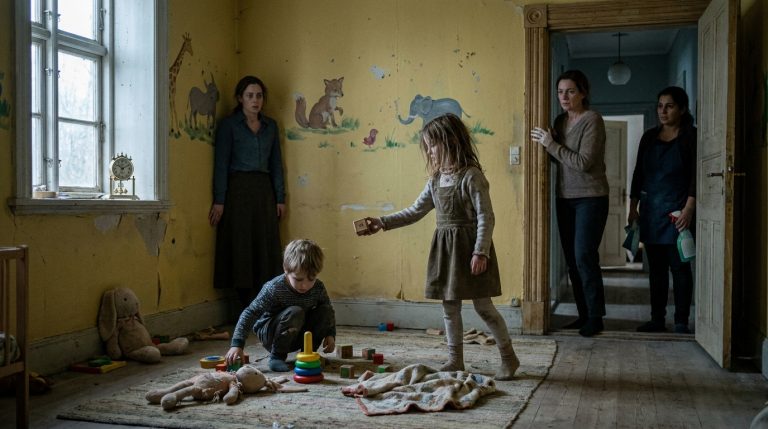
A Home Reclaimed: The Quiet Rhythm of Three Souls Finding Their Place in the Softened Light
CHAPTER 1: The Weight of Presence
The echo of expensive heels had finally vanished, leaving behind only the scent of faint, floral perfume and the oppressive sterility of the receiving room. Adrienne stood motionless, his hands tucked deep into his pockets, his gaze fixed on the spot where the five women had lined up only minutes before. They had stood like statues—polished, precise, and completely hollow.
He felt the heavy, rhythmic thud of his own heart. It was a sound he usually associated with the high-stakes friction of his office, not his foyer. Beside him, Lily hadn’t moved. She was still clutching Kora’s apron, her knuckles white against the faded, flour-dusted fabric. The contrast was physically jarring: the stark, cold marble floor against the warmth of the worn, fraying cotton.
“They’re gone, Lily,” he said, his voice sounding thin in the vaulted space.
Lily didn’t look at him. She just pressed her forehead harder into Kora’s side. “I know.”
The simple assertion made Adrienne shift. He expected a child’s tantrum, a spark of defiance, or even a tearful breakdown. Instead, he encountered a terrifying, absolute clarity. She wasn’t just resisting the five women; she was actively rejecting a world that categorized people by their utility rather than their presence.
He looked at Kora. For eleven years, he had seen her as a fixture—a reliable component of the household machine, much like the silver service or the climate control system. Now, he saw the small, nervous tremor in her hands as she gently patted Lily’s back. He noticed the way her gray hair was pinned back with a simple, rusted clip, and the way her shoes were worn thin at the soles.
“Miss Bennett,” Adrienne began, then stopped. The title, usually so comfortable and compartmentalized, felt like a barrier he had accidentally built. “I need you to… I need us to consider what happens next.”
“I am the cook, sir,” Kora replied, her voice barely a whisper, yet it held the weight of an anchor. “I am where I belong.”
“But you aren’t, are you?” Adrienne found himself walking toward them. The space between them, usually a respectful five feet of professional distance, felt like a canyon he was slowly crossing. “Lily doesn’t see you as the cook. She sees you as the witness. The one who stays.”
He glanced at his daughter. Lily finally looked up, her eyes wide, serious, and stripped of the performative softness that the other women had tried to mirror. She looked at him with the terrifying, unblinking intelligence of someone who had already figured out the secret to living.
“You said I could choose,” Lily said.
Adrienne felt a phantom chill slide down his spine—a sudden, sharp memory of his own childhood, of a door closing and a woman named Elena vanishing without a goodbye. He had spent his entire adulthood building a life of permanent, replaceable things to ensure he would never feel that hollow ache again. And here it was, staring back at him in his daughter’s gaze.
“I did,” Adrienne said, and for the first time in his life, he didn’t feel the need to qualify the statement. “I said you could choose.”
The house seemed to stretch around them, the long corridors of dark wood absorbing the tension. Somewhere in the kitchen, the faint, ticking pulse of a wall clock counted down the seconds, reminding him that the world outside was waiting for him to resume his role, to be the man who managed things. But as he looked at the quiet, fragile tableau of the girl and the cook, he realized the rhythm of his house had fundamentally changed.
He reached out, his hand hovering, then falling back to his side, unable to bridge the final, invisible gap. “We’ll talk about this at dinner,” he said, his voice finally steadier. “For now, go back to the kitchen, Miss Bennett. Just… be there.”
As Kora turned to leave, Lily didn’t let go of her hand. She held on, the fabric of the apron bunching between their fingers, a lifeline woven from years of small, unnoticed kindnesses. Adrienne stood alone in the center of the hall, the silence wrapping around him like a heavy, velvet shroud. He looked at the heavy door, then back at the stairs. He realized he was no longer looking for a solution. He was waiting for the house to tell him what he had done.
CHAPTER 2: The Architecture of Routine
The heavy door to the study clicked shut, and the sound was final—a guillotine blade descending on the previous order of the house. Adrienne stood in the hallway, his fingers tracing the grain of the door frame as if he were trying to memorize the texture of a map he had only just begun to read. Behind him, the house felt suddenly, sharply unfamiliar.
He didn’t move toward the office. Instead, he turned toward the library, his boots making no sound on the thick, plush carpet. He needed a moment before the inevitable shift of the evening routine. He needed to verify the machinery.
The library was a tomb of silence and dust, illuminated by the dying orange light of the sunset filtering through high, leaded windows. He walked to the mahogany desk he rarely used, his eyes scanning the surface for anything out of place. His hand stopped mid-air. Resting on the blotter was a thin, leather-bound folder—a personnel audit from the agency. It shouldn’t have been here. It belonged in the administrative safe, filed under the house manager’s lock.
He opened it. It was a list of the previous nannies, their tenures measured in months, sometimes weeks. Beside each name, a handwritten notation in Mrs. Prut’s precise, angular script: Incompatible. Attachment threshold exceeded.
Adrienne’s pulse quickened. The phrase was clinical, cold, and entirely designed to remove the human element from a child’s upbringing. He looked at the names—women who had come with bright smiles and polished credentials, just like the five from this morning. He looked at the dates. Every time a nanny had stayed long enough to form a genuine bond—to become someone who stayed when the house was dark—she had been categorized as an incompatibility.
The realization hit him with the force of a physical blow. This wasn’t just a household. It was a curated exhibit. The Vance image required a nanny, but it could not tolerate a presence. He felt a surge of cold fury, directed inward. He had been the one to authorize these audits. He had been the one to sign off on the turnover rates, thinking he was ensuring efficiency, never questioning why the turnover was so high.
He shoved the folder into his briefcase, his movements stiff. The library felt smaller now, the shadows stretching longer across the floor, threatening to swallow the remaining light.
Out in the hallway, he heard the faint, rhythmic sound of footsteps—the soft, hesitant tread of Kora heading toward the kitchen. She wasn’t carrying a leather folder or a scripted list of qualifications. She was carrying a tray of tea, her movements slow and deliberate, the way of a person who has spent a decade navigating a house that was never meant to be hers.
He stepped out to catch her, the floorboards creaking beneath him.
“Miss Bennett,” he called out.
Kora froze. She didn’t turn around immediately. She took a breath, her shoulders straightening in that small, familiar gesture of preparing for a correction. When she did turn, her face was a mask of neutral, professional composure.
“Yes, sir?”
“The kitchen,” Adrienne said, choosing his words with surgical precision. “You don’t need to return to the cooking rotation tonight. Lily is in her room. Take the night to… stabilize the transition. I will handle the evening service.”
Kora looked at him, her eyes searching his for the catch, for the inevitable pivot back to the status quo. She didn’t find one. “Sir, the kitchen staff—”
“The kitchen staff will do as I say,” he interrupted, his voice firm, shedding the cold, detached register he usually reserved for his employees. He saw the flicker of surprise in her eyes, a tiny crack in her stoic facade. It was a small victory—a pebble thrown into a stagnant pond, creating ripples that he knew would eventually turn into waves.
“Go to her,” he said. “She’s waiting for you.”
He watched her walk away, her apron fluttering slightly in the hallway draft. He stood there for a long time, listening to the house settle around him. He felt the weight of the audit folder in his briefcase—the evidence of his own complicity in the systematic erasure of his daughter’s happiness. He walked to the window and looked out at the estate grounds, seeing not the sprawling, manicured lawn he had always been proud of, but a cage. A beautiful, expensive, and meticulously maintained cage.
But tonight, the silence in the hallways didn’t feel like a vacuum. It felt like the space between heartbeats. He knew, with a clarity that unsettled him, that the audit folder would not be the only thing he would have to confront before the week was out. Mrs. Prut, the agency, the very structure of his daily life—they were all built on the assumption that he would continue to play his part.
He looked at his watch. 7:00 PM. Lily would be starting her book. He thought of the soft glow of the lamp in her bedroom, the worn rabbit, and the smell of lavender detergent that always seemed to linger near Kora. He had lived in this house for eleven years, but he realized, as he watched the first stars emerge over the trees, that he was only just now moving in.
He turned back toward the kitchen, ready to face the staff, ready to break the machinery he had built. Every step he took felt heavier, more deliberate. He wasn’t just walking across a floor anymore; he was stepping onto a bridge that was being built beneath his feet with every decision he made.
CHAPTER 3: The Ghost of the Past
The transition from the library to the kitchen was not merely a walk across floorboards; it was a physical descent into the heart of the house’s internal mechanism. As Adrienne moved, the grand, high-ceilinged echoes of the main hall faded, replaced by the humming, rhythmic vibration of the domestic staff quarters. He could hear the low, clinical murmur of voices—Mrs. Prut’s voice, specifically—issuing directives with the precision of a metronome.
He stopped just short of the swinging door. The scent hit him first—not the usual sterile cleaning solution of the main house, but something older, sharper. Dried herbs, the faint, metallic tang of an iron, and there, underneath it all: the unmistakable, powdery scent of pressed lavender.
His lungs seized. The air in his throat suddenly felt thin, as if he were breathing the atmosphere of a room he hadn’t stepped into in twenty-five years. He saw the nursery of his childhood—not the museum-piece rooms of his own mansion, but the small, cramped corner of a drafty estate where Elena had sat in a wooden chair, her hands always busy with needlework.
The phantom of her face drifted into his mind—eyes that had held a quiet, watchful sadness, a warmth he had desperately clung to until the morning she had simply ceased to be. He reached out to steady himself, his hand striking the cold, polished oak of the door frame. The contact brought him back to the present, but the vibration of the memory lingered, turning his blood to ice. He hadn’t just been auditing employees; he had been systematically purging the “Elena” from his own daughter’s life.
He pushed the door open.
The kitchen went silent. It was a vacuum of sound. Three staff members, including Mrs. Prut, were gathered around a stainless-steel island. Mrs. Prut, a woman whose posture was a testament to decades of enforced professional rigidity, turned with a pleasant, practiced smile that didn’t reach her eyes.
“Mr. Vance,” she said, smoothing the front of her uniform. “I was just finalizing the inventory for the weekend. The new agency representative will be calling to confirm the second-tier candidates by tomorrow morning. I assume you want to review them before the breakfast service?”
She spoke with the absolute certainty of someone who knew the script by heart. She was the conductor of this orchestra, and until this moment, Adrienne had been the one who had written the music.
He stood in the doorway, his briefcase heavy at his side, the weight of the leather audit folder pressing against his leg. He looked at the staff—people he had employed for years yet hardly recognized as individuals. They were components, each performing a specific, frictionless function.
“Cancel it,” he said.
Mrs. Prut’s smile didn’t flicker, though the air in the room seemed to shift, thickening with unspoken confusion. “I’m sorry, sir? The agency contact?”
“Cancel the second-tier search,” Adrienne said, his voice low, lacking the clipped, authoritative edge he usually adopted for staff. It was something else—something more human, and therefore, far more dangerous. “There is no search. The position is filled.”
“Filled, sir?” Mrs. Prut tilted her head, a gesture of patronizing inquiry. “I don’t believe the agency provided a file for—”
“Miss Bennett is the nanny,” Adrienne said.
The silence that followed was absolute. He watched the reaction ripple through the room. One of the kitchen assistants dropped a tea towel; the fabric hit the floor with a dull, soft sound. Mrs. Prut’s expression didn’t change, but he saw the tension in her jaw, the way her hands tightened on the edge of the island. She wasn’t just surprised; she was visibly, deeply offended by the breach of protocol.
“Mr. Vance,” she said, keeping her voice even, the tone she used when correcting a mistake he didn’t realize he was making. “Miss Bennett is an excellent cook. She is a long-standing member of the service team. But she is not qualified for personal care. She lacks the academic background, the language certifications, the formal training required for a Vance child. To promote someone from that sector… it creates a fundamental imbalance in the house.”
She was speaking to him like a child, or a manager whose investment was failing. It was the same language he had used to justify his own coldness for years.
Adrienne walked into the kitchen, his boots sounding loud and invasive on the tile. He stopped across from her. He realized then that the “imbalance” she spoke of wasn’t about the household; it was about the control. If the help could become family, the line between employer and servant was exposed as a fiction, and the house of cards he had built would begin to collapse.
“The imbalance,” Adrienne said, leaning over the island, his shadow falling across her ledger, “is that for eleven years, I have been looking at people in this house and seeing only their utility. I have been measuring their worth by how little space they occupy and how little noise they make.”
He looked at the ledger—at the neat columns, the precise ink, the cold data points of human lives. He reached out and snapped the book shut. The sound was like a gunshot in the sterile space.
“I am not interested in the agency’s qualifications, Mrs. Prut,” he said, his voice dropping, gaining a dangerous, quiet heat. “I am interested in who shows up in the dark. Kora Bennett has been here. She has been the one to sit with my daughter. She has been the one to provide the stability I was too blind to see. If that is an ‘imbalance,’ then I am done with balance. You have the rest of the evening to finish your inventory. Tomorrow morning, you will assist Miss Bennett with the transition of her responsibilities. Do you understand?”
Mrs. Prut stood her ground, but her composure was fraying. The mask was slipping, revealing the brittle, anxious woman beneath the uniform. “Sir, if you proceed with this, the household structure will be untenable. The other staff—”
“Then they will adjust,” Adrienne said, turning toward the door. “Or they will find employment elsewhere. That is their choice.”
He didn’t wait for her response. He pushed through the swinging door and stepped back into the hallway. His hands were shaking—a small, involuntary tremor he couldn’t suppress. He looked down at his palms and saw the dust of the library still clinging to his skin. He had just severed the final anchor of his previous life. He felt, for the first time in twenty-five years, like a man truly capable of breathing, even as the walls of the house felt like they were closing in.
CHAPTER 4: The Shared Table
Adrienne stood in the dining room, his hands firmly gripped behind his back. The tremor in his palms had subsided, but a residual hum of adrenaline remained beneath his skin. The table was set for three. It was a configuration that felt entirely foreign—the fine bone china, the polished silver, the centerpiece of winter lilies—all arranged with the precision of a stage set designed for a performance that had suddenly been rewritten.
Mrs. Prut had followed his instructions to the letter, yet the silence in the room was brittle. It felt as if the house itself were holding its breath, waiting to see if the new order would endure the first inevitable collision of reality and rule.
The swinging door creaked. Lily entered first, her movements lacking their usual hesitant caution. She walked to her chair, her gaze darting toward the threshold, scanning for Kora.
“She’s coming, Lily,” Adrienne said, surprised by the softness in his own voice.
“I know,” Lily replied, her tone a mixture of expectation and newfound confidence.
A moment later, Kora appeared. She wore her usual uniform, but there was a subtle, almost imperceptible difference in her posture. She no longer lingered at the edge of the threshold; she stepped fully into the dining room, her hands folded neatly in front of her. She looked at Adrienne, her eyes conveying a complex blend of professional duty and the raw, unadorned acknowledgment of their shared secret.
“Sit, Kora,” Adrienne said, gesturing toward the chair at the end of the table.
Kora hesitated—a single, fleeting moment of internal recalibration—before taking the seat. She sat with a straight back, her hands placed gently on the linen tablecloth, a stark contrast to the way she had stood in the doorway only yesterday.
The dinner service began. The staff moved with a fluidity that bordered on the robotic. Mrs. Prut, lurking in the shadows of the sideboard, watched every movement with a gaze that Adrienne could feel like a prickle on the back of his neck. She was hunting for a crack in their composure, a slip in the professional facade he had just dismantled.
“The peas are excellent,” Adrienne noted, the words feeling thin. He looked at Kora. “They’re from the garden?”
“Yes, sir,” Kora replied. Her voice was steady, grounded. “I had them put aside from the morning harvest. They’re sweet this year.”
“I like them,” Lily chimed in, shoveling a forkful into her mouth with vigor. “Miss Kora says everything in the garden needs room to breathe.”
Adrienne watched his daughter, noting the way she looked at Kora—not with the grasping, desperate need she had displayed in the receiving room, but with a settled, quiet satisfaction. She was anchored. He had spent years terrified that he would fail to provide the perfect life for her, thinking that ‘perfect’ meant ‘controlled.’ Now, watching them, he saw that the only thing Lily had ever needed was someone who was simply there.
He looked over at Mrs. Prut, who stood rigid by the sideboard. Her eyes were fixed on Kora’s hands—hands that were currently holding a wine glass with a grace that seemed to offend the house manager. Adrienne realized then that the decoy secret he had uncovered—the agency’s curation protocol—was merely the surface. The deeper, more insidious reality was the expectation that this house was a machine.
If he allowed this meal to continue, if he acknowledged Kora as an equal at his table, he was effectively setting a match to the legacy his father had left him—the legacy that demanded he be a man of cold, efficient lines.
“Is there something you need, Mrs. Prut?” Adrienne asked, his voice sharp, cutting through the ambient clatter of cutlery against china.
The house manager startled, her eyes snapping to his. “No, sir. I was only… ensuring the service was appropriate.”
“The service is fine,” Adrienne said. “You may step out. We will manage.”
It was a dismissal that shattered the final remains of the protocol. He saw the flash of indignation in Mrs. Prut’s eyes before she bowed her head, her face masking the resentment, and retreated to the kitchen. The door swung shut, and the room grew significantly quieter.
Kora exhaled, a soft, involuntary sound. She reached for her water glass, her fingers trembling ever so slightly.
“She’s watching, you know,” Kora said quietly. “She doesn’t like this change, Adrien.”
“She’s paid to manage the house,” he replied, taking a slow sip of his own wine. “She isn’t paid to decide the architecture of it. I’ve realized that I’ve been letting a house manager dictate the content of my life. That ends tonight.”
He looked at Kora, and for the first time, he saw the depth of the burden she had been carrying—the weight of eleven years of silent service, of witnessing his failures as a father from the shadows, of quietly patching the holes he had torn in his daughter’s world.
“I’m sorry,” he said, the words feeling heavy, unaccustomed on his tongue.
Kora looked up, her gaze meeting his with a sudden, devastating clarity. “You don’t need to be sorry for what you didn’t know, sir. You only need to be responsible for what you know now.”
The honesty of her statement hung in the air, a physical weight that made it difficult to speak. Adrienne looked down at his plate, the half-eaten roast chicken suddenly unappealing. He had spent his life winning arguments, negotiating contracts, and manipulating markets. Yet, he had never faced an opponent as formidable as the truth, spoken in a quiet voice across a dining room table.
He realized that by bringing Kora to this table, he had moved beyond the point of no return. The house would continue to resist. The staff, the agency, the social circles that demanded a certain standard of ‘professional’ distance—they would all push back. But as he looked at Lily, now laughing at something Kora was whispering, he felt a strange, quiet resolve.
He wasn’t just building a family. He was excavating a life from beneath the layers of cold, professional stone he had spent his entire adulthood constructing. And tonight, for the first time, the foundation felt solid.
CHAPTER 5: The Intrusion of Order
The sound of the knocker was not the gentle tap of a visitor; it was the sharp, authoritative rap of someone who believed they owned the ground upon which the house stood. Adrienne felt the vibration through the floorboards, a jarring interruption that cut through the fragile peace of the dining room.
He didn’t move. He looked at Kora, whose eyes had widened—a flicker of the old caution returning. Lily looked toward the hallway, her fork still poised halfway to her mouth.
“Stay here,” Adrienne said, his voice quiet but commanding.
He rose from the table, his movements stiff. The dining room air, warm and smelling of roasted herbs and home, felt suddenly thin as he walked toward the foyer. His pulse, which had been leveling off, began a rhythmic, urgent hammering against his ribs. He knew who was at the door before he reached it. The agency didn’t accept cancellations easily. They dealt in contracts, in reputations, and in the meticulous curation of the lives of the wealthy. They weren’t coming for tea; they were coming to rectify an inventory error.
He reached the front hall. Mrs. Prut was already there, hovering by the door with a look of practiced triumph. She opened it before Adrienne could intervene.
Standing on the threshold was Marcus Thorne, the senior director of the elite placement firm. Thorne was a man who looked like he had been constructed out of sharp angles and expensive wool. He didn’t wait for an invitation. He stepped inside, his polished shoes clicking sharply against the marble, bringing with him the cold, damp air of the winter night.
“Mr. Vance,” Thorne said, his voice a smooth, modulated baritone. He didn’t offer a hand. He scanned the foyer with a gaze that stripped the house of its warmth, cataloging the state of the furniture and the lighting with a clinical assessment. “I received your message about the ‘restructuring’ of your household staff. I must say, I found it somewhat… unorthodox.”
“It wasn’t a request for consultation, Thorne,” Adrienne said, stopping ten feet away. He felt the weight of his own house behind him, the small, quiet life he was trying to grow, contrasted against the massive, immovable force of Thorne’s institutional authority. “It was an instruction.”
Thorne smiled. It was a gesture that didn’t reach his eyes, which remained fixed on the hallway leading back to the dining room. “When one manages a property of this scale, one must consider the optics, Adrienne. A cook—a woman who has spent eleven years in the scullery—suddenly elevated to a primary caregiving role? It creates a narrative of instability. The board members, your business partners… they look for consistency in a man’s home as an indicator of his stability in the market.”
“My home is not a market, and it is not an indicator,” Adrienne said, his voice dropping into the register he used when he was shutting down a hostile takeover.
“Of course not,” Thorne said, stepping forward. He moved with a predator’s grace. “But the contract we have, the one governing the Vance domestic services, is quite explicit about the qualifications required for personnel entrusted with the ward of the estate. Promoting Ms. Bennett is a breach of protocol. A breach that, if it became public, could trigger a review of your fitness to maintain the current guardianship status.”
Adrienne felt the air leave the room. It was a threat, veiled in the soft language of ‘protocol.’ Thorne wasn’t just talking about a nanny; he was talking about the custody of Lily. He was tapping into the very fear that had governed Adrienne’s life—the fear that someone would decide he was unworthy, that he was too ‘unstable’ to keep his own daughter.
“You’re threatening me?” Adrienne asked, his voice dangerously low.
“I am advising you,” Thorne countered, his smile widening. “We have provided five impeccable candidates today. Any one of them would restore the appropriate standard. Why risk everything for a sentiment?”
“It isn’t a sentiment,” Adrienne said, his hands clenching at his sides until his knuckles ached. “It is a choice. One that you seem to think you have the right to veto.”
He looked past Thorne, toward the dining room. He saw the sliver of light from the hallway illuminating Kora’s silhouette as she stood by the table. She was looking at him—not with fear, but with a quiet, patient expectation. She had been here for eleven years. She had watched him make mistake after mistake, and yet she had never left. She knew the man he was behind the contracts, and she knew the man he was trying to become.
Adrienne turned back to Thorne, his decision crystallizing into something unbreakable. The cold, mechanical structure of his life had relied on people like Thorne—people who turned human lives into assets to be managed. But if he was going to lose everything for the sake of a facade, he would rather lose it all while protecting the only thing that had ever been real.
“Get out, Thorne,” Adrienne said.
Thorne blinked, his calm demeanor slipping for the first time. “I beg your pardon?”
“This is my house. These are my employees. And that child is my daughter,” Adrienne said, his voice echoing in the marble hall. “If you ever step foot on this property again to dictate how I live, I will personally dismantle your agency, asset by asset. You think I care about the board? You think I care about the ‘optics’? I care about the person who stays when the lights go out. And you are not that person.”
Thorne stared at him, his face flushing with a mixture of shock and suppressed rage. He realized, in that moment, that the leverage he had spent years cultivating was gone. Adrienne was no longer acting for the ‘appropriate standard’; he was acting for his own heart.
“You’re making a catastrophic mistake, Adrienne,” Thorne said, his voice thin with malice.
“I’m making a choice,” Adrienne replied. “Finally.”
He stepped aside and opened the door. The cold night wind rushed in, extinguishing the warmth of the foyer, but Adrienne didn’t flinch. Thorne walked out, his polished shoes sounding like mocking applause on the walk. Adrienne slammed the door.
He stood there, panting, the silence of the house rushing back to fill the void. He had just declared war on the only system he had ever known. He felt exposed, fragile, and utterly terrified—but as he turned back toward the dining room, he felt something else, too. For the first time in his life, he didn’t feel like he was waiting for the other shoe to drop. He was finally, truly, at home.
CHAPTER 6: The Weight of the Secret
The attic was not a place Kora had been intended to visit. It was a space of discarded things—broken furniture, trunks of forgotten seasonal decor, and the dense, suffocating scent of trapped time. She had come up here driven by a restless energy, a need to escape the pressurized atmosphere of the floors below where the staff were whispering in corners and Mrs. Prut was orchestrating a quiet, tactical retreat.
The storm outside had begun in earnest, a low, rhythmic drumming against the slate roof that sounded like a heartbeat. Kora moved through the aisles of sheeted furniture, her flashlight cutting a narrow, dusty path through the gloom. She wasn’t sure what she was looking for until she saw it: a small, cedar-lined trunk tucked behind a stack of moth-eaten rugs. It was locked, but the key—a heavy, tarnished brass thing—sat resting on the floorboards nearby, as if someone had left it behind in a hurry years ago.
She knelt, her knees aching against the hard, unyielding wood. She turned the key. It resisted, then gave with a dry, metallic click.
Inside were bundles of letters, tied neatly with fraying twine. She pulled one out, her fingers trembling as she unfolded the brittle paper. It was from a nanny—one whose name she vaguely recognized from the staff rumors of a decade ago. It wasn’t a professional report. It was a plea.
I don’t understand why the master is so cold, the letter read, the ink faded to a pale, ghost-like gray. I only tried to read to her. I only tried to stay until she fell asleep. And now they say I am incompatible. They say I am a risk to the family image. I am so afraid for the little one. She doesn’t know why I’m leaving.
Kora felt a cold, sharp pain bloom in her chest. She pulled out another, then another. They were all the same. Each woman had been removed, not for cause, but for connection. The system wasn’t designed to find nannies; it was designed to break bonds before they could become permanent. The “incompatibility” wasn’t a failure of the staff; it was a success of the curation protocol.
The weight of it was staggering. She realized then that the house wasn’t just a home for Adrienne and Lily; it was a battlefield where human connection was routinely defeated by the cold, calculating architecture of the Vance estate.
A sudden, sharp crash of thunder shook the house, and Kora gasped, clutching the letters to her chest. She heard footsteps on the stairs—not the light, skipping tread of Lily, but the slow, heavy, measured gait of someone who belonged to the house’s machinery. Mrs. Prut.
Kora scrambled to her feet, shoving the letters back into the trunk. Her hands were frantic, her breath coming in shallow, ragged hitches. She had uncovered the mechanism, the truth that Adrienne was only just beginning to suspect. She looked at the trunk, then at the narrow attic door. She couldn’t leave these behind, but she couldn’t take them.
The door handle turned.
“Miss Bennett?” Mrs. Prut’s voice floated up into the attic, cool and devoid of any warmth. “I thought I heard someone up here. The storm has caused a leak in the guest wing, and I require the spare linens. I believe they are kept in this general vicinity.”
Kora forced her heart to slow. She stood in the shadows, the trunk half-open, her flashlight beam flicking off. “I’m just… organizing, Mrs. Prut,” Kora said, her voice sounding steadier than she felt.
“Organizing? In the dark?” The door pushed open, and Mrs. Prut stood framed by the dim light of the hallway lamp, her eyes darting through the gloom with a predatory precision. She spotted the trunk, then her eyes locked onto Kora.
The silence between them was not a pause; it was an intersection. Mrs. Prut knew. She had always known. She was the one who had written the notations in the audit folder, the one who had maintained the curation of the Vance image. Her expression wasn’t one of shock; it was one of cold, calculating appraisal.
“You shouldn’t be here, Kora,” she said, her voice dropping into a register that made Kora’s skin crawl. “Some things in this house are left in the attic for a reason. They represent the… redundancies of the past. It would be a pity to have to repeat that history, wouldn’t it?”
“Is that why you removed them?” Kora asked, her voice gaining strength, fueled by a sudden, protective fire. “Because they cared for the child? Because they were human?”
Mrs. Prut stepped into the attic, the floorboards groaning under her weight. She didn’t answer directly. “We serve the legacy of the house. Mr. Vance believes he has a choice, but the house has its own momentum. He will come to realize that the ‘incompatibilities’ were always for his own protection. And you, Miss Bennett, have just made yourself the most significant incompatibility of all.”
She reached out, her fingers tightening on the handle of the attic door, her eyes never leaving Kora. “I suggest you return to your quarters. Mr. Vance is already under a great deal of stress from his confrontation with Mr. Thorne. I would hate for him to be burdened with the knowledge that his new nanny has a penchant for rummaging through things that don’t concern her.”
Kora looked at the trunk, then at Mrs. Prut. She realized then that she hadn’t just discovered a secret; she had ignited a fuse. The house was not going to let them be. The system was already reacting, mobilizing to protect the “optics” at any cost.
She walked past Mrs. Prut, her head held high, though her hands were shaking so hard she had to shove them deep into the pockets of her apron. She had the truth now. It was burning in her mind, a fragile, dangerous thing, but it was enough. She had to get to Adrienne. She had to show him that the battle wasn’t just against the agency—it was against the very walls of the house itself.
CHAPTER 7: The Final Convergence
Kora’s breath hitched as she navigated the narrow servants’ stairs, her feet striking the wood with a rhythmic, hurried cadence that echoed through the hollow spaces of the walls. She had to reach Adrienne. Every creak of the floorboards felt like a betrayal, a warning signal to the house that she was carrying the one secret that could dismantle it entirely. She clutched the bundle of letters to her chest, the brittle paper crunching beneath her grip, a sound that seemed loud enough to wake the dead.
She reached the main landing, intending to head straight for the study, when the shadow of a figure detached itself from the gloom of the hallway. It was Adrienne. He stood near the window, watching the storm lash the glass, his silhouette framed by the sporadic, ghostly illumination of lightning. He looked exhausted, the sharp, authoritative lines of his face softened by a weariness that went deeper than simple sleep deprivation.
“Adrienne,” she gasped, stumbling toward him.
He turned, his eyes narrowing as he saw the state of her—her hair loose from its pins, her face pale, the bundle of letters gripped so tightly her knuckles were translucent. He reached out to steady her, his hands firm on her shoulders. “Kora? What happened? I saw Prut earlier, she was—”
“She knows,” Kora interrupted, her voice a ragged whisper. She thrust the letters into his hands. “She’s been doing it for years. Not just to me—to all of them. The ‘incompatibility’ reports? They aren’t reports, Adrienne. They’re a record. A record of every time this house broke someone who actually tried to love your daughter.”
Adrienne took the letters, his brow furrowing as he looked down at the faded ink. He didn’t read them right away. He looked at Kora, his eyes searching hers for a tremor of doubt, a sign that she was wrong. But he found only the stark, uncompromising clarity of someone who had reached the bottom of a well.
“Read them,” Kora pressed. “Read what they did to Elena.”
The mention of the name hung in the air like a physical weight. Adrienne’s hands shook, the paper rattling in the sudden silence of the hall. He opened a letter at random, his eyes darting across the text, the lines blurring as the meaning sank in. It wasn’t just administrative; it was systemic. The ‘management’ of his house had been a calculated, multi-generational effort to ensure that no one—no nanny, no employee, no soul—could ever penetrate the rigid, cold boundaries of the Vance estate.
And he had been the one to sign the checks. He had been the one to validate the purges, calling them ‘efficiency.’
“They didn’t just remove them, did they?” he whispered, his voice catching. “They erased them.”
“They were erased the moment they showed heart,” Kora said. “And I was supposed to be next. Mrs. Prut told me as much upstairs.”
Adrienne’s face drained of color. The rage that had driven him to confront Thorne in the foyer returned, but now it was colder, sharper—the focused fury of a man who realized he had been an accomplice in the slow death of his own humanity. He looked back toward the end of the hall, toward the rooms where Lily was sleeping. He could hear the wind howling around the eaves of the house, a mournful, restless sound that seemed to echo the lost voices of the women in his hands.
“Prut is still downstairs,” Adrienne said, his voice terrifyingly calm. “She thinks I’m still the man who needs her to keep the machinery running.”
“What are you going to do?” Kora asked, watching him.
“I’m going to stop the machine,” he replied.
He didn’t wait for her to respond. He started down the hallway toward the stairs, his movements deliberate, calculated. He had spent his life building walls, and tonight, he would tear them down with his own hands. Kora followed him, her heart pounding against her ribs. She saw the way his jaw was set, the way his shoulders pulled back—the transformation was complete. The billionaire, the patriarch, the man of cold lines—all of it was being replaced by someone else. Someone who finally understood that a house without a heart was just a tomb.
They reached the top of the main staircase. Below, in the foyer, the lights were dimmed to a soft, golden glow. Mrs. Prut was there, standing by the console table, adjusting a stray vase of flowers. She looked up as they descended, her face a mask of perfectly calibrated deference.
She saw the letters in Adrienne’s hand. Her expression shifted—a fraction of a second, a tightening of the eyes—but she did not retreat. She held her ground. She was the final guardian of the Vance protocol, and she had no intention of yielding.
“Mr. Vance,” she said, her voice smooth, inviting. “I was just about to close the estate for the night. I assume you’re ready to put this… unpleasantness behind us?”
Adrienne stopped at the bottom of the stairs. He held the letters out toward her, not as a request, but as an indictment. “This isn’t ‘unpleasantness,’ Prut,” he said, his voice echoing against the cold marble walls. “This is the history of what you have done in my name. And it ends tonight.”
The silence that followed was heavy, laden with the weight of decades of secrets. The storm outside seemed to pause, the rain tapping against the glass like fingers seeking entry. Adrienne took a step toward her, and for the first time, Mrs. Prut stepped back. The predator had become the prey, and the house, for once, seemed to be holding its breath in anticipation of the truth.
CHAPTER 8: The Golden Square
Mrs. Prut did not scream. She did not rail against the injustice or attempt a desperate denial. She simply looked at the letters in Adrienne’s hand—at the ink that had survived a decade of her careful, clinical scrubbing—and she seemed to shrink. The authority that had armored her for thirty years evaporated, leaving behind a small, brittle woman whose entire existence had been tied to the preservation of a lie.
She turned and walked toward the servants’ entrance, her movements stiff, mechanical, the gears of her own internal machine finally grinding to a halt. She didn’t look back. She simply vanished into the shadows of the corridor, and with her departure, the house seemed to exhale.
Adrienne stood in the center of the foyer, the silence pressing in, but this time it wasn’t the silence of a tomb. It was the silence of a sanctuary. He looked at Kora, who had stayed on the stairs, her hands still trembling but her gaze fixed on him with a steady, quiet light.
“Is it done?” she asked, her voice barely audible.
“It’s done,” Adrienne replied. He crossed the floor and stood at the bottom of the stairs, looking up at her. He felt a profound, heavy exhaustion, but beneath it, the first stirrings of something he hadn’t experienced in years: genuine, unburdened peace.
Over the next few weeks, the Vance house underwent a transformation that was as slow and inevitable as the changing of the seasons. The staff who relied on the protocol drifted away, replaced by those who understood that a home was not a machine to be tuned, but a living, breathing space. The clinical sterility of the hallways softened. Plants appeared in the windows, the heavy curtains were pulled back to let the light stream in, and the rooms that had once felt like museum exhibits began to hold the warmth of actual living.
Adrienne took the framed drawing of the three figures in the garden—the one Lily had made—and placed it on his desk, right in the center, where the personnel audits used to sit. It was his daily reminder. He realized, as the months passed, that the ‘clean lines’ he had once prized were nothing more than a defensive wall, a way to ensure he would never again experience the sharp, hollow ache of being left behind. He had tried to outrun his past, but in doing so, he had almost lost his future.
The culmination of this shift came on a quiet Saturday afternoon. Adrienne sat in the living room, reading, when he heard Lily’s voice from the kitchen, laughing at some whispered secret with Kora. He set his book aside and walked to the room where they were working on a puzzle—a sprawling, complex map of the world.
He knelt beside them, the floorboards warm under his weight. He took a piece of the puzzle—a small, jagged shape—and looked for its place.
“Here, Daddy,” Lily said, pointing to a gap in the center of the ocean. “It fits right there.”
Adrienne placed the piece, and it snapped into position with a satisfying click. He looked at Kora, who was watching him with a soft, knowing smile. She reached out and brushed a stray lock of hair from Lily’s forehead, her hand lingering there with a natural, maternal grace. She was no longer ‘Miss Bennett’ to him; she was the heart of the house.
He realized then the truth he had been avoiding: his rigidity had not been about success or order. It had been about his own fear. He had been terrified that if he allowed anyone to truly belong to him, they would eventually disappear, leaving him to face the dark alone. But looking at Kora, he understood that the only way to avoid the dark was to be the person who stayed.
He reached into his pocket and pulled out the brass key Kora had found in the attic—the key to the trunk of lost things. He didn’t lock anything away; instead, he placed it on the table, a symbolic artifact of a secret that no longer held any power over them.
“I found this in the attic,” he said quietly. “I think we can find a better use for it than keeping secrets.”
“What would you like to use it for?” Kora asked.
Adrienne looked around the room—at the soft light filtering through the curtains, at the half-finished puzzle, at the two people who had taught him that the most important things in life were not the things you could control, but the things you chose to cherish.
“We’ll use it to lock the door to the garden,” he said, his voice warm. “So that we never have to worry about the cold getting in again.”
He sat back on his heels, the weight of the past finally settling into its proper place: a memory, a scar, a lesson. He wasn’t the man he had been a year ago, and he never would be again. He was someone who finally understood that his success wasn’t measured by the house he kept, but by the love he was willing to protect.
The house was quiet, filled only with the soft sounds of a life being lived in real-time. In the window, the golden square of the lamp glowed, a beacon against the darkening evening. Somewhere, far away, the system he had dismantled continued its rigid, lonely path, but it no longer had any reach within these walls. They were home, and for the first time, nobody was going anywhere.