The Architect of Silence: A High-Stakes Chess Match Between Truth, Blood, and the Painted City
CHAPTER 1: THE GEOMETRY OF SURVEILLANCE
The office was a tomb of silence, save for the rhythmic thrum of the heating vents and the frantic, delicate scratching of Sophia’s pencil against the heavy stock of her sketchbook. Vincent didn’t turn around. He stayed at the window, his silhouette cutting a sharp, uncompromising line against the pale, diffused light of the Chicago sky.
Down on the street, the man in the brown coat adjusted his collar. It was the third time in ten minutes. His movements were clinical, practiced—the movements of a man who had spent his life watching other people’s lives from a distance.
“Left shoulder, Mr. Vincent,” Sophia said, her voice small but piercingly clear. She didn’t look up. Her eyes were fixed on the drawing in front of her, where she had captured the man’s stance with jagged, precise lines. “He dips it every time he checks the watch. Like he’s hiding something under the coat. Something heavy.”
Vincent’s jaw tightened. He didn’t ask her how she knew. He had learned, over the past three months, that Sophia’s artistic eye was not just about aesthetics. It was about raw, unfiltered data. While his security team looked for guns, faces, and threats on a database, Sophia looked for the way a person’s weight shifted when they lied to themselves.
“Twelve minutes,” Vincent stated, his voice a low, gravelly vibration. He watched the man turn his head sharply to the left, his eyes sweeping the street—not for traffic, but for the building’s entrance. “He’s not looking for a way in. He’s looking for a way out, just in case he gets spotted.”
“He looks like the shadows you draw when you’re sad,” Sophia added, finally glancing up. Her eyes were dark, devoid of the complex paranoia that dictated Vincent’s daily existence. “He’s waiting for something he’s afraid of.”
Vincent finally turned away from the window. The office, usually a sanctuary of controlled power, felt suddenly exposed. The man in the brown coat was not a hitman—the posture was too rigid for that. He was a collector. A scout. And if he had been watching them for three days without Vincent’s sophisticated sensor arrays picking him up, it meant he knew exactly how the security protocols functioned. He knew where the blind spots were.
He walked over to his desk, picking up a heavy, steel-edged paperweight—a remnant of his early days—and rolling it across the mahogany. The sound was like a gunshot in the quiet room.
“Miguel,” Vincent said into the intercom, his tone clipped. “Get up here. Bring the perimeter logs from the last seventy-two hours.”
He didn’t wait for a response. He looked at Sophia, who had returned to her drawing. Her pencil was moving faster now, sketching the man’s silhouette with an intensity that made the hair on Vincent’s arms stand up.
“Sophia,” he asked, his voice softer, but still edged with the steel of his trade. “What else does the man see?”
Sophia paused. She tilted her head, her gaze shifting as if she were looking through the walls, through the glass, through the layers of the city. “He’s not looking at us, Mr. Vincent. He’s looking at the alleyway behind the shipping warehouse. He thinks we don’t know it exists.”
Vincent felt the blood drain from his face. The alleyway was where he kept the physical ledger, the one thing he had trusted to no digital system. The man wasn’t just watching the building; he was waiting for the transfer.
The door burst open. Miguel entered, his face pale, clutching a tablet. “Mr. Vincent, the cameras… the feeds for the north side just looped. They’ve been looping for an hour.”
Vincent looked at the drawing on Sophia’s lap. The man in the brown coat was no longer just a shadow; he was the focal point of a machine that had already started turning.
“He’s not a scout, Miguel,” Vincent said, his voice dropping into the cold register of a man who had reached a decision. “He’s a ghost. And he’s coming to finish what he started.”
Suddenly, the lights in the office flickered once—a sharp, violent surge that died instantly, leaving them in the dim, gray twilight of the late afternoon. Sophia dropped her pencil. It clattered against the floor, a sound far too loud in the sudden, absolute silence. Then, a low, mechanical whirr echoed from the hallway outside, followed by the metallic click of the elevator override.
“Get behind the desk,” Vincent ordered, his hand instinctively moving toward the hidden drawer beneath the surface. “Now.”
CHAPTER 2: THE INVISIBLE THREAT
Vincent’s fingers met the cold, hidden steel toggle under the lip of the desk. He did not click it immediately. In the dark, his mind worked with the cold, mechanical precision of a Swiss timepiece. A sudden power drop. An elevator override. These were not the crude hallmarks of a common thief; they were the opening gambit of an adversary who had memorized the board.
Behind him, Miguel’s breath was shallow, a dry, fluttering rasp in the darkness. “The main breaker is down,” Miguel whispered, his tablet screen reflecting in his sweat-sheened forehead like a fractured blue mirror. “Auxiliary power is holding, but only for the internal servers. The security gates on the ground floor are locked in default-open mode.”
“They didn’t cut the line from the street,” Vincent said, his voice flat, stripped of all emotion. “If they had, the backup generator would have kicked in within three seconds. This was a software-level command. A diagnostic loop.”
His fingers finally pressed the toggle. A heavy, hydraulic thud resonated from the walls as four solid-steel deadbolts slid into the doorframe. The room was now a sealed vault. The only light came from the crimson status LEDs on the backup power unit beneath the credenza, throwing long, jagged shadows across the ceiling.
Sophia did not cry out. She was already crouched in the knee-well of the desk, her knees pulled tight to her chest, her pink skirt tucked around her ankles. She held her sketchbook flat against her knees, her small fingers tracing the wooden grain of the desk’s inner panel. She looked up at Vincent, her eyes reflecting two points of dark, steady light.
“He’s still there,” she whispered, her voice barely louder than the hum of the cooling fans. “The man in the brown coat. He didn’t run when the lights went out.”
Vincent leaned over the desk, his hands resting on the cold, polished mahogany. “He wouldn’t. He’s the anchor.”
He reached down, pulling a sleek, aluminum-cased terminal from the recessed drawer. The screen glowed to life, casting a cold, clinical blue over his face. He tapped a sequence of keys, bypassing the compromised main interface. The camera feed from the elevator lobby was dark, but the diagnostic overlay showed a steady stream of data flowing through the secondary network port.
“Miguel,” Vincent called out softly. “Look at the routing table.”
Miguel crept forward, his shoes whispering against the low-pile carpet. He leaned over Vincent’s shoulder, his eyes scanning the lines of green text scrolling down the side of the display. “It’s bypassing the firewall. How is it doing that? The encryption keys are rotated every midnight.”
“It’s not bypassing them,” Vincent said, his gaze fixed on a single, repeating hexadecimal string at the bottom of the screen. “It’s using an authenticated handshake. It has a master key.”
The air in the room felt thick, tasting faintly of ozone and old dust. Vincent watched the terminal. The elevator override signal wasn’t trying to bring the car up. It was trying to retrieve something. A data harvest.
“Mr. Vincent,” Sophia said, tapping her finger against the side of the desk to get his attention. “In my drawing… from yesterday… the man had a small silver box in his hand. He wasn’t holding it like a phone. He was holding it against the copper pipe by the light pole.”
Vincent’s eyes narrowed. “The copper pipe. The ground line for the hotel’s external telecom trunk.”
He understood now. The man across the street wasn’t just watching; he was physically tapped into the copper riser that bypassed the primary digital security of the penthouse. It was a brilliant, low-tech bridge to a high-tech heist. The digital signal was being injected directly into the hardware layer.
“He’s draining the archive,” Vincent muttered. The archive. The physical ledger wasn’t just paper; the terminal in this office held the decryption maps for the entire network of safe houses and political payrolls. If those maps were compromised, the empire would dissolve before sunrise.
“Can we cut the line?” Miguel asked, his voice rising in panic. “I can go down to the basement. The main trunk splitters—”
“No,” Vincent cut him off, his voice sharp as a razor. “If you go out there, you walk right into his net. He’s waiting for the system administrator to panic and trigger a manual reset. A manual reset opens the hardware firewalls for thirty seconds. That’s all he needs to clone the drive.”
Vincent’s hands moved over the keyboard with deliberate, unhurried speed. He wasn’t trying to block the signal. Instead, he was constructing a mirror-trap—a ghost directory filled with thousands of lines of corrupted, identical data that would look genuine to an automated scanner but would jam the receiver’s drive with a self-replicating loop.
“We let him think he’s winning,” Vincent murmured, his eyes reflecting the cold blue of the terminal. “We feed him the decoy. Let him take the file.”
“But what if he realizes it’s a fake?” Miguel asked, wiping sweat from his upper lip.
“He won’t. Not until he tries to unpack it at his base. And by then, the signal trace will have locked onto his physical coordinates.”
On the screen, a progress bar appeared, glowing a dull orange. DECOY TRANSFER IN PROGRESS: 14%… 28%…
Sophia reached out, her small hand gently tugging at Vincent’s sleeve. He looked down at her. She was pointing at her sketchbook, where she had drawn a detailed close-up of the man’s coat lapel. On the dark wool, she had carefully shaded a tiny, circular pin—a geometric shape consisting of a hollow triangle split by a vertical line.
“I saw this when he crossed the street on Tuesday,” Sophia whispered. “He kept his hand over it when the wind blew.”
Vincent stared at the drawing. The coldness in his chest turned to absolute ice. The hollow triangle with a vertical line was not a generic design. It was the personal insignia of the ‘Sovereign Guard’—the ultra-secret internal security division of the Chicago Police Department, a unit that had been officially disbanded ten years ago. A unit whose members had all been sworn to absolute secrecy, or buried.
But that wasn’t what made his heart stop.
He looked back at the diagnostic screen, where the decryption handshake was finalizing. The master key that had authorized the data siphon was displayed in the terminal’s security log: KEY_AUTH: V_MARONE_09.
Vincent’s breath caught in his throat. That key had been generated for one person, and one person only. His older brother, Alberto, who had been dead for six years.
The progress bar hit 100%. The transfer was complete. The screen went black, and then the lights in the office snapped back on, blindingly bright, casting harsh, unforgiving shadows across the room.
The elevator outside chimed.
CHAPTER 3: THE CALCULUS OF VIOLENCE
The chime echoed through the penthouse office, a crystalline intrusion into the suffocating silence. Vincent did not move. He stood behind the massive, mahogany desk, his hand still resting on the cold, serrated edge of the concealed steel drawer. Beside him, Miguel had frozen, his hands still hovering over the glowing terminal, his eyes wide and fixed on the reinforced elevator doors.
Sophia was a statue beneath the desk, her chin resting on her sketchbook. She hadn’t blinked. Her gaze was locked on the seam where the elevator doors met the frame, her eyes tracking the microscopic movement of the metal as it began, with a sluggish, hydraulic whine, to part.
“Miguel,” Vincent whispered, the word a razor-thin command. “The secondary lockdown.”
Miguel scrambled to his feet, his shoulder catching the edge of the terminal, sending a ripple of green light across the room. He slammed a series of override commands into the wall-mounted interface. But the sequence didn’t register. The screen flickered, displaying a static, singular error code: ACCESS DENIED – SYSTEM HIERARCHY OVERRIDE.
Vincent’s heart hammered against his ribs—a rhythmic, heavy thud that felt like a countdown. The override wasn’t just a hack; it was an internal command from the building’s own central operating system. He’s not breaking in, Vincent realized, the horror of it settling into his marrow. He’s being welcomed.
The elevator doors slid open with a hiss of pressurized air. The lobby beyond was empty, bathed in the same harsh, clinical white light that had flickered throughout the floor. But the elevator car itself was vacant. There was no one inside. No hitman, no Detective Walsh, no brother returned from the dead.
Only a single, black leather briefcase sat in the center of the car’s brushed-steel floor, bathed in the light.
“Don’t move,” Vincent ordered, his voice dropping into the low, gravelly register he used when he was prepared to burn his own empire to the ground. He stepped out from behind the desk, his movements deliberate, controlled. He moved with the predatory grace of a man who had spent his life navigating minefields.
Sophia stood up slowly, her sketchbook clutched to her chest. She followed Vincent’s line of sight, her eyes darting to the briefcase. “It’s the same kind,” she whispered, her voice barely audible. “The ones the men had on the balcony. The ones with the secret inside.”
Vincent ignored her, his eyes scanning the corridor. The hallway was empty, but the security cameras—now back online—showed nothing but the static hum of an idle floor. He reached the threshold of the elevator, his boots making no sound on the plush carpet. He stopped, looking down at the briefcase. It was identical to the one Marcus and Tony had used, the same grain of leather, the same polished silver latches.
He reached out, his fingers hovering inches from the handle. He felt the cold radiation of the metal, the sheer, undeniable weight of the trap.
“Mr. Vincent,” Sophia called out from behind him. Her voice lacked the tremor of fear; instead, it held a sharp, observant curiosity. “Look at the floor.”
Vincent shifted his gaze downward. Just outside the elevator, barely visible against the dark carpet, lay a small, crumpled piece of paper. It looked like a receipt, discarded and forgotten. He crouched, his muscles coiled, and picked it up. It was a dry-cleaning slip, dated three days ago.
Client: A. Marone.
The name triggered a visceral, physical recoil. Alberto. The dry-cleaner’s address was a storefront in a district Vincent had liquidated years ago. He looked back at the briefcase, his breath hitching. The door-seal mechanism at the top of the elevator frame groaned, a high-pitched, metallic shriek that signaled a structural failure in the hydraulic pressure.
Suddenly, the floor beneath the elevator lurched. The car dropped three inches, the metal screeching against the guide rails. The emergency brakes caught with a violent, teeth-rattling jar that shook the entire office.
“The building,” Vincent growled, his mind racing through the architectural schematics of the penthouse. “He’s not attacking the office. He’s attacking the foundation.”
The elevator was a diversion, a weight-triggered catalyst. The briefcase wasn’t meant to be opened; it was a payload. Vincent saw the tiny, blinking red light embedded in the base of the briefcase, hidden in the shadow of the handle. It wasn’t an explosive; it was a localized EMP generator, primed to pulse the moment the briefcase was moved.
“Back!” Vincent roared, grabbing Miguel by the collar and shoving him toward the secondary service stairwell. “Sophia, move!”
They dived toward the reinforced frame of the office door just as the briefcase emitted a soundless, high-frequency whine. The air in the room ionized, the scent of ozone spiking into a sharp, bitter tang. The office lights didn’t just flicker—they exploded, a shower of glass and sparks raining down onto the carpet. The terminal, the intercom, the security grid—everything powered by the central hub went dead in a cascading wave of blackness.
The silence that followed was absolute, a void in the middle of the city.
Vincent lay on the floor, his hand shielding his face from the glass. His ears rang with a steady, high-pitched tone. Beside him, Miguel was gasping, struggling to find his footing in the dark.
“Is everyone… are you alright?” Vincent asked, his voice rough.
He felt a small, warm hand slip into his. Sophia. She hadn’t made a sound.
“I’m here,” she whispered.
In the sudden, oppressive darkness of the room, Vincent looked toward the elevator lobby. The briefcase was gone. The EMP hadn’t just fried the electronics; it had physically warped the steel floor of the elevator car. Through the gap where the elevator doors had been, Vincent saw a shadow move—a tall, rigid figure standing in the darkened lobby, the silhouette of a man who knew exactly how much damage he had caused.
The man didn’t run. He stood still, the light from the hallway catching the faint, hollow shape of a triangle pin on his lapel. He raised a hand, tracing a slow, deliberate salute toward the darkness of the office.
Then, he turned and walked into the stairwell, his footsteps steady, rhythmic, and terrifyingly calm.
“He’s not hiding anymore,” Vincent whispered, his blood running cold. “He wants me to follow him.”
CHAPTER 4: THE BROKEN SEAL
Vincent didn’t wait for his vision to fully clear or for the ringing in his ears to subside. He surged forward, his boots striking the floor with a heavy, urgent thud. The darkness of the lobby was thick, smelling of acrid insulation and burned copper. Miguel was right behind him, his breathing ragged, holding a heavy tactical flashlight that flickered with a dying yellow glow.
“Stay close,” Vincent hissed, his voice stripped of all patience.
They reached the heavy, fire-rated door leading to the stairwell. Vincent didn’t use the handle; he slammed his shoulder into the panel, the metal groaning as the locking mechanism—now dead without power—yielded with a screech. He burst into the stairwell, his hand already on the grip of the compact pistol he had retrieved from the wall-safe before the blackout.
The stairwell was a vertical shaft of damp concrete and shadow. The emergency lighting had failed, leaving only the faint, cold ambient light filtering down from the rooftop hatch. Vincent moved down the steps, his back pressed against the cold, sweating concrete wall. Every movement was a calculation, a slow, deliberate shift of weight designed to minimize sound.
“He’s here,” Sophia whispered from behind them. She was huddled close to Miguel, her hand gripped tight to the hem of his coat. She didn’t look afraid; she looked focused, her eyes scanning the angles of the stairs with the same intensity she applied to her sketches. “He didn’t run fast. He was waiting.”
Vincent paused on the third-floor landing. He peered down into the well of the stairs. There were no footfalls, no echoes. The silence was too perfect. He looked at the wall, running his gloved fingers along the concrete. In the dim light, he spotted a faint smear of oil—the kind used for cleaning mechanical gears. It was fresh, a smudge against the gray.
He knelt, bringing his face close to the stair tread. There was a scratch, almost invisible, marking the metal edge of the step. It was a precise, professional mark, the kind left by a boot heel designed to provide traction on slick, industrial surfaces.
“Miguel,” Vincent whispered. “Look at this.”
Miguel leaned over, his light cutting through the gloom. “That’s… that’s a military-grade boot print, Mr. Vincent. High-density rubber. You can’t buy that at a store.”
Vincent stood, his jaw set. The Sovereign Guard hadn’t been a standard police unit; they were an extraction team, trained in urban warfare and silent entry. If this man was one of them, he hadn’t just been a detective—he was a specialist. And if he was a specialist, he didn’t leave fingerprints; he left breadcrumbs.
He turned his attention back to the landing door. It was slightly ajar. Vincent pushed it open, his weapon raised, expecting a confrontation. Instead, he found the empty hallway of the third-floor executive suite.
He walked to the center of the hallway and stopped. On the floor, resting squarely in the path they would have taken, was a single, small item.
It was a wax seal. Red, perfectly circular, and imprinted with a symbol Vincent hadn’t seen in over a decade: a stylized, interlocking set of wings—the crest of the Marone family’s original transport business, the company that had folded before his empire even existed.
Vincent picked it up, the wax cold and brittle against his skin. It wasn’t just a sign; it was a taunt.
“He’s not trying to kill us yet,” Vincent said, his voice a low, dangerous rumble that echoed off the sterile office walls. “He’s trying to remind me of who I used to be.”
“Why?” Miguel asked, his voice trembling as he shone the light on the seal. “Why drag up the past now?”
Vincent stared at the wings, the sharp edges of the seal pressing into his palm. “Because he knows the archive isn’t just about money. He knows it’s about the roots. He thinks if he pulls the thread, the whole suit comes apart.”
He looked at Sophia. She was staring at the seal, her head tilted, her gaze intense. She walked forward and looked at the wall behind the seal. There was a small, almost imperceptible discoloration in the paint—a square outline, as if a frame had been hanging there for years and was only recently removed.
“He took something,” Sophia said. “A picture. I saw it on the wall when we toured the building last month. It was an old one. A boat. Your father’s boat.”
Vincent’s vision blurred for a split second, the cold, calculated exterior he maintained finally cracking. That boat was the foundation. It was where his father had begun the shipping routes, where the first illicit cargo had been hidden, and where the original payrolls were buried in a watertight compartment beneath the hull.
The man in the brown coat wasn’t just a threat to his current power; he was a surgical strike against the origin of it. He was stripping away the history, the leverage, the very identity of the Marone name.
“He’s going to the docks,” Vincent realized, his voice sharp with a sudden, crystalline clarity. “He’s not after the ledger in the penthouse anymore. He’s after the source.”
He turned to Miguel, his movements now rapid, authoritative. “Get the SUV. We don’t take the main road. We use the service tunnel under the bridge. If he wants a ghost hunt, we’ll give him one.”
He looked at Sophia. She was still staring at the blank spot on the wall, her pencil gripped tight, not drawing, just feeling the empty space. “Are you scared, Sophia?”
She looked up at him, her eyes clear, steady, and terrifyingly honest. “No,” she said. “I’m just drawing what happens next.”
Vincent didn’t ask her what she meant. He didn’t have to. He could feel it in the air—the change in the pressure, the tightening of the city’s grip. He turned and headed for the stairwell, the wax seal clenched in his fist, his resolve hardening into something colder and more dangerous than any weapon. The game had shifted from defense to a hunt, and he would play it on his own terms, even if he had to tear the city down stone by stone to do it.
CHAPTER 5: THE PROXY WAR
The service tunnel was a throat of black, weeping concrete that ran beneath the city’s major arteries, a vein of rusted piping and forgotten infrastructure. Vincent walked with his hand resting near his sidearm, his eyes scanning the gloom. Behind him, Miguel moved with a nervous, shuffling gait, his flashlight beam dancing erratically over the slick walls, while Sophia held close to his leg, her presence a quiet, unsettling anchor in the dark.
“Stay focused on the ventilation grates,” Vincent commanded, his voice echoing against the damp surfaces. “The Sovereign Guard doesn’t fight in the open. They manipulate the environment. They want us to think we’re being hunted, but they’re actually herding us.”
Miguel swallowed hard, the sound sharp in the tight space. “Herding us where, sir? The docks are three miles out. We’re walking into a bottleneck.”
“Exactly,” Vincent replied, his gaze fixed on a distant flicker of light ahead—the service hatch leading toward the waterfront warehouses. “They know I’ll prioritize the archive. They know I have to verify if the original cargo records are still in the compartment. They’re banking on my obsession with the past.”
A sudden, sharp metallic clink rang out from the shadows ahead. Vincent stopped instantly, holding up a hand. The sound hadn’t been a footfall; it was the rhythmic, precise tapping of a flashlight handle against a pipe—a signal.
Vincent’s mind flashed back to a decade ago: Alberto, standing in a shipyard at midnight, tapping a rhythm on a crate of smuggled goods to warn of a patrol. The memory hit him with the force of a physical blow, a ghost of a brother who had supposedly been lost to the waves, now seemingly orchestrating this dance.
“Miguel, wait here,” Vincent said, his tone leaving no room for argument. “If I’m not back in ten minutes, take Sophia out through the drainage pipe on the north wall. Don’t look back.”
“Mr. Vincent, no,” Miguel protested, but the look Vincent gave him—a cold, final stare—silenced him.
Vincent moved forward alone, his steps silent, his body low. The tunnel opened into a large, subterranean chamber where the city’s storm drains met the harbor runoff. The air here was heavy with the smell of brine and rot. In the center of the chamber, illuminated by a single, harsh hanging work light, sat a metal desk—an identical copy of the one in his own office.
And sitting behind it, his face obscured by the shadow of a brimmed hat, was a man.
Vincent didn’t draw his weapon. He felt a strange, detached stillness descend over him. He walked toward the desk, the sound of his footsteps the only noise in the vast, echoing space. As he approached, he realized the man was holding something: a physical photograph, framed in worn, salt-crusted wood.
“You always were the sentimental one, Vincent,” the man said. His voice was a rasp, like sandpaper on stone. It was a voice Vincent hadn’t heard in six years, a voice that had haunted his dreams and anchored his guilt.
Vincent stopped three paces away. He didn’t speak. He just looked at the man’s hands—calloused, scarred, the hands of a man who had survived the things that had supposedly killed him.
“Alberto,” Vincent finally breathed, the name feeling foreign, heavy with the weight of years.
The man tipped his hat, revealing a face deeply lined, the skin mapped with the trauma of a life lived in the margins. He wasn’t the brother Vincent remembered; he was a relic, a man hollowed out by bitterness and the relentless, grinding pressure of a grudge that had never been allowed to die.
“I’m not here to play games with the past, brother,” Alberto said, his gaze fixed on the photograph he held. “I’m here to finish the audit. You built a kingdom on foundations that weren’t yours to claim. You forgot the deal we made on that boat. You forgot who kept the records.”
“You died,” Vincent said, his voice hard, but the crack in his resolve was showing. He looked at the photograph—it was the boat, the SS Serenity, sitting in the harbor, its hull marked with the same wings as the wax seal.
“I was discarded,” Alberto corrected, his eyes flashing with a sudden, sharp heat. “You took the credit, you took the seat at the head of the table, and you left me to drown in the fallout of the ‘legitimate’ business. But you forgot one thing: you never destroy the source code. You only hide it.”
He tossed the photograph onto the desk. It landed face-up, revealing not just the boat, but a clear shot of a man standing on the pier—a young, recognizable version of the current Chief of Police, receiving a briefcase from Vincent’s own father.
The implication hit Vincent like a physical weight. The archive wasn’t just proof of his own illegal operations; it was a map of every bribe, every favor, and every compromised official that allowed the city’s elite to survive. If Alberto held that, he didn’t just hold Vincent’s legacy—he held the keys to the city’s destruction.
“You’re working for the Guard,” Vincent realized, his eyes narrowing. “You’re not here for revenge, Alberto. You’re here to sell the city.”
Alberto’s smile was devoid of warmth. “I’m here to reset the balance, Vincent. You played the role of the Architect, but you never understood the blueprint. You built on top of a tomb, and now, it’s time to dig.”
Vincent’s hand tightened on his weapon, but he stopped as he noticed something out of the corner of his eye. Sophia had moved up the tunnel, ignoring his order to stay back. She was standing in the shadows, her eyes locked not on the desk, but on a series of wires running from the floorboards to the ceiling—a daisy-chained circuit of charges, primed and ready.
She wasn’t looking at him, but she shook her head—a tiny, imperceptible motion.
It’s a trick, she was signaling. Look at the floor.
Vincent glanced down. Beneath the desk, there were no boot prints—just the dust of the floor, undisturbed and perfect, save for the chair’s position. This man, this brother, wasn’t physically seated there. It was a projection, a voice broadcast through a high-end speaker hidden in the vents, the man himself likely watching from a remote, secure location, using a holographic loop to keep Vincent pinned in the kill zone.
“You’re not here,” Vincent said, a dark, dangerous calm settling over him.
The image of Alberto flickered, a momentary glitch in the light. “I am everywhere you’ve failed to look, Vincent,” the voice replied, distorted and echoing. “And I’ve already sent the first packet of the archive to the press. By the time you reach the warehouse, your world won’t exist.”
The holographic Alberto vanished, the work light cutting out, leaving Vincent in complete, suffocating darkness. The sound of a heavy, steel bolt slamming shut echoed from the tunnel entrance behind him.
They were locked in.
CHAPTER 6: THE DECOY
Vincent didn’t move. He stood perfectly still, his breathing steady, forcing his pulse to slow despite the adrenaline flooding his system. The chamber was a tomb of silence, but he knew the silence was a mask. He could smell the faint, metallic scent of ozone still clinging to the air, and beneath it, the damp, stagnant odor of the city’s underbelly.
“Miguel,” Vincent whispered, his voice barely a breath. “Stay low. Sophia, get behind the support beam.”
He didn’t wait for them to confirm. He lowered himself to the concrete, his fingers tracing the floor in a wide, sweeping arc. He was looking for the wire—the triggering mechanism he had seen in the projection’s final moments. He found it near the base of the central pillar: a thin, nearly invisible monofilament stretched taut across the floor. It wasn’t a trap for weight; it was a circuit breaker. If he moved too far to the left, he would trip it, and the entire drainage assembly would likely flood with a caustic, industrial runoff.
“He wants me to panic,” Vincent muttered to himself. “He wants me to try the door.”
He reached into his jacket and pulled out his tactical light. He didn’t click it on. Instead, he unscrewed the lens cap, using the bare, focused beam as a pinpoint laser to scan the room. He bypassed the floor and aimed the light at the ceiling. The chamber was laced with pipes, and among them, he saw it: a small, dark aperture—a hidden camera, its lens glass glinting with a dull, matte finish.
The man wasn’t just watching; he was waiting for Vincent to reveal the extent of his own countermeasures.
“Sophia,” Vincent said, keeping his voice a low, gravelly vibration. “Do you see the small pipe on the wall? The one with the rusted valve?”
“Yes,” her small voice came back, steady and unnervingly calm.
“When I give the word, I want you to point your flashlight at the valve. Just the valve. Don’t move the light.”
Vincent positioned himself, his body coiled. He was playing a game of surgical precision against a ghost. If Alberto was using a loop to project the phantom, he was running it from a remote terminal. If Vincent could disrupt the signal—not by brute force, but by causing a localized feedback in the broadcast node—he could force a system reboot.
“Now,” Vincent commanded.
Sophia shone her light directly onto the rusted valve. Vincent pulled a small, high-intensity flare from his utility belt—a tool designed for emergency signaling—and, without lighting it, he jammed it into the intake of the valve. The flare’s casing was magnesium-based, and as it pressed against the corroded metal, he used his pocketknife to twist the flare’s internal contact.
It was a gamble—a desperate, technical reach—but as the magnesium reacted with the moisture of the pipe, it created a localized, high-density magnetic surge.
The chamber lights flickered violently. A screeching, distorted burst of digital static tore through the air, so loud it felt like a hammer blow against Vincent’s skull. The air in the room seemed to bend. For a split second, the holographic projection of Alberto reappeared, but it was shattered—fractured into thousands of translucent shards, the face of his brother swirling in a chaotic, digital vortex.
The projection screamed—not a human sound, but the agonizing shriek of a system collapsing under its own weight. Then, the connection snapped. The work light hummed, flickered to a steady amber, and the chamber was plunged into a new, deeper silence.
Vincent didn’t wait for the resolution. He lunged for the steel bolt on the door. He didn’t try to pull it; he hammered his shoulder into the casing, using the leverage of his entire body weight. The metal, already warped from the EMP’s structural trauma, buckled. With a final, agonizing groan, the bolt sheared off its mount.
The door swung open, revealing the tunnel beyond.
But they weren’t in the tunnel anymore.
Vincent stepped out, his weapon raised, expecting the dark reaches of the drainage pipes. Instead, he found himself staring into the vast, open space of the Riverside construction site—the very development deal that had started this entire cascade of betrayal. The moonlight flooded the site, casting long, stark shadows across piles of rebar and skeletal steel beams.
He was standing on the second-story platform of an unfinished warehouse. Across the site, in the center of a wide, dirt-packed clearing, sat a man in a brown coat. He was sitting on a folding chair, reading a newspaper, his back to Vincent.
“You’re late, brother,” the man said without turning around.
Vincent’s grip on his gun didn’t waver, but his heart stopped. This wasn’t a projection. He could see the wind moving the man’s coat, the way he shifted his weight in the chair. This was physical. This was real.
“Why the warehouse, Alberto?” Vincent asked, his voice steadying. “Why the Riverside?”
The man folded his newspaper with deliberate slowness and stood up. He turned, and Vincent felt the air leave his lungs. It was Alberto, but older, his face a landscape of scars and cold, empty calculation. He held a black folder—the very one that had been switched at the gala, the one that supposedly contained the falsified contracts.
“Because the city isn’t built on concrete, Vincent,” Alberto said, his voice carrying clearly across the site. “It’s built on the things we bury beneath it. And you and I? We’re the only ones who know where the graves are.”
He tossed the folder onto the dirt. It hit the ground with a soft, heavy thud.
“The archive isn’t in the cloud, and it isn’t in a safe,” Alberto added, looking toward the shadows where Sophia and Miguel remained hidden. “It’s in the infrastructure. And if you want it, you’re going to have to prove that you’re still the man who built it, not just the man who hides behind it.”
He didn’t reach for a weapon. He didn’t run. He just stood there, waiting, as if the entire site were a stage set for the final, inevitable movement of a play that had been running for years.
Vincent felt a shiver of pure, unadulterated dread. The archive was the decoy. He realized it with a jolt of cold, sharp reality. Alberto didn’t want the archive; he wanted Vincent to admit that he had already lost it, that the foundation was already compromised.
“You’re not here to fight me,” Vincent whispered, his eyes scanning the site, the shadows, the rising steel. “You’re here to witness the collapse.”
CHAPTER 7: THE GATHERING STORM
Vincent moved before he fully processed the thought. He didn’t chase after the space where Alberto had stood—that was exactly what the trap required—but instead pivoted toward the shadow of the central crane, his eyes tracking the perimeter. The Riverside construction site was a sprawling graveyard of unfinished ambition, a maze of half-poured foundations and leaning, skeletal steel that seemed to moan under the force of the nocturnal wind.
“Miguel,” Vincent signaled with a sharp hand gesture, “get Sophia into the storage unit. That unit is built on a concrete slab—no cables, no sensors. Move.”
Miguel didn’t hesitate. He grabbed Sophia’s hand and sprinted toward the corrugated metal hut near the site entrance. Vincent stayed in the open, his weapon held at a low-ready, his senses hyper-tuned to the subtle shifts in the wind—the way it whistled through the hollow steel of the scaffolding, the distant, rhythmic grinding of a loose cable against a beam.
He had been played. The decoy file, the EMP, the staged “brother” appearance—it was all designed to keep him here, in the dirt, while the true collapse occurred elsewhere.
The archive isn’t in the building, he realized, the logic locking into place. It’s being digitized right now, and the server isn’t off-site. It’s being fed through the site’s own main grid, connected to the city’s fiber-optic backbone.
He started climbing. The primary power conduit for the site ran up the spine of the main crane, a vertical shaft of rust and precarious bolts. If he could reach the junction box near the cab, he could cut the entire site’s connection to the city grid. It would mean destroying his own leverage, the very thing he had spent years hoarding, but it was the only way to stop the broadcast.
The climb was grueling. The steel was slick with condensation, and the wind whipped at his coat, threatening to peel him from the structure. Every handhold felt like a compromise between progress and a fatal fall. Halfway up, the structure groaned—a deep, resonant sound of metal shearing under stress. He froze.
Below, in the clearing, the work light flickered back to life. A figure—not Alberto, but a man in a tactical vest—stepped into the light. He wasn’t looking up at Vincent. He was looking at the ground, marking the dirt with high-intensity flares. A perimeter. They were containing him.
Vincent didn’t look down. He focused on the junction box thirty feet above. He reached out to grab a support strut, but as his weight shifted, the strut snapped with a violent crack. He dangled for a second, his boots kicking at empty air, the sound of the metal ringing out like a bell across the quiet site.
He recovered, his muscles burning, and hauled himself up. He reached the junction box, his fingers fumbling with the lock. It was already open.
He pulled the lid back. Inside, the terminal wasn’t a site controller; it was a localized transmitter, compact and hummed with the heat of a high-speed data feed. The upload was already 80% complete. He looked at the fiber-optic cable, the vein that led back to the city, and realized that simply cutting it would trigger an alarm in the city’s central command.
He needed to burn the signal.
He reached into his utility kit and pulled out a small, emergency bypass shunt—a piece of hardware designed for his own security protocols. He wired it into the transmitter’s power supply, hoping to force a ground-fault loop. As he twisted the wires, the wind suddenly died. The site fell into a silence so profound it felt like the world had stopped.
He felt the presence before he heard it.
He didn’t turn around. He just tightened his grip on the shunt. “You’re not here to stop me, are you?”
Behind him, clinging to the beam just ten feet away, was the man in the brown coat. The real one. The one who had watched the office. He didn’t look like a soldier; he looked like a ghost, his skin pale, his eyes hollowed by a lifetime of professional detachment. He was holding a small device—a remote trigger for the site’s structural integrity, the one Alberto had hinted at.
“I’m not here to stop you, Vincent,” the man said, his voice flat, devoid of malice. “I’m here to confirm the vacancy. Your empire is already gone. The Board has already decided that the Riverside deal is a liability. You’re not being audited; you’re being liquidated.”
The man dropped the trigger. It didn’t fall to the ground; it dangled from a wire, swinging like a pendulum.
“The archive is being deleted as we speak,” the man continued. “Not by a leak, but by a purge. Your own political allies—the ones you paid for so many years—they’re the ones executing the command. They’re using your own signature to authorize the deletion of the very documents that would prove their involvement. They’re wiping you off the map, and they’re using you as the eraser.”
Vincent felt the cold reality sink in. He wasn’t the target; he was the sacrifice. The archive was the bait that kept him distracted, keeping him in the dirt, keeping him off-balance while the people he had protected turned their backs and wiped him out of existence.
“Sophia,” Vincent gasped, a sudden, sharp clarity breaking through his exhaustion. He looked down at the storage hut. “You didn’t come here for me. You came for the records inside the unit.”
The man in the brown coat smiled—a thin, brittle expression. “She’s the only one who knows where the physical copies are, aren’t you, Vincent? She noticed the details. She’s the only one who saw the original manifest.”
Vincent didn’t hesitate. He jammed the shunt into the box, a flash of white-hot light blinding him as the circuit blew, the transmitter screaming as it self-destructed in a cascade of sparks. The site plunged into darkness, and the hum of the city grid died with it.
He dropped from the crane. He didn’t land gracefully; he tumbled onto the dirt, his body absorbing the impact, rolling toward the hut. The perimeter lights were out, the tactical team left in the dark, but the sound of an engine revving near the entrance signaled the arrival of something worse.
He reached the hut and threw the door open. Miguel and Sophia were there, but the wall of the hut had been breached. The records—the files he had hidden—were gone.
The only thing left was a single, fresh sketch sitting on the floor. It was a drawing of the crane, the junction box, and a figure standing on the platform. It was Vincent, but in the sketch, his face was blank—a mirror, a void.
Sophia wasn’t there.
CHAPTER 8: THE FRAGILE TRUTH
Vincent stood frozen in the center of the hut, the paper in his hand feeling impossibly light. He stared at the sketch—the crane, the junction box, and his own blank, featureless face. It was Sophia’s handiwork, no doubt, but the starkness of the missing identity was a blade, twisting in the air between the silence and the storm. He didn’t have time to mourn the loss of the files; he had to find her.
“Miguel!” Vincent roared, his voice cracking against the corrugated metal walls. “Check the perimeter! If they took her, they didn’t go through the front gate.”
Miguel was already at the wall, his hands frantically tearing at the loose metal sheeting where the intruders had clearly forced entry. “There are tire tracks, Mr. Vincent. Deep ones. Heavy-duty tread—the same kind used by the city maintenance vehicles.”
Vincent strode to the opening, his eyes raking the moonlit dirt. The tracks led not toward the highway, but toward the central concrete spillway that connected the site to the river. The realization hit him with the force of a falling beam: they weren’t trying to smuggle her out of the city; they were taking her to the one place that still contained the original ship manifests—the Serenity, his father’s old boat, currently docked in a restricted industrial slip that only the city’s top contractors could access.
“They’re going to the docks,” Vincent said, his jaw locked in a grim line. “They need her to interpret the cargo manifests because they can’t break the encryption on the physical ship’s log.”
“The logs are sixty years old, sir,” Miguel said, turning back with a look of desperate confusion. “Why now? Why after all this time?”
“Because the ship’s log contains the names of the people who authorized the original routes,” Vincent replied, his hand moving to the sidearm at his hip. “It’s not just a list of goods; it’s the original deed to the city’s corruption. Whoever is behind this—the Guard, the Board, whoever they are—they need those names to consolidate the power grab they’re launching tonight.”
Vincent turned and started running. He didn’t head for the SUV. He knew the roads would be watched, the exits blocked by the same city vehicles that had snatched Sophia. He headed for the service ladder leading down to the river-level drainage system, a path he had used as a boy to move cargo when the police were patrolling the harbor.
The run through the tunnels was a descent into a subterranean purgatory. The air grew thick and wet, the walls closing in with the weight of the city above. His lungs burned, the icy dampness biting into his chest, but he didn’t slow. Every shadow looked like a trap; every drip of water sounded like a footstep.
He reached the river-level outlet and pushed through the heavy iron grate, emerging into the biting cold of the harbor air. The waterfront was a ghost town, the docks silent, save for the rhythmic slap of dark, oil-slicked water against the rotting pylons. The Serenity sat at the end of the slip, a skeletal ruin of a vessel, its deck shrouded in the mist rolling off the river.
He could see them.
Three figures standing on the deck. A man in a brown coat—the one from the office—was holding a flashlight, directing it toward the cabin door. A second man, wearing a dark tactical vest, was prying at the rusted lock with a crowbar. And there, small and still, stood Sophia, her sketchbook still in her hand, her posture rigid.
Vincent didn’t call out. He didn’t approach. He slipped into the shadow of a stack of rusted shipping containers, his breath hitching as he saw what the man in the tactical vest was doing. They weren’t just searching for the logbook; they were rigging the cabin with shaped charges. They weren’t planning to leave the evidence behind.
The man in the brown coat stepped back, his posture one of cold, detached authority. He looked toward the cabin door, his silhouette framed by the harsh glare of the flashlight.
“The girl can translate the manifest, but she can’t see the truth,” the man said, his voice carrying over the water, flat and mechanical. “She sees the beauty in the lines, the geometry of the structure. She doesn’t see that this ship is the gravestone of the entire Marone family.”
Vincent’s vision blurred. The man in the brown coat turned his head, looking directly toward the shipping containers where Vincent was hidden. He wasn’t surprised. He was waiting.
“Come out, Vincent,” the man called out, his voice echoing off the dark water. “The manifest isn’t in the cabin. It’s on the bridge. And if you want to save the child, you’ll have to walk across the deck before the timer hits zero.”
Vincent looked at the watch on his own wrist—a gift from his father, the glass cracked—and saw the second hand sweeping toward the quarter-mark.
He didn’t think about his empire. He didn’t think about the archives. He looked at Sophia, who was staring not at the men, but at the deck, her eyes tracing a series of patterns—the same geometry she had sketched in the hut. She was drawing on the deck itself, her finger moving in the grime, outlining something invisible to the men beside her.
A map.
She was showing him the safe path through the explosive grid they had laid down.
Vincent’s heart hammered against his ribs. He stepped out from the shadows, his hands held up, his eyes locked on Sophia’s small, determined hand as it finished the final line on the deck. He wasn’t walking into a trap anymore. He was walking into a calculated risk, a geometric gamble, and for the first time in his life, he didn’t care about the consequences of winning or losing. He only cared about the line he had to walk.
“I’m here,” Vincent said, his voice steady, his eyes never leaving the path Sophia had traced. “Let her go.”
The man in the brown coat smiled, a gesture that never reached his eyes. “Step forward, Architect. Let’s see if your hands are still steady enough to build something worth saving.”
CHAPTER 9: THE WEIGHT OF IRON
The deck of the Serenity was a treacherous geometry of rust and jagged metal, a skeletal floor that felt as though it might give way at the slightest misstep. Vincent tracked the path Sophia had etched into the grime—a series of sharp, diagonal slashes and precise angles that navigated the dead-zone of the pressure-plate triggers. He felt the weight of the air, thick with the smell of rotted hemp and brine, and the cold, unblinking gaze of the man in the brown coat watching from the cabin’s edge.
One step, two, pivot on the ball of the right foot. His muscles screamed with the effort of holding his center of gravity, every movement a masterclass in controlled, agonizing slowness. Behind him, the man in the tactical vest moved with professional, clinical indifference, watching Vincent like a biologist observing a lab rat.
“You’re walking the line of your own history, Vincent,” the man called out, his voice low and devoid of inflection. “But history has a tendency to collapse when you put too much weight on it.”
Vincent didn’t answer. He focused on the deck—a small, recessed plate near the starboard railing. Sophia’s line bypassed it by a fraction of an inch. He shifted his weight, his boot landing on a rusted rivet that held firm. He was twenty feet from the cabin door, but the path ahead was a web of interlocking trigger zones. He could feel the proximity of the charges; the ship itself seemed to vibrate with a low-frequency hum, the resonance of death primed in the hold.
He looked toward Sophia. She was standing near the cabin entrance, her eyes darting between the deck plates and the man in the tactical vest. She held her sketchbook up, the pages flipped to a drawing of the deck’s original structural schematic, her finger pointing at a specific, weathered bolt near the cabin bulkhead.
The secondary release, he realized, the realization hitting him with the force of a physical blow. The explosive grid wasn’t just a trap—it was an anchor. If he hit the wrong plate, the ship wouldn’t just blow; it would sink, taking the manifest and the evidence into the silt of the harbor.
He took another step, his heart hammering against his ribs. The man in the tactical vest pulled a secondary remote from his belt, his thumb hovering over a glowing orange button.
“Don’t,” Vincent said, his voice a low, steady gravel. “You kill the girl, you kill the leverage. You don’t know the manifest’s language. She’s the only one who can decipher the code.”
The man hesitated. His gaze shifted toward the man in the brown coat, who stood motionless, his hollow eyes reflecting the dark harbor water.
“The girl is redundant,” the man in the brown coat replied, his tone chillingly detached. “We have enough of the archive to frame the collapse. She’s just a witness. And witnesses are a luxury we can no longer afford.”
The man in the tactical vest thumbed the button.
Vincent didn’t wait for the explosion. He lunged, his entire body weight shifting to his left, sliding across the deck in a spray of rust and grit. He reached the cabin bulkhead just as the secondary charge—a small, focused directional blast—tore through the starboard hull. The ship lurched, the deck tilting at a violent, sickening angle.
The blast threw him against the metal, the impact slamming the wind from his lungs, but he grabbed Sophia, pulling her into the shelter of the doorway. The air was filled with a cloud of suffocating, acrid smoke, the ship moaning as the water began to rush into the hold.
He didn’t check for injuries. He didn’t check for blood. He scrambled to his feet and shoved open the cabin door, which was jammed, protesting with a long, metallic screech. Inside, the cabin was a space of rotting wood and stale, trapped history. He moved to the steering console, his hands frantic, searching for the compartment Sophia had indicated in the hut.
It wasn’t a lock; it was a counterweight mechanism, a relic of the old smuggling days. He pulled a rusted lever, and a panel in the floor slid open, revealing a heavy, lead-lined cylinder.
“The manifest,” he breathed. He gripped the cylinder and hauled it up, the weight of the iron grounding him.
He didn’t have time for victory. The cabin floor began to submerge, the cold harbor water pouring in, rising rapidly around his boots. Outside, the man in the brown coat was moving toward the door, his weapon raised, his face a mask of cold, bureaucratic efficiency.
“Give it to me, Vincent,” the man shouted over the sound of the rushing water. “It’s over. You can’t leave this ship.”
Vincent looked at Sophia. Her eyes were wide, but she pointed toward the bridge’s emergency port—a small, circular window that led out toward the harbor’s lower maintenance platform.
He didn’t look back at the cabin. He didn’t look at the files or the men. He grabbed Sophia, swung her through the narrow aperture, and followed, the freezing water of the harbor rising to meet them as they plunged into the darkness of the river.
The ship shuddered, a deep, structural groan echoing through the water as the final charges detonated. The Serenity folded in on itself, a dying titan sinking beneath the surface of the harbor, taking the secrets, the archive, and the last remnants of the Marone family’s history down into the dark, silent silt.
Vincent surfaced, his lungs gasping for the freezing air, his arm locked tight around the cylinder. He looked back at the harbor. There was nothing left but ripples and the fading, indifferent lights of the city skyline, watching from a distance as the last of his world disappeared into the mud.
CHAPTER 10: THE MIRROR MATCH
Vincent breached the surface in a spray of icy foam, gasping for air that felt like needles against his lungs. He treaded water, his arm locking the cylinder against his side, his eyes scanning the murky, oil-slicked darkness of the slip. Sophia broke the surface a few feet away, her small face pale and pinched with the cold, her eyes wide as she searched for him.
“Stay with me,” he rasped, his voice tearing at his throat. He kicked toward the rotting pilings, his muscles screaming under the strain of the current. They grabbed the slime-slicked wood and hauled themselves onto a low-slung maintenance platform, collapsing onto the splintered planks.
He didn’t wait for his heart rate to slow. He immediately rolled onto his side and checked the seal on the lead cylinder. It was intact, untouched by the river’s chemical bite. But as he wiped the muck from the surface, he saw a jagged scratch across the metal—a mark that hadn’t been there when he pulled it from the hold. It was a sequence of numbers, hand-etched into the lead. A coordinate.
“The bridge,” Sophia whispered, shivering violently. She pointed toward the distant, illuminated span of the city bridge, where the headlights of a dozen vehicles were now converging, forming a wall of light against the harbor gloom. “The manifest isn’t just about the cargo. It’s the activation code for the city’s power grid, Vincent. They didn’t want the evidence—they wanted the key to control the flow.”
Vincent felt a cold, jagged realization pierce through his exhaustion. Alberto, the Guard, the Board—they weren’t trying to destroy the city’s infrastructure; they were trying to override it. The “archive” he had spent years protecting was a digital ghost, but this cylinder contained the hardware override—the master shunt that had been installed when the city’s grid was first electrified, a relic of an era when everything had a physical off-switch.
“We have to get to the bridge,” Vincent said, his voice hard, decisive. He hauled himself up, the cold seeping into his bones, and helped Sophia to her feet.
They didn’t run. They moved through the darkness of the industrial district, ghosting past the perimeter of the police cruisers now swarming the docks. Vincent moved with a singular, terrifying focus. He wasn’t just an Architect anymore; he was a demolitionist. He knew every blind spot in this district, every alleyway that had been paved over but still existed in the city’s memory.
They reached the bridge’s maintenance access door—a heavy, steel-plated gate bolted into the massive stone pylon. It was here that he had spent years as a young man, installing the very fail-safes that he was now about to trigger. He reached into his coat and retrieved the shunt he had salvaged from the site.
He didn’t need to break the lock. He pushed his own, original skeleton key into the aperture. The mechanism clicked, a sound of heavy, dormant machinery finally waking up after decades.
As the gate swung open, a figure stepped out from the shadows of the pylon. It was the man in the brown coat. He wasn’t holding a weapon. He was holding a tablet, his face lit by the soft, blue glow of the interface.
“You’re early, Vincent,” the man said, his tone as hollow as the harbor water. “But the upload is already underway. The city’s power grid is being partitioned. By midnight, the Board will have the kill-switch for every hospital, every data center, and every emergency system in Chicago. And you? You’ll be the one who signed the activation order.”
“You used my signature,” Vincent said, walking toward him, his hand steady.
“I used your legacy,” the man replied. He stepped aside, gesturing toward the stairs leading up to the bridge’s control room. “Alberto is waiting for you. He wants you to see it. He wants you to witness the final brick being pulled from your wall.”
Vincent didn’t look at the tablet. He didn’t look at the flashing data stream. He looked at Sophia. She was staring at the man in the brown coat, her eyes not on his face, but on his collar. On the hidden wire running beneath his shirt, the source of the broadcast signal.
Vincent didn’t say a word. He didn’t engage the man. He stepped toward him, his movement a sudden, violent blur. He didn’t strike the man; he snatched the wire from the collar, ripping the transceiver free and crushing it under his boot.
The man in the brown coat stumbled, his expression finally flickering with genuine, panicked surprise.
“The signal is dead,” Vincent said, his voice cold, final. “Now let’s see how much of your control remains when you can’t see the board.”
He turned and led Sophia into the darkness of the pylon, the stairs spiraling upward toward the bridge’s summit, toward the man who had been waiting for this moment since the day he was declared dead. The final confrontation was no longer about leverage or archives; it was about the blood that had been spilled to build the city, and the silence that would remain when the debt was finally paid.
CHAPTER 11: THE FINAL STROKE
Vincent surged into the control room, his boots skidding on the polished floor. The space was a cathedral of glass and humming server racks, dominated by a central console where the city’s power grid was splayed across a massive wall of monitors. Alberto stood before it, his hands moving with a fluid, terrifying grace, his fingers dancing across the keys.
He didn’t turn. “You’re late, Vincent. The partition is at ninety-nine percent. The handshake is complete.”
Vincent didn’t waste his breath on words. He lunged, the heavy lead-lined cylinder clutched in his hand like a bludgeon. He slammed it down onto the console, the impact shattering a peripheral monitor and sending a shower of plastic and glass across the room. Alberto spun, his eyes wide, his mask of cold composure finally slipping to reveal the raw, jagged desperation beneath.
“You don’t know what you’re stopping!” Alberto snarled, reaching for a sidearm holstered beneath his coat. “If this cycle doesn’t finish, the surge will fry the entire downtown sector. It’s not a kill-switch anymore, Vincent—it’s a containment protocol! You’ve already triggered the overload!”
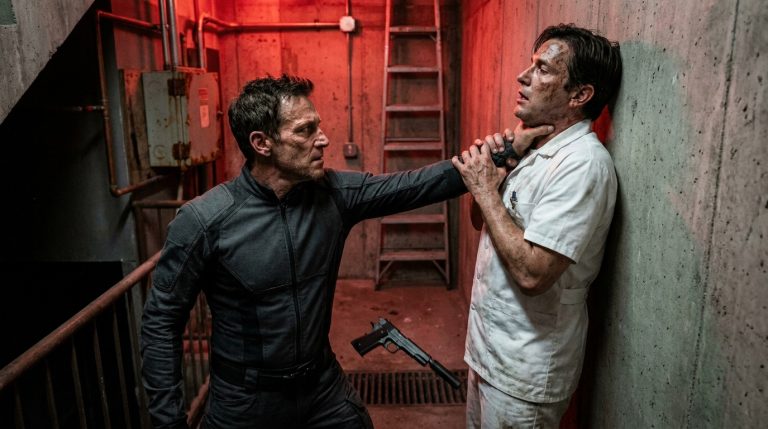
Vincent ignored the threat, grabbing Alberto by the throat and slamming him back against the server racks. The air was thick with the smell of ozone and overheated electronics. He looked past Alberto to the screens; they weren’t showing a simple power-down. They were showing a cascading failure—the grid was attempting to purge the corrupted nodes, a digital scorched-earth policy initiated by the Board to delete their own footprints.
“The archives,” Vincent growled, his face inches from his brother’s. “The political records. You weren’t selling the city; you were using them as the sacrificial files. You were going to burn the evidence by overloading the grid.”
“I was going to save what I could!” Alberto gasped, his skin turning a sickly shade of grey. “The Board wasn’t just purging data, Vincent. They were wiping the servers containing the identities of the people who funded the Serenity’s original runs. If those records disappear, the city’s entire debt—the millions the contractors owe—simply ceases to exist. They would have walked away clean, and you would have been the one they pinned the grid failure on.”
Vincent felt the weight of the truth settle in his gut. The Board didn’t care about the power grid. They cared about the debt. By collapsing the system, they would trigger a bankruptcy that wiped the ledgers clean, leaving the city in ruins but their own accounts untouched.
Vincent looked at the cylinder he had hauled from the ship. It wasn’t a list of names. It was a physical, hard-wired ledger of every transaction, a paper-and-ink record that existed outside the digital reach of the Board. He understood now why Alberto had been so desperate, why the Guard had been mobilized.
He didn’t throw the cylinder. He didn’t use it as a weapon. He turned toward the primary terminal.
“Sophia,” he said, his voice quiet, urgent. “The override sequence. Can you bypass the purge?”
Sophia, who had been huddled near the doorway, stepped into the light of the terminals. Her face was smudged with soot, her eyes bright and unyielding. She moved to the console, her hands moving over the keys, bypassing the administrative overrides with a speed that made Alberto freeze in shock. She wasn’t just interpreting manifests; she was reading the structure of the city’s digital skeleton.
“I can shunt the overload,” she whispered, her voice steady. “But it will require a direct connection. One of us has to hold the contact while the pulse passes through the shunt.”
Vincent looked at the central terminal, then at the cylinder in his hand. The shunt was designed to accept the physical ledger as a grounding rod. It was an antique solution for a modern catastrophe.
“Move,” Vincent commanded. He shoved Alberto aside, the man stumbling back, dazed and defeated, his grand design crumbling into a frantic, useless scramble. Vincent jammed the cylinder into the primary terminal port.
A bolt of blue light arced from the console, wrapping around his arm, biting into his skin with the intensity of a lightning strike. He roared, the pain a white-hot wall that tried to force him to his knees, but he held on. He gripped the console, his eyes locked on the monitors as the purge signal hit the cylinder.
The data wasn’t being deleted. It was being downloaded—a massive, physical data-dump into the only remaining record of the city’s sins. The servers screamed, the lights on the bridge flickered and died, and the city below them plummeted into a momentary, profound darkness before the backup grids kicked in, the surge diverted, the architecture held.
The room fell into silence. The monitors were black. The hum of the bridge was gone.
Vincent slumped against the console, his arm charred and trembling, his breath a ragged, shallow sound. He looked up. Alberto was gone, fled into the shadows of the pylon, leaving nothing behind but the scent of salt and the heavy, metallic tang of an ending.
Sophia stood over him, her face illuminated by the dim, flickering light of her own small flashlight. She reached out and touched the cylinder, now cold and silent.
“It’s done,” she said.
Vincent didn’t respond. He looked out the window at the city. The lights were coming back on, one block at a time, a flickering web of order returning to the chaos. The archive was safe, but the weight of it—the truth of the city’s foundations—was now his to carry.
He leaned his head back, the exhaustion finally pulling him into the silence. He had built his world on shadows, but as the first gray light of dawn touched the horizon, he realized he was no longer an Architect of the hidden. He was the keeper of the truth, and for the first time in his life, he was not afraid of what the morning would bring.