A Legacy of Ash and Iron: An Aging Marine Protects the Last of His Quiet World
CHAPTER 1: THE WEIGHT OF THE STEEL
The air inside Blue Ridge Arms smelled of gun oil and floor wax, a clean, sterile scent that mocked the grit under Arthur’s fingernails. He stood motionless, his boots planted firmly on the worn concrete. Tyler, the one with the beard that looked like it had been sculpted rather than grown, leaned over the counter, his smile tight and condescending.
“You sure you’re not looking for a walking cane with a built-in flashlight, old man?”
Arthur didn’t blink. He felt the cold iron of his own resolve, a weight he had carried for thirty-four years. He wasn’t insulted—insult required an expectation of respect from those who hadn’t earned the right to offer it. He watched the way Tyler’s gaze flickered to the others, a desperate search for validation.
“Home defense,” Arthur repeated, his voice a low, steady hum that seemed to vibrate against the glass of the counter. “Reliable. A lockbox that doesn’t fail when the room goes dark.”
Tyler snorted, sliding a compact 9mm across the glass. The metal clattered. “Wo, easy there, Gramps. Let’s make sure you can hold it steady first. You think they make one with a vibration alert so he doesn’t forget it’s in his hand?”
Marcus and Devon joined the chorus, a ripple of laughter that felt as hollow as a drum. Arthur looked at them—really looked at them. He saw the shift in their shoulders, the way their eyes danced, searching for the reaction they were owed. He saw a room full of boys who had never known the quiet of a midnight perimeter, never known the cost of an order given in the dark.
He didn’t move to touch the weapon. Instead, he reached into the inner pocket of his canvas jacket, his hand moving with a slow, deliberate grace. He pulled out a leather-bound notebook. It was scarred, the corners softened by decades of use. He uncapped his pen, the metal clicking against the plastic, and began to write.
The shop fell into a peculiar, strained silence. The laughter didn’t stop because of anything Arthur said; it died because the absence of his reaction was like a void. The boys stood there, suddenly acutely aware of their own volume. Arthur didn’t look up. He sat in the folding chair, a pillar of stillness, mapping the layout of the room, the blind spots of the security cameras, the placement of the exit signs.
He wasn’t waiting for the owner. He was waiting for the realization to dawn on them that they were not the ones in control of the atmosphere.
As he traced a line in the notebook, he glanced toward the front window. A black Ford truck pulled into the lot, kicking up a plume of dry, gray dust. A man stepped out—broad-shouldered, carrying a posture that Arthur recognized even through the glass. It was a stance born of discipline, tempered by years of watching the horizon.
When Ray Dalton pushed through the door, the bell didn’t just chirp; it sounded like an alarm. Ray took two steps, saw the empty space beside the counter, and then his gaze locked onto the folding chair. The inventory box under his arm hit the floor. The sound was flat, final.
Ray’s face drained of color, his posture snapping into a line of perfect, involuntary military alignment. He looked at the boy, then at the notebook in Arthur’s hands, and his jaw locked.
“Colonel Callaway,” Ray said, his voice stripped of every pretense. “Sir, it’s an honor.”
The shop went still. Tyler’s hand, which had been resting casually on the register, froze. Arthur stood up, the notebook closing with a soft thud, his eyes meeting Ray’s with a sharpness that left no room for error. The silence in the room changed then, hardening into something heavy and dangerous.
CHAPTER 2: THE ECHO OF AN ORDER
The silence in Blue Ridge Arms was not empty. It was pressurized, a vacuum created by the collision of Ray Dalton’s absolute military bearing and the sudden, clumsy collapse of his employees’ posturing. Tyler remained frozen, his hand still hovering over the register, his face a study in fading defiance and rising, cold-blooded realization.
Arthur didn’t shift his weight. He didn’t look for a way to leverage the power he now held in the room. He simply stood, his gaze fixed on a point just past Ray’s left shoulder, his hands resting naturally at his sides. He had spent his life operating in environments where the air was thick with the threat of invisible harm; this tension was merely a different frequency of the same resonance.
“Sir,” Ray said again, the formality of the address acting as a buffer against the raw, ugly reality of his staff’s behavior. “My apologies. I had no idea they were… failing to uphold the standards of this establishment.”
Arthur held up a hand. The motion was small, almost imperceptible, but it cut through the room like a command. “Ray. You don’t have to.”
“Yes, I do, sir,” Ray replied. He didn’t turn around to face the trio, but his presence seemed to expand, filling the shop until the walls felt like they were bowing inward. “They didn’t know, and they didn’t care to find out.”
Arthur glanced toward the window. Outside, the heat shimmered off the cracked asphalt of the parking lot, the dry Virginia summer pressing against the glass. He felt the familiar pull of his own land, the quiet perimeter of his property eight miles out. The break-ins that had left Dorothy Hines shivering in her own bed weren’t just petty crimes to him anymore; they were a violation of the boundary he had maintained for three decades. His notebook, still resting on the folding chair, contained more than just notes—it held the documented patterns of a week’s worth of activity on the rural roads near his land.
A cruiser crested the rise of the road, its blue-and-white paint job faded by the sun. It slowed as it approached the shop, the engine’s idle a low, rhythmic thrumming that disrupted the focus of the room. It was Deputy Miller, a man Arthur had known since he was a boy, currently patrolling the sector where the break-ins had spiked. The cruiser didn’t pull into the lot, but slowed to a crawl, the driver’s side window down.
The interruption shifted the atmosphere. Tyler let out a long, shuddering breath, his hand finally dropping from the register. Marcus looked at the floor, his beard suddenly seeming too large for his face. Devon remained by the counter, his eyes glassed over with something Arthur recognized—the raw, stinging shame of a person who has suddenly realized the world is deeper, and more unforgiving, than they had dared to believe.
“I need that firearm, Ray,” Arthur said, his voice quiet, conversational. “The one we discussed. For the house.”
Ray blinked, the intensity in his eyes flickering for a fraction of a second before he nodded, his discipline returning. “Of course. Let’s move to the back.”
As Arthur followed Ray toward the secure room behind the racks, he caught a glimpse of Devon’s reflection in the glass of the counter. The boy was staring at the space where Arthur had sat—at the chair, at the notebook. Arthur felt a flicker of something, a ghost of a warning. He hadn’t come here to be a hero, but the weight of the Sig Sauer in the back room and the growing instability in the town’s periphery told him that the quiet was ending.
The journey to the back room was short, yet every step felt like a calibration. Arthur moved with the gait of a man who still expected an ambush, his feet finding the path of least friction on the floorboards. Ray led him to a heavy, wall-mounted rack, his movements precise, almost ritualistic.
“The Sig P320,” Ray said, producing a case. He set it on the workbench. “Reliable. No fluff, no digital nonsense. Just physics.”
Arthur opened the case. The smell of cold steel and synthetic lubricant hit him, grounding him. He picked up the frame, the balance of it perfect in his palm. He slid the magazine in, the clack of the metal a definitive, final sound.
“They’ve been hitting the old farms,” Arthur said, not looking up. “Not just the ones on the main road. The ones tucked away. They’re looking for something, Ray. It’s not just cash and jewelry.”
Ray stopped. He looked at Arthur, his expression tightening. “What makes you say that, Colonel?”
“Three of the last six homes hit had empty safes,” Arthur said, his tone clinical. “People in this town don’t leave empty safes unless they were forced to open them. And they’re taking documents, old maps, property deeds. Things that don’t have a street value.”
Ray’s jaw set. The Marine he had been twenty years ago was peering through the shop owner’s facade. “The land-use project,” Ray whispered. “They’re trying to force the long-term residents out so the county can rezone for the corporate expansion.”
Arthur didn’t answer, but the look he gave Ray was enough. He closed the case, the weight of the pistol suddenly feeling like a heavy, cold anchor.
“I’m going home, Ray,” Arthur said. “And I don’t intend to let anyone else walk through my door without an invitation.”
CHAPTER 3: THE THRESHOLD OF THE QUIET
Arthur sat in the driver’s seat of his truck, the engine idling with a rough, uneven vibration that traveled through the floorboards and settled into his bones. The silence of the rural road was absolute, a stark, suffocating contrast to the pressurized atmosphere he had just exited at Blue Ridge Arms. He watched the shop through the windshield, his eyes tracking the way the light hit the dust motes dancing in the air of the parking lot. Ray Dalton was still standing by the door, a silhouette of rigid, unresolved tension.
Arthur didn’t shift into gear. He waited. He knew the sensation of being observed; he had lived his life expecting the weight of a gaze from the treeline. He checked his mirrors—left, center, right—taking in the periphery of his environment. His hands, corded and steady on the wheel, felt the residual heat of the Sig Sauer case resting in the passenger seat. It was a tool, nothing more, but its presence altered the geometry of his solitude.
He finally eased the truck into gear and pulled away, the tires crunching over the loose gravel of the lot. The drive home was a ritual he had perfected over twenty years—a steady, unhurried pace that kept the vehicle centered on the crown of the road. But today, the landscape felt different. He wasn’t just observing the fields; he was reading them.
The rural roads were lined with overgrown ditches and rusted barbed-wire fences that had long ago lost their ability to hold back the encroaching scrub. As he turned onto his own long, dirt driveway, Arthur slowed to a near crawl. He noted the way the tall grass along the perimeter of his property had been flattened in a irregular, jagged line. It wasn’t the work of deer. It was the heavy, clumsy tread of someone who didn’t know how to move quietly through the brush.
He pulled up to his house, a modest structure that sat hunkered down against the hillside, and cut the engine. The silence rushed in to fill the space, but it was thinner now, strained by the knowledge of what was coming.
Arthur stepped out of the cab, his boots sinking into the dry, parched earth of his driveway. He didn’t head for the front door. He walked the perimeter of the property, his eyes searching for the small, almost invisible discrepancies that separated a home from a target. Near the shed, he paused. The latch on the secondary equipment door, which he hadn’t opened since last Saturday, was slightly misaligned. The screws had been backed out just enough to allow the door to be shimmied, then forced back into place.
He didn’t touch the door. He leaned in, his nose catching the faint, acrid scent of ozone and cooling motor oil—not his own. Someone had been here. Not to steal the mower or the fuel canisters, but to observe, to calibrate, to mark.
He felt the cold, hard reality of the situation settle into his chest. This was not a random burglary. The precision of the forced latch, the strategic placement of the flattened grass—it was the work of someone who treated his home like a logistical puzzle to be solved.
Arthur walked back to the truck, his movements fluid and efficient. He retrieved the case, but he didn’t open it. He walked to the front door, unlocked it with a key that had been on his ring for three decades, and stepped into the dim, cool air of the interior. The house smelled of dried herbs and the lingering, faint scent of Elaine’s perfume—a ghost of a life that was slowly being pressured out of existence.
He set the case on the nightstand in his bedroom, next to his bed. He sat on the edge of the mattress, the springs groaning under his weight, and opened the leather-bound notebook. He turned to the fresh page he had started at the gun shop. He didn’t write about his feelings. He wrote down the time of his arrival, the exact coordinates of the disturbed latch, and the scent he had encountered.
He was mapping them. If they wanted to play the game of territorial expansion, they would find that the terrain was not as empty as they had assumed. He wasn’t just a retired Colonel living in the quiet; he was a man who had spent years observing the shift of shadows in even darker places.
As he worked, a flicker of movement caught his eye through the bedroom window—a flash of light reflecting off a dark-colored SUV idling at the end of the driveway, just beyond the reach of his own property line. They were watching him, waiting for the old man to succumb to the weight of his age, to make the one mistake that would justify their intrusion.
Arthur reached out and touched the cover of the Sig Sauer case, his finger tracing the cold, synthetic edge. He wasn’t going anywhere. And he wasn’t going to be the one who made the mistake. He closed the notebook, the snap of the elastic band sounding like a rifle bolt in the quiet room. He had enough evidence now to know that the threat was organized, methodical, and currently operating under the assumption that he was helpless.
He stood up and walked to the kitchen, his pace measured, his mind already calculating the variables of the upcoming night. He wasn’t afraid. He was simply waiting for them to cross the threshold.
CHAPTER 4: THE GEOMETRY OF SURVIVAL
Arthur stood in the kitchen, the light from the overhead fixture casting long, stark shadows across the linoleum floor. He didn’t turn on the main lamp; he preferred the dim, manageable glow of the range hood. It kept the house focused, small, and defensible. His notebook lay open on the laminate table, a grid of lines and scribbled notations that transformed the rural landscape into a theater of tactical operations.
He reached for the kettle, the familiar weight of the metal reassuring, but his mind remained on the driveway. The idling SUV had eventually pulled away, but not before he had etched the silhouette of its movement into his memory. They weren’t just watching; they were testing the perimeter. It was a classic reconnaissance pattern—approach, wait for a reaction, retreat, repeat.
A sharp, rhythmic rapping at the front door broke the stillness. Arthur didn’t reach for the handgun yet. He stepped into the darkened hallway, his movements silent, his presence low to the ground. He checked the viewport, his eye adjusting to the moonlight bleeding through the porch light. It was Devon. The young man stood on the threshold, his shoulders hunched, his hands shoved deep into the pockets of a grease-stained jacket. He wasn’t armed, but he looked frayed, like a wire stretched to the point of snapping.
Arthur unlatched the deadbolt, the metal sliding back with a heavy, deliberate clunk. He didn’t open the door wide.
“Devon,” he said, his voice flat, not a question.
“I saw them, Colonel,” Devon said, his voice cracking. He didn’t look at Arthur, his gaze instead fixed on the dry, parched earth of the porch. “I was on my way home from the shop, and I saw that black SUV near the turnoff to your property. They were checking the old survey markers at the edge of the creek.”
Arthur pulled the door open, just enough to let the boy in. The smell of exhaust and anxiety followed Devon into the house. Arthur gestured toward the kitchen, and they walked into the light. Arthur watched the boy—he saw the same hesitation he had felt twenty years ago in a different kind of desert, the same internal struggle to reconcile the world as it was with the world as it had been promised to be.
“Why were you looking for them, Devon?” Arthur asked, his voice neither accusing nor gentle. It was the question of a commander assessing the reliability of an asset.
Devon sat at the table, his fingers tracing the edge of Arthur’s notebook. “Because they’re not just checking markers. I heard Ray talking on the phone after you left. He thinks they’re moving on the county records office tomorrow morning. Filing for an emergency easement.”
Arthur felt a chill that had nothing to do with the night air. An emergency easement would bypass the standard zoning hearings, effectively putting the land—his land—at the mercy of a corporate acquisition committee that had been operating in the dark for months. He looked down at the table, his eyes catching a small, crumpled piece of paper Devon had placed there. It was a receipt, stained and torn, but on the back, a series of alphanumeric codes had been written in a hurried, nervous hand.
It was a vehicle identification marker, the kind used by fleet-servicing outfits that didn’t have permanent logos. It was the same marker he had caught a glimpse of on the SUV earlier that evening.
“You’re putting yourself in danger, son,” Arthur said, reaching out to slide the paper toward him.
“I’m already in it,” Devon replied, meeting Arthur’s eyes for the first time. The boy’s gaze was clear, purged of the hollow posturing from the gun shop. “We all are. If this town loses its history to satisfy a project that won’t even exist in five years, what’s left?”
Arthur didn’t answer. He turned to the counter, his mind working through the tactical implications. If they were heading to the records office, they needed that easement to be signed, sealed, and delivered before anyone could raise an objection. They were relying on the bureaucracy to act faster than the citizens.
“They need a signature,” Arthur said, half to himself. “And they need a valid claim of immediate public necessity.”
He moved to the drawer beneath the counter, pulling out a heavy, rusted metal box. He didn’t open it, but he rested his hand on the lid. The weight of it was substantial, a collection of documents he had salvaged from the wreckage of the Fallujah operation, things he had kept because they were the only evidence that certain people had never intended for that land to be habitable—let alone developable.
“Devon,” Arthur said, his tone shifting. “If you want to help, you don’t go to the records office. You go to the VFW. Tell the guys there to meet me at the county line at 0600. And tell them not to bring their wallets. Tell them to bring their records.”
Devon stood up, a new resolve setting into his posture. He looked at the notebook, then at the metal box, and nodded once. He didn’t ask what was inside. He didn’t need to. The shift in the room was absolute; the quiet had been replaced by the focused, cold air of preparation.
“I’ll tell them, Colonel,” Devon said, his voice steady.
As the door clicked shut behind the boy, Arthur walked back to the kitchen table. He sat down and opened the notebook again. He began to draw, not a map of the land, but a diagram of the county building’s access points, the traffic patterns of the morning commuters, and the weak points in the administrative chain. He was no longer just protecting his home; he was preparing to dismantle the very foundation of the threat that was coming for it. The rust on his hands seemed to deepen, a reminder that some things were best kept beneath the surface until the moment was right to strike.
CHAPTER 5: THE IRON BARRICADE
Arthur stood on his front porch, watching the sky. The horizon, which had been a clear, scorched blue only hours ago, had curdled into a bruised, violent purple. The air was heavy, tasting of ionized copper and the ozone of an approaching front. He watched the first heavy, fat drops of rain strike the parched earth of his driveway, turning the dry, gray dust into dark, treacherous slush.
He didn’t move. He stood with his arms crossed, his gaze fixed on the road leading down toward the county line. The plan was simple: meet the men from the VFW, consolidate their presence at the courthouse, and confront the development committee with the reality of their claims. But the weather was not part of the calculus.
A flash of light silhouetted the treeline, followed immediately by a crack of thunder that rattled the windowpanes of his house. The sky opened up with a sudden, savage intensity. The rain didn’t just fall; it hammered, a relentless deluge that turned the slope of his driveway into a running sluice of mud. Arthur checked his watch. 05:45. He had fifteen minutes to get to the county line.
He turned back inside, grabbing his raincoat and the heavy, rusted metal box from the kitchen counter. He didn’t hesitate. He knew the geography of this valley; he knew which roads would flood and which would hold. But as he stepped out into the deluge, the intensity of the storm was greater than anything he had seen in years.
He climbed into his truck, the engine turning over with a rhythmic, labored protest. As he pulled out of the driveway, the tires spun, finding no traction in the shifting, wet clay. He corrected the slide, the truck fishtailing once before biting into the firmer gravel of the shoulder. He moved forward, his headlights cutting weak, yellow paths through the driving wall of water.
He reached the main road and turned south. He hadn’t gone half a mile when he saw it: a massive oak branch, slicked with moss and age, had snapped under the weight of the wind and lay sprawled across the road, effectively blocking both lanes. The SUV he had seen the previous night—the same dark, non-descript vehicle—sat idling on the other side of the obstruction, its lights staring back at him like the eyes of a predator.
They were waiting. They knew he was coming.
Arthur brought the truck to a stop ten feet from the branch. He didn’t turn off the engine. He watched the SUV, his hand resting on the passenger seat where the Sig Sauer lay concealed beneath a heavy coat. The driver of the SUV didn’t get out. Instead, a passenger door opened, and a man in a high-visibility raincoat stepped out, his face obscured by the hood and the relentless downpour. He walked toward the fallen tree, his movements slow, deliberate, and undeniably mocking.
He didn’t make a move to clear the road. He simply stood there, hands on his hips, watching Arthur through the rain.
Arthur’s mind raced, his tactical training locking onto the variables. He was alone, the road was blocked, and the storm was making any detour through the surrounding fields impossible. If he stayed, he was pinned. If he backed up, he was giving them exactly what they wanted—the delay that would allow them to arrive at the courthouse and push their easement through without opposition.
He shifted into reverse, but not to retreat. He backed the truck up twenty yards, creating a narrow lane of open space. He watched the man by the tree, who now seemed to be signaling to the driver of the SUV. The driver began to inch forward, clearly intending to pin Arthur’s truck against the embankment.
Arthur didn’t wait. He shifted into four-wheel drive, locked the differential, and slammed the truck into drive. He didn’t aim for the man or the SUV; he aimed for the weakest point of the fallen oak—a section of rotted, exposed wood that was already saturated with water. He accelerated, the engine roaring as it surged against the mud.
The truck hit the branch with a shuddering, bone-jarring impact. The wood splintered with the sound of a gunshot, and the heavy trunk was shoved backward, sliding across the wet asphalt like a sled. The force of the collision sent a spray of mud and debris across the hood of the SUV. Arthur didn’t let up. He surged through the gap, his bumper clipping the SUV’s side mirror before he straightened out and accelerated past them, leaving the man in the raincoat standing in the downpour, his hands still raised in an aborted signal.
He didn’t look back. He pushed the truck, the steering wheel vibrating under his grip as he navigated the slick, flooding road toward the county seat. He knew the shortcut—a narrow, steep path through the back of the property that would bypass the main highway. It was a route he hadn’t used since the early days of his marriage, but he knew every twist and turn, every dip in the road that would turn into a river.
The storm raged, the lightning illuminating the landscape in fleeting, strobe-like flashes of white. Arthur’s focus was absolute. He wasn’t just driving; he was fighting, his entire being committed to the singular objective of reaching the county records office before the first administrator walked through the door.
As the courthouse silhouette finally appeared through the driving rain, Arthur slowed. He saw the VFW trucks already pulling into the lot—a small, battered phalanx of work trucks and sedans, their lights cutting through the gloom. He realized then that he hadn’t just called for support; he had mobilized a memory, a collective history of men who had seen their world threatened before and knew exactly how to stand their ground. He pulled into the lot, parked, and took a deep breath. The hard part was just beginning, and he knew he wouldn’t be able to stay in the shadows much longer.
CHAPTER 6: THE COURTHOUSE BREACH
Arthur pushed through the double glass doors of the county records office, his boots leaving dark, gritty trails of mud on the polished linoleum floor. The lobby was sterile, illuminated by flickering fluorescent lights that buzzed with a low, headache-inducing hum. He was wet, his jacket heavy with the cold, driving rain, and he knew he looked like a man who had walked through a storm to start a war. He didn’t care.
He moved with a stiff, calculated cadence, his hand hovering near the pocket where the heavy, rusted metal box sat secured against his ribs. The VFW contingent stayed a few paces behind him—three retired men, their faces etched with the same grim determination that had carried them through decades of quiet civilian life. They weren’t here to shout or make a scene; they were here as witnesses.
As they reached the main counter, a clerk—a woman with thin, nervous eyes and a nameplate that read ‘Mrs. Gable’—looked up. Her expression transitioned from professional boredom to guarded anxiety as she took in the group.
“We’re closed for processing until 0900,” she said, her voice brittle. “You can’t be back here.”
Arthur leaned forward, his palms flat on the cold, gray surface of the counter. The smell of burning rubber suddenly flared in his nostrils—an intrusive, phantom scent—and for a split second, the fluorescent lights blurred into the hazy, smoke-choked sky of a city under siege. He blinked, pushing the memory down, anchoring himself in the present.
“I’m not here to process, Mrs. Gable,” Arthur said, his voice quiet, steady, and entirely devoid of the apology she clearly expected. “I’m here to prevent a filing. The emergency easement for the rural tracts along the northern border. I know it’s on the docket for this morning.”
The clerk’s eyes flickered to the side, toward the heavy, oak-paneled doors leading to the administrative offices. A man stepped out—tall, wearing a suit that cost more than Arthur’s truck, with a smile that didn’t reach his eyes. It was Elias Thorne, the lead consultant for the land-use project. He looked at Arthur, then at the men behind him, and his smile didn’t falter, though his posture stiffened.
“Colonel Callaway,” Thorne said, his voice smooth, practiced. “You’re a long way from your garden.”
“And you’re a long way from the truth, Thorne,” Arthur replied. He didn’t raise his voice. He didn’t have to. The presence of the men behind him—solid, silent, unyielding—gave his words a physical gravity.
Thorne glanced at his watch, a nervous twitch in his jaw. “The records office is conducting official business. If you persist in this intimidation, I’ll have security escort you out.”
Arthur stepped around the counter, ignoring the clerk’s sharp intake of breath. He didn’t head for Thorne; he walked directly toward the master filing cabinet that held the active project folders. He knew the system. He knew that the ’emergency’ easement Thorne was seeking was a shell—a document designed to hide the fact that the land in question had been zoned as a protected wetland for decades.
“You’re filing for a waiver based on economic urgency,” Arthur said, his fingers dancing over the labels on the drawers. “But you’ve failed to disclose the soil reports from the 2004 survey. The ones that identify the heavy metal runoff from the chemical processing facility that used to occupy that sector.”
Thorne stopped. The color drained from his face, replaced by a mottled, angry red. “You don’t know what you’re talking about. Those reports are sealed.”
“They were never sealed,” Arthur said, his hand finding the correct tab. “They were just ignored.”
He pulled the folder. It was thick, heavy with the weight of decades of negligence. Thorne moved forward, his hand out, but one of the VFW men—a man named Silas, who hadn’t spoken a word since they left the parking lot—stepped into his path. Silas didn’t touch him; he simply stood there, a wall of faded denim and iron-hard resolve. Thorne stopped.
Arthur opened the folder. It wasn’t just land development they were looking at; it was a map of corporate malpractice that spanned generations. He turned to Mrs. Gable, who was now staring at the documents with a look of dawning horror.
“Look at the dates, ma’am,” Arthur said, pointing to the signatures on the bottom of the disclosure forms. “Thorne isn’t trying to build a housing development. He’s trying to bury a crime.”
The room became silent, the buzzing of the lights suddenly deafening. Arthur felt the truth, solid and sharp, beneath his fingertips. He had come here to stop a project, but he had uncovered a rot that went straight to the heart of the county government. Thorne’s expression wasn’t one of defeat; it was the look of a man who realized he had been outplayed by someone who didn’t care about the rules of the game.
Thorne reached for his phone, his thumb hovering over the screen. “You’ve crossed a line, Callaway. You don’t have the authority to hold those records.”
“I don’t need authority,” Arthur said, closing the folder and tucking it under his arm. “I have the evidence.”
He turned to leave, his heart rate steady, his eyes tracking every movement in the room. He knew they wouldn’t let him walk out the front door without a fight. The stakes had just shifted from a local land dispute to a fight for the integrity of the entire region. He signaled to his men, his movements tight and efficient. As they reached the glass doors, he saw two patrol cars pull into the lot, their lights flashing in the rain. It was the trap. He had anticipated it, but the reality of it—the cold, blinding light of the cruisers—was a test of everything he had learned in the dust.
He didn’t run. He walked forward, the heavy file tucked against his side like a weapon, ready to hold the line.
CHAPTER 7: THE CRUMBLING FAADE
The rain lashed against the windshield of the patrol cars, creating a chaotic, watery veil that distorted the figures emerging from the vehicles. Arthur stood by the courthouse entrance, the heavy file pressed against his chest. He felt the cold iron of the threshold beneath his boots. His pulse, usually a steady, calibrated rhythm, was spiking—an adrenaline-fueled thrumming that threatened to cloud his judgment. He took a slow, deliberate breath, drawing in the scent of damp wool and wet stone.
Two officers moved forward, their movements stiff, cautious. Their yellow reflective vests were slick with water. Arthur recognized one—Deputy Miller, the man he had seen patrolling the roads near his farm. But behind them, two other figures detached themselves from the darkness of a nondescript sedan. They weren’t in uniform. They wore dark, tactical-style windbreakers and held themselves with the calculated, predatory ease of private security.
Arthur’s vision blurred at the edges. The light from the patrol car bar—a spinning, dizzying carousel of red and blue—sent shadows dancing across the concrete in a way that made the ground beneath him seem to tilt. Was Miller here to uphold the law, or was he merely a pawn in Thorne’s game of emergency easements? Arthur blinked, the world sharpening again, but the disorientation lingered, a sharp, metallic taste of exhaustion clinging to the back of his throat.
“Colonel Callaway,” Miller shouted over the roar of the rain, his voice strained. “Drop the folder. We’ve received a report of unauthorized entry and theft from the records office.”
Arthur didn’t move. He looked past the deputy to the two men in tactical gear. They had hands on their hips, their posture defensive, waiting for a move.
“This isn’t theft, Miller,” Arthur said, his voice projecting with the practiced clarity he had used on the drill grounds at Quantico. “This is a disclosure of documented environmental contamination. The easement Thorne is pushing isn’t just about development—it’s about sealing the liability of a toxic site that this county has been ignoring for twenty years.”
The two men in tactical gear stepped forward, ignoring Miller’s raised hand. Their intent was clear: reclaim the folder by any means necessary. Arthur shifted his weight, his heels locked into the concrete. He didn’t have to be a soldier to know how to hold a position. He simply had to be the immovable object in their way.
“Miller,” Arthur said, shifting his focus to the deputy. “Look at the signatures on that disclosure form. Ask Thorne who authorized the ’emergency’ classification. And then ask yourself why a land-development consultant is accompanied by armed, private security on public property.”
The deputy hesitated. He looked back at Thorne, who had emerged from the courthouse entrance, his face a mask of calculated fury. Thorne waved a hand at the security men, his voice sharp and demanding. “Take it, now! He’s trespassing.”
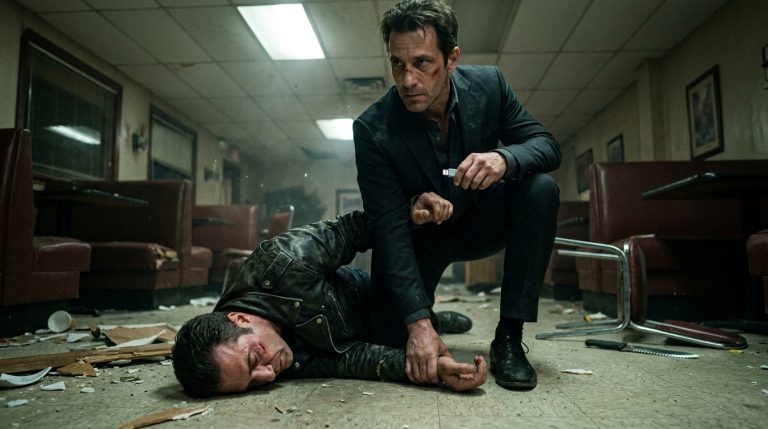
One of the security men lunged. Arthur didn’t retreat. He pivoted, using the momentum of the man’s own forward movement to redirect him, his hand catching the man’s arm and steering him into the slick, mud-streaked concrete of the parking lot. The man went down hard, his face splashing into a puddle.
The sound of the impact—the dull, wet thud—ripped through the air. The second security man stopped, his face twisting in hesitation, looking to Miller for a directive. The deputy’s hand was on his sidearm, but it remained holstered. He was caught in the impossible space between the law he was sworn to uphold and the reality of the corruption he was suddenly standing in the middle of.
“It’s over, Thorne,” Arthur said, his voice low, projecting across the wet parking lot. He held the folder aloft, a heavy, dark shield. “The files are already logged. Not here—not in this office—but in the hands of the state environmental office. They received a digital copy the moment I opened that cabinet.”
It was a bluff, a strategic gamble, but it hung in the air with the weight of absolute certainty. Thorne’s eyes darted toward the courthouse, then back to the folder, his bravado finally fracturing. He knew the cost of that folder being opened. He knew that once the seal of the ’emergency easement’ was broken, the entire project would collapse under the weight of the contamination data.
The security man on the ground scrambled to his feet, but he didn’t advance. He retreated, his eyes locked on the VFW men who had emerged from their trucks, standing as a silent, monolithic line of defense. The deputy, Miller, lowered his hand from his sidearm. He turned and looked at Thorne, his expression changing from confusion to a cold, hard realization.
“Thorne,” the deputy said, his voice tight. “Stay where you are.”
Arthur lowered the folder, the iron-like tension in his muscles finally beginning to bleed away. He stood in the rain, feeling the cold soak through his jacket to his skin. He was exhausted—a deep, marrow-level fatigue—but the ground beneath him felt firm. The threat was still there, the web of corruption still unraveled, but the first barrier had been breached. They were no longer operating in the shadows.
He looked at Thorne, whose face was a map of frustrated, impotent rage. The man was still standing there, but his authority had evaporated, washed away by the storm and the stubborn persistence of a man who refused to leave his own land. Arthur didn’t say another word. He simply turned and began to walk toward his truck, his gait slow but steady, a man who had finally earned his way back to the quiet.
CHAPTER 8: THE SETTLING DUST
Arthur didn’t move as Thorne’s composure finally disintegrated. The consultant’s face, previously a carefully curated mask of corporate indifference, now twitched with the raw, jagged panic of a man who had built a foundation on sand. Around them, the courthouse lobby was suffocatingly quiet. Even the storm outside seemed to have paused, holding its breath as the weight of the documents Arthur had exposed began to ripple through the room.
Thorne reached out, not to strike, but to steady himself against the reception desk. “You think you’ve won something, Callaway? You’ve only triggered an audit. By the time they sift through those files, I’ll be long gone. And the land? It’s still toxic. Nobody can build there. Nobody can even live there. You’ve just turned your own property into an asset that’s worth exactly zero.”
Arthur looked at him, his gaze level, unbothered by the desperation in the man’s voice. “I didn’t do this for the value of the land, Thorne. I did it because the people who lived here deserved to know why their families were getting sick.”
He didn’t wait for Thorne to respond. He signaled to the deputy, Miller, who was now standing with his notepad open, his expression shifting from suspicion to a cold, professional resolve. The law was finally catching up to the speed of the reality Arthur had unveiled.
As the security men retreated and Thorne was escorted toward the administrative holding room, Arthur walked toward the heavy glass doors. His muscles ached with a deep, pervasive fatigue, a physical toll for the days of tension and the long, rain-slicked drive. He reached the threshold and stepped out. The storm had broken, leaving the sky a bruised, clearing indigo. The air was cool, smelling of damp earth and crushed pine—a clean, sharp scent that washed away the stale, sterile atmosphere of the courthouse.
He walked to his truck. The VFW men were waiting by their vehicles, their silhouettes framed by the fading lights of the cruisers. They didn’t cheer; they simply nodded as he passed—a silent acknowledgement of a mission completed.
Arthur climbed into the driver’s seat. He reached over to the passenger side, where the Sig Sauer case sat, untouched. He didn’t pick it up. Instead, he pulled out the leather-bound notebook. He turned to the final page, the one where he had mapped the tactical nodes of the courthouse, and drew a single, heavy line through the entire diagram. The mission was closed.
He drove home in the quiet, the road now clear of fallen branches and the ominous presence of the black SUV. The valley seemed to breathe a sigh of relief as he crossed the county line. When he arrived at his farm, he didn’t head for the house immediately. He walked to the garden—the patch of earth that Elaine had planted with such deliberate, loving care.
The rain had been a blessing. The zucchini plants, in their far corner, were standing tall, their broad, green leaves vibrant and pulsing with life. The tomatoes, staked near the fence, were heavy with fruit, their stems strengthened by the sudden influx of water. He knelt in the mud, his hands sinking into the cool, dark soil.
He found a small, rusted garden trowel that had been partially buried near the fence line—a tool he thought he had lost seasons ago. He picked it up, feeling the familiar, coarse texture of the handle. It was an object that had served him for years, a testament to the labor of maintaining something beautiful in a world that was often indifferent. He began to clear the debris left by the storm, his movements rhythmic and steady.
Devon arrived an hour later, his truck kicking up a faint plume of mist from the still-damp drive. He stepped out, his eyes sweeping the garden. He didn’t speak; he simply picked up a second tool and began to work alongside Arthur, their movements synchronizing in the quiet.
They worked until the sun began to dip behind the ridge, painting the sky in soft, bruised gold. There were no secrets left between them—only the work, and the shared, profound peace of knowing that the rot had been excavated.
Arthur stopped, his back stiffening as he leaned against the fence. He looked out over the fields, his view no longer obscured by the shadow of a threat. He realized that the quiet he had been protecting wasn’t just an absence of noise; it was a presence—a deep, rooted connection to the land and the people he had fought to keep safe.
He reached out and placed a hand on Devon’s shoulder. It was a gesture of connection, a silent passing of a mantle that went beyond the VFW or the memories of Fallujah. It was about the future.
“The zucchini have plenty of room to spread out now,” Arthur said quietly.
Devon smiled, a genuine, easy expression that matched the settling of the land. “They sure do, Colonel.”
Arthur turned back to the garden, the last of the tension fading into the dusk. He wasn’t a hero, and he wasn’t looking for a medal. He was just a man, finally home, back in the silence that he had earned, and for the first time in years, the silence didn’t feel like a weight—it felt like a promise.