A Quiet Vigil at the Edge of Memory: How a Single Janitor Taught a Generation to Remember
CHAPTER 1: THE WEIGHT OF MARIGOLDS
The sun was still struggling to climb over the treeline, casting long, fractured shadows across the overgrown rows of Hillcrest. To anyone else, it was a neglected graveyard, a place where the town’s past had been left to dissolve into the soil. To Ray, it was a ledger. Every headstone was a name that required a witness, and today, as he knelt in the damp mud, he felt the familiar, achy thrum in his knee—a physical reminder of 1968 that never quite let him forget the jungle heat of Southeast Asia.
He reached out, his calloused fingertips tracing the carved ‘J. Moore’ on the leaning slab. The stone was cold, slick with a fine layer of morning dew. He moved with the slow, deliberate grace of a man who had spent decades keeping a secret that weighed more than lead. He cleared a patch of creeping ivy, his movements rhythmic, practiced. He wasn’t just cleaning a grave; he was maintaining a promise.
“You’re not forgotten,” he whispered, his voice thin, blending into the rustle of the wind through the pines. “Not this week.”
He placed the dandelions against the base of the stone. As he sat back on his heels, he noticed something that sent a sharp, involuntary shiver down his spine. The dirt at the corner of the grave, the spot he cleared every single week, had been disturbed. There was a depression there, a small, clean-edged hole about the size of a compass, as if something had been pushed into the ground and then pulled back out. He leaned closer, his brow furrowing beneath his wire-rimmed glasses. It wasn’t the work of an animal; it was too precise.
A crunch of gravel behind him broke his focus.
Ray froze. He didn’t turn around immediately. He kept his hands low, resting on the mud, his heart hammering against his ribs like a trapped bird. He had spent years in the shadows of Westport High, the invisible janitor who mopped floors and changed chalk trays, precisely because he knew how to remain unseen. He took a slow, steadying breath, the scent of damp earth and rotting leaves filling his lungs.
He looked down at the bouquet again, then toward the gate. A black sedan, too sleek, too expensive for this forgotten stretch of Route 19, sat idling. The reflection of the morning light on its windshield was blinding.
Ray wiped his hands on his trousers, leaving streaks of dark, wet soil on the khaki fabric. He didn’t know who was in that car, but he knew with a sudden, sinking certainty that the silence he had curated for a decade was about to shatter. He looked back at the stone one last time, his gaze lingering on the name ‘Moore.’
Then, he heard the passenger door click open. A polished boot struck the gravel, followed by a heavy, measured silence that felt like a command. Ray stood up, his limp more pronounced than usual as he turned to face the intruder, his hand instinctively reaching into his jacket pocket to grip the worn leather notebook he carried everywhere. He felt the sharp corner of the envelope tucked deep inside his lining, the one he had hoped would never need to be unsealed.
The man stepping toward him wore a suit that moved with the precision of a uniform, his face a mask of professional stillness. But it was the way the man looked at the grave—not as a stranger, but as someone searching for a ghost—that made Ray realize the war wasn’t in the past anymore. It was standing ten feet away, and it had finally found him.
CHAPTER 2: THE ECHO IN THE CHASSIS
The sedan’s engine didn’t cut out when the man stepped out; it kept idling, a low, rhythmic thrumming that resonated through the soles of Ray’s boots. It was the same frequency as the distant troop carriers he used to hear in the pre-dawn mist of ’68, the sound that usually preceded a mortar strike or the sudden, suffocating silence of an ambush. Ray stood his ground, though his shoulders locked in a defensive posture he had spent thirty years trying to unlearn.
The man from the sedan was older than he looked from a distance, perhaps nearing fifty, with silver tracing his temples and eyes that held the hard, polished look of a whetstone. He didn’t approach immediately. He let the silence stretch, observing Ray as if he were trying to read the worn stitching on a uniform that had been patched too many times.
“Mr. Navaro,” the man said, his voice clipped and precise, entirely lacking the performative warmth of a civilian greeting. “I apologize for the Sunday intrusion. My name is Agent Miller.”
Ray didn’t offer a handshake. He kept his hands at his sides, his fingers brushing the fabric of his pocket where the notebook sat. The damp morning air clung to his skin, heavy and smelling of wet limestone and the faint, sweet decay of the wild dandelions he had just placed on the grave. “The cemetery is public property, I suppose,” Ray replied, his voice raspy from disuse. “But you’re a long way from the highway, Agent.”
Miller shifted his gaze to the headstone. He didn’t look at it with the casual curiosity of the jogger who had taken that photo. He looked at it with an anatomical intensity, his eyes tracking the moss, the leaning angle of the stone, and the fresh petals scattered at its base. “We’ve been looking for the source of these coordinates for a long time, Ray. The military record for Lieutenant James Moore was archived as ‘complete’ in 1970. No next of kin, no remaining service file, no active status.”
“People disappear,” Ray said, his tone flat. “The war was good at that.”
“The war was,” Miller agreed, stepping closer, his boots crunching loudly on the dry grass. “But the files don’t. Not when there’s a persistent, decade-long anomaly at a gravesite that wasn’t supposed to exist according to the official survey maps.”
A flash of memory struck Ray—sharp and jagged, like a blade of tall elephant grass. He was sitting on a crate, his hands trembling as he scribbled names onto the back of a ration wrapper, knowing that by morning, those names would be the only thing left of his squad. He shook the thought away, his grip tightening on the notebook in his pocket. The phantom sound of a helicopter blade seemed to hang in the air, a persistent hum that synchronized with the sedan’s engine.
“I’m just a janitor,” Ray said, turning his back on the man to pick up his small, plastic watering can. “I look after the high school. I look after the stone. There’s no mystery here, just a man who didn’t want to be forgotten.”
“A commendable sentiment,” Miller said, his tone softening just enough to be dangerous. He didn’t move away; he followed Ray as he began to walk toward the gate. “But ‘commendable’ doesn’t explain the redacted service number that popped up in our system the moment that photo went viral. It doesn’t explain why a man with your background, your specific training in the 3rd Marine Division, decided to spend forty years mopping floors in a town that doesn’t even know your middle name.”
Ray walked slowly, the limp in his leg acting as a metronome, keeping him anchored to the present. He could feel Miller’s eyes on his back, weighing his movements, measuring his gait. Every instinct in Ray’s mind—the instincts that had kept him alive when radios cut out and the jungle turned black—screamed at him to lose this man, to vanish into the dense tree line that bordered the cemetery. But he was seventy now. His world had shrunk to the size of this town and the boundaries of this graveyard.
“I’m tired, Agent,” Ray said, stopping at the iron gate. The metal was pitted with rust, a faded, flaking texture that felt remarkably like the dry skin of his own hands. “If you have a warrant, show it. If you have a question, ask it. But don’t stand there and try to deconstruct my life like you’re reading a casualty report.”
Miller stopped five paces behind him. He reached into his breast pocket and produced a small, leather-bound folder. He didn’t open it; he simply held it, the weight of it visible even from a distance. “I don’t need a warrant to ask why you’re still keeping watch. I just need you to look at this.”
Ray didn’t want to look. He knew what kind of documents lived in those folders—the kind that brought ghosts back into the sunlight. He looked down at the gravel, at the way the light played across the debris, and he realized with a sinking heart that the silence he had built wasn’t just crumbling; it had been dismantled from the inside out.
He took a slow breath, the smell of dust and stagnant air filling his senses, and finally turned back to the man with the polished eyes. “What’s in the folder, Miller?”
Miller opened the cover just enough for the light to catch the edge of a document. It wasn’t a photo of the grave. It was a list, typed on thin, translucent paper, containing rows of names—names Ray hadn’t spoken out loud since he was twenty-two.
CHAPTER 3: THE ARRIVAL
Ray didn’t reach for the folder. He kept his hands at his sides, his fingers curled into his palms to hide the involuntary tremor that had taken root the moment he saw the ink. The names on that list weren’t just letters; they were the sound of his own breathing in the dark, the way the air felt when a squad fell silent, the smell of cordite and wet rot. He looked at Agent Miller, whose face remained a mask of practiced neutrality, and saw not an enemy, but a man who was merely a tool of an institution that was finally waking up to its own long-standing negligence.
“You think you’ve found a story,” Ray said, his voice barely rising above the rustle of the wind. “You think this is some kind of procedural, something you can file, stamp, and close by the end of the week.”
Miller didn’t blink. He pulled the folder back slightly, the paper fluttering with a dry, papery sound that seemed incredibly loud in the morning quiet. “I don’t think anything, Mr. Navaro. I’m just the one who has to confirm the provenance of these records. When the Pentagon received the package you carried, they didn’t see a janitor. They saw a chain of custody that spans five decades.”
Ray looked past Miller, toward the cemetery gate. A stray dog was trotting along the fence line, its head low, sniffing at the overgrown weeds. For a fleeting second, Ray felt the familiar, paranoid itch between his shoulder blades—the sensation that he wasn’t alone in this space. He glanced at the tree line. The branches of the ancient oaks were thick with shadows, and the birds, which usually filled the air with their morning racket, had gone strangely, unnaturally silent. Someone else was out here, watching, waiting for the interaction to turn into something actionable.
“If you want to talk,” Ray said, his tone shifting from defensive to weary, “do it where the walls aren’t listening.”
He didn’t wait for Miller’s response. He walked toward his own truck—an old, rusted-out Chevy that was as much a part of the landscape as the mossy stones. He moved with a deliberate, rhythmic gait, his bad leg dragging slightly in the loose dirt. He knew Miller would follow. The agent had too much invested in this now; the folder in his hand was his mandate, his leverage, and his burden.
As he reached the truck, Ray felt the grit of the earth under his boots. It was a grounding, abrasive sensation that helped him stay in the present. He opened the passenger door, the hinges groaning in protest, and gestured for Miller to sit.
“I’m not a target,” Ray said as he climbed into the driver’s side. He ignored the smell of stale coffee and old upholstery, focusing instead on the way Miller’s movements were mirrored in the side mirror. Miller was looking toward the treeline too, his posture shifting, his hand moving with subconscious precision toward his side, where a holster would be, even if he wasn’t currently displaying a weapon.
“Is there a reason to believe we are in danger, Ray?” Miller asked, his eyes still scanning the periphery of the cemetery.
“In this world?” Ray let out a dry, mirthless laugh. “Danger is just a matter of perspective. You brought the sunlight in, Agent. You don’t get to be surprised when the shadows start moving.”
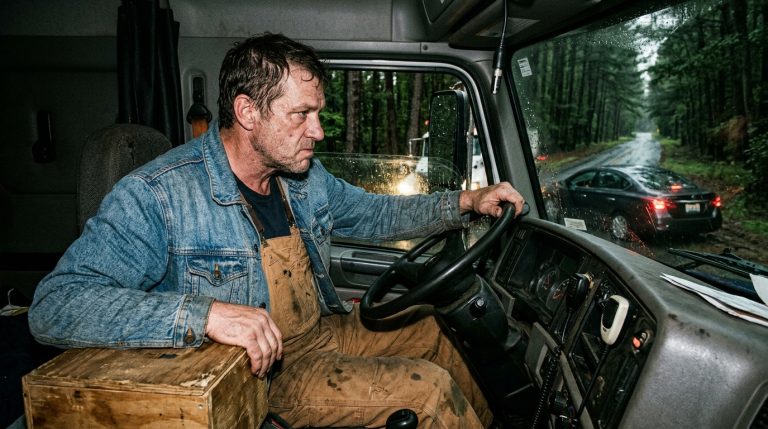
Ray turned the key. The engine coughed twice, a metallic, rattling protest that shuddered through the frame of the truck, before finally catching with a low, throaty rumble. He put the vehicle in gear and began to crawl along the rutted path that served as a road, his eyes fixed on the rear-view mirror. He saw movement—a flash of a coat, a flicker of something dark against the backdrop of the pines. Someone was definitely there, and they weren’t interested in honoring the dead.
“Where are we going?” Miller asked, his voice tighter now, the professional mask starting to slip.
“To the only place where the past actually stays buried,” Ray replied. He wasn’t going home. He wasn’t going to the school. He was heading for the older part of town, where the streets were narrow, the buildings were crumbling, and the alleys were deep enough to lose anyone who wasn’t looking to be found.
He gripped the steering wheel, his knuckles standing out like knots on a rope. The “decoy” secret—the idea that he was just a man with a guilty conscience—felt like a fragile shell. He had to keep Miller focused on the list, on the records, on the idea of the “custodian of record.” If Miller discovered the truth—that Ray had been more than a witness, that he had been the one to authorize the very records he now kept in his jacket—the entire fragile structure of his life would collapse.
“You want to know about Moore?” Ray asked, staring at the road ahead, his eyes reflecting the desaturated gray of the overcast sky. “Fine. But you need to understand that every answer is a door. And once you open it, you don’t get to close it again. Do you understand the cost of that, Agent? Because I’ve been paying it for fifty years.”
Miller looked at the folder, then at Ray, his expression oscillating between suspicion and an emerging, unwanted empathy. The silence between them was heavy, filled with the dust of the road and the distant, impending sense that they were driving toward an ending that neither of them was prepared to face. Ray accelerated, the truck lurching forward, leaving the sanctuary of the cemetery and the ghosts of Hillcrest behind, heading straight into the heart of a truth that was no longer waiting to be told.
CHAPTER 4: THE REDACTED LEDGER
The truck swerved slightly as Ray hit a pothole, the steering wheel shuddering in his grip. The suspension groaned, a long, drawn-out protest of rusted metal that echoed the tension rising in the cabin. Agent Miller had shifted his seat, his hand hovering near his jacket pocket, his eyes darting toward the narrow, winding streets of the old town as they passed.
“You’re driving toward the docks, Ray,” Miller noted, his voice devoid of heat, yet sharpened by the urgency of the moment. “There’s nothing out there but salt-rotted warehouses and memories.”
“Memories are exactly what you came for, aren’t they?” Ray gripped the wheel harder, his knuckles white against the dark, peeling rubber. He could feel the eyes of the city on them—or perhaps it was just his own exhaustion playing tricks, turning the shadows of the streetlamps into the silhouettes of watchers. He felt a sudden, sharp spike of paranoia, the same sensation he’d had in the jungle when the perimeter started to feel thin. Was Miller really an agent, or was this some kind of deep-level clearance check designed to make him crack?
He glanced at Miller, catching the sharp glint of light off the man’s watch. For a second, it looked like a signal, a flash of recognition. Ray’s heart stuttered. He hit the brakes, the truck fishtailing momentarily on the slick road before coming to a grinding halt in front of a decommissioned storage facility.
“Out,” Ray commanded, his voice tight.
Miller didn’t hesitate. He stepped out, his movements fluid and trained, his posture instantly scanning the perimeter. The air here was heavy with the smell of brine, wet iron, and the pervasive scent of ozone—a storm was gathering somewhere out over the bay.
Ray followed, his bad leg complaining with every step. He didn’t head for the front entrance; he circled around to a side door, a rusted utility hatch that he’d been maintaining for years, just in case. He pulled a key from his keychain—a heavy, brass thing that felt archaic in his hand—and inserted it into the lock. It jammed, the metal grating against metal, and for a moment, the friction was almost more than he could bear. It was a physical manifestation of his life: locked, rusted, and requiring force to open.
“The list, Miller,” Ray said, his voice dropping to a low, gravelly rasp. “You showed me the edge of the paper. You want to know what’s on it? It’s not just Moore. It’s everyone. Every man I carried in my pack until the weight became too much to stand.”
Miller stepped closer, his face obscured by the flickering neon of a nearby sign. “The Pentagon needs to know how you got these names, Ray. They need to know why a janitor has access to classified casualty lists that were purged in the mid-seventies. This isn’t just about ‘honoring’ soldiers. This is about institutional integrity.”
“Institutional integrity,” Ray repeated the words like they were a curse. He finally forced the hatch open, the heavy steel door swinging inward with a screech that sounded like a scream. He walked inside, the darkness welcoming him like an old friend. The space was cavernous, smelling of stagnant water and dust.
He didn’t turn on the lights. He knew his way by touch—the smooth edges of the shelves, the cool bite of the concrete floor. He moved to the back, where a single, unassuming file cabinet sat half-hidden under a tarp. He pulled the tarp back, the dust motes dancing in the sliver of moonlight filtering through a high, grimy window.
“You want the truth?” Ray asked, reaching for the handle of the cabinet. He was trembling now, not from fear, but from the raw, physical exhaustion of carrying this weight for half a century. “The truth is that you’re looking for a hero, Miller. But there are no heroes here. There was only a medic who didn’t want to go home alone, and a world that was perfectly happy to let us all stay in the ground.”
He opened the cabinet. Inside, stacked in orderly, devastating rows, were notebooks—dozens of them, worn leather, fraying fabric, scorched corners—each one filled with the handwriting of a man who had refused to forget. As Miller approached, his flashlight beam cutting through the gloom, he didn’t reach for his gun. He reached for one of the books.
Ray watched him, his own vision blurring for a moment. He saw Miller’s hand tremble—a tiny, human detail that made the man in front of him feel fragile, mortal, and dangerously close to the same precipice Ray had been standing on for decades.
“These aren’t just records,” Miller whispered, his voice catching. “These are… these are families. They’re living breathing people who never got closure.”
“They got silence,” Ray corrected, his eyes dark with the strain of the moment. “Which is what they were promised. And now you’re here to break that, too.”
Outside, a car door slammed—a sound that didn’t belong to Miller’s sedan. Ray stiffened. The perimeter had been breached, just as he’d feared. He looked at Miller, seeing the realization hit the agent’s face. They weren’t alone anymore. Someone else had followed the thread, and they were standing right outside the hatch, waiting for the truth to be fully exposed. Ray grabbed the ledger from Miller’s hand, his grip tight, his survival instincts screaming that the decoy was gone, and the real war—the one he’d tried to leave in the jungle—was finally closing in.
CHAPTER 5: THE HILLCREST CEREMONY
The heavy steel door groaned as Ray slammed it shut, sliding the rusted bolt home with a jolt that rattled his teeth. Outside, the muffled thud of boots against the gravel signaled that the perimeter had indeed been breached. He didn’t look at Miller. He turned his attention back to the file cabinet, his hands working with a feverish, desperate precision. He had to hide the ledgers—not from Miller, but from whoever was currently trying to kick down his door.
“Ray, listen to me,” Miller said, his voice rising above the rhythmic thudding against the metal door. “If we’re in danger, I need to know why. If there are people coming for these files, we need a secure extraction. We cannot stay here.”
Ray didn’t answer. He was frantically scanning the row of notebooks, his fingers trailing over leather bindings that had been dried by heat and soaked by monsoon rain. He reached for a slim, black book—the one he’d kept separate from the rest—and pulled it out. As he did, a slip of paper fluttered to the concrete floor.
He leaned down, his bad leg seizing, and snatched it up. It was a casualty manifest from an operation he had never recorded. His breath hitched. Among the names listed in his own neat, looping script, there was a signature at the bottom: an officer who had disappeared in 1974, a man Ray had assumed was long dead. But the ink on the paper was fresh—a correction made in a hand that looked suspiciously like his own, but recent.
The realization hit him with the force of a physical blow. He hadn’t just been a witness; he had been the one authorized to redact the records. The “decoy” secret—that he was merely a janitor keeping watch—was disintegrating. He looked at Miller, who was now drawing a sidearm, his eyes fixed on the vibrating hatch door.
“You’re not just an agent,” Ray whispered, the betrayal tasting like copper in his mouth. “You’re the one who sent the internal ping, aren’t you? You didn’t find the photo online. You were tracking the file.”
Miller’s expression hardened. The facade of the sympathetic investigator dropped away, revealing the cold, calculating professional underneath. “The Corps doesn’t forget, Ray. And we don’t like loose ends that have been walking around for fifty years. Give me the manifest.”
The hatch buckled, the metal screaming as a crowbar dug into the seam. Ray didn’t retreat. He took a step forward, the concrete floor biting into his soles. He realized then that the “ceremony” at Hillcrest wasn’t just a memorial—it was a trap, a way to lure him out of hiding and force him to surrender the records that proved the military had orchestrated the very silence he had been fighting to break.
“You want it?” Ray held the black book out, but his grip was iron. “You’ll have to take it from the man who actually stood in the mud while your predecessors were shredding the truth.”
The hatch flew open with a violent clang, and a silhouette filled the doorway, backlit by the harsh glare of the streetlamps. Ray didn’t hesitate. He swung his heavy metal flashlight, the only weapon he had, not at the intruder, but at the main power conduit running along the wall. The sparks showered down, a cascade of blue-white light that blinded the room for a critical second.
He moved with the muscle memory of the jungle, sliding into the darkness, his body instinctively hugging the cold, damp concrete. He knew these shadows better than anyone. As the intruders stumbled into the sudden blackness, shouting orders that meant nothing to him, Ray slipped through a secondary ventilation shaft he’d cleared weeks ago—a path only a man who had spent years as a phantom could know.
He was out, his breath ragged, his chest burning. The cold night air hit him, sharp and biting. He scrambled toward the edge of the bay, the salt spray rising up to meet him. He wasn’t running away; he was circling back. He had the manifest. He had the proof. And for the first time in a decade, the “Watchman” was no longer just standing guard. He was on the offensive.
He reached the treeline, his boots silent on the pine needles. He looked back at the warehouse. Miller was standing in the doorway, weapon drawn, searching the dark for a shadow that had already vanished. Ray tucked the black book into his inner pocket, the weight of it a promise. He had one chance left to ensure that Moore, and every other name in his ledger, was honored on his terms, not the military’s. He turned toward the distant, flickering lights of the town and started to run.
CHAPTER 6: THE ECHO
Ray’s lungs burned, a raw, searing heat that mirrored the intensity of the morning sun as it crested over the treeline. He didn’t stop until he reached the iron gate of Hillcrest. He was exhausted, his body failing him in ways that made his age feel like a physical weight, but he pushed through the gate, the rusted hinges offering no protest this time. He was back where he started, back at the grave of Lieutenant Moore.
He didn’t look back to see if Miller was still following. He knew he was. The rhythmic sound of footsteps on the gravel was too deliberate to be anyone else. Ray knelt in the damp, cool earth, the familiar ache in his leg throbbing in time with his racing heart. He placed the black ledger—the manifest he had carried through hell and half a century of silence—onto the headstone.
“It’s all here,” Ray said, his voice quiet, almost lost in the vast, still silence of the graveyard. He felt Miller stop a few paces away. “Every name. Every report. The ones who came home, and the ones I left behind in the mud because I was the only one left to remember them.”
Miller didn’t move to take the book. He stood in the dappled light, his weapon holstered, his face stripped of the cold, professional veneer that had defined their encounter. “You were never just a custodian, Ray. You were the officer in charge of the field reports for the 3rd Division. You didn’t leave because you were guilty—you left because you refused to sign the documents that would have erased these men from the official record.”
Ray looked up, his eyes meeting Miller’s. The truth wasn’t a secret anymore; it was a ghost that had finally been given a name. He wasn’t a man who had failed; he was the man who had carried the entire burden of that failure on his own shoulders, guarding the truth in the shadows while the world moved on.
“I was the medic,” Ray said, his voice steadying. “I held their hands when they died. I promised them they wouldn’t be forgotten. I didn’t care about the records. I cared about the promise.”
Miller stepped forward, his expression softening into a rare, genuine look of respect. He reached out, not for the gun, but for the ledger. He handled it with a reverence that felt like an apology. “The Pentagon has been looking for the ‘Watchman’ because the archive isn’t just a list, Ray. It’s the proof the Department of Veterans Affairs needs to finally recognize the unlisted combat deaths from the ’74 transition. You didn’t just save memories. You saved their families from a lifetime of uncertainty.”
Ray looked at the grave, at the clean, polished stone that now bore both their names. He felt a profound, settling peace, a quiet that flowed through him like cool water. He thought of the young kids with their wild flowers, the future he had inadvertently built simply by refusing to look away. The struggle—the paranoia, the hiding, the decades of quiet, invisible service—it all collapsed into this single moment of resolution.
“I’m tired, Miller,” Ray said, and for the first time, it didn’t sound like defeat. It sounded like the end of a long, arduous march.
“The ceremony isn’t over,” Miller said, his voice low. He reached into his pocket and pulled out a small, folded flag. He placed it beside the ledger on the grave. “There are people waiting. People who have been searching for their fathers, their brothers, for forty years. They aren’t looking for a hero, Ray. They’re looking for someone who was there. They’re looking for you.”
Ray stood up, his movements stiff, his body feeling as though it had finally been unburdened of a weight he’d carried since 1968. He turned and saw, at the edge of the cemetery, a small group of people—a young woman with tears in her eyes, an older man clutching a faded photograph, a group of veterans standing in silence. They weren’t there for the military pageantry; they were there for the man who had knelt in the mud for ten years, whispering to the dead.
He took a deep breath, the scent of fresh-turned earth and morning dew filling his lungs. He walked toward them, his limp no longer a sign of weakness, but a badge of honor. He had reached the end of his watch. The silence had been broken, the names had been reclaimed, and the echo—the resonance of his choice—would carry on long after he was gone. He didn’t look back at the grave. He knew Moore was at peace.
He reached the group, and the young woman stepped forward, her hands outstretched. Ray took them, her warmth grounding him in a world that, for the first time, felt entirely, beautifully real. He had spent his life in the shadows, waiting for the world to notice, and as he stood there, surrounded by the people whose lives he had inadvertently mended, he realized he didn’t need the recognition of the military. He had the only thing that had ever mattered: the truth, and the people he had fought to save.
The afternoon sun settled over Hillcrest, casting a golden, warm light on the rows of stones. The wind moved through the trees, no longer like ghosts, but like a soft, comforting breath. Ray Navaro, the Watchman, finally stood still, his journey complete, his heart at rest, and the silence he had once feared was now filled with the voices of those he had never stopped remembering.