The Architect of Silence: A Retired Engineer’s Calculated Siege to Dismantle a Suburban Tyrant’s Empire
CHAPTER 1: THE PROPERTY LINE
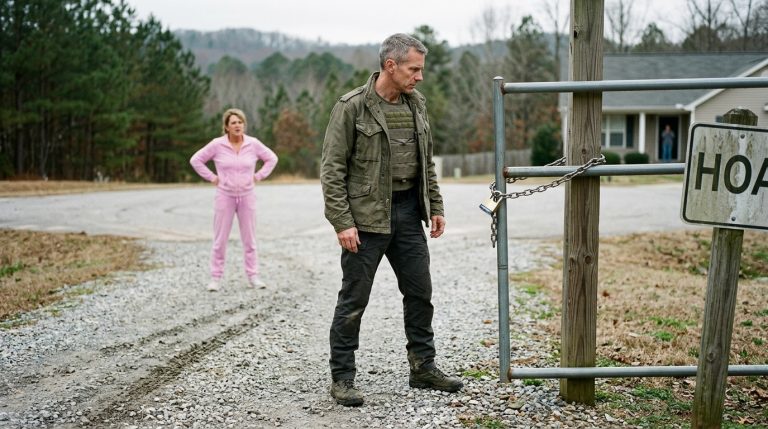
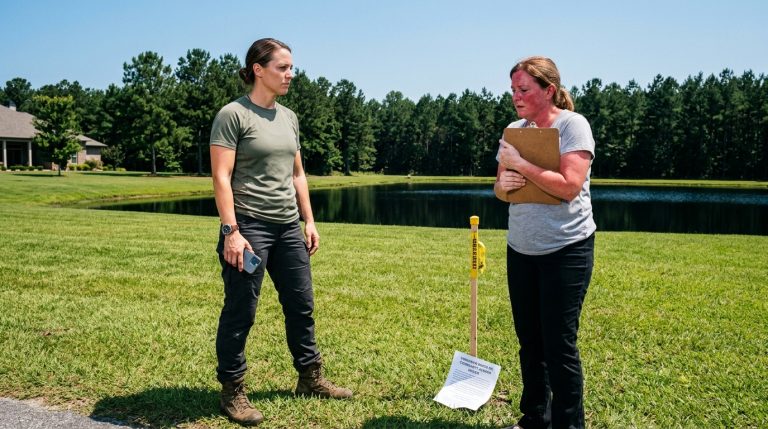
The morning sun cut through the oaks like a scalpel, pinning Karen Miller to the edge of my driveway. She didn’t just stand there; she occupied the space with the predatory posture of a debt collector who hadn’t yet realized the target was bankrupt. Her pink tracksuit looked like a wound against the earthy, muted tones of the property my grandfather had cleared by hand.
“That’s another five hundred, Mr. Harrison,” she said. Her voice was too thin, too high—the sound of someone who had never heard the word ‘no’ from someone who didn’t fear her. She held the clipboard up, the plastic cover of the roofing shingles behind me glinting like an insult. “Your service to this country doesn’t exempt you from our bylaws. These debris piles are a stain on the community.”
I didn’t move. I didn’t reach for the paper. I watched her—the way her pulse hammered a frantic, shallow rhythm against her neck. I wasn’t seeing a neighbor. I was seeing a logistical problem, a structural failure in the integrity of my home’s environment. I calculated the distance between her feet and the rusted iron stake hidden in the tall grass. She was invading the buffer zone.
“They’re not debris, Karen,” I said, my voice steady, stripped of the fatigue that had been clinging to me for weeks. “They’re materials. And according to the historical carve-out recorded in the county deed, this property isn’t subject to your review committee’s aesthetic whims.”
Her smirk tightened, a predatory twitch of the lips. “The courts don’t care about dusty old papers from the sixties, Harrison. They care about property values. And your house is tanking them.”
She tapped her pen against the clipboard. It was a rhythmic, calculated taunt. She thought she was winning because she had the paper, the pen, and the local ordinance, but she was missing the fundamental flaw in her siege. She had stopped looking at the ground. She was so focused on the idea of my compliance that she hadn’t noticed the specific way the soil dipped at her heels.
I looked past her, toward the suburban wall of beige houses that looked like a movie set built for ghosts. A delivery truck rumbled down the street, and for a split second, I saw a flash of movement in the window of the house across the way—a neighbor watching, their curtain trembling with suppressed panic.
“You’re going to lose the house by the end of the month,” she said, her voice dropping to a conspiratorial, oily whisper. “The board has already approved the lien. You’re fighting a war you lost before you moved in.”
She took a step forward, the clipboard thrust toward me like a shield. I didn’t reach for it. Instead, I glanced at the roofing pallet, then back at her. A thought crystallized, cold and precise. If she wanted a war of attrition, I would stop playing the defender. I would stop trying to fix the mailbox and start dismantling the infrastructure that allowed her to exist.
“You’re very confident, Karen,” I said, stepping closer, closing the distance until the air between us felt heavy with the scent of pine and something metallic, like an impending storm. “But tell me, when the board realizes that your ‘architectural enforcement’ has actually opened the community up to a massive liability regarding the utility grid, will they be as supportive?”
Her smirk vanished, replaced by a momentary, flicker-thin hesitation. She didn’t know what I was talking about. She couldn’t know. The blueprints in my attic were the only record that mattered.
“You’re bluffing,” she spat, though her hand trembled.
I turned my back on her, walking toward the porch. “Check your page 27 again, Karen. You might find there’s more to this property than just paint colors.”
As I reached for the door handle, I heard a sharp, cracking sound—the distinct, high-pitched snap of plastic hitting asphalt. I didn’t look back. I just listened. She had dropped the clipboard. It was a small, almost pathetic sound, but it meant everything. The siege had changed. I was no longer the one being measured; I was the one holding the ruler.
And then, the phone in her pocket began to vibrate—a long, frantic, uneven buzz that didn’t stop. She fumbled for it, her face going pale as she glanced at the screen, her eyes darting toward me with a sudden, sharp edge of fear that I hadn’t seen before. The context of her harassment hadn’t just shifted; it had evaporated.
She wasn’t just here to fine me. She was running from something else entirely.
CHAPTER 2: THE BLUEPRINT AUDIT
The vibration stopped as abruptly as it had begun, leaving a hollow silence that felt heavier than the ambient noise of the suburb. Karen hadn’t looked at the screen; she had stared at me, her expression a fractured mosaic of arrogance and genuine, prickling panic. She didn’t wait for an explanation or a retort. She turned, her pink tracksuit flashing against the manicured green of the neighbor’s lawn like a neon warning sign, and hurried back toward her golf cart.
I watched her go, not with the satisfaction of a win, but with the cold, diagnostic focus of an engineer identifying a structural weakness. My hand stayed on the door handle. The wood was weathered, slightly soft from years of neglect—a sharp contrast to the aggressive, inorganic perfection of the surrounding houses. Inside, the air was still, smelling faintly of sawdust and old paper, a sensory echo of the man who had built this place. My grandfather.
I locked the door, engaging the deadbolt with a satisfying, heavy click that signaled a total separation from the outside. The house was not merely a structure; it was a physical argument against the beige uniformity encroaching on the property line.
I moved to the hallway, my boots echoing on the hardwood floor—the original pine he’d laid down in ’68. In the hallway closet, I pulled the dusty, cardboard box from the top shelf. It had been buried under decades of tax records and faded polaroids. I carried it to the kitchen table, the light from the window catching the swirling dust motes.
As I lifted the lid, a phantom scent hit me—the sharp, clean bite of linseed oil and cedar. It was a memory, visceral and sudden, of his workshop. He’d taught me that if you wanted to understand a building, you didn’t look at the walls; you looked at the foundation and the utility lines. You looked for where the power entered, and where the water left.
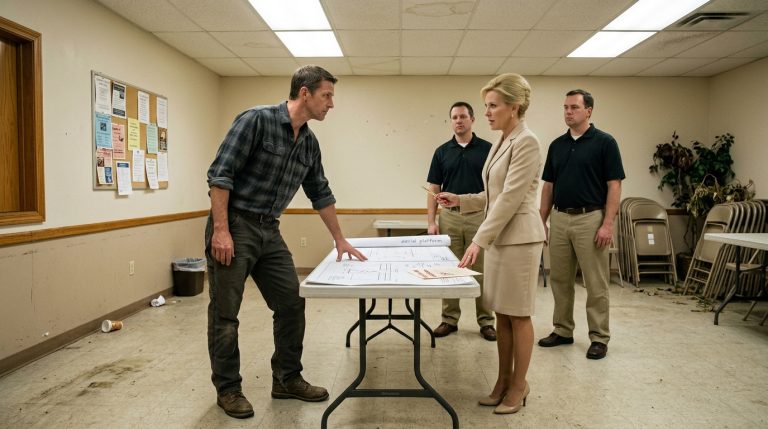
I spread the blueprints out. They were fragile, the paper yellowed to the color of old bone. My fingers traced the ink lines, precise and steady. There it was: the 1968 boundary markers, the original utility survey, and the note—Easement: Non-Transferable.
A flicker of movement outside the window caught my eye. A black sedan, heavy and anonymous, was idling near the curb, just far enough away that the driver wouldn’t be caught by a passing glance. It stayed there for a long moment, then slowly crept forward, its engine barely a hum. It wasn’t an HOA patrol. It was too heavy, too deliberate.
I looked back at the blueprints, specifically at a section near the north corner of the property. The utility easement wasn’t just a technicality; it was a complex web of junctions that fed the entire subdivision’s backbone. If the HOA thought they could force a foreclosure, they were operating under the assumption that the land title was clean. But these blueprints, unrecorded in the modern digital registry by some clerical oversight in the late nineties, changed the math entirely.
My pulse leveled out. The stakes had shifted from paint finishes and lawn heights to something fundamentally infrastructural. If Karen was working for someone—some investment firm eyeing this two-acre island of antiquity—they were walking into a blind spot they couldn’t even see.
I grabbed a pencil, not for the renovation work, but for mapping the board. I started sketching the connections, the power dynamics, the chain of command. Karen was the face, but she was just a structural failure waiting for a stress test. I needed to know who was pulling the strings, and more importantly, I needed to know why this specific property was worth a siege.
The house creaked, a familiar sound of settling timber that felt like a heartbeat. I wasn’t just restoring a home anymore. I was reinforcing a fort. I gathered the blueprints, folding them with surgeon-like care, and tucked them into the hidden compartment of my old rucksack.
The front door rattled. A soft, tentative knock, followed by the sound of something being slid under the door. I walked to the entrance, my movements fluid and quiet. A white envelope. No return address. I opened it, the paper heavy and expensive, the kind of stationery that suggested power.
Cease the audit. The fines are the least of your concerns.
No signature. Just a reminder that my curiosity was being monitored. I looked out the peephole. The black sedan was gone, but a new, smaller car—a silver hatchback—was now parked in the driveway across the way. The curtains there were drawn, but I could feel eyes on me.
I turned off the kitchen light, plunging the house into a dim, gray twilight. I didn’t need the light to see the board anymore. I had the blueprints, I had the leverage, and for the first time since I’d returned, I knew exactly where the first structural crack in their empire was located. I wasn’t going to negotiate the fines. I was going to leverage the infrastructure.
I walked back to the kitchen, my resolve hardening. Tomorrow, I wouldn’t be outside trimming the hedges. I would be at the county office, verifying exactly what the modern records said about the land—and who, exactly, had requested access to the original 1968 files before I arrived.
The war wasn’t about the lawn. It was about the foundation. And I was the only one who knew what was buried beneath it.
CHAPTER 3: THE SILENT SCOUT
The morning light felt thin, brittle. I stood by the kitchen window, the blueprint still folded against my chest inside the rucksack. The silence of the house had been broken, not by the expected knock, but by the low, electric hum of an approaching golf cart. It wasn’t the distant noise of the neighborhood; it was the specific, aggressive whine of the HOA president’s transport.
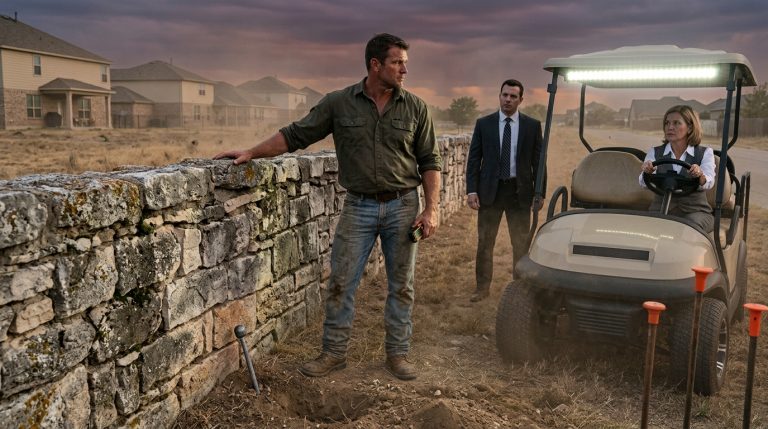
I didn’t retreat. I moved to the mudroom, my movements measured, keeping to the shadows cast by the deep-set window frames. Through the glass, I saw the cart pull onto the gravel. It wasn’t just Karen this time. Beside her sat a man in a crisp, charcoal-gray suit that looked absurdly out of place against the backdrop of our rural driveway. He held a leather-bound folio—not a clipboard, not a laminated list of rules, but something that spoke of legal authority rather than suburban petty theft.
This was the escalation. The fines weren’t enough; they were bringing in the muscle to secure the land.
I opened the door before they could reach the porch. I didn’t step outside; I stood in the threshold, occupying the space where the old wood met the new, neglected gravel. The air was cool, biting. I leaned against the doorframe, crossing my arms, my face devoid of the frustration they were clearly hunting for.
“Morning,” I said. My voice was low, carrying only the necessary volume to bridge the ten feet between us.
Karen jumped, her hand twitching toward the steering wheel. The man in the suit remained motionless, his eyes scanning the property, not looking at me, but at the structure—the eaves, the foundation, the way the oak trees stood like sentinels. He was a surveyor, or perhaps a lawyer masquerading as one.
“Mr. Harrison,” Karen began, her voice already pitched for a performance. She gestured toward the man. “This is Mr. Vance. He’s here to perform a necessary assessment of the property’s structural safety, mandated by the board.”
“Mandated by the board,” I repeated, letting the words hang in the stagnant air. “You’re a long way from home, Vance. And you’re currently standing on private property that falls outside the jurisdiction of your HOA. You’re trespassing.”
Vance finally looked at me. His eyes were flat, gray, and entirely devoid of the performative emotion Karen relied on. “The state and county have protocols for ‘unimproved’ zones, Mr. Harrison. We’ve been granted a temporary access order to evaluate the structural integrity of the main dwelling. For safety reasons, of course.”
“Let me see the order,” I said. I didn’t reach for it. I stayed exactly where I was.
Vance sighed, a slow, calculated exhalation. He opened the folio and pulled out a single sheet of paper. He held it out, but he didn’t hand it over. He kept it at a distance, ensuring I would have to step off the porch to examine it.
I didn’t move. I already knew what it was: a boilerplate legal notice, likely filled with enough bureaucratic jargon to intimidate anyone who hadn’t spent twenty-five years reading blueprints and government contracts. It was a bluff, designed to force me into a defensive stance. If I stepped off the porch, I was accepting their presence. If I stayed, I was “obstructing.”
“That’s a court-ordered access notice for a commercial survey,” I said, my voice steady, cutting through the thin morning air. “But you’re currently in a residential subdivision zone. This order hasn’t been filed with the county clerk. I checked the digital index this morning.”
A flicker of genuine surprise touched Vance’s eyes. He hadn’t expected me to know the filing status. Karen’s smug smirk wavered; she looked at him, seeking a cue, a secondary attack plan. She was the one who usually handled the conflict, but she was out of her depth now that the conflict had turned from neighborhood complaints into legal maneuvering.
“The clerk is a formality,” Vance said, his voice smooth, professional. “We can settle this today, or we can go through the standard legal channels, which, frankly, will make your situation here significantly more expensive.”
“I think I’ll take my chances,” I replied. I stepped back, my hand resting on the heavy deadbolt. “You’re off the property, Vance. And Karen, keep the golf cart off the gravel. You’re damaging the base.”
I didn’t wait for them to process the rejection. I retreated, closing the door and locking it. Through the glass, I watched them. Karen was talking rapidly, her gestures wild, frustrated. Vance stood still, his gaze fixed on the front door, his expression unreadable. He wasn’t the kind of man to give up because of a closed door; he was the kind of man to start looking for the next point of ingress.
I walked to the kitchen and placed the blueprint on the table again. The survey hadn’t been about safety. It had been about finding a flaw, a reason to condemn. They were trying to manufacture a reason to take the land before I could even begin the restoration.
I went to the wall where my grandfather had hung a set of tools—rusted, iron-wrought, and heavy. I didn’t need them for construction, but I needed the weight of them in my hands. The game had evolved. They weren’t just testing the defenses; they were preparing to breach them.
I heard the cart hum to life, backing away slowly down the long gravel driveway. They were leaving, but they weren’t done. The game of attrition had shifted into a game of surveillance.
I sat down, pulled out the map I had started earlier, and began to draw the perimeter of the utilities. If they wanted a structural assessment, I would give them one. I would show them exactly what this house was holding up, and why, if they pushed too hard, the entire neighborhood would go dark.
CHAPTER 4: THE FIRST COUNTERMOVE
The gravel crunched under my tires as I pulled my truck away from the property, the weight of the blueprints in the rucksack beside me serving as a constant, grounding reminder of the task ahead. The subdivision, with its beige façades and sterile, uniform lawns, felt like a mask sliding over the face of the landscape. I kept my eyes on the road, watching the rearview mirror, but the silver hatchback from yesterday was nowhere to be seen.
The county office was a brick monument to mid-century public service, a place where paperwork went to be filed, forgotten, or intentionally buried. Inside, the air was recycled and cold, smelling of ozone and floor wax. I approached the counter, the wood worn smooth by decades of hands seeking answers or trying to hide them.
The clerk, a woman whose name tag read ‘Margaret,’ didn’t look up from her monitor. She was typing with a slow, rhythmic tapping that sounded like a countdown. I placed my request for the historical land-use records for the Serenity Lakes area, specifically the 1968 carve-out documents, on the counter.
She paused. The typing stopped. She looked up, her eyes narrowing slightly as she took in my appearance—the calloused hands, the faded jacket, the aura of someone who wasn’t there for a permit renewal. “Those files aren’t in the active digital database, Mr. Harrison. You’ll need to put in a formal information request. It takes ten business days.”
“I don’t have ten business days,” I said, my voice low and level. I leaned in, just enough to communicate that I wasn’t going to be brushed off by a protocol that didn’t apply to historical titles. “I have the original physical documentation right here. I’m here to verify why your digital registry has omitted the utility easement listed in the ’68 survey.”
Margaret’s composure cracked, a small, subtle tremor of the lip. She didn’t reach for my paperwork. Instead, her gaze shifted to the door, then back to me. “I don’t handle easements. That’s Planning and Development.”
“Then direct me to someone who does,” I said. “And while you’re at it, check the log for who accessed these files last week.”
She turned back to her monitor, but her movements were different now—hesitant, flickering. She clicked through several windows, her brow furrowed. “There’s no record of a recent access request for that parcel.”
“Check the physical sign-out ledger,” I pressed.
She hesitated, then stood up and walked toward the back of the room, disappearing into a maze of filing cabinets. The seconds stretched into minutes. The silence in the office was absolute, save for the hum of the fluorescent lights. I stood there, watching the door, my mind running through the logistics of the deception. If the records were scrubbed from the digital system but still existed in the physical ledger, someone was trying to hide the chain of custody for the land title.
When she returned, she wasn’t carrying the ledger. She was carrying a phone, which she quickly set down on the counter. “The supervisor is on their way out to speak with you. I’m afraid I can’t assist further.”
“Margaret,” I said, my voice sharpened by the realization of the obstruction. “If you’re being told to withhold information regarding a historical land carve-out, you’re putting yourself in the middle of a liability that is going to be significantly more than a clerical error.”
She didn’t answer. She just looked past me toward the door, where a man in a dark suit was striding toward the counter. It wasn’t Vance, but he shared the same sharp, angular features, the same air of practiced intimidation.
“Mr. Harrison,” the man said, not offering a hand. “I’m the records supervisor. Margaret tells me you’re looking for ghosts in our system.”
“I’m looking for the truth about a recorded easement,” I replied, my stance widening, shifting from civil inquiry to a defensive perimeter. “The kind of truth that doesn’t just disappear because someone doesn’t want it in the digital records.”
“There are no secrets here, only outdated documents that have been superseded by modern municipal code,” the supervisor said, his voice smooth as glass. “I suggest you go home and focus on your property maintenance. The HOA has reported a significant number of violations that will reach a court-mandated resolution if you continue to ignore them.”
He knew exactly what the HOA was doing. He wasn’t just a supervisor; he was an enabler. The realization hit me with the force of a physical blow. The HOA, the investment firm, the county records—it was all one closed loop, designed to isolate and exhaust anyone who stood in the way of the acquisition.
I didn’t argue. I didn’t reach for the paperwork. I smiled—a cold, thin expression that didn’t reach my eyes. “I appreciate the advice. I’ll be sure to keep that in mind.”
I turned and walked toward the exit, feeling his gaze burning into my back. I didn’t look back until I reached my truck. As I pulled out into the street, I saw him pick up a phone, his eyes tracking me the entire way.
The siege had officially escalated. They weren’t just using fines; they were using the county bureaucracy to paint me as the antagonist. I tapped the rucksack on the seat next to me. They thought they had the law on their side, but they had forgotten one thing: I knew exactly how to dismantle a structure from the foundation up, and I had the original plans to prove it.
The target wasn’t the HOA anymore. It was the entire network that held it together.
CHAPTER 5: THE MIDPOINT REVEAL
The drive back to the property was a descent into a carefully curated silence. Every street I passed in Serenity Lakes looked identical—the same muted beige paint, the same pristine, lifeless lawns, the same calculated distance between the houses. It was a sterile, artificial environment, and for the first time, I could see the seam where the reality of the land ended and the artifice of the development began.
As I approached the turn-off for my own drive, a flickering streetlamp caught my attention. It buzzed with a dying, erratic rhythm, the light pulsing in a way that suggested a failing transformer rather than a simple bulb burnout. I pulled to the shoulder and killed the engine. The silence that followed was total. I stepped out of the truck, the crunch of gravel under my boots sounding unnaturally loud in the evening air.
I walked toward the edge of the property line, where the ancient oak trees marked the boundary of my grandfather’s two acres. Beyond them, the newer, paved road of the development stretched out. I knelt down at the base of the nearest oak, pulling a small hand-trowel from my pocket. I needed to see what was buried there. According to the original blueprints, this was the primary junction point for the underground utilities that fed the entire subdivision—a relic of the original plan that had been conveniently “forgotten” in the newer site maps.
The soil was hard, baked by the summer heat, but as I dug, the texture changed. Beneath the topsoil, the dirt gave way to a layer of coarse, industrial gravel. I cleared it away, my heart hammering a steady, rhythmic beat against my ribs. There, half-buried in the earth, was a concrete housing unit, stamped with a serial number that dated back to 1968. It was a massive, antiquated node.
I leaned closer, brushing away the last of the debris. There were no modern data cables here. It was a centralized analog hub, a junction box that, according to the schematics I’d studied, served as the primary load-balancer for the entire western sector of the estate. If this node were bypassed or shut down, the entire neighborhood’s connectivity would effectively vanish.
The realization settled over me, cold and absolute. They weren’t just trying to force a foreclosure to take the land for residential expansion. That was the cover. They were trying to take the land to control this node—the heart of the subdivision’s infrastructure. If they owned the land, they owned the grid. If they owned the grid, they could manipulate the utility market for the entire area, charging premiums for “maintenance” and “upgrades” that no one could refuse because they wouldn’t have a choice.
A sudden, sharp beam of light swept across the trees. I went flat against the dirt, the cold dampness of the earth pressing against my chest. A black SUV rolled slowly past the edge of the property, its headlights cutting through the dark like twin blades. It stopped fifty yards up the road.
I didn’t move. I watched through the screen of low-hanging branches. A door opened, and a man stepped out—not Vance, not Karen. He was taller, broader, his movements suggesting a professional security detail rather than corporate muscle. He walked to the edge of the road, looked toward my property, and tapped a device on his wrist.
“The survey didn’t take,” I heard him murmur, his voice carrying over the stillness. “He’s onto the grid mapping. We need to move the timeline up. If we don’t have that title in escrow by Monday, the firm won’t be able to initiate the Phase Two annexation.”
Phase Two. The words confirmed everything. The HOA wasn’t just a group of neighbors; it was a front for a mid-sized investment firm specializing in hostile land acquisition. They weren’t interested in maintaining property values; they were interested in asset liquidation.
I remained motionless, my breath shallow and silent, until he returned to the vehicle and it pulled away. The threat was no longer an abstraction; it was a time-sensitive ultimatum. They had forty-eight hours before they escalated.
I stood up, the trowel still clutched in my hand. I hadn’t just uncovered a decoy; I had found the real engine driving the siege. I looked at the concrete node, the relic of my grandfather’s foresight. He hadn’t just built a home; he had built a leverage point that was now the most dangerous piece of property in the county.
I started filling the hole, packing the earth back over the junction box with surgical precision. I couldn’t stop them by playing the game of rules and notices anymore. If they wanted to play hard, I would show them exactly how an engineer secures a position. I had the blueprints, I had the ground, and now, I had the incentive.
I walked back to my truck, the weight of the rucksack feeling lighter than it had this morning. I knew their objective. I knew their timeline. And, thanks to the node, I knew exactly where to strike to bring their entire, artificial empire crashing down.
CHAPTER 6: TACTICAL EXPOSURE
The engine ticked as it cooled, a metallic rhythm that matched the rapid, analytical pulse of my thoughts. I didn’t start the truck. Instead, I pulled the folded blueprints from my bag and spread them across the center console, the dim light from the dashboard highlighting the intricate, hand-drawn lines of the property’s utility grid.
I was no longer looking for fines. I was looking for the throat of the beast.
The investment firm’s timeline was clear: Monday. They needed the title, and they needed it before the county planning committee met for their quarterly review. If I could expose the firm’s back-channel connection to the HOA—the very organization supposed to represent the residents’ best interests—the resulting public scandal would freeze the annexation process in its tracks. But to do that, I needed more than just intuition. I needed a paper trail.
I remembered Mr. Henderson, the elderly neighbor I’d seen being berated for a college flag. If there was a list of grievances against Karen, he would be at the top of it. More importantly, if anyone in this development had been bullied into silence, it would be the people who had lived here long enough to remember a time before the beige walls took over.
I started the engine and turned toward the street. The neighborhood was quiet, the houses glowing with the synthetic warmth of LED lighting. I drove slowly, my gaze sweeping the front lawns until I spotted Henderson’s house. It was smaller than the others, its yard meticulously maintained but lacking the manufactured perfection the HOA demanded.
I parked at the curb. The air felt tight, charged. I walked up the path, noticing the absence of the flag that had caused him such distress. I knocked, the sound of my knuckles against the wood feeling like a challenge to the sterile peace of the street.
Henderson opened the door a crack, his face etched with the weariness of a man who had spent his life avoiding trouble. He looked at me, then at the street, his eyes darting toward the distant glow of a security camera on the neighbor’s house. “Mr. Harrison. You shouldn’t be here. She… she has people watching.”
“I know,” I said, keeping my voice low. “I’m not here to cause you trouble, Henderson. I’m here because I know why she’s doing it. And I know you know, too.”
He paused, the tension in his shoulders shifting, not into relaxation, but into a grim, resigned alertness. He opened the door wider and gestured for me to enter. The interior of the house smelled of old books and peppermint—a sharp, sudden contrast to the sterile, deodorized atmosphere outside.
“She’s been coming around every week,” Henderson said, his voice a dry rasp. “Asking me to sign a ‘voluntary release of claim’ document. She says it’s for the good of the neighborhood, but the company name on the letterhead… it’s not the HOA. It’s some firm out of the city. A firm that buys distressed properties to clear them for commercial zones.”
My suspicion solidified into certainty. “Do you have the letter?”
He moved to a desk, his movements slow but deliberate, and pulled a document from a folder. It was a standard legal instrument, but buried in the fine print at the bottom was the name: Vanguard Land Acquisitions.
I scanned the page. It wasn’t just a release of claim; it was an irrevocable power of attorney, granting the firm the right to negotiate on behalf of the homeowner. It was a total surrender of property rights.
“They’ve been systematically targeting the long-term residents,” I said, looking at the signature line—Karen Miller, Authorized Agent.
“She promised that if I didn’t sign, the fines would make it impossible for me to stay,” Henderson whispered. He looked at me, his eyes showing a flicker of the man he must have been once—someone who wouldn’t have been bullied by a woman in a pink tracksuit. “I have no family left to leave this place to, but I have my pride. I just… I didn’t know how to fight them.”
“You don’t have to,” I said, sliding the document back toward him. “I need you to keep this safe. I’m going to use it to rip that firm’s control away from the board. But I need you to do something for me first. I need you to talk to the others. I need to know how many more of these have been circulated.”
Henderson gripped the edge of the table, his knuckles white. “If I do this, there’s no going back, is there?”
“No,” I replied. “There isn’t. But by Monday, the people who have been terrorizing this neighborhood are going to be the ones losing their footing.”
I left his house with the promise of his cooperation, the cold air hitting me like a physical wake-up call. I was no longer a lone defender on an island; I was starting to build a resistance. As I walked back to my truck, I noticed the flickering streetlamp from earlier had finally died, leaving the street in a patch of deep, impenetrable shadow. The grid was becoming unstable.
My phone vibrated in my pocket. A text from an unknown number. The county records supervisor says hello. You’re playing a game you don’t understand, Harrison.
I didn’t answer. I put the truck in gear, my eyes tracking the movement of a pair of headlights two streets over. They were coming for me, but they had underestimated the terrain. I didn’t just know the grid; I was the one who had written the map.
The siege was no longer just about the house. It was about the entire foundation of the estate, and I was just getting started.
CHAPTER 7: THE BOARDROOM PIVOT
I sat in the idling truck for a long minute, watching the screen of my phone until the backlight timed out, plunging the cab back into the deep, gray gloom of the evening. The supervisor’s threat was a calculated attempt to rattle me, to push me into making a move they could track. They wanted me on the defensive. They wanted me worried about the law.
But they had miscalculated. I wasn’t just a man fighting for his grandfather’s house; I was an engineer who understood that any system, no matter how complex, had a point of critical failure.
I put the truck in gear and pulled away from the curb, moving slowly through the winding streets of Serenity Lakes. I didn’t go home. Instead, I drove toward the community clubhouse, a sprawling, modern structure of glass and polished stone that stood at the center of the development. It was there that the board held their “open” meetings—a theatrical display of democracy designed to rubber-stamp the firm’s agenda.
The parking lot was mostly empty, save for Karen’s golf cart, which was parked conspicuously near the main entrance, and a single black sedan that I recognized from my earlier surveillance. They were inside, likely finalizing the documentation for Monday’s meeting.
I parked at the far edge of the lot, in the deep shadow of an ornamental pine, and killed the lights. I pulled a small, high-intensity flashlight and a multi-tool from my bag. If I couldn’t beat them with paper, I would find another way to disrupt their assembly. I approached the rear of the building, moving with the measured, quiet intensity that had served me well in the field.
The clubhouse was protected by a standard digital security system—a proximity sensor and a keypad. It was the same system that managed the entry gates to the estate. I pulled the rucksack closer, retrieving a small, custom-built bypass device I’d fashioned from a salvaged transformer and a logic board. It was a crude tool, but it was effective against the off-the-shelf security the firm had skimped on to save costs.
As I worked on the housing of the keypad, a movement in the distance caught my eye. A figure was walking toward the clubhouse from the main road—not a security guard, but someone who moved with the tentative, hesitant step of someone who didn’t want to be seen. I ducked into the shadows, my heart rate steadying into a combat-calibrated rhythm.
It was Mr. Henderson. He looked smaller than he had earlier, his shoulders hunched against the biting wind. He reached the door, hesitated, and then tapped a code into the keypad. The lock clicked, and he slipped inside.
My pulse quickened. He hadn’t just been a victim; he had access. Or perhaps he was being forced to attend. Either way, he was a bridge. I waited for the door to cycle shut, then approached the keypad, finished the bypass, and pushed the door open just enough to slide inside.
The interior was polished, sterile, and smelled of expensive floor wax. I moved through the lobby, guided by the low, muffled sound of voices coming from the main boardroom. I stayed in the dark, my feet making no sound on the plush carpeting.
I reached the threshold of the boardroom and peered through the sliver of space between the door and the frame. Karen was standing at the head of the long, mahogany table, her face taut and angry. She was shouting at someone—not the board members, but the man from the black sedan.
“He knows about the node,” Karen said, her voice strained. “He’s been out there. He’s been digging. If he’s already mapped the grid, the county filing for annexation is going to be flagged for environmental impact. We can’t hide the easement if he brings it to the public hearing.”
The man in the sedan leaned back, his face a mask of cold indifference. “Then deal with him, Karen. The firm isn’t paying for excuses. We need that land by Monday. If he won’t sign the power of attorney, find a way to make the house uninhabitable. Condemnation is a fast-track process.”
“He’s ex-Army Corps of Engineers,” she hissed. “He doesn’t break like the others.”
“Everyone breaks,” the man replied. “It’s just a matter of finding the right amount of pressure.”
The air in the hallway seemed to drop ten degrees. My hand tightened around the multi-tool. They weren’t just going to fine me into submission anymore; they were going to sabotage the house itself.
I had the leverage. I had the truth. And now, I had their timeline. The Boardroom Pivot wasn’t just a metaphor—it was a literal, tactical necessity. I slipped away from the door, moving back toward the entrance, my mind already running through the structural integrity of my property and how to turn it into a, defensive position they couldn’t breach.
They thought they were the ones holding the cards. They didn’t realize they were already sitting in a structure that was about to collapse under its own weight. I didn’t need to fight them in their boardroom; I just needed to let them overplay their hand.
I exited the building, the cool night air feeling like a challenge. I walked back to the truck, the weight of the realization pressing down on me. Monday was forty-eight hours away. It was time to reinforce the foundation.
CHAPTER 8: THE FRAGILE ALLIANCE
The rain began as a muted tapping on the truck’s roof, but within seconds, it escalated into a torrential, blinding sheet that turned the subdivision’s manicured roads into gray rivers. I sat in the cab, the windshield wipers struggling to clear the blur, watching the house. It stood, dark and defiant, against the weeping sky.
I knew Henderson was likely home, waiting for some sign of the next move. But the storm changed the calculus. A storm this severe would cause power fluctuations across the entire estate—it would stress the very node I had unearthed just hours ago. If the firm was planning to move on Monday, they wouldn’t want the grid failing during the weekend. They needed the infrastructure stable.
I grabbed my bag, stepped out into the deluge, and sprinted for the porch. The water hit my clothes, ice-cold and heavy. I didn’t head inside. I rounded the side of the house, moving toward the edge of the property where the node was buried. The earth, already loose from my earlier excavation, was beginning to turn into a thick, clinging mud.
I started digging, not with the trowel, but with my hands. I needed to reinforce the housing unit against the incoming deluge. If the grid took a direct hit from a surge, it wouldn’t just flicker; it would blow. And I needed that node intact—not for the neighborhood, but for the leverage it gave me.
“Mr. Harrison?”
I spun around, my boots slipping in the mud. Henderson was standing at the edge of his property line, huddled under a heavy, yellow raincoat. He looked small, fragile, and utterly out of place in the driving storm.
“Get inside, Henderson!” I shouted, the rain drowning out my voice.
“I couldn’t stay there!” he yelled back, stumbling toward me. “They called. Karen… she’s coming over tonight. She said she needs to ‘discuss the transition’ before the weekend. She knows I talked to you. I saw her car pull into the clubhouse parking lot again!”
I stood up, wiping the mud from my face. The realization hit me with the force of the wind—the firm wasn’t waiting for Monday. They were moving now, under the cover of the storm, to secure the signatures they needed before I could organize the neighbors.
“Did you sign anything?” I asked, gripping his shoulder to steady him.
“No,” he said, his eyes wide with fear. “But she was on the phone, Harrison. She was talking about an ’emergency structural breach’ at my property. She’s going to use the storm to condemn the house tonight!”
The logic was brutal, efficient, and entirely illegal. By condemning the house while the storm was active, they would force him out under the guise of safety, effectively seizing the property before he could contest it. And if they could do it to him, they would do it to the rest of the holdouts by morning.
“We don’t have time for a slow strategy,” I said, my voice dropping, hard and cold. “If she’s coming to your house to serve an emergency condemnation, she’s going to pass this driveway. We need to stop her here.”
“How?” Henderson asked, his voice shaking.
“By giving her exactly what she’s looking for,” I said, a grim, sharp plan forming in my mind. “She wants a structural breach? Let’s show her one.”
I looked at the node, then at the house. I had the tools, I had the knowledge of the grid, and I had a front-row seat to their tactical incompetence. If they wanted to play the role of municipal authorities, I would show them what happens when you try to force a structure that isn’t ready to give.
I gestured toward my house. “Get inside, Henderson. Lock the doors. Don’t open them for anyone, not even the police, unless you see my signal. Tonight, we’re not just defending the property. We’re putting the firm’s entire operation on a countdown they can’t stop.”
He nodded, a spark of resolve finally igniting in his eyes, and scrambled back toward his house. I turned back to the mud, my hands working the earth with a frantic, focused energy. I had the blueprints in my head, and I knew how to rewire a node to simulate a total grid failure the moment anyone tried to access the main line.
As the lightning flared, illuminating the beige, lifeless houses of the estate, I felt a grim, resonant satisfaction. The storm wasn’t an obstacle—it was a weapon. And I was going to use it to ground every one of their plans in the dirt.
CHAPTER 9: THE UTILITY LEVERAGE
The house groaned under the assault of the storm, the timber shifting in a way that sounded like metal being stretched to the point of failure. I moved through the mud-caked kitchen, the air thick with the smell of wet earth and copper. My work on the junction node was finished, but the setup was precarious; it required a live feed of power to maintain the false-positive signal I’d programmed into the grid. If the firm’s people arrived and tried to manually override the node to initiate the ’emergency’ condemnation, they would trigger a cascading failure that would be impossible to fix without shutting down the entire block’s grid.
I stood at the kitchen window, watching the driveway. A set of headlights appeared, cutting through the swirling rain—two vehicles, moving with the slow, deliberate pace of predators. They didn’t bother with the clubhouse; they headed straight for the property.
I checked my watch. The storm had slowed their progress, but not enough to deter them. I walked to the back door, checking the heavy iron bolts I’d installed when I first arrived, then retreated to the basement entrance, where I had stashed the override tools. My grandfather hadn’t just built this house to withstand a storm; he’d built it to be a bastion.
The first vehicle, a heavy SUV, lurched to a halt in the driveway, splashing mud onto the porch steps. The second vehicle, a van, parked behind it, blocking the exit. Three men climbed out, clad in tactical rain gear that looked as far removed from suburban HOA maintenance as a combat zone was from a park. Karen was with them, holding her clipboard like a shield, her face a pale mask of desperate, performative authority.
They moved toward the porch, their footsteps heavy and confident. They weren’t looking for a debate; they were here for an eviction.
I went to the junction box hidden behind the interior paneling in the basement. I had spliced a simple override switch into the feed, one that would dump the entire load of the house’s internal power into the node’s diagnostic port. The moment they touched the primary circuit on the exterior, the surge would trip the entire western sector of the subdivision.
The heavy thud of a boot against the front door vibrated through the floorboards.
“Mr. Harrison! This is the Serenity Lakes Architectural Review Committee. We have a structural emergency order. Open the door, or we will be forced to execute a forced entry for the safety of the community!” Karen’s voice was strained, amplified by the wind, but it carried the distinct, shrill edge of someone who was terrified of what would happen if they failed.
I didn’t answer. I stood in the dark, my hand hovering over the switch. My mind flashed back to the desert, the feeling of a perimeter being breached, the focus required to prioritize the objective over the noise. This wasn’t about the fines. This wasn’t about the paint. It was about controlling the gate.
“You have thirty seconds, Harrison!” the lead man shouted, his voice a gravelly, professional bark.
I waited, my breathing slow and rhythmic. I could hear them shifting, the metallic click of a battery-operated ram being prepped. They were preparing to shatter the door.
I shifted my focus to the node monitor. The load was building. The entire neighborhood’s connectivity was passing through the shunt I had installed. The firm’s network was already flagging the anomaly, their own security systems struggling to reconcile the data dump I was forcing into their servers.
I looked at the floorboards above me, where the sound of their preparation was loud and rhythmic. They were so confident, so convinced that I was a lone, broken veteran with nothing left to lose. They had no idea they were walking into a system that had been designed by an expert to handle exactly this kind of intrusion.
The heavy thud of the ram against the door shook the very foundation of the house. I tightened my grip on the switch.
“Ten seconds, Harrison!”
I didn’t blink. I waited until the wood began to splinter under the repeated impact. They were inside the property boundary. They were touching the primary circuit of the node now. I felt the pulse in my hands, the hum of the power vibrating through the house’s frame.
I counted the seconds, the silence of the basement amplifying the chaos above. When the door finally gave way with a sickening, explosive crack, I pulled the switch.
The basement lights flared with a blinding, white intensity, then died. Above, the sound of the ram stopped. A sudden, dead silence fell over the house, followed immediately by the distant, eerie sound of every streetlamp in the subdivision flickering, dying, and then plunging the entire estate into an absolute, suffocating darkness.
I didn’t wait. I turned and disappeared into the shadows of the basement, my movement as silent and purposeful as a ghost. The siege had truly begun, and for the first time, the darkness was entirely on my side.
CHAPTER 10: THE TRAP IS SPRUNG
The darkness was absolute, a heavy, suffocating blanket that swallowed the storm. I moved through the basement, my feet finding the stairs by memory, the scent of ozone from the fried junction box lingering in the cool, damp air. Above me, the porch had transformed into a theater of frantic, uncoordinated noise. Someone was cursing, a sharp, jagged sound that was immediately cut off by the booming roll of thunder.
They weren’t prepared for the total grid collapse. They had expected a simple, compliant homeowner, not a structural disruption that cut them off from their own digital support network. I reached the main floor and pressed myself against the wall, peering through the broken frame of the front door.
Karen was hysterical. Her voice was thin, vibrating with a high-pitched terror as she fumbled for a flashlight that didn’t seem to be working. “The network is down! Everything is down! The firm’s servers aren’t responding—the backup isn’t triggering!”
“Keep your head down,” the lead enforcer growled. He sounded rattled. He’d counted on a quick, quiet condemnation, not a blackout that left them blind in the middle of a torrential downpour. I watched as he pulled a high-capacity drive from his tactical vest—the reason they hadn’t brought weapons. They weren’t here to fight me; they were here to harvest the site data, to erase the very history that protected my title before the authorities could even process the emergency order.
That was their error. They thought the history was digital. They didn’t realize it was etched into the very soil they were standing on.
I slipped out the back door, moving into the yard. The rain was a physical weight, cold and driving, turning the earth into a slick, treacherous morass. I didn’t head toward them. I headed toward the power line transition box I had rigged earlier. I needed to ensure that even if they managed a manual reset, the surge would permanently wipe their device if they tried to plug it into the junction.
As I circled around the side of the porch, I saw a figure huddled near the edge of the driveway—it was Vance, the man in the suit. He was shouting into a radio, his face illuminated by a sudden, violent strike of lightning. He looked toward the house, his eyes narrow, searching the darkness.
“The grid is completely offline!” he yelled over the storm. “We’re isolated! We need to pull the data manually and get out of here. If this gets out to the planning board before we have the title, we’re finished!”
I moved closer, staying low, my boots sliding in the thick mud. I was within ten feet of him. He didn’t see me. He was too focused on the frustration of his failing technology. I picked up a heavy, rusted garden stake from the edge of the flower bed—an antique, something my grandfather had used to keep the roses upright. It was iron, cold, and possessed enough weight to be a serious tool of persuasion.
“You’re not going to get the data, Vance,” I said.
He spun around, his hand moving toward his jacket, but he stumbled on the slick mud. He went down hard, the radio sliding out of his reach. I stepped forward, looming over him in the darkness, the iron stake gripped firmly in my hand. He looked up, his eyes widening as he realized he was cornered, isolated from his team by the very darkness I’d created.
“Who are you?” he stammered, his bravado dissolving into a desperate, frantic realization of his own vulnerability.
“I’m the one who owns the ground you’re standing on,” I said. “And you’re trespassing on a closed site.”
I didn’t strike him. I didn’t need to. I reached down and snatched the radio from his hand, crushing the antenna with a sharp, brutal twist of the pliers. The link to his team was gone.
“Tell them to leave,” I commanded. “If they don’t leave in the next sixty seconds, I’m going to personally ensure that the county records board receives a very detailed, very public report on the firm’s illegal attempts to condemn residential property during an emergency. And believe me, Vance—I have the documentation to prove it.”
He looked at the dark house, then at me. He was a man of the boardroom, of the contract, of the safe, clean lie. He wasn’t equipped for the wet, cold, brutal reality of a standoff in the middle of a storm.
“They’ll kill you for this,” he whispered, a desperate, last-ditch threat.
“They can try,” I replied, my voice hard as stone. “But they’ll have to get through the foundation first.”
I backed away, leaving him in the mud. I retreated into the house, knowing that the moment he signaled his team to pull back, the entire house of cards they’d built would start to wobble. The firm was isolated, their timeline was ruined, and the trap I’d set for their administrative takeover had finally snapped shut.
Now, all that was left was the final, inevitable collapse.
CHAPTER 11: THE LEGAL ENDGAME
The rain had softened to a persistent, icy drizzle. I stepped out from the back of the house, the night air sharp and biting. The estate was a graveyard of silent, dark structures, save for the flickering, emergency-lit glow of the clubhouse parking lot. They were still there, huddled around their vehicles, their attempts to restore the grid as futile as their attempts to intimidate me.
I didn’t head for them. I walked straight to the edge of the property, where the main trunk line for the entire subdivision’s utility hub was buried. I had the override switch in my hand—a simple, elegant piece of engineering that I had spent the last hour connecting to the county’s emergency notification system.
The firm’s enforcer was standing near the SUV, his face pale, his attention fixed on the dead utility pole. He wasn’t looking at me. He was looking at the reality of a project that had just been severed from the grid. He knew what this meant. Without the connectivity, the firm couldn’t verify the titles, couldn’t initiate the digital filings, and couldn’t hide the fact that the entire subdivision was built on a series of fraudulent easements.
I pulled out my phone. The notification system was live. I didn’t call the police; they were part of the county bureaucracy that had been trying to bury me for weeks. Instead, I broadcasted the schematics—the true blueprints of the 1968 carve-out—directly to every resident’s mobile device, along with the proof of Vanguard Land Acquisitions’ predatory intent.
The effect was instantaneous. Within seconds, the dark, silent houses of the neighborhood began to glow with light. Doors opened. People stepped out, their phones glowing in the dark like constellations. The facade of the “Serenity Lakes” community was dissolving in real-time, replaced by the collective realization of what had been happening behind the closed doors of the boardroom.
I walked toward the clubhouse, my posture steady, my boots heavy on the wet asphalt. Karen and the firm’s lead enforcer turned as I approached. They were defeated, their faces slack with the realization that the game was over.
“You don’t understand,” Karen whispered, her voice stripped of its saccharine, authoritative tone. She looked broken, a mirror image of the elderly man she had bullied just days before. “The firm… they don’t care about this place. They were just going to tear it down and leave us with nothing.”
“I know,” I said, stopping a few feet from her. I didn’t feel anger. I felt a cold, crystalline sense of purpose. “But you didn’t have to help them.”
I didn’t need to say anything more. I reached into my bag and pulled out a digital recorder, playing back the conversation I’d captured in the boardroom. The words—cold, calculating, predatory—echoed across the parking lot, amplified by the heavy silence of the night.
The firm’s enforcer didn’t move. He knew that the moment this audio hit the county board, his firm’s reputation—and their legal standing—would be vaporized. He turned, his shoulders slumped, and climbed into the SUV, his movements heavy and defeated. He didn’t look at me, and he didn’t try to stop the inevitable. He just drove away, leaving Karen alone in the rain.
She stood there, her pink tracksuit soaked, her clipboard discarded in a puddle. She had nothing left. No authority, no leverage, no mask of suburban perfection. She was just a woman who had played a game she didn’t understand, and now, she had to deal with the consequences.
I walked past her, toward the clubhouse doors. The neighbors were gathering, their voices low, urgent, and angry. They were looking at me, not with the fear they’d once held, but with a new, collective strength. I had the blueprints. I had the truth. And as I turned to face them, I knew that the restoration wasn’t just about the house anymore. It was about the entire community, reclaimed from the artificial shell that had held it hostage.
The legal endgame wasn’t just a battle I had won; it was a precedent I had set. As the first patrol car pulled up, the red and blue lights reflecting off the wet pavement, I felt a deep, profound sense of peace. The house was secure. The foundation was rock-solid. And for the first time in years, the property was finally, truly, my own.
CHAPTER 12: THE RESTORATION
The scene in the clubhouse parking lot had reached a fragile, hushed equilibrium. The arrival of the authorities—not the local ones controlled by the county, but a state-level investigative team triggered by the digital evidence packet I’d released—had shifted the atmosphere from one of aggressive siege to a controlled, bureaucratic dismantling.
I stood near the edge of the property, my rucksack heavy at my side, watching as the investigators began to process the site. Karen Miller sat on the bumper of a patrol car, her face pale, her hands resting motionless in her lap. She wasn’t fighting anymore. The weight of the firm’s betrayal and the public exposure had stripped away the last of her suburban armor. She wasn’t an HOA president; she was a casualty of a machine she had only partially understood.
Mr. Henderson walked over to where I stood, his movements tentative. He looked at the house, then at the dark, silent node junction in the distance. The storm was tapering off into a light, mournful drizzle. “They’re leaving, aren’t they?” he asked, his voice barely audible over the low hum of the parked patrol cars.
“They are,” I replied. “The investigation is going to take time, but the annexation is dead. The title is secure.”
He nodded, a slow, thoughtful gesture. “You saved more than just the dirt, Harrison. You saved the history. I think… I think I’ll put that flag back up tomorrow.”
I watched him walk back toward his house, his step noticeably lighter. It was the first pillar of the resolution—a small, quiet restoration of order. I turned toward my own property, the two acres of oak and ranch-style structure that had been the epicenter of the conflict. The house looked different now. It didn’t look like a target anymore; it looked like a foundation.
I walked up the porch steps, the wood still damp and cold. I reached into my bag and pulled out a small, weathered hammer—the one my grandfather had used to build the original front door frame. It was scarred, the handle worn down to the smooth grain of well-handled ash. I walked to the door frame, where the ramming in the storm had splintered the wood, and began to work.
The repairs weren’t quick. I took my time, the rhythmic tink-tink-tink of the hammer providing a meditative, settling counterpoint to the distant noise of the investigation. Every strike was precise, a physical affirmation of the structure’s integrity. This was the symbolic closure I had promised myself—repairing the damage, not by replacing it with something new, but by meticulously, patiently restoring what had been built to last.
As I worked, the sky began to clear in the east, a thin, bruised purple light bleeding across the horizon. The neighborhood, usually so sterile and silent, was beginning to stir. I could see neighbors coming out of their homes, their expressions a mix of confusion, anger, and a tentative, growing sense of community. The silence had been broken, and for the first time, they were looking at each other—not as residents of a gated subdivision, but as people who had been lied to.
I hammered the last nail into the oak frame, the sound final and resonant. I wiped the dust from the wood, the texture beneath my fingers steady and strong. The structural status of the property was restored, but the arc of the battle had also reached its natural, quiet conclusion.
I leaned against the doorframe, looking out over the property. The oaks were still standing. The node was buried, safely tucked away beneath the earth, its purpose served. The firm had been driven out, their leverage destroyed by the very infrastructure they’d tried to exploit.
I felt a presence beside me. It was Karen. She stood at the bottom of the porch steps, her hair matted with rain, her face stripped of all pretense. She didn’t look at the house; she looked at the ground.
“I didn’t think it would go this far,” she said, her voice hollow.
“It went exactly as far as it had to,” I replied.
She nodded slowly and began to walk away, back toward the small, beige house she had tried so hard to protect, not realizing that she had been its first victim. I didn’t watch her go. I turned back to the house, the door now repaired, the seal tight and secure.
The emotional weight of the last few weeks began to settle into a quiet, manageable ache. The battle had been long, the costs real, but the result was a piece of history preserved. I stepped inside, the house feeling warm and solid beneath my feet. I walked to the kitchen, set the hammer on the table, and made a cup of coffee.
The world outside was changing. By morning, the estate would be in the hands of the residents, and the firm would be in the hands of the state. But here, inside these walls, everything was as it should be. The foundation was rock-solid, the history was intact, and for the first time, the house was finally, truly at rest.