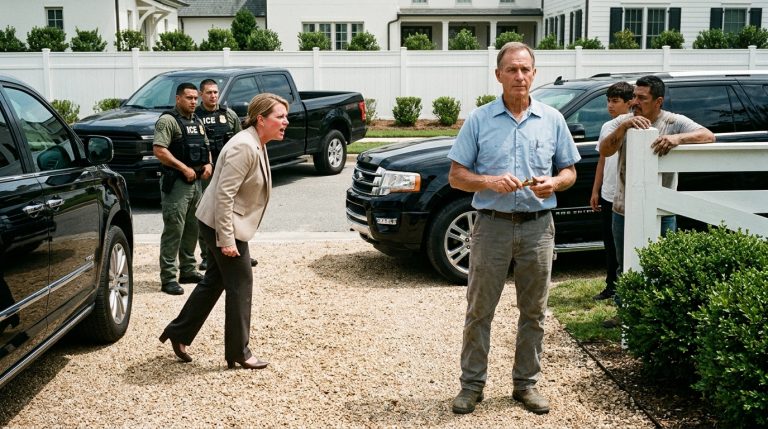
Building a Quiet Fortress Against Entitlement: How One Veteran Reclaimed His Land From a Petty HOA Tyrant
CHAPTER 1: The Line in the Sand
That illegal structure has to come down now or I’m calling the authorities.
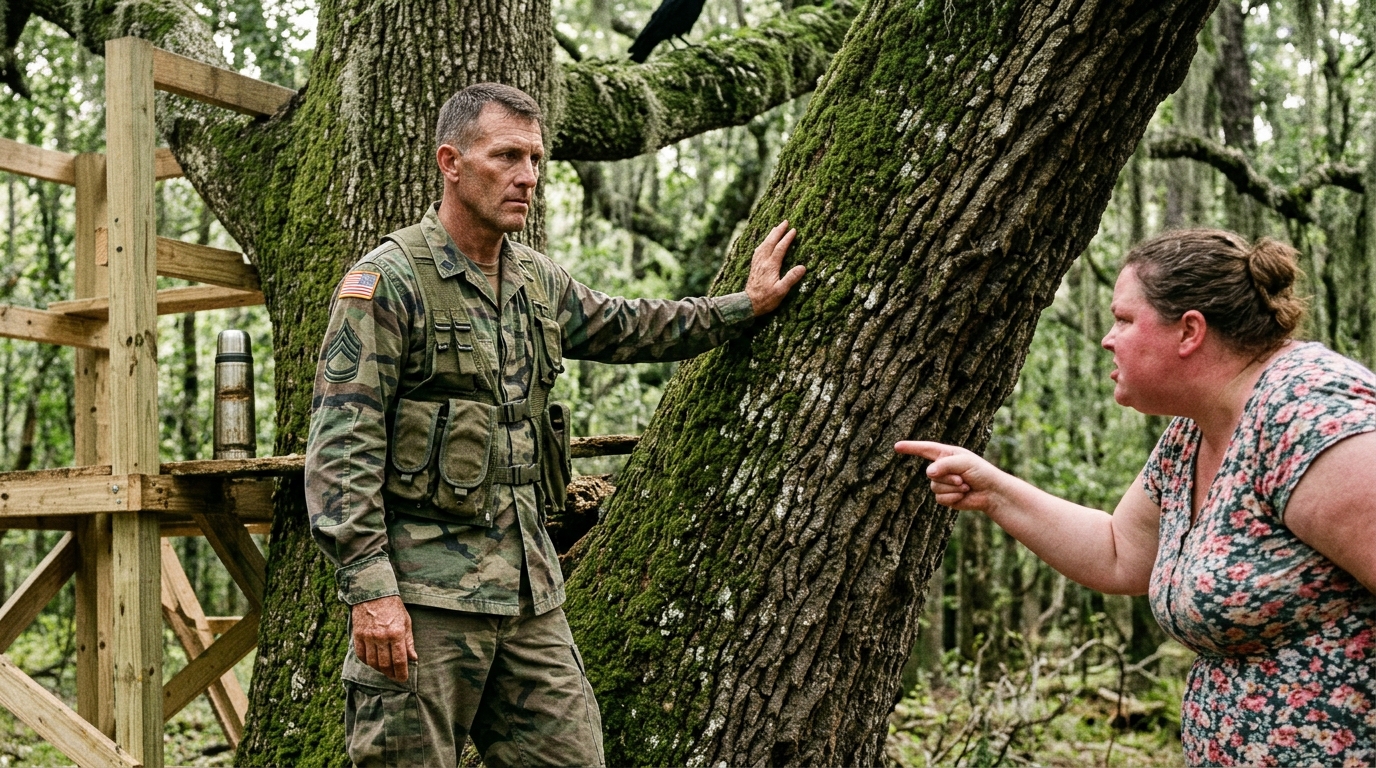
The voice was a shriek, a blade of pure entitlement slicing through the trees. It belonged to a woman I had never formally met, a plus-sized cloud of floral prints marching across the manicured lawn separating her subdivision from my ten acres of woods.
Her face was flushed and puffy, a mask of self-righteous fury. She pointed a sausage-like finger directly at the deer stand I had spent the last three weekends building.
It was a solid fortress of pressure-treated lumber and galvanized steel bolts nestled in the fork of an old oak. It was my cathedral of quiet, and she was turning the air sour with the grating force of her personality.
Ma’am, I started, keeping my voice low and even, the way my sergeant taught me to handle chaos. You are on my property.
She did not break her stride or slow her tirade. Her small, hard eyes scanned my work, hunting for flaws in the mitered corners.
This is a clear violation of Whispering Pines estates community bylaws, she snapped. Section 7, subsection B. No unapproved external structures.
She had the cadence of a petty dictator who had memorized a book of arbitrary rules. I unscrewed the cap of my metal thermos, taking a slow sip of lukewarm coffee to anchor my patience against the rising heat in my gut.
My name is Jack. Six months prior, I had cashed out my army pension and sunk every last penny into this patch of untamed woodland.
The county clerk’s office had verified my parcel was completely separate from the Whispering Pines HOA territory. I had checked the deeds, the surveys, and the zoning maps twice.
I was not just outside their jurisdiction. I was in an entirely different world.
Ma’am, I tried again, my voice flat as I set the thermos down on a wooden crossbeam. This is rural residential land. Your association has no authority here.
She scoffed, a short puff of air smelling faintly of cinnamon gum. Don’t you get smart with me, mister. I am the president of the homeowners association. We have a visual easement. Your junkyard treehouse lowers property values.
That was the first flash of real friction, a hot burn starting in my ribs. I looked down at my calloused hands, then back at her. This was not going to end with a polite wave across a fence line.
The following day, the first paper salvo arrived tucked under my truck wiper a quarter-mile from her house.
It was a cream-colored envelope embossed with a gold pine cone. Inside was a formal violation notice for fifty dollars, complete with a misspelled name and an aggressive signature scrawled by Karen Peterson.
I took the notice inside and dropped it on the kitchen table where Maria was pouring coffee.
She can’t do this, can she? Maria asked, her nurse’s eyes narrowing at the paper.
No, I said, reaching for my legal pad to start a fresh log. But she thinks she can, and that is the only reality we have to deal with right now.
CHAPTER 2: Shadows on the Perimeter
The second cream-colored envelope did not wait for a mailbox. It was wedged under my truck’s windshield wiper two days later, fluttering lightly against the glass in the morning wind.
Inside, the fine had doubled to one hundred dollars.
A fresh note was scrawled at the bottom in that same loopy, aggressive script.
Your maps are irrelevant. All adjacent properties are subject to visual blight standards. Pay the fine.
I picked up the envelope, feeling the stiffness of the heavy cardstock between my calloused fingers.
Maria walked out onto the back deck, holding a mug of steaming black coffee that offered a thin wisp of vapor to the cold air.
She’s escalating, Maria said, her eyes dropping to the paper in my hand.
She’s panicking, I corrected, setting the notice beside my logbook. When an amateur realizes rules don’t stretch as far as their temper, they start inventing new ones.
The noise complaints started the following Saturday.
I was on the far edge of my ten acres, clearing deadfall with a chainsaw. It was eleven in the morning, broad daylight, well within any legal or neighborly bounds of decency.
A sheriff’s cruiser rolled slowly up my gravel driveway, tires crunching over the loose stone.
The deputy behind the wheel looked young, tired, and visibly embarrassed to be handling the call.
He cut his engine and stepped out, keeping his hands away from his belt as I powered down the saw.
Sir, we had a complaint about excessive noise, the deputy said, gesturing vaguely toward the dense treeline. Sounded like a commercial logging operation, according to the caller.
I wiped a streak of sweat from my forehead with the back of my glove.
At eleven in the morning on my own private timberland.
The deputy offered a tight, sympathetic smile, dropping his gaze to the gravel.
I know, sir. The dispatcher said the caller was very insistent. Said it sounded like a disturbance of the peace.
She lives in the large white house at the end of the subdivision road, doesn’t she? I asked, leaning my weight against the orange handle of the saw.
The deputy gave a slow, knowing nod, already backing toward his cruiser door. Just try to keep it restricted to reasonable afternoon hours, sir. Have a good day.
He turned the key and backed out down the long lane without waiting for an answer.
He was just a patrolman doing his rounds, but Karen was weaponizing the county dispatch like a personal concierge service.
I walked back to the kitchen table, pulled open the binder, and logged the exact time of the police visit alongside the second fine notice.
My file was growing thick, heavy with the weight of paper and petty persecution.
The real shift, however, came on a Tuesday morning when I noticed a dark, unnatural glint near the roofline of the house across the property line.
I grabbed a pair of binoculars from the hall closet and stepped out onto the back deck.
Focused through the lenses, the distant edge of Karen’s roof revealed a brand-new mechanical eye staring right back at me.
It was a commercial-grade security dome, mounted high under her second-story eaves.
Its dark hemispherical lens was pointed straight through the gap in the trees, angled directly at my back deck, my kitchen window, and the path to my deer stand.
CHAPTER 3: The Garden Gnome Alliance
The brick house across the subdivision road sat under a canopy of shade trees, impeccably kept except for the sudden human drama unfolding on its small front lawn.
Karen’s gleaming white SUV was parked half-hazardly, blocking half of Arthur Henderson’s driveway.
She stood on the grass with her hands planted firmly on her hips, towering over the white-haired retired mechanic who was gesturing helplessly at a collection of ceramic gnomes surrounding a bird bath.
Even from fifty yards away, the waves of condescension rolling off her frame were thick enough to choke on.
I paused by my mailbox, watching Arthur look utterly defeated as Karen pointed a finger from the colorful ornaments to a printed notice in her hand.
After dropping one final cutting remark, she spun on her heel, climbed back into her vehicle, and sped off down the asphalt.
Arthur stood motionless for a long moment, staring down at his little ceramic figures as if they were soldiers about to face an impossible charge.
Then, with a heavy sigh that carried across the quiet street, he began slowly bending down to pick them up one by one.
I waited until the dust from the white SUV settled down the road before stepping across the property line.
Everything alright over there, Arthur? I asked, keeping my voice steady and low.
He looked up, startled, his watery eyes blinking behind thin wire-rimmed glasses while his hands trembled slightly around a small fishing gnome.
It is just the president, he said, the title tasting like bitter ash on his tongue. She claims my gnomes violate section nine about nonconforming ornaments, demanding a hundred-dollar fine or their immediate removal.
I’ve had a few run-ins with her myself, I said, offering a slight, reassuring nod. She seems to treat the rulebook like a personal weapon.
That was all it took to break the dam of his quiet frustration.
For five years it has been something new every single week—garbage cans an inch out of place, trim paint a shade too off-white, or an American flag pole six inches too tall.
He clutched the ceramic figure tighter against his chest.
My late wife loved these little guys, and I keep them out here to remember her smile.
A hard, cold knot tightened in my ribs as I looked at the aging man.
Arthur Henderson—a retired Air Force mechanic who had lived in Whispering Pines for thirty years—was being bullied in the twilight of his life by a bureaucratic tyrant.
We walked over to my kitchen table ten minutes later, where Maria poured him a hot cup of coffee.
Arthur unzipped a worn grocery bag and dumped a massive shoebox onto the wood surface, spilling out dozens of cream-colored violation notices, canceled fine checks, and aggressive warning letters signed by Karen Peterson.
It was a meticulous, heartbreaking archive of sustained, targeted harassment.
I kept every single one, Arthur said, his voice dropping to a harsh whisper. I just never knew what else to do with them.
You have a complete paper trail of abuse of power, I said, sliding my own thick binder of grievances next to his shoebox. And I think we finally have enough weight to push back.
CHAPTER 4: The Black Cyclops Eye
The camera appeared under the eaves of her second-story roof like an unnatural growth on otherwise tidy beige siding.
It was a commercial-grade dome unit, massive and dark, mounted with its hemispherical lens angled directly toward my back deck and the entrance of my woods.
The hypocrisy was thick enough to choke on.
She had spent weeks screaming about visual blight and unapproved structures, yet she had bolted an ugly piece of industrial hardware to her house just to stare into my private life.
Maria stared out the kitchen window, her hands tightening around a dish towel.
Can she legally point a camera straight into our yard like that?
It is a gray area on her property line, I said, setting my coffee mug down with a sharp clink against the wood. But it proves state of mind better than any piece of paper she has filed against us.
Instead of letting anger dictate my next move, I reached into my pocket and pulled out my digital camera.
I walked out onto the sunlit grass, raised the telephoto lens, and captured a series of sharp, high-resolution photos of her surveillance device from multiple angles.
I took a short video panning from her lens straight back to my kitchen window, establishing the undeniable line of sight.
Then, I pulled out a fresh copy of the Whispering Pines architectural guidelines that Sarah had provided.
Buried deep in section eleven was a clear rule stating that no electronic fixture or antenna could be attached to the exterior of any dwelling without prior written approval from the architectural committee.
Since Karen was the entire committee, she had bypassed her own paperwork.
She had violated her own sacred covenant.
I went to my truck, pulled out a compact outdoor camera of my own, and mounted it discreetly in a high branch of an old oak near the property boundary.
It was not pointed at her windows, but it had a clear, unobstructed view of her dome camera, recording its position twenty-four hours a day.
If she moved it, serviced it, or denied it later, I would have a permanent timestamped record.
My phone buzzed against my thigh with an alert from Sarah just as I finished securing the bracket.
We have enough evidence of targeted harassment and structural hypocrisy to blow her little board meetings wide open, the young lawyer’s text read.
Get ready for the annual meeting next Tuesday.
CHAPTER 5: The Annual Meeting Ambush
The parking lot of the Whispering Pines clubhouse was jammed bumper-to-bumper, a packed sea of sedans and SUVs that hadn’t seen this kind of foot traffic in a decade.
Inside, the drafty assembly room was humming with a low, tense energy, every folding chair occupied and rows of residents lining the side walls.
I sat quietly in the very back row beside Sarah, keeping my expression neutral while the weight of our documentation rested in a leather folder on my lap.
At exactly seven o’clock, Karen pushed through the side entrance carrying a thick stack of papers and a practiced, authoritative smile.
She walked straight to the podium at the front, expecting the usual handful of ghosts and quiet compliance.
Then she looked up, scanning the sea of unfamiliar, resolute faces staring back from the pews.
Her smile cracked right down the middle, the color draining from her cheeks as she recognized Arthur Henderson sitting front and center with a clipboard in his hands.
She tapped the microphone, her fingers trembling slightly against the metal stand.
Welcome to the annual meeting of the Whispering Pines Estates Homeowners Association, she began, her voice pitching slightly higher than normal.
Before she could launch into her scripted agenda, Arthur stood up from his chair.
Point of order, Madam President, he said, his voice ringing clear and steady through the audio system. According to our bylaws, a petition signed by nearly forty percent of the membership has been submitted to amend tonight’s order of business.
Karen’s face mottled into a furious shade of crimson.
That is completely out of order, she snapped, gripping the edges of the podium. The agenda is set by the board and we will proceed accordingly.
Sarah stood up beside me in the back row, her legal presence cutting through the tension like cold steel.
It is entirely in order, Madam President. The petition meets every legal threshold, and the members will have their say.
Arthur didn’t wait for permission. He signaled toward a projector set up near the front, throwing a bright, crisp image against the white wall behind Karen’s head.
The first slide was a stunning photograph of my deer stand bathed in clean morning light.
This is the so-called blight on our community, Arthur announced calmly.
He clicked the remote, and a second slide flashed onto the wall—a close-up, undeniable image of Karen’s heavy black surveillance dome staring directly into my private windows.
And this is the neighborhood standard she installed without architectural approval.
A wave of murmurs and outright chuckles rolled through the crowded room as the stark hypocrisy hung larger than life above her.
Karen stammered, her mouth opening and closing without sound as she reached blindly for her small gavel.
I move for a formal vote of no confidence, Arthur said, raising his voice over the rising tide of the room. And a full independent forensic audit of all association accounts for the past seven years.
The room erupted into a deafening chorus of ayes before Karen could even draw another breath to scream.
CHAPTER 6: Dust and Debris
The vote was not even close.
When Arthur called for the tally, a forest of hands shot up across the packed room in total support of her removal.
Only two reluctant votes were cast against it—her Florida proxy cronies who stared rigidly at their shoes to avoid catching anyone’s eye.
Karen stood frozen at the front of the podium, her face turning a sickly, waxy gray as the reality of her deposition sank in.
Fine, she shrieked, her voice cracking with hysterical disbelief as she knocked over a glass of water with her elbow. Run this place into the ground. You will all be begging for my rules back.
She snatched her leather purse, turned on her heel, and stormed out through the back exit without looking at a single soul.
The forensic audit ordered by the interim board uncovered what we had suspected beneath all the petty fine notices.
The community improvement fund had been drained into a personal slush fund, paying for unauthorized landscaping at her own property and suspicious contractor checks issued to her unemployed relatives.
Faced with the auditor’s ledger, the district attorney filed felony embezzlement charges rather than offering a quiet settlement.
The gleaming white SUV disappeared from her driveway within a month, replaced by a modest sedan, and a bright orange for-sale sign went up on her front lawn.
The house sold quickly to cover mounting legal fees and court-ordered restitution to the association.
By mid-morning on a crisp Tuesday weeks later, I stood on my back deck holding a warm ceramic mug, looking out over the golden tree line of my ten acres.
The ugly black security camera across the property line was gone, replaced by empty siding where the new owners had already stripped away the hardware.
My own hunting stand sat sturdy and quiet in the fork of the old oak, untouched by rules or paperwork.
Arthur Henderson’s ceramic gnomes stood proudly back around his bird bath across the street, watching over a neighborhood that had finally reclaimed its common sense.
Maria stepped out onto the wooden planks beside me, resting her hand lightly against my sleeve as the morning sun burned the last of the valley mist away.
Everything is quiet, she said softly.
Just the way it was meant to be, I replied, taking a slow sip of coffee.