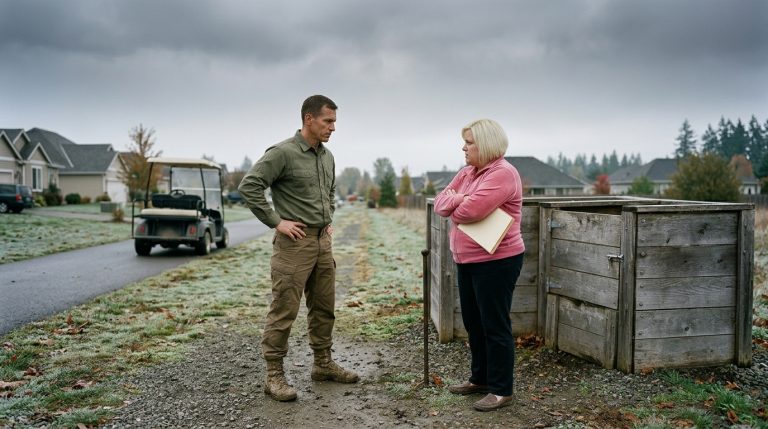
The Weight of Stone and Water: A Calculated Reckoning Against Small-Town Corruption
CHAPTER 1: THE MORNING RUIN
The coffee in the travel mug had gone stone cold, but the bitterness on Ezra’s tongue had nothing to do with the roast. Fifty yards down the slope, where a century of hand-cut limestone had held back three acres of crystalline Rocky Mountain water, a gray plume of smoke drifted lazily into the pale dawn.
Dexter Hawthorne stood by the wreckage, his pressed white polo standing out against the devastation like an insult. He held his phone up at an angle, angling for the best light, a wide, practiced grin stretching across his face as he snapped a selfie with the smoking ruins of a family legacy.
“Free demolition,” Dexter called out over the crunch of gravel as Ezra stepped out of the truck. His voice carried that effortless, suburban-developer smugness that belonged in a boardroom, not a high-altitude valley. “Your little swamp was killing our property values anyway, Ezra. Time to join the twenty-first century.”
Ezra didn’t run. Running was for men who didn’t understand physics. Instead, his boots found a steady, measured rhythm on the road, every step calculated, every muscle in his jaw locked tight. His gaze drifted past Dexter’s smug grin to the jagged gap in the masonry. The stones weren’t just broken; they were fractured along fault lines carved by shaped explosive charges. Clean, professional, and entirely unauthorized.
“You didn’t just clear a swamp, Dexter,” Ezra said, his voice dropping into a low, flat register that lacked any trace of panic. “You pulled the plug on a pressure valve.”
Dexter snorted, sliding his phone into his pocket and dusting imaginary ash off his sleeve. The BMW X7 idled softly behind him, its exhaust mixing with the residual chemical reek of ammonium nitrate. “Don’t get dramatic with me, hydraulic engineer. We’ve got standards in Milbrook Estates. Stagnant runoff and hillbilly ponds don’t mix with upscale resort valuations. My legal team filed the abatement notices weeks ago.”
“Abatement notices require county seals and engineering sign-offs,” Ezra said, closing the distance until the space between them narrowed to a sharp, transactional margin. He didn’t look at Dexter’s face; he watched the slight twitch in Dexter’s left thumb—the micro-tell of a man who had rehearsed his lines but hadn’t calculated the bounce-back. “You used a county building inspector who wouldn’t know a foundation from a parking lot curb.”
“The market has spoken,” Dexter smirked, turning on his heel and gesturing grandly toward the valley below, where the cookie-cutter roofs of Milbrook Estates sat nestled in the natural flood basin. “Enjoy the view while you can. We’re breaking ground on the golf course expansion next month.”
The crunch of Dexter’s loafers retreating across the stone fragments was drowned out by a low, rhythmic vibration deep within the earth—a distant, subterranean murmur that no one else was listening for.
Ezra stared at the empty space where the spillway used to be, his mind instantly running the numbers on the upcoming spring snowpack sitting three thousand feet above them. The air grew thinner, carrying the distinct metallic taste of a storm front, but the real danger wasn’t coming from the sky. It was sitting six weeks away, loaded into the snowdrifts, and Dexter had just cleared the final gate.
CHAPTER 2: THE COUNTERSURVEY
The heavy oak door of the county clerk’s office smelled of old paper, floor wax, and the quiet desperation of underpaid clerks trying to look busy. Ezra didn’t wait for an invitation. He placed a three-ring binder flat on the counter, the leather cover worn smooth at the corners, and let the dead weight of it drop with a dull, authoritative thud.
Behind the glass partition, a middle-aged clerk looked up over half-moon spectacles, her expression sliding instantly into the bored defensiveness of someone paid to protect the bureaucracy from taxpayers. “Records requests require a standard forty-eight-hour processing window, Mr. Blackwood. Fill out form forty-four-B.”
“Form forty-four-B is for public zoning inquiries,” Ezra said, his voice flat, low, and stripped of any conversational padding. His fingers rested lightly on the binder. “This isn’t an inquiry. This is a formal challenge to a fraudulent emergency abatement order, backed by an independent engineering firm that charges four hundred dollars an hour just to read its own reports. You have ten minutes to pull the original 1954 boundary surveys for parcel twelve, or I walk forty feet down the hall to the district attorney’s intake desk and file an obstruction motion under state statute nine-A.”
The clerk blinked, her eyes darting from Ezra’s rigid posture down to the embossed seal of Matthews and Associates stamped on the corner of the binder. The sharp edge of the counter dug into Ezra’s palms through his jacket sleeves, a physical reminder of the friction required to force a rusted machine to turn.
“I’ll see what’s in the basement archive,” she muttered, sliding off her stool with a sigh that rattled the metal shelving behind her.
Ezra stayed anchored in place, his gaze fixed on the flickering fluorescent tube overhead. Every second spent standing in this sterile box was a second Dexter Hawthorne was likely using to file another batch of illegal permits or line another county official’s pocket with developer cash. The psychological lens was a simple, brutal equation: predator and prey. Dexter was currently operating under the assumption that the initial strike—the dynamite—had broken Ezra’s footing. A predator who thinks his target is bleeding out forgets to look behind him.
Five minutes later, the clerk returned carrying a cardboard box smelling of dry rot and mold. She dropped it onto the counter with a cloud of dust that caught the harsh overhead glare. “These are the secondary annex files from the Eisenhower administration. Most of the original surveyors are dead, Mr. Blackwood. You won’t find a loophole in there.”
“I’m not looking for a loophole,” Ezra said, pulling the box toward him. “I’m looking for the perimeter pins.”
He flipped open the topmost folder. The parchment was yellowed, brittle at the edges, and covered in the precise, hand-inked cartography of a draftsman who used a ruler and india ink instead of digital mapping software. He scanned the margins, his eyes tracking the old property markers—the iron pin set in the granite outcrop by the creek, the original municipal water-rights easement signed when Warren G. Harding was in office, and, crucially, Samuel Blackwood’s explicit, handwritten signature declining membership in the newly minted Milbrook Estates Sanitary District back in November of nineteen fifty-four.
There it was. Plain as black ink on aged paper. Exempt from local assessment, maintenance jurisdiction retained by owner.
Ezra pulled his phone from his pocket, angled the lens over the document, and tapped the screen twice. The camera shutter clicked softly in the quiet room.
“Found it?” the clerk asked, her tone shifting from dismissive to wary.
“Found the foundation,” Ezra said, closing the binder with a sharp snap that echoed off the linoleum walls.
He didn’t waste breath on small talk. He scooped up the folder, turned on his heel, and pushed through the heavy glass double doors into the bright midday glare. The mountain wind hit him instantly, smelling of dry pine and exhaust, carrying the faint, distant rumble of heavy trucks moving through the valley below.
The legal counter-offensive had just cleared its first hurdle. But legal paper didn’t stop excavators, and county clerks didn’t stop developers. Ezra climbed back into his truck, tossed the binder onto the passenger seat, and checked his fuel gauge. The needle hovered near empty, right where it always did when there was too much ground to cover and not nearly enough time before the thaw.
CHAPTER 3: THE PAPER TRAIL
The dashboard clock ticked forward in harsh, digital increments, matching the dry, mechanical rhythm of the tires rolling over asphalt. Ezra didn’t take the direct route back to the homestead. Instead, he swung the truck toward the old Milbrook community center—a low-slung, beige brick building sandwiched between a manicured putting green and the administrative trailers of Hawthorne’s development office.
The engine block pinged as he cut the ignition, cooling rapidly in the thin mountain air. Inside his jacket pocket, the phone was silent, but his mind was running parallel tracks: the 1954 boundary exemption proved the HOA had no legal jurisdiction over the Blackwood dam, yet Dexter’s paper empire was flooding the county courts with fabricated citations faster than a single engineer could answer them. Bureaucracy wasn’t designed to find truth; it was designed to exhaust friction.
Ezra pushed open the truck door, the hinge groaning in protest against the wind, and crossed the asphalt lot. The front door of the administrative annex was unlocked—a casual oversight born of absolute, unchallenged local dominance.
He slipped inside without a sound, the linoleum floor cold beneath his work boots. The hallway smelled of industrial floor wax and stale coffee, dead quiet except for the faint hum of a commercial server rack housed in the back utility room.
He didn’t head for the main office where Dexter held court. Instead, he bypassed the reception desk and slipped into the auxiliary records room—the repository where the HOA stored three years of mandatory financial filings, vendor payouts, and maintenance contracts. These were public documents under state law, though access usually required a notarized request and a week of bureaucratic stalling. Today, nobody was stalling.
Ezra slid a thumb drive from his pocket and stepped up to the secondary filing cabinet marked Maintenance Disbursals 2023–2025.
His fingers moved with methodical efficiency through the hanging folders, sliding past standard landscaping invoices and snow-removal receipts until his thumb caught on a tab marked Hawthorne Consulting – Special Infrastructure Allocation.
The paper texture changed under his fingers—crisp, thick cardstock instead of cheap copy paper. He pulled the file out and carried it to the small laminate table under the flickering emergency exit light.
There it was. Layer 1 of Dexter’s machinery laid bare in black and white.
An eighteen-thousand-dollar line item paid out monthly to Mountain West Advisory, a shell corporation sharing an identical business address with Dexter’s primary development firm. Below it sat inflated landscaping contracts awarded to Dexter’s brother-in-law for mowing county easements that local volunteers had already cleared for free. But tucked beneath the secondary invoices was something sharper—a handwritten memo initialed by Dexter himself, cross-referencing parcel twelve and scheduling the demolition of upstream water barriers ahead of the municipal resort re-zoning vote.
The numbers didn’t add up to routine HOA maintenance. They added up to systematic embezzlement.
Ezra pulled his phone from his pocket, angling the camera over the ledger pages. The shutter clicked silently, capturing each financial discrepancy, each forged authorization signature, each piece of stolen homeowner equity funneled directly into a private land grab. The physical weight of the evidence settled in his chest—not as a victory, but as leverage. Dexter hadn’t just built an administrative barrier; he had funded his entire corporate expansion using money stolen from the very neighbors he was now manipulating.
A sudden, sharp scrape of a shoe on the linoleum outside the door cut through the silence.
Ezra didn’t flinch. His hand closed around the edge of the folder, his muscles tensing into the calculated stillness of a predator waiting in the brush. The shadow stretching across the frosted glass of the office door lengthened, pausing right before the handle turned.
CHAPTER 4: THE SABOTAGE
The handle rattled—a dry, metallic twist that signaled someone trying an unlatched door out of casual habit rather than targeted suspicion. Ezra didn’t run. Running across hollow linoleum was an amateur’s error. Instead, his weight shifted onto the balls of his boots, his right hand slipping into his coat pocket to grip the cold metal housing of his flashlight.
The door swung inward three inches, catching on a loose floor mat.
“Anybody in the annex?” a gravelly voice called out—maintenance detail, local contractor grade.
Ezra didn’t answer. He pressed flat against the shadow of the tall metal shelving, holding his breath until the heavy footsteps echoed down the hall, retreating toward the front lobby. The ledger pages were tucked securely beneath his waistband, cold against his lower back.
He waited two full minutes, letting the silence settle into a steady rhythm before slipping back out through the service exit into the damp chill of the late afternoon. The sky above the ridge had turned the color of bruised slate, the air carrying that particular, sharp pressure drop that preceded a high-altitude storm.
When he reached his truck, the radio was crackling with static and a local weather update: the mountain snowpack was destabilizing three weeks ahead of schedule due to an unexpected atmospheric warming trend. The numbers clicked into place with terrifying clarity. Dexter’s crew hadn’t just destroyed the dam for a view; they had broken the primary retention wall right before the heaviest melt in a decade, and now someone was covering the tracks with hammers and chisels.
Ezra threw the truck into gear, the tires spinning on loose gravel as he pointed the nose back up toward the homestead.
By midnight, the temperature had plummeted, turning the valley into a frozen landscape of sharp shadows and biting wind. Ezra didn’t sleep. He sat at his kitchen table under the harsh glare of a single overhead bulb, spreading out the stolen financial ledgers alongside the 1954 boundary papers and Dr. Martinez’s computer-generated flood models. The house around him creaked in the wind, the timber framing groaning against the mountain pressure.
Then, the sensor panel mounted by the back door beeped—a sharp, single tone that cut through the low whistle of the gale.
Ezra stood up instantly, his movements economic and silent. He stepped to the window, pulling the edge of the thermal curtain back an inch.
Down by the shattered remains of the old stone dam, three dark figures moved against the moonlight like ghosts crawling over a graveyard. The beam of a high-powered tactical flashlight cut across the frost-covered rocks, illuminating the glint of steel. Even from two hundred yards away, the rhythmic, metallic ping-clang of sledgehammers striking the remaining foundation piers carried clearly on the freezing wind.
They weren’t repairing anything. They were actively hacking away at the fractured limestone base, deliberately engineering a catastrophic structural failure that would turn the upcoming melt into an uncontrolled torrent.
Ezra’s jaw tightened until the bone ached. The predator-prey calculation was complete. Dexter hadn’t just used bureaucracy as a weapon; when the legal pressure had started to crack his facade, he had sent hired muscle to finish the demolition in the dark, betting that the ensuing flood would wipe away every trace of corporate fraud under a blanket of natural disaster.
He reached for his phone, dialing the sheriff’s direct line without a second hesitation, his eyes never leaving the flashlights bobbing among the frozen ruins of his family’s legacy.
“County Dispatch,” a tired voice answered on the third ring.
“This is Ezra Blackwood,” Ezra said, his voice flat, cold, and razor-sharp. “Property on Mill Creek Road. I have three trespassing contractors actively sabotaging public safety infrastructure with hand tools. Send a unit. Now.”
The line crackled with static, the wind howling against the windowpanes as the countdown to the spring thaw entered its final, irreversible phase.
CHAPTER 5: THE INEVITABLE CREST
The air in the valley didn’t just warm; it fractured. By dawn, the atmospheric pressure dropped so sharply that the timber frames of the homestead groaned like stressed steel under a heavy load. Ezra stood on the frost-whitened porch, a mug of black coffee cooling ignored in his grip, watching the upper ridges where the heavy, soot-colored snowpacks had begun to sweat under a sudden, unseasonal chinook wind.
The sabotage from the night before had done its work. The compromised masonry piers, weakened by sledgehammers and deliberate micro-fractures, couldn’t hold back the initial surge of meltwater.
A low, subterranean rumble—like a heavy freight train rolling over loose gravel—rippled up the riverbed.
Ezra didn’t flinch. His boots crunched against the frozen decking as he turned back inside to check the sensor monitors on the kitchen counter. The digital readouts were flashing red. Node 4: Flow rate exceeded. Node 2: Sub-basin capacity breached. The mountain was shedding its winter coat all at once, and without the central retention wall to meter the release, the entire volume was funneling straight down into the narrow bottleneck above Milbrook Estates.
The phone on the wall buzzed—a short, frantic ring. It wasn’t the police dispatcher this time. It was Janet Morrison, her voice tight with panic over the speaker.
“Ezra? The creek behind our property is overflowing its banks. Water is already pooling in the cul-de-sacs. The county emergency line is jammed, and Dexter’s people are barricading the main access road with maintenance trucks!”
“They aren’t barricading it to help, Janet,” Ezra said, his voice cold, steady, and entirely devoid of panic. “They’re trying to hide the fact that the drainage culverts were never cleared during the development re-zoning. Hawthorne built his resort plans over the natural overflow channel. Gravity is about to collect the invoice.”
“What do we do?”
“Get your family to higher ground on the ridge road,” Ezra instructed, his hand tightening around the phone casing. “Do not wait for the HOA sirens. They aren’t coming.”
He hung up before she could answer, pulling on his heavy canvas coat and stepping back out into the biting wind. The smell of wet earth and crushed pine mixed sharply with the bitter exhaust fumes of his idling truck. He didn’t waste time trying to save Dexter’s pristine lawns or stop the wall of water; physics was already handling the execution.
Down the valley, the first heavy wave of slate-gray runoff hit the cookie-cutter perimeter of Milbrook Estates. The manicured lawns vanished beneath a churning sheet of foam and debris as the water surged across the asphalt, turning the showcase driveways into roaring rapids.
From his vantage point on the high ground, Ezra watched the inevitable consequence unfold with the cold clarity of a man reading a blueprint. The McMansions built directly over the natural flood basin offered no resistance to the volume. Water always found its home, and tonight, it was moving right through the front doors of the development that had tried to legislate reality out of existence.
The headlights of an expensive SUV flashed frantically near the central cul-de-sac—a BMW X7 bogged down in two feet of churning brown water, its rear wheels spinning helplessly against the flooded curb.
Ezra shifted his truck into gear, the tires biting into the gravel, and rolled down the slope to watch the ledger balance itself out.
CHAPTER 6: THE FINAL LEDGER
The water swirling around Dexter’s ankles carried the distinct, bitter taste of corporate defeat. He stood by the driver-side door of his marooned vehicle, his breath frosting in the damp evening air, his hands half-raised in a futile gesture of protest as the red-and-blue strobes of arriving county sheriffs cut through the gloom.
Ezra didn’t rush. He killed the engine, stepped down from the cab of his truck, and let his boots settle firmly onto the wet asphalt of the flooded cul-de-sac. The physical friction of the gravel underfoot felt solid, an absolute contrast to the sliding sand of Dexter’s fabricated empire.
“You planned this,” Dexter shouted across the rushing current, his voice cracking with a frantic, exhausted rage that lacked any vestige of its former boardroom polish. “You let the dam go! You let it wash everything away!”
“Physics doesn’t take bribes, Dexter,” Ezra said, closing the distance step-by-step through the calf-deep runoff. His voice was low, carrying effortlessly over the steady roar of water streaming through the unmanaged basin. “You spent three years using fake municipal citations and forged safety reports to cover up eighteen hundred thousand dollars in embezzled HOA funds. You engineered the demolition of a flood barrier because your resort development required artificial ponds on stolen paper parcels. Gravity just audited your books.”
Sheriff Maria Santos stepped out of her cruiser, her boots splashing through the shallows as she flanked Dexter from behind. The heavy click of steel handcuffs snapping into place sounded sharp and final against the roar of the runoff.
“Dexter Hawthorne,” Sheriff Santos said, her tone flat and official. “You’re under arrest for fraud, grand embezzlement, environmental sabotage, and criminal negligence resulting in multi-million-dollar property damage.”
Dexter struggled against the cuffs, his face twisting into an ugly mask of disbelief as the camera lights from local news vans—parked on the dry ridge above—flashed across his mud-stained polo shirt. “This is a hostile takeover! My legal team will—”
“Your legal team resigned thirty minutes ago when the federal prosecutor unsealed the shell corporation bank records,” a sharp voice cut through the spray. Rebecca Torres walked up the flooded grade, carrying a thick binder wrapped in waterproof plastic. She stopped beside Ezra, her expression cold and precise. “Every fraudulent invoice to Mountain West Advisory, every kickback to your brother-in-law’s landscaping firm, and every cent stolen from the Milbrook homeowners has been cross-referenced with your personal assets. You are personally liable for the entirety of the eight-point-two million dollars in structural flood damage.”
Dexter went silent, the last bit of air leaking out of his posture as he was guided toward the back of the patrol cruiser. The red and blue lights painted the churning water in alternating flashes of harsh color, illuminating the flooded foundations of the McMansions that had tried to legislate away a century of engineering.
Two hours later, the community center gymnasium was packed to capacity with three hundred shivering, shell-shocked residents sitting on folding chairs over gymnasium floors dotted with mud tracked in from the rising waters. Ezra stood near the back, leaning against the reinforced concrete wall, arms crossed over his chest.
Janet Morrison took the microphone at the center stage, her voice steady and resolute. “For three years, we trusted a man who used our dues to finance his own private land grab while dismantling the very infrastructure that kept our homes dry. That ends tonight. The reformed board has voted unanimously to establish the Blackwood Trust for Watershed Management, ensuring that engineering standards will never again be traded for corporate profit.”
The applause that followed wasn’t polite; it was heavy, earned, and laced with the hard-won clarity of a neighborhood that had learned its lesson through cold water.
When the meeting adjourned, Ezra walked back out into the night. The rain had cleared, leaving behind a sharp, high-altitude sky glittering with cold stars. He drove back up the winding road to the homestead, parking his truck by the edge of the property where the old dam used to stand.
The air smelled of wet limestone, crushed pine, and fresh mountain earth.
He walked down to the edge of the empty basin. The federal disaster relief grants and the court-mandated restitution funds from Dexter’s frozen assets were already earmarked for the reconstruction. By summer, a new, federally certified stone dam—built to five-hundred-year specifications using the exact hand-cut limestone quarried by his great-grandfather—would rise across the creek bed.
Ezra reached down, his fingers brushing against a stray fragment of gray rock left behind by the excavation. The stone was cool, dense, and unyielding. He picked it up, turned it over in his palm, and placed it neatly atop the remaining foundation pier.
Some things couldn’t be negotiated, legislated, or swept away by a press release. They had to be built to last. He turned back toward the warm lights of the farmhouse, the steady, rhythmic murmur of the mountain stream reminding him that water, above all else, always remembers where it belongs.