Echoes of the Unnamed: A Daughter’s Duty to Reclaim Her Father’s Ghost from the Dust of History
CHAPTER 1: THE WEIGHT OF A NAME
The tassel on Ellie’s cap bobbed against her cheek, a rhythmic, frantic motion that matched the thrumming in my chest. We were supposed to be here for her, the new Second Lieutenant, not for the ghosts I’d spent a decade tucking into the back row of my mind. The general stood at the podium, his posture a testament to years of rigid discipline, but as his gaze drifted over the crowd and snagged on my forearm, his composure fractured.
The room, a cavern of polished wood and expectant applause, went quiet in a way that had nothing to do with the program. His eyes widened, the two stars on his shoulder suddenly seeming to weigh a thousand pounds as he stared at the ring of chain links on my wrist—the broken one, the six hash marks, the tally of names I didn’t talk about.
“Atlas 2-3,” he whispered, and the microphone caught it, broadcasting the call sign into the rafters.
Ellie leaned into me, her arm still threaded through mine. Her touch was warm, solid, and entirely oblivious to the fact that the man on the stage had just recognized a dead man. She nudged my elbow, a soft, questioning gesture, her eyes scanning the room to see who had caused the sudden, atmospheric pressure drop.
“Dad?” she asked, her voice a sharp contrast to the ringing silence left by the general’s whisper.
I didn’t answer. I couldn’t. The smell of the campus changed, the scent of polish and starch replaced by the phantom heat of a burning cargo truck on a road outside Kalat. My internal compass spun, pointing north toward a past I had meticulously buried to give my daughter a clean start. I felt the weight of the six marks on my skin. They felt heavy today—not like a burden, but like a tether pulling me back into a life I’d spent years insisting I hadn’t lived.
The general stepped down from the platform, his eyes fixed on me with a terrifying, hollow intensity. He wasn’t looking at the graduate. He was looking at the man who had pulled a burning vehicle off Route Red when the maps said it was impossible. My daughter’s grip on my arm tightened, her knuckles going white as she realized that the man walking toward us knew something about her father that she didn’t—a secret that turned her graduation into a doorway to a past I’d never dared to open.
CHAPTER 2: THE LOBBY CONFLUENCE
The microphone hummed, a low, electric vibration that seemed to crawl right up the spines of everyone in the room. The General stood five feet away, his boots planted on the polished floor with the absolute stillness of a man who had suddenly found himself walking through a minefield he thought he’d cleared decades ago.
Ellie’s hand was still hooked into my elbow, her grip tight, her knuckles a pale contrast against the dark fabric of her gown. She was looking at me, then at the General, then back to the silver stars on his shoulders, searching for the bridge between her father—the man who kept receipts in his dash and liked his coffee black—and the man who had just been addressed by a call sign from a war zone.
“Dad?” she repeated, the word softer this time, but weighted with a sudden, sharp clarity. She wasn’t just a daughter anymore; she was a cadet, trained to read the room, trained to spot the inconsistency in a briefing. And I was the inconsistency.
The General blinked, the high-gloss veneer of the ceremony cracking beneath the pressure of his own history. He didn’t look at Ellie. He looked at my wrist, his gaze hovering over the broken chain link.
“I apologize,” he said, his voice dropping into the lower register he used when he was shutting down a conversation, not starting one. He shifted, his eyes flickering toward the doors. “I spoke out of turn, Lieutenant. A memory… misfired. It’s a common occupational hazard.”
But he wasn’t looking at the graduate. He was looking at me.
“Atlas 2-3,” I whispered, the call sign tasting like copper and grit on my tongue. I didn’t mean to say it, but the floor seemed to tilt, the smell of the polished wood fading into the harsh, metallic scent of a desert heat-shimmer. I felt the phantom weight of a steering wheel under my palms, the shudder of a cargo truck hitting a crater.
“You shouldn’t have,” he said, barely audible, his eyes searching mine. He took a step forward, closing the distance, his hand twitching toward a salute he couldn’t finish.
Ellie stepped between us, not with aggression, but with the quiet, devastating efficiency of a leader. “You knew him,” she stated, not as a question, but as a report. “And you knew he was alive when the reports said he wasn’t.”
The tension in the room was absolute. The Dean had stopped shuffling his papers. The band members were motionless, their instruments held like relics. The General looked at Ellie, really looked at her, his expression softening from the rigid mask of a commander into something older, something deeply tired.
“The system is a machine, Lieutenant,” he said, his voice finally losing its practiced steadiness. “And like any machine, it relies on the people feeding it information. Sometimes, those people are tired. Sometimes, they are scared. And sometimes, they are just human.”
He reached out, his hand hovering near my shoulder, but he didn’t make contact. The proximity was a violation of the ceremony, a breach of the distance between the podium and the floor. He glanced at the exit—the double doors that led out into the cool, indifferent afternoon.
“We are not doing this here,” he said, his eyes locking onto mine with an urgency that wasn’t about rank. “But if you walk out those doors, you don’t get to keep pretending you’re a ghost. You don’t get to keep the ledger closed.”
“I’m not a ghost,” I said, my own voice sounding thin, foreign. “I’m a father. That’s all.”
“Then show her,” he replied, and for the first time, he turned fully toward Ellie. “Lieutenant, congratulations on your commission. I suspect you have a much more difficult briefing coming your way.”
He didn’t wait for a response. He spun on his heel, his movements sharp, precise, and entirely devoid of the performative grace he’d displayed minutes earlier. He walked toward the lobby doors, a man navigating his own history, leaving behind the carefully curated atmosphere of the commissioning ceremony.
Ellie stood on the stage, the bars on her shoulders glinting under the lights, her eyes fixed on my wrist. I felt the tattoo, the broken link, the six marks that had been my quiet, private tally for ten years. The air in the field house felt thin, insufficient.
“Dad,” she said, and her voice didn’t have the weight of a complaint. It had the weight of a decision. She didn’t wait for me to move. She stepped down from the stage, her heels clicking against the wood with a rhythmic, steady sound, and walked straight toward the lobby.
I followed. My knee clicked, a sharp, familiar protest, but I didn’t stop. I walked out of the sterile, starched air of the field house and into the lobby, where the light was fading and the shadows of the past were already waiting by the trophy case.
CHAPTER 3: THE RESIDUAL ECHOES
The lobby was a space of transition—not quite the ceremony, not quite the parking lot—and it felt like the air had been scrubbed clean of ceremony. The glass of the trophy case was cool and slick under my fingertips, a stark contrast to the heat still radiating off my skin. The General was gone, vanished into the grey exterior light, but the weight of his words remained. They hung in the air like dust motes in a shaft of dying sun.
Ellie stood three feet away, her posture still perfect, her chin set with that specific, dangerous stillness I’d seen her use during ROTC debates. She wasn’t looking at the trophies. She was looking at me, her gaze dissecting the distance between the dad who drove her to grocery stores and the man who had pulled a truck off a road in Kalat.
“Explain,” she said. The command was soft, stripped of the performative volume of the stage, but it had the bite of an order.
I looked at my wrist. The broken chain link felt heavier now, as if the General’s attention had somehow activated the metal, making it pull against my skin. The six hash marks were silent, as they always were, but they felt loud. I turned away from the trophy case and walked toward the entrance, the lobby floorboards giving with that familiar, springy protest.
“The road outside Kalat,” I started, and the words felt stiff, like they hadn’t been exercised in years. “It wasn’t a tactical maneuver, Ellie. It was just math. There were too many bodies, not enough steel, and a radio that had gone silent three hours before the sun hit the horizon.”
She walked with me, matching my pace, her eyes never leaving my profile. We stepped through the double doors, and the outside air hit us—thin, sharp, and smelling of dry earth and impending winter. It was a cold that cut through the starchy heat of the field house. The parking lot was a maze of SUVs and sedans, families laughing, doors slamming, the mundane sounds of a life that felt a million miles away from the one I had just been dragged back into.
“And the system?” she asked, her voice tight. “The casualty letter? The fact that you were officially… not here?”
“I was a driver, Ellie. When the convoy hit the red patch, the paperwork lost its priority. I didn’t reach out because I didn’t want the paperwork to catch up. If you’re a ghost, you don’t have to explain the scars to your daughter. You just have to be there.”
She stopped by her car, a sleek, reliable thing she’d paid for with summer jobs and focus. She leaned against the door, crossing her arms. The bars on her shoulders, the ones she had worked four years to earn, seemed to mock the idea of hiding.
“You didn’t protect me, Dad,” she said, her voice dropping, losing that edge of command. It was just hurt now. “You lied to me. You let me grow up thinking you were just a guy who worked for a logistics firm, a guy who didn’t understand the life I was choosing. All the while, you were the one who knew exactly what the cost of those choices looked like.”
I wanted to reach for her, to smooth the tension out of her shoulders, but my hands felt clumsy. I realized then that my silence hadn’t been a shield; it had been a wall I’d built between us, and I had been standing on the wrong side of it for a decade. The realization was as cold as the wind sweeping across the campus.
“I thought I was keeping the war away from you,” I said. “I didn’t want you to see the world as a place where names get erased by a clerical error.”
“The world is that place,” she replied, and there was a flicker of something new in her eyes—not just disappointment, but a terrifying, burgeoning resolve. She looked past me, toward the distant line of trees marking the edge of the campus, her focus shifting from the past to the horizon. “And now that I know, I can’t un-know it. You gave me the armor, Dad, but you forgot to tell me I was wearing it.”
A gust of wind rattled the nearby trees, a harsh, dry sound. Somewhere in the distance, a staff sergeant scolded a family for lingering too long in a fire lane. The mundanity of it, the way the world kept spinning while our private axis had been knocked out of alignment, was almost too much to process.
I looked at my hand, at the broken link. For years, I had kept the secret to keep her safe, to keep her life simple and clean. But looking at her now, standing there with the weight of the commission and the sudden, sharp realization of what I had been, I saw that I hadn’t kept her safe. I had just kept her in the dark.
“I’m going to fix it,” she said, her voice steadying. She pulled her phone from her pocket, the screen casting a pale, unnatural light onto her face. “The record, the memorial, the whole mess. If I’m going to wear these bars, I’m going to make sure the people who earned them actually exist on the books.”
I wanted to stop her, to tell her to leave the paperwork to the ghosts, but the words died in my throat. She wasn’t asking for my permission. She was doing what I had failed to do for a decade. She was starting to build her own wall, and it was going to be made of something much stronger than my silence.
“We start with the memorial,” she said, her fingers dancing across the screen. “And then we find out who else the machine forgot.”
She looked up at me, a small, sad smile playing on her lips. It wasn’t the smile of a daughter who was proud of her father; it was the smile of a leader who had just realized her primary subordinate was a liability. She pushed off the car, the metal groan of the frame punctuating the silence between us.
“Get in the truck, Dad,” she said, her eyes turning toward the campus administration building. “We have a ledger to balance.”
CHAPTER 4: THE MEETING OF MIRRORS
The interior of Hattie was a sanctuary of mechanical familiarity, a space where every rattle had a source and every scent was an echo of a decade spent on the road. As I turned the key, the engine caught with a familiar, deep-throated rumble. Beside me, Ellie sat with her posture straight as a blade, her hands resting on her knees. She didn’t look at the dashboard, or the photos, or the receipts tucked into the radio slot; she was looking straight ahead, at the path leading toward the administration building.
“We aren’t just going to ask for a file,” she said, her voice devoid of the earlier warmth, replaced by a cool, analytical focus. “We’re going to walk in there with a demand for the original manifest. If the General’s memory is even half as sharp as he claimed, there’s a paper trail. Someone, somewhere, had to file the movement order for that convoy.”
I pulled out of the parking spot, the tires crunching over the gravel. I kept my eyes on the road, watching the campus unfold—the manicured grass, the stone buildings that looked like they had stood for a century, the students laughing and holding roses. It felt alien, a vibrant, living world that hadn’t seen the dust of a road outside Kalat.
“The paperwork didn’t just get fat-fingered,” I said, my voice heavy. “It got buried. In a war, when a unit loses a driver and a rig, the administrative fallout is a cascade. If the system labeled me as a casualty, there’s a death file. That file has a signature. And signatures don’t disappear just because a clerk was tired.”
As we approached the administration building, a figure moved toward us from the edge of the parking lot. A man with a cane, walking with a deliberate, rhythmic drag that spoke of long-term healing. Beside him, another man with a faded cap and a patch I recognized even in the failing light. Sergeant Luis Reyes. He saw Hattie, his eyes narrowing in recognition before he broke into that familiar, crooked smile.
I pulled the truck over, the brakes squealing in protest. Ellie didn’t wait for me to kill the engine; she was out the door before the truck had fully settled, her movements fluid and purposeful.
“Lieutenant,” Reyes said, snapping a salute that was as clean as it was practiced. His gaze then shifted to me, his expression shifting from formality to something far more complicated—a shared, unspoken geography of experience. “We weren’t sure you’d actually show up to the memorial rededication, but after the General spoke…” He trailed off, his eyes scanning the campus, as if looking for the ghost he had spent ten years trying to thank.
“We’re doing more than a rededication,” Ellie said, her voice cutting through the evening air. She held her ground, her authority already carving out a space for us in the quiet lot. “We’re cleaning the record. And we need to know everything.”
The man with the cane—Reyes’s brother—stepped forward. His cane had the worn sheen of something used for stability in a storm. “The records are a mess, Lieutenant,” he said, his voice gravelly. “But we kept our own. Not official ones, mind you. Just the ones we carried in our heads and in our packs. We found the manifest from the transit hub. It was never processed.”
He reached into his jacket pocket and pulled out a manila envelope, the edges frayed and yellowed by time. He handed it to me, not to Ellie. The paper was cold against my skin.
“I don’t know who you’re looking for, or which desk they’re sitting behind,” he continued, his eyes meeting mine with a terrifyingly clear sense of purpose. “But that manifest? It shows a diversion that never officially happened. It shows a cargo truck that was supposed to be in the motor pool, not on Route Red.”
I opened the envelope. Inside was a single, flimsy sheet of carbon-copied paper. It was a movement order, stamped and signed, but at the bottom, there was a handwritten note—a scrawl that I recognized immediately. It was the handwriting of the logistics officer who had signed my initial deployment papers. The man who had been the first to call my mother.
“It wasn’t a clerical error,” I murmured, the words feeling like stones in my mouth. “It was an erasure.”
Ellie leaned in, her eyes scanning the document. I could see the exact moment the realization hit her—not just that her father had been erased, but that someone had actively chosen to sweep his survival, and the survival of the men he’d pulled from the fire, under the rug to avoid the fallout of an unauthorized convoy mission.
“They didn’t just forget you,” she said, her voice a dangerous whisper. “They needed you to stay dead so they wouldn’t have to explain why you were where you weren’t supposed to be.”
The silence that followed was heavy, punctuated only by the distant, rhythmic ticking of Hattie’s cooling engine. Reyes and his brother watched us, their faces unreadable, their postures suggesting they had been waiting for this moment for a decade. The truth wasn’t a mountain—it was a trap, and we had just walked into the center of it.
“We aren’t just going to the administration office,” Ellie said, folding the document with a precision that bordered on surgical. She looked at me, her eyes fierce. “We’re going to the board. And I’m going to make them look at every single page of this.”
I looked at the manifest, then at my wrist, then at the daughter who had finally decided to fight a war I’d spent ten years pretending hadn’t happened. The sun had dipped below the horizon, and the campus lights were flickering to life, illuminating the path forward. It was a long road, but for the first time in years, I wasn’t driving it alone.
CHAPTER 5: THE ADMINISTRATIVE MAZE
The administration building was a cavern of beige walls and low-hanging lights that hummed with a headache-inducing frequency. It was a space designed for patience, for rows of chairs and forms that requested information the system already had but chose not to see. Ellie walked beside me, her steps silent on the industrial carpet, her presence an anchor. We didn’t look for the lobby directory; we knew exactly where the records division was housed. It was always in the back, behind the doors that only opened with a key card and a reason.
My knee protested the steady gait, a dull, rhythmic throb that reminded me of every mile I’d driven since the road outside Kalat. We reached the heavy oak door with a frosted glass window. It lacked the grandeur of the trophy case, but it possessed a quiet, stifling authority. I didn’t knock. I pushed, and the door swung inward, revealing a cramped office filled with stacks of paper that threatened to topple like tectonic plates of history.
A man sat behind a desk cluttered with folders. He didn’t look up immediately, his pen scratching against a ledger with the relentless pace of a ticking clock. When he did look up, his eyes were as faded as the manila folders surrounding him.
“Division is closed for the day,” he said, not pausing his writing.
“We’re not here for a request,” Ellie said, her voice cutting through the stale air. She stepped forward, placing the folded manifest on his desk with a grace that masked the underlying force of her intent. She didn’t raise her voice, but the way she straightened her shoulders, the way the bars on her uniform caught the harsh light, turned the cramped room into a theater of accountability. “We’re here for an amendment.”
The clerk looked at the paper. He didn’t touch it at first. He just looked at it, his expression not shifting, his breathing not changing. But I saw the subtle shift in his eyes—a flicker of recognition, a shadow of an old fear.
“This is an unofficial document,” he said, though his voice lacked the confidence of a true denial.
“It’s a record of movement,” I said, my voice steady, stripped of the caution I had carried for a decade. “It’s a ghost that’s finally decided to walk back into the light. And it’s signed by a man whose signature you know very well.”
He reached out, his fingers trembling slightly as he picked up the paper. He turned it over, examining the handwritten note at the bottom. The silence in the room stretched, filled only by the rhythmic, mechanical hum of the building’s climate control and the distant sound of a copier clicking somewhere down the hall.
“This shouldn’t exist,” he whispered, a confession disguised as a complaint.
“But it does,” Ellie said. She pulled a second document from her side—the proof of the memorial plate change. “And the memorial records are being updated as we speak. You have two options. You can process the correction now, or you can explain to the board why you chose to ignore the manifest when it was presented by a commissioned officer.”
The clerk looked at Ellie, then at me. The office felt smaller, the walls of paper looming closer. He looked like a man trapped in a house of cards, realizing that one gust of wind was finally blowing everything down. He looked at the clock, then at the phone on his desk, his hand hovering over the receiver.
“I can’t do this alone,” he muttered. “The digital records… they’re locked in a hierarchy. I’m just a clerk.”
“Then unlock the hierarchy,” I said. “Start with the transit hub logs. You have the access.”
He sighed, a sound that seemed to leak out of him like old, trapped air. He began to type, the keys clacking in a discordant rhythm. I watched the screen—the lines of data, the strings of numbers that had effectively erased a decade of my life, the bureaucratic shorthand for ‘disappeared’.
Then, the screen glitched. A red error message flashed: Access Denied: Record Restricted / Level Alpha.
The clerk froze. His hands hovered over the keyboard as if he’d been burned. “I told you. It’s locked. This isn’t just an oversight, it’s a systemic suppression. Someone at the senior command level flagged this record as ‘Permanent Void.’ You don’t just amend a ‘Permanent Void’ with a request.”
Ellie looked at the screen, her eyes narrowing. She wasn’t surprised. In fact, she looked like she had been expecting it. “If it’s a ‘Permanent Void,’ then someone had to authorize the status change after the fact. Who is the authorizing officer?”
The clerk shook his head, looking toward the door. “I can’t say.”
“You can,” I said, my voice low, leaning over the desk so he could see the ring on my wrist, the six marks that represented the cost of the void. “You can tell us, or you can be the only person left to explain why it was hidden when the board starts asking questions. It’s your choice.”
The clock ticked. The light flickered. Outside, the world was moving on, but in this room, time had stopped. The clerk looked at the phone, then at the screen, and finally, he typed a single command. A name appeared on the monitor—the name of the officer who had signed my death notice, the man who was now the General’s superior.
“He’s still here,” the clerk said, his voice barely a whisper. “But he doesn’t know you’re alive. If he finds out you’re standing in front of me, he’ll ensure this file isn’t just locked—he’ll ensure it ceases to exist.”
The floor beneath us felt like it was shifting. The truth wasn’t just a record; it was a active cover-up, and we had just signaled that the ghost was no longer content to remain in the shadows. The clerk hit ‘Print,’ the machine whirring to life, but the sound was quickly drowned out by the sudden, heavy silence of the hallway outside.
Ellie looked at me, her eyes reflecting the cold glare of the office lights. We had the evidence, but the machine had just woken up.
CHAPTER 6: THE PLAQUE PROOF
The printer spat out the final page with a metallic hiss, a sound that seemed to echo with unnatural loudness in the confined, windowless office. I reached for the warm paper, my fingers brushing the freshly dried ink. It was the movement order for the convoy, the one that proved I had been there, the one that proved I had been ordered to a route that didn’t technically exist on the official grid.
Ellie stood on the other side of the desk, her eyes fixed on the door. The hallway outside had gone quiet—the kind of quiet that follows a sudden, heavy pressure drop. The clerk was trembling now, his hands shoved deep into his pockets as if he were trying to hide himself from the very air in the room.
“You need to go,” he whispered, his eyes wide, fixed on the door handle. “He knows. The system flags every unauthorized access of a Level Alpha file. It doesn’t matter who you are, Lieutenant. It matters that you just opened a door that was bolted shut by the highest level of command.”
I didn’t answer. I folded the paper, the crease sharp against my palm. I looked at the clerk, a man who had lived his life in the beige, quiet comfort of a system he feared, and then I looked at Ellie. She was already moving, her stride purposeful, her hand resting on the small of my back to guide me out.
“We don’t need to run,” she said, her voice a calm, focused anchor in the rising tension. “We have the manifest. We have the proof. We aren’t the ones in the wrong here.”
But as we stepped out into the hallway, the reality felt different. The light in the corridor seemed thinner, the shadows longer. We were walking back toward the lobby, toward the exit, but every doorway we passed felt like a potential blind spot. We were no longer just a father and daughter trying to fix a plaque; we were a disruption in a machine that had dedicated a decade to our erasure.
“Dad,” Ellie whispered, stopping suddenly near the stairwell. She pulled me behind a pillar, her touch firm. She pointed toward the lobby.
Two men in dark, nondescript suits were standing by the trophy case. They weren’t soldiers. They didn’t have the posture or the sharp, predatory stillness of a command staff. They had the weary, practical look of men who cleaned up problems before they reached the front page. They were holding tablets, their eyes scanning the room, their attention focused entirely on the lobby exit.
“They’re waiting for us,” I said, the words settling into my chest with a cold, familiar weight. It was the same feeling I’d had on the road to Kalat—the sensation of being watched by an enemy that preferred to remain invisible.
“They aren’t looking for a Second Lieutenant and her father,” Ellie said, her voice quiet, intense. She wasn’t afraid; she was calculating. “They’re looking for a glitch. They’re looking for an anomaly that just turned itself back on.”
I felt the tattoo on my wrist, the six marks, the physical history of a man who was supposed to be gone. “We can’t go out the front,” I said.
“No,” she agreed, already turning toward the service elevator. “We go through the loading dock. It’s where the university receives the plaques, the materials, the bulk goods. If there’s an order for the memorial change, it’s going to be there.”
We moved through the building like ghosts, my knee clicking in the silence, my breath shallow. Every step was a calculation. We avoided the main halls, sticking to the service corridors where the smell of toner and floor wax was thick, almost suffocating. The reality of what we were doing—taking on a system that had effectively declared us dead—felt less like a fight and more like an attempt to rewrite the physics of our own lives.
As we reached the service elevator, I caught a glimpse of my reflection in a glass pane. I looked older, my gray hair catching the light, my skin mapped with the small, quiet repairs of a decade. Beside me, Ellie looked like a younger, sharper version of that same resilience. She was the best of the repair work. She was the one who refused to let the gaps in the chain define the whole.
“If they find us,” I started, but she cut me off.
“They won’t,” she said, and her voice had the absolute, unwavering conviction of a leader who had decided on the outcome. “We’re not fighting the system anymore, Dad. We’re just reclaiming the truth it tried to forget. And truth is a lot harder to erase than a paper file.”
She pressed the button for the basement. The elevator doors slid shut, sealing us in the sterile, yellow-lit box. I looked at the manifest in my hand one last time before sliding it into my jacket pocket, close to my heart.
The descent was smooth, silent, and steady. We were headed toward the belly of the machine, toward the shipping docks where the memorial parts were being prepped. We were going to make the correction, whether the system liked it or not. I realized then that my fear was a habit—a decade-long reflex—but that Ellie was the change. I had spent ten years trying to stay invisible; she was the one who had finally decided to stand in the light.
The elevator shuddered as it reached the basement, the doors sliding open to reveal a concrete cavern filled with shipping crates and the hum of a loading lift. We stepped out, the cool, damp air of the lower level hitting us. We were close. The plaque was here, somewhere among the boxes, and the men in suits were still upstairs, looking for a ghost that had finally decided to speak.
CHAPTER 7: THE REDEDICATION
The loading dock was a labyrinth of shadows and industrial geometry. We moved behind a wall of stacked crates, our footsteps muffled by the layer of dust covering the concrete floor. The shipping crate containing the new plaque was positioned near the far wall, illuminated by a single, flickering overhead light. It looked small, almost inconsequential, for the amount of history it was meant to hold.
“There,” Ellie whispered, her eyes sweeping the room. She didn’t head straight for the crate. Instead, she took a long, slow look at the exits. The sound of heavy footsteps—not the soft, padded pace of the suits upstairs, but the deliberate, rhythmic cadence of men who knew the layout—began to echo from the freight elevator down the hall.
We had been tracked. The manifest hadn’t just been a record; it had been a trail.
“They’re closing the loop,” I said, my voice barely audible over the hum of the cooling units. I kept my hand on my wrist, feeling the weight of the chain. My knee was throbbing, a dull, insistent reminder of the physical cost of being ‘alive’ again.
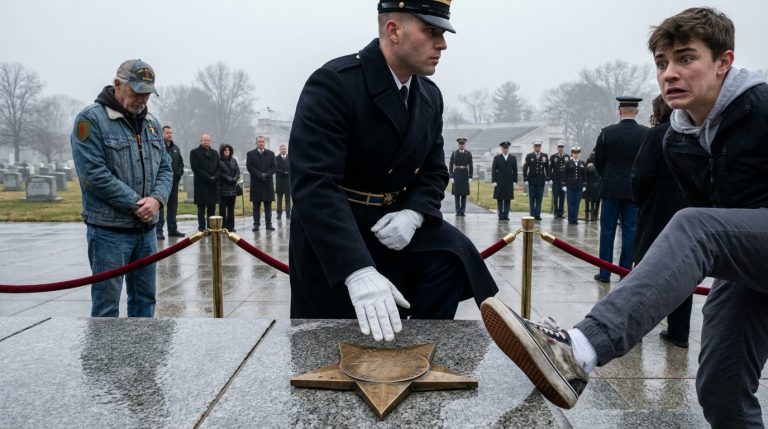
Ellie looked at the crate, then at me. Her expression was hard, stripped of the last vestiges of the cadet who followed orders. She was a woman who had realized that some orders were meant to be broken. “We have the manifest,” she said, her voice a steel-edged whisper. “If we get this plaque into the stone, if we finish the dedication, they lose the narrative. They can’t delete a public record once it’s set in bronze.”
The sound of the freight elevator doors sliding open was a heavy, metallic groan. Three men stepped out. They were shadowed, their faces obscured by the dim light, but the way they fanned out confirmed our fear. They weren’t here to talk.
“We need to move, now,” I said.
I didn’t wait for her to agree. I moved toward the crate, the grating of my boots on the concrete sound like a gunshot in the stagnant air. As I reached the seal of the crate, I saw it—the wire was already broken. The crate had been opened. Someone had gotten here first.
I pried the lid back, the wood splintering with a sharp, dry snap. Inside, nestled in protective foam, was the bronze plaque. It was beautiful, the initials crisp and precise. But as I lifted it, I saw that the surface had been scoured. The metal was dull, the initials intentionally marred as if someone had taken a grinder to the work to ensure it couldn’t be read.
“They didn’t just track us,” I realized, the anger rising in my throat like a tide. “They sabotaged it.”
Ellie was beside me in an instant, her hand hovering over the ruined bronze. She didn’t look at the men approaching; she looked at the wreckage of our effort. Her jaw set, a muscle in her cheek twitching. She looked up at the shadows of the men, then back at me, a sudden, fierce light in her eyes.
“Then we don’t use the plaque,” she said.
She turned and marched toward the loading bay’s emergency toolkit cabinet—a heavy, red steel box bolted to the wall. She grabbed a heavy-duty wrench and a set of chisels. She wasn’t going to wait for a manufacturer to give us permission. She was going to write the truth into the stone herself.
The men in the shadows took another step forward. One of them pulled a radio from his belt, his voice a low, distorted static.
“I’ll hold them,” I said, stepping between Ellie and the advancing shadows.
“No,” Ellie said, her voice firm. “You’re going to help me read the stone. We’re doing this together.”
She jammed the chisel into the mortar of the existing memorial stone, the one that had held the lie for ten years. The sound of metal hitting stone was the loudest thing in the world—a sharp, ringing declaration of intent. I didn’t hold them back with force; I held them back with the sheer, undeniable reality of what we were doing. I stood before the wall, the manifest in one hand, my other hand guiding her strike as she began to chisel away the error, stone by stone, grit by grit.
The men paused. They were professionals, trained to manage problems, but they weren’t trained to stop a father and daughter who had already decided that the cost of the truth was worth the price of the fight.
“Keep going,” I told her, my voice steady. “The names, Ellie. Make sure the initials are deep. Make sure they stay.”
She hit the stone again, a clean, sharp strike, and the old error crumbled away. The dust filled the air, a white cloud that seemed to swallow the shadows. We were doing the work now—the real work. We weren’t asking for permission from the system anymore. We were carving our own history, one letter at a time, until the truth was as permanent as the building itself. The men watched, motionless, and for the first time in ten years, I felt the weight of the broken chain on my wrist stop pulling. It wasn’t a burden anymore; it was an anchor.
CHAPTER 8: THE FINAL PORCH
The dust settled, slow and deliberate, coating the concrete floor in a fine, white film. The three men in the shadows stood motionless, their hand-held radios silent. They were waiting for an order that would never come, because the room had changed. The memorial stone, once a smooth expanse of bureaucratic denial, was now a rough, honest testament. The six initials were carved deep, clear, and unyielding.
Ellie stepped back, her breath coming in shallow, controlled bursts. She wiped a smudge of stone dust from her cheek with the back of her hand, leaving a pale streak. She looked at the result, then at the men who had been sent to stop her. She didn’t look like a cadet anymore. She looked like someone who had just finished a very long, very necessary task.
“It’s done,” she said, her voice steady.
The man in the center—the one who had been leading the attempt to silence us—slowly holstered his radio. He looked at the plaque, then at the manifest clutched in my hand, and finally, he gave a slow, almost imperceptible nod. He had been sent to protect a lie, but faced with the truth carved in stone, he realized the lie no longer held the weight of law. They turned and walked back toward the freight elevator, their departure as quiet as their arrival. They had realized that some records, once rewritten, cannot be unwritten.
We left the loading dock under the cover of the gathering dusk. The campus felt different now—less like a monolithic machine and more like a place of people, of memories, of failures and repairs.
The drive to my mother’s house was a slow, contemplative journey through the fading light. Ellie kept her hand on the armrest, her fingers tracing the edge of the new uniform sleeve, her gaze fixed on the road ahead. We didn’t talk much. We didn’t need to. The silence in the cab was no longer the heavy, suffocating weight of a secret; it was the quiet of a house after a long-awaited renovation.
When we reached my mother’s porch, the house was glowing with the soft, warm light of an evening kitchen. The smell of slow-cooked beans drifted across the lawn, a scent that felt like the absolute anchor of the world. My mother was waiting on the porch, a tray in her hands, her face illuminated by the yellow glow of the doorway.
As we stepped onto the wood, the boards creaked in a way that felt like a greeting. I walked up the steps, my knee finally silent, and stood before her. She didn’t ask questions. She just looked at my face, then at Ellie, and smiled—a slow, knowing smile that had weathered a decade of uncertainty. She knew. She had always known that truth has a way of finding its home.
We sat on the porch, the evening breeze cooling the summer heat. Ellie pulled her phone out and sent one final message, confirming the permanent update to the university records—a digital seal on the physical work we had done. She set the phone aside and leaned her head back, watching the stars begin to emerge above the treeline.
“You know,” I said, the words feeling easy, light, “I spent so long thinking I was hiding you from the world. I thought I was being the wall.”
Ellie reached over and took my hand, her fingers tracing the broken chain link on my wrist. She didn’t look at me, but her grip was solid, an immovable anchor. “You weren’t the wall, Dad. You were just the foundation. I’m the one who had to build the house.”
She was right. The repair work was done. I looked down at the bronze coin the General had given me, still sitting in the small pocket of my trousers. I took it out and placed it on the porch railing. It caught the last rays of the sun, a dark, star-marked disc that now felt less like a memory and more like a simple, honest weight.
My mother brought out the plates, the steam rising into the cooling air. We ate in the quiet, the sound of the porch swing’s gentle creak marking the rhythm of the evening. It wasn’t a grand finish. There were no cameras, no applause, no final speeches to be made. Just the beans, the cooling air, and the realization that the ledger had finally been balanced.
I looked at the porch light, the one my mother had kept burning for a decade, and felt the last of the tension in my shoulders dissolve. The mystery was gone, replaced by the simple, enduring reality of a name properly placed, a history correctly told, and a future that Ellie was already building with her own steady, determined hands.
I took a deep breath, the air clean and honest. The work was finished. The ghost was home. And for the first time in ten years, I wasn’t just a driver. I was a father, sitting on a porch, listening to the world settle into a peace that was finally, truly deserved.