The Survey Line: A Calculated Dismantling of a Corrupt Kingdom Built on Beige Vinyl and Greed
CHAPTER 1: THE SURVEY LINE
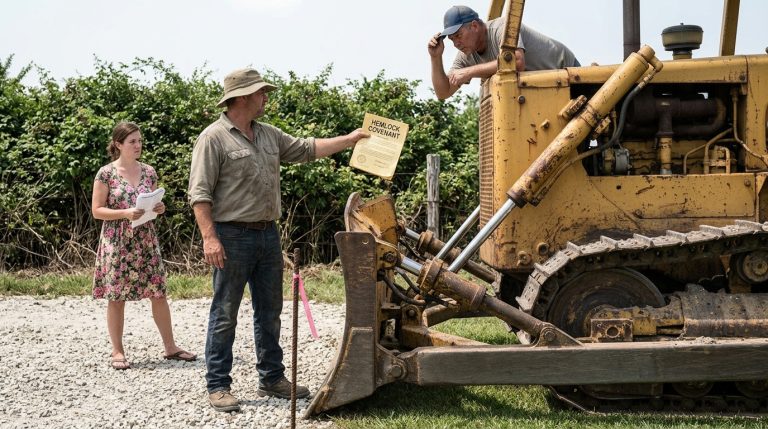
The scent of dry earth and old iron hung heavy in the humid air. I didn’t move. I stood perfectly still on my side of the survey pin—a small, rusted stake driven deep into the dirt—watching Karen Miller violate every boundary, both legal and social, that I had spent years maintaining.
She was deep inside my ten acres, her floral-print dress a garish, fluttering eyesore against the muted greens of my woods. She clutched the Reconics Trail camera to her chest as if she had just conquered a battlefield, her face twisted in that familiar, suffocating expression of righteous indignation. She wasn’t just trespassing; she was claiming a victory over an enemy she couldn’t comprehend.
“That camera was a violation, Mr. Thorne,” she announced, her voice thin and sharp, cutting through the natural silence of my sanctuary. “Confiscated for the neighborhood’s good. You’ll be hearing from the committee.”
I didn’t answer immediately. I took a breath, the steady, rhythmic intake of a man who had spent two decades clearing routes where the ground itself was meant to kill him. I didn’t see a neighbor; I saw a variable that needed to be calculated. My eyes shifted to her hands—the way she gripped the plastic casing, the lack of awareness in her stance. She was so convinced of her own authority that she didn’t notice the infrared light on the device had already captured her entrance, her movement, and the exact moment she reached for the strap.
“You’re standing five feet inside my property line, Karen,” I said, letting her name drop like a stone into a still pool. No title. No ‘President.’ Just a neighbor who had crossed a line she couldn’t see.
She recoiled, her posture stiffening. “I am protecting the residents of Whispering Pines from your deviance. This is evidence.”
“It’s theft,” I replied, my voice steady, stripped of heat. The friction between us was palpable, a grinding of gears. I noticed a small, jagged tear in the fabric of her sleeve where she’d snagged it on the oak tree during her frantic struggle to rip the camera loose. It was a detail she hadn’t noticed yet.
“I’ll be seeing you in court,” she hissed, turning on her heel with the haughtiness of a low-budget super-villain, her mumu fluttering behind her.
I watched her go, not moving to stop her. The “Therefore/But” logic was already clicking into place. She had taken the camera. Therefore, I had the perfect excuse to involve the law. But if I handled this correctly, the camera wasn’t the goal—it was the wedge. As she stomped away, I looked down at the iron survey pin at my feet, its top rusted to the color of dried blood. She thought she was winning a dispute over a backyard camera, but she hadn’t realized that the moment she walked onto my land, she had stepped off the map of her own influence and into a war of attrition she was destined to lose.
I turned back toward my house, the silence of the woods already beginning to settle back into place, but the air felt different now—thicker, charged with the quiet, inevitable cost of what was to come.
CHAPTER 2: THE DIGITAL SCRUB
The silence that reclaimed the woods was brittle. It was the kind of quiet that follows a mortar blast—not peaceful, but heavy with the atmospheric pressure of what had just happened. I stood by the iron survey pin, its surface rough with the corrosion of decades, and watched the sway of the saplings where Karen had disappeared. She hadn’t just stolen hardware; she had stolen a piece of my perimeter. In my years as a combat engineer, I had learned that a boundary is only as strong as the person willing to defend it. If you let the enemy move the fence line, you’ve already lost the battle.
I didn’t turn back to the house immediately. I walked the ten-foot-wide path I mowed with military precision, the grass crushed under my boots, a stark, straight line dividing my wild woods from the manicured, artificial perfection of the HOA. The scent of dry, churned earth and damp moss was comforting, a contrast to the acidic tang of Karen’s presence. I reached into my pocket, feeling the cold, smooth weight of my phone. It was a tool, just like a landmine detector or a breaching charge.
Back inside, my house was a fortress of solitude, designed to be invisible. The floor-to-ceiling windows looked out into the dense, untamed green of my property, a sight that usually brought a sense of equilibrium. Tonight, it felt like a tactical map. I sat at my grandfather’s oak desk, the wood scarred and seasoned by time, and opened the laptop. The fan whirred to life, a steady, mechanical drone that matched the pace of my own pulse.
I connected the external drive. The progress bar crawled across the screen, a thin blue line of potential. This was where the phantom of my past caught up with me. Reviewing the footage, I felt that familiar, gnawing urge to clear the route, to identify the IEDs—or in this case, the petty bureaucratic traps—before they could detonate. I wasn’t watching a movie; I was conducting an after-action review.
The footage synced. My screen filled with the ghostly, infrared world of the night-time woods. It was a gray, desaturated landscape where motion was the only color. I scrubbed through the files, my eyes tracking the movement. A deer, fluid and graceful; a raccoon, a frantic ball of static energy. Then, the anomaly.
It wasn’t a tactical threat, but it was a rupture in the expected order. Karen’s poodle, a white, yapping smudge of pixels, darted onto the Henderson lawn. The camera, perched in the oak, caught the entirety of the transgression. I paused the playback, the frame freezing on Karen’s face—a momentary flicker of something entirely alien to her usual persona: a conspiratorial, dark, and calculating focus. She checked the perimeter, her body language betraying a seasoned habit. She wasn’t just walking a dog; she was performing a task.
I leaned back, the leather of my chair creaking. The military training surfaced, unbidden. You don’t look at the explosion; you look at the cause. Why would a woman so obsessed with the aesthetic perfection of her kingdom be the one to soil its most prized asset?
My mind traced the lines of force. This wasn’t about the dog. It was about dominance. It was about the ability to break the rules that she enforced on everyone else—a classic hallmark of a power-based hierarchy. I saved the file, labeling it with surgical precision. The next clip was even more telling. The dark tracksuit, the spray paint can, the methodical destruction of David Fletcher’s sign.
The weight of the house felt different now. It was no longer just a home; it was a command center. I had the raw intelligence. I had the patterns. The “Therefore/But” logic was tightening. Karen had trespassed, therefore she had provided me with the grounds for a counter-offensive. But she believed she was in a position of unassailable authority. She had no idea that her own behavior was the kinetic force that would eventually shatter her own foundation.
I didn’t need to be loud. I didn’t need to be aggressive. I just needed to be precise. I closed the laptop, the screen going black, reflecting my own face—calm, measured, and entirely unbothered by the coming friction. I walked to the kitchen and poured a glass of water, watching the way the light refracted through the glass, distorted and clear all at once. The woods outside were deep and dark, hiding their secrets, but I had the digital eyes to see through the camouflage. Tomorrow, the calculation would change. Tomorrow, I would start reaching out.
CHAPTER 3: THE ALLIANCE OF THE DISAFFECTED
I didn’t rush the process. Rushing is for amateurs who want to be seen; I wanted to be effective. My grandfather’s desk was solid oak, a surface that had survived decades of wear, and as I sat there, I felt the familiar pull of a mission-oriented mindset. I had the files, the digital fingerprints of Karen’s ego-driven sabotage, but files are just data. To turn data into leverage, I needed human friction. I needed the people she had already pushed to the breaking point.
David Fletcher’s address was four streets over, a house that mirrored the rest of the neighborhood’s desperate, beige-vinyl conformity, yet it stood out because of the meticulous care given to the surrounding landscape—a sharp contrast to the neglected patches of common area Karen oversaw. I didn’t drive; I walked. In a suburban landscape designed for cars, walking is a form of invisibility. It lets you observe the seams of the environment: the rusted gate hinges, the cracked pavement, the subtle signs of decline that an HOA president would be too distracted by power to notice.
I found Fletcher in his garage, the space organized with the obsessive focus of a man who spent his life managing logistics. He was sorting a box of hand tools, his movements deliberate, his posture holding the rigidity of someone who had spent his career fixing things that others had broken. When he looked up and saw me standing in the driveway, he didn’t appear startled. He was a man who expected variables.
“Mr. Thorne,” he said, setting a wrench down on the pegboard-lined wall. His voice was gravelly, tempered by years of frustration. “I assumed you’d be by eventually. The rumors about the camera incident are moving faster than the HOA newsletter.”
“Rumors are just noise,” I said, stepping into the shade of the garage. The air smelled of metallic oil and dry concrete. “I’m here because I have something that isn’t noise. I have evidence.”
Fletcher’s eyes narrowed. He was a tall man, lean and sharp, and he didn’t waste time on pleasantries. He gestured to a small workbench where a folded copy of the latest Whispering Pines newsletter lay. It was a glossy, insipid document filled with reminders about mailbox paint colors and lawn height. I leaned over and pointed to a small, obscure footnote at the bottom of the landscaping section—a reference to a ‘contractual adjustment fee’ that didn’t appear in the previous year’s budget. It was an anomaly, a tiny ripple in the water, but it was enough to catch a trained eye.
“She’s cooking the books in plain sight,” I said, my voice low. I didn’t need to elaborate. Fletcher looked at the footnote, his jaw tightening until the muscle bulged.
“I’ve been tracking these adjustments for six months,” he whispered, a dangerous edge to his tone. “Every time I ask for an itemized breakdown, Karen buries me in administrative paperwork. She treats this association like a personal fiefdom.”
“She isn’t just a tyrant, David. She’s a thief.” I didn’t show him the video of the envelope yet. Not here, not in a garage where a neighbor might walk by. I needed to know if he was a partner or just a fellow victim. “I’m building a case, but I don’t need a witness. I need a movement. I need people who understand that this isn’t about rules—it’s about the fact that she’s using your money to fund a lifestyle of petty control.”
Fletcher stared at me, his gaze analytical. He was calculating the risks, weighing the stability of his home against the necessity of burning it down to clear the infection. It was the same look I had seen in the eyes of local guides in hostile territory—the moment they decided whether to lead you across the pass or leave you to the elements.
“There’s someone else,” he said finally, pulling a small notebook from his pocket. “Maria Sanchez. She was the treasurer two years ago. She tried to audit the landscaping contracts and was practically driven out of the neighborhood by a smear campaign. She has the institutional memory of this disaster. If you have the evidence, she’s the one who can translate it into a crime.”
I took the name. It felt like acquiring a key to a locked room. “Why are you helping me?” I asked, though I already knew the answer.
Fletcher walked to the garage door, looking out at the perfectly manicured, soulless street. “Because I’m tired of living in a place that feels like a prison,” he said. “And because I don’t like being lied to.”
As I walked away, leaving the garage behind, I didn’t look back. I had the next link in the chain. The friction was building, the resistance was mounting, and for the first time since Karen had stepped onto my property, I felt the machinery of the system beginning to align in my favor. I wasn’t fighting a person anymore; I was dismantling a structure, and the foundation was already starting to crack under the weight of its own greed.
CHAPTER 4: THE ACCOUNTANTS LEDGER
The walk back from Fletcher’s garage had been easy, but the weather had other plans. A sudden, driving rain began to turn the dusty paths of the neighborhood into a slick, rutted mire. It was the kind of downpour that felt like an intrusion, forcing me to abandon my plan to cut across the common area and instead take the long way around, keeping to the shadows of the tree line. The air smelled of wet iron and ozone, the scent of a system under pressure, and I felt the weight of the water soaking into my jacket.
I reached Maria Sanchez’s house with my boots heavy with mud. The home was a sharp contrast to the surrounding neglect—a pocket of deliberate, manicured order that felt like a sanctuary in the middle of a storm. I didn’t knock with a flourish; I used a measured, rhythmic cadence, the kind that signals intent without urgency. When she opened the door, she was holding a damp cloth, her eyes darting past me to ensure no one was watching from the street.
“You’re early,” she said, her voice thin but sharp. She didn’t invite me in immediately; she looked at the rain dripping from my coat, then at my face. She was a woman who lived by calculations, and she was clearly checking the variables.
“The storm changed the route,” I replied, stepping inside only when she stepped back.
The interior of her house was a museum of her professional life. Spread across her dining room table were stacks of documents, their edges yellowed, held down by heavy paperweights. This wasn’t just a home; it was an archive of grievances. As I wiped the mud from my boots, I felt the sharp, analytical atmosphere of the room. This was where the phantom of the HOA’s corruption became quantifiable.
“David Fletcher told me you were coming,” she said, closing the door and locking it with a heavy deadbolt. “He said you have proof that goes beyond simple mismanagement.”
I didn’t answer with words. I placed the encrypted external drive on the table, right in the center of her organized chaos. “I have video, Maria. Not just of the HOA meetings. Of the landscaping company. Of the payments.”
She didn’t touch the drive at first. She looked at it as if it were a bomb, her expression unreadable. She walked to the window, peering through the blinds into the driving rain, ensuring the street was empty. She was a woman who had been bullied once, and she wasn’t about to be caught off guard again.
“If this is what I think it is,” she said, finally turning back to me, “then Karen Miller hasn’t just been stealing. She’s been violating state statutes on fiduciary duty. I kept records from when I was treasurer—the inconsistencies in the Prestige Landscaping invoices were the reason they pushed me out. If your video matches the dates of these invoices, we don’t just have a neighborhood dispute. We have a felony.”
She pulled a chair out and gestured for me to sit. The table was covered in spreadsheets, the lines of which were as rigid and unforgiving as a prison fence. She started pointing out the discrepancies—the erratic billing cycles, the lack of itemized labor costs, the sudden surges in costs during the off-season. It was a masterclass in reading the language of theft.
“She used the complexity of the contracts as a shield,” Maria explained, her finger tracing a column of numbers. “She assumed no one would look past the top-line total. But the adjustments… these are the key.”
As she spoke, I felt the tension in the room shift. We weren’t just two neighbors talking; we were two people mapping a path through a minefield. The rain lashed against the windows, a persistent, rhythmic drumming that made the house feel isolated, a bunker in the middle of the suburb.
I looked at the invoices she had set aside, the headers stark and clinical. One specific header caught my eye—a vendor code for an entity I hadn’t seen in the previous documents. It was small, buried in the middle of a sub-total block, but it was out of place. It was a discrepancy—a V-1 style ripple in the data—that suggested the kickbacks weren’t just limited to landscaping.
“What is that?” I asked, pointing to the code.
Maria leaned in, her eyes magnifying behind her glasses. She traced the line, her brow furrowing. “I never noticed that code before. It’s… that’s not for landscaping. That’s for administrative expenses.”
The reality of the situation expanded in my mind. The kickbacks weren’t just the main course; they were part of a systemic, multi-layered operation. She hadn’t just been siphoning money; she had been running a business out of the HOA’s budget. My respect for the scale of the corruption grew, but so did my certainty. Karen had been too arrogant, too convinced that the system was hers to protect, to realize that she was leaving a trail of crumbs a mile wide.
We sat there for hours, the light in the house dimming as the storm continued to beat against the glass. By the time I left, the map was complete. We had the evidence, we had the analysis, and we had the motivation. We had moved from being victims of a petty tyrant to being the architects of her dismantling. The air outside was still thick with rain, but as I stepped back into the night, the path forward felt illuminated, the terrain mapped out with the cold, hard logic of a strategy that couldn’t fail.
CHAPTER 5: THE LEGAL AMBUSH
The rain had stopped, leaving the night air heavy with the scent of wet asphalt and decay. I stood in the darkness of my living room, watching the headlights of a car sweep across the opposite wall—a slow, deliberate arc that died out just before reaching my driveway. My hand was steady, but the rhythm of my thoughts had accelerated. Karen wasn’t just a neighbor anymore; she was a predator who had just realized the prey was armed with more than just a trail camera.
I reached for my phone. The screen flickered to life, showing the draft of the legal complaint Anne had prepared. It was a masterpiece of cold, professional hostility. Every word had been weighed, every allegation backed by the digital footprint I had spent the last week meticulously gathering. I sent a single text to Anne: The ledger is confirmed. The anomalies are consistent. Proceed.
The wait was instantaneous. My phone buzzed, a sharp vibration against the silence of the house. Served, she replied.
I didn’t celebrate. Celebration is a luxury for those who think the fight is over. Instead, I moved to the desk, the oak surface cool under my touch. I opened a fresh file on my laptop, the screen illuminating the room in a pale, sterile light. I needed to anticipate her move. If I were Karen, facing a formal legal summons that bypassed the neighborhood board and targeted my personal assets, where would I go?
I paced the length of the room, my boots making no sound on the floor. The house felt smaller tonight, its walls closing in like a tightening perimeter. Every shadow in the woods outside seemed to hold a potential witness, or a potential threat. My paranoia, once a tool for survival in the field, was now a lens through which I viewed the entire neighborhood. Was that a car engine, or was it the sound of someone idling near my property line? Was the silence of the woods natural, or was it a tactical void?
I forced myself to stop. Panic is a variable that leads to errors. I sat down and forced my attention back to the monitor, focusing on the specific wording of the civil complaint. We had named her personally. We had bypassed the HOA’s liability insurance. We had effectively turned her home, her bank accounts, and her reputation into the battlefield.
I checked the time. It was late, but for someone like Karen, the night was just another opportunity to plot. I knew she would go to the board members—the two cronies she’d kept in her pocket. She would try to intimidate them into passing an emergency resolution to fund her legal defense with HOA money. It was the only move she had left.
I opened the folder labeled ‘Evidence’ and began to arrange the files chronologically. I needed to be ready to intercept her. If she tried to pass that resolution, I needed Fletcher and Maria to be in the room, ready to present the formal notification that a lawsuit had been filed. It was a tight timeline. We were essentially locking her in a vice.
The realization hit me: this was no longer about stopping a petty tyrant. This was about the slow, methodical destruction of her entire infrastructure. I felt the familiar weight of the task. It was the same feeling as clearing a route through unknown territory—you don’t know what’s waiting in the dark, but you know that if you move slowly and check every inch of the ground, you can eventually strip away the enemy’s defenses.
I heard the sound again—a car, moving slower this time, passing the end of my long, private driveway. I didn’t look out the window. I remained in the glow of the monitor, my focus fixed on the sequence of events we were about to trigger.
The battle wasn’t happening in the woods anymore. It was happening in the digital ether, in the cold, calculated language of legal filings and financial records. I closed the file, the sense of finality settling in my chest. Tomorrow, the ambush would spring. Tomorrow, the mask would start to slip, and I would be the one watching from the shadows, waiting for the first sign of panic.
CHAPTER 6: THE PUBLIC FRACTURE
The ping came at 2:00 a.m., a sharp, crystalline sound that cut through the darkness of the living room like a blade. I didn’t reach for the phone immediately. I let it sit on the oak desk, the screen pulsating with a soft, rhythmic light. It was an email, sent to the official HOA inquiry address I had been monitoring through a redirected filter. My breath remained steady, the disciplined composure of a man who had long ago learned that urgency is the enemy of strategy.
When I finally tapped the screen, the contents weren’t a surprise—they were an indictment. It was an emergency blast from Karen Miller, marked URGENT in aggressive, all-caps characters. She was calling for a special session, not to debate the audit, but to authorize an immediate, unlimited retainer for a legal team to “defend the community against malicious external interference.”
She was panicking. I watched the text, the way her language had devolved from the pseudo-professionalism of her early letters into raw, sputtering vitriol. She was cornered, and like any cornered animal, she was clawing at the nearest surface. The irony was palpable: she wanted the community to pay to defend her personal corruption.
I checked the timestamp. She had sent it minutes after being served.
I didn’t reply. I didn’t need to. I reached for my secondary device, the one linked to Fletcher. I typed a short, concise message: She’s moving to secure legal funding. The audit petition is our only counter-move. Be ready.
The response was almost instantaneous. We have the signatures. Meeting is locked for tomorrow.
I stood up and moved to the window, peering out into the night. The neighborhood was quiet, a stark, lifeless sprawl of beige vinyl under the dim glow of streetlights. Somewhere out there, in one of those houses, Karen Miller was probably pacing, her hands shaking, her mind racing through a Labyrinth of bylaws and intimidation tactics. She had no idea that she was playing against a field she couldn’t see.
By mid-morning, the community center was a hive of activity. I didn’t go in; I stayed in the periphery, watching from a distance as residents arrived. They didn’t look like a group of people intimidated by a HOA president. They looked like a jury. I saw Fletcher standing at the entrance, a stack of folders under his arm, greeting people with the calm, steady assurance of a man who was about to turn the tide.
The sound of the meeting carried through the thin walls—a dull, rising murmur of voices, punctuated by the sharp, desperate banging of a gavel. Karen was losing the room. I could hear it in the way the crowd’s response shifted from confused murmurs to sharp, unified shouts. She was trying to shout over them, her voice cracking, reaching for that note of authority that had once cowed the entire neighborhood, but it was hollow now.
Then, the sound changed. The gavel banging stopped, replaced by a sudden, heavy silence that felt like the drop before a rollercoaster.
I walked toward the side entrance, my boots crunching on the gravel path. Through the narrow gap in the curtains, I saw it: Maria Sanchez was standing at the podium. She wasn’t shouting; she was speaking with the cold, rhythmic precision of an accountant reading a final balance sheet. She held up a series of documents, each one a testament to the years of siphoning, the Prestige Landscaping invoices, and the “administrative” adjustments Karen had tried to bury.
Karen was standing behind the table, her face a mask of distorted fury, her hands white-knuckled as she gripped the edge of the wood. She looked smaller than she had a week ago, the floral dress hanging loosely on her frame as if her very sense of self-importance was evaporating. The two cronies at her side were staring at the floor, their political survival instincts kicking in; they were already dissociating themselves from her, leaning away as if she were radioactive.
“The audit is not a request, Madam President,” Maria’s voice rang out, amplified by the PA system. “It is a requirement of the bylaws.”
The roar of the crowd was instantaneous—a deep, resonant sound of collective agreement. It wasn’t just a vote; it was a verdict. Karen tried to jump back in, her mouth moving, her finger pointing, but the room had already moved past her. She was a ghost in her own kingdom, a relic of a failed regime.
I turned away from the window, the cold, hard satisfaction of the moment settling into my bones. The fracture was complete. She had pushed, she had fought, and she had destroyed the only thing that had kept her in power: the illusion of her own inevitability. She had forced the community to look behind the curtain, and once they saw the mess she had made, there was no going back.
I walked back to my car, the gravel crunching under my feet. The final piece was in motion. The internal collapse was now irreversible, and the legal trap was already tight around her throat. She had fought for control, and in the process, she had provided the final, fatal piece of evidence that would end her, not just as a president, but as a resident.
CHAPTER 7: THE RAID
The scene outside Karen Miller’s house was a study in controlled chaos. Two unmarked cruisers sat at odd angles across the manicured lawn of Whispering Pines, their emergency lights painting rhythmic, strobing gashes of red and blue across the perfectly beige vinyl siding. I stood across the street, tucked into the shadow of a large oak tree, my posture relaxed but my senses tuned to the frequency of the operation. I wasn’t just watching; I was confirming the closure of the loop.
The lead investigator, a man whose suit looked as tired as his expression, approached Karen’s front door. She had opened it before he even knocked, her face a pale, strained map of confusion and dawning realization. The conflict I had orchestrated from the periphery was now manifesting in the physical world. I watched the interaction—not through the lens of a camera, but with the raw, unfiltered clarity of a man who understood the physics of consequence.
She was gesturing, her hands flapping in that frantic, bird-like motion I’d seen on the trail cam footage, but this time, the indignation didn’t land. The investigator remained a solid, immovable object in the face of her storm. He held the warrant out—a document I knew by heart, listing the statutes, the evidence codes, and the judicial authorization. It was a piece of paper, but it carried the weight of the state.
I saw the exact moment the realization took hold. Her posture slumped, the brittle shell of her authority finally cracking under the pressure of the law. She stepped aside, letting the team in. As they moved through the front door, the house seemed to exhale, the artificial silence of the HOA shattered by the methodical arrival of a search team.
My phone vibrated. A message from Anne: Search is underway. The landscaping contractor’s office has also been hit. They’re folding.
The causal loop I’d set in motion—the survey pins, the camera, the quiet accumulation of evidence, the alliance with Fletcher and Maria—was reaching its terminal velocity. I stayed in the shadows, watching the investigators move through the windows, their silhouettes sharp against the interior lighting. They were methodically pulling files from the cabinets, bagging hard drives, and cataloging the very records Karen had spent years protecting with her labyrinthine bylaws.
There was no sense of triumph, only a cold, logical satisfaction. I felt the grit of the road beneath my boots—the dry earth, the rusted iron of the survey stakes, the texture of a reality being corrected. The injustice wasn’t that she had been a tyrant; it was that she had used the trappings of order to hide the rot of greed.
I saw Karen led out to the back seat of the cruiser. She didn’t look like a president of an HOA; she looked like an empty vessel, her face devoid of the smug confidence that had defined her existence. The neighbors were beginning to emerge from their houses, drawn by the strobing lights, their faces caught in the flicker—some stunned, others openly watchful, a few, perhaps, relieved.
The circle was closing. The internal collapse had been the catalyst, but this was the final, structural demolition. I didn’t need to be closer. I didn’t need to confront her. The law was a far more efficient instrument of correction than any words I could provide.
I turned and began the walk back to my own property, the long, private driveway pulling me into the darkness of my woods. The air was cool, smelling of damp earth and the promise of a quiet night. I had started this with a desire for silence, for a buffer against the noise of a world that refused to respect boundaries. As I reached my front door, I stopped and looked back one last time. The red and blue lights were fading in the distance, a dying signal of a war that had been fought and won, not with volume, but with precision. The kingdom of beige was burning, and I, for one, was ready for the peace that would follow.
CHAPTER 8: THE SETTLEMENT OF SILENCE
The transition from chaos to quiet was physical. It settled into the marrow of my bones like the cold of a winter morning. I stood at the edge of my property, watching the taillights of the last police cruiser disappear around the bend of the road, leaving the neighborhood in a state of stunned, hollow stillness. Karen Miller was gone—not just from her house, but from the narrative that had constrained my life for the past year.
I turned back toward the woods, my boots finding the familiar, packed-down trail I had maintained for so long. The iron survey pin, hidden by the encroaching shadows of the undergrowth, glinted briefly as I passed. It was just a piece of metal, but it had been the fulcrum upon which I’d balanced the leverage needed to break her world.
The next morning, the neighborhood felt different. The air didn’t have that pressurized, vibrating quality of an impending conflict. Instead, it was simply air—the scent of damp leaves, the distant call of a crow, the natural, unmanaged entropy of the forest. I walked the boundary line, checking the fence. It was still there, a suggestion of separation, but the tension had evaporated. The “beige kingdom” was no longer a threat; it was just a collection of houses.
A few days later, a courier arrived with a thick envelope—the final settlement agreement, signed, notarized, and legally binding. It wasn’t just a document; it was a full admission of the corruption she had denied until the very moment the warrants were served. Maria and Fletcher had already been elected as interim leaders, their work focused on transparent audits and cleaning the administrative rot that had festered for half a decade.
I took the check—the restitution for the stolen camera and the legal fees—and walked to the oak tree where the first trail camera had been mounted. I didn’t need the surveillance anymore. The threat had been neutralized by its own inherent instability. I took the new camera from my pack—a more robust, high-resolution device—and installed it, but not for security. I turned it toward the game trail where the deer and the foxes moved, where the rhythm of the woods was dictated by biology, not bylaw.
I returned to my porch and set the check on the small, scarred side table. I didn’t cash it immediately. I sat there for a long time, watching the way the sunlight filtered through the canopy, dappling the forest floor in shifting patterns of gold and gray. I remembered the feeling of that first letter on cream-colored stationery, the petty arrogance of her demands, and compared it to the hollow, broken figure I had seen handcuffed in her own driveway.
It was the five-pillar catharsis, though I didn’t think of it in those terms. I thought of it as clearing a route. I had stripped away the obstacle, not by brute force, but by out-maneuvering the rules she had used to build her cage.
I reached into the shed and pulled out a small, rusted hand trowel—the same one I had used to clear the weeds along the survey line when this had all begun. I walked back to the edge of the property, where the common area fence had begun to sag, and began to work. It was a small act of repair, a way to settle the earth back into its natural alignment. My hands felt the familiar, grounding friction of the soil, the resistance of the roots, the weight of the work.
As I worked, Fletcher appeared on the other side of the fence. He looked tired, but his eyes were clear, his posture lacking the rigid, defensive tension of the last few months.
“The audit came back this morning,” he said, his voice calm. “The scale of the landscaping kickbacks… it’s worse than Maria predicted. It’s a total systemic collapse.”
“She built the system to protect herself,” I replied, standing up and wiping the dirt from my hands. “When you build a structure on a lie, it doesn’t take much to bring it down. You just have to find the right pin.”
He nodded, a slow, quiet gesture of respect. “We’re going to be okay here, Thorne. For the first time in five years, we’re just neighbors.”
“That’s all I ever wanted,” I said.
He walked away, back toward the interior of the development, and I remained by the fence. The sun was dipping lower, turning the sky into a bruised, beautiful purple. I felt a deep, resonant calm, the kind that only comes after the removal of a persistent, low-level threat. My emotional connection to the land—the sanctuary I had fought to protect—felt stronger, more rooted. I had not only defended my territory; I had helped restore a neighborhood to its own natural state.
I walked back to the house, leaving the trowel on the porch. The world was quiet. The woods were waiting. I sat on the back step, watching the fireflies emerge in the gathering dark. The game was over. The structure was gone. There was only the silence, and the ground, and the long, slow, peaceful stretch of time ahead.