The Line in the Sand: A Recon Marine’s Cold-Blooded Dismantling of a Suburban Tyrant
CHAPTER 1: THE FIRST CALCULATION
The midday sun beat down on the lawn, turning the grass into a shimmering heat haze, but I felt none of it. My focus was a razor, honed by fifteen years of reconnaissance in terrain far more hostile than a manicured suburban cul-de-sac.
“Construction on the access path begins tomorrow,” Karen said. Her voice had that brittle, high-pitched cadence of someone who had never been told ‘no’ and lived to talk about it. She held the flyer out like a peace offering, but I could see the way her knuckles whitened against the clipboard. She was nervous. A tremor of adrenaline, barely perceptible, betrayed her.
I didn’t take the paper. I looked past her shoulder at the lake—my lake. The water was a sheet of polished steel, perfectly still, reflecting the dark, silent pines that guarded the perimeter of my thirty acres. It was a tactical asset of immense value, a natural buffer that defined the integrity of my sanctuary. And she was standing on my grass, claiming it for a kayak launch.
“Karen,” I said, my voice dropping into a register that made her pause, a low-frequency hum that signaled the end of the polite charade. “You are trespassing. You have ten seconds to clear my property line before I initiate a report with the Sheriff’s Department.”
Her face flushed a blotchy, uneven red. “You don’t understand the covenants,” she hissed, her composure fraying at the edges. “The HOA has a recreational easement. You’ll be fined for every minute you obstruct our community project.”
I stepped into her personal space, noticing the subtle, rhythmic twitch in her jaw. She wasn’t just a busybody; she was a predator, and she was currently attempting to maneuver me into a defensive position. But she had made a fundamental error in her intelligence gathering: she had assumed I was just another resident. She didn’t see the man who had spent a decade and a half drawing lines in the sand and defending them with everything he had.
I held up my phone, the screen already recording the metadata of our exchange. “Your ‘covenant’ is an fiction, Karen. You are now being recorded, and you are currently in violation of state trespassing statutes. Leave.”
The air grew heavy with the sudden, sharp silence of the afternoon. For a heartbeat, she looked like she might double down, like she might launch into a rehearsed monologue about HOA rights. But then she caught the look in my eyes—a flat, cold assessment of her tactical position—and the smugness evaporated. She spun on her sandals, her posture collapsing into something defensive, hurried, and panicked.
As she stomped toward the street, I looked down at the flyer she’d dropped. Something was off. The font, the map, the specific phrasing of the easement—it was too aggressive, too desperate. I didn’t just feel anger; I felt the cold, familiar onset of a hunt. I reached into my pocket and touched the cold metal of my phone, already calculating the first move. This wasn’t a fight. It was a systematic eradication of a threat. And I had just found the first discrepancy that would bring her whole empire crashing down.
CHAPTER 2: THE CEASE AND DESIST
The rumble of the Ford Ranger’s engine faded into the distance, but the air above the lawn still felt heavy, saturated with the exhaust of a retreating enemy. I stood motionless at the boundary line, the yellow plastic cap of my survey stake catching the early morning light. It was a small, vibrant splash of color against the deep, verdant green of my property, a silent sentinel that seemed to hum with the weight of the law.
The younger landscaper’s face—pale, wide-eyed, shifting from confusion to caution—played in my mind like a low-resolution video loop. He had been a pawn, just as Karen intended. The older one, the man with the sun-beaten face, had possessed enough years of experience to recognize the smell of a losing fight. They hadn’t just left; they had retreated.
I took a slow, deep breath, my lungs filling with the crisp, pine-scented air. For a fleeting second, the scent of the nearby crushed weeds triggered a sharp, involuntary memory: a dry, arid ridge in the Hindu Kush, the dust of the valley floor clinging to my gear, the absolute, terrifying necessity of knowing exactly where one line ended and the next began. The adrenaline that surged then was a familiar, cooling chemical cocktail—not panic, but crystalline focus. I shoved the memory back into the dark corner of my mind where it belonged. This wasn’t a war zone; it was a subdivision. But the rules of engagement remained identical: identify the threat, establish the perimeter, and wait for the adversary to overextend.
I didn’t head straight to the office. Instead, I walked the perimeter of lot 17, my pace steady and rhythmic. My boots pressed into the soft earth, a tactile reminder that I was standing on ground I had carved out of the chaos of the world. Every few yards, I checked the markers I had set—bright, aggressive, and entirely professional. They were not suggestions. They were a legal fortress built of steel rebar and professional licensure.
When I finally reached the barn, the interior was a stark contrast to the humid morning outside. The air was cool and smelled faintly of ozone and old paper. I moved to the drafting table, the massive closing plat unrolling with a dry, authoritative crackle. The blue oval of the lake was centered there, a perfect geometric reality that stood in complete defiance of Karen’s cartoonish map.
I picked up my pen. My hand was steady. I didn’t need to shout, and I didn’t need to panic. I needed to document. I pulled a fresh legal pad from the drawer and began to draft the formal Notice of Trespass.
My lawyer, Ben Carter, was a man who appreciated the lethality of precise language. He understood that a well-placed sentence was worth a thousand arguments. I typed out the draft, my fingers moving with the mechanical efficiency of someone soldering a circuit. I referenced the specific county plat numbers, the survey markers, and the explicit lack of any recorded easement for ‘Lake View Commons.’ I didn’t just mention the trespass; I laid out the potential for punitive damages, highlighting the specific statutes concerning the willful destruction of property and the illegal solicitation of community funds.
As I worked, the silence of the house—usually a source of comfort—seemed to sharpen. I thought of Sarah. She was at her design studio, likely dealing with color palettes and fabric swatches, completely unaware that our sanctuary was currently under siege by a woman in a pastel polo shirt. I decided to keep the details sparse for now. She didn’t need to carry the weight of this, not yet. I had built this life to protect her, and part of that protection meant serving as the filter for the world’s jagged edges.
The letter grew in length, a cold, clinical accumulation of facts. I wasn’t just writing a letter; I was constructing a wall. I would have it delivered by a professional process server—not via mail, not by hand. I wanted the cold, legal weight of a stranger in a dark suit standing on Karen Miller’s porch, handing her the document that would invalidate her “grand opening.”
I stopped typing and looked at the clock. It was nearly noon. I stood up, stretching the tightness out of my lower back, and walked to the window. The lake was still, a dark mirror reflecting the passing clouds. Somewhere, buried in the HOA’s files, there was an origin point for Karen’s aggression. She was acting as if she had the authority of a sovereign power, but she was only as strong as the documents she stood upon. And if her documents were as hollow as her claim to my lake, then the entire structure of her authority was just waiting for a structural failure.
I didn’t know what I would find when I went to the records office, but I knew what I was looking for. No one lies with that much confidence unless they have something they are deathly afraid of being discovered. I grabbed my keys, the metal biting into my palm. The hunt was no longer theoretical. The battlefield had been mapped, and the enemy had just handed me the key to their front door.
I drove out of the subdivision, passing the manicured lawns and the perfectly spaced oak trees, feeling like a ghost moving through a world of illusions. The HOA’s infrastructure was a facade, a thin shell of social pressure and vague, menacing bylaws. But I had the surveyor’s precision, and I was about to peel that facade back to see exactly what kind of rot was growing beneath. Karen Miller had made the catastrophic mistake of attacking a man who knew how to draw lines in the dirt. She thought she was building a community resource; she was actually building her own cage.
CHAPTER 3: THE RECORDS ROOM RECKONING
The county courthouse was a monolith of grey granite, a place where the air always tasted of limestone dust and fading ink. I stepped through the heavy revolving doors, my boots clicking rhythmically against the polished terrazzo floors. The transition from my property—from the smell of pine needles and the physical certainty of my survey stakes—to this bureaucratic labyrinth was jarring. Here, the world wasn’t measured in degrees and distances, but in the brittle, yellowing pages of history.
The records room was tucked away in the sub-basement, a space that felt less like a government office and more like an archival vault. The humidity was controlled, but the air remained stagnant, heavy with the scent of long-forgotten disputes and iron-filed cabinets. I approached the counter, the wood worn smooth by decades of palms, and presented my request. The clerk, a man with skin like parchment and eyes that suggested he had seen far too many property feuds to care about any individual one, took my list of file numbers.
He didn’t ask questions. He didn’t need to. He simply retreated into the depths of the stacks, leaving me to wait in the silence.
I leaned against the counter, my mind already working through the permutations of Karen Miller’s deception. If the HOA’s recreational easement was a fiction, then the financial paperwork supporting it had to be equally fraudulent. She wasn’t just a petty tyrant; she was an administrator of a lie. And in this room, lies had a paper trail. I just needed to find the inconsistency that shouldn’t be there.
When the clerk returned, he dropped a heavy, banker-sized box onto the counter. It hit the surface with a thud that echoed off the high, fluorescent-lit ceiling. “Everything under Lake View Estates HOA, 1978 to present,” he muttered, then retreated back to his desk.
I carried the box to a vacant table near the back, pulling out a chair and sitting down. I didn’t rush. I began by sorting the files into chronological stacks. I needed to build a timeline, to see where the divergence occurred—where the sleepy, benign HOA became the high-pressure engine of Karen’s ego.
Hours bled into one another. The fluorescent lights hummed, a constant, low-frequency sound that eventually became the background music of my investigation. I started with the early years, the era of the original developers. It was boring, meticulous work—meeting minutes discussing streetlights, snow removal, and the occasional complaint about unkempt hedges. It was a normal neighborhood.
Then, five years ago, the narrative shifted. The minutes began to change tone. They grew sharper, more focused on fines and the acquisition of power. I found Karen’s name for the first time on a budget amendment, and then, with terrifying frequency, on every board approval thereafter.
I paused, my finger hovering over a bank statement from three years ago. There, buried in a list of ‘miscellaneous administrative fees’ that totaled nearly four thousand dollars, was a line item that didn’t fit. It was a payment to a consulting firm I’d never heard of, tagged to an address that, according to my mental map, was nothing more than a vacant commercial lot in the next county.
I pulled the corresponding invoice, but it was just as vague. No services rendered, no hourly breakdown. Just a payment authorized by the signature of Karen Miller.
I felt a cold prickle of alertness at the base of my neck. I began to cross-reference the payments with the project approvals in the board minutes. Every time Karen proposed a new, restrictive fine or a ‘community improvement’ project, a corresponding ‘consulting fee’ or ‘administrative expense’ vanished from the HOA’s general ledger. It was a siphon. A slow, steady drain of the community’s money into the pockets of an entity that didn’t exist.
My mind raced. This was more than just a power trip over my lake. Karen wasn’t just hoarding authority; she was using the HOA as a front for embezzlement. The “Lake View Commons” project wasn’t about a beach or a kayak launch. It was about creating a massive, unaccountable line item—a project expensive enough to mask the final, desperate transfer of funds before she was caught.
I leaned back, the wooden chair groaning under the weight of the realization. The room seemed to grow colder. I wasn’t just defending my land anymore. I was holding the thread that could unravel her entire, carefully curated life. I looked at the files, the stacks of paper representing hundreds of households being systematically drained by a woman who thought she was invisible.
The micro-mystery of those payments wasn’t just a clerical error; it was the heartbeat of her fraud. And if she had done it once, she had done it a hundred times. I pulled out my legal pad, my pen moving with a calculated, rhythmic pressure. I needed to document the anomalies, map the financial bleed, and turn this mountain of paper into a roadmap for her destruction.
The clerk at the counter glanced over, his expression impassive. He couldn’t see the lines I was drawing in the air, the connections I was making between the cold, grey facts on the page and the woman who had stood on my lawn with such smug, unearned confidence. I had come here for information, but I was leaving with a weapon. I would document every cent, every signature, and every lie. When I was done, Karen Miller wouldn’t just be ousted from a board—she would be facing the kind of accountability that no amount of HOA bylaws could ever mitigate.
The fluorescent lights flickered, a momentary dip in power that made the room grow dark for a second. I didn’t move. I just kept writing, the scratching of the pen the only sound in the vault. The path forward was becoming increasingly clear: she wanted to play by the rules, so I would show her exactly what happened when the rules were enforced by someone who had been trained to dismantle systems from the inside out.
CHAPTER 4: THE SUBURBAN RECONNAISSANCE
I pushed the heavy exit door of the courthouse open, and the late afternoon heat hit me like a physical weight. It was a stark departure from the tomb-like chill of the basement. My truck, a reliable, unobtrusive piece of machinery, sat in the far corner of the parking lot, but I didn’t reach for the keys immediately. I paused, the manila envelope tucked firmly under my arm—a collection of cold, hard facts that felt heavier than the stack of rebar I’d driven into the dirt days ago.
I had the proof. The fraudulent invoices, the phantom consulting firms, the mathematical evidence of a siphoning operation that had been running for years. It wasn’t just a petty HOA squabble anymore. It was an investigation.
“Marking territory again, or just checking the fence line?”
The voice, dry and familiar, came from the direction of a silver sedan two rows over. Arthur Henderson was leaning against his driver’s side door, an iced tea tumbler in his hand, his eyes sharp and observant behind wire-rimmed glasses. He looked like a man who had seen enough of the world to know when a storm was brewing.
I walked over, my movements controlled and deliberate. “Just gathering data, Arthur,” I said, keeping my tone level. I didn’t want to broadcast the details of the embezzlement until I had the entire tactical picture laid out, but Arthur was an ally—perhaps the most valuable one in the subdivision. He knew the terrain, and more importantly, he knew the people.
“I saw the trucks parked on your shoulder this morning,” Arthur said, his expression sobering. “The neighbors are talking. They’re starting to wonder if Karen’s ‘Lake View Commons’ is as solid as she claims. She’s been sending out emails—daily ones now. Very frantic. Very loud.”
I nodded, my grip tightening on the envelope. “Frantic people make mistakes. She’s overcompensating because she knows the pressure is building.”
Arthur took a sip of his tea, looking toward the exit of the lot. “She’s calling for a neighborhood emergency session, Marcus. Three days from now. She’s looking to push through a special assessment, a ‘legal fund’ to handle the ‘Thorne situation.’ She thinks she can get the residents to pay for her defense before they realize they’re actually paying for her cover-up.”
I looked at him, the weight of the information in my envelope shifting from a personal defense to a community responsibility. “If she calls that meeting, Arthur, we don’t just sit in the back. We force a disclosure.”
“I have the feeling you’ve got something in that envelope that’ll do more than just disclose,” Arthur said, a thin, knowing smile playing on his lips. “I’ve lived in this neighborhood long enough to know when a man is preparing to go to ground. Just tell me what you need.”
“I need eyes, Arthur,” I said, my voice low and steady. “People are scared of her, and she relies on that isolation. If we can show them that they aren’t alone, that there’s a pattern of abuse that extends far beyond my property line, her board will fracture. She’s counting on the community being a pack of sheep. We just need to show them there’s a wolf in the shepherd’s clothing.”
Arthur nodded, his gaze hardening. “I can talk to the Garcías. They’re still stinging from those fines. And I know a few others—people who have been quiet because they didn’t think there was a fight worth having.”
“Keep it quiet,” I warned. “Don’t mention the embezzlement yet. Just keep them informed that the legal status of the land is under review and that Karen is about to ask them for money they shouldn’t spend.”
I watched Arthur drive away, his taillights fading into the chaotic flow of late-day traffic. I got into my truck, the engine turning over with a steady, reassuring growl. The drive back to the house was a process of internal calibration. I wasn’t just a homeowner anymore; I was a strategist. The neighborhood wasn’t just a cluster of houses; it was the battlefield.
As I pulled into my driveway, the sun was beginning to dip behind the pines, casting long, dark shadows across the lake. The water, once a source of simple tranquility, now looked like a tactical anchor point. The fence line stood in the distance, a perfect, gleaming line of steel that seemed to hold the encroaching chaos of the HOA at bay.
I walked into the barn, the cool, quiet space a welcome contrast to the sensory overload of the courthouse and the parking lot. I opened the envelope and spread the documents out on the drafting table. I had the ledger, the invoices, and the proof of the empty shell companies.
It was enough to destroy her, but timing was everything. A poorly timed strike would only allow her to frame it as a personal vendetta. I needed to wait until she was in front of the community, when she was at her most arrogant, at her most convinced that she was untouchable. I needed the moment where her own hubris would dictate her downfall.
I pulled out my phone and dialed Ben Carter. “We have the documentation,” I said the moment he picked up. “She’s embezzling through shell firms. The paper trail is definitive.”
“Then we’re in the end game,” Ben replied, his voice calm and professional. “She’s cornered, Marcus. And a cornered animal is the most dangerous kind.”
“I know,” I said, looking out the window toward the neighboring houses, where lights were beginning to flicker on like signal fires in the dusk. “That’s why we’re going to give her exactly enough room to make the move that ends it.”
The night air was beginning to turn cool, carrying the scent of damp earth and the distant, rhythmic chirping of crickets. I sat in the dim light of the barn, the documents laid out before me like a map of a campaign. The final moves were being plotted, not in a military tent, but in the sterile quiet of a home office. Karen Miller thought she was playing a game of intimidation, but she had failed to realize that the fight had already been won. She was just waiting for the realization to catch up with her.
CHAPTER 5: THE COMMUNITY CENTER SHOWDOWN
The community center building sat at the edge of the subdivision, a flat-roofed, brick structure that looked perpetually tired, as if the weight of a thousand HOA grievances had finally bowed its frame. I parked my truck beneath a flickering streetlight, the illumination casting long, angular shadows across the asphalt. My breath was a steady, rhythmic pulse in the quiet. I checked my reflection in the side mirror—composed, focused, the mask of the reconnaissance surveyor fully in place.
I didn’t have a weapon. I didn’t need one. I had the ledger, a series of sworn affidavits, and the cold, hard logic of the law.
Inside, the room was already filled. The air was thick, heavy with the scent of cheap coffee and the collective, low-frequency hum of a hundred restless people. I scanned the room as I entered. Arthur Henderson was positioned near the back, his posture casual but his eyes tracking everything. The Garcías were huddled toward the center, their presence a quiet, defiant anchor.
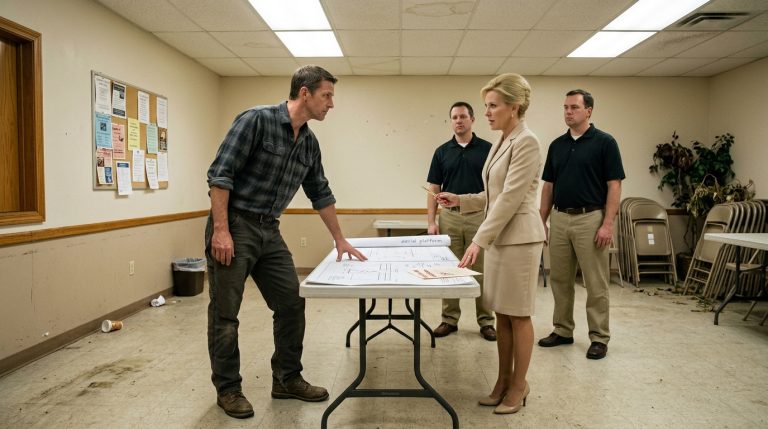
At the front, behind a folding table that looked like it might collapse under the weight of her ambition, sat Karen Miller. She was wearing a structured navy blazer that looked out of place in the casual setting, a tactical choice for authority. As I moved through the crowd, the murmurs died away. It was a ripple effect—people recognized me, the ‘difficult recluse,’ and the air in the room grew noticeably tighter.
I took a seat in the back row, placing my bag on the floor. I didn’t acknowledge her. I didn’t have to. I watched her scan the room, her eyes flickering with a nervous intensity that she tried to suppress with a stiff, professional smile. She was counting heads, calibrating her dominance.
“Good evening, everyone,” she began, her voice amplified by the straining microphone. It echoed, metallic and harsh. “We are here to address the ongoing obstruction of our community development goals, and to formalize a necessary legal fund to protect our collective property rights.”
She spoke with a practiced, rehearsed rhythm, but I saw the tell—the way she gripped the edge of the table, her knuckles white. She was rushing the pacing. She wanted to force the vote before the room had time to think, before the weight of the questions she knew were coming could settle in.
I didn’t wait. I stood up. The movement was sudden, quiet, and carried the weight of absolute intent. I didn’t move toward the front; I simply stood, and the sight of me was enough to cause the room to swivel in unison.
“Madame President,” I said, my voice cutting through the microphone’s feedback with a flat, resonant clarity. I didn’t need to shout. “Before we discuss a legal fund, let’s talk about the legal status of the land you’re currently trying to develop.”
Karen froze. Her face shifted from calculated control to a mask of indignation. “Mr. Thorne, you are out of order. This meeting is for members only.”
“I am a member,” I replied, my gaze fixed on her. “And as a member, I’m requesting a formal disclosure of the engineering reports for Lake View Commons.” I walked forward now, the floorboards creaking under my boots. Every step was deliberate, calculated to maximize the pressure of the silence. “Where are they, Karen?”
The room had gone completely still. It wasn’t just the tension of a meeting anymore; it was the pressure of a shifting tectonic plate.
“We have them,” she said, her voice rising in pitch, a desperate, shrill edge appearing. “They are in the administrative files. This is a distraction—”
“A distraction from what?” I arrived at the front, setting the manila envelope on the table. It slid across the plastic surface, a heavy, dark weight in the center of her controlled environment. “The report for a development that was never surveyed? Or the consulting invoices that have been bleeding this community dry for the last three years?”
The reaction was immediate. A man in the second row stood up, his face reddening. “What are you talking about, Marcus? What invoices?”
Karen’s control shattered. She stood up, her blazer appearing suddenly too large, her posture slumping. “He’s lying! He’s trying to disrupt our progress to protect his own land!”
I opened the folder, pulling out the ledger summary. I didn’t shout. I simply held the pages up, exposing the numbers. “These are public records, Karen. They aren’t mine. They’re yours. Four thousand dollars for ‘administrative consulting’ to a firm that doesn’t exist. Fifty thousand dollars in ‘environmental mitigation’ for a beach that isn’t on the community plat.”
The room erupted. It wasn’t the organized outrage I had envisioned; it was a sudden, chaotic release of pent-up suspicion. People were shouting, voices clashing, the authority of the board collapsing in real-time as the residents began to compare their own experiences of sudden, inexplicable fines and arbitrary assessments.
Karen gripped the microphone, her knuckles bone-white, but she had lost the room. The power she had wielded—the threat of the lien, the fear of the fine—had vanished, replaced by the sudden, sharp reality of theft. She looked at me, her eyes wide, and for the first time, I saw the truth of her situation. It wasn’t just arrogance. It was raw, unadulterated fear. She was looking at the end of the world she had built, and she had no counter-move left.
I didn’t smile. I didn’t gloat. I simply stood my ground, watching the structure of her tyranny buckle under the weight of the facts. She tried to speak, her mouth moving, but the sound was lost in the roar of the community. She had wanted to force a vote, to consolidate her power, but she had instead ignited the very thing she feared most: the collective, relentless truth of the people she had tried to manipulate.
CHAPTER 6: THE LEGAL FILING
The aftermath of the meeting was not a quiet withdrawal; it was a slow, agonizing unraveling of the social fabric of Lake View Estates. People were still shouting, but the tone had shifted from outrage to a cold, biting disappointment. They looked at the board members as if they were seeing them for the first time—not as neighborhood leaders, but as accomplices.
I didn’t stay to watch the final collapse of the board’s collective dignity. I waited for Ben Carter, who was already moving through the crowd like a shark through a school of distressed fish, gathering names and contact information from the very people who had been most vocal about the fraud.
We walked out into the cool night air. The transition from the stifling heat of the center to the crisp, dark evening felt like a reprieve. My truck sat alone in the lot, its metal skin glinting under the harsh orange glow of the mercury-vapor lights.
“They’re going to fold, Marcus,” Ben said, his voice clipped and efficient. He didn’t sound triumphant; he sounded like a man who was finishing a standard procedural task. “The board members are already calling. They’re terrified of that personal liability. They’re ready to sign affidavits, ready to hand over the remaining records, and ready to distance themselves from Karen.”
I leaned against the truck, the cold steel of the fender seeping through my jacket. A sudden, sharp memory flickered into my mind—a bridge I’d once had to survey in a region where the topography shifted every time the monsoon arrived. We’d pushed too hard, relied on outdated maps, and the entire structure had nearly buckled under the weight of our logistics. This was the same feeling: the precarious threshold where strategy meets structural reality.
“She’s still not acknowledging it,” I said, looking back at the community center. Through the glass doors, I could see Karen standing alone in the corner of the room, her blazer slightly askew, her posture rigid. She wasn’t looking at the residents. She was staring into the middle distance, a woman who had lived so long in the architecture of her own lies that she no longer had a blueprint for reality.
“She won’t acknowledge it until the sheriff serves her with the injunction,” Ben said, opening his briefcase to retrieve the final legal filing. “And even then, she’ll try to pivot. These people don’t disappear; they just relocate their delusion.”
“Not this time,” I replied. I took the document from him, the weight of it in my hand feeling substantial—the physical manifestation of everything I had been building since she first stepped onto my property. “She loses the board, she loses the financial backing, and she loses the neighborhood. The injunction is just the final nail.”
We stood in the parking lot for a long minute, the silence between us filled with the logistical weight of what came next. There was the filing, the service of process, and the inevitable scramble of the HOA’s insurance firm to cut ties with a client who had become a walking liability.
As Ben drove away, I remained by my truck, the quiet settling back over the subdivision. It was a deceptive quiet. The neighborhood was changing. The power dynamics that had governed Lake View Estates for five years were being dismantled, reconfigured by the cold, precise application of law and the persistence of residents who had finally realized their own leverage.
I drove home, taking the long way around the lake. The water looked different now—not just a sanctuary, but a focal point of justice. I reached my driveway and pulled to a stop. The house was dark, Sarah likely asleep, unaware that the final phase of this campaign was already in motion.
I didn’t go inside immediately. I walked down to the fence line, the black steel posts standing in a row, a silent, disciplined formation. I traced the line of the wire with my fingers. It was taut, unyielding. It was the physical proof that order could be maintained, even in a world that thrived on chaos.
Karen Miller would be served by morning. The board would resign by the end of the week. And then, the true nature of her financial desperation—the Layer 2 reality she had fought so hard to bury beneath these “administrative fees”—would be exposed for the final time. She hadn’t just been a tyrant; she had been a desperate woman trapped by the very machines she had created to secure her status.
The wind rustled through the tops of the pines, a low, melancholy sound that filled the night. I stood there for a long time, the cold seeping into my bones, a deep, satisfied exhaustion taking hold. The objective had been defined, the terrain surveyed, and the enemy’s logistics systematically destroyed. There were no more moves for her to make.
I turned back toward the barn, my boots crunching on the dry earth. The quiet was no longer just the absence of noise; it was the presence of a hard-won peace. The fight had come to my door, and I had seen it through to the end. The final chapter was already being written; it was just a matter of waiting for the ink to dry.
CHAPTER 7: THE FINAL RECKONING
I didn’t turn off the truck’s engine until I was parked at the edge of the cul-de-sac. Karen’s house was a fortress of pretension, every bush trimmed to a geometric impossibility, every stone in the walkway laid with a level of precision that felt almost hostile. But the light on the porch was failing, a frantic, electric shudder that mirrored the internal collapse of the woman inside.
I stepped out into the night. The air was heavy, thick with the scent of ozone and the damp, metallic tang of an approaching storm. I walked up the driveway, my boots quiet on the pristine concrete. I wasn’t there for a conversation. I was there for the final administrative closure.
Before I could reach the front door, it swung open. Karen stood there, framed by the warm, amber light of the foyer. Her navy blazer was gone, replaced by a silk blouse that looked wrinkled, lived-in, and strangely fragile. Her hair, usually a rigid, immovable structure, was loose, fraying at the edges. She didn’t look like the HOA president. She looked like a ghost of herself.
“You don’t get to walk away,” she said, her voice devoid of its usual sharp authority. It was thin, brittle—the sound of someone who had spent their last ounce of strength maintaining a facade that had finally shattered.
I stopped at the base of the porch steps, keeping the distance, keeping the leverage. “The board has resigned, Karen. The insurance firm has issued a formal withdrawal. You’re done.”
She let out a dry, hacking laugh that held no humor. She held a glass in her hand—not water, not wine, but something that smelled of sharp, cheap spirits. “You think you’re so smart with your stakes and your surveys. You think you’ve cleared a path to peace. You have no idea what it costs to maintain a place like this. The fines, the assessments, the constant maneuvering—it wasn’t about the lake. It was about survival.”
“It was about theft,” I corrected, my voice a flat, unyielding counterpoint to her hysteria. “You gambled on the community’s silence, and you lost. The financials are in the hands of the district attorney. There is no survival left for you here.”
She stepped forward, her movements unsteady. “I was saving them. I was keeping the property values up, keeping the neighborhood from descending into the chaos that you brought with your ‘private property’ philosophy. I did what had to be done.”
“You did what benefited you,” I said. I pulled the final injunction from my jacket, the paper crisp and cold in the night air. “And you did it with money that didn’t belong to you. The audit uncovered the shell companies, Karen. You weren’t managing a community; you were feeding a debt that had nothing to do with this neighborhood.”
Her expression darkened, a flash of pure, unadulterated venom crossing her features. For a second, the mask of the community leader slipped entirely, and I saw the predator underneath—the same desperation I had felt in the heat of conflict in a dozen other places. She lunged, not for me, but for the papers in my hand.
I didn’t flinch. I moved with the cold, reflexive precision of a man who had spent years calculating the physics of human motion. I sidestepped, the air rushing past me as she stumbled, her own momentum carrying her down the porch steps. She hit the grass hard, the glass in her hand shattering against the stone path, the sharp, crystalline sound echoing through the quiet cul-de-sac like a gunshot.
She lay there for a moment, chest heaving, the silk of her blouse stained by the damp, dark earth. She looked up at me, her eyes wet, her face a ruin of failed ambition. “You’ve ruined everything,” she whispered.
“I didn’t ruin it,” I said, looking down at her, not with satisfaction, but with the cold, surgical detachment of an observer. “I just uncovered the foundation you built it on. It was already broken. You were just waiting for someone to point out the cracks.”
She started to sob then—not a soft, quiet release, but a jagged, tearing sound that seemed to come from the very center of her being. She wasn’t just crying for the HOA or the lake; she was crying for the loss of the control she had fought to protect, for the inevitable collapse of the reality she had so carefully constructed.
I didn’t offer a hand. I didn’t offer comfort. I simply placed the injunction on the top step, where she would see it the moment she stood up. The paper was bright, official, and undeniable in the flickering light of the porch.
I turned and walked back to my truck. The storm was finally breaking, the first heavy drops of rain beginning to fall, dark and irregular against the windshield. I started the engine, the vibration of the dash a steady, grounding force. I didn’t look back. I had my boundary, I had my sanctuary, and the threat that had attempted to erode it was gone—not by my hand, but by the weight of her own internal rot.
As I pulled away, the last thing I saw in the rearview mirror was her silhouette, kneeling in the grass, the porch light finally clicking off, leaving her in the absolute, crushing dark. The subdivision was quiet. The war was over. And for the first time in eighteen months, the silence was truly my own.
CHAPTER 8: THE SETTLEMENT OF SILENCE
The morning mist clung to the lake, a soft, white shroud that muted the world and gave the landscape a surreal, dreamlike quality. I stood on the deck I had built, my hands gripping the railing. The steel was cold against my palms, a grounding contrast to the feverish intensity of the past few weeks.
Karen Miller’s house was no longer a fortress; it was merely a building, silent and shuttered behind the morning light. The news had traveled fast—by sunrise, the subdivision was a hive of quiet, incredulous activity. The HOA board had issued an official statement, a brief, sterile document confirming their mass resignation and the appointment of an interim committee to oversee the transition.
I turned away from the lake and walked back toward the barn. My office was a disaster—stacks of paper, colored strings pinned to the corkboard, and the half-finished drafts of our legal filings still littering the drafting table. I began the process of dismantling the war room. I started with the strings, pulling them loose from the corkboard one by one, watching the map of my campaign fall away into meaningless threads.
There was a knock at the door. I looked up to see Arthur Henderson standing there, his hat in his hands. He didn’t look like the tactical ally who had stood in the courthouse lot; he looked like a neighbor.
“I heard the news,” he said, his voice quiet. “She’s packed. Or her movers are. A couple of trucks showed up an hour ago.”
I nodded, continuing to stack the files. “The financial reality of the situation didn’t leave her much choice. The house was leveraged to the hilt, and once the bank got word of the lawsuit, the timeline for her exit became measured in days, not months.”
Arthur walked further into the room, his eyes scanning the equipment, the maps, and the sheer scale of the work I had put into the defense. “You did a hell of a job, Marcus. Not just for your own land, but for the rest of us. People are walking taller today. They’re talking about the garden, about the playground repairs. The place feels… different. Lighter.”
“It’s what a neighborhood should be,” I said, my voice steady. I handed him a folder—the final summary of the forensic accounting we’d done. “Give this to the interim board. It’s the roadmap for the reclaim process. It shows exactly where the money went and who the contractors were who were feeding off the HOA. They can use it to file the recovery claims.”
Arthur took the folder, his expression grave. “You’re really done with it?”
“I am,” I said. “I came here for the peace, Arthur. I have it now.”
After he left, I spent the afternoon cleaning. I swept the sawdust from the barn floor, wiped down the survey equipment, and stored the maps in the fireproof cabinet. Each action was deliberate, a ritual of normalization. I was scrubbing away the last traces of the conflict, returning my environment to its default state of quiet, disciplined order.
Around sunset, Sarah returned from the studio. She walked in, sensing the shift in the atmosphere—the absence of the tension that had defined our house for the last few weeks. She found me on the porch, a coffee in my hand, looking out at the lake.
She stood beside me, sliding her arm through mine. We watched the sun dip behind the treeline, painting the sky in deep, bruised shades of purple and gold. The fence line—that perfect, gleaming row of steel—caught the light, holding the boundary between my land and the rest of the world.
I took a sip of the coffee, feeling the warmth spread through me. The struggle had been a crucible, a series of calculated maneuvers and agonizing risks, but the result was something I could hold on to. I looked down at my hands. They were steady.
“Is it over?” she asked, her voice barely a whisper in the quiet.
“It is,” I said.
I thought back to the lawyer’s office, the cold, grey walls of the records room, and the look on Karen Miller’s face as she sat in the dark. It was a descent that had been entirely of her own making, a product of a fear so deep and a desperation so singular that she had hollowed out her own community to feed it. She had tried to project her shadow across my lake, but in doing so, she had only illuminated her own darkness.
I reached out and touched the railing of the dock, checking the stability of a bolt I’d driven in weeks ago. It was firm. I would need to sand the wood in the spring, perhaps give it another coat of sealant, but the foundation was sound. The sanctuary was intact.
The lake shimmered, the surface broken only by the occasional ripple of a rising fish. The wind was gentle, the air crisp with the promise of a clear, cool night. The war had come, and it had been fought, and it had been won, not with violence, but with the persistence of a man who knew the value of a single, straight line.
I was finally, definitively home. The peace I had worked for, the sanctuary I had mapped out of the dust, was no longer just a potential. It was a fact. I leaned my head back against the post, listening to the silence of the trees. It was a good sound. It was the sound of a world restored to its proper dimensions.