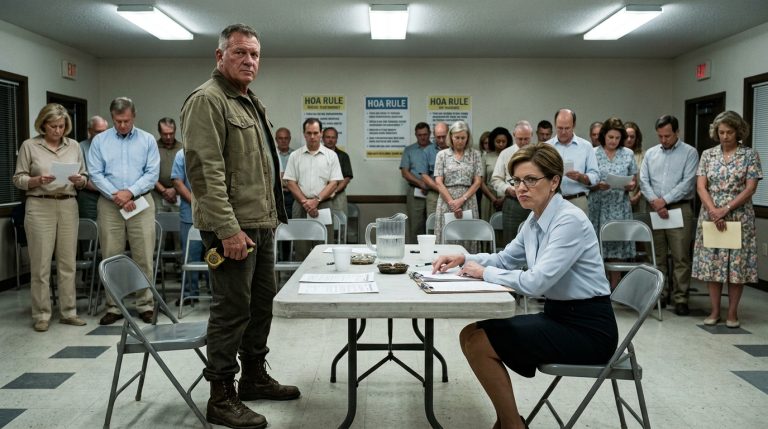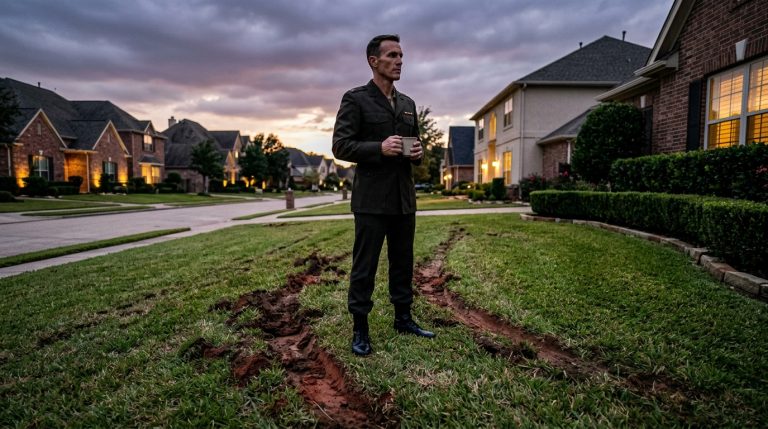
The Concrete Line: A Disabled Veteran Stands His Ground Against a Suburban Tyrant
CHAPTER 1: THE MORNING LINE
The brass casing of my Zippo felt cold against my thumb as I flipped the lid open and snapped it shut. Two seconds. Open, click, shut.
Through the front window, the morning sun hit the white hood of a Range Rover parked sideways across my driveway.
Brenda Clearwater crouched on my concrete walkway in designer jeans, her knuckles white around a red utility knife. The steel blade sliced through the thick orange polymer of my path marker with a dry, ripping sound.
I pulled open the front door. The cool desert air hit my face, smelling of damp gravel and morning shade.
“That’s federal property, Brenda,” I said. My voice came out flat, low enough that it didn’t wake Carmen upstairs.
Brenda stood up, wiping her palms against her thighs. She didn’t flinch. She just stepped back, planted her heel on the ruined plastic marker, and ground it into the dirt.
“These eyesores violate Section 4 of the architectural guidelines, Miles,” she said, her chest rising as she pulled her shoulders back. “I told you last Tuesday. Desert Winds doesn’t look like a construction zone just because you have trouble walking.”
I shifted my weight onto my right side, feeling the familiar dull ache radiate up my left thigh down to the scarred muscle. I flicked the Zippo lid again. Click.
“The federal court order says otherwise,” I said, pointing a thumb back toward the framed document sitting on my entryway table. “Those markers are non-slip guides. The judge signed off on them three weeks ago.”
“This is a private community,” Brenda said. She tossed the box cutter into her leather bag, the zipper closing with a sharp snap. “A piece of paper from a judge doesn’t override the property values of eight hundred homes.”
She walked toward the driver’s side of her Range Rover, her keys jingling in her hand. The vanity plate—HOA BOSS—glinted in the rising sun.
“Move the truck,” I said. “Carmen leaves for her shift at seven.”
Brenda paused with her hand on the door handle. She turned back, a tight, artificial smile stretching across her face.
“Tell Carmen to be careful pulling out,” she said. “The wheels of her Honda were three inches over the curb line last night. That’s a fifty-dollar fine on her windshield right now.”
She climbed into the cab, slammed the door, and fired the engine. The white SUV backed out slowly, exhaust curling into the dry morning air, leaving a black scuff mark across the edge of my driveway.
I didn’t yell. I didn’t chase the car.
I leaned down, picked up the shredded pieces of orange marker, and felt the rough, jagged edge where the blade had cleanly cut through the mounting tape. My left knee twitched under the strain, a cold bead of sweat dripping down my neck as I stood back up.
I pulled my phone out of my work shirt pocket and stopped the recording.
CHAPTER 2: PAPER TRAIL PRESSURE
The scent of burnt coffee and old paper filled Tom Rodriguez’s kitchen as he slid a thick yellow folder across the Formica table.
I set my brass Zippo down on the corner of the stack to keep the fan from blowing the top sheets away. My left leg throbbed in time with my pulse, heavy and dead from standing too long in the driveway.
“That’s six months of landscaping assessments,” Tom said, his worn, calloused fingers tapping an invoice printed on cheap printer paper. “Every household in Desert Winds got hit with a forty-dollar monthly increase back in October. Brenda said it was for ‘enhanced turf restoration.'”
I leaned over the table, resting my forearms against the edge to take the weight off my hip. “Who signed the vendor authorization?”
“Dale Pinkerton,” Tom said, grimacing as he took a sip from his mug. “As HOA treasurer, he cleared it through a company called Verdant Desert Management.”
I reached out and pulled the top invoice toward me. The paper felt strangely thin, almost damp in the morning air.
At the header, the logo for Verdant Desert Management looked like a low-resolution clip-art cactus pasted over a fake address in North Scottsdale. But what caught my eye was tucked right inside the faded blue envelope Tom had saved: a pristine, unblemished billing receipt with no tax identification number and a phone number that had two digits transposed at the end.
“Did you ever see their crews?” I asked, flipping the Zippo lid open with my free hand. Click.
“Not once,” Tom said, leaning back. “They claimed they did midnight deep-root watering because of the heat. But my bedroom faces the front common area. Nobody was out there except the coyotes.”
“It’s not about grass, Tom,” I said, my voice dropping as the math lined up in my head. “She fined Carmen fifty bucks for a wheel on the curb this morning. She’s trying to drain people out.”
“She’s been doing it to the retirees on Ocotillo Lane for a year,” Tom said, his hands clenching into fists on the table. “They can’t afford three fines a month on fixed incomes. Two of them sold their places back in January.”
I pulled out my phone, lined up the camera over the Verdant Desert invoice, and took three clear photos, making sure the missing tax ID and the unassigned phone number were perfectly in frame.
“She used the box cutter on my walkway at dawn,” I said quietly, tapping the phone screen to upload the images to my secure drive. “She thinks I’m going to pack up and list the house because my leg hurts.”
Tom watched me, his forehead creasing with caution. “Miles, she’s got the HOA attorney on retainer using our own dues. You bring this up without a ironclad lock, she’ll slap a lien on your property before sunset.”
“Let her try,” I said, picking up my lighter and slipping it into my pocket. “An HOA lien doesn’t do much good when the federal prosecutor is reading the paperwork.”
The front screen door rattled as Carmen walked in, her blue nurse scrubs wrinkled from a twelve-hour trauma shift, her eyes heavy with exhaustion. She stopped, looking between Tom and me, her gaze landing on the yellow folder spread out over the table.
“She fined me again, didn’t she?” Carmen asked, dropping her lunch bag onto the counter with a heavy thud.
“She did,” I said, standing up slowly and letting my good leg take the brunt of the strain. “And she just gave us the exact rope we needed.”
CHAPTER 3: THE TIPPING POINT
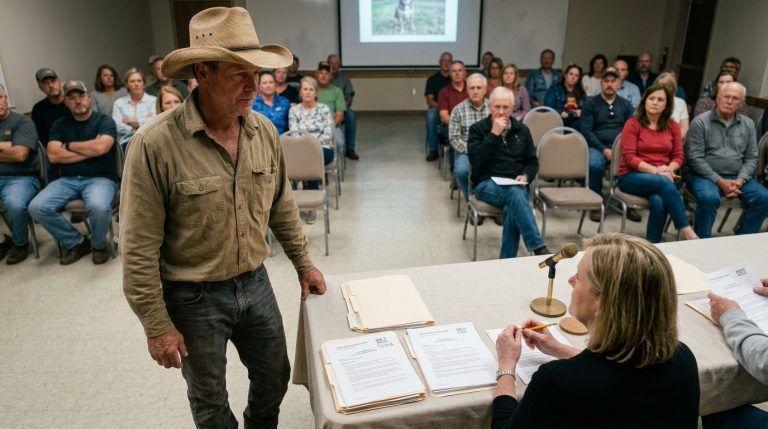
The clubhouse air conditioner hummed violently, blasting ice-cold air across seventy folding chairs jammed row by row into the carpeted room.
I sat near the center aisle, resting my left leg straight out in front of me to keep the stiffness from locking my knee. Beside me, Tom Rodriguez adjusted his glasses, a stack of copied invoices hidden flat inside his jacket pocket.
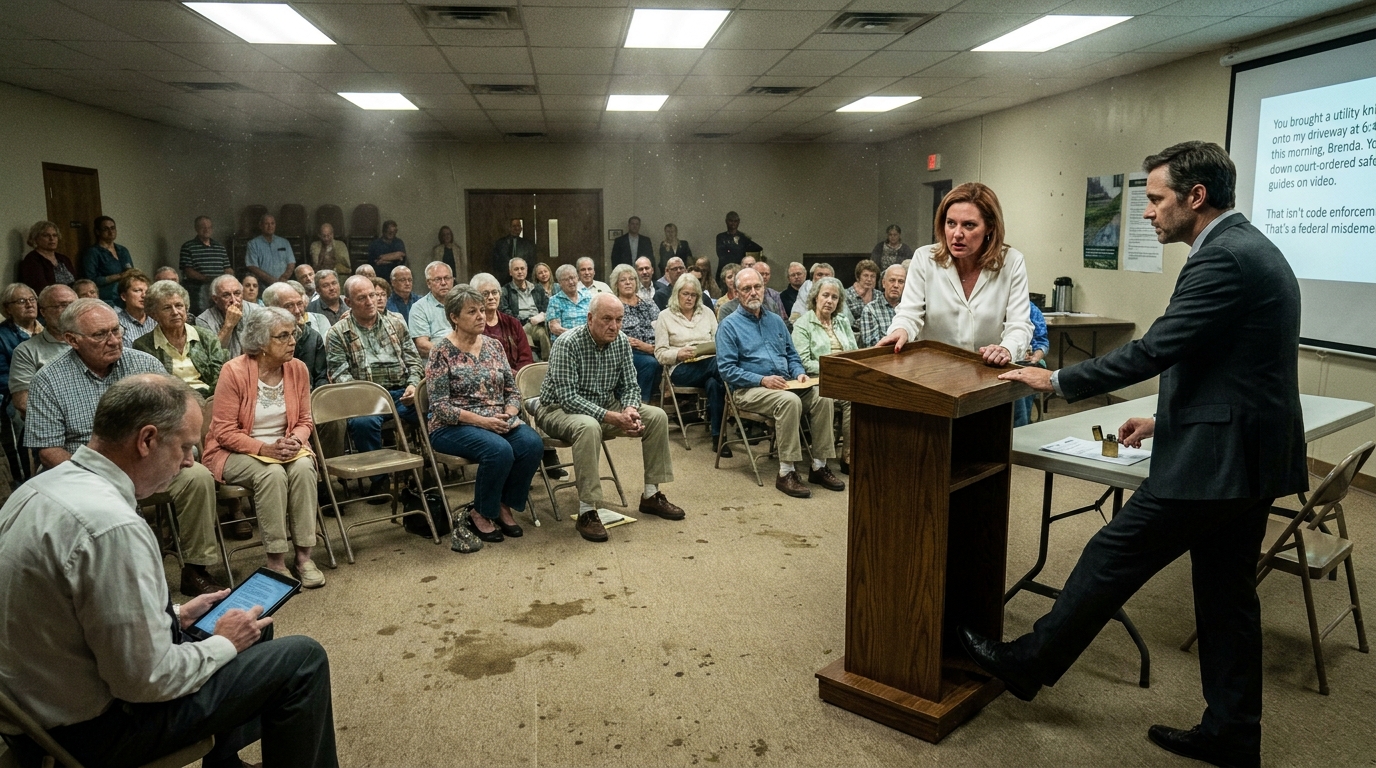
Brenda Clearwater stood behind the podium at the front, her polished fingernails gripping the edges of the dark oak wood. Dale Pinkerton sat to her left, his tablet open, fingers hovering over a spreadsheet.
“We brought everyone here tonight on short notice because our community’s architectural standards are under direct threat,” Brenda’s voice boomed through the PA speakers. “Section 4 was designed to protect property values, not accommodate personal modifications that degrade the aesthetic uniformity of Desert Winds.”
A murmur rippled through the older residents sitting around us. Judy Whitmore leaned forward from the second row, nodding aggressively.
“I have submitted a formal board motion,” Brenda continued, tapping her microphone twice. “To mandate the immediate removal of all non-conforming pathway markers, painted lines, and reflective tape on private walkways across all eighty-four lots.”
“Those markers are mandated by a federal court order, Brenda,” I called out from my chair. My voice cut straight through the low hum of the crowd.
Brenda didn’t look down at me. She picked up her glass of water, took a deliberate sip, and set it down on the podium with a sharp clack.
“The board’s legal advice is clear, Mr. Miller,” Brenda said, her tone dripping with rehearsed patience. “Federal guidelines suggest reasonable accommodation, but they do not permit individual homeowners to deface visible front yards with industrial safety hazard markers.”
Dale cleared his throat, leaning toward his microphone. “The enforcement fines for non-compliance will increase to one hundred dollars per day, effective midnight.”
“One hundred dollars a day?” Tom stood up beside me, his chair legs scraping hard against the tile threshold. “Where is that money going, Dale? Because our quarterly dues jumped forty percent for landscaping, and I haven’t seen a lawnmower on Ocotillo Lane since November.”
Brenda’s posture stiffened. Her neck flushed bright red against her white silk collar, a small muscle in her jaw twitching as she glared at Tom.
“Sit down, Mr. Rodriguez,” Brenda snapped, dropping her passive-aggressive mask entirely. “Finances are not on tonight’s emergency agenda. This meeting is strictly about maintaining neighborhood standards.”
“Then let’s talk about standards,” I said, sliding my hands onto the armrests and pushing myself up onto my good foot.
I reached into my shirt pocket, pulled out the brass Zippo, and set it squarely on the small folding table in front of me. Click.
The sharp metal snap echoed in the sudden silence of the room. Brenda stared at the lighter, her lips pressing into a thin line as every eye in the clubhouse turned toward us.
“You brought a utility knife onto my driveway at 6:47 this morning, Brenda,” I said, holding her gaze. “You cut down court-ordered safety guides on video. That isn’t code enforcement. That’s a federal misdemeanor.”
CHAPTER 4: THE STING
“You are out of order, Miles!” Brenda screamed, her voice cracking as she slammed her wooden gavel onto the podium.
The loud bang bounced off the folding chairs, but nobody moved. Tom Rodriguez stepped forward from the row beside me, pulling three thick paper packets from inside his jacket and dropping them directly onto the front table.
“Page one is the federal compliance order signed by Judge Patricia Hernandez,” Tom said loudly, turning to face the crowd of seventy homeowners. “Page two is a bank audit showing ninety-six thousand dollars transferred from our reserve fund to Verdant Desert Management—a company registered to Dale Pinkerton’s home address.”
Dale’s face turned gray. His hands flew across his tablet, trying to shut down the screen, but his fingers trembled so hard he dropped his stylus onto the floor.
“This is a smear campaign!” Brenda shouted, her hands clutching the podium until her knuckles turned ghostly white. “You have no right to circulate unapproved documents at a board meeting! Security, clear the room!”
The double doors at the back of the clubhouse swung open with a heavy thud.
Carmen stood in the doorway, wearing her dark blue nurse scrub jacket over her shoulders. Beside her walked a sharp-featured woman in a navy tailored suit, carrying a black leather briefcase.
Judge Patricia Hernandez walked down the carpeted aisle, her low heels clicking against the floor with steady, unhurried rhythm.
“You won’t be clearing the room, Mrs. Clearwater,” Judge Hernandez said, stopping right beside my chair. She looked up at Brenda, her expression cold and unreadable. “I am here to oversee the enforcement of Civil Case 402, which your board has willfully defied.”
Brenda’s chest heaved. She looked from the judge to Dale, her mouth opening and closing without making a sound.
“This board meeting is adjourned!” Brenda shrieked, grabbing her leather bag off the table and making a desperate dash toward the side exit door behind the podium.
“I wouldn’t take another step, Brenda,” I called out, my voice steady as I picked up my Zippo and snapped it shut. Click.
In the side hallway, two men in dark suits stepped out from the shadows, blocking the emergency exit. The lead officer pulled an identification badge from his belt and held it up into the bright fluorescent light.
“Agent Walsh, FBI,” the man said, his voice flat and heavy. “Brenda Clearwater and Dale Pinkerton, do not touch those computers.”
CHAPTER 5: THE COLLAPSE
Brenda turned slowly, her heels skidding against the linoleum. She pointed a trembling finger straight at my face, her voice rising into a sharp, hysterical shrieking that echoed across the quiet room.
“He set this up! He’s harassing me because I wouldn’t let him ruin our community values!” She spun toward the crowd of neighbors, grabbing the edge of Judy Whitmore’s folding chair. “He’s using his military status to bully women! He threatened me in his driveway this morning!”
Judy pulled back, her mouth hanging open as she looked from Brenda’s wild eyes down to the federal badge in Agent Walsh’s hand. Nobody stood up for her. Nobody said a word.
“Mrs. Clearwater,” Agent Walsh said, stepping forward with his partner while pulling a folded paper warrant from his coat. “We have bank records from Arizona National showing two hundred and fourteen thousand dollars wired directly from Verdant Desert Management into an account under your name.”
Dale Pinkerton suddenly put his head in his hands, slumping forward over the board table. “I told you, Brenda,” he muttered, his voice muffled against his sleeves. “I told you the federal audit would trace the tax ID.”
“Shut up, Dale!” Brenda screamed, her face twisting as she backed up against the painted drywall.
She reached blindly into her open leather bag, her fingers wrapping around the red box cutter she had used on my driveway six hours ago. She flicked the thumb slider forward with a violent click, the bare steel glinting under the lights as she held it out toward the federal agents.
“Get away from me!” she yelled, her breath coming in ragged, shallow gasps. “You can’t do this to me! I built this neighborhood!”
I didn’t step back. I shifted my weight onto my right foot, taking one slow, heavy step down the aisle toward the front. I pulled my Zippo out, flipped the top open, and held the open casing flat in my palm. Click.
“Put the knife down, Brenda,” I said quietly. My voice was dead weight, completely level. “You aren’t fighting the HOA board anymore. You’re fighting a judge, a grand jury, and two hundred homeowners who finally see what you are.”
Brenda looked at the steel blade in her hand, then looked at the silent faces of the neighbors she had fined, bullied, and cheated for three years. Her wrist began to shake so violently the cutter rattled against her gold rings.
Agent Walsh stepped in cleanly, twisting her wrist down with one sharp movement. The red utility knife dropped onto the thin carpet with a dull thud.
Metal handcuffs clicked sharply into place around her wrists behind her back.
As the second officer led Brenda past my chair, her designer purse dragging on the carpet behind her, she stopped for one second. Her eyes were red, the arrogance completely gone, replaced by a cold, desperate panic.
“You ruined everything,” she whispered, her voice cracking.
“No,” I said, slipping my lighter back into my pocket. “You did that yourself the second you brought a blade to my front yard.”
CHAPTER 6: QUIET GROUND
The desert sun was just cresting the horizon, turning the dry air warm as I smoothed my palm over the textured top of the new non-slip marker. My knee gave a small, familiar ache, but there was no rush today. No Range Rover parked across the driveway. No shadow crouching by the curb.
Tom Rodriguez walked across his front lawn, holding two ceramic mugs. He set one down on the edge of my mailbox post, the dark coffee steaming into the cool morning air.
“New board election is set for next Tuesday,” Tom said, resting his hand against the timber post. “We’ve already got forty signatures nominating you for treasurer.”
I picked up the mug, took a slow sip, and felt the warmth settle in my chest.
“I’m an IT consultant, Tom,” I said, looking out toward the quiet street as a neighbor walked her dog past the driveway, waving gently as she passed. “Not a politician.”
“That’s why everybody wants you,” Tom replied, a quiet smile tugging at his mouth. “You just care about the rules being fair.”
The front door opened behind me. Carmen stepped out onto the porch in her fleece jacket, holding Zoe’s hand. Zoe ran straight down the walkway, her small sneakers stepping dead-center on the bright orange markers, completely sure of her footing.
“It holds,” Zoe said, jumping once on the polymer strip before looking up at me.
“It holds,” I agreed, setting my coffee down to pull out my Zippo.
I flipped the lid open, listened to the clean metal snap ring out across the yard, and closed it with a soft click. I slipped it into my pocket, reached down, and took Carmen’s hand as she walked down to stand beside me.
The street was peaceful, the sprinklers clicking softly in the distance, and under my boots, the path was completely clear.