A Rusted Trailer And A Quiet Stand: How One Common-Sense Veteran Dismantled A Neighborhood Tyrant
CHAPTER 1: THE EMPTY GRASS
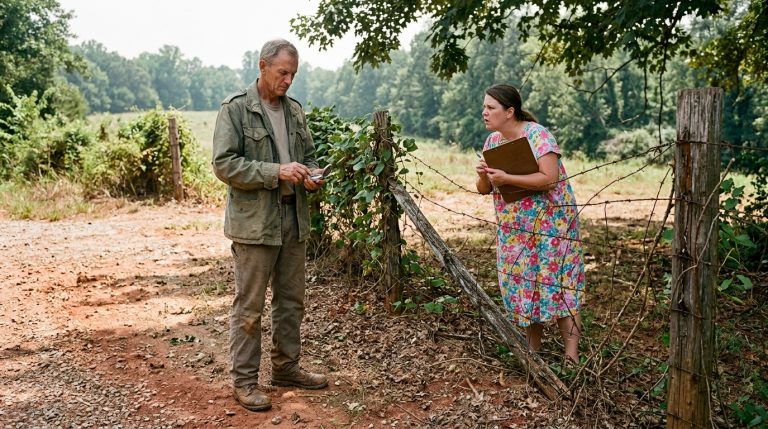
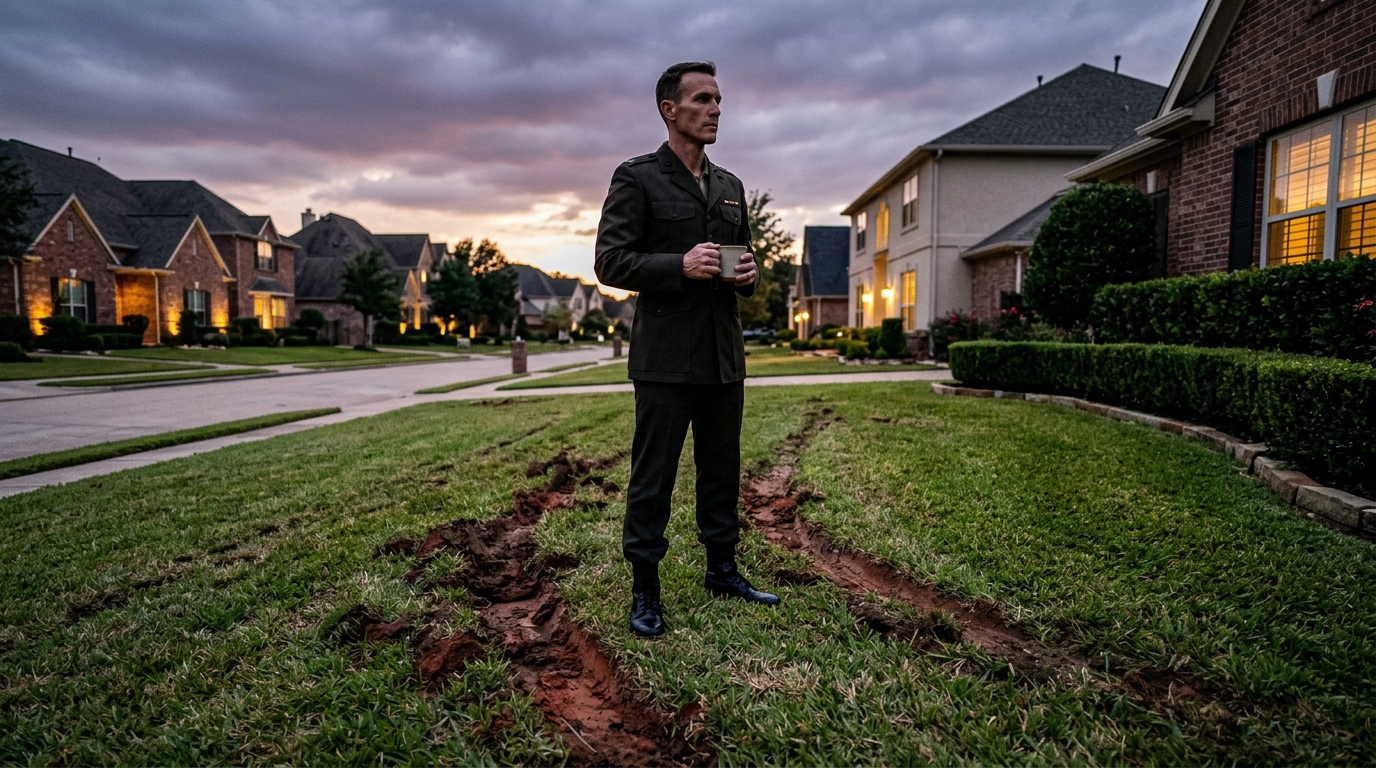
The red clay tracks cut deep through the St. Augustine grass, tearing up three years of Saturday morning watering in one violent arc. I stared down at the gouges left by the dual-axle rig, my thumb brushing the cracked rim of my old ceramic coffee mug. The coffee inside was stone cold, tasting of burnt chicory and cheap grit.
My pocket vibrated again with a sharp, insistent stutter. Karen Miller’s voice didn’t wait for a greeting.
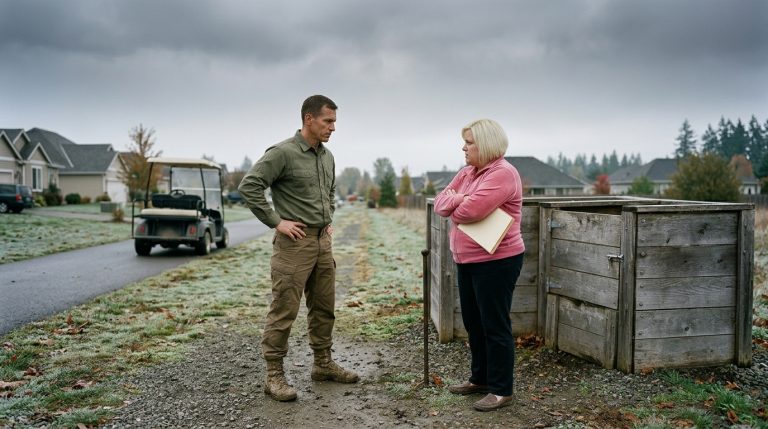
“That rust bucket has been an eyesore on your lawn for forty-eight hours, Mr. Davies,” she snapped through the speaker, her tone grating like a dry hinge. “The bylaws are explicitly clear. Trailers, campers, and commercial vehicles must be stored in a garage or an approved offsite facility.”
I kept my eyes fixed on the empty patch of crushed weeds where the sixteen-foot horse trailer had sat three hours prior. The neighbor’s lawnmower droned two streets over, a faint, rhythmic whine that did nothing to mask the sudden ringing in my ears. I didn’t shout. Shouting wastes oxygen and alerts the other person that they’ve managed to unseat your balance.
“Karen,” I said, my voice dropping into the low, flat register I used when briefing supply lines in hostile sectors. “You didn’t leave a warning tag on the door. You didn’t knock. My property line starts ten feet past that oak tree.”
A sharp, theatrical huff puffed into the receiver. “I am the president of this association, and it is my duty to preserve property values. Your violation has been processed. You can retrieve the equipment from A-1 Affordable Towing on the industrial loop. I suggest you bring cash for the storage fees.”
The line hummed with self-righteous static. I took a slow, deliberate breath, letting my shoulders drop away from my ears as I calculated the weight of the friction ahead.
“Karen,” I whispered, shifting my grip on the heavy ceramic mug until my knuckles turned white. “Before you authorized that haul, did your driver bother to check what was bolted down inside?”
CHAPTER 2: THE INDUSTRIAL LOOP
The gravel crunched under my tires with a dry, sharp rattle. A single dim light bulb hung above the greasy plexiglass window of the office, casting a yellow stain over the cracked dirt.
I stepped out of the cab, keeping my movements deliberate. The sun was dipping below the salvage yards on the western ridge, leaving long, jagged shadows across rows of impounded sedans.
Inside the small office, a man with a stained t-shirt stared blankly at a comic book splayed across the counter. He didn’t look up when the door groaned on its hinges.
“Yeah? What do you want?” he grunted, turning a page without lifting his chin.
“I’m here to retrieve my property,” I said, letting the door swing shut behind me. “A sixteen-foot aluminum horse trailer towed from Oakridge Estates earlier this afternoon.”
The man dropped the comic book flat against the counter, a greasy smirk stretching across his face. “Oh, yeah. The horse trailer. Got the paperwork?” He jabbed a stubby finger toward a laminated sign taped to the barrier.
Towing fee, four-hundred fifty dollars. Gate fee, seventy-five. Administrative fee, one-hundred twenty-five. Then the line items for daily storage and specialty transit added up fast, pushing the total past eight hundred.
“Cash only,” he muttered, the smirk widening as he waited for the predictable argument.
I didn’t reach for my wallet. Instead, I rested my palm flat against the scuffed laminate counter, feeling the grit of decades of dust under my fingers.
“And what about the living animal that was locked inside that metal box when your driver dragged it off my grass?”
The man’s eyes flickered upward, the smirk faltering for a fraction of a second. “Ain’t my problem. We just tow what the HOA authorizes. Whatever’s inside is on the owner.”
“That animal was locked down for over four hours in ninety-degree heat without ventilation while you hauled it across county lines,” I said, keeping my tone flat, stripped of all threat, leaving only the hard geometry of liability. “The state agricultural code requires an immediate inspection and a signed transit manifest for livestock transport. You didn’t file one.”
The man swallowed hard, his Adam’s apple bobbing sharply against his collar. The bravado drained out of his posture, leaving him looking suddenly small behind the glass.
“Look, man, I just work the desk,” he muttered, fumbling blindly for a ring of keys hanging from a magnetic hook on the wall. “Just get your trailer and get out of here.”
CHAPTER 3: THE YELLOW HIGHLIGHTER
The three-ring binder lay open across my kitchen counter, its plastic pockets stuffed with violation notices and photocopied covenants. I twisted the cap off a fresh yellow marker, the chemical scent sharp against the quiet air of the house.
The HOA rulebook was a thick block of glossy paper designed to intimidate people into compliance. Most residents skimmed the first ten pages and assumed the board possessed absolute, unquestioned authority over every blade of grass.
I traced the margin of Article Four, Section Two, where trailer parking restrictions were defined. The text prohibited commercial and recreational equipment from remaining in public view, but it stopped short of defining what constituted public visibility.
“Judgment call,” I muttered, dragging the tip of the highlighter across the vague phrasing.
A rule written with deliberate ambiguity is not a law; it is a weapon meant for selective enforcement. Karen relied entirely on that grey area to manufacture infractions whenever a neighbor failed to show proper deference.
I flipped further ahead, scanning the fine-levying procedures outlined in Section Seven. A mandatory fourteen-day cure period was explicitly required before any financial penalty could be assessed or forwarded to collections.
She hadn’t waited fourteen hours, let alone fourteen days. She had bypassed the formal warning track entirely to maximize the sting.
The pages turned with a dry, stiff rustle under the overhead light. Buried deeper in the amendments section, a small procedural clause caught my eye regarding board-approved contractors and conflict-of-interest disclosures.
Every contract involving a related party required a mandatory public vote and a signed disclosure form filed with the treasurer. I pressed my thumbnail against the paper, marking the spot where accountability was legally supposed to begin.
She had signed every single authorization herself without a quorum, treating community funds like a private petty cash drawer. The paper trail was right here in black and white, waiting to be pulled apart piece by piece.
CHAPTER 4: THE COFFEE SHOP LEDGER
The front porch light of Mrs. Gable’s house flickered against the azalea bushes as I stepped onto her welcome mat.
She opened the door a mere three inches, her fingers clutching the safety chain like a shield. Her eyes darted toward the street before she recognized my face in the shadows.
“Mr. Davies,” she whispered, her voice trembling slightly as she unlatched the chain. “Is there another notice?”
“No notices, Eleanor,” I said, stepping into the warm, cluttered hallway that smelled faintly of peppermint and old paper. “I’m here about your gnomes.”
Her face crumpled into a web of fine lines, the exhaustion of living under petty threats finally breaking through her guarded posture. She led me into the kitchen, where a cracked ceramic plate held a single folded piece of heavy cardstock—the violation invoice from two years prior.
“Two hundred dollars,” she said, tapping a frail finger against the fine print. “I had to pay it out of my grocery money because she said the neighborhood aesthetics would collapse if I kept Harold’s gifts by the steps.”
I placed my phone on the Formica table, displaying the photo of the business registry search I had pulled that afternoon.
“Eleanor, the company that towed my trailer last week is A-1 Affordable Towing,” I said, keeping my tone steady and low. “Do you know who owns it?”
She shook her head, her gaze fixed on the coffee ring staining the tabletop.
“A man named Frank Miller,” I continued. “He operates under the name Frank Gable. He is Karen’s brother-in-law.”
The silence in the kitchen stretched tight, broken only by the grandfather clock ticking in the hall. A slow, cold realization settled into the lines around her eyes, replacing fear with a sharp, clear anger.
“She used our fines to line her own family’s pockets,” Eleanor whispered, her knuckles whitening as she gripped the edge of the table.
“She did,” I said, sliding the folder across the counter toward her. “And you aren’t the only one on this street she targeted.”
CHAPTER 5: THE ANNUAL GAVEL DROP
Rows of plastic folding chairs were packed tight across the linoleum floor. Residents sat holding printed truth packets, their expressions shifting from quiet tension to open disbelief as they scanned the pages.
At the head table, Karen Miller gripped her wooden gavel with white knuckles, her face flushing a deep, mottled crimson.
“There are unauthorized materials being distributed,” she snapped into the microphone, her voice rising sharply over the murmur of the crowd. “Disregard every word of it. This meeting is locked to the official agenda.”
Bob the accountant stood up near the center aisle, holding his copy of the budget ledger without a trace of hesitation.
“Madam President, you listed one hundred fifty thousand dollars in administrative expenses for three straight years,” Bob said, his voice calm and level. “Can you provide an itemized breakdown, or explain why you blocked a legal records request under state property code?”
Karen slammed her gavel down with a sharp crack that rattled the water pitcher on the table. “Out of order! Sit down, Mr. Johnson, or you will be removed from the property.”
I stepped out from the aisle and walked directly to the center of the floor, placing my heavy three-ring binder on the edge of the front table.
“My name is Jack Davies,” I said, my voice cutting through the room with absolute quiet authority. “You didn’t just issue fines, Karen. You hired your brother-in-law’s company to illegally tow my property from my lawn.”
The projector behind the head table flickered to life, casting the state business filings and the family barbecue photo onto the white pull-down screen.
“A-1 Affordable Towing is registered to Frank Gable, who is Frank Miller, your husband’s brother,” I continued, watching her breath catch in her throat. “That is an undisclosed conflict of interest, and it violates every fiduciary duty this association holds.”
Karen scrambled to her feet, knocking her plastic chair back against the wall with a loud clatter.
“That is a complete lie! You have no proof, and this meeting is adjourned right now!” she shrieked, raising her gavel like a weapon.
“Actually, it’s not adjourned,” a sharp voice called out from the third row as Sarah Jenkins stood up, holding a thick legal file. “According to your own bylaws, a motion for removal can be made from the floor with a quorum present. Furthermore, you are hereby served with a civil lawsuit for willful misconduct and financial fraud.”
Sarah walked forward and dropped the papers directly onto the table in front of Karen’s trembling hands.
“The vote for removal is called,” I said, turning to face the packed room of homeowners.
Every single hand in the clubhouse shot up into the air. Karen stared down at the legal papers, her mouth opening and closing silently as the gavel slipped from her numb fingers and rolled across the table.
CHAPTER 6: THE NEW NORMAL
The folding tables in my backyard were stacked high with platters of grilled meat and bowls of potato salad, while children ran through the sprinklers near the side fence.
Mrs. Gable sat in a lawn chair by the flower beds, a quiet smile resting on her face as she looked down at her small family of ceramic gnomes standing proudly by the front steps once more.
“You missed a spot on the grill, Jack,” Sheriff David Miller said, walking over with a cold bottle of water in his hand and nodding toward the paddock where his Andalusian stallion grazed peacefully on fresh clover.
“The meat’s fine, Dave,” I said, wiping my palms on a clean rag. “The grill just runs hot on the left side.”
Over the past month, the district attorney’s indictments had wound their way through the county courts, locking down the fraudulent asset seizures and forcing Karen’s household into bankruptcy liquidation to cover legal fees.
The neighborhood bylaws had been stripped of every subjective trap and petty restriction, replaced with plain language and mandatory grace periods for everyday maintenance.
Bob the accountant walked over, holding an updated ledger that showed a healthy reserve fund free of mysterious administrative drains.
“Auditors wrapped up the final review this morning,” Bob said, tapping the binder against his thigh. “Every penny siphoned over the last decade has been tagged for restitution through the receivership.”
I nodded, watching the Rodriguez family laugh with Mark the firefighter near the patio as music drifted softly from the outdoor speakers.
No one was looking over their shoulder anymore, and no one was fearing a certified envelope arriving in the mailbox with an unearned fine attached to it.
I picked up my old ceramic coffee mug from the wooden deck railing, feeling the familiar, worn weight of it against my fingers.
The lawn was quiet, the St. Augustine grass recovering nicely where the red clay tracks had once scarred the turf.
Justice was safe, the rules made sense, and the boundary was secure.