The Engineer’s Retribution: A Meticulous Dismantling of Suburban Tyranny Through Blueprint, Law, and Calculated Truth
CHAPTER 1: THE CALCULATION OF RUIN
The damp, heavy air of Oak Creek Meadows didn’t smell like a suburban morning; it smelled like the Mississippi Delta after a levee breach. I stood at the edge of the quagmire that had once been the therapeutic foundation for my granddaughter’s progress, the smell of stagnant earth and decomposing lawn clippings clinging to the humid air. The safety yellow slide, a beacon of color I had installed with painstaking precision only eight weeks prior, now jutted out of the murky brown water like the rusted mast of a ship claiming its final resting place.
I shifted my weight, feeling the mud pull at the soles of my field boots. They were old, worn-in, and had walked the perimeter of hurricane-ravaged infrastructure in Florida, yet they felt heavy now, burdened by the realization of what was occurring beneath the surface. My granddaughter, Sarah, had built her strength on these tiles, fighting the friction of her own muscles to navigate a landscape I had engineered for her success. Now, that same engineering was being dismantled by a four-inch corrugated plastic pipe.
I didn’t need to look at the fence to know where the source lay. I had followed the erosion patterns—the subtle, unnatural scarring of the grade—back to the property line. The water wasn’t behaving; it was being commanded.
“That’s an act of God, Mr. Evans,” a voice sliced through the drizzle. It was slick, coated in that precise, condescending pity the HOA used as a rhetorical weapon.
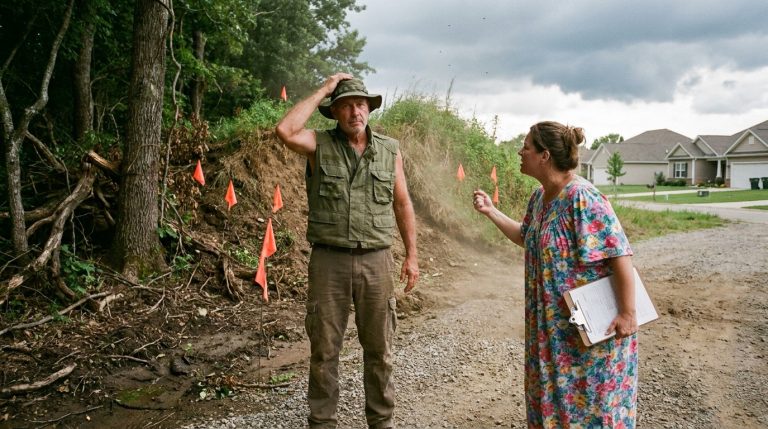
I turned. Karen, the president of the Oak Creek Meadows Homeowners Association, stood on her side of the line. She was draped in a fuchsia velour tracksuit that seemed violently at odds with the gray, saturated landscape, her arms crossed over her chest with a rigidity that mirrored the bylaws she treated as gospel. She was dry. Her manicured lawn remained an island of defiant, well-drained perfection, while my world sank into the mire.
“Perhaps you should have built on higher ground,” she continued, her lips curving into a smile that never touched her eyes. “The HOA is not responsible for your poor life choices.”
I didn’t answer. I didn’t reach for anger—anger was a volatile compound I had learned to neutralize decades ago while working with the Corps of Engineers. I simply looked past her, noticing the way her freshly planted Arborvitae trembled with every discharge of the hidden pipe behind them. I saw the tell-tale discoloration of the earth where the runoff surged.
“It’s a simple drainage issue,” I said, my voice quiet, cutting through the silence of the morning. “But you’ve miscalculated the grade, Karen.”
She stiffened, her gaze narrowing. “I have a binder full of regulations, Mr. Evans. I suggest you consult yours.”
She turned, her movements precise, leaving me alone with the gurgle of the water. As she walked away, I didn’t see a neighbor; I saw a variable in a failing system. She thought this was a dispute over property aesthetics. She had no idea she had just declared war against the man who wrote the manual for the ground she was standing on. Beneath my boots, the earth felt unstable, but in my mind, the blueprints were already unrolling, clear and sharp.
I walked back toward my garage, the air growing colder, and the first piece of the puzzle clicked into place: she had provided the evidence, but I held the pen that had defined the landscape’s truth. I reached into my pocket, my fingers brushing against the cold steel of the gate latch, and felt a familiar, grim sense of discipline. The swamp was going to be drained. And the system she had broken would be the very thing that broke her.
CHAPTER 2: THE ANATOMY OF RECONNAISSANCE
The silence of my garage was a sharp, sterile relief compared to the oppressive humidity of the yard. Here, the air was cool and smelled of motor oil, dry concrete, and the faint, metallic tang of cold-rolled steel. This was my sanctuary, a space where variables could be isolated, measured, and solved. I stepped out of my field boots, leaving the mud of the “swamp” on the heavy rubber mat by the door, and walked barefoot across the smooth, gray-sealed concrete.
The memory of the Mississippi Delta was intrusive. It had a way of surfacing whenever I saw soil lose its structural integrity—a sudden, phantom pressure in my chest, a residual tension from years spent calculating the difference between a secure dam and a catastrophic failure. The mud in my yard wasn’t just water and dirt; it was a failure of duty. Karen wasn’t just a neighbor; she was a breach in the levee.
I moved to the center of the room, toward my primary workbench. The “Command Center,” as I’d once half-jokingly called it in my mind, was organized with the same military precision I had applied to every project for the last three decades. I pulled the heavy-duty task light down, the articulation of the arm smooth and silent. It cast a harsh, focused pool of light onto the surface of the main table, where I had already staged the essential tools for the morning’s documentation.
I didn’t start with the anger. I started with the camera.
I pulled the high-resolution digital camera from its padded case and began a methodical check of the SD card. Every image of the submerged playground was there—the yellow slide, the soft-surface tiles looking like sodden sponges, the water-line staining the fence at the property line. I spent ten minutes cycling through the photos on my laptop, organizing them into a folder labeled “Evidence_Lot43.” I didn’t just want photos; I wanted data. I opened a spreadsheet and began entering timestamps, water depth measurements from my yardstick tests, and the exact coordinates of the standing pools.
The work was methodical, rhythmic. It was the “sovereign protector” lens I had worn for thirty years. I wasn’t just fixing a yard; I was performing an audit of a crime scene.
After the digital records were set, I turned to the mechanical. I pulled the soil augur from the wall rack. Its steel bit was sharp, clean, and ready. I grabbed three collection jars, labeling them with masking tape and a permanent marker: North-Unsaturated, Center-Flooded, Boundary-Discharge. I stood still for a moment, listening to the hum of the freezer in the corner. The silence was absolute, but my mind was loud with calculations.
If Karen had installed a four-inch pipe—a standard corrugated drainage line—she was likely looking at a discharge capacity of roughly forty to sixty gallons per minute under peak pressure. Given the grade of the slope behind her patio, she wasn’t just draining her patio; she was actively funneling every drop of runoff from her roofline and garden directly into the weakest point of my lot’s natural drainage path.
I set the jars aside and moved to the drafting cabinet. My hands found the handle of the third drawer without looking. I pulled out the long, thick cardboard tube, the surface dusty but the seal intact. I laid it on the drafting table and unscrewed the cap.
As I unrolled the massive blueprint—Oak Creek Meadow Subdivision, Phase 2, Storm Water Management—the paper creased with a sound like dry autumn leaves. I weighed the corners down with heavy brass drafting weights. There it was. My own signature, dated twenty years ago, sitting in the approval box at the bottom right. The lines of the neighborhood were a roadmap to her inevitable defeat.
I traced the layout with my index finger, my skin catching on the dry ink. Her lot, number 42, had been engineered with a precise 1% grade toward the street-side storm grates. There was no provision for a rear-yard discharge. None. I found the French drain notation—a system designed for passive, slow-speed percolation, not the concentrated, violent surge of a four-inch pipe.
The evidence was laid out before me, a perfect triptych of technical malpractice: the original intent of the design, the current physical state of the field, and the illegal deviation she had authored. I reached for my phone, but stopped. I wouldn’t call her. I wouldn’t engage in a shouting match over the fence. I took a photo of the blueprint section showing her lot, ensuring the engineering seals and my own signature were in the frame.
The “Karen Papers” had begun. I opened a fresh document on my computer and started the draft, my fingers moving across the keyboard with the same steady cadence I’d used to build base camps in monsoons. I wasn’t looking for a conflict; I was building a barricade. I would be precise, I would be factual, and I would be relentless. I looked up at the clock on the wall. 10:15 AM.
The first stone had been placed. I leaned back in my chair, the metal frame groaning under the weight of the moment, and stared at the blueprints. My granddaughter’s playground was sinking, but the ground she stood on was about to be reclaimed. I picked up my pen, checked the wording of the HOA bylaw I had memorized, and began to write.
CHAPTER 3: THE FORMAL ESCALATION
I folded the letter into the crisp manila envelope with the steady hands of a man who had negotiated supply lines in conflict zones. It was a document of fact, not emotion. I had laid out the timeline of discovery, referenced Article 7, Section 3 of the HOA bylaws, and attached the site map I had hand-drawn to account for the grade deviation. To any reader, it would appear as the work of an aggrieved resident seeking a neighborly fix. To a professional, it was a tactical warning.
I stepped out of the garage and into the drizzle. The air had cooled further, turning the humidity into a fine, clinging mist that coated the windshields of the cars parked in the driveways of Oak Creek Meadows. I drove slowly, my tires crunching over the damp asphalt, the weight of the manila envelope on the passenger seat feeling more significant than a stack of blueprints.
The clubhouse was a beige, unremarkable structure at the center of the development. It stood as a monument to the mediocrity Karen thrived in—a place where petty disputes over paint colors were treated with the gravity of constitutional crises. I pulled into the empty lot. The parking stall markers were faded, the white paint peeling away from the gray asphalt like dry, dead skin.
I walked toward the official HOA mailbox—a locked, wall-mounted steel unit near the entrance. I slid the envelope through the narrow slot. The metal flap made a sharp, clean clack as it snapped shut, a sound that echoed in the quiet morning.
As I withdrew my hand, I noticed a detail I hadn’t registered before. A digital log scanner was integrated into the frame of the unit, a recent addition, no doubt part of the “transparency and modernization” initiative Karen had touted in the last newsletter. I tapped my fingers on the plastic housing of the scanner. It wasn’t just a mailbox anymore; it was a tracking device. My envelope was now a timestamped data point in her system.
A shadow moved against the clubhouse window. I kept my face neutral, turning back toward my truck. I didn’t need to see her to know she was watching. The psychological warfare had begun with the clack of that metal flap. She would find the letter by noon. She would read it, likely scoff at the technical diagrams, and then feel the first prick of irritation—not because of the water, but because of the precision. She hated precision. It was the one thing she couldn’t interpret into her favor.
Driving back home, the neighborhood looked different than it had twenty years ago. The trees had matured, their roots pushing against the sidewalks, causing the concrete to buckle and heave—a slow-motion failure of the original grading I had designed. Nature was reclaiming the geometry, just as I intended to reclaim my lot.
I pulled into my driveway. The swamp in the backyard looked even more profound in the dim, gray light. The water had reached the base of the playground’s frame. I walked down the side of the house, my boots sinking into the saturated turf. The gurgle from the black pipe was still there, constant and indifferent. It was the sound of a system being forced to accommodate a flaw it wasn’t designed for.
I stood there for a long time, watching the water pool around the base of the yellow slide. This was the decoy. This was the conflict the board would focus on: the playground, the mud, the petty, visible mess. They would fight me on the rules of structures and landscaping, and they would do it because it was easy to see. They would be blind to the structural degradation happening to the sub-soil, the way the saturation was compromising the load-bearing capacity of the earth.
I turned back to the house, my mind already running the calculations for the inevitable response. She would send a notice. She wouldn’t be able to help herself. A violation notice. A fine. Something to reassert the power hierarchy she had built. I had laid the first stone of the foundation. Now, I just had to wait for her to pick up the hammer and swing it at her own foot.
The house felt quiet, but the air inside was thick with a new, sharper focus. I went to the kitchen, poured a cup of coffee, and sat at the small table by the window that overlooked the backyard. I wasn’t just a retiree with a hobby project anymore. I was an engineer on-site, and the survey had only just begun. The phone on the counter was silent, but I could hear the gears of the neighborhood turning, the slow, rhythmic grind of bureaucracy preparing to churn out a mistake. I watched the light fade behind the houses, waiting for the first sign of movement in the HOA’s rigid, rusted machine.
CHAPTER 4: THE COUNTERATTACK
The storm didn’t arrive with a warning; it struck with the sudden, violent intent of a tactical ambush. One moment, the sky was a bruised, stagnant gray; the next, it was venting a deluge that blurred the glass of my kitchen window into a smear of slate and white. The hail hit the siding of the house with a sound like scattered buckshot, a percussive rhythm that set my teeth on edge.
I didn’t reach for my coffee. I stood up, the chair scraping against the floor, and moved toward the utility door that led to the garage. If my drainage plan was going to fail, it would happen now. The saturation levels were already pushing the limits of the sub-soil; this surge would provide the data point I needed to prove the neighborhood’s collector system was being overwhelmed.
I pulled on my rain gear—the heavy, yellow-slicked coat that had seen service in three different climate zones—and grabbed the high-intensity flashlight from the workbench. I cracked the garage door. The air was frigid, smelling of ozone and wet asphalt. I stepped out into the teeth of the squall.
The backyard was unrecognizable. It had become a churning, muddy theater of physics. The water was cascading off the roof, hitting the already sodden ground with a sound that was slowly being drowned out by the roar of the wind. I didn’t head for the playground; I headed for the fence line, for the source of the rot.
I waded through the mud, the cold seeping into the seams of my boots. My target was the point where the fence met the utility easement, the precise location where I knew the neighborhood’s storm water trunk line ran. As I approached, the water was no longer flowing; it was boiling. Karen’s illegal pipe was venting a concentrated, high-pressure stream that was digging a channel deep into the earth, cutting through the grass like a blade.
And then, the sound changed.
It wasn’t just the roar of the rain anymore. It was a rhythmic, metallic thud-thud-thud—the sound of the collector pipe, overwhelmed by the volume of runoff, struggling to purge air and sediment. The pressure was building. I shone my flashlight along the property line, tracking the path of the flow toward the back corner of the lot.
My breath caught. The water was piling up against the retaining berm I had built as a secondary defense for the playground. The force of the discharge from Karen’s pipe was creating a localized vortex, scouring the dirt away from the foundations of the fence posts. The structural integrity of the entire barrier was failing.
I turned back toward the house, but stopped. A flash of fuchsia caught my eye in the strobing light of the storm. Karen was standing on her back patio, partially shielded by a sliding glass door, watching. She wasn’t hiding from the rain; she was surveying the results of her engineering. Her silhouette was rigid, triumphant. She saw the mud, the chaos, the destruction of my yard, and she clearly believed she was winning.
She didn’t see the man in the yellow coat standing in the center of the downpour. She didn’t see the calculations running behind my eyes. She only saw the target.
I pulled my phone from the inner pocket of my slicker, shielding the screen with my body. I didn’t care about the rain. I recorded a thirty-second video of the torrent, panning from the black pipe to the surging vortex and finally to the water line creeping up the base of the playground slide. I captured the date, the time, and the sheer, undisputed brutality of the flow.
Then, my mailbox sensor pinged on my smartwatch.
I looked down. Message received. The HOA board’s automated notification system. I didn’t open it yet. I knew what it was. She had found the letter, and she was already pulling the trigger on the retaliation. My phone vibrated again, the digital alert blinking like a warning light. Violation Notice: Unauthorized Structures and Improper Drainage Maintenance.
The irony was as cold as the rain hitting my face. She was automating her own indictment.
I walked back toward the garage, my movements measured, the roar of the storm now a backdrop to the clarity forming in my mind. She had just handed me the evidence of malice. By issuing a violation for “improper drainage” while the illegal discharge was actively happening, she was confirming she knew the source of the problem and was choosing to punish the victim rather than mitigate the hazard.
I entered the garage, peeling off the slicker and tossing it into the corner. My body was shivering, but my focus was sharp, crystalline. I sat down at the drafting table, the blue light of my laptop reflecting in the puddles on the concrete floor. I opened the digital notice. It was a formal, sterile document—the kind that looked authoritative, official, and dangerous.
I began to draft the response. I wasn’t going to argue. I was going to document. I attached the video I had just captured, the metadata timestamp clearly marking it during the peak of the squall. I wrote a brief, clinical summary of the “incident,” using terms like point-source discharge and structural erosion.
I wasn’t playing the game of an aggrieved neighbor. I was playing the game of a consultant writing a site-failure report. Every fine she listed, every threat of a lien she brandished, was just another line in the ledger of her eventual liability. She thought she was burying me under a mountain of paper, but she was building the very structure that would collapse on her. I looked at the screen, the cursor blinking like a heartbeat, and pressed send. The ball was in her court, and she had just stepped onto a surface that was completely, structurally compromised.
CHAPTER 5: THE COALITION
I pushed away from the drafting table. The digital “send” confirmation was still glowing on the screen, a small, triumphant pulse of light in the dim garage. But the victory was purely administrative. If I stayed in this room, I was just an engineer with a folder of grievances. To be an adversary capable of dismantling Karen’s system, I needed a broader base of leverage.
I walked out of the garage, the air outside still sharp with the smell of the damp earth after the squall. The storm had left the subdivision looking bruised. My yard was still a disaster, but the sky had cleared to a brittle, high-altitude blue. I headed toward the Garcias’ house, three doors down. David, the mechanic, was in his driveway, wiping down a set of tools with a shop rag. He looked up, his face lined with the familiar fatigue of the working class.
“Mark,” he nodded, his voice guarded.
I didn’t lead with the lawsuit or the blueprints. I led with the reality he lived every day. “The storm did a number on the storm drains, didn’t it, David? I noticed the runoff pooling at the corner by your driveway.”
David’s hands stilled. He looked at the street, his jaw tightening. “It’s not just the storm, Mark. It’s the way the water doesn’t move anymore. Every time it rains, the street-side drains just back up. It’s like the whole system is choked.”
I stepped into his space, my voice lowered. “It is choked. It’s not an accident, David. It’s a design failure that’s being exacerbated by unauthorized modifications at the top of the grade.” I reached into the satchel at my side and pulled out a single, simplified printout of the subdivision’s original grading plan. I didn’t show him the complex hydraulics; I showed him the line of the water. “I spent thirty years building infrastructure. This isn’t just about my yard. It’s about the fact that your driveway is essentially acting as a spillway because the people in charge don’t understand the physics of what they’ve altered.”
David looked at the paper, his grease-stained finger tracing the lines. He wasn’t a civil engineer, but he understood the concept of flow. “Why are you showing me this?”
“Because you were fined for a basketball hoop that didn’t violate a single municipal code,” I said, my voice steady. “I’m not looking for a mob. I’m looking for witnesses who are tired of being told that their lived reality is just a ‘bylaw violation.’ I’m building a record of systemic negligence, not a neighborhood complaint.”
He looked at me for a long time, the rag dangling from his hand. The resentment in his eyes was palpable—a dark, hardened core of frustration that had been built up over two years of arbitrary fines and petty harassment. “My wife, Maria… she’s got a list,” he said, his voice barely a whisper. “Dates, times, and every letter they sent us. We’ve been keeping it just to prove we aren’t crazy.”
“Keep keeping it,” I replied, my own pulse quickening with the grim satisfaction of the mission. “And when the time comes, I’m going to need you to sign an affidavit stating that the board refused to address these drainage issues when they were brought to light. It’s the only way to attach personal liability to their negligence.”
Leaving the Garcia house, I felt the weight of the variance matrix shifting. Was I doing this for the neighborhood, or was I just using their grievances as fuel for my own fire? The thought was a cold, intrusive phantom in my mind, but I pushed it down. The pragmatism of the task remained. I moved on to Mrs. Gable’s house, my footsteps heavy on the wet sidewalk.
She opened the door, her face pale, her hands trembling as she clutched the same gnome I had seen weeks ago. Her garden was a disaster—a reflection of a woman who had been bullied into submission. I didn’t speak of lawsuits with her. I sat with her in her kitchen, the air smelling of peppermint tea, and listened. I listened for an hour, recording nothing, simply establishing the bridge of trust. When I left, she didn’t need to ask for a plan; she just asked if I would keep fighting.
The strategy was working, but the cost was becoming clearer. Every house I visited, every story of humiliation I cataloged, added to the immense, crushing weight of the injustice. I wasn’t just building a coalition; I was absorbing the pain of an entire subdivision. By the time I reached my own driveway, the sun was setting, casting long, orange shadows across the stagnant water in my yard.
I stood at the fence line, looking toward Karen’s house. The lights were on, warm and inviting, a stark contrast to the dark, water-scarred wreckage of my own kingdom. She was in there, no doubt planning her next administrative strike. I looked down at my hands, stained with the soil of a dozen different lawns, and felt a strange, cold peace. The coalition was growing, the facts were stacking up, and the trap was slowly, methodically closing. I had the witness statements, the engineering data, and the legal counsel—all the components of an inevitability she couldn’t outrun. The next phase wouldn’t be about complaints. It would be about confrontation.
CHAPTER 6: THE POISON PILL
The garage was silent, save for the rhythmic humming of the dehumidifier working to draw the moisture out of the air—a futile task against the damp, clinging humidity that had seeped into the concrete foundations. I sat at my drafting table, the harsh light of the task lamp illuminating the twenty-page mitigation application. It was a masterpiece of technical bureaucracy. To the untrained eye, it was an earnest, expensive effort to fix a drainage problem. To an engineer, it was a finely tuned trap.
My hand hovered over the final signature line. The document was technically flawless—every slope, every flow-rate calculation, every soil-saturation analysis was grounded in the original 1998 subdivision specifications. I had spent the last three nights refining the language to ensure that, legally, the board could not deny the application without exposing themselves to gross negligence.
I checked the final attachment: the permit application for the excavation. I had hand-drawn the location of the French drain system I proposed to install, but my pencil had lingered over a specific area near the property line. During my last survey in the rain, I had spotted a slight, abnormal protrusion in the grass—a small plastic cover, barely visible, near the base of the fence.
I’d nudged the soil away with the tip of my trowel. It wasn’t just dirt; it was an electrical junction box, and it didn’t belong to any residential line I recognized. It was tied into the common-area lighting grid for the subdivision—the lights that lined the street and the path to the clubhouse. Karen hadn’t just installed a drainage pipe; she had tapped into the community power grid to keep her “English garden” pumps running, siphoning electricity from the HOA’s master meter.
I hadn’t included this in the application yet. It was too valuable, too volatile. It was the ace I would hold until the hearing.
I reached for the envelope. The paper felt heavy, substantial—the weight of three decades of structural integrity colliding with the flimsy, arrogant architecture of a tyrant’s whim. I sealed it. The sound of the adhesive strip tearing was like a shot in the quiet garage.
I stood up and moved to the window. Across the street, a maintenance truck from the utility company was idling near the clubhouse. The community was beginning to notice the irregularities; the lights on the street had been flickering since the storm, a side effect of the draw on the overloaded grid. The system was showing signs of strain everywhere. Karen’s “English garden” was acting as a parasite on the community infrastructure.
My phone buzzed on the table. Another violation notice from the HOA. I didn’t look at it. I already knew the contents: another daily fine, another threat of legal action, another attempt to force me into a defensive stance. She was trying to exhaust me. She didn’t realize that I didn’t need to be fast; I only needed to be accurate.
I picked up the application and walked out into the cool, biting air of the night. My truck was waiting in the driveway, the engine cold. I climbed in, the scent of gasoline and old leather grounding me. I drove slowly through the subdivision, passing the darkened houses, the silence punctuated only by the distant, rhythmic clicking of a streetlamp struggling to stay lit.
I stopped in front of the community mailbox again. The scanner glowed with a faint, blue LED, the gatekeeper of her fragile, rules-based kingdom. I slid the application into the slot. This wasn’t a request for help; it was an ultimatum. By tomorrow morning, the board would have to decide whether to authorize a project that would uncover the illegal pipe, the unauthorized excavation, and the siphoned power grid.
I turned the truck around, my tires crunching on the gravel. I drove past her house. The windows were dark, but the yard was illuminated by a single, high-intensity spotlight she’d installed—the one that drew power from the junction box I’d uncovered. As I drove by, the spotlight flickered, the hum of the transformer audible even over the engine.
She was running on borrowed energy, on illegal connections, on the fragile confidence of a bully who had never been forced to face a hard, objective truth. I pulled back into my own driveway, the sight of the water-scarred yard no longer causing me a spike of anger. It was just a site. A location to be restored. I shut off the engine and sat in the dark for a moment, listening to the quiet of the neighborhood, the silence of a system that was currently holding its breath. The trap was set. The application was in her hands. Now, there was nothing left to do but wait for the inevitable, grinding failure of her own design.
CHAPTER 7: THE PUBLIC RECKONING
The clubhouse was suffocating. Every beige square of the acoustic ceiling tiles felt like it was pressing down on the collective nerves of the room. It was packed—more people than I had seen in this subdivision in two decades. The air smelled of stale coffee and the damp, woolly musk of rain-soaked coats. I sat in the front row, my drafting case balanced on my knees like a shield. Beside me, Dave—my lawyer—looked perfectly at home, his calm, clinical demeanor a stark contrast to the agitated buzzing of the crowd.
At the front of the room, behind a long, folding table draped in a cheap plastic cloth, Karen sat in the center. She looked brittle. The fuchsia tracksuit was gone, replaced by a stiff, navy-blue power suit that looked like armor. She clutched her gavel, her knuckles white. She looked out at the room, her eyes darting from face to face, searching for an ally, but all she found were sets of jawlines pulled tight with shared resentment.
“We have a lot of items on the agenda tonight,” she began, her voice brittle. “Let’s try to keep the comments brief.”
She knew. I could see it in the way she avoided looking at me. She knew the mitigation application I’d filed—my “poison pill”—was the first item on the new business agenda. She had tried to bury it, to push it to the end of the meeting, but the pressure from the residents, mobilized by Arthur Henderson, had forced the board to bring it to the floor immediately.
“Item A,” she announced, the words forced. “The mitigation application for Lot 43.”
I didn’t wait for her to finish. I stood up. The movement was slow, deliberate. I walked to the front of the room, my boots echoing on the linoleum. I didn’t approach the board table; I approached the projector. I hadn’t been invited to speak, but the room went so quiet that the sound of a pin hitting the floor would have been a thunderclap.
“Madame President,” I said, my voice projecting with the effortless authority of a man who had commanded crews in disaster zones. “I believe the board has a misunderstanding of the request.”
“You are not on the agenda to speak, Mr. Evans,” she snapped, but the gavel in her hand was shaking.
“I am the lead engineer on the application,” I replied, my voice cool. “And I am here to clarify that if this board denies the application, you are formally rejecting a professional, code-compliant plan to fix a public safety hazard. A hazard that this board has been notified about for weeks.”
Dave stood up. He didn’t say a word; he just tapped his laptop. The screen behind Karen flickered to life. It showed the original 1998 subdivision storm water management plan—my plan. The room gasped. I could see the faces of the older residents, people like Arthur, recognizing the signature on the document. It was a stamp of legitimacy that Karen couldn’t erase.
“Mr. Evans isn’t just a resident,” Dave said, his voice booming. “He is the author of the neighborhood’s drainage integrity. And tonight, he’s showing you how that integrity was destroyed.”
Karen tried to speak, to yell over us, but the room was already turning. Someone from the back shouted, “Let him talk!” Then another. The dissent was a low, rising hum that became a roar. Karen stood up, her face turning a mottled, furious red, and she slammed the gavel down—once, twice, three times. But the noise in the room didn’t stop. It was a structural failure of her own authority.
I clicked the remote. The screen shifted to the footage from the night of the squall: the high-pressure vortex, the failing fence posts, the pipe hidden behind the Arborvitae.
“This isn’t a playground issue,” I said, my eyes locked on the board members. They were shrinking into their chairs, avoiding my gaze, realizing they were being dragged into the wreckage of Karen’s ego. “This is an issue of gross negligence and the siphoning of community power to maintain an illegal alteration.”
I turned to Karen. She looked small now, the navy suit no longer armor but a shroud. She started to stutter, to try and justify the “improvements” to her garden, but the truth was in the room, physical and undeniable. She had broken the system, and the system—the very rules she had used to terrorize others—was now the weight pinning her to the floor. The board members were looking at her not with loyalty, but with the cold, calculating eyes of people who had just realized they were going to be fined into bankruptcy because they had followed her lead.
The room erupted into a chaos of accusations. I didn’t need to say another word. I stepped back, the remote in my hand feeling light. The truth didn’t need to be argued; it just needed to be seen. Karen was shouting, but no one was listening. Her kingdom had dissolved in the cold, clear light of engineering facts.
CHAPTER 8: THE FINAL GRADE
The drive home from the clubhouse was the shortest journey of my life, yet the asphalt felt like it was shifting under my wheels. I pulled into my driveway, the engine ticking as it cooled in the damp night air. Karen’s house, dark and defiant, sat like a tombstone at the end of the cul-de-sac. The spotlight she’d installed—the one siphoning off the community grid—was dead. Someone from the utility company must have finally cut the line, or perhaps the junction box had finally shorted under the strain of the night’s events. The darkness was a relief.
I walked to the backyard. The remediation crew had already arrived, their heavy machinery sitting idle on the grass, looking like prehistoric beasts waiting to tear into the earth. It had been two weeks since the hearing. The legal settlement had been ratified, the HOA board gutted and reformed under Arthur Henderson’s steady, pragmatic hand.
I stood at the fence line, looking at the black corrugated pipe that had caused it all. It looked so pathetic now—just a length of plastic shoved into the dirt, an amateur attempt to command the physics of the land. I took the shovel from the stack of tools the crew had left behind. The steel bit into the ground with a satisfying, clean resistance.
I worked for hours. The rain had ceased, leaving behind a cold, crisp silence that felt like the world had been scrubbed clean. I wasn’t just removing a pipe; I was undoing a mistake. Every shovelful of mud I turned felt like a reset, a reclamation of the grade. When I finally reached the pipe, I didn’t pull it out; I shattered it. A few heavy strikes with the back of the shovel, and the plastic split, revealing the dark, stagnant water trapped within.
I watched as the water drained away, not onto my lawn, but back into the channel where it belonged, directed toward the street-side drains I had designed two decades ago. The “poison pill” had worked. By forcing the board to admit the existence of the illegal diversion, I had secured the funding to restore the original grading. The neighborhood was being returned to its intended structural state, stone by stone, yard by yard.
The repair of the playground was the final piece of the logic. The crews had finished the re-installation that afternoon. I walked over to it, my hands calloused, the smell of damp earth heavy on my clothes. It stood there in the moonlight, the bright yellow plastic and the fresh rubber tiles glowing with a resilience that felt like a personal victory. I ran my hand along the frame. It was solid. It was engineered to last, designed to provide a space for Sarah that no petty tyrant could ever take away.
I heard a sound behind me. It was the soft crunch of gravel. I turned to see Arthur Henderson standing at the edge of my lot, a flashlight in his hand. He didn’t say anything at first; he just looked at the restored grading, the water flowing steadily toward the storm drain in the street.
“It works,” he said, his voice quiet. “The whole system. Since the crews cleared those obstructions, the standing water at the corner of Elm Street has disappeared. The neighborhood is breathing again.”
“It was always designed to breathe, Arthur,” I replied, my voice hoarse. “It just needed the right conditions.”
He nodded, turning to look back toward the cul-de-sac. “She’s moving out tomorrow. The house is listed. I think… I think the community is ready to move past this, Mark. You did more than just fix your yard. You fixed the foundation of our expectations.”
I didn’t answer. I didn’t need to. I watched him walk away, his flashlight beam swinging rhythmically across the green, restored grass.
I walked back to the bench I had built for my son and his wife. I sat down, the wood cool against my back. The yard was quiet. The war of the HOA had ended, not with a bang, but with the subtle, inevitable return to a balanced state. I had used my skills, my knowledge, and my patience to dismantle a system that had been built on fear. And in doing so, I had ensured that Sarah would have her kingdom.
I looked up at the stars. The sky was immense and indifferent to the squabbles of subdivisions, but down here, in the small, measured geography of my lot, everything was finally level. The grade was set, the water was flowing, and the foundation was secure. I closed my eyes, the smell of the damp earth finally losing its bitterness, turning into the clean, refreshing scent of a new season. The engineer’s work was done, and for the first time in months, the only calculation left to make was the simple, quiet math of peace.