A Fragile Restoration: The Quiet Path of Sergeant Hale and the Unbroken Echoes of Grace
CHAPTER 1: The Threshold of Winter
The snow fell in slow, silent sheets, turning the parking lot into a colorless void. Marcus Hale sat with his back against the brick, the cold leaching through his jacket, but he didn’t move. He felt the familiar pull of the void—that place where the past was not a memory, but a constant, recurring present. Beside him, Shadow, the German Shepherd, leaned heavily against his leg, his amber eyes tracking the diner door with the dull patience of an animal that had learned the world offered little else.
Marcus raised the chipped mug to his lips. It was empty, but he held it anyway, the ceramic edge digging into his skin. His fingers trembled, a fine, rhythmic tremor that he’d stopped trying to hide. He wasn’t waiting for anything. He was just occupying space until the cold forced him to move.
Then, the chime of the door.
He didn’t look up, but Shadow’s ears flicked forward. The sound of boots on ice—not the harsh, dragging scrape of the usual patrons, but a soft, rhythmic tap. Tap. Tap.
Marcus’s hand tightened around the mug. His internal alarm, honed by years of hyper-vigilance, flared. Stop, he thought. Keep walking. “It’s too cold to be invisible, young man.”
The voice was thin, like parchment paper, but it carried an unexpected authority. Marcus finally looked up. Standing in the falling snow was a woman who looked no older than a memory, wrapped in a wool coat that had seen better decades. She wasn’t looking at him with pity; she was looking at him with the precise, clinical appraisal of someone who knew exactly how much he was hurting.
“Ma’am,” Marcus rasped, his voice sounding foreign to his own ears. “You should move along.”
Agnes Whitaker didn’t move along. Instead, she adjusted her grip on her wooden cane, looked at the empty chair across from his spot on the concrete, and sat down. She did it with a quiet, practiced grace that defied her ninety-three years.
“I’ve spent ninety years watching the world walk past things that need noticing,” she said, folding her hands over the head of her cane. She glanced down at Shadow, who was now watching her with an unnerving, silent intensity. “You look like a man who has forgotten how to be found.”
Marcus felt a sharp spike of defensiveness—a surge of the old, jagged pride. He looked away, his eyes scanning the road for an exit, a reason to get up, a way to escape this sudden, invasive light. But as he looked at the fraying cuff of his own jacket, then back to the steadiness in her eyes, he realized he didn’t have the energy to run.
“I’m just passing through,” he lied.
“We all are,” she replied, and for the first time, Marcus noticed the way her shadow seemed to blend into the gray of the snow. “But even travelers need a meal.”
Inside the diner, the door opened again. The warm, golden light spilled out, casting long, wavering shadows across the lot. Marcus looked at the door, then back at Agnes, and for the first time in years, the cold didn’t feel quite as absolute. He realized then that she hadn’t just sat down; she had breached his perimeter, and he hadn’t even thought to stop her.
Then, he saw it. Through the glass, a waitress was watching them, her hand hovering over the order pad, her expression caught between confusion and a sudden, sharp recognition that he had seen in his own mirror a thousand times before.
He wasn’t the only one being watched. And now, he realized, he was no longer alone in the dark.
CHAPTER 2: The Weight of the Welcome
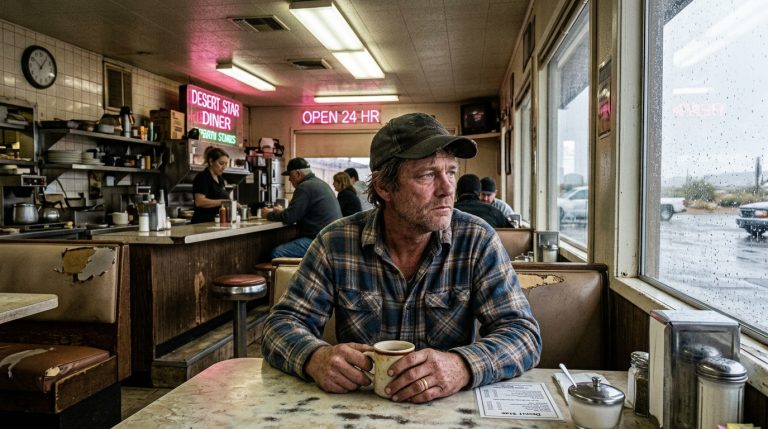
The heat inside the diner was thick, smelling of old coffee, industrial cleaner, and the faint, lingering scent of frying grease—a landscape of domestic stability that felt alien to Marcus’s senses. He stood just past the threshold, the door behind him still swinging shut with a soft, mournful thud. He didn’t want to move. If he stood still, he was a fixture, a part of the architecture. If he took another step, he was a participant.
Shadow pushed past him, his claws clicking rhythmically on the worn linoleum. The dog didn’t hesitate. He walked straight toward the warmth of the back kitchen door, his tail a steady, low-slung pendulum. Marcus felt the weight of his own jacket, heavy and damp from the melting snow, and he had to fight the urge to shiver. The transition from the biting, absolute cold of the parking lot to this humid sanctuary made his vision blur for a fraction of a second.
The sound of a radio in a barracks in Okinawa. A mistake made with a transport manifest. A supply chain failure that cost nothing in lives, but everything in reputation. The memory flared behind his eyes, cold and sharp as a razor—a psychological phantom triggered by the sudden shift in ambient temperature. Marcus blinked, forcing the image of a spreadsheet and the disappointed face of a superior into the dark corners of his mind. Not here. Not now.
“Well? You standing there until you become a coat rack, or are you going to help with those dishes?”
The voice was Rick Dalton’s, low and raspy, cutting through the hum of the overhead lights. Rick stood behind the counter, a wet rag in his hand, his eyes tracking Marcus with a mixture of suspicion and grudging curiosity.
Marcus looked at him. The man was a bulwark of routine, a creature of this diner’s ecosystem. He didn’t offer pity, and that was the only thing Marcus found he could tolerate.
“I’m here,” Marcus said, his voice sounding raspy in the sudden quiet of the diner.
He didn’t wait for an invitation. He moved toward the kitchen, his boots heavy, every step a calculated decision to keep moving forward. The kitchen was a cramped, utilitarian space, dominated by a stainless-steel sink that shone with the polished dullness of a tool used to the point of exhaustion. Lily Carter was there, turning away from a rack of steaming plates, her eyes wide as she saw him.
“You’re actually coming in,” she said, though it sounded less like a statement of fact and more like a gentle realization.
“She said to,” Marcus replied, gesturing vaguely toward the door where Agnes sat.
Lily looked toward the front of the house, then back to Marcus. She handed him an apron. It was a faded, grease-stained thing, the fabric softened by years of use. Marcus took it. He didn’t put it on immediately; he just held the fabric in his hands, feeling the coarse texture. It was a mundane object, a simple barrier against the world, but it felt like the heaviest thing he’d ever been asked to carry.
He tied the strings behind his back, his fingers moving with the mechanical precision of a soldier breaking down a rifle. It was a task he knew, a rhythm he understood. He didn’t look at Lily as he turned to the sink. He started the water, the temperature biting and hot, steam rising in a thin, white veil that obscured the grime of the day.
Outside the kitchen door, he could hear the low murmur of the diner, the clink of silverware against ceramic, the occasional laugh. It was a sound he had spent years avoiding, because sounds meant people, and people meant expectations. He began to scrub, the coarse brush against the plates becoming a meditation.
Rinse, scrub, stack.
The rhythm grounded him. It kept the phantoms at bay. But every time the kitchen door swung open, allowing a glimpse of the front, his eyes instinctively searched for Agnes. She was still at her table, her hands folded, a cup of tea untouched before her. She wasn’t watching him, but her stillness felt like an anchor.
He wondered, briefly, what she wanted. It was easy to believe she was just kind—that she was a saint of the small-town outskirts. But Marcus had learned that there was always a reason for someone to be that present. He felt a sudden, sharp spike of suspicion. Was she collecting something? Was she watching him because he was a puzzle she hadn’t quite solved, or because she saw a reflection of her own internal damage in the way he held his shoulders?
He squeezed the sponge hard, water running down his wrists, cold and hot at the same time. Shadow was sitting near the back exit, his ears swiveling to capture the sounds of the room, his amber eyes focused on the threshold of the kitchen. The dog was his pulse—steady, watchful, loyal.
The door swung open again. It was Lily, carrying a stack of plates. She stopped just behind him, waiting for him to finish the one he was working on. The space was tight, and her presence was a warmth he hadn’t realized he was hungry for.
“You don’t talk much, do you?” she asked, her tone light, trying to bridge the gap of his silence.
“Not much to say,” Marcus replied, not turning around.
“That’s okay. Rick talks enough for three people. We need someone who just gets the job done.” She placed the plates down. “You know, the last guy who stood at that sink just dropped his apron and walked out mid-shift. Never saw him again.”
Marcus paused, the brush hovering over a plate. “Why did he leave?”
Lily shrugged, a movement that rippled through her ponytail. “Some people don’t like the quiet. Some people can’t stand the thought of being found, even if they’re the ones doing the hiding.”
She turned and left, the door swinging shut behind her, leaving Marcus in the rhythmic, steaming silence of the kitchen. The comment sat in his mind like a stone. Being found. He looked down at the soapy water, seeing his own reflection—a man with tired eyes and a jaw clenched against the world. He wasn’t hiding, he told himself. He was just surviving.
But as he looked at the plate in his hand, a chip in the rim catching the light, he realized he didn’t know the difference anymore. He went back to the scrubbing, the repetition now flavored with a new, nagging doubt about the nature of the shelter he had just accepted.
CHAPTER 3: The Inventory of Quiet Things
Marcus didn’t leave the kitchen when the shift ended. He stayed until the water in the sink grew cold and gray, leaving a scum of starch and grease against the steel. He scrubbed the sink down, his movements slower now, the initial adrenaline of “work” replaced by a dull, aching fatigue that settled deep into his lower back.
Rick Dalton stood at the pass-through window, counting the register. He didn’t look at Marcus, but he didn’t tell him to leave, either.
“You did alright,” Rick said, his voice flat, devoid of praise but free of the earlier suspicion. “You’re back at six. Not five, not seven. Six.”
Marcus nodded, pulling the apron strings loose. They were damp, clinging to his shirt. “Six,” he repeated.
As he walked toward the back door, his boots thumping softly on the rubber mats, he passed a shelf where cleaning supplies and extra diner stock were piled in a disorganized heap. His eyes caught a flash of something out of place—not a mop or a bucket, but a small, leather-bound notebook tucked behind a crate of napkins. It wasn’t a logbook; it was too small, the leather cracked and worn at the edges.
Marcus didn’t touch it. He just saw it. He walked past, the cold air from the back door greeting him like a familiar friend, and he stepped out into the night.
The temperature had dropped further. The parking lot was a landscape of blue-grey shadows, the snow reflecting the dim, amber glow from the diner’s windows. Shadow was waiting, his ears upright, his stance relaxed. When he saw Marcus, the dog gave a soft, almost imperceptible huff of air.
Marcus leaned against the brick, the cold soaking through his work clothes. He wasn’t tired in the way that meant sleep. He was tired in the way that meant his mind was finally catching up to his body. He looked back through the narrow slit of the door he’d just exited. Through the gap, he could see the back of the shelf again. The notebook.
It didn’t matter, he told himself. It was just a book. But in a place where nothing was out of place—where Rick had a rule for every glass, every utensil, every hour—a lost notebook was a discrepancy.
He stayed there for a long time, watching the snow drift. His thoughts drifted to the kitchen. He thought about the previous man Lily had mentioned, the one who left his apron behind. Where did he go? Why did he leave? He felt the weight of his own existence in this town—a temporary anchor in a shallow harbor.
“You aren’t thinking about leaving, are you?”
Marcus started, his hand moving instinctively toward his pocket, even though there was nothing there. Agnes was standing by the corner of the building, her shadow long and distorted against the snow. She wasn’t leaning on her cane; she was holding it like a staff.
“It’s late, Agnes,” Marcus said, his voice hard. “You should be inside.”
“I’ve spent a lifetime being inside,” she replied. She stepped forward, her movements efficient, almost gliding over the uneven ice. She looked at the diner, then at Marcus. “You’re looking for things that aren’t there, Marcus. You’re looking for a pattern, a tactical layout, a reason to be suspicious.”
“It’s a habit,” Marcus said.
“It’s a prison.” She looked at him then, her eyes bright and clear, reflecting the light from the building. “People think I come here for the pie. I come here because this place is a collection of fragments. Everyone here is holding onto something they’re afraid to set down. Rick, Lily, even that man who sits at the counter and talks too much. They’re all just… leftovers.”
“And me?” Marcus asked.
Agnes smiled, but it was a sad, tight thing. “You’re the one who hasn’t decided if he’s a guest or an inmate yet.”
She didn’t wait for a reply. She turned and began walking toward the road, her path steady. Marcus watched her, feeling a strange, hollow sensation in his chest. He turned back to the door. He didn’t want to go back inside, but the cold was becoming an enemy again.
When he finally pushed the door open to retrieve his gear, he stopped. The shelf. The crate of napkins had been shifted. The leather-bound notebook was gone.
His skin prickled. He had been standing right there. He hadn’t heard the door open, hadn’t heard a footstep, but someone had moved the crate. He looked toward the kitchen. Lily was at the far end, wiping down the grill, her back to him. Rick was in the office, the light glowing through the glass partition.
Marcus stood in the doorway, the freezing wind pushing against his back, and for the first time, he realized that “working” here wasn’t just a matter of scrubbing dishes. He had stepped into a house of mirrors, and someone—or something—was shifting the reflections while he wasn’t looking.
He didn’t move. He stood there, watching the kitchen, feeling the weight of the silence. He wasn’t a guest. He wasn’t an inmate. He was something else entirely, and he was being watched. He reached into his pocket, his fingers brushing the fabric, searching for the comfort of an object that wasn’t there. He was empty-handed, and for the first time in years, the emptiness felt like a threat.
CHAPTER 4: The Fracture of Routine
The kitchen went dark with a sharp, sickening pop—not the sound of a fuse blowing, but the sound of something strained to its absolute limit giving way. One moment, Marcus was watching the steam rise in the harsh fluorescence of the overheads; the next, the world vanished into a deep, impenetrable charcoal.
His first instinct wasn’t to speak. It was to drop into a crouch, his hands instinctively finding the edge of the stainless-steel counter. His heart didn’t race—it slowed, locking into that cold, rhythmic beat of a man who lived in the tension of uncertainty. Behind him, he heard a sharp intake of breath from Lily.
“Power,” she muttered, the word strained. “Rick! The transformer’s acting up again.”
The diner outside went silent. The murmur of the patrons, the clatter of silverware—everything ceased. The transition was so abrupt it felt like being submerged in water. Marcus stayed low, his hand hovering over his waistband where a tool would usually be, scanning the darkness for movement. Shadow let out a low, vibrating growl, a sound that started in his chest and seemed to rattle the floorboards beneath Marcus’s boots.
“Stay down,” Marcus said, his voice a low rasp that didn’t carry.
“I can’t,” Lily whispered back, her voice shaking slightly. “The freezer units… if they go down for more than an hour, we lose the stock. And it’s minus ten out there.”
Marcus heard her fumbling, her boots scuffing the floor. A match struck—a tiny, flickering point of orange that did nothing but deepen the shadows. Lily’s face appeared in the flare, pale and etched with a sudden, desperate anxiety. She held the match to a stubby emergency candle she’d pulled from a drawer.
The candlelight threw long, jittering shadows against the stainless steel. Marcus straightened slowly, his posture still alert. He looked toward the dining area. He could see silhouettes—heads turned, the faint glow of cell phones lighting up faces with ghostly blue radiation.
“I need to check the back panel,” Marcus said, his voice regaining its command-structure rhythm. “You stay here. Don’t go out there.”
“Why not?”
“Because,” Marcus said, his eyes fixed on the sliver of light coming from the diner’s floor, “some people don’t like it when things go dark. They take advantage.”
He moved toward the back door, Shadow stepping silently at his heel. He didn’t use the match. He navigated by memory, his hands tracing the familiar geometry of the kitchen—the sharp corner of the prep table, the cold, wet rim of the sink. He moved with a predator’s economy, ignoring the freezing draft that had started to seep in through the seals as the heating system died.
Outside, the wind was a low, mournful howl, scouring the side of the building. Marcus gripped the handle of the back door and cracked it open. The smell of ozone and wet, freezing earth hit him. He stepped out onto the loading dock, the snow already swirling around his ankles like white smoke.
He reached the utility panel. It was encased in a heavy metal housing that felt like ice beneath his gloves. He pried it open, his fingers numbing instantly. He checked the main breaker, finding the switch locked in the ‘off’ position, but it wasn’t a mechanical failure. There was a thin, jagged piece of metal jammed into the housing—not by accident, but by intent.
Someone had forced it.
He didn’t pull the metal out. He stared at it, the realization washing over him with the weight of cold iron. This wasn’t an infrastructure issue. This was a message. Or a test.
He looked back toward the diner. Agnes’s table was at the edge of the dining area, near the front windows. Even in the dim, erratic light of the patrons’ phones, he could see her silhouette. She hadn’t moved. She wasn’t holding a phone. She was just sitting there, staring toward the kitchen, as if she knew exactly where he was standing and what he was seeing.
A sudden, sharp metallic clang rang out from the front of the diner—the sound of someone kicking the front door open.
“Get off your ass, Rick!” a voice shouted—Derek Collins, thick and slurry with rage. “You think you can hide in the dark? I know you’ve got someone back there! I saw him come in!”
Marcus felt his jaw tighten. He hadn’t just been hired to wash dishes. He was a lightning rod. He looked at the jammed breaker, then at the silhouette of Agnes, then back toward the interior of the diner. The silence that followed Derek’s shout was the silence of a held breath.
Marcus didn’t run back inside to help Rick. He didn’t rush to the front. He stood on the loading dock, feeling the cold seep into his bones, and made a choice. He pulled the jammed metal from the breaker, but he didn’t flip the power back on. He left it in the ‘off’ position, letting the diner continue to sink into the darkness.
If they wanted to hunt in the shadows, he would show them exactly how dangerous it was to play in the dark. He slipped back into the shadows of the loading dock, his movements as silent as a falling flake of snow. The game had shifted, and for the first time since he’d arrived, he wasn’t just a guest; he was the terrain.
CHAPTER 5: The Shadow of the Guest
Marcus pressed his back against the corrugated metal siding of the diner. His breathing was a ghost of a sound, shallow and controlled, barely stirring the stagnant, freezing air. Beyond the thin partition of the kitchen door, Derek Collins was venting, his voice a ragged, slurry roar that filled the darkened diner like rising water.
“Rick! I know you’re in there! I saw the lights go, but I know how you operate! You think you can freeze me out?” Derek’s boot hammered against the door frame. The vibration traveled through the floor, a dull, rhythmic thud that Marcus felt in the soles of his feet.
Marcus didn’t flinch. He stayed low, his eyes tracking the sliver of space between the door and the frame. He could see a flickering shadow—Derek’s silhouette, swaying and disjointed. Shadow, still pressed against Marcus’s leg, didn’t growl. The dog was a statue, his ears pinned back, his amber eyes locked onto the movement in the dark.
Marcus checked his surroundings. The loading dock was a narrow channel, cluttered with empty crates and a rusted-out trash bin. It was a tactical disadvantage, but it provided cover. He picked up a loose metal pipe—a handle from an old pallet jack—and felt the weight of it. It was cold, biting into his palm, but it was solid.
“You’re not welcome here, Derek,” Rick’s voice emerged from the diner, low and dangerous, somewhere near the front counter. “Get out before I call the sheriff.”
“Sheriff’s busy with the drift on the highway! Nobody’s coming, Rick! Not for you, and definitely not for that drifter you’re hiding!”
Marcus closed his eyes for a heartbeat. The drifter. That was what they called him. A designation. A label to make him easier to discard. He felt the phantom pressure of the Okinawa manifest on his shoulders again—the shame of being the one who didn’t hold the line. He realized then that Derek wasn’t just a drunkard. He was a mirror. He was the manifestation of every judgment Marcus had leveled against himself, personified in a man who smelled of cheap whiskey and bitter resentment.
Derek lunged, throwing his weight against the kitchen door. The wood groaned—a high, splintering protest. The door didn’t give, but the frame buckled inward.
Marcus moved. He didn’t rush. He drifted. He slipped around the corner of the loading dock, staying in the absolute periphery of the light cast by the diner’s windows. He moved toward the kitchen door from the side, a shadow within shadows. He wasn’t acting as a soldier; he was acting as a ghost.
He reached the door just as Derek hit it again. The impact was violent. Marcus lunged, not at Derek, but at the latch. He flicked it open. The door swung inward, and Derek, caught mid-momentum, stumbled into the darkness of the kitchen, his balance shattered.
He fell, a heavy, uncoordinated mass of limbs and fabric, landing hard on the tiled floor. The sound was like a sack of grain hitting the ground.
Marcus stood in the doorway, the freezing wind rushing into the kitchen behind him, carrying the scent of the storm. He didn’t speak. He didn’t strike. He just stood there, the metal pipe held loosely at his side.
Derek struggled to sit up, his breathing ragged, his head lolling to the side. “Who—who’s there?”
The silence that filled the kitchen was heavy, pressurized. It wasn’t just the absence of light; it was the absence of everything Marcus had spent his life trying to rebuild. In that darkness, he realized he wasn’t protecting the diner. He was protecting the lie that he was still broken.
“You’re in the wrong place,” Marcus said. His voice was steady, unnervingly calm.
Derek scrambled backward, his heels scraping against the tile. “You… you’re the one. The guy from the road.”
“Get out,” Marcus said, and he took a step forward. His boots clicked against the floor, a deliberate, measured sound. “If you take one more step toward that front door, I won’t be able to stop what comes next.”
Derek scrambled to his feet, his fear finally overriding his rage. He didn’t stop to argue. He turned and bolted, his heavy boots clattering toward the front exit, crashing into chairs and tables in his frantic, sightless retreat. He threw the front door open, the light from the street casting a sharp, blinding rectangle into the room before he vanished into the snow.
The diner fell back into its deep, suffocating silence.
Marcus stood in the kitchen, the air swirling around him. He felt the adrenaline begin to ebb, leaving behind a cold, hollow space. He hadn’t fought. He hadn’t broken anything. He had used fear, the same weapon that had been used against him.
Lily’s voice drifted from near the counter, barely a whisper. “Marcus?”
He didn’t answer. He turned and looked toward the front of the room. Through the gloom, he saw Agnes. She was still sitting at her table, her hands folded over her cane. Even in the dark, he could feel her gaze—not looking at him, but through him.
He realized then that the decoy wasn’t Derek. The decoy was the idea that he could be saved by a job or a town. The real test wasn’t holding the line; it was deciding what he was going to do now that the line had been erased. He leaned the metal pipe against the wall and felt his own exhaustion—a weight that finally, mercifully, felt like it belonged to him.
CHAPTER 6: The Echo of the Wire
Marcus didn’t check the screen. He didn’t have to. The vibration against his ribs was a specific frequency, a pattern he had spent years trying to scrub from his memory, yet he knew it the moment it started. He walked out of the kitchen, his boots crunching softly on the scattered glass Derek had broken in his retreat.
He didn’t want to answer it. If he answered, he was acknowledging that he still had a place in the world that had formed him. He stood in the center of the dark diner, the cold air from the front door biting at his face. Agnes was still there, a statue in the gloom.
“The world doesn’t stop just because you do, Marcus,” she said, her voice barely a whisper in the vast, empty room.
He didn’t look at her. He pulled the phone from his pocket, the screen casting a harsh, pale blue light onto his palm. Reeves.
He pressed the side button to answer, but he didn’t bring it to his ear. He just stared at the device as if it were a bomb. The silence stretched until it felt like the walls themselves were closing in. He finally lifted it.
“Hale,” he said.
“You’re still there,” Reeves’ voice came through, metallic and flat, sounding as if he were calling from the edge of the world. “I tracked your truck’s last registered stop. Flagstaff. Why are you still in Flagstaff, Marcus?”
Marcus leaned against the counter. The darkness of the diner felt like a shroud. “I found work.”
“You found a hiding spot,” Reeves corrected. “There’s a difference. We have a contract open—high-tier, short duration. You’re the best man I know for the logistics on this. You could be on a plane by dawn. You could leave all that, whatever ‘that’ is, behind.”
Marcus looked toward the kitchen. Lily was huddled by the emergency candles, her face a pale mask of fatigue. He thought about the notebook he’d seen earlier—the one that had vanished. He thought about the jam in the breaker box. This wasn’t a random town. It was a pressure cooker, and he was realizing, with a sinking feeling, that he had been placed here—not by accident, but by a design he was only just beginning to see.
“I can’t leave,” Marcus said.
“Why not?” Reeves asked, his voice hardening. “Because of a dog? Because of a diner owner?”
“Because if I leave now, I’ll never know why I came,” Marcus replied.
He disconnected the call. The silence that followed was total. He felt a sudden, violent shiver rack his body—the cold was finally penetrating, finding the cracks he’d been trying to patch with work and rhythm. He looked at the phone, then turned it off, the screen fading to black.
“You’re a stubborn man,” Agnes said. She was standing now, her cane clicking against the floorboards as she approached him. She moved with a strange, unnatural fluidity, as if she were a part of the building itself.
“Who are you, Agnes?” Marcus asked. He didn’t ask it with anger. He asked it with a crushing, heavy exhaustion.
She stopped a few feet from him. In the near-total darkness, her eyes seemed to hold the only light in the room. “I’m a woman who has spent forty years watching men like you try to patch their own hulls with scraps of driftwood. You think you’re alone in this? You think you’re the first person to stand in this kitchen and wonder if they’re the one who caused the wreck?”
She reached out, her hand brushing the sleeve of his jacket. The touch was light, but it made Marcus flinch.
“I made a mistake,” Marcus said, the words tearing out of him, sharp and ugly. “It wasn’t a combat failure. It was an inventory error. A manifest discrepancy that led to a supply chain halt in a sector that wasn’t supposed to be active. People were stranded. They didn’t die, but they were abandoned. I was the one who signed the papers. I was the one who missed the flag.”
He waited for her to recoil. He waited for the judgment. But Agnes just tightened her grip on her cane.
“And you’ve been running from that sheet of paper for five years?”
“It was my job to be the filter,” Marcus said, his voice dropping to a whisper. “I failed. That’s all there is to it.”
“No,” Agnes said. “That’s the lie you tell yourself so you don’t have to face the truth. You aren’t running from the mistake. You’re running from the fact that you enjoyed the authority, and you’re terrified that you’ll have it again.”
The words struck him with the force of a physical blow. He stood paralyzed, the weight of the last five years crashing down on him—the traveling, the silence, the isolation. It wasn’t penance. It was a retreat from the responsibility of being human.
The diner door creaked, then slammed shut. Rick walked in, carrying a heavy tool bag. He stopped, staring at Marcus and Agnes in the near-darkness. He didn’t look surprised to see them there. He looked tired.
“The power’s out for the night,” Rick said, his voice flat. “The lines are down a mile up the road. We aren’t opening until the plows get through.”
Marcus looked at the two of them—Rick, the man who guarded this space, and Agnes, the woman who held its history. He realized then that the decoy—the idea that he was just a drifter who had found a job—had been shattered. He was in the middle of a clearing house for people who had nowhere left to go, and the real question wasn’t how to leave, but how to survive the truth of why he had stayed.
CHAPTER 7: The Architecture of Abandonment
Marcus remained in the center of the diner, the silence of the power outage pressing against his eardrums like deep water. Rick Dalton stood near the office partition, his silhouette a heavy, immobile weight in the gloom. He didn’t look like a diner owner anymore. With the light stripped away, the sharp angles of his face and the controlled, tactical way he held his tool bag made him look like a man who had built this place specifically to wait for someone like Marcus to arrive.
“You’re not leaving,” Rick said. It wasn’t a question. It was a statement of fact that carried the weight of a final decision.
Marcus turned his head slowly toward the kitchen. The moonlight filtered through the fogged windows, creating long, distorted blades of light across the linoleum. He saw the spot where he had found the notebook earlier. It was back. The small, leather-bound book sat squarely on the center of the prep table, catching the pale, ethereal glow.
He didn’t walk toward it immediately. He let the realization breathe. He wasn’t a drifter. He was a replacement.
“How many?” Marcus asked. His voice sounded thin, stripped of all the bravado he had clung to over the last few days.
Rick didn’t pretend to misunderstand. “Agnes has been here for a long time, Marcus. People come through this town because they’re broken, or because they’re running. Most of them have nowhere else to go. We just give them a place to stand while they figure out if they’re going to survive the next mile.”
“You’re not just a diner owner,” Marcus said, his eyes shifting to the kitchen.
“I’m a caretaker,” Rick corrected. “And Agnes? She’s the architect. She knows who needs to be found. She’s been doing it since the war. She looks for the ones who still have a conscience, even if they’ve forgotten where they buried it.”
Marcus felt a sharp, cold sting of betrayal, but it was eclipsed by a sudden, jarring clarity. The manifest error. The supply chain failure. It hadn’t been a tragedy he was forced to carry alone; it had been a test he didn’t know he was taking. He looked at his own hands, the hands that had scrubbed the same plates, fixed the same hinges, and held the same line for five days.
He walked into the kitchen, his boots quiet on the floor. He picked up the notebook. It was heavy, dense with names, dates, and small, handwritten notes beside each entry. He flipped to the end. The final entry was a set of coordinates—not a destination, but a location in the mountains above town—and a name he recognized from his own past, a soldier who had served in the same unit during his second tour.
The decoy secret—that he was just a man looking for a job—lay shattered on the floor, scattered like the glass Derek had broken. The truth was far more surgical. He hadn’t arrived in Flagstaff by chance. He had been lured here by the ghosts he couldn’t stop feeding.
“She called the names, didn’t she?” Marcus asked, his eyes still fixed on the coordinates. “Every time one of us arrived, she made the call.”
Rick didn’t answer. He didn’t have to.
“You’re going to go, aren’t you?” Lily asked from the shadows. She had been standing by the back door the whole time, a witness to the unfolding. She didn’t sound sad; she sounded resigned. “Every one of them eventually goes to the coordinates. Some of them come back. Most of them just… fade away.”
“I’m not a ghost,” Marcus said.
“You were when you got here,” Rick muttered, turning back to his office. “Now you’re just a man with a choice. You want to keep running, or you want to see what’s waiting at the end of the wire?”
Marcus closed the notebook, the leather cool and dry against his skin. He looked at Shadow. The dog was waiting by the door, his posture no longer that of a victim, but of a scout. He looked at Marcus with a piercing, unwavering intelligence that seemed to ask the same question.
Marcus stepped back to the threshold of the diner. He looked at Agnes, who was watching him from the front table. She didn’t look like a saint or an architect anymore. She looked like a woman who had given everything she had to keep the memory of lost men alive, even if it meant sacrificing them to the truth.
He didn’t say goodbye. There was nothing left to say that hadn’t been articulated in the silence of the last week. He pushed the door open, the cold air hitting him with renewed force, and stepped out into the night. He wasn’t walking away from the diner; he was finally walking toward the only thing he had ever truly been afraid of: the realization that he hadn’t been abandoned, but that he had been waiting for the moment he was strong enough to return.
The coordinates were in the mountains, a long, brutal trek through the drifts, but for the first time in five years, the path didn’t look like an escape. It looked like a destination. He turned his collar up against the wind, whistled softly to Shadow, and started toward the edge of the town, leaving the warmth of the diner behind for the clarity of the ice.
CHAPTER 8: The Weight of the Summit
The ascent was a slow, agonizing erasure. With every hundred feet of elevation, the roar of the wind grew, stripping away the triviality of the diner, the neon, and the manufactured rhythm of dishwater and static. Marcus climbed, his breath a constant, jagged rhythm that burned his throat. Shadow moved ahead, his paws finding purchase in the packed crust of the drifts, his amber eyes reflecting the cold, unwavering light of the moon.
The coordinates led to a derelict fire watchtower perched precariously on a granite shelf overlooking the valley. As Marcus reached the base, the structure loomed, a skeleton of rusted iron and splintered wood. He stopped, his lungs searing, his legs trembling with the effort of the climb. He wasn’t alone.
A man sat on the bottom step of the stairs—David, a man he hadn’t seen since the manifest error in Okinawa. David looked older, his hair graying prematurely, but his eyes were steady. He was holding a small, rusted metal tag—the same type of dog tag Marcus had flipped in his pocket for five years.
“I knew you’d come,” David said, his voice carried away by the wind. “Agnes told me you were the last one.”
Marcus stepped into the light of the fire-watch lamp David had lit. “What is this, David? A reunion?”
“It’s a clearing,” David replied. He stood, his movements stiff from the cold. “Agnes isn’t an architect, Marcus. She’s a survivor of the same logistics cluster you failed. She lost her husband in that supply chain shutdown. She spent her life finding every man who signed off on those manifests and bringing them here to decide if they were going to spend the rest of their lives hiding, or if they were going to do the one thing they were too afraid to do: own it.”
Marcus felt the truth hit him—a cold, crystalline weight. The “error” wasn’t just his. It was a failure of the entire unit, a systemic rot that Agnes had meticulously tracked for decades, not for revenge, but for an accounting.
“I signed the papers,” Marcus said. He pulled the worn, bent dog tag from his pocket. It had been his tether, his punishment, and his secret. “I didn’t just fail a manifest. I looked the other way because it was easier than challenging the command.”
“We all did,” David said. “That’s why we’re here. To leave the tags. To stop the running.”
Marcus looked at the tower, then back down the valley toward the faint, amber glow of Flagstaff. He felt a profound, terrifying lightness. He walked to the center of the granite shelf, the wind howling around him like a choir. He knelt and placed his dog tag on the rock. It was a small, insignificant piece of metal, but as he let it go, the pressure in his chest—the one he had carried since the day of the error—finally dissipated.
He didn’t need the tag to remind him of his failure. He owned it now, and in owning it, he was finally free of it.
The climax didn’t come with violence. It came with the quiet surrender of a man who had finally stopped fighting his own reflection. He turned to David and nodded. They stood there, two men reconciled by the truth of their own flaws, while the mountain wind swept the past away.
The denouement was slow, measured in the rhythm of the descent. They walked back down the slope as the sky began to bleed the soft, promise-filled gray of a new dawn. Marcus reached the edge of town, the diner coming back into view. It looked smaller now, a simple wooden structure against the vastness of the horizon.
He walked to the back door, where he had spent five days scrubbing away the evidence of his own presence. He picked up his coat from the hook by the door. Lily was there, brewing the first pot of coffee. She looked at him, then at the empty space where his apron had hung.
“You’re not coming back,” she said. It wasn’t a question.
“I have a life to rebuild,” Marcus said. He reached into his tool bag, pulled out a wrench he had borrowed on the first day, and placed it neatly on the workbench—repaired, oiled, and ready for the next person who needed a purpose.
He walked out to the parking lot. His truck was buried in snow, but for the first time, he didn’t see it as a vehicle of escape. He saw it as a means of transit. He cleared the windshield, the glass clear and cold under his touch. Shadow jumped into the passenger seat, settling in with a sigh of relief.
He drove past the diner, past the spot where he had first met Agnes. She was standing on the porch, her coat wrapped tight against the morning chill. She didn’t wave. She just watched him go, her expression one of quiet, satisfied peace.
Marcus kept driving until the diner was a speck in the rearview mirror. He wasn’t running. He was moving toward a life that wasn’t built on shame, but on the quiet, steady labor of being a man who stood for something. He reached over and patted the dash. The air was clear, the road was open, and for the first time in five years, the silence inside his head was not an empty space, but a beginning.