The Paper Siege: A Retired Colonel Methodically Dismantles a Suburban Empire Built on Fraud and Lies
CHAPTER 1: THE LINE IN THE DUST
The fence wire hummed under the pressure of the midday sun, a taut, vibrating line of galvanized steel that had separated my family’s two hundred acres from the sprawl of Whispering Pines for a century. On the other side, the world was a pastel-colored fever dream. Karen stood there, encased in a pink tracksuit that seemed to hold her ego together under immense strain, her fingers clutching a clipboard like it were a holy relic.
She wasn’t just standing there; she was occupying space, a suburban force of nature that assumed the rest of the world was merely a waiting room for her directives.
“Your grandfather’s handshake is worthless, Colonel,” she said, her voice a serrated blade of entitlement. “This is Section D. You are in violation.”
I didn’t move. I didn’t reach for my weapon, and I certainly didn’t raise my voice. I leaned against a weathered fence post, the rough, silvered wood pressing into my shoulder—a texture of permanence that her pristine subdivision would never possess. My hands remained hooked in my belt, relaxed. In the Corps, I had seen men lose everything because they let their blood pressure spike before the first shot was fired. I had no intention of being one of them.
She shoved a document through the barb wire. The paper was stiff, glitzy, and bore the gaudy logo of a pine tree that looked like it had been lifted from a clip-art library in 2005. I took it, not because I accepted her authority, but because a soldier knows that you don’t fight an enemy until you’ve cataloged their ammunition.
“Fifty-two thousand, eight hundred and forty dollars and seventeen cents,” I read aloud, my voice flat, carrying across the dust-choked gap between us. I didn’t look at her. I looked at the totals, the line items for ‘unapproved outbuildings,’ and the laughable ‘general unkempt appearance.’ My eyes locked onto the bottom of the page—the signature line. It was a rubber stamp. No wet ink. No surveyor’s certification. Just a blunt, arrogant assumption of ownership.
“You’re mistaken,” I said, finally lifting my gaze to meet hers. My eyes were the only thing moving. I channeled the stillness of a command post during a siege. “This land is a survey of history, Karen. It was recorded before the first brick of your subdivision was even fired in a kiln.”
“The board voted,” she chirped, a triumphant, vapid little smile playing on her lips. “It’s annexed. You’re part of the green belt management now.”
She looked behind her at the two cronies who trailed her like shadows, their arms crossed, trying to adopt a posture of institutional power. They were playing a game of jurisdiction, but they didn’t know the rules. They thought the game was about who could yell louder over a fence. I knew it was about who could hold the quietest ground.
A tremor of rage, cold and clean, moved through my chest—not the hot, sloppy anger of a man losing control, but the focused, lethal energy of a tactician identifying a target. I folded the paper, the crease sharp as a razor, and tucked it into my back pocket. I would not argue. I would not plead. I would simply ensure that when this was over, there would be no Whispering Pines left to define ‘compliance.’
She turned, her heels digging into the dry dirt with a smug, rhythmic click. She thought she had delivered a final warning. She had actually delivered a mission briefing.
“The office is open until four,” she called over her shoulder, her tone dismissive.
I didn’t answer. I didn’t watch them walk away, either. I turned back toward my barn, the silhouette of my great-grandfather’s legacy standing firm against the horizon. As I walked, I realized the fence wasn’t just a boundary anymore; it was a front line. And in the dirt near the post, I saw something that made my heart go still: a fresh surveyor’s stake, driven into my soil without permission—and it was painted with the exact same shade of ‘whisper white’ that was currently dripping from the trim of every house in that subdivision.
CHAPTER 2: RECONNAISSANCE AT THE COURTHOUSE
The stake remained in the ground, a jagged splinter of white paint against the earthy, sun-baked complexion of my pasture. I didn’t pull it out. To pull it would be to acknowledge their jurisdiction, to engage in a petty tug-of-war on their terms. Instead, I stood over it, feeling the dry wind whip against the frayed collar of my shirt, and let the silence of the land amplify the absurdity of the intrusion. I had spent thirty years looking at blueprints, calculating the load-bearing capacity of bridges, and assessing the structural integrity of terrain under fire. I knew a false foundation when I saw one.
I walked back to the F250, my boots crunching on the gravel drive. Every muscle in my body felt the weight of the coming operation. My grandfather had built this farm on a handshake and a deed that predated the existence of the very state bureaucracy I was about to navigate. To threaten that history with a rubber-stamped piece of paper was not just a legal nuisance; it was an act of architectural violence. I didn’t reach for my phone to call them. I didn’t raise my voice. I simply cranked the ignition, the engine’s low, steady rumble a reminder that some things were built to endure, while others were built to be folded.
The drive into town was a study in stillness. I kept my hands at ten and two, watching the scenery shift from the rolling, unkempt beauty of my acreage to the manicured, sterile uniformity of Whispering Pines. As I passed their main entrance, I caught a glimpse of their community sign—a polished wooden slab that looked like it had been scrubbed of all character. I didn’t look at it with anger. I looked at it with the clinical detachment of an engineer inspecting a failed retaining wall.
The county courthouse appeared on the horizon, a limestone monolith of government authority. It was a place of archives, dust, and the slow, grinding machinery of records. It was the only terrain where I could win this, but it required an ammunition I didn’t yet possess: hard, verified, certified fact.
I parked in a spot meant for county vehicles, a minor defiance that felt right. Inside, the courthouse breathed the scent of decaying paper and floor wax. My heels clicked against the marble tiles, a rhythmic, solitary sound that echoed through the high-ceilinged corridors. I reached the clerk’s office, the glass partition reflecting my own face—a visage of neutral focus, the “Colonel” look I had perfected over three decades of service.
Brenda was behind the counter, a woman whose beehive hairdo seemed to be the only thing keeping the building’s ceiling from collapsing. She looked up, her expression a tired mask of bureaucratic fatigue.
“Records request,” I said, my voice steady, stripped of all extraneous emotion. I placed my driver’s license on the counter. Beside it, I intentionally let my retired military ID slip out. The golden eagle on the card caught the fluorescent light, an old habit of mine—establishing credibility before the first question was asked.
Brenda’s eyes shifted from the license to the military ID. Her posture, previously slumping, straightened. The weary lines around her mouth softened into a brief, professional nod.
“What can I help you with, Colonel?” she asked, her voice dropping the transactional edge it held for the general public.
“Whispering Pines Estates,” I said. “I need the original master plat, every covenant recorded since 2005, and a certified copy of the deed for my own parcel. I need to see the boundary definitions as they were originally filed.”
She tapped her keyboard, the clack of the keys sounding like a rapid-fire drill. “They’ve been keeping us busy lately, the folks from the Pines. Lots of people coming in about liens and fines. I can get you the master records.”
As she moved to the back, I waited, my pulse a steady, metronomic beat. I felt a phantom memory pull at me—the time we had to stabilize a suspension bridge in the tropics after a monsoon. We had to find the primary support cable, the one that held the integrity of the whole structure. Whispering Pines was the bridge, and I was looking for the rust in its main cable.
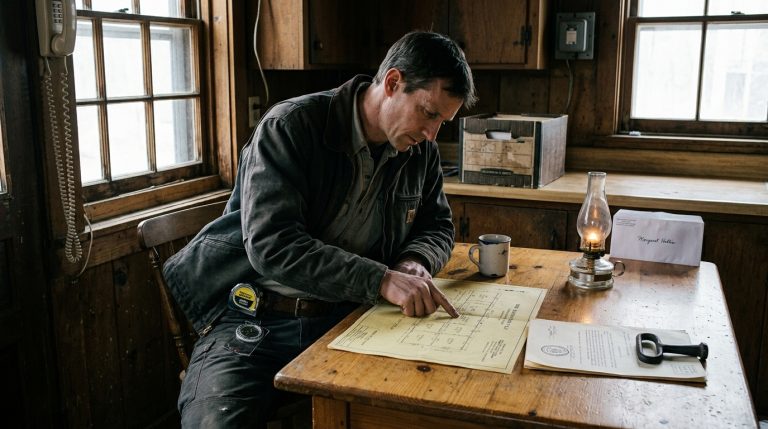
Brenda returned with a stack of oversized, heavy-stock paper and a few bound volumes that smelled of ancient glue. She laid them out with a sense of reverence. I took my time, pulling a fountain pen from my pocket—a tool, not a toy—and began to methodically trace the lines on the maps.
The original plat was clear. It was a masterpiece of survey engineering. The subdivision was a defined geometric shape, and my land was a separate, jagged anomaly sitting squarely outside its perimeter. There was a thick, ink-dark line of separation between the two.
“They’re trying to annex the undeveloped adjacent parcel,” I murmured, more to myself than to Brenda.
“That’s what they say on their filings,” she replied, leaning over the counter, her curiosity finally winning out. “But look here, Colonel. This amendment from six months ago.”
She pointed to a recent document, the paper crisp and new, standing out against the yellowing files of the past. My eyes narrowed. The thick boundary line was gone. In its place, a thin, shaky line now included my two hundred acres under the designation: Section D, Future Green Belt.
“The signature,” I said, pointing to the bottom.
“Rubber stamp,” Brenda noted, her voice hardening. “And the notary seal? It’s a conflict of interest. She notorized her own company’s expansion filing. That’s not just poor form, Colonel. That’s a violation of state notary law.”
The bridge wasn’t just rusted; the bolts had been sheared off by hand. I felt the weight of the revelation, not as a shock, but as a final piece of a tactical puzzle clicking into place. They hadn’t just made a mistake; they had fabricated a reality. They had built a fake foundation, and now, I knew exactly where to place the explosive.
“I need certified copies of everything,” I said, my voice barely above a whisper, yet vibrating with the weight of the decision. “Every page.”
Brenda began to stamp the documents, the thump-thump-thump of the official seal echoing in the quiet office. Each strike was a confirmation of the fraud. I watched her, feeling the cold, clinical satisfaction of a mission taking shape. Karen wanted a war over fence lines and paint colors. She had no idea she had just handed the keys to the kingdom to the one man who understood exactly how to tear it down.
CHAPTER 3: THE FIRST VOLLEY
The walk to the F250 felt longer than the walk inside. The envelope under my arm was heavy—a density derived not from the paper itself, but from the potential energy trapped within the ink. Every page was a coordinate, a vector for a strike I was now meticulously calculating. As I descended the courthouse steps, the Texas heat hit me like a physical barrier, sharp and dry, tasting of dust and impending change. I didn’t rush. I moved with the calibrated deliberation of a man who knew exactly what the terrain looked like when the firing started.
I reached the truck and slid the envelope into the glove box, treating it with the care one might afford a detonator. I didn’t drive away immediately. I sat in the cab, the engine idling, watching the courthouse. It was an imposing structure, built to outlast the petty tyrants who cycled through its offices. It was a place of permanence, and for the first time in weeks, I felt a resonance with it. Karen and her “Whispering Pines” were a temporary infestation; this building, these records, the laws they were codified in—these were the bedrock.
I put the truck in gear and pulled onto the main road. The route back took me past the edge of the subdivision. I saw the same white sedan creeping along the curbs, the “compliance inspector” making his rounds. I kept my eyes on the road, my expression a mask of indifference. To engage him would be a waste of momentum. My objective now was the home front. I needed to establish the perimeter, to draft the formal response that would legally serve as my opening salvo.
When I pulled into my driveway, the sight of the white surveyor’s stake—still standing in the tall grass—brought a cold clarity to my mind. It was a symbol of their reach, a stake driven into my history. I didn’t pull it. I drove past it, the tires crunching over the gravel until I reached the barn.
Inside, the light filtered through the slats in dusty, golden shafts, illuminating the heavy oak table I’d inherited. It was here that I began the work. I took the certified copies and spread them across the wood, overlapping them like a map of a battlefield. The fraudulent amendment sat center stage, the “Section D” label glaring in the soft light. I pulled out my laptop, the screen a glowing, sterile square in the warm atmosphere of the barn.
I began to draft the correspondence, not as a victim of harassment, but as a property owner asserting sovereign control. Every word was chosen for its legal weight, stripped of any emotional resonance that could be twisted against me. I wasn’t writing to Karen; I was writing for the record. I was writing for a judge who would one day look at these files and decide which reality was true.
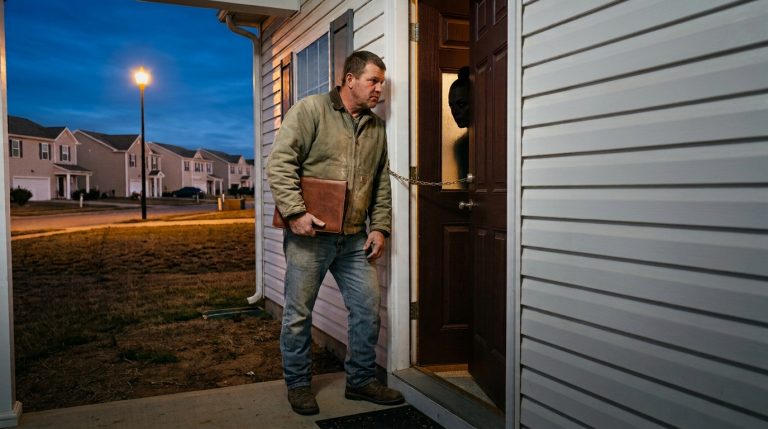
I stopped mid-sentence. A sound drifted from the driveway—a gravel crunch, slow and deliberate.
I stood, moving toward the side window of the barn. Outside, a vehicle sat idling near my gate. It wasn’t the white sedan this time; it was a black SUV, sleek and unremarkable. A man stepped out, his suit too expensive for the dust of my pasture. He stood near the gate, hands deep in his pockets, looking at the property with an appraising, clinical gaze. He wasn’t there to issue a fine. He was there to scout.
My instinct, honed over thirty years of military intelligence, was to confront him, to drive him off. But I checked the impulse. The V-4 constraint. My perception told me he was a threat, but was he? Or was he simply a reconnaissance probe sent to see how I would react to a new variable? If I marched out there, I would be playing into their hand, proving that their presence could dictate my movements.
I stepped back into the shadows of the rafters. I watched. He stayed for a full three minutes, his eyes scanning the barn, the house, the fence line. He wasn’t taking photos. He was observing, assessing the sightlines. He was looking for vulnerabilities, checking if the perimeter was as solid as I claimed.
He eventually turned, got back into the SUV, and rolled slowly away, kicking up a plume of red dust.
I waited until he was gone, then sat back down at the table. My fingers hovered over the keyboard. The letter I had been drafting now felt insufficient. A cease-and-desist was a standard defensive maneuver, but this SUV? This was a escalation I hadn’t mapped. They were sensing the friction, and they were probing for the source.
I went to my evidence binder—the three-ringed, color-coded fortress I’d been building—and added a new tab. External Probing. I logged the time, the description of the vehicle, and the man’s physical build. Then, I returned to the letter. I added a clause, specific and pointed, referencing the recent unauthorized access to my property perimeter.
I would not show them fear. I would show them that their presence was being recorded, archived, and turned into evidence. Every move they made was being folded into the case. I printed the document, the hum of the laser printer a steady, reassuring sound in the quiet of the barn. I tucked it into a clean envelope, sealed it with a heavy hand, and labeled it for certified delivery.
This was the first volley. It wasn’t just a letter; it was a notification that I had seen them, I had recorded them, and I was holding them accountable to the letter of the law. I walked out of the barn, the envelope in hand, the air feeling cooler now, the sunset turning the sky into a bruising purple. I stopped by the white surveyor’s stake. I didn’t touch it. I simply stood over it, looking toward the horizon, and recognized that the landscape of this war was shifting. They weren’t just bureaucrats anymore; they were an adversary who had realized that their target was looking back, and now, they were starting to sweat.
I walked to the mailbox at the end of the long, winding drive, the gravel turning under my feet. I raised the red flag, a simple signal of intent. I would wait for their next move, and in the meantime, I would continue to build the case, one document at a time. The barn was no longer a place of storage; it was a command center, and the quiet war had just become a contest of endurance.
CHAPTER 4: THE RESISTANCE UNITES
I didn’t run. Running is for men who have lost their grip on the terrain. I walked back toward the house, the gravel crunching beneath my boots with a familiar, grounding cadence. The laptop in the barn was a command post, and every ping was a data point. I entered, the smell of sawdust and old oak welcoming me, and crossed to the desk. The email was from David—the young man from the subdivision who had been struggling with the “Arctic White” trim violation.
The subject line was simple: They’re snooping at the perimeter.
I opened it, the glow of the screen reflecting in the cold steel of a tool rack on the wall. He hadn’t just reported movement; he had attached a grainy, high-resolution photo taken from an upstairs window. It showed a man in a windbreaker, pacing the very edge of the fence line, holding a digital measuring wheel. Not a surveyor. Not a county official. Someone working for the HOA, gathering data for a map that didn’t exist in the county records.
This wasn’t just intimidation; this was reconnaissance for an expansion of their fraudulent claim. They were preparing to finalize their hold on the “Green Belt” designation, and they were doing it on the ground, measuring the exact meters of their projected theft.
I began to type, my fingers moving with the precision of a technician. I didn’t call for a rally. I called for intelligence. I messaged David, instructing him to keep the documentation rolling. I needed timestamps, descriptions, and, if possible, the license plate numbers of any vehicles involved in these “inspections.” I wasn’t fighting back with passion; I was fighting back with a cold, analytical grid. Every movement of theirs was a move on my board.
A new email appeared, this one from Mrs. Gable. It was short, disjointed, and frantic. She had been fined for the “tackiness” of her late husband’s garden gnomes. She asked me if I thought it was worth paying the $500. I stared at the screen, the cursor blinking like a heartbeat. The money was irrelevant. The fine was a diagnostic tool, a way to measure the breaking point of the residents. If they paid, they were compliant. If they refused, they were potential allies.
I drafted a reply, but I stopped myself. I needed more than just a resistance group; I needed a network. I opened a spreadsheet, a hidden file I had encrypted on my drive. I began listing the neighbors, the violations, the dates, and the specific board members responsible for each interaction. I was building a database of their failures.
The barn air felt heavy, charged with the static of the digital war I was coordinating. I stepped out onto the porch, looking out at the vast, darkened expanse of the hayfield. The wind moved through the grass like a tide, a subtle, undulating motion that mirrored the slow build-up of the strategy I was executing. I had the records now—the official ones from the clerk’s office. I had the first signs of organized dissent. I had a clear look at the enemy’s reconnaissance.
What I didn’t have was the final link to their financial structure. I knew the name “Pristine Properties,” and I knew the smell of the self-dealing, but I needed the connective tissue—the bank records, the check trails, the signatures.
My phone buzzed in my pocket. It was a local number I didn’t recognize. I answered it, keeping my voice neutral, the voice of the Colonel.
“Miller,” I said.
“Colonel,” the voice was cautious, refined. “This is Arthur Davies.”
The attorney. The tone was professional, urgent.
“I’ve been reviewing the plat documentation you dropped off,” he continued. “You were right about the forged surveyor stamp, but there’s something else. I did a deep-dive into the Whispering Pines Articles of Incorporation. They’re filed as a 501c4 social welfare organization. Do you know what that means for a board president?”
“Tax-exempt status,” I replied, my eyes scanning the dark field, “with severe penalties for private inurement.”
“Exactly. But to pull the trigger on a formal investigation with the State Attorney General, we need a smoking gun. We need proof of money changing hands in a way that benefits a specific individual—the President, her family, her proxies. If you can get your hands on the financial minutes from the last two board meetings, the ones where the new landscaping vendor was approved, we might have enough to bypass the local sheriff and go straight to the state.”
“I’ll get them,” I said. I didn’t ask how. I didn’t ask for permission. I had been behind enemy lines before; I knew how to retrieve a high-value asset.
“Be careful, Colonel,” Davies added. “They aren’t just playing by their own rules anymore. They’re desperate. When a bully starts to feel the pressure, they don’t retreat. They reach for more dirt.”
I ended the call and stood in the darkness, the silence of the farm returning to me. He was right. The man in the windbreaker with the measuring wheel was just the beginning. They were going to try to squeeze me, and when that failed, they would turn their eyes toward the people in the subdivision who were starting to talk to me.
I looked back toward the house. The windows were dark, but the office was waiting. I needed to map the next step. I needed to know which vendor contracts were being signed, who was being paid, and when the next board meeting was scheduled. I had the intelligence of the perimeter; now, I needed the intelligence of the vault.
I walked back into the office, the glow of the monitor the only light in the room. I sat down and opened the county’s public search portal once more, my mind already working on the next phase. They wanted to annex my land. I was going to annex their secrets. The war wasn’t about the fence line anymore. It was about the ledger, and I was going to read every line of it until their kingdom turned to ash.
CHAPTER 5: THE FORENSIC WAR ROOM
The hum of the tower beside the oak table changed pitch, a high-frequency whine that set my teeth on edge before the monitor went entirely blank. My hand remained poised over the mouse, frozen. In the silence that followed, the weight of seventy-two hours of meticulous forensic accounting threatened to crush the air out of the barn. I didn’t panic; panic is a luxury for those who don’t have to account for their variables. I breathed in, the scent of dust and ancient wood filling my lungs, and began the triage.
I didn’t reach for the power switch—that would only invite a data surge. Instead, I pulled the side panel of the machine, my fingers navigating the familiar circuitry with a surgeon’s calm. This was the mechanical equivalent of a bridge failure under load. I needed to see which structural component had snapped. The hard drive, the repository of every invoice, every scanned check, and every highlight of Karen’s signature, was cold to the touch.
I pulled the drive, the SATA connection stiff and unyielding. I had a secondary, air-gapped machine in the corner—an archaic relic I kept for exactly this kind of contingency. I slotted the drive in, my movements precise and devoid of hesitation. As the machine booted, I stood back, my posture rigid, watching the progress bar. Every second of delay was a second the enemy had to notice the dip in the digital surveillance.
The system pinged to life. I accessed the partition, the file directory scrolling in a blur of white text on black background. It wasn’t the drive that had failed; it was the boot sector. The data was intact. I let out a breath I hadn’t realized I was holding.
But the reprieve was short-lived. A new notification arrived, not from the system, but from my secondary surveillance feed. One of the cameras covering the north fence line—the one bordering the Whispering Pines easement—had been disabled. No signal. Just a static-filled void where the image of the hayfield should have been.
They weren’t just probing anymore. They were actively blinding my sensors.
I moved to the window, peering through the slats. The night was a heavy, impenetrable dark, the moon obscured by a thick bank of clouds. I couldn’t see the fence line, but I could hear it—a faint, metallic scraping, the sound of wire-cutters biting into galvanized steel. My heart rate didn’t spike; it settled into a low, steady rhythm. This was the transition from the paper war to a kinetic one, and while I had hoped to keep the conflict contained to legal procedure, I had been an engineer long enough to know that you cannot control the terrain when the enemy decides to burn the forest.
I didn’t reach for a weapon. I reached for my gear: a heavy flashlight, a camera with a high-powered lens, and my logbook. If they wanted to play in the dirt, I would give them a show.
I stepped out into the night, the air biting and sharp against my face. I moved not with the heavy tread of a man rushing to a confrontation, but with the silent, deliberate gait of a scout. I stayed in the shadows of the barn, hugging the wall, my senses tuned to the wind. The scraping sound intensified—a rhythmic, sharp bite, then the groan of wire losing its tension.
They were cutting the perimeter.
I reached the tree line and dropped to one knee, the damp earth staining my trousers. Through the lens of my camera, I caught the flickering, erratic beam of a high-intensity flashlight. Two figures, shrouded in dark, utilitarian gear, were working at the section of the fence where the fraudulent survey stake had been driven. They were moving with a clumsy, panicked efficiency—not professionals, but amateurs in over their heads.
I snapped the photos, the shutter’s quiet click masked by the wind. I didn’t need to hear them speak to know who they were. The taller one had the frantic, jerky movements of a man afraid of being caught, and the shorter one was holding a digital measuring tool—the same one the man in the windbreaker had been using.
This was the evidence Davies needed. This was the physical manifestation of their desperation. They weren’t just annexing land on paper; they were physically carving their boundaries into my soil.
I took the shot, a high-resolution frame of their faces caught in the harsh glare of my own flash.
I didn’t wait for them to finish. I triggered the alarm—a simple, high-frequency remote siren I’d wired to the fence two weeks prior. The barn erupted in a sudden, piercing shriek that cut through the night like a physical force.
The figures at the fence jerked back, the wire-cutters falling into the tall grass. They didn’t linger. They scrambled back toward the edge of the woods, stumbling over the uneven terrain, their flashlight beam swinging wildly like a dying star. They vanished into the dark before the echoes of the siren had even faded.
I walked to the fence, my boots tracing the path they had taken. The wire was sheared, a clean, sharp slice through the steel, hanging loose in the cold night air. I touched the cut, the metal feeling icy and bitter under my fingers.
I didn’t repair it. I left it exactly as they had left it. I pulled my notebook from my pocket, the page already damp with dew, and recorded the time and the coordinates. They had just committed criminal trespass and property damage. They had just given me the final pieces of the state-level case we needed.
I walked back toward the barn, the weight of the evidence in my camera and my notebook feeling like a victory. They thought they had blinded me, but all they had done was walk into the center of my trap. The ledger was being written, and tonight, they had added a chapter in blood and broken wire. I sat at my table, the encrypted drive humming, and began to draft the formal complaint to the Sheriff’s Department. I wasn’t just a farmer fighting an HOA anymore; I was an engineer dismantling a collapsing structure, one brick at a time. The collapse was coming, and I was going to ensure that when it fell, it fell on exactly the right people.
CHAPTER 6: THE TROJAN HORSE
I didn’t repair the fence. Leaving the jagged wire dangling was a silent testament to their intrusion, a physical scar on the landscape that served as a visual anchor for the testimony I would soon provide. I returned to the barn, my boots heavy with the red dirt of the pasture, and spent the remainder of the night in a state of hyper-focused maintenance. I transferred the photographs of the two vandals—their faces stark and frightened in the flash’s glare—onto a encrypted flash drive, then wiped the cache of my local machine.
I didn’t sleep. Sleep is for the victor, and there was still a battle to be fought. I spent the predawn hours re-organizing my presentation, weaving the new images of the fence-cutting directly into the timeline of the HOA’s “compliance inspections.” It was no longer a story of bureaucratic overreach; it was a story of criminal escalation.
By the time the sun began to bleed over the horizon, painting the sky in colors of bruised orange and slate, I was ready. I dressed in my service uniform jacket. The brass eagles on the shoulders were slightly tarnished, a reflection of the years they had spent in storage, but they still commanded a specific, unwavering gravity. When I caught my reflection in the hallway mirror, I didn’t see a retired farmer or a disgruntled landowner. I saw an officer prepared to command a field.
The drive to the county courthouse was a journey through the territory of the enemy. I passed the Whispering Pines entrance again. This time, there were no compliant sedans patrolling. Everything was quiet, a superficial, forced stillness that hung over the manicured lawns like a shroud. They had no idea that the foundation they had built upon was currently being liquidated beneath their feet.
The courthouse was already bustling when I arrived. I found Arthur Davies near the entrance, his white hair a beacon of order in the sea of suits. He didn’t offer a platitude. He looked at the flash drive I held, then at the uniform.
“You look ready, Colonel,” he said, his voice clipped and professional.
“I’m ready,” I replied. “They tried to cut the fence last night.”
Davies’s eyebrows arched, a spark of genuine predatory delight crossing his eyes. “Tell me you have evidence.”
I handed him the drive. “High resolution. Two faces. Time-stamped.”
He slipped it into his pocket, his expression hardening. “This changes the trajectory, Jack. This isn’t just about platting irregularities now. This is a criminal complaint. If we present this to the commission, we force Judge Harris’s hand. He won’t be able to ignore a literal record of criminal trespass and vandalism.”
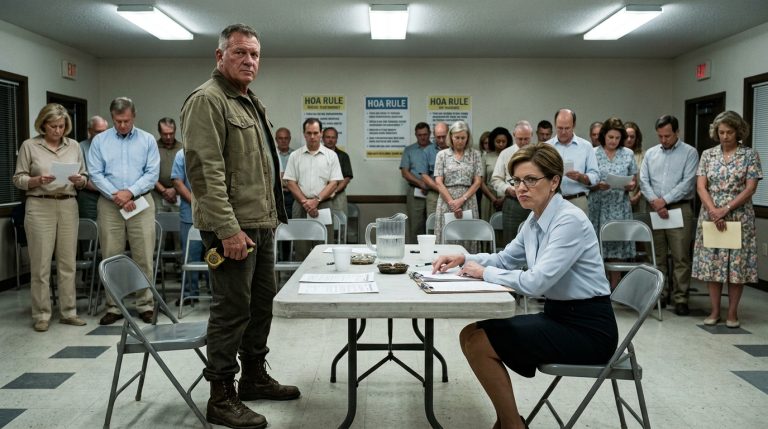
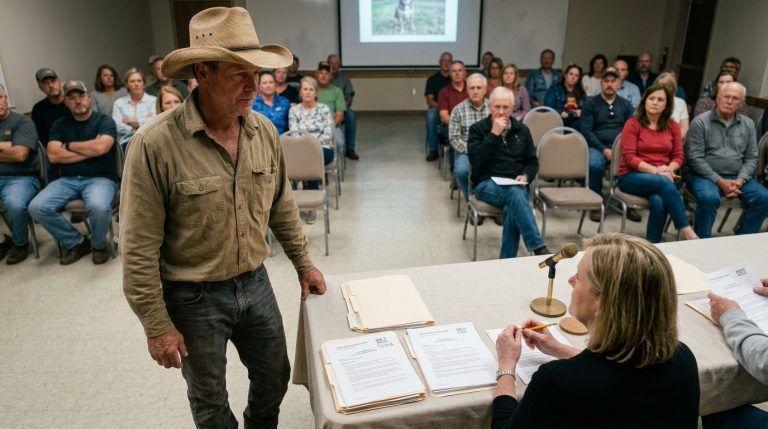
We entered the chamber. The atmosphere was stifling, thick with the scent of floor wax and nervous energy. My allies—David, Emily, Mrs. Gable—were already seated in the back rows. They looked tired, but their presence was a silent affirmation of the alliance we had forged.
Then, the doors swung open, and Karen Miller walked in. She was flanked by her two board members, their posture rigid, their faces masks of defensive arrogance. She stopped when she saw me, her eyes darting to the uniform, then to Davies. She clearly expected a routine administrative dispute; she was not prepared for the sight of a man who had clearly moved from defense into a systematic, tactical offense.
She took her seat, her hand trembling slightly as she opened a file folder. She was trying to project power, but the tilt of her head was wrong—a micro-signal of internal collapse that I’d learned to read decades ago on foreign soil.
Judge Harris took the bench, his gavel ringing out like a singular, authoritative shot. The room fell into a heavy, suffocating silence.
“Agenda Item Four: Whispering Pines Subdivision Platting and Zoning Irregularities,” the Judge announced, his voice echoing off the limestone walls.
I stood up. I didn’t look at the Judge, and I didn’t look at the audience. I walked to the podium, the weight of the flash drive in Davies’s pocket like an anchor. I looked directly at Karen. She looked back, her eyes wide, realizing in that exact micro-second that she had walked into a firestorm she didn’t have the ammunition to combat.
“Good morning, Judge,” I began, my voice steady, projecting to the back of the room with the practiced ease of an officer issuing orders. “I am Colonel Jack Miller. And today, I am not just here to discuss property lines. I am here to discuss the organized, systematic dismantling of the rule of law in this county.”
I clicked the remote. The first slide appeared on the screen—the original plat map, solid, unshakable, and ancient. Beside it, the fraudulent amendment, thin and shaky, a forgery laid bare. The room erupted in a low, collective murmur.
I didn’t wait for them to quiet down. I had the ground now, and I wasn’t going to relinquish it until the mission was complete.
CHAPTER 7: THE PUBLIC EXECUTION
The courtroom, or rather the commission chamber, had become a pressure cooker. Karen stood up, her chair scraping harshly against the floor, a sound that cut through the silence like a jagged edge. “This is a coordinated attack!” she shouted, her voice losing its polished, suburban sheen. “You have no right to present private documents—this is slander, and I will have my lawyers sue for every cent you have!”
She was lashing out, but it was the frantic, uncoordinated flailing of a person who had spent years operating in the shadows and was now being thrust into the glare of a searchlight. Judge Harris didn’t even look at her; he was focused on the screen, his eyes narrowed as he traced the forged surveyor’s seal I’d projected in high-resolution, forty-foot scale.
“Sit down, Mrs. Miller,” the Judge said, his voice flat and dangerous. “The podium belongs to Colonel Miller. You will have your time, though I suggest you choose your next words with extreme caution. We are discussing felony fraud and potential criminal racketeering.”
The word ‘felony’ seemed to deflate her. The two cronies at her side looked as if they wanted to vanish into the limestone walls. I didn’t gloat. Gloating was for amateurs who had won by luck. I had won by engineering, and I continued with the same detached, methodical cadence. I switched the slide to the financial flowchart—the one that traced the money from the homeowners’ dues to Pristine Properties, and from there, into the pockets of the Miller family.
“This,” I said, pointing to the line item representing the exorbitant landscaping contract, “is not community management. This is a closed-loop system of self-dealing. The residents of Whispering Pines were never paying for ‘Green Belt Maintenance.’ They were paying for the personal enrichment of the Miller family.”
The reaction in the room was a low, rising roar. David and Emily, sitting in the third row, were looking at each other, the realization hitting them with the force of a physical blow. The neighbors weren’t just angry; they were seeing, for the first time, exactly how they had been bled dry.
“I have subpoenaed the bank records,” I continued, signaling to Davies, who stood up and distributed a fresh stack of documents to the commissioners. “These indicate that the vendor was a front, with no employees, no equipment, and no legitimate business history beyond a state registry filed three days before the HOA contract was awarded. It is a textbook case of embezzlement.”
Karen’s hands were shaking so violently that the papers in her folder began to rattle. She wasn’t looking at the commissioners anymore; she was looking at the exit. But the exits were blocked by the sheer weight of the evidence I’d placed before the board.
“I am not asking for a zoning adjustment,” I concluded, my voice firm and resonant. “I am asking for the immediate revocation of the Whispering Pines Estates HOA charter, and I am handing over this full, documented evidence of criminal racketeering to the State Attorney General’s office for immediate prosecution.”
I stepped away from the podium. The silence that filled the room was absolute, a void waiting to be occupied by the consequences of the last hour. Judge Harris looked at Karen, then at the thick binder I had laid on his desk. He didn’t bang his gavel. He didn’t need to.
“Mrs. Miller,” the Judge said, his voice dropping to a near-whisper that carried further than any shout. “I have heard enough to initiate a formal inquiry. You are hereby ordered to surrender all HOA financial records, contracts, and board minutes to this commission within twenty-four hours. Failure to comply will be treated as obstruction of justice.”
Karen didn’t answer. She slumped, the pastel pink of her suit looking like a costume from a play that had long since gone off the rails. She turned and walked toward the exit, her cronies trailing her in a pathetic, disorganized retreat. She had entered this room thinking she was the master of her tiny suburban fiefdom. She was leaving it as a target of a state-wide criminal investigation.
My allies in the back of the room were standing. There was no applause—the gravity of the moment felt too heavy for that. Instead, there was a collective, exhaled breath of a community that had just realized it was no longer under occupation. I walked back toward them, the uniform feeling like a weight I had carried through a long, exhausting campaign.
I looked at David and Emily. They looked older, wiser, and remarkably relieved.
“We have to form a new board,” David said, his voice quiet. “A real one.”
“Start with the bylaws,” I advised, my tone returning to the pragmatic, clinical register of an engineer. “Strip them of the ‘earthtone’ requirements. Strip them of the ‘compliance’ police. Build a structure that serves the residents, not the administrators. If you build it on transparency, you’ll never have to worry about a tyrant moving in again.”
I walked out of the courthouse, the midday sun blindingly bright after the oppressive dimness of the chamber. My truck waited in the lot. The work wasn’t entirely over—there were still the court dates, the depositions, the long, grinding process of the criminal case—but the objective was achieved. The threat to my land was dismantled.
I started the engine, the familiar rumble of the Ford F250 a promise of returning to a life that hadn’t been defined by the threat of an HOA fine. I drove home, not as a combatant, but as a man returning to the soil that had nurtured his family for a century. The fence line was broken, but I would fix it tomorrow, and the ground beneath it was finally, legally, and permanently mine.
CHAPTER 8: THE FINAL SETTLEMENT
The transition was not a roar, but a long, exhaling silence. I sat in the cab of the F250, the engine cold, my hands resting on the steering wheel. The drive back to the farm was not a retreat; it was a return to a landscape that had been stripped of its illusions. The road that had once felt like a contested boundary now felt like what it always was: simple, enduring earth.
I reached the gate. It remained mangled, the wire dangling where the vandals had cut it. I stepped out of the truck, the crunch of gravel beneath my boots sounding unusually loud in the stillness of the afternoon. I didn’t reach for my tools to begin the repair immediately. I walked to the break and stood there, staring across the pasture. This was the spot. The place where Karen had stood with her clipboard, where the first surveyor’s stake had been driven. Now, it was just grass, wind, and the shadow of the ancient oak.
The legal fallout would be extensive—years of depositions, audits, and the slow, grinding machinery of state-level prosecution—but the immediate objective, the security of this two-hundred-acre line, was complete. Layer 2, the core truth I had been fighting to preserve, was not just about the property’s value. It was about the continuity of history. My grandfather had walked this soil after the Great War, and I had defended it after a lifetime of service. It was never a matter of money or “green belt management.” It was a matter of stewardship.
I heard the sound of a vehicle approaching—a slow, cautious roll. It was David, pulling up to the gate in his sedan. He got out, looking out of place in his business attire, his face etched with the weariness of the last few weeks. He didn’t speak immediately. He just looked at the fence, then at me.
“The board is dissolved,” he said, his voice quiet. “The state has appointed a receiver. They’re letting us write the new bylaws from scratch. We’re erasing every single one of those oppressive rules.”
“Good,” I replied. “Transparency is the only structural integrity that matters in a community.”
He looked around the farm, a hesitant respect in his eyes. “You were right, Colonel. About all of it. We were just looking for a way to make things neat and clean. We didn’t realize we were being farmed.”
“Everyone is being farmed by someone,” I said, my voice devoid of cynicism. “The trick is knowing when to stop being the crop.”
He lingered for a moment, then climbed back into his car. I watched him pull away, his tail lights fading into the dust. He was part of the aftermath now—part of the new structure.
I went to the barn and retrieved a wire-stretcher and a pair of pliers. I spent the next hour working the fence, my movements rhythmic, focused, and meditative. The metal bit into my calloused palms, a physical reminder of the friction this war had cost. But as I pulled the galvanized wire taut and locked it into place, the structural integrity of the line returned. The gap was closed. The intrusion was sealed.
When I finished, I wiped the grease from my hands and walked to the house. The interior was exactly as I had left it. The oak table, the binder of evidence, the map of the county. I picked up the binder and sat down. I didn’t need it anymore. I took the pages out, the neatly organized tabs—each one a distinct tactical victory—and laid them on the table.
The truth was simple: The corruption at the heart of Whispering Pines was a symptom of a larger rot, the kind that thrives when people believe they can purchase convenience and security at the cost of their independence. Karen Miller was just a footnote in that rot. The real victory wasn’t the prosecution; it was the fact that the next person who tried to drive a stake into this soil would find that the ground here was too hard, too historically deep, and too well-defended to be moved by a rubber stamp.
I opened the wood stove, the iron door heavy and cold. I fed the pages of the binder into the heart of the hearth, one by one. The flame caught, bright and hungry, turning the fraudulent amendments, the violation notices, and the itemized invoices into ash. There was a poetic justice in it. The paper war had started with a sheet of flimsy, arrogant threats, and it ended with the consumption of that threat by the very hearth that had warmed my family for three generations.
I watched the fire burn down to a dull, pulsing glow. The air in the barn felt lighter. I stood up, walked to the door, and looked out at the fields. The sun had set, the stars were beginning to prick the velvet sky, and the silence was no longer a tactical pause. It was just peace. The war was over, the line was held, and the story was complete. I closed the barn door, the latch clicking with a final, solid sound, and walked toward the house. My service was finished.